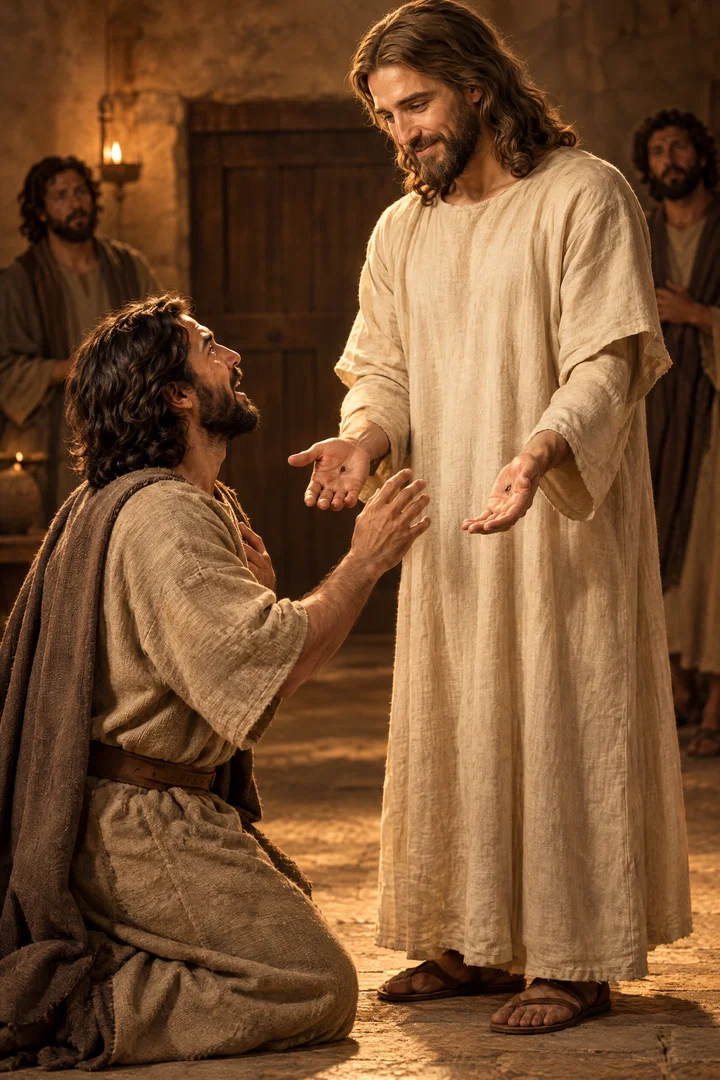
John 20:29
Jesus saith unto him, Thomas, because thou hast seen me, thou hast believed: blessed are they that have not seen, and yet have believed.
Translations
Jesus says to him, Thomas, because you have seen me, you have believed: blessed are they that have not seen, and yet have believed.
King James Version, KJV Cambridge Paragraph Bible
Jesus saith unto him, Thomas, because thou hast seen me, thou hast believed: blessed are they that have not seen, and yet have believed.
Jesus saith to him, Thomas, because thou hast seen me, thou hast believed: blessed are they that have not seen, and yet have believed.
Revised Version, American Standard Version
Jesus saith unto him, Because thou hast seen me, thou hast believed: blessed are they that have not seen, and yet have believed.
Jesus saith to him, 'Because thou hast seen me, Thomas, thou hast believed; happy those not having seen, and having believed.'
Jesus says to him, Because thou hast seen me thou hast believed: blessed they who have not seen and have believed.
Jesus saith unto him—Because thou hast seen me, hast thou believed? Happy, they who have not seen, and yet have believed!
Berean Standard Bible, Majority Standard Bible
Jesus said to him, “ Because you have seen Me, you have believed; blessed are those who have not seen and yet have believed.”
Jesus said to him, “ Because you have seen me, you have believed. Blessed are those who have not seen and have believed.”
Jesus said to him, Because you have seen me you have belief: a blessing will be on those who have belief though they have not seen me!
Iesus said vnto him, Thomas, because thou hast seene me, thou beleeuest: blessed are they that haue not seene, and haue beleeued.
Douay-Rheims (Challoner revision)
Jesus saith to him: Because thou hast seen me, Thomas, thou hast believed: blessed are they that have not seen, and have believed.
Pictures
Cross-references 20 of 30
- Luke 24:36-37
And as they thus spake, Jesus himself stood in the midst of them, and saith unto them, Peace be unto you.
Describes Jesus appearing to the disciples at the earlier meeting.
- 1 Peter 1:8
Whom having not seen, ye love; in whom, though now ye see him not, yet believing, ye rejoice with joy unspeakable and full of glory:
Believers love and believe in Christ without seeing him.
- Mark 16:14
Afterward he appeared unto the eleven as they sat at meat, and upbraided them with their unbelief and hardness of heart, because they believed not them which had seen him after he was risen.
Jesus rebukes the disciples for disbelieving those who witnessed his resurrection.
- John 20:25
The other disciples therefore said unto him, We have seen the Lord. But he said unto them, Except I shall see in his hands the print of the nails, and put my finger into the print of the nails, and thrust my hand into his side, I will not believe.
Thomas demands physical proof before believing the report that Jesus is risen.
- 2 Corinthians 5:7
( For we walk by faith, not by sight:)
Both describe believing and living by faith rather than sight.
- John 20:20
And when he had so said, he shewed unto them his hands and his side. Then were the disciples glad, when they saw the Lord.
Jesus shows the disciples his hands and side after his resurrection.
- Romans 10:17
So then faith cometh by hearing, and hearing by the word of God.
Faith comes through hearing the message.
- Luke 24:30-31
And it came to pass, as he sat at meat with them, he took bread, and blessed it, and brake, and gave to them.
The disciples recognize the risen Jesus when he breaks bread.
- John 21:1-8
After these things Jesus shewed himself again to the disciples at the sea of Tiberias; and on this wise shewed he himself.
The risen Jesus appears to the disciples by the sea.
- Luke 24:39
Behold my hands and my feet, that it is I myself: handle me, and see; for a spirit hath not flesh and bones, as ye see me have.
Jesus invites the disciples to see and touch him as proof that he is bodily present.
- Hebrews 11:1
Now faith is the substance of things hoped for, the evidence of things not seen.
Faith is conviction about what is not seen.
- Acts 1:3
To whom also he shewed himself alive after his passion by many infallible proofs, being seen of them forty days, and speaking of the things pertaining to the kingdom of God:
Jesus appeared alive after his suffering and gave many proofs.
- 1 Corinthians 15:6
After that, he was seen of above five hundred brethren at once; of whom the greater part remain unto this present, but some are fallen asleep.
Records Christ appearing to five hundred at once.
- Hebrews 11:6
But without faith it is impossible to please him: for he that cometh to God must believe that he is, and that he is a rewarder of them that diligently seek him.
Faith without sight is necessary to please God.
- 1 John 3:2
Beloved, now are we the sons of God, and it doth not yet appear what we shall be: but we know that, when he shall appear, we shall be like him; for we shall see him as he is.
Believers will see Christ as he is and become like him.
- Matthew 28:1-10
In the end of the sabbath, as it began to dawn toward the first day of the week, came Mary Magdalene and the other Mary to see the sepulchre.
Both texts recount the risen Jesus appearing and being believed.
- Luke 24:40-43
And when he had thus spoken, he shewed them his hands and his feet.
The risen Jesus shows his wounds and eats before the disciples.
- John 4:48
Then said Jesus unto him, Except ye see signs and wonders, ye will not believe.
demand for faith beyond miracles illustrates the blessing
- John 4:50
Jesus saith unto him, Go thy way; thy son liveth. And the man believed the word that Jesus had spoken unto him, and he went his way.
nobleman believing the word exemplifies the blessing
- 1 Corinthians 15:7
After that, he was seen of James; then of all the apostles.
Records appearances to James and the apostles.
Commentary
Each commentary is drawn from primary sources: the writings of Ellen G. White and Adventist pioneers and periodicals. Each commentary is separate. Its own words are not a quotation; follow the references to read the source passages.
Ellen G. White
39 sources
Jesus told Thomas that his trust came only after looking at the risen Saviour, but the blessing rests on those who trust without ever looking upon him in person.Ms 155, 1904, par. 14–17Ms 2, 1868, par. 1–21T 490.2–491.3 Thomas stands as the pattern of one who is sincere yet slow to trust, refusing his brethren's report and insisting on seeing and touching the wounds for himself.Ms 5, 1867, par. 4–6EW 155.2ED 85.31T 79.2–3LSEGW 95.1–2 Trust that rests on his word without demanding visible proof is more pleasing to him than trust that waits for sight to compel it.6RED 38.2–39.23SP 220.2–221.24T 233.1–2 All who receive him now must do so through the testimony of those who saw and heard, passed from one to another, with abundant evidence already piled up on every side.ST Sep 26, 18786RED 38.2–39.2SG1 74.23SP 221.3 Insisting on removing every cause for doubt before trusting is faithlessness that hardens the heart, yet he meets unreasonable demands not with reproach but with tender revelation of himself as the crucified Saviour to break down doubt.Ms 2, 1868, par. 1–2ST Sep 26, 18783SP 222.1DA 807.5–808.1
Thomas in the Upper Chamber
Thomas was absent when Jesus first met the disciples after the resurrection and so missed seeing him in that interview.EW 155.2Lt 5, 1877, par. 17–18 Absence or delay over what seems a small spiritual advantage or religious privilege can cause missing Jesus.Lt 5, 1877, par. 17–18 All can do a work for God and must be minutemen, never off duty and ready at any moment to speak or act for truth, because a word spoken or an act performed at the right moment can balance a soul in favor of truth and save him to eternal life, and influences that seem small can attract souls to Jesus where a minister's labor would not touch the heart.Lt 5, 1877, par. 17–18
Thomas refused to humbly receive the report of his fellow disciples that Christ had risen and appeared to them, showing lack of confidence in his brethren.Ms 5, 1867, par. 4–6EW 155.2 He self-confidently boasted he would not believe unless he saw in his hands the print of the nails and put his finger into the print and thrust his hand into his side, demanding sight plus touch of the nail prints and the spear wound before he would believe.Ms 5, 1867, par. 4–6EW 155.2
When Jesus met the disciples again with Thomas present, he gave Thomas the evidence of feeling added to sight that he had demanded, meeting unreasonable demands for proof with tenderness, love, mercy and considerate revelation of himself as the crucified Saviour rather than reproach or argument.EW 155.2ST Sep 26, 18783SP 222.1DA 807.5–808.1 Seeing the risen Jesus bearing the wounds of crucifixion swept away his doubts and broke down the barriers of doubt, so he needed no further evidence and wanted no further evidence.6RED 72.3–73.23SP 222.16RED 52.3–53.2 He then believed when he beheld him and confessed him as Lord and God, and his experience encouraged others who had not yet seen Jesus to consider the testimony about his resurrection.EW 155.26RED 72.3–73.2DA 807.5–808.1
The disciples likewise recognized Jesus by his voice and by seeing his wounded hands and feet.DA 802.1–803.2 Seeing him moved their unbelief to give way to faith and joy.DA 802.1–803.2 Their recognition confirms that he had truly risen in a body and not as a spirit.
At the later meeting in Galilee many believers who had never seen Jesus before saw the marks of his crucifixion and worshiped him.DA 818.2–819.1
Thomas is the pattern called doubting Thomas, meaning one who does not believe without seeing, including one who does not believe in visions and needs proof that the testimony given is indeed the voice of God before believing and being made happy.1T 79.2–3LSEGW 95.1–2 He was faithful and earnest yet slow of heart to believe, one widely varied type of character among the first disciples who were to be the world's teachers.ED 85.3 He was sincere yet unable to believe until given evidence.1T 79.2–3
Blessed Belief Without Seeing
Jesus mildly and reprovingly rebuked Thomas for unbelief when He gave him the evidence he had demanded, telling him to stop being faithless and believe.Ms 2, 1868, par. 1–2Ms 5, 1867, par. 4–6SG1 74.2EW 155.2 He gave no commendation to slowness to believe, and God was not pleased with Thomas's unbelief in refusing to humbly receive the report of his brethren.Ms 5, 1867, par. 4–6EW 155.22T 695.1–696.1 The same lack of commendation rests on those who are slow of heart to believe in the last days.Ms 5, 1867, par. 4–62T 695.1–696.1
The verse pronounces blessed those who have not seen Jesus and yet have believed.Ms 155, 1904, par. 14–17Ms 2, 1868, par. 1–2SG1 74.21T 490.2–491.3 They cannot inspect the wounds of His crucifixion as Thomas did, but they believe the disciples' testimony, and God credits them with that belief.Ms 155, 1904, par. 14–17 Even though Jesus gave Thomas the evidence he demanded, He did not commend him for withholding belief until he had seen, but commended faith that does not insist on seeing first and rebuked boasting in unbelief.Ms 2, 1868, par. 1–21T 490.2–491.3
Faith that believes without seeing for oneself would have been more acceptable and pleasing to Jesus than Thomas's faith after seeing.6RED 38.2–39.23SP 220.2–221.2DA 807.2–4 Thomas believed after seeing the risen Jesus, but faith based on the testimony of his companions who had seen Him would have been more acceptable had he believed that testimony.6RED 38.2–39.23SP 220.2–221.2 Everyone who receives Christ now must believe through others' testimony, and requiring personal sight before believing would leave no one able to believe unto salvation.3SP 220.2–221.2DA 807.2–4
The verse contrasts faith grounded in Christ's word with doubt that demands visible proof.4T 233.1–2 Spiritual knowledge of Christ as the glorified Redeemer, received by faith, is more desirable and enduring than knowing Him only by sight or earthly companionship.AA 452.1
The verse is an assurance that the merciful Saviour can bring rest to a doubting soul, as Jesus gave rest to Thomas's doubting soul.Lt 46, 1896, par. 4–5 Refusing to believe unless one can see is unbelief that keeps people from trusting God's power, while faith does not depend on seeing but turns to God when obstacles arise and asks Him to work.Lt 46, 1896, par. 4–5Ms 163, 1899, par. 1–4
Believing Through Others Testimony
Everyone who receives Christ now does so through the testimony of others who have seen and heard him, for that testimony was meant to pass from one person to another so that many who had not seen or heard him themselves would believe in his resurrection.ST Sep 26, 18786RED 38.2–39.2SG1 74.2DA 807.2–46RED 58.2–59.2 Thomas believed after seeing the risen Jesus, but the blessing rests on faith that rests on trustworthy testimony rather than requiring sight, and such faith based on the testimony of others would have been more acceptable and pleasing.ST Sep 26, 18786RED 38.2–39.2DA 807.2–46RED 58.2–59.2 He was gently and mildly rebuked for refusing his fellow disciples' testimony until he saw for himself, when he should have believed what his companions reported.ST Sep 26, 18786RED 38.2–39.26RED 58.2–59.2
If all followed Thomas in refusing to believe until seeing for themselves, no one could now receive Jesus and believe in his resurrection unto salvation, since requiring the same direct sight and personal inspection before believing would leave no one able to believe.3SP 220.2–221.2EW 155.26RED 58.2–59.2 It is the divine will that those who cannot themselves see and hear the risen Saviour receive the report of the disciples, and God was not pleased with Thomas's self-confident demand for sight plus touch before he would believe.3SP 220.2–221.2EW 155.2 Christ's words and the peace he pronounced on his disciples are for those who believe their testimony, and God credits with belief those who cannot inspect the wounds of his crucifixion as Thomas did yet believe that testimony.Ms 155, 1904, par. 14–17
Those with weak and wavering faith who think the evidence Thomas had from his companions would cure their doubt already have not only that evidence but additional testimony piled up on every side. The evidence available through others' testimony, together with further evidence, is abundant and sufficient grounds for faith.3SP 221.3ST Sep 26, 1878
Peril of Demanding Sight
Treating doubt as a virtue and boasting in unbelief is faithlessness, not wisdom, and insisting on unmistakable evidence with every cause for doubt removed before believing receives no commendation.Ms 2, 1868, par. 1–22T 103.2–104.11T 490.2–491.3 Thomas withheld belief until he had seen for himself, and he believed only because sight compelled him and left no room to doubt.2T 103.2–104.1 Even though he was given the proof he had demanded, he was told to stop being faithless and believe, while the blessing was pronounced on those who believe without having seen.Ms 2, 1868, par. 1–22T 103.2–104.11T 490.2–491.3 The same lack of commendation rests on those who are slow of heart to believe in the last days, who like Thomas boast they will not believe the testimony of their brethren unless they see for themselves.Ms 5, 1867, par. 4–6
Waiting like Thomas until every possible cause for doubt is removed risks never having that desire granted.6RED 59.33SP 221.36RED 39.3ST Sep 26, 1878 Instead of reaching certainty, the waiter becomes gradually fixed and entrenched in unbelief until the weight of strong evidence in favor of Jesus cannot be perceived.6RED 59.33SP 221.36RED 39.3ST Sep 26, 1878 Those with weak and wavering faith who suppose the evidence Thomas had from his companions would cure their doubt already possess not only that evidence but additional testimony piled up on every side, with abundant evidence sufficient for faith.ST Sep 26, 1878
Rejecting plain and conclusive evidences of divine truth hardens the heart and blinds the understanding.6RED 59.33SP 221.36RED 39.3ST Sep 26, 1878 Like the skeptical Jews, the unwilling mind lets neglected precious light fade utterly away until what little light was possessed goes out in the closing darkness gathering around it. Needing even greater evidence than doubting Thomas needed is a wrong course of standing aside with indifference, expressing doubts, suspicions and fears until more proof is received, and refusing to put the hand zealously and energetically to the work of building up what is required.7MR 114.1–45MR 61.2Lt 16, 1861, par. 12–14 By that influence the advance and reform among God's people is retarded.7MR 114.1–45MR 61.2Lt 16, 1861, par. 12–14
Patience Toward Doubting Thomases
Jesus met Thomas's unreasonable demand for set conditions of proof not with reproach or argument but with tenderness, love, mercy and considerate self-revelation as the crucified Saviour.ST Sep 26, 18783SP 222.1DA 807.5–808.1 That loving response broke down the barriers of doubt and drew forth faith, so that Thomas confessed him as Lord and God.ST Sep 26, 18783SP 222.1DA 807.5–808.1 His dealing is the pattern for meeting doubt over religious truth, which is to be met not with reproach or argument but by tenderly revealing Christ as the crucified Saviour.ST Sep 26, 1878DA 807.5–808.1
Doubting Thomases are those who, like Thomas, cannot believe published testimonies nor receive evidence through the testimony of others about visions they have never seen and whose influence they have no personal knowledge of, but must see and have the evidence for themselves.GW92 279.3–45T 668.1–21T 327.3–329.2Ms 3, 1862, par. 1–3 They need proof that the testimony given is indeed the voice of God before they will believe and be made happy.GW92 279.3–4LSEGW 95.1–2 Such persons are not to be set aside or deprived of the benefits and privileges of the church if their Christian course is otherwise correct and they have formed a good Christian character.GW92 279.3–45T 668.1–21T 327.3–329.2Ms 3, 1862, par. 1–3 Toward them long patience, kindness and brotherly love are to be exercised, with no trial or hard labor against them, until they find their position and become established for or against.GW92 279.3–45T 668.1–21T 327.3–329.2Ms 3, 1862, par. 1–3 If, however, they fight against visions of which they have no knowledge, carry opposition so far as to oppose that in which they have had no experience, and feel annoyed when those who believe speak of the visions and comfort themselves with the instruction given through vision, they show they are not right.GW92 279.3–45T 668.1–2 To such liberty is not to be yielded but labor is to be bestowed upon them, because their influence endangers souls and may lead the weak astray.GW92 279.3–4
Sources
Pioneers and periodicals
87 sources
Jesus reproved Thomas for believing only after seeing him risen, and pronounced blessing on those who have not seen and yet have believed.RH Nov 13, 1900ST Apr 24, 1901RH Apr 21, 1868ST Apr 11, 1900RH Sep 4, 1900 Believing without seeing is a more blessed and better state than belief through seeing, though his doubt is treated as perplexity rather than sin.RH Sep 2, 1873RH Sep 2, 1873ST Jun 2, 1898RH Nov 13, 1900 All who now receive Christ do so through the testimony of trustworthy eyewitnesses conveyed through the Spirit, which is sufficient evidence, for direct sight would give knowledge leaving no place for faith.ST Sep 26, 1878ST Oct 16, 1884 That faith rests on God's word and Scripture, especially Moses and the prophets, and on the recorded evidence of resurrection and ascension, and does not demand visions, new signs, miracles, or visible presence for courage.RH Nov 13, 1900ST Apr 17, 1901RH Sep 2, 1873ST Oct 16, 1884ST Dec 2, 1889 It is to be lived as practical, loving, steady, personal trust in the unseen Saviour who is really near, with longing fulfilled when believers at last see him face to face and are made like him.RH Nov 13, 1900RH Aug 5, 1873RH Sep 2, 1873RH Sep 2, 1873RH Feb 12, 1861
Occasion and Timing
The saying belongs to a later meeting when Thomas was present, eight days after the first evening meeting following the resurrection, the next recorded appearance after those on resurrection day and that night.ST Apr 22, 1897ST Jun 2, 1898ST Nov 24, 1898 It was a second refreshing of the group, when the risen Jesus manifested himself to them with Thomas among them.ST Nov 11, 1908 Thomas, who had doubted, received full assurance when shown the marks of the nails and the wound in the side, and he afterward retold the experience to the gathered believers as testimony to the resurrection.ST Feb 10, 1914RH Jun 3, 1873 That appearance helped establish that the risen Christ was the same person known before death, and it is commemorated by an annual feast honoring the showing of the wounds eight days after the resurrection.RH Jun 3, 1873ST Aug 3, 1882
That later meeting fell on the second day of the week, or on the second or third day, and not on the next first day.ST Apr 22, 1897ST Jun 2, 1898RH Aug 1, 1854 The first meeting itself occurred only at the very close of the first day as it merged into the second, with the disciples gathered in ignorance that Jesus must rise, in fright and unbelief rather than expecting him or honoring the day.ST Apr 22, 1897 Counted as after eight days from the earlier Sunday-evening meeting, and indeed as more than eight days after the first meeting, it could not have been on the first day of the week and therefore establishes no pattern of first-day worship.ST Apr 22, 1897ST Feb 17, 1890RH Sep 17, 1857
The risen Jesus did not remain continuously with the disciples but manifested himself on separate occasions during the forty days before the ascension, and these manifestations are called appearings.RH Aug 31, 1869 The meeting with Thomas present served to establish conviction of the resurrection, to reclaim Thomas to belief that Christ had risen, and to instruct about future work, with Jesus greeting them with peace.RH Aug 1, 1854RH Nov 24, 1868RH Apr 1, 1873 It is not presented as an assembly for religious purposes, gives no indication that the disciples gathered to honor the first day, and contains no instruction to observe it as sacred, since meeting on a day does not change that day's character nor mark it as sacred or commemorate its timing.RH Aug 1, 1854RH Nov 24, 1868RH Apr 1, 1873
Differences between John's resurrection account and the other Gospels do not by themselves mean contradiction, since one account may record details the others omit.ST Mar 5, 1912
Thomas Encountering Risen Jesus
Thomas had refused the testimony of the other disciples, continued to doubt after they believed, and demanded to examine the nail wounds in the hands and the spear wound in the side before he would believe.ST Oct 7, 1880ST Dec 2, 1889ST Aug 14, 1893
Jesus mercifully met that unreasonable demand with tenderness rather than reproach or argument, inviting him to examine the wounded hands and feet and side and identifying the wounded body as himself.ST Sep 26, 1878RH Oct 21, 1862RH May 6, 1909
Seeing the risen Jesus led Thomas to believe and confess him as his Lord and God.RH Oct 21, 1862ST Jun 3, 1897RH Nov 13, 1900
Overwhelmed by Christ's glory he did not carry out the touching he had made a condition, and his belief was genuine.RH Nov 13, 1900RH Sep 2, 1873
Seeing him moved the disciples from doubt to faith and joy, and their recognition confirms that Jesus truly rose in a body, not as a spirit and not as a dead person's spirit returning.RH Nov 26, 1872ST Jun 12, 1884
Thomas as a witness who knew whether he had touched the nail wounds in the hands and the spear wound in the side could not be deceived about the resurrection.RH Oct 7, 1862
The resurrected body was literal and tangible, able to be seen and handled and to bear the crucifixion marks, yet changed from mortal and corruptible to immortal and spiritual, not immaterial and not a different body from the one crucified.RH Nov 26, 1872RH Nov 26, 1872
In that immortalized, Spirit-born state Jesus moves and appears as the wind blows where it wishes, passing through closed doors by superior power, and this same condition will be true of every immortalized saint at the resurrection of the just.RH Sep 15, 1874ST Apr 1, 1880
The risen Jesus was the same Son of God who had been crucified and buried, retaining recognizable identity, voice, habits and features, and this appearance helped establish that he was the same person known before death.ST Aug 3, 1882
Personal appearance convinces and identifies the risen Christ, and the righteous will rise in like manner: not emaciated with disease but with the bloom of eternal health, recognized by friends parted by death, with children gathered by angels and borne to their mothers' arms, showing a close relation between the future state and the present with Christ as head.RH Feb 12, 1901
Thomas believed the resurrection event when he saw, without yet understanding its significance.
One teaching holds that his sight followed belief he already had and the requested evidence only confirmed it, while those who refuse to believe cannot expect sight alone to reveal truth.ST Sep 23, 1908
Jesus' words remained a gentle reminder that Thomas had failed at a critical time when his testimony was needed, and his tendency to doubt hindered him from accomplishing much.ST Oct 21, 1930RH Sep 2, 1873
Blessed Faith Without Seeing
Thomas believed because he had seen the risen Jesus, and this is set in contrast with those who have not seen and yet have believed, whom Jesus pronounces blessed while reproving Thomas for believing only after seeing.ST Apr 24, 1901RH Apr 21, 1868ST Apr 11, 1900ST Apr 24, 1901ST Feb 26, 1885 His unbelief had kept him from the blessing he could have had by trusting what had been revealed without first demanding sight.ST Jan 22, 1894 Faith that does not depend on sight is pleasing to the Lord.RH Apr 21, 1868
Believing without seeing is a more blessed and better state than belief that comes through seeing, and this unseen trust is better for believers just as Jesus' departure was better for his disciples.RH Sep 2, 1873RH Sep 2, 1873RH Nov 13, 1900 Thomas believed after seeing and was joyful in believing, yet his doubt is understood as perplexity rather than sin.RH Sep 2, 1873RH Nov 13, 1900 Doubts of this kind should not lead to abandoning hold on God or conscience nor to thinking God has abandoned the doubter, for they may distress but cannot destroy those who remain in God's care, Christ will supply what is lacking, and even when a person cannot yet believe that person is called to trust.RH Nov 13, 1900
Three groups are distinguished: those who see and do not believe, those who see and believe, and those who believe without seeing, and the verse expressly blesses the last.RH Nov 13, 1900 This is the present condition of Christians who trust Christ without having seen him in person, for people cannot now see the Saviour in person but those who believe his words are blessed.RH Nov 13, 1900RH Sep 4, 1900ST Jun 2, 1898 Faith of this kind does not depend on seeing Jesus in person.ST Jun 2, 1898
All who now receive Christ do so through the testimony of others, and Thomas could have believed the reports of trustworthy eyewitnesses.ST Sep 26, 1878RH Aug 12, 1862 He was reproved because he refused his fellow disciples' testimony until he saw for himself, and their eyewitness testimony conveyed through the Spirit is sufficient evidence for belief in the resurrection.ST Sep 26, 1878 Direct sight would have given knowledge, leaving no place for faith.RH Aug 12, 1862 Faith that believes the evidence of brethren without demanding to see with one's own eyes is more acceptable to Jesus.
That faith rests on God's word and Scripture, especially Moses and the prophets, on the preached Word and on the recorded evidence of Christ's resurrection and ascension.RH Nov 13, 1900ST Apr 17, 1901RH Sep 2, 1873 As the two disciples on the road to Emmaus needed to believe the truth from Scripture rather than depend on recognizing Jesus by sight, so the gospel is to be believed because of the Word preached, not because of anything impressive about the preacher, for truth, not the preacher, sanctifies.ST Apr 17, 1901 It rests on the testimony God has given in Scripture, not on seeing Christ or receiving a message from the dead, since even someone returning from the dead would not persuade those who reject that testimony.RH Sep 2, 1873 Blessing comes to those who receive and believe the plain declaration of God's Word rather than resenting it, and this means trusting its plain teaching rather than resisting it while accepting error or traditions based on strained inferences.ST Dec 2, 1889RH Mar 1, 1906 Conversion rests on faith grounded in his Word, and understanding the Scriptures strengthens believers to endure trials, for seeing the risen Jesus could reassure his followers but was not the basis of lasting faith.ST May 13, 1903
The faith Jesus approves does not demand visions, new signs, miracles, visible presence, emotional experiences, repeated arguments, visible success, or majority approval as its foundation, but trusts his word.RH Nov 13, 1900ST Aug 13, 1896 Wanting some visible manifestation of acceptance in order to have courage and assurance in serving the Lord is a mere excuse, for what is lacking is not sight but faith.ST Oct 16, 1884 Christ demands this stronger trust and develops it, and his own person and talk are their own best evidence for belief.ST Aug 13, 1896
Faith is blessed when it rests on Christ and his word without requiring personal sight as proof, and Christ reproved unbelief while commending those who believe without seeing.ST May 4, 1876 It can rest on his word without sight or physical proof, placing faith above observation and above confidence in the unchanging course of natural law and leaving room for God's miraculous action.RH Jan 21, 1904 The ancient church walked by this principle of walking by faith rather than sight, trusting God's promise, and requiring visible proof before believing reverses that principle.RH Apr 28, 1859
The blessing includes the Old Testament prophets and saints who longed for Christ without seeing signs of his coming or knowing the details of his life and death, and everyone who now comes to Christ with living faith.RH Nov 13, 1900 It includes Lazarus, who had not seen Christ yet after hearing the account concluded from prophecy that the appointed time had come and believed firmly, and though he did not fully understand Christ's mission and faced opposition from religious leaders his faith did not waver.ST Jul 5, 1910 Such faith makes Christ present, heaven near, and salvation sure, and makes the gospel's truths and promises real and precious, answering to the incorruptible, unfading inheritance it leads to.RH Nov 13, 1900
The written account of Jesus' signs is given so that readers may believe that he is the Christ, the Son of God, and have life through his name, for Jesus gave Thomas physical evidence after Thomas had refused the other disciples' testimony. In all Jesus did and in all he said and in the record he left there is life to every believing soul, as shown in the touching and instructive closing chapters of John that tell of the crucifixion and the resurrection and their wonderfully good lessons.
The verse also points to a future blessedness when longing to see the unseen Saviour is fulfilled, when believers will see Christ face to face, behold him in glory, and be made like him.RH Nov 13, 1900 If all followed Thomas in refusing to believe until seeing, no one would believe unto salvation. Those with weak and wavering faith who think the evidence Thomas had from his companions would cure their doubt already have not only that evidence but additional testimony piled up on every side, and the evidences of God's faithfulness to his word in all ages are so numerous that both the skeptic and the doubting believer are left utterly without excuse.ST Sep 26, 1878ST Oct 16, 1884
Sabbath Day Question
The evening meeting after the resurrection came only at the very close of the first day as it merged into the second, with the disciples gathered in ignorance that Jesus must rise from the dead and in fright and unbelief rather than expecting him or honoring the day, so it gives no support for first-day sacredness.ST Apr 22, 1897 The fact of resurrection on the first day of the week does not prove a design to change the Sabbath from the seventh day to the first, for Jesus appeared several times to show the disciples he was alive and had risen, and the later appearance when Thomas was present and came to believe served to establish conviction of the resurrection and instruct about future work, not to mark the day as sacred or commemorate its timing.RH Jun 20, 1871RH Nov 24, 1868ST Aug 6, 1912RH Apr 1, 1873 In no case in that account did he tell them the day was holy or set it apart, the conversation contains no instruction to observe it as sacred, and meeting on a day does not change that day's character.ST Aug 6, 1912RH Apr 1, 1873
The saying belongs to a second meeting after eight days from the evening meeting, more than eight days after the first meeting, placing it on the second or third day of the week rather than on the next first day.ST Apr 22, 1897ST Feb 17, 1890RH Sep 17, 1857 It therefore does not describe an appearance on the first day of the week, does not establish a pattern of first-day worship, and does not establish that Christ instituted the first day as a Sabbath.ST Apr 22, 1897ST Feb 17, 1890RH Sep 17, 1857
A different teaching treats the existence of a new sacred day as divinely assured, so that belief in what necessarily follows from that assurance is warranted and blessed even without a separate express command, since it is blessed to believe without seeing.RH Jul 29, 1873 The opposing teaching held by others is that Christ's appearances to his disciples when they gathered after his resurrection and his blessing of them, including his words blessing those who believe without seeing him, gave the first day of the week special honor and teach disciples to regard that day as specially sacred.RH Apr 15, 1873
Dangers of Doubting
To demand proof after a fact has been well proven is unreasonable, and continued doubting in such a case is no honor and no mark of intelligence.RH Apr 3, 1879 Thomas stands as one who would not believe without proof, a volunteer in unbelief, like those who will not believe what has mathematical demonstration.RH Aug 14, 1860 The account sets doubt over against believing, and that contrast bears on the Bible and the moral responsibilities its principles establish.RH Apr 3, 1879 Believing is what men choose to believe, and believing a lie has the same power to produce joy or grief as believing the truth, as when Jacob believed his sons' lie about Joseph and mourned.RH Aug 14, 1860
Unbelief kept Thomas from sharing the other disciples' joy in the risen Saviour and from enjoying communion with him. While he doubted he stayed apart from the disciples and spent days in gloom over Calvary. Faith is more precious than doubt. Doubt can grow when people withdraw from church worship and the preached Word, in contrast to the blessing on those who believe without seeing.ST Oct 7, 1880 The disciples' own faith was weak and wavering and was not confirmed until after the resurrection and ascension.ST Mar 10, 1887
If all refused to believe until seeing, no one would believe unto salvation, since all who now receive Christ do so through the testimony of others. Those with weak and wavering faith already have not only the companions' evidence that Thomas had but additional testimony piled up on every side, with abundant evidence on every side.ST Sep 26, 1878 Waiting like Thomas for every cause of doubt to be removed risks never having the desire granted but becoming gradually entrenched in unbelief until the weight of evidence in favor of Jesus cannot be perceived.ST Sep 26, 1878 Rejecting the plain and conclusive evidences of divine truth hardens the heart and blinds the understanding, and as with the skeptical Jews the neglected precious light fades utterly from the unwilling mind, going out in the darkness closing around it.ST Sep 26, 1878
Believing without seeing is a more blessed state than believing after visible proof, though Thomas's doubt is perplexity rather than sin.RH Nov 13, 1900 Doubts should not lead to abandoning hold on God or conscience, nor to thinking that God has abandoned the doubter.RH Nov 13, 1900 Doubts may distress but cannot destroy those who remain in God's care, Christ will supply what is lacking, and even when a person cannot yet believe that person is called to trust.RH Nov 13, 1900 Doubt can be brought directly to Jesus and answered by the evidence of his work, for he mercifully gave Thomas the evidence asked for while blessing those who believe without seeing him.RH May 6, 1909 He met unreasonable demands for proof with tenderness rather than reproach or argument, revealing himself in love and mercy as the crucified Saviour until Thomas confessed him as Lord and God, and that dealing teaches tender response to those who doubt religious truth and kind concern for hesitating weakness.ST Sep 26, 1878RH Mar 24, 1910
Thomas pictures a dried-up, backsliding disciple who sits among Christ's followers at the table commemorating Christ's love without living faith.RH Apr 9, 1872 The fountain-head of grace has run dry for lack of heavenly rain on a parched soul, through abandoning secret prayer or keeping it as an empty form, and with the decline of prayer comes a growth of secret sins, so that when prayer stops death begins.RH Apr 9, 1872 The root is in the heart, and nothing but thorough heart-work and deep re-conversion can make him again a perennial disciple always abounding in the work of the Lord.RH Apr 9, 1872 He is the pattern of doubters who need seen proof before believing, and seeing the proof with his own eyes convinces even the most doubting Thomas.ST Aug 16, 1883RH Dec 3, 1908 Those who doubt that a great work can be accomplished quickly should remember that blessing is pronounced on those who believe without seeing.ST Aug 1, 1878
Doubting Thomases toward the advent movement are to consider the seen fact that Sabbath reform united with the announcement of the second advent has commanded attention as neither truth alone could do.RH Dec 3, 1908 The required answer is positive conviction of truth and courage based on intelligent faith, to observe the seventh-day Sabbath contrary to world custom and church example and despite the disappointment of 1844.RH Dec 3, 1908 That work growing and extending during the last forty years to almost every land, with witnesses raised up within the present generation, furnishes convincing evidence that the work is not of men and that Sabbath and advent go together by Scripture and providence so that neither can now be successfully proclaimed without the other.RH Dec 3, 1908
Living by Unseen Faith
Blessed faith is to be lived out in practical, loving, childlike, steady and personal trust, even amid seeming impossibilities and when standing alone.RH Nov 13, 1900 It need not wait until every objection is removed or every difficulty resolved, but believes when the weight of evidence supports belief, whether from the Bible, from experience, or from the influence of God's Spirit.RH Nov 13, 1900RH Aug 5, 1873 Choosing that faith may involve self-denial and bearing a cross, and brings blessing to see more clearly.RH Aug 5, 1873 It also points forward to a future blessedness when believers will see Christ face to face and be made like him.RH Nov 13, 1900
Greater blessing belongs to trusting Christ himself without seeing him, rather than putting faith in one's own faith or feeling.RH May 9, 1871 The timid sinner outside the fold, in danger and cold and darkness, should not wait for some mysterious feeling of love and faith and warmth and light before coming.RH May 9, 1871 He should trust the unseen love and beauty of the Shepherd who long ago paid for him and now opens the gate to lead him home, and in light or darkness seek to do his will and leave the work of faith to Jesus.RH May 9, 1871
Jesus is just as really near those who cannot see him as if they could see and touch him, and blessing comes in believing and trusting him without sight.RH Feb 12, 1861 That means reaching out by faith when feeling and prayer fail, touching the hem of his garment as the sick woman did, and putting the trembling hand in his to be led and guided by his will even through darkness.RH Feb 12, 1861 People are blessed when they believe without seeing God visibly take their hearts, for faith accepts and gives in trust in God's word even without sight.RH Jan 19, 1905
This faith rests not on book knowledge but on love, and brings quiet confidence in God's presence.RH Mar 4, 1902 It embraces Christ even when his presence cannot be seen or proved.ST Jan 30, 1907 Belief in God does not require seeing him, since his presence can be known through his action in the world, as dissolved sugar is known by its taste.
Faith that demands sight is not true faith and cannot save.RH Nov 13, 1900 The faith that trusts Christ without seeing him is blessed and acceptable to God, since nothing can please him without faith.RH Nov 13, 1900 It proves that grace and a renewed nature are within, and is the root of godly character, bringing power in prayer, strength of mind, firmness under temptation, courage in the Lord's work, and joy.RH Nov 13, 1900 Such faith answers the Laodicean charge of spiritual poverty, for it is the gold refined by fire and works through love.RH Nov 13, 1900
The promise of blessing to those who believe without seeing encourages resisting unbelief, welcoming the Saviour, and trusting him with loving faith.ST Mar 23, 1888 Thomas's demand to see is a warning against doubting, and faith need not wait for visible proof but trusts Jesus' promise and claims grace.ST Mar 23, 1888RH Jul 8, 1909
Faith reaches the unseen Saviour, who is present everywhere to comfort the sick, strengthen the weak, and sustain at the point of death, so believers can trust and receive his help even though he is not visible to the outward eye.RH Sep 2, 1873 Though unseen, Christ leads his people everywhere, inspiring hope, strength and joy, and his presence is not limited to one place, so he is with them wherever they gather and wherever they need comfort.RH Sep 2, 1873
Christians by this faith love, trust, follow and worship their unseen Saviour, and their longing to see him will be fulfilled when they behold him in glory.ST Sep 17, 1885 Living faith also leads to confessing Christ through words and actions and witnessing openly for him rather than hiding faith, in contrast to a tendency to doubt that hinders accomplishing much even when belief itself is genuine.RH Sep 2, 1873
As the apostles were slow to grasp his teaching and did not expect his resurrection, so many professed disciples will be unprepared for his sudden return, but those who love his appearing and believe his word will be watching for him.ST Jun 26, 1901 Faith trusts Christ and his promises despite the unseen, making the future kingdom and the coming of the Lord real and stirring to watchfulness, so that seeing the world's apparent triumph of evil, disorder and sorrow does not require believing those appearances are final.RH Jan 9, 1855 The disciples' deep love for Jesus and longing for personal fellowship, and their joy in seeing him, will be fulfilled when he appears and receives his people to himself at his second coming.ST Jul 23, 1912
Conversion rests on faith grounded in his Word, not on seeing him, and understanding the Scriptures strengthens believers to endure trials.ST May 13, 1903 Seeing the risen Jesus could reassure his followers, but was not the basis of lasting faith.ST May 13, 1903
Absent Thomases returning to the gathered believers find the risen Saviour among them giving his blessings, picturing those who come back to the prayer meeting and find Christ present with his people.ST Dec 1, 1881
There are times when not seeing is more blessed than seeing, for faith can be blessed without sight.RH Feb 27, 1913 In judging others, withholding judgment and interpreting their actions kindly may be better than seeing or assuming the worst.RH Feb 27, 1913
Those who doubt that a great work can be accomplished quickly should remember that Jesus pronounced blessed those who believe without seeing.ST Aug 1, 1878 Doubting Thomases toward the advent movement are to consider the seen fact that Sabbath reform united with the announcement of the second advent has commanded attention as neither truth alone could do, requiring positive conviction of truth and courage based on intelligent faith to observe the seventh-day Sabbath contrary to world custom and church example and despite the disappointment of 1844, yet growing and extending during the last forty years to almost every land with witnesses raised up within the present generation, which furnishes convincing evidence that the work is not of men and that the Sabbath and the advent go together by Scripture and providence so neither can now be successfully proclaimed without the other.RH Dec 3, 1908
The meeting with Thomas teaches the blessedness of faith even when it does not rest on seeing Jesus, and is aimed at reclaiming Thomas from doubt and unbelief.ST Oct 4, 1899 It was part of a second shower of blessing to the disciples when Thomas was with them, in which the risen Jesus manifested himself to the group and refreshed them.ST Nov 11, 1908 When his doubts were swept away on seeing the risen Jesus, Thomas retold the experience to the gathered believers as testimony to the resurrection.ST Feb 10, 1914
Thomas, who had doubted, received full assurance when Jesus showed him the marks of the nails and the wound in his side.RH Jun 3, 1873 That appearance eight days after the resurrection is commemorated by an annual feast honoring it.RH Jun 3, 1873
Sources