Luke 24:30
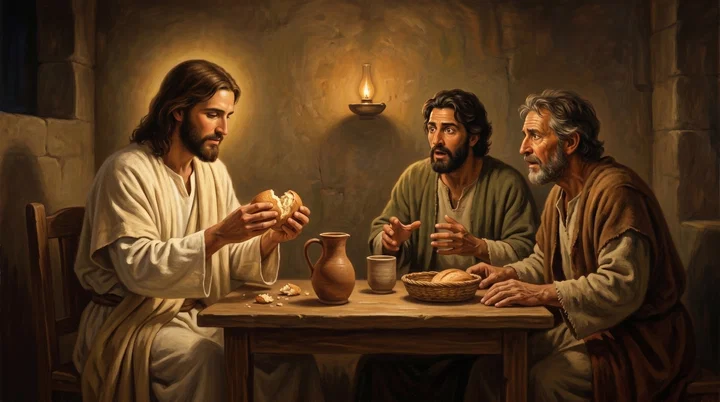
And it came to pass, as he sat at meat with them, he took bread, and blessed it, and brake, and gave to them.
Translations
And it came to pass, as he sat at meat with them, he took bread, and blessed it, and broke, and gave to them.
King James Version, KJV Cambridge Paragraph Bible
And it came to pass, as he sat at meat with them, he took bread, and blessed it, and brake, and gave to them.
And it came to pass, as he sat at table with them, he took bread, and blessed it, and broke, and gave to them.
And it came to pass, when he had sat down with them to meat, he took the bread, and blessed it, and brake, and gave to them.
And it came to pass, when he had sat down with them to meat, he took the bread and blessed; and breaking it he gave to them.
And it came to pass, in his reclining (at meat) with them, having taken the bread, he blessed, and having broken, he was giving to them,
And it came to pass as he was at table with them, having taken the bread, he blessed, and having broken it, gave it to them.
And it came to pass, when he reclined with them, taking the loaf, he blessed, and, breaking it, went on to give unto them.
Berean Standard Bible, Majority Standard Bible
While He was reclining at the table with them, He took bread, spoke a blessing and broke it, and gave it to them.
When he had sat down at the table with them, he took the bread and gave thanks. Breaking it, he gave it to them.
And when he was seated with them at table, he took the bread, and said words of blessing and, making division of it, he gave it to them.
And it came to passe, as hee sate at table with them, he tooke the bread, and blessed, and brake it, and gaue it to them.
Douay-Rheims (Challoner revision)
And it came to pass, whilst he was at table with them, he took bread, and blessed, and brake, and gave to them.
Pictures
Cross-references 20 of 27
- Mark 16:14
Afterward he appeared unto the eleven as they sat at meat, and upbraided them with their unbelief and hardness of heart, because they believed not them which had seen him after he was risen.
Jesus appears to the eleven at a meal and rebukes their unbelief.
- John 20:19
Then the same day at evening, being the first day of the week, when the doors were shut where the disciples were assembled for fear of the Jews, came Jesus and stood in the midst, and saith unto them, Peace be unto you.
evening gathering the two return to in Jerusalem
- Luke 24:35
And they told what things were done in the way, and how he was known of them in breaking of bread.
The disciples report recognizing Jesus when he broke the bread.
- Luke 24:39-43
Behold my hands and my feet, that it is I myself: handle me, and see; for a spirit hath not flesh and bones, as ye see me have.
Jesus appears bodily to the disciples and eats before them.
- Luke 24:13-15
And, behold, two of them went that same day to a village called Emmaus, which was from Jerusalem about threescore furlongs.
Jesus meets the two disciples on their journey to Emmaus before the meal.
- Acts 20:7
And upon the first day of the week, when the disciples came together to break bread, Paul preached unto them, ready to depart on the morrow; and continued his speech until midnight.
Both describe breaking bread as an ordinary meal, not necessarily communion.
- Mark 16:12
After that he appeared in another form unto two of them, as they walked, and went into the country.
Both recount Jesus appearing to the two disciples on the Emmaus journey.
- Acts 2:46
And they, continuing daily with one accord in the temple, and breaking bread from house to house, did eat their meat with gladness and singleness of heart,
Breaking bread in homes describes sharing ordinary meals.
- John 6:35
And Jesus said unto them, I am the bread of life: he that cometh to me shall never hunger; and he that believeth on me shall never thirst.
Christ is described as the bread of life he gives.
- Acts 20:11
When he therefore was come up again, and had broken bread, and eaten, and talked a long while, even till break of day, so he departed.
Both describe breaking bread and eating as an ordinary meal.
- Luke 9:16
Then he took the five loaves and the two fishes, and looking up to heaven, he blessed them, and brake, and gave to the disciples to set before the multitude.
Jesus blesses and breaks bread before sharing it with others.
- Luke 24:16
But their eyes were holden that they should not know him.
The Emmaus disciples initially fail to recognize Jesus.
- Acts 10:40-41
Him God raised up the third day, and shewed him openly;
The risen Jesus appeared to chosen witnesses who ate and drank with him.
- Luke 24:42-43
And they gave him a piece of a broiled fish, and of an honeycomb.
Jesus eats before the disciples, further proving his risen body is real.
- Luke 24:1
Now upon the first day of the week, very early in the morning, they came unto the sepulchre, bringing the spices which they had prepared, and certain others with them.
sets first-day setting for Emmaus events
- 1 Corinthians 10:16
The cup of blessing which we bless, is it not the communion of the blood of Christ? The bread which we break, is it not the communion of the body of Christ?
The passage identifies this text as referring to the Lord’s Supper.
- Mark 6:41
And when he had taken the five loaves and the two fishes, he looked up to heaven, and blessed, and brake the loaves, and gave them to his disciples to set before them; and the two fishes divided he among them all.
Jesus also gives thanks and breaks bread when feeding the crowd.
- Matthew 15:36
And he took the seven loaves and the fishes, and gave thanks, and brake them, and gave to his disciples, and the disciples to the multitude.
A parallel example of Jesus giving thanks and breaking bread.
- Matthew 14:19
And he commanded the multitude to sit down on the grass, and took the five loaves, and the two fishes, and looking up to heaven, he blessed, and brake, and gave the loaves to his disciples, and the disciples to the multitude.
Jesus blesses, breaks, and distributes bread.
- John 21:13
Jesus then cometh, and taketh bread, and giveth them, and fish likewise.
appearance on another day defeats first-day argument
Commentary
Each commentary is drawn from primary sources: the writings of Ellen G. White and Adventist pioneers and periodicals. Each commentary is separate. Its own words are not a quotation; follow the references to read the source passages.
Ellen G. White
44 sources
As He shared the simple evening meal in their Emmaus home at sunset, He took the head of the table and acted as head of the household in taking the bread, blessing it, breaking it, and giving it to them.DA 795.2FE 189.13SP 215.1–3DA 800.3–4Ms 155, 1904, par. 61–63
That familiar manner and voice in blessing, with the nail marks seen in His outstretched hands, opened their eyes to know Him as their risen Lord and turned their sorrow to joy.DA 795.2ST Sep 19, 1878ST Nov 14, 18783SP 213.2–3
He had kept His identity hidden while He expounded Moses and all the prophets concerning Himself, and revealed Himself only after He had led them to faith in His life, death, and resurrection.CE 87.13SP 214.1–2ST Sep 19, 1878ST Sep 19, 1878FE 189.1
He did this because overwhelming joy at seeing Him alive would have satisfied them before the truth took root, and He wanted their faith to rest on the unquestionable evidence of the Scriptures rather than on His personal testimony alone.3SP 214.1–2ST Sep 19, 1878ST Sep 19, 1878ST Oct 6, 1909
As they rose to worship Him He vanished from their sight, and forgetting weariness and leaving the food uneaten they hastened back by night to Jerusalem to tell how He had opened the Scriptures and revealed Himself as the living Saviour.3SP 214.1–2ST Sep 19, 1878ST Sep 19, 18783SP 215.1–3ST Sep 26, 1878
Context and Meal Action
The verse belongs to the walk to Emmaus after the resurrection, when the risen Jesus joined two disciples journeying toward Emmaus and walked and talked with them for hours to teach and comfort them.DA 795CE 87.1ST Sep 19, 18783SP 212.1–2 They were discouraged, sorrowing and perplexed, having left Jerusalem to go home to take up their old work and hide their crushed hopes.ST Sep 19, 18783SP 212.1–23SP 215.1–3 They did not recognize Him, for His appearance bore no special marks that immediately revealed Him as the Son of God.CE 87.1ST Sep 19, 1878SG4 119.1 Yet His words sank deep into their hearts as He identified with His suffering followers and accompanied them even on a difficult road.ST Sep 19, 18783SP 212.1–2
At sunset the disciples reached their home at Emmaus, and because the day was far spent and night was at hand they pressed Him to stay with them for the night.3SP 215.1–3Ms 155, 1904, par. 61–63COS 183.2–184.2 He entered to abide with them and to share a simple evening meal with them at their table.3SP 215.1–3Ms 155, 1904, par. 61–63COS 183.2–184.2 The prepared food was set before them for that evening meal.3SP 215.1–3COS 183.2–184.2
As He sat at meat with them He took the place of honor at the head of the table and acted as head of the household, whose duty it was to ask the blessing on the food.DA 800.3–4ST Oct 6, 19093SP 213.1ST Oct 6, 1909COS 183.2–184.2 Placing His hands upon the bread, He took it, blessed it, broke it, and gave it to them, as was His custom.DA 795.2FE 189.1ST Oct 6, 19093SP 213.1COS 183.2–184.2 The familiar act of taking, blessing, breaking and giving the bread then opened their eyes to recognize Him.DA 795.2FE 189.1DA 800.3–4
Recognition of Risen Jesus
The familiar act of taking the bread, blessing it, breaking it, and giving it opened their eyes to know their companion as their risen Lord, Master, and Redeemer, turning their sorrow into joy.DA 795.2ST Sep 19, 1878FE 189.1ST Sep 26, 1878 At the evening meal He spoke and acted in His own familiar way of asking the blessing, though that duty belonged to the head of the family, and His familiar voice and words and manner made Him known.ST Sep 19, 1878ST Nov 14, 18783SP 213.2–36RED 31.3–32.1ST Oct 6, 1909 Their discovery that Jesus had risen filled them with joy and eagerness to tell that the living Saviour had risen.DA 795.2ST Sep 26, 1878 This recognition came immediately afterward, joined to His teaching from Moses and all the prophets concerning Himself, which had made their hearts burn as He opened the Scriptures and afterward opened their understanding to understand them.FE 189.1
As He extended His hands to bless and break the bread they saw the wounds and cruel nail marks of the crucifixion in His hands.ST Sep 19, 1878ST Nov 14, 18783SP 213.2–3DA 800.3–4ST Oct 6, 1909 That sight, with His familiar voice and manner of blessing, proved their companion was Jesus risen from the dead.ST Sep 19, 1878ST Nov 14, 18783SP 213.2–36RED 31.3–32.1ST Oct 6, 1909 When He began the blessing and spoke the familiar blessing they recognized His voice and the wounds together and knew He was their risen Lord.DA 800.3–46RED 31.3–32.1ST Oct 6, 1909
As they rose to worship Him and glorify God, and would have embraced Him, He stopped hiding His true identity so their joy might be full and then suddenly disappeared and vanished from their sight.3SP 214.1–2ST Sep 19, 18783SP 213.2–36RED 31.3–32.1Ms 155, 1904, par. 61–63 He had deliberately kept Himself hidden until after He had taught the Scriptures, and at the table in breaking bread and asking the blessing they knew Him as Jesus and saw the marks of the crucifixion in His hands.3SP 214.1–2ST Sep 19, 1878Ms 155, 1904, par. 61–63 In that moment He let Himself be recognized before He was gone.3SP 214.1–2ST Sep 19, 1878ST Sep 19, 1878
Reason for Delayed Revelation
He kept His true identity hidden while sitting with them and teaching, revealing Himself only after He had interpreted the Scriptures and led them to faith in His life, character, mission to earth, death, and resurrection.3SP 214.1–2ST Sep 19, 1878ST Sep 19, 1878ST Oct 6, 1909 He did not first reveal Himself as risen and then teach, because He knew their overwhelming joy at seeing Him alive would satisfy their souls so they would no longer hunger for the sacred truths He needed to impress indelibly on their minds.3SP 214.1–2ST Sep 19, 1878 He held back His self-revelation even at the table so that hunger would remain, that they would receive the light given that day on the way to Emmaus and then impart it to others, who would spread the precious knowledge until thousands received it.3SP 214.1–2ST Sep 19, 1878
He wanted truth to take firm root not because it was supported by His personal testimony but because the typical law and the prophets of the Old Testament agreeing with the facts of His life and death presented unquestionable evidence and an intelligent faith.3SP 214.1–2ST Sep 19, 1878ST Oct 6, 1909 Their earlier failure to recognize Him reflected ignorance of the prophecies about His life, suffering, death, and resurrection.ST Oct 30, 1884 Knowing those prophecies would have sustained their faith and kept their hopes steady.ST Oct 30, 1884
Scripture Opened and Witness
On the way to Emmaus He began at Moses and all the prophets and expounded in all the Scriptures the things concerning Himself, and afterward He opened their understanding so they could understand them.CE 87.1FE 189.1Ms 203, 1898, par. 9Ms 94, 1897, par. 28–30 As He opened the Scriptures their hearts burned within them.CE 87.1FE 189.1SPBC 149.3 He joined the two disciples as they walked to Emmaus and later revealed Himself in the upper chamber to those assembled there.Ms 203, 1898, par. 915MR 23.4 It is the privilege of believers to understand what God has spoken and to have a clear, well-defined experience, for what the Lord has revealed is for us and our children forever.CE 87.1 Christ Himself as divine Teacher talks with believers and enlightens all who seek truth with hearts open to heaven.CE 87.1Lt 25, 1903, par. 12–14 The same enlightenment comes through the Holy Spirit shining upon the sacred page when Daniel, Revelation, and the other prophecies of the Old and New Testaments are studied with prayer.Lt 141, 1897, par. 39
When the Scriptures are searched with humble heart and believed as simple verity and truth, their illuminating power quickens faith and kindles the heart to burn with the love of God.Ms 35, 1891, par. 8–10 The same burning happens when those seeking the righteousness of Christ dwell on the themes of the great salvation, feed on the Bible as nourishing food for the soul, meditate on the incarnation of Christ, and contemplate the great sacrifice made to save from perdition and bring pardon, peace, and everlasting righteousness.SPBC 149.3 Then the soul glows with grand and elevating themes, holiness and truth, grace and righteousness occupy the thoughts, self dies, and Christ lives in His servants.SPBC 149.3 Joining the two on the way and appearing in the upper chamber gave abundant, certain evidence that He was a living Saviour risen early in the morning of the first day of the week.Ms 203, 1898, par. 9Ms 94, 1897, par. 28–30Ms 78, 1910, par. 30 His body had not seen corruption, for the disciples had gone to the sepulcher and found it empty and had seen the shroud but not Him, and then had seen Him and talked with Him.Ms 203, 1898, par. 9
Made calm and joyful by belief of the truth that Christ had risen from the dead, the disciples bore unflinching witness that could not be controverted.Ms 203, 1898, par. 9Ms 94, 1897, par. 28–30 This decided triumph made of none effect the falsehood of the priests and established Christianity by evidence that could not be controverted.Ms 203, 1898, par. 9Ms 94, 1897, par. 28–30 The chapter presents His saving work in which through His suffering and death He made salvation possible.Lt 100, 1910, par. 18 All who repent, are converted, and come to the Father through faith in Him may receive forgiveness of sins and be sanctified through belief of the truth.Lt 100, 1910, par. 18 After His resurrection He continued His earthly work as educator and one who spoke as never man spoke, opening the Scriptures to the lonely, disappointed travelers and to those in the upper chamber and binding their hearts with a holy, new, and sacred hope and joy.15MR 23.4
Christ Present With Followers
Though He had conquered death and held all authority, He humbly walked with two suffering and perplexed disciples to teach and comfort them, even along a difficult road.ST Sep 19, 18783SP 212.1–26RED 30.1–2 In doing so He identified Himself with His followers in their trouble, showing that the same human sympathy and love He manifested before His death continue with His people after His resurrection and ascension.ST Sep 19, 18786RED 30.1–2 He remains with them in their hardest paths.ST Sep 19, 1878
As He was beside the despondent disciples on the way to Emmaus, so He is beside despondent, sorrowing, and grieving people today to walk with them.Ms 80, 1886, par. 25–26Ms 80, 1886, par. 27 He brings them consolation, and gives peace and life to all who accept Him.Ms 80, 1886, par. 25–26Ms 80, 1886, par. 27 Fellowship with Him is a source of joy.5T 600.2
The meal at Emmaus is linked with feeding on the Bread of Life, while hearts burn in holy joy at the Saviour's unseen presence beside His followers as He opens the Scriptures.Lt 57, 1895, par. 34CT 342.1–2 That fellowship parallels believers meeting and conversing with their Redeemer in lonely retreats, as with the Waldenses.HSFM 242.4–243.2 As He opened the truths of Scripture to the two disciples, so He strengthened them to reject false guides and to worship God alone.HSFM 242.4–243.2
Living Application
Once He was made known to them their joy was greater than their former despair, for they had left Jerusalem to go home to take up their old work again and hide their crushed hopes, but the discovery that Jesus had risen filled them with eagerness to tell the others of a living Saviour risen from the dead so that all could rejoice together.3SP 215.1–3ST Sep 26, 1878 Forgetting hunger and tiredness, they could not stay to eat the prepared food or remain at home, but though it was late they started back to Jerusalem at once over the rough, dark road.3SP 215.1–3 On arriving they told how He had opened their eyes and revealed Himself to them in the meal and the breaking of bread, and how He had shown them the chain of prophecy from the patriarchs to that time foreshadowing what had happened to their Saviour.ST Sep 26, 1878
Their return is the true course for anyone who receives light by seeing Jesus and talking with Him.RCNBP 6.3–7.1 Such a one should follow their example by returning to those whom God has led and is still leading, telling them how he has seen Jesus and talked with Him.RCNBP 6.3–7.1 He should seek counsel from those of deep experience who bear the living testimony and the last message of warning, and strengthen unity instead of taking a different line and breaking up the church.RCNBP 6.3–7.1
The meal teaches to long for His presence and company, to search the heart and invite Jesus to abide in the home and remain because the day is far spent and night is at hand.Ms 155, 1904, par. 61–63Lt 11, 1875, par. 1–4 At the table, in breaking bread and asking the blessing, they knew Him as Jesus, saw the marks of the crucifixion in His hands, and glorified God, and as they would have embraced Him He was gone.Ms 155, 1904, par. 61–63 The same burning of hearts in holy joy comes when those seeking the righteousness of Christ dwell on the themes of the great salvation, feed on the Bible as nourishing food for the soul, meditate on the incarnation of Christ, and contemplate the great sacrifice made to save from perdition and bring pardon, peace, and everlasting righteousness.SPBC 149.3Lt 57, 1895, par. 34 Then the soul glows with grand and elevating themes, holiness and truth and grace and righteousness occupy the thoughts, self dies and Christ lives in His servants, and the meal setting becomes feeding on the Bread of Life in the Saviour's unseen presence beside His followers.SPBC 149.3Lt 57, 1895, par. 34
Recognition of the risen Christ comes when He personally reveals Himself, for at Emmaus they had seen Him only as a weary traveler and had failed to take in His tracing of His own history from Moses and the prophets until His familiar manner of taking, blessing, breaking, and giving the bread disclosed His ways and the cruel nail marks in His hands before He vanished from their sight.Ms 35, 1891, par. 8–10 When the Scriptures are searched with humble heart and believed as simple verity and truth, their illuminating power quickens faith and kindles the heart to burn with the love of God.Ms 35, 1891, par. 8–10 The same opening of the understanding to know what is truth comes through the Holy Spirit shining upon the sacred page when Daniel, Revelation, and the other prophecies of the Old and New Testaments are studied with prayer and with humble, believing hearts.Lt 141, 1897, par. 39
Sources
Pioneers and periodicals
119 sources
On the evening of the resurrection day Jesus sat at an ordinary supper in a home at Emmaus, and as guest took the place of host to bless the bread, break it, and give it to the two disciples with him.ST Apr 4, 1900ST Dec 10, 1894ST Apr 4, 1900RH Jul 4, 1865ST Feb 22, 1899 In the breaking and giving of the bread their eyes were opened and they knew him as the risen Lord by his familiar manner and voice and by the wounds in his hands, after which he vanished from their sight.ST Oct 14, 1889RH Feb 12, 1901ST Dec 10, 1894ST Apr 25, 1906ST Nov 27, 1893 He had kept himself hidden while he opened Moses and the prophets to show that the Messiah must suffer and enter his glory, so that their faith would rest on Scripture and not on sight alone.ST Sep 19, 1878ST Sep 19, 1878ST Sep 19, 1878ST Jan 30, 1912RH Dec 1, 1874 His sharing food with them proves he rose with a real body of flesh and bones that could be seen and touched, not as an invisible spirit.RH Jun 25, 1861RH Nov 21, 1854RH Apr 12, 1860ST Nov 8, 1910ST Jun 2, 1898 The meal lays no command, blessing, or sign upon the first day, which was spent in ordinary travel and sadness and unbelief, and was far spent when they ate.RH Jan 13, 1859ST May 24, 1910RH Nov 14, 1871RH Nov 1850RH Feb 13, 1872
Meal at Emmaus
On the evening of the resurrection day Jesus sat at meat with the two disciples at Emmaus and took bread, blessed it, broke it, and gave it to them.ST Apr 4, 1900ST Dec 10, 1894ST Apr 4, 1900ST Apr 17, 1901ST Sep 15, 1887 He had gone in to abide with them toward evening and sat down with them to supper, and by this breaking of the bread he was made known to them so that their eyes were opened and they knew him.ST Apr 4, 1900ST Dec 10, 1894ST Apr 4, 1900ST Apr 17, 1901ST Sep 15, 1887 The sharing took place on the day he rose, as the day was far spent, and in that moment their eyes were opened and they recognized him as risen.ST Apr 17, 1901ST Sep 15, 1887ST Nov 24, 1898 The appearance was to the two on the way to Emmaus after the resurrection, while sharing a meal with them.ST Sep 15, 1887ST Nov 24, 1898
The meal took place toward evening when the day was far spent, after the two had walked about seven or seven and one-half miles, sixty furlongs, from Jerusalem to Emmaus.ST May 24, 1910ST Apr 13, 1882ST Nov 11, 1889ST Feb 20, 1879RH May 1, 1900 They had urged him to stay because the day was nearly over, he remained while they prepared and ate, and afterward made himself known to them in breaking bread.ST Apr 17, 1901ST May 24, 1910ST Apr 13, 1882 It was a private evening meal after he joined them on the road, not a called religious assembly for worship and not the establishment of Sunday meetings.ST Apr 13, 1882RH Jan 17, 1856RH Dec 21, 1869 The supper happened before the two set out on the sixty-furlong return to Jerusalem, a journey of at least two hours begun near six o'clock sunset in early April, so the first day expired before they reached Jerusalem and the later meeting with the ten was after sunset on the evening beginning the second day.ST May 24, 1910ST Apr 13, 1882 The first part of the day was spent walking seven and one-half miles from Jerusalem to Emmaus, the day was far spent and closing when the meal took place, and from that meal they walked back to Jerusalem to tell the eleven.ST Nov 11, 1889ST Feb 20, 1879RH May 1, 1900 After he made himself known they walked fifteen miles back to Jerusalem and it was nearly night when they returned, making about fifteen miles of travel that day.ST May 24, 1910ST Nov 11, 1889ST Feb 20, 1879 The setting was on the first day after the resurrection before the evening meeting with the eleven, while the other disciples were keeping close at home with doors shut for fear of the Jews and eating their supper, and the two returned late in the evening to tell what had happened.ST Nov 11, 1889ST Feb 20, 1879RH May 1, 1900 The meal and the return journey help establish that the disciples reached Jerusalem only after the first day had passed, and he probably returned with them, unseen, to Jerusalem.ST May 24, 1910ST Sep 13, 1905 The whole account is of travel and an evening meal, which proves the day was treated as ordinary and gives no act linking the resurrection to Sunday-keeping and lays no basis for honoring Sunday as the Sabbath.ST Nov 11, 1889ST Feb 20, 1879RH May 1, 1900
The eating was an ordinary evening meal or supper in a private home, not the Lord's Supper and not a called religious assembly for worship.RH Jul 4, 1865RH Jan 17, 1856RH Dec 11, 1860RH Sep 2, 1851RH Jul 21, 1868 They sat down to eat as the day was ending, they were together at their residence and it was mealtime, and the breaking of bread was part of the meal through which they recognized Jesus.RH Jul 4, 1865RH Jan 17, 1856RH Dec 11, 1860 Breaking of bread here can refer to sharing a common meal, the same kind of breaking of bread as eating meat with gladness from house to house, explained as breaking bread and eating and talking a good while.RH Dec 11, 1860RH Sep 2, 1851 It was common breaking of bread and eating a meal, as he customarily did in taking bread, giving thanks, and breaking it, and the breaking of bread in this account does not by itself mean the Lord's Supper.RH Jul 4, 1865RH Sep 2, 1851RH Jul 21, 1868 He met with them as they sat together to eat, not as having assembled for worship, and not in a meeting to celebrate the resurrection or observe the first day as a holy day.ST Apr 13, 1882RH Jan 17, 1856RH Dec 21, 1869 So understood it proves the breaking of bread on the first day of the week was ordinary eating, giving no ground for limiting the Lord's Supper to that day or for observing that day as a Sabbath above any other day.RH Dec 11, 1860RH Sep 2, 1851
Though a guest, Jesus took the place of honor at the head of the table as host to bless the food with devotional thanks.ST Sep 19, 1878ST Oct 6, 1909ST Apr 17, 1901ST Oct 6, 1909ST Feb 22, 1899 Although blessing the food was usually the head of the family's duty, he did it in the exact familiar way he used when with his disciples, and his place at the head of the table shows he belongs at the head of every home.ST Sep 19, 1878ST Oct 6, 1909ST Apr 17, 1901ST Oct 6, 1909ST Feb 22, 1899 It was a simple evening meal of bread, he was present with them while they prepared the meal, shared it with them, and they did not go back supperless but rose up the same hour and returned to Jerusalem.ST Apr 17, 1901ST Feb 22, 1899ST Jul 12, 1910 When he raised his hands to bless they recognized the pierced hands and saw the print of the nails and the wounds in his hands, and by that familiar action and his familiar voice they knew their companion was Jesus risen from the dead.ST Sep 19, 1878ST Oct 6, 1909ST Apr 17, 1901ST Oct 6, 1909ST Feb 22, 1899 As they rose to worship him he suddenly disappeared.ST Sep 19, 1878ST Oct 6, 1909 The account does not say he vanished immediately out of their sight, nothing in it forbids that he ate with them, and it leaves uncertain how long he stayed, whether at the very beginning of the meal or for a little time afterward.ST Jul 12, 1910
Recognition of Jesus
As he took the bread, blessed it, broke it and gave it to them at supper, their eyes were opened and they recognized him as the risen Jesus, and he then vanished from their sight.ST Dec 10, 1894ST Apr 25, 1906ST Nov 27, 1893ST Feb 14, 1911ST Jul 21, 1898 That simple act of hospitality at Emmaus, after receiving the bread, marked the moment of recognition of their Master.ST Apr 25, 1906ST Jul 21, 1898ST Apr 25, 1906 It was the moment their eyes were opened after he had explained from Scripture that Christ must suffer, die and rise again, and it shows his making himself known to the sorrowful and discouraged and his love as bread shared with the hungry, weary and sinful.ST Nov 27, 1893 They knew him by his familiar way of blessing and handling the bread and by his familiar voice and words and manner, although asking the blessing was usually the head of the family's act.ST Jul 29, 1908ST Oct 30, 1884RH Feb 12, 1901ST Feb 21, 1878 His distinctive manner, together with the nail marks visible on his hands, identified him to them, illustrating that personal habits and ways of speaking or acting help make a person recognizable and that in the resurrection friends will likewise recognize one another by distinctive manner as well as appearance.ST Jul 29, 1908ST Oct 30, 1884RH Feb 12, 1901 His immortal body retained its identity in that familiar act after he had kept them from recognizing him, and the saints' bodies will likewise retain their identity when changed to immortality.ST Feb 21, 1878 After explaining his position to them on the way, he proved his identity to them at the table in the evening by showing his still-open wounds as he gave them bread, a living reality to be fixed indelibly on the mind, much thought of and realized, so as to leaven the whole character and life, renewing and strengthening all that is holy and pure and uprooting all that is wicked.RH Aug 13, 1872
When he lifted his hands to offer devotional thanks, they saw the nail marks and wounds in his hands and recognized him as their risen Lord and Saviour.ST Oct 14, 1889ST Feb 10, 1881ST Nov 14, 1878 His words, his manner and his wounded hands revealed him, so that the two sorrowing disciples whose faith had died with him looked at one another with astonished glances.ST Feb 10, 1881ST Nov 14, 1878 He deliberately kept his identity hidden while he humbly accompanied, taught and comforted the two discouraged disciples for hours on the journey, though he had conquered death and possessed all authority, identifying with his suffering and perplexed followers.ST Sep 19, 1878ST Sep 19, 1878ST Sep 19, 1878 He did not reveal himself as risen first and then teach them, because he would lead them to an intelligent faith in his life, his character, his mission to earth, and his death and resurrection, so that the truth would take firm root in their minds not because it was supported by his personal testimony but because the typical law and the prophets of the Old Testament agreeing with the facts of his life and death presented unquestionable evidence of that truth.ST Sep 19, 1878ST Oct 6, 1909ST Apr 17, 1901 He knew their joy at seeing him alive again would satisfy their souls so they would no longer hunger for the sacred truths he needed to impress indelibly on their minds, so he held back his self-revelation even at the table that hunger would remain, that they would receive the light given that day and then impart it to others, who would spread the precious knowledge until thousands received it.ST Sep 19, 1878 Only after interpreting the Scriptures did he stop hiding his true identity and make himself known to them so their joy might be full, and then he vanished from their sight, while his words nevertheless sank deep into their hearts and they came to know him as their risen Redeemer.ST Sep 19, 1878ST Sep 19, 1878ST Oct 6, 1909 He remains with his people in their hardest paths, sharing the same human sympathy and love he showed before his death and ascension.ST Sep 19, 1878
At first they did not recognize him because their eyes were holden and he appeared in another form, and they were ignorant of the prophecies and slow to believe the resurrection reports.ST Jul 29, 1908ST Oct 30, 1884RH Jan 21, 1873 Two earnest disciples had left Jerusalem for home on resurrection day grieving and confused by his death and the reports that he had risen, mourning their Master and Lord because they supposed he would have delivered Israel as a king in the line of David and would redeem Israel by establishing an earthly kingdom, and their hopes were blasted by his death.ST Jul 29, 1908RH Jan 21, 1873 On the way he comforted their hearts by rehearsing the Scriptures that speak of him and explaining to their understanding the passages that speak definitely of his advent, death and work of redemption, and their hearts warmed and burned within them at the encouragement, yet they still failed because they did not understand what was written and needed the Comforter, the Spirit of truth, when the veil would be taken away so they could expound with clearness and power that convinced hearers by the thousand.RH Jan 21, 1873 Their movement from burning hope to bitter disappointment to renewed burning certainty parallels waiting for the second advent after disappointment.RH Jan 21, 1873 His appearing confirmed that he was alive, after he had explained from Scripture that the Messiah had to suffer and die and then made himself known to them. Those who questioned that his resurrected body was the same veritable material body of flesh, blood, bones, muscles and viscera that was buried treated this lack of recognition on the journey to Emmaus as a difficulty for that claim, holding that he was not always recognized through his material body but his presence was recognized when their spiritual perception was opened.RH Nov 26, 1872RH Nov 26, 1872
No Sunday Sacredness
The breaking of bread at Emmaus gives no command to keep the first day, no declaration that it is henceforth a Sabbath, no hallowing and blessing of that day, no prohibition of work upon it, and no appointment of it as a perpetual sign.RH Jan 13, 1859RH Nov 14, 1871RH Feb 13, 1872ST Oct 21, 1897RH Feb 25, 1862 Jesus said nothing about the first day in connection with the meal and did nothing to the day to make it a Sabbath, and a change of the Sabbath from the seventh to the first day would require explicit divinely inspired words to that effect which are not found here.RH Jan 13, 1859RH Nov 14, 1871RH Feb 25, 1862 The meeting with the two and then with the whole company that night was not to commend a commemoration of the resurrection nor worship establishing a new day, but ended in upbraiding for unbelief respecting the resurrection, showing no purpose or even thought to change the Sabbath.RH Nov 14, 1871ST Nov 18, 1886RH Feb 27, 1872 The account says nothing about the Sabbath or a change of the Sabbath, gives the day no sacred title, and does not establish it as set apart for worship, so it disproves a first-day sabbath rather than proving one.RH Feb 13, 1872ST Oct 21, 1897RH Feb 25, 1862RH Feb 25, 1862
The supper was an evening meal in a private house and a compassionate visit to comfort two sad and disappointed disciples whose hopes were broken by His death, not a public meeting to celebrate the resurrection.RH Oct 23, 1856ST Feb 3, 1887ST Jul 1, 1880ST Oct 4, 1899 They did not believe He had risen, and the eleven to whom they afterward reported still did not believe, so the gathering was presented as evidence that Jesus had risen, not as a religious gathering or observance of Sunday.ST Jul 1, 1880ST Oct 4, 1899 It was not a called religious assembly for worship and not the establishment of Sunday meetings, and it carried no divine command to be observed as a Sabbath.ST Apr 13, 1882ST Jul 1, 1880ST Jul 1, 1880
Jesus and the two spent a considerable part of that same day in ordinary business and labor, traveling sixty furlongs or seven and one-half miles to Emmaus and returning the same distance after it was toward evening and the day far spent, about fifteen miles in all.RH Nov 1850ST Oct 17, 1878ST Mar 18, 1889RH Jan 13, 1852RH Dec 16, 1858 The journey was not undertaken for religious purposes and was not a worship meeting, and He did not rebuke the traveling or instruct them to do differently in the future, which shows He approved traveling on that day and gave His own example for it.RH Nov 1850RH Nov 19, 1872 That business travel proves the day was treated as a working day and not kept as a Sabbath rest, and it cannot be called the Lord's day on the ground that the Lord rested on it, since He was walking and working.ST Oct 17, 1878ST Mar 18, 1889RH Jan 13, 1852RH Dec 16, 1858
It was a day of bustle and activity, anxiety and unrest, doubt and fear and sadness, on which the disciples passed the long hours not believing that Christ had risen until evening.RH May 1, 1900ST Mar 11, 1889ST Apr 12, 1883ST Sep 10, 1896 They were keeping close at home with doors shut for fear, eating their supper, and when He appeared they were terrified and affrighted and were upbraided because they believed not those who had seen Him after He was risen.RH Nov 14, 1871RH May 1, 1900 They were not gathered to honor the resurrection, were not celebrating it in any sense, and were not keeping the day as a Sabbath or in any other way in honor of that event, and the sadness of the day had not ended until the meal at Emmaus, so the first day was not shown to be more joyful than the preceding Sabbath or to have become a Sabbath.RH May 1, 1900ST Apr 12, 1883RH Feb 27, 1872
The supper took place late when the day was far spent and nearly over and closing, after they urged Him to stay, and He remained while they prepared and ate before making Himself known in breaking bread.ST May 24, 1910ST Apr 13, 1882ST Jul 21, 1909 The two then set out on the sixty-furlong return to Jerusalem, a journey of at least two hours begun near six o'clock sunset in early April, so the first day expired before they reached Jerusalem and the later meeting with the ten was after sunset on the evening beginning the second day.ST May 24, 1910ST Apr 13, 1882ST Mar 24, 1909 The group had gathered near the close of that first day, but Jesus met with them after the second day had begun, and the evening meal toward evening on the evening following the first day therefore puts the first meeting with the disciples after the first day had passed.ST Jul 21, 1909ST Mar 24, 1909RH Feb 25, 1862 Those who reckoned the late hour differently still called eight or nine o'clock, at least two hours after sundown, the evening of the first day, proving in their teaching that the first day was reckoned far beyond sundown.RH May 8, 1879
The Emmaus narrative is cited as one of Christ's meetings with His disciples on the first day after His resurrection, as proof that He rose on Sunday and met followers that afternoon and evening.RH Feb 25, 1862ST Jul 2, 1894ST Mar 9, 1882 His example at that meeting has been presented as an argument for observing the first day as a Sabbath and for making Sunday a substitute for the Sabbath of the Lord, set against the continued observance of the seventh-day Sabbath in Luke 23:56 and Acts 13:14-16, Acts 17:2, Acts 18:4,11.RH Feb 25, 1862RH Aug 5, 1851 Even that use lays no basis for Sunday keeping, for a change of the Sabbath, for making Sunday observance obligatory, or for limiting the Lord's Supper to that day, and it confounds the Sabbath of the Lord with sabbaths done away and with a human substitute.RH Aug 5, 1851ST Mar 9, 1882 The resurrection account has been expounded without using it to claim that Sunday was made sacred or instituted as a weekly day of worship.ST Jan 2, 1879
Bodily Resurrection Proved
The risen Jesus at Emmaus had a real, substantial, corporeal body with flesh and bones that could be seen, touched, handled, and share food, and the breaking and giving of bread proves He was not changed by death and resurrection into an invisible, ethereal, non-corporeal being.RH Jun 25, 1861ST Nov 8, 1910RH Oct 8, 1903 He was the same real, substantial, corporeal Son of Man who had promised to come again, alive and not the return of a departed spirit, and the same Jesus who died was raised and appeared bodily to His disciples.RH Nov 21, 1854ST Nov 8, 1910ST Jun 12, 1884 Because He remained a literal person after His resurrection, His coming again will be the literal, personal, visible return of that same corporeal Being.ST Nov 8, 1910ST Nov 8, 1910
His immortal body retained its identity and was recognized by the familiar way He handled the bread and asked the blessing, with His distinctive manner and voice identifying Him after He had kept them from recognizing Him.RH Feb 12, 1901ST Feb 21, 1878 When He lifted His hands to bless, the nail marks visible on His hands further identified Him to the Emmaus disciples.RH Feb 12, 1901 Personal habits and ways of speaking or acting help make a person recognizable, and as Christ was known by them, friends will likewise recognize one another by distinctive manner as well as appearance when changed to immortality.RH Feb 12, 1901ST Feb 21, 1878
His eating with the disciples at Emmaus before vanishing from their sight shows that a real, substantial spiritual being can become visible to people and then invisible while still being real.ST Oct 6, 1914RH Jan 22, 1857RH Mar 13, 1856 His sudden disappearance after breaking bread illustrates how the risen Jesus could move beyond human perception and beyond ordinary visible limits, like the movements of angels and like the Spirit-born person who is not bound by ordinary limits.ST Oct 6, 1914RH Jan 22, 1857RH Mar 13, 1856
The meal belongs to the fourth recorded appearance of the risen Christ, when He joined two disciples on the way to Emmaus, and it is counted as one of five recorded appearances on the day of the resurrection and the night following.RH Apr 12, 1860ST Jun 2, 1898 It belongs to the evening of the resurrection day, reckoned as His fifth appearance that day just as the disciples were reporting their experience, and in a wider reckoning it is one of no less than twelve post-resurrection appearances to many different persons and companies.ST Apr 24, 1901ST Aug 3, 1882 Jesus made Himself known alive to the two at the country village, and those two then carried that witness to the disciples shut in at Jerusalem for fear of the Jews, who refused to believe their testimony that He was risen until Jesus Himself appeared among them.ST Aug 3, 1882 The appearances were made to those who had known Him before His death so they could answer for the identity of His person and put His resurrection beyond dispute as the secure basis of faith.RH Nov 21, 1854ST Aug 3, 1882
Prophecy and Scripture Opened
The meal belongs to the encounter in which the risen Jesus showed from the Scriptures that the Messiah had to suffer, die, and enter his glory.ST Jan 30, 1912 The two on the way to Emmaus had accepted Jesus as the promised Messiah but did not yet understand that he must suffer and rise, for they expected him to redeem Israel by becoming a temporal king.RH Dec 1, 1874ST Apr 21, 1881 Their hope was shattered and turned to sadness and sore disappointment by his crucifixion and burial, and the report of his resurrection only partly revived it.RH Dec 1, 1874RH Dec 8, 1874ST Apr 21, 1881 That disappointment did not prove their faith false and did not make their hope baseless, because Jesus himself afterward showed them that his suffering and death were only the fulfillment of prophecy.RH Dec 8, 1874ST Apr 21, 1881 He strengthened their faith not by pointing to his mighty works, but by explaining from Moses and the prophets the Scriptures concerning himself, showing that the prophecies of his birth, life, mission, death, and resurrection had been fulfilled in him. This further light from Scripture corrected their mistake, revived their hope, and prepared them to accept him as the Son of God and the expected Messiah, illustrating how people may grasp part of the truth yet misunderstand Christ's work until they receive further light.RH Dec 1, 1874
Their conversation on the road was about the events that had shattered their hopes, and as the risen Christ joined them and opened the Scriptures concerning himself, their hearts burned within them as he spoke.ST Jul 30, 1885ST Jan 7, 1889 His words opened their eyes to recognize him as Redeemer and Conqueror of death, bringing comfort and refreshment through fellowship centered on Scripture and spiritual things.ST Jul 30, 1885ST Jan 7, 1889 Their opened eyes and understanding, and their hearts burning as he explained the Scriptures, show how the Holy Spirit enables people to recognize Christ and understand the truth about his mission, death, and resurrection and to have steady hope.RH Aug 11, 1903 After he opened their eyes they recognized him, and they saw how he had shown them the chain of prophecy from the patriarchs to that time foreshadowing what had happened to their Saviour.
Their discovery that Jesus had risen filled them with joy and made them eager to return at once and tell the other disciples that the living Saviour had risen and that they had seen him.ST Sep 26, 1878ST Mar 8, 1905RH Jul 6, 1911 They told the others how he had made himself known to them as he shared the meal, taking bread, blessing, breaking, and giving it to them.RH Jun 5, 1860 Their testimony was heard by the other disciples, and their encounter strengthened the message that he had risen.ST Apr 11, 1900RH Jul 6, 1911 Yet those who heard at first did not believe their report.RH Jun 5, 1860
This walk to Emmaus is Luke's distinct account, not given by Matthew or Mark.ST Apr 28, 1909 It differs from the accounts of Matthew, Mark, and John because each evangelist was impressed to tell particulars the others did not tell, omitting some events and mentioning others without contradiction.ST Mar 5, 1912 Luke did not witness the meal himself and wrote first, receiving the events from the Lord through Peter, writing as the Spirit of God dictated what would touch hearts in the world, making no effort to harmonize his statements with the others while stating what is true.ST Mar 5, 1912
Walking With Jesus Today
Willing hospitality and pressing invitation gave the opportunity to recognize him, for the two constrained him to tarry because the day was far spent and night was at hand, and had they not urged him he would have passed on and they would have missed the blessing of personal recognition in his taking and blessing the bread.ST Feb 10, 1881ST Apr 4, 1900ST Apr 17, 1901 He had acted as if he would go farther in order to test their interest in the truth he had presented on the road, and their strong desire for his presence led him to stay and reveal himself.ST Apr 4, 1900ST Apr 17, 1901 Indifference would have lost what hospitality gained, for familiarity with prophecy sustains faith and hope, and the blessing of his presence is enjoyed in proportion to the interest and sacrifice brought to seek him.ST Feb 10, 1881ST Jul 24, 1879 His taking the place of honor at the table and blessing the bread shows that Jesus belongs at the head of every home, and believers should ask him to stay as guest in hearts and homes.ST Feb 22, 1899RH Nov 14, 1912
Jesus draws near in the daily walk to followers who are sorrowful, discouraged, sad, perplexed and lonely, humbly accompanying them though he had conquered death and possessed all authority, with the same human sympathy and love he showed before his death.ST Sep 19, 1878ST Jun 26, 1901ST Nov 27, 1893 He is interested in the troubles his disciples consider important and invites them to tell him what burdens them, listening to their grief and remaining nearer than they suppose.ST Jun 26, 1901ST Apr 7, 1881 He comforts them through fellowship centered on his Word, for his exposition of Moses and the prophets concerning his suffering, death and resurrection brought courage to sad hearts and made hearts burn, and religious conversation about sacred things is joined with the gladness of his presence.ST Jun 26, 1901ST Nov 27, 1893ST Mar 1, 1905 In the breaking of bread the living Jesus dispels doubt and brings hope and joy, and he gives his people the bread of his love to share with the hungry, weary and sinful and to tell others that he lives.ST Nov 27, 1893ST Nov 27, 1893
Weariness and hunger were gone when he was known in blessing the bread, the evening meal left untasted, and full joy took their place.ST Jul 29, 1908 So elated by that copious shower of blessing, one of the preparatory showers before the pentecostal baptism, they left at once although it was night and hurried back by night over the same road to Jerusalem to tell their joy to the mourning eleven.ST Jul 29, 1908ST Nov 11, 1908 They entered by the eastern gate open for the feast, passed dark silent houses through narrow streets by the light of the rising moon to the upper chamber where Jesus had spent the last night before his death, knocking until cautious hands unbarred the door, with Jesus entering with them as their unseen companion all the way.ST Jun 3, 1897 They carried the tidings that Christ is a living Saviour risen from the dead, the greatest message on which human hope for time and eternity depends, bringing joyful tidings and being met by the cry that the Lord is risen indeed and has appeared to Simon.ST Jul 29, 1908ST Jun 3, 1897
To feel one's need of Christ and to seek him through his Word assures his presence and help, for he came because in their trouble their conversation was of him and they were in need of his counsel, to comfort and encourage them and to make them witnesses of the truth.ST Apr 17, 1901 The God who walked with them is still the same today, and believers may by faith see the same Jesus, now in heaven, present with and caring for his people in close companionship.RH Dec 30, 1915 He loved companionship, acted as a stranger and held back at the door to draw out a more cordial welcome, responsive to the love of friends and finding joy in their company and invitation, and walking with him brings his teaching.ST Feb 8, 1883RH Dec 3, 1901 The event is a living reality to be fixed indelibly on the mind, much thought of and realized, so as to leaven the whole character and life, renewing and strengthening all that is holy and pure and uprooting all that is wicked, even as the conversation that opened understanding gives a foundation for belief.RH Aug 13, 1872
Sources