Translations
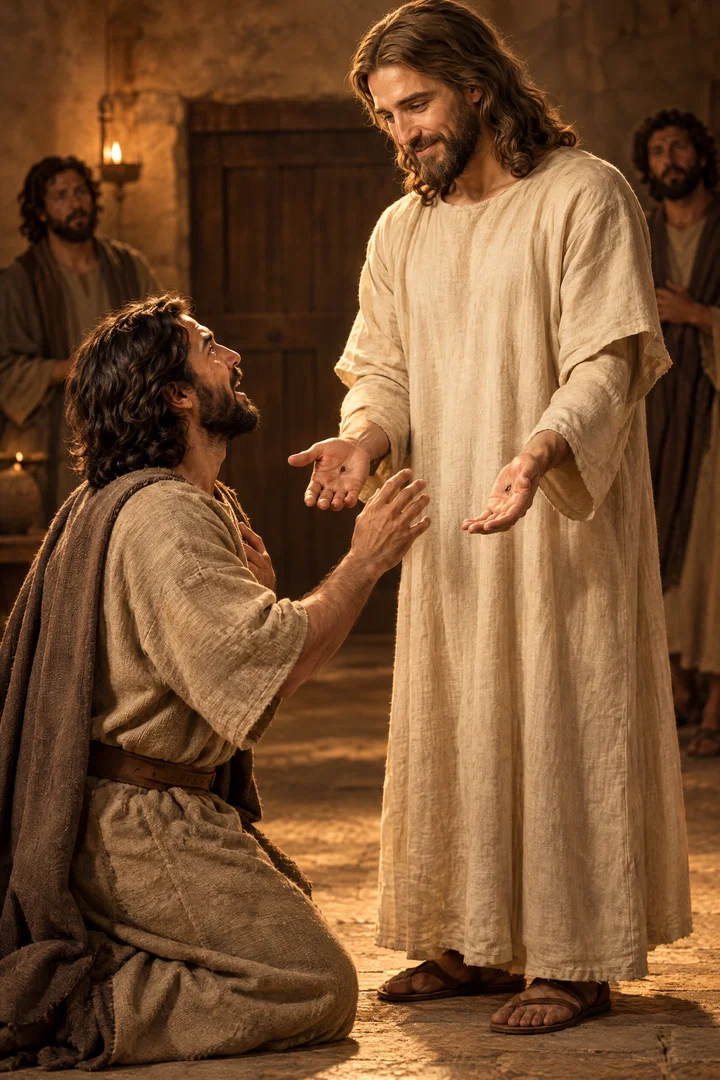
And Thomas answered and said to him, My LORD and my God.
King James Version, KJV Cambridge Paragraph Bible
And Thomas answered and said unto him, My Lord and my God.
And Thomas answered and said to him, My Lord and my God.
Revised Version, American Standard Version
Thomas answered and said unto him, My Lord and my God.
And Thomas answered and said to him, 'My Lord and my God;'
Thomas answered and said to him, My Lord and my God.
Thomas answered, and said unto him—My Lord, and my God!
Berean Standard Bible, Majority Standard Bible
Thomas replied, “ My Lord and my God!”
Thomas answered him, “ My Lord and my God!”
And Thomas said in answer, My Lord and my God!
Then Thomas answered, and said vnto him, Thou art my Lord, and my God.
Douay-Rheims (Challoner revision)
Thomas answered, and said to him: My Lord, and my God.
Pictures
Cross-references
- Luke 24:39
Behold my hands and my feet, that it is I myself: handle me, and see; for a spirit hath not flesh and bones, as ye see me have.
Jesus shows his hands and feet as physical evidence that he is bodily risen.
- John 20:19
Then the same day at evening, being the first day of the week, when the doors were shut where the disciples were assembled for fear of the Jews, came Jesus and stood in the midst, and saith unto them, Peace be unto you.
The risen Jesus appears to the gathered disciples with the doors shut.
- John 20:20
And when he had so said, he shewed unto them his hands and his side. Then were the disciples glad, when they saw the Lord.
The disciples rejoice when they see the risen Lord and his wounds.
- Matthew 1:23
Behold, a virgin shall be with child, and shall bring forth a son, and they shall call his name Emmanuel, which being interpreted is, God with us.
Emmanuel means “God with us,” affirming Jesus’ divine identity.
- Hebrews 1:8
But unto the Son he saith, Thy throne, O God, is for ever and ever: a sceptre of righteousness is the sceptre of thy kingdom.
Both call Jesus God; Hebrews also distinguishes the Son from God, who anoints him.
- Hebrews 1:6
And again, when he bringeth in the firstbegotten into the world, he saith, And let all the angels of God worship him.
Both show Jesus rightly worshiped; God commands the angels to worship the Son.
- John 1:1
In the beginning was the Word, and the Word was with God, and the Word was God.
Both identify Christ as God.
- Mark 16:14
Afterward he appeared unto the eleven as they sat at meat, and upbraided them with their unbelief and hardness of heart, because they believed not them which had seen him after he was risen.
Jesus appeared to the disciples after rising, before Thomas was present.
- Colossians 2:9
For in him dwelleth all the fulness of the Godhead bodily.
All the fullness of the Godhead dwells bodily in Christ.
- Philippians 2:11
And that every tongue should confess that Jesus Christ is Lord, to the glory of God the Father.
It says every tongue will confess Jesus Christ as Lord, to the Father’s glory.
- John 5:23
That all men should honour the Son, even as they honour the Father. He that honoureth not the Son honoureth not the Father which hath sent him.
The Son is to be honored as the Father is honored.
- John 20:1
The first day of the week cometh Mary Magdalene early, when it was yet dark, unto the sepulchre, and seeth the stone taken away from the sepulchre.
Christ’s resurrection is associated with the first day of the week.
- 1 Corinthians 15:5-8
And that he was seen of Cephas, then of the twelve:
Lists witnesses to the risen Christ, including the apostles.
- 1 Peter 1:8
Whom having not seen, ye love; in whom, though now ye see him not, yet believing, ye rejoice with joy unspeakable and full of glory:
Describes loving and believing in Christ without seeing him.
- Luke 6:46
And why call ye me, Lord, Lord, and do not the things which I say?
Jesus is called Lord, yet his lordship calls for obedience.
- Luke 24:40-43
And when he had thus spoken, he shewed them his hands and his feet.
The disciples see the risen Jesus and watch him eat.
- Matthew 10:32
Whosoever therefore shall confess me before men, him will I confess also before my Father which is in heaven.
Jesus promises to acknowledge those who confess him before others.
Commentary
Each commentary is drawn from primary sources: the writings of Ellen G. White and Adventist pioneers and periodicals. Each commentary is separate. Its own words are not a quotation; follow the references to read the source passages.
Ellen G. White
43 sources
Thomas answered Jesus by acknowledging Him as his own Lord and divine Saviour, recognizing the crucified One risen from the dead as the Christ and Messiah who had conquered death.6RED 38.2–39.2ST Sep 26, 18783SP 220.2–221.2 He had insisted he would not believe without seeing and touching the wounds, and Jesus gave him the evidence he demanded by showing the marks of crucifixion and inviting him to touch, so that his doubts were swept away forever and he wanted no further proof.EW 155.23SP 235.2SG1 74.26RED 72.3–73.2 Jesus accepted that acknowledgment while rebuking him for requiring sight before believing, and pronounced blessed those who believe without seeing through the testimony of witnesses.3SP 220.2–221.2Ms 155, 1904, par. 14–17Ms 2, 1868, par. 1–2EW 155.2DA 807.2–4 He revealed Himself to Thomas with love and mercy as the crucified Saviour, breaking down unreasonable conditions and barriers of doubt, which shows doubt is better met with loving consideration and patience than with reproach and controversy.6RED 40.13SP 222.1DA 807.5–808.1GW92 279.3–4 That acknowledgment means laying hold on truth and appropriating Christ as personally one's own, bringing rich treasures of grace, peace, and joy.Ms 75, 1900, par. 10–116T 416.1
Resurrection Appearance Setting
The verse belongs to the risen Jesus appearing to the disciples, where His wounded hands and feet and His eating before them show He was bodily risen, and the disciples' doubt gave way to faith and joy and recognition of Him as their risen Saviour.DA 802.1–803.2 The disciples recognized Him through His words, manner, and wounded hands, confessing Him as their Lord and God.ST Nov 14, 1878ST Oct 30, 1884 That recognition is connected with understanding the prophecies of His life, suffering, death, and resurrection, which would have sustained their faith and hope.ST Oct 30, 1884 Thomas was absent when Jesus met with the disciples, and missing that meeting meant missing an interview with Jesus.Lt 5, 1877, par. 17–18
Thomas had insisted he would not believe without seeing and touching the wounds.EW 155.2SG1 74.2 Jesus gave him the evidence he demanded by showing the marks of the crucifixion and inviting him to touch His hands and side, convincing him that Jesus had risen.EW 155.2SG1 74.2COS 185.4–6 Jesus proved He had read Thomas's private thoughts and words by repeating his exact condition for belief.DA 807.2–46RED 58.2–59.2 None of the disciples had seen Jesus for a week to tell Him of Thomas's stubborn unbelief.
Seeing his wounded Lord bearing the marks of crucifixion swept Thomas's doubts away forever, so he wanted no further evidence and needed no further proof.3SP 235.26RED 72.3–73.26RED 52.3–53.2ST Oct 10, 1878 Seeing the marks of crucifixion identifies Him as the Christ who had been crucified, and those who held one account place this recognition by the marks at the meal in Emmaus.Ms 167, 1904, par. 2–4 Thomas afterward recounted how his doubts were swept away, and when the gathered believers saw Jesus they worshiped Him, His countenance like the face of God.DA 818.2–819.1
Meaning of Confession
The words are the recognition of the risen Jesus as the crucified Lord risen from the dead.6RED 38.2–39.2ST Sep 26, 18783SP 220.2–221.2 They identify Him as Saviour, as the Christ who was crucified, and as the Messiah who conquered death.6RED 38.2–39.2ST Sep 26, 18783SP 220.2–221.26RED 40.13SP 222.1 They are Thomas's answer to Jesus, recording his acknowledgment of Jesus as his Lord and his God.6RED 38.2–39.23SP 220.2–221.21T 79.2–3 That answer supplies the example behind the name doubting Thomas, who did not believe until he could accept the evidence before him.1T 79.2–3
Convinced that Jesus had risen, Thomas needed no further proof and no longer needed to touch the wounds.3SP 220.2–221.2DA 807.2–46RED 58.2–59.23SP 235.2 His certainty ended his demand for further proof, his doubts were swept away forever, and he wanted no further evidence.ST Sep 26, 18783SP 235.2 He made the confession overcome with affection and devotion, his heart leaping for joy at the resurrection.6RED 38.2–39.2ST Sep 26, 1878 Casting himself at Jesus' feet, he worshiped Him as his Lord and his God.DA 807.2–46RED 58.2–59.2 His testimony strengthened the faith of the gathered believers.6RED 58.2–59.2
Jesus accepted this acknowledgment while rebuking Thomas for requiring sight before believing.3SP 220.2–221.2DA 807.2–4 Faith based on the testimony of others is also blessed.DA 807.2–4
Seeing and Believing
Thomas made a virtue of doubting until every cause for doubting was taken away, insisting he must have the unmistakable physical evidence he had declared beforehand.Ms 2, 1868, par. 1–2ST May 4, 18762T 103.2–104.1 When that demanded evidence was granted him, no room was left to doubt and he was compelled to believe, and his cry of My Lord and my God is belief by sight in contrast to believing without having seen.Ms 2, 1868, par. 1–2ST May 4, 18762T 103.2–104.1 Jesus did not commend that unbelief but reproved it with the words, Be not faithless, but believing.Ms 2, 1868, par. 1–2EW 155.2DA 807.2–4SG1 74.2 He gave Thomas the proof he wanted while still rebuking him for requiring sight before believing.EW 155.2DA 807.2–4SG1 74.2ST May 4, 1876
Against that sight-faith Jesus pronounced blessed those who believe in Him without seeing Him.Ms 2, 1868, par. 1–2EW 155.2DA 807.2–4SG1 74.2 That blessing falls on believers who cannot see or touch the marks of the wounds yet believe the testimony of the disciples, and God credits them with that belief.Ms 155, 1904, par. 14–17Ms 2, 1868, par. 1–2DA 807.2–4 The eyewitness report of the disciples is the appointed means by which others come to believe in the resurrection.Ms 155, 1904, par. 14–17DA 807.2–4SG1 74.2 Faith resting on the testimony of others is therefore also blessed.EW 155.2DA 807.2–4
Thomas's experience gives no warrant for waiting until every doubt is removed before believing.6RED 39.36RED 59.33SP 221.3 Insisting on having every cause for doubt removed can lead people to reject clear evidence of divine truth.6RED 39.36RED 59.33SP 221.3ST Sep 26, 1878 Those who keep waiting in that way may become hardened in unbelief and fixed in it, with the mind blinded and the heart hardened.6RED 39.36RED 59.33SP 221.3ST Sep 26, 1878 They lose the light they have neglected and the light they have received.6RED 39.33SP 221.3ST Sep 26, 1878
Guiding Honest Doubters
Jesus met Thomas not with reproach but with love and mercy, revealing Himself as the crucified Saviour whose tender, considerate dealing broke down the unreasonable conditions of faith and the barriers raised by doubt and drew faith out of a doubter.6RED 40.13SP 222.1ST Sep 26, 18786RED 60.1 That generous love and tender condescension is what brings forth the acknowledgment, My Lord and my God.6RED 40.13SP 222.1ST Sep 26, 18786RED 60.1
Doubt is better met with loving consideration than with words of reproach or controversy.DA 807.5–808.1 Persistent controversy seldom weakens unbelief, but puts it on self-defense where it finds new support and excuse. Revealing Jesus as the crucified Saviour in love and mercy can lead even formerly unwilling people to acknowledge Him as Lord and God, and many once unwilling will yet make that acknowledgment when He is so revealed to them.3SP 222.1DA 807.5–808.16RED 60.1
His treatment of Thomas gives the pattern for treating those who have doubts about religious truth and make those doubts prominent. This includes those who cannot believe on the testimony of others or on the published visions and Testimonies but must see and have the evidence for themselves.GW92 279.3–41T 327.3–329.25T 668.1–2Ms 3, 1862, par. 1–3 They are not to be set aside or pushed aside merely for their doubts, but to be treated with patience, kindness, forbearance, and brotherly love while they seek evidence and decide what they believe, until they find their position and become established for or against.GW92 279.3–41T 327.3–329.25T 668.1–2Ms 3, 1862, par. 1–3 If such doubters go beyond doubt and fight against and oppose that of which they have no knowledge and in which they have had no experience, the church may know that they are not right.5T 668.1–2
Demanding even greater evidence than doubting Thomas did means looking on the work with indifference and expressing doubts, suspicion, and fears instead of putting hand to the work with zeal and exerting energy to build up what Christ has required.7MR 114.1–45MR 61.2Lt 16, 1861, par. 12–14 Such influence does not work directly to tear down but works indirectly to distract, hinder, and retard advance and reform among God's people.5MR 61.2 It unites with the powers of darkness arrayed against them.5MR 61.2 Thomas's doubting itself means honest skepticism toward wonderful things shown by God, not indifference, for he can be deeply moved, regard the speaker as sincere, and desire to believe and be the happiest man alive if he could believe, while still unable to explain what has been related or to accept testimony until convinced it is indeed the voice of God.CET 85.1–3 Jesus gave rest to Thomas, whose faith had been troubled by doubt, so that Thomas could rest in Jesus as his Lord and God.Lt 46, 1896, par. 4–5
Personal Appropriation and Joy
The confession is personal recognition of Jesus as Lord and God, a laying hold on truth and an appropriating of Christ as personally one's own.Ms 75, 1900, par. 10–116T 416.1 That place is reached through close connection with Him who offered Himself as a sacrifice to save a perishing world.6T 416.1 It comes by following on to know the Lord, by striving earnestly for identity with the Redeemer, and by living by faith in Christ.6T 416.1
Doing the work He did and living for the saving of souls brings the learner there, for it is the result of being educated by Christ line upon line.6T 416.1 When young workers reach the place where they can truly make this confession, grace and peace and joy in rich measure become theirs.6T 416.1 Appropriating the truth about Christ in this personal way brings rich treasures of grace, peace, and joy.Ms 75, 1900, par. 10–116T 416.1
Sources
Pioneers and periodicals
99 sources
Thomas personally addresses the risen Jesus as his Lord and his God, recognizing in Him the same crucified One alive again by the wounds of nails and spear.ST Sep 26, 1878ST Sep 26, 1878RH Oct 21, 1862ST May 30, 1878ST Jan 4, 1883 His confession rests on bodily proof that the risen Christ was the same literal, tangible person who had been crucified, showing His wounds and entering through shut doors in a spiritual yet real body that is the pattern of immortal saints.RH Nov 26, 1872RH Nov 26, 1872RH Dec 18, 1855RH Jun 19, 1860 In calling Him God without correction, the confession honors the Son as truly divine and worthy of worship while distinguishing Him from God the Father whose name He bears.ST May 30, 1878RH Nov 10, 1859RH Jun 18, 1867ST May 27, 1908ST May 30, 1878 Because Thomas believed only after seeing, Jesus blesses those who believe without seeing, teaching that demanding sight before faith fixes unbelief while tender love that removes barriers draws out saving personal confession.ST May 4, 1876ST Apr 11, 1900RH Apr 21, 1868ST Apr 11, 1900RH Nov 13, 1900 The second meeting eight days later reclaimed Thomas from doubt and established the resurrection but gave no command making the first day holy or changing the Sabbath from seventh to first, though some held those first-day appearances as support for special honor to that day.ST Apr 22, 1897ST Feb 17, 1890ST Oct 4, 1899RH Jun 19, 1860ST Aug 6, 1912
Setting and Sequence
The confession belongs to the second meeting with the disciples when Thomas was present, eight days after the first evening appearance.ST Jan 9, 1893ST Nov 24, 1898 It stands as one event in the series of manifestations of the risen Jesus during the forty days before the ascension.ST Jan 9, 1893RH Aug 31, 1869 Those were appearances at intervals, not a continuous presence with them.RH Aug 31, 1869 This meeting is counted among His appearances after the resurrection.ST Nov 24, 1898
Thomas had been absent at first and had refused to believe the disciples' witness unless he could see the print of the nails and put his finger into the wounds and his hand into the side.ST Jun 3, 1897 After eight days Jesus came through shut doors, greeted the disciples with peace, and invited Thomas to touch the hands and side and to be believing rather than faithless.ST Jun 3, 1897 Thomas then answered with acknowledgment of Jesus as his Lord and his God.ST Jun 3, 1897 Jesus declared that Thomas believed because he had seen, and pronounced blessing on those who have not seen and yet believe, and the signs recorded were written so that readers may believe that Jesus is the Christ, the Son of God, and by believing may have life in His name.ST Jun 3, 1897
John's account gives some particulars that the other Gospel accounts omit, and those differences do not make the accounts contradictory.ST Mar 5, 1912 The confession belongs to the infallible proofs of the resurrection recorded in John 20:11-31, together with the appearance to Mary Magdalene at the tomb and the appearance on the evening of the first day of the week to the disciples behind shut doors with the greeting of peace and the showing of hands and side.ST Jun 3, 1897 This appearance when Thomas was present is one of several witnesses to the resurrection.ST Aug 3, 1882 They confirm that the risen Jesus was the same person they had known before His death.ST Aug 3, 1882
Nothing was farther from the expectation of the apostles than His resurrection, for they were slow of heart to grasp His plain teaching and were disappointed followers unprepared to see Him alive.ST Jun 26, 1901 Their faith had failed at His arrest and was not confirmed until after His resurrection and ascension.ST Mar 10, 1887 Thomas was troubled by doubts while the disciples as a whole were unprepared for the trial before them, yet Jesus continued to love disciples who were not wholly faithful or ready.RH Jun 4, 1914 Even after Thomas saw and believed that He had risen, he and the others did not yet understand the significance of what Christ had accomplished, including the atonement through His blood, with mistaken ideas about His kingdom and mission still hindering their understanding. Their unreadiness pictures how masses of professed disciples will be unprepared for His sudden appearance at the second advent, while those who believe His Word and love His appearing will be looking for Him.ST Jun 26, 1901
Thomas is remembered as the disciple who doubted and was convinced only by seeing for himself.RH Apr 30, 1908 The verse records his response to the risen Christ when He appeared to the disciples again eight days after the resurrection.ST Jun 2, 1898 It is referred to as the moment when he recognized Jesus as his Lord. His name is also linked to an uncertain tradition that he carried the gospel to India and was buried at St. Thomas Mount near Madras.RH Apr 30, 1908
Words of the Confession
Thomas speaks the words straight to the risen Jesus himself, calling him both Lord and God, and he makes the claim personal by saying my Lord and my God rather than acknowledging him only in general.ST Sep 26, 1878ST May 30, 1878ST Jan 4, 1883 The tender and considerate way Jesus reveals himself as the crucified Saviour draws that personal faith out of the doubter.ST Sep 26, 1878
The confession recognizes the one standing before him as the same Lord who had been crucified, identified by the wounds of nails in the hands and spear in the side.RH Oct 21, 1862ST Apr 24, 1901ST Apr 24, 1901ST Jan 4, 1877 Seeing and being invited to examine hands and side brings certainty that he is alive after crucifixion, and personal certainty that he is the Messiah whom Thomas, having checked the marks, could not mistake or doubt.ST Sep 26, 1878RH Oct 21, 1862RH Oct 7, 1862 The answer is given after seeing hands and side, expressing belief in the risen Jesus and ending all demand for further proof.ST Sep 26, 1878ST Apr 24, 1901ST Apr 24, 1901
Jesus shows he has read Thomas's private thoughts and words by repeating his exact condition for belief and inviting touch of hands and side, though none had told him of it during the week. Overwhelmed by Christ's glory, Thomas wants no further proof and does not carry out the touching he was invited to do.RH Nov 13, 1900 Seeing is enough to convince him that this is the same Son of God who was crucified and buried. What convinces him is not mere bodily form but recognizing Jesus' loving presence in words and expression, which lifts his love higher and leads him to acknowledge divinity, so with heart leaping for joy he casts himself at Jesus' feet.ST Mar 23, 1888
The words are spoken in deep affection and devotion, with joy, worship and adoration, upon recognizing the crucified Saviour risen and revealed in love and mercy.ST Sep 26, 1878ST Oct 10, 1878 He confesses personal attachment to Jesus as his Lord and acknowledges divinity by calling him God.RH Sep 2, 1873 The response follows doubt, after receiving the very proof of the wounds he had demanded, and confirms recognition of the risen Christ.ST Jun 9, 1898 That recognition and worship, with no further evidence wanted, strengthened the gathered believers' faith in Jesus as Messiah who conquered death.ST Oct 10, 1878 The disciples together recognize him in the same way, through words, manner and wounded hands, and confess him as Lord and God.ST Nov 14, 1878ST Feb 10, 1881
The confession identifies Jesus as the Christ, the Son of God, in whom people may believe and receive life, marking the move from refusing the other disciples' testimony to confessing after confrontation with the wounds. True faith so receives Christ in all his offices and characters, recognizing him as Son of man and confessing him as Lord and God.RH Apr 21, 1859 He is Immanuel, Christ and God, and the words give believers personal language to love him as their own God and delight in the name of Jesus.RH Aug 25, 1868
The confession as Thomas expressed it came after Jesus told him to see hands and side and be believing and not faithless.ST Apr 24, 1901 That recognition through manner and wounded hands belongs with understanding the prophecies of his life, suffering, death and resurrection, which would have sustained faith and hope.ST Oct 30, 1884
Witness to Bodily Resurrection
The risen Christ was the same literal, bodily, tangible person who had been crucified, showing Thomas the wounds in His body and calling that body Himself, not a spirit.RH Nov 26, 1872RH Dec 18, 1855 Thomas's belief followed seeing Him, and the marks of the crucifixion served as evidence that Christ had truly risen and more fully established the fact of His resurrection.RH Nov 26, 1872RH Jun 19, 1860 That proving to unbelieving Thomas that He had really risen gives no proof that the disciples assembled to commemorate the resurrection, no proof that the meeting was on the first day of the week, and no proof for a change of the Sabbath from the seventh to the first day.RH Jun 19, 1860
His wounded hands and feet and His eating before them show that He was bodily risen, and the disciples' doubt gave way to faith and recognition of their Saviour. His resurrected body was literal and tangible bearing the marks of His crucifixion, which Thomas could see and handle, yet it was not mortal and corruptible like present human bodies but a spiritual body.RH Nov 26, 1872 The disciples' difficulty recognizing Him was because their eyes were held, not because His body was unfamiliar or unreal.RH Nov 26, 1872
The confession is part of the physical evidence that Jesus was alive after resurrection, as Thomas addressing the risen Jesus shows.ST Feb 27, 1907 Thomas saw the marks of the nails and the spear and recognized Jesus, supporting the identification of the returning Christ as the same personal Jesus who rose, appeared to His disciples, and ascended.RH Feb 16, 1869 Entering through closed doors shows that a physical body under ordinary human control could not enter that way, but Christ's superior power could bring His body through, since what is beyond human ability need not be beyond His.ST Apr 1, 1880
Christ's resurrection state retaining identity despite immortality is the example of the state of immortalized saints.ST Feb 21, 1878 The new birth begun in conversion is completed at the resurrection, when the just become immortal and bear the image of the heavenly.RH Sep 15, 1874 In like manner the saints when changed to immortality will retain bodily identity and be recognizable, and the righteous will rise recognizable by personal appearance to friends parted by death, not emaciated with disease but with the bloom of eternal health, with children gathered by angels and borne to their mothers' arms, with Christ as head by whom and through whom all shall be united.ST Feb 21, 1878RH Feb 12, 1901
Thomas's doubts ended when he saw the risen Jesus bearing the wounds of crucifixion, and he wanted no further evidence.ST Oct 10, 1878RH Oct 21, 1862 He recognized and worshiped Jesus, and his testimony that the evidence of resurrection answers doubt strengthened the gathered believers' faith in Jesus as the Messiah who had conquered death.ST Oct 10, 1878RH Oct 21, 1862
Proof of Christ's Divinity
Thomas directly addresses Jesus as both Lord and God, and Jesus does not correct him, which establishes that the Son may rightly be called God and bear the Father's name.ST May 30, 1878ST May 30, 1878 He is therefore to be honored as God and worshiped, not regarded as merely a man.ST May 27, 1908ST May 30, 1878 He is divine, not merely a superior man or a helper who lacks divinity.ST May 27, 1908
The confession calls Jesus God while still distinguishing Him from the Father, for Jesus Christ is Lord as the Son while the other is known as God the Father.RH Nov 10, 1859 He bears the divine name as the Son who inherits it from His Father.RH Jun 18, 1867
Thomas in this way worships Jesus, the crucified Son of David, by confessing Him as Lord and God.RH Jan 25, 1906 This means Jesus bears the divine names Son, Lord, and God and is worthy of divine worship.RH Jan 25, 1906 Every believer should make the same confession to Him with childlike confidence, standing on the rock of His divinity as the ground of salvation.RH Jan 25, 1906
Jesus is the believer's Lord and all, the one who gives life and strength, saves from sin and bondage, and is the believer's hope and portion.ST Oct 14, 1880 He is enough for every need, with strength upholding the weak, grace supplying need, a word that can be trusted without knowing the future, and perfect love filling the heart's deepest longing.ST Dec 8, 1881 Christ Himself satisfies the heart's longing for love and gives perfect peace. Thomas chooses to worship Jesus as his Lord and God rather than treating an atom as an object of worship.RH Oct 26, 1911 His calling Jesus my Lord and God expresses a personal relation that brings believers into close relation with God's rule, for all authority in heaven and earth belongs to Christ and they are joined to the whole universe under His care, so that the heavens, the earth, and the angels are theirs and angels serve Christ as ministering spirits for those who will inherit salvation.RH May 12, 1904
Believing Without Seeing
Thomas believed when he saw Jesus, and Jesus set this against the blessing of those who have not seen yet believe, showing that believing without seeing is pleasing to the Lord.ST Apr 11, 1900RH Apr 21, 1868RH Nov 13, 1900 His belief followed seeing him a week after the other disciples had seen him, and the blessing Jesus pronounced next is especially for those who have not seen him yet believe.ST Apr 11, 1900RH Apr 21, 1868RH Nov 13, 1900 Jesus reproved this unbelief that demanded physical proof before believing and then believed only after the requested evidence of the wounds was given.ST May 4, 1876ST Apr 11, 1900RH Apr 3, 1879 Doubt is no virtue when a fact has been well proved, and demanding further proof in such a case is unreasonable.ST May 4, 1876ST Apr 11, 1900RH Apr 3, 1879
Insisting on having every cause for doubt removed before believing can lead people to reject strong evidence, become fixed in unbelief, and lose the light they have received.ST Sep 26, 1878RH Sep 2, 1873RH Jul 8, 1909 Making belief depend on seeing Jesus is therefore warned against, and a tendency to doubt is a hindrance to doing much even when belief itself is genuine.ST Sep 26, 1878RH Sep 2, 1873RH Jul 8, 1909 Thomas’s prior belief in Jesus made the evidence convincing, illustrating that faith can precede and open the way to seeing spiritual truth.ST Sep 23, 1908 His unbelief had kept him from sharing the other disciples’ joy and communion with the risen Saviour, leaving him alone in grief over Calvary, showing that faith is more precious than doubt.ST Sep 23, 1908
Thomas rose beyond recognizing Jesus by sight to a spiritual confession of faith, declaring Jesus to be his own Lord and God without carrying out the touching he had been invited to do.RH Nov 13, 1900RH Nov 13, 1900ST Aug 16, 1883 His earlier doubt and caution make his conviction especially compelling, providing evidence that can help other doubters believe.RH Nov 13, 1900ST Aug 16, 1883 Even the most doubting becomes convinced when coming to see the evidence with his own eyes.RH Nov 13, 1900ST Aug 16, 1883 Saving faith speaks of Christ personally as my Lord and God, while mere belief such as devils have lacks this trusting personal confession.RH Nov 13, 1900RH Sep 2, 1873RH Dec 3, 1867
Faith must be confessed and witnessed through words and actions and open Christian living, for hiding that witness weakens faith and Christian influence.RH Nov 13, 1900RH Sep 2, 1873RH Dec 3, 1867 Saying the words of confession while living in ways opposed to Christ makes the confession hollow, and such inconsistency can lead others to despise the speaker as hypocrite or traitor, or to stumble and perish.RH Sep 2, 1873RH Dec 3, 1867 The confession is drawn out by generous love and tender condescension that breaks down unreasonable conditions of faith and barriers of doubt, not by words of reproach or controversy.RH Aug 4, 1904RH Mar 24, 1910 Persistent controversy seldom weakens unbelief but puts it on self-defense where it finds new support and excuse, while Christ’s trusting love, kindness, tender patience, and patient treatment of hesitation give the pattern for treating those who have doubts about religious truth and make those doubts prominent, renewing hope and sealing love.RH Aug 4, 1904RH Mar 24, 1910
The other disciples were likewise unbelieving until they saw him, requiring at least as much visible proof as Thomas who needed to see before believing, with faith failing at the arrest and not confirmed until after resurrection and ascension.ST Aug 14, 1893ST Mar 10, 1887
Sunday and Sabbath Question
The confession gives no proof that Christ kept the first day of the week or made it the Christian Sabbath after His resurrection.ST Apr 22, 1897RH Jun 19, 1860 It gives no proof that the disciples assembled to commemorate the resurrection, no proof that the meeting was on the first day of the week, and no proof for a change of the Sabbath from the seventh to the first day.ST Apr 22, 1897RH Jun 19, 1860 It took place at the second meeting with the disciples, eight days after the evening meeting that followed the resurrection, which puts it on the second or third day of the week and not on the first day.ST Apr 22, 1897RH Sep 17, 1857 Only one meeting happened on the first day of the week, at its very close, when the disciples were gathered in fright and unbelief, not expecting Him to have risen and not assembled to honor the day.ST Apr 22, 1897
The meeting after eight days is not identified as occurring on a particular day of the week.RH May 1, 1900 The phrase after eight days does not establish that the meeting occurred on the next first day of the week.RH Nov 24, 1868 Occurring more than eight days after the first, it could not have fallen earlier than the second or third day of the week.RH Sep 17, 1857 One reckoning places it on the second day of the week in the evening with peace be unto you, not a religious assembly and not authorizing first-day observance.RH Aug 1, 1854 Thomas was present and the appearance removed his doubts and cured his unbelief about the resurrection by impressing the fact that He had risen, without showing that the first day was sacred or that the disciples were commemorating the resurrection.RH May 1, 1900RH Aug 1, 1854RH Nov 24, 1868
The appearances on the first day showed that He was alive and had risen; they did not declare the first day holy or set it apart as a day of worship.ST Aug 6, 1912 The purpose was to reclaim Thomas from doubt and unbelief, to establish conviction that Christ had risen, to instruct about future work, and to teach how blessed faith is.ST Oct 4, 1899RH Apr 1, 1873 Meeting with them on the first day of the week did not make that day holy.RH Apr 1, 1873 Those who held the contrary taught that the appearances were significant first-day events and part of His pattern of meeting gatherings and blessing them to support special honor for the first day.ST Feb 17, 1890ST Jun 2, 1909RH Apr 15, 1873 In that reckoning the meeting with Thomas took place after the earlier Sunday-evening meeting, not on that same day, and the occasion eight days after the resurrection when He showed the wounds in hands and side and gave full assurance of faith was used to support an annual celebration.ST Feb 17, 1890RH Jun 3, 1873
Personal Faith and Life
Faith that makes this personal confession also trusts Him as Shepherd and Rock, turning prophecies into history, promises into deliverance, sorrow into joy, peril into victory, and death into life.RH May 7, 1867 The words are a fitting cry of personal devotion to Christ, whose love gives Himself for sinners and transforms even the most depraved heart, to whom belong the believer's glory and spiritual love and His cross.RH Jul 4, 1865 They express personal faith in Jesus as Saviour and a close, trusting relationship with Him.RH Oct 4, 1853RH Jan 20, 1859 They become a cry of devotion when Jesus is received by faith, spoken from conviction that He loves and saves the believer, and are the fitting response when the heart welcomes the Saviour and recognizes Him with love as its own.RH Oct 4, 1853RH Jan 20, 1859ST Mar 23, 1888
The confession gives words to repeat in overcoming unbelief, confessing Jesus as my Lord and my God joined with trust in the Saviour who died for the believer.ST Nov 16, 1876 They are words for assurance of faith in redemption, so that those seeking cleansing from sin may hope to receive evidence of an interest in His redeeming blood and confess Him as their Lord and God.RH Feb 25, 1873 They are joined with the cry Abba, Father enabled by the spirit of adoption.RH Jul 7, 1859 The heart softened by contemplating His sacrifice yields wholly to Him in adoration acknowledging Him as Lord and God.ST Jan 13, 1888
Thomas's recognition and joy in acclaiming the risen Jesus anticipates the redeemed welcoming Him in His visible presence.ST Jul 23, 1912 This belongs to His appearing alive to the apostles when nothing was farther from their expectation than His resurrection, for they were slow of heart to grasp His plain teaching and were disappointed followers unprepared to see Him alive.ST Jun 26, 1901 Their unreadiness pictures how masses of professed disciples will be unprepared for His sudden appearance at His second advent, while those who believe His Word and love His appearing will be looking for Him.ST Jun 26, 1901
Thomas is the pattern of a doubting, dried-up disciple, to be a Thomas among Christ's followers when they gather at the table to commemorate their Master's love being to be outwardly present with them while inwardly backslidden.RH Apr 9, 1872 He has lost former zeal and substance in Sabbath-school, prayer-meeting and service because the fountain-head of grace has run dry through abandonment of secret prayer and stealthy growth of secret sin, needing thorough heart-work and deep re-conversion to become hale and useful again.RH Apr 9, 1872 He is the pattern of willful unbelief, for people believe just what they choose to believe, and believing a lie produces joy or grief just as believing the truth does, so those who refuse clear proof and those who doubt and want proof are compared with Thomas who wanted proof.RH Aug 14, 1860ST Jan 29, 1902 Those who doubt the advent movement are doubting Thomases, and the growth and extension of the united Sabbath reform and announcement of the second advent into almost every land during the present generation furnishes convincing evidence that this work is not of men and ought to renew courage and overcome doubt.RH Dec 3, 1908
The setting includes disciples who were not wholly faithful or ready, with Thomas troubled by doubts and the disciples unprepared for the trial before them, yet whom Jesus continued to love.RH Jun 4, 1914 A second shower of blessing came to the disciples when Thomas was with them, as the risen Jesus appeared among them and refreshed them before the Pentecostal baptism.ST Nov 11, 1908 Thomas's doubts were swept away when he encountered the risen Jesus, giving way to belief, and he acknowledged Jesus as his Lord and God within the disciples' testimony about seeing Jesus after the resurrection.ST Feb 10, 1914ST Oct 7, 1880 To speak it as never before is the end of unbelief in personal faith, claiming Jesus personally with fresh assurance that Jesus wants to save, that the Lord wants to save, and that angels of God want to save, so there is no reason to remain unbelieving, escaping doubt and despair.RH May 19, 1904 After Christ showed the wounds in His hands, feet, and side and appealed to belief, the believers confessed Him as their Lord and God and chose to believe, their faith strengthened by the evidence and the Spirit to accept the sanctifying truths for the last days.RH Feb 19, 1867
Sources