John 21:19
This spake he, signifying by what death he should glorify God. And when he had spoken this, he saith unto him, Follow me.
Translations
This spoke he, signifying by what death he should glorify God. And when he had spoken this, he says to him, Follow me.
King James Version, KJV Cambridge Paragraph Bible
This spake he, signifying by what death he should glorify God. And when he had spoken this, he saith unto him, Follow me.
This he spoke, signifying by what death he should glorify God. And when he had spoken this, he saith to him, Follow me.
Revised Version, American Standard Version
Now this he spake, signifying by what manner of death he should glorify God. And when he had spoken this, he saith unto him, Follow me.
and this he said, signifying by what death he shall glorify God; and having said this, he saith to him, 'Be following me.'
But he said this signifying by what death he should glorify God. And having said this, he says to him, Follow me.
Now, this, he said, signifying, by what manner of death, he should glorify God. And, having said this, he saith unto him—Be following me.
Berean Standard Bible, Majority Standard Bible
Jesus said this to indicate the kind of death by which Peter would glorify God.And after He had said this, He told him, “ Follow Me.”
Now he said this, signifying by what kind of death he would glorify God. When he had said this, he said to him, “ Follow me.”
Now this he said, pointing out the sort of death by which he would give God glory. And after saying this, he said to him, Come after me.
And this spake he signifying by what death he shoulde glorifie God. And when he had said this, he said to him, Folowe me.
Douay-Rheims (Challoner revision)
And this he said, signifying by what death he should glorify God. And when he had said this, he saith to him: Follow me.
Pictures
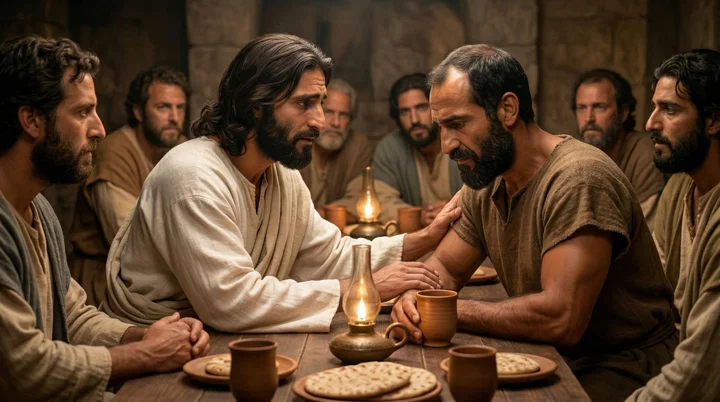
Cross-references
- John 13:36-37
Simon Peter said unto him, Lord, whither goest thou? Jesus answered him, Whither I go, thou canst not follow me now; but thou shalt follow me afterwards.
Jesus had earlier said Peter could not follow him then but would follow later.
- 2 Peter 1:14
Knowing that shortly I must put off this my tabernacle, even as our Lord Jesus Christ hath shewed me.
Peter says Jesus showed him that his death was near.
- John 12:26
If any man serve me, let him follow me; and where I am, there shall also my servant be: if any man serve me, him will my Father honour.
Following Jesus leads the servant to be where he is.
- John 21:1-14
After these things Jesus shewed himself again to the disciples at the sea of Tiberias; and on this wise shewed he himself.
Jesus meets his disciples while they are fishing.
- Matthew 26:69-75
Now Peter sat without in the palace: and a damsel came unto him, saying, Thou also wast with Jesus of Galilee.
Peter’s denial contrasts with his later death for Christ.
- Luke 22:54-62
Then took they him, and led him, and brought him into the high priest’s house. And Peter followed afar off.
Peter’s denial became a failure he later remembered with repentance.
- Luke 9:23
And he said to them all, If any man will come after me, let him deny himself, and take up his cross daily, and follow me.
Both call disciples to follow Jesus, even through a path of suffering.
- John 21:23
Then went this saying abroad among the brethren, that that disciple should not die: yet Jesus said not unto him, He shall not die; but, If I will that he tarry till I come, what is that to thee?
The mistaken report that John would not die shows the disciples did not equate death with Christ’s coming.
- John 13:37
Peter said unto him, Lord, why cannot I follow thee now? I will lay down my life for thy sake.
Peter's pledge to die for Christ
- Acts 12:2
And he killed James the brother of John with the sword.
James’s death is included among the disciples’ victories.
- 1 Peter 4:16
Yet if any man suffer as a Christian, let him not be ashamed; but let him glorify God on this behalf.
Both connect suffering for Christ with glorifying God.
- Philippians 1:20
According to my earnest expectation and my hope, that in nothing I shall be ashamed, but that with all boldness, as always, so now also Christ shall be magnified in my body, whether it be by life, or by death.
Christ is magnified in the body through life or death.
- 1 Peter 2:21
For even hereunto were ye called: because Christ also suffered for us, leaving us an example, that ye should follow his steps:
Christ’s followers are called to follow his path.
- John 18:15-27
And Simon Peter followed Jesus, and so did another disciple: that disciple was known unto the high priest, and went in with Jesus into the palace of the high priest.
Peter denies Jesus, contrasting with his later death for him.
- Revelation 2:10
Fear none of those things which thou shalt suffer: behold, the devil shall cast some of you into prison, that ye may be tried; and ye shall have tribulation ten days: be thou faithful unto death, and I will give thee a crown of life.
The faithful are promised a crown even if faithfulness costs them their lives.
- Luke 22:32
But I have prayed for thee, that thy faith fail not: and when thou art converted, strengthen thy brethren.
Jesus prays that Peter’s faith will endure and that he will strengthen his brethren.
- 1 Corinthians 1:18
For the preaching of the cross is to them that perish foolishness; but unto us which are saved it is the power of God.
The cross is God’s power to save, and Peter glorifies God through his death.
- 2 Peter 1:15
Moreover I will endeavour that ye may be able after my decease to have these things always in remembrance.
Peter refers to his coming death as his decease.
Commentary
Each commentary is drawn from primary sources: the writings of Ellen G. White and Adventist pioneers and periodicals. Each commentary is separate. Its own words are not a quotation; follow the references to read the source passages.
Ellen G. White
17 sources
Jesus drew Peter aside alone after restoring him and appointing him to care for the flock, and told him that when old age weakened him he would be taken where he did not wish to go and put to death by crucifixion with his hands stretched out.3SP 232.26RED 70.1–2ST Nov 23, 1915ST Oct 3, 18786RED 50.1–2 That death would glorify God by its very manner, and Peter received the revelation without fear or discouragement, understanding he must give his life for Christ and later knowing his martyrdom was near.3SP 232.26RED 70.1–2Ms 109, 1898, par. 19–21ST Nov 23, 1915ST Oct 3, 1878 He lived on in repentance and humility, loving Christ no longer merely as teacher but as God who was all in all to him, and at last was crucified with his head downward at his own request, feeling unworthy to die as his Master died, yet even then still dependent on grace and not beyond failure.Ms 109, 1898, par. 19–21ST Nov 23, 19154T 342.1 The command to follow covered not only his death but every step of his life, calling him to wait on God's plan rather than run ahead, to do his own appointed work without curious concern over another's future, and to keep his eye single to the glory of God.Ms 109, 1898, par. 19–21Ms 35, 1891, par. 44–45DA 816.1ST Oct 3, 1878
Death That Glorifies God
The saying belongs to a gathering near the Sea of Galilee in a place not likely to be disturbed, surrounded by reminders of Jesus and His mighty works, with minds full of His words and deeds.DA 809.3 Jesus took Peter aside alone to speak privately with him in sympathy to strengthen him for the final test of his faith, after restoring him to his place and appointing him to care for the flock.6RED 70.1–2ST Nov 23, 19156RED 50.1–2DA 815.3–4 That private word gave him after his failure another opportunity to prove his love.DA 815.3–4
After a life of usefulness, when old age weakened his strength, Peter would be taken where he did not wish to go.3SP 232.26RED 70.1–2ST Oct 3, 18786RED 50.1–2DA 815.3–4 The stretching out of his hands explicitly stated both the fact and the manner of his death by crucifixion.6RED 70.1–2ST Oct 3, 18786RED 50.1–23SP 232.3DA 815.3–4 By that death Peter would glorify God by the very manner of his death.3SP 232.2Ms 109, 1898, par. 19–21ST Nov 23, 19153SP 232.3DA 815.3–4 This was also shown as the meaning that Peter would truly follow his Lord in death after long and useful service.3SP 232.26RED 70.1–2ST Oct 3, 18786RED 50.1–2
Peter received the revelation without fear, discouragement, or being disconcerted, willing to suffer any death for his Lord.6RED 70.1–2ST Oct 3, 18786RED 50.1–23SP 232.3DA 815.3–4 He understood that the time had come to give up his life for Christ, and he later knew he would soon suffer martyrdom as the Lord had shown him.AC1 70.3 His later willingness to give his life for the gospel fulfilled the prophecy.ST Nov 23, 1915
He lived in repentance and humility in contrast to his denial, made ready to share in his Lord's mission of sacrifice.4T 342.1DA 815.5 He no longer knew Christ merely as man and heaven-sent teacher but loved Him as God who was all in all to him, and his willingness to give his life fulfilled the prophecy by bearing suffering willingly and gladly.ST Nov 23, 19154T 342.1DA 815.5 At last he fell at his work at the hands of the enemy, crucified with his head downward at his own request, counting it too great an honor and feeling unworthy to die in the same manner as his Master.Ms 109, 1898, par. 19–214T 342.1DA 815.5HSFM 234.2 Even restoration and long service did not make him safe from failure, and the call toward that death did not remove his personal helplessness and need to depend on grace and remain close to principle.Ms 122, 1897, par. 14–15
Call to Follow Jesus
The command to follow was instruction for Peter not only for his death but for every step of his life.DA 816.1 It met his habit of acting on his own and trying to plan the work instead of waiting to carry out the appointed plan.DA 816.1 It means not to run ahead of Christ, for rushing on before the Lord gains nothing.DA 816.1 Letting Christ go before keeps the follower from meeting the hosts of Satan alone and from being overcome by the enemy.DA 816.1
Following Christ is each person's individual work and duty, regardless of different futures or assignments given to others, for Christ's will governs each person's future.Ms 109, 1898, par. 19–21Ms 35, 1891, par. 44–45ST Oct 3, 18783SP 232.3 It forbids looking at another to point out defects of character and to ask about their future, and forbids undue concern and curiosity about what another person will do.Ms 109, 1898, par. 19–21Ms 35, 1891, par. 44–45ST Oct 3, 1878 To follow means to keep the eye single to the glory of God, letting the world go out of the reckoning and letting eternal realities come in.Ms 35, 1891, par. 44–45 It means to be a Christian at home as in church and in heaven.Ms 35, 1891, par. 44–45 Trusting His guidance is the only safe course when even the wisest may err and the strongest may stumble.PP 556.1–2
Sources
Pioneers and periodicals
65 sources
Jesus was telling Peter beforehand what kind of death he would die to bring glory to God, and then he told him to follow him.ST Jun 17, 1897ST Jul 22, 1880 He had just said that when Peter grew old he would stretch out his hands and be led where he did not want to go, meaning he would be taken by his enemies to be crucified.ST Oct 3, 1878ST May 1, 1901ST Apr 20, 1915ST May 1, 1901 That death would glorify God because Peter would remain faithful to the truth even at the cost of his life, making his crucifixion a victory and not a defeat.RH Nov 20, 1866RH Jul 19, 1864ST Dec 2, 1889RH Oct 24, 1912ST Feb 4, 1913 Spoken after Peter had been restored from his denial and charged to care for Christ's lambs and sheep, the command called him to follow his Master even through suffering and death.ST Nov 23, 1915RH Feb 14, 1854RH Nov 7, 1907 The same call belongs to every believer to the end, to obey Christ, serve others in need and suffering, and keep on in the work given them without turning aside to compare their lot with another's.ST Jun 26, 1901ST Apr 22, 1880ST Jun 17, 1897ST May 1, 1901ST Dec 11, 1928
Setting and Immediate Context
The saying explains that the words just spoken foretold the kind of death by which Peter would glorify God, and then records the command to follow.ST Jun 17, 1897ST Jul 22, 1880 Those preceding words were that when Peter grew old he would stretch out his hands and be led where he did not wish to go, and they foretold the manner of his death through which he would glorify God.ST May 1, 1901ST May 1, 1901ST Jun 17, 1897
The conversation belongs to the meeting with the risen Jesus in Galilee at the Sea of Tiberias, where the disciples had gone fishing and he met them on the lakeshore in a quiet place where they remembered his words and works, fulfilling his promise that they would see him there.ST Nov 4, 1886RH Sep 10, 1857 It was his third meeting with the disciples after the resurrection, on a fishing occasion rather than at a religious meeting, when he appeared to seven disciples.ST Nov 11, 1889ST Jun 2, 1898ST Nov 24, 1898 That appearing is counted as the seventh of eleven recorded appearances after the resurrection, one of the appearings at intervals during the forty days between resurrection and ascension when he did not remain continuously with them but showed himself alive by many infallible proofs and spoke of the things pertaining to the kingdom.RH Aug 31, 1869ST Jun 2, 1898ST Nov 24, 1898 The day of the week of that meeting is not known and gives no evidence that it took place on the first day, and even where the day is supposed to have been the first day it was not thereby made a holy day.RH Sep 10, 1857ST Nov 11, 1889ST Jun 2, 1898
It comes after Jesus three times asked Peter whether he loved him and three times charged him to care for his lambs and sheep, and just before Peter turned, saw John following, and asked what John would do.RH Feb 14, 1854 Hearing this foretelling of his own lot on earth emboldened Peter to ask for similar information about John's future career.RH Feb 14, 1854
Death Jesus Foretold
Jesus told Peter beforehand plainly that he must die at the hands of his enemies, revealing how he would die and that the death would glorify God.RH Oct 30, 1855ST Nov 20, 1893ST Feb 10, 1898 This prediction of Peter's death is distinct from the promise to come again, for death and the coming are distinct and opposed, since the coming brings resurrection and victory over death and prevents it, not death itself.ST Nov 20, 1893ST Feb 10, 1898 If come meant die, the words about John tarrying until he came would mean living until he died.ST Feb 10, 1898
When Peter was old he would stretch out his hands and be taken where he did not wish to go, referring to crucifixion and to a death he did not choose.ST Oct 3, 1878ST Nov 4, 1886ST Apr 20, 1915 His outstretched hands point to the cross, and the outstretched arm is a type of Christ's cross through which deliverance from sin and salvation come.RH Apr 23, 1908 Victory for individuals and the church comes through Christ's power, for apart from him they can do nothing.RH Apr 23, 1908
When old, Peter was taken to be crucified and requested to be crucified head downward because he considered himself unworthy to die in the same posture as Jesus.ST Apr 20, 1915RH Oct 24, 1912 For one who had denied the Lord with oath and curse to die in the same manner as his Master died was too great an honor, yet as an aged man he died on a cross with his head toward the earth, unflinching and sustained by grace and counting it a joy to yield up his life for the gospel.RH Nov 7, 1907RH Oct 24, 1912 Peter ultimately followed Jesus even to the cross, sealing his life's work with his blood, giving his life for the gospel in a death that would glorify God.RH Sep 26, 1912RH Mar 18, 1915 He knew that this martyr death shown to him by Jesus was soon to come.RH Sep 26, 1912
The martyrdom is identified as occurring at Rome under Nero about A.D. 67 in defense of the faith.ST Oct 3, 1906 Apart from this revelation the Bible gives here no further information about when, how, or where Peter died.ST Apr 16, 1896 Peter's death was specially made known by this revelation of the kind of death by which he would glorify God, in contrast to the generally uncertain death of believers.ST Apr 16, 1896ST Jun 28, 1877
Glorifying God by Death
Peter would glorify God through the death he would suffer, dying as a martyr for the faith.RH Nov 20, 1866RH Jul 19, 1864RH Oct 24, 1912 Jesus foretold that Peter would die as a martyr and thereby glorify God, and then called him to follow.ST Jun 2, 1914RH Jul 19, 1864 Though he had once denied his Lord with curse and oath, as an aged man he died on a cross with his head toward the earth, unflinching and sustained by grace.RH Oct 24, 1912 God is glorified when people risk or lose their lives rather than deny his truth or violate his commands.RH Nov 20, 1866 Faithfulness to principle may bring loss, but that loss is gain.ST Sep 9, 1889
Peter would glorify God by dying on a cross, and his death for Christ's sake was preferable to denying his Lord to gain safety.ST Sep 9, 1889ST Jan 18, 1905ST Jan 28, 1913 His earlier denial was an expedient choice, while his eventual death for faithfulness was the right choice even at financial or personal cost.ST Sep 9, 1889ST Jan 18, 1905 His death for Christ's sake was preferable to denying his Lord for expediency.ST Jan 28, 1913 His death by crucifixion would glorify God, yet his life was a success even when it ended in death, because faithfulness to duty and love of what is pure, good, and true — not earthly victory — made him a victor.ST Dec 2, 1889ST Feb 4, 1913 His crucifixion was not a failure but a victory, for faithfulness and duty can bring honor to God even when they end in death and look like defeat by worldly standards.ST Dec 2, 1889ST Feb 4, 1913
Peter was crucified while faithfully carrying forward the work of building God's church, and his death did not stop the church from growing.ST Jun 2, 1914 His crucifixion was done by the majority trampling rights of conscience.ST Sep 4, 1901 It stands with the putting to death of Jesus Christ, the stoning of Stephen, and the persecution of Paul as proof that majority rule persecutes the faithful.ST Sep 4, 1901
Call to Follow Jesus
After restoring Peter to his place among the disciples and appointing him to care for the flock, Jesus gave the final personal direction to follow him, renewing Peter's call to follow and serve in caring for Christ's followers and preaching the gospel rather than seeking earthly wealth or honor.ST Nov 23, 1915RH Nov 7, 1907 This came after Peter was tested by the threefold question about love and restored to his place among the twelve with the work of feeding the Lord's flock.RH Nov 7, 1907 His later willingness to give his life for the gospel fulfilled the prophecy that his death would glorify God.ST Nov 23, 1915
The command links Peter's coming death with faithful discipleship, connecting the kind of death by which he would glorify God with the call to follow.ST Jun 2, 1909ST Jun 2, 1909 Jesus told Peter beforehand that his death would glorify God and then commanded him to follow, calling him to remain faithful even in face of the dangers and death awaiting him.ST Jun 2, 1909 When old Peter would be taken to be crucified, and the command to follow thus called him to follow even through suffering and death.ST Apr 20, 1915
Peter was to model his life, work, and suffering on Jesus, who had gone through the way before him and conquered, and not to run ahead of his Master.ST May 1, 1901 His later willingness to give his life for the gospel fulfilled this prophecy.ST Nov 23, 1915
Following Christ means serving others along paths of need, sorrow, and suffering even as death approaches, for the servant follows where the Master has gone.ST Apr 22, 1880 It means walking paths of compassion and service, seeking the lost, caring for the neglected and poor, comforting the sorrowing, and strengthening the weak, with the servant sharing the Master's way and being where the Master is.ST Oct 23, 1884 After entrusting Peter with care of his flock, following Jesus meant continuing his work of loving and serving people by feeding them with God's Word, a charge that also applied to the other apostles.ST May 1, 1901
Peter's love for Christ was to be shown through obedience in caring for Christ's flock, proclaiming his resurrection and Messiahship, and standing courageously before those among whom he had once denied his Master.ST Jun 26, 1901 This meant caring for Christ's followers and preaching the gospel, not seeking earthly wealth or honor. All believers can truly represent Christ before the world only by obeying him.ST Jun 26, 1901
The command to follow applies to everyone to the end, and following Jesus is the only way to success.ST May 1, 1901 Believers are to bring their gifts to the Lord and go wherever he leads.ST Jul 31, 1901 Peter's example presents taking up the cross and continuing in the service still before him even when it is hard.ST Dec 11, 1928 Faithful service may cost a person his life, and he may count it a privilege to suffer for Christ.
Peter could now appreciate and obey the direction because he knew more fully his own weakness and Christ's power and was ready to trust and obey in Christ's strength.RH Nov 7, 1907 After three and a half years with Jesus he had learned humility and was prepared to follow his Master even to death for Christ's sake. His work was rooted in personal relationship with Christ and was possible only through the grace of the one who conquered the enemy. At the close of a life of labor and sacrifice the disciple once unready to discern the cross counted it a joy to yield up his life for the gospel, feeling only that for one who had denied the Lord to die in the same manner as his Master died was too great an honor.RH Nov 7, 1907
Each disciple is to obey Christ without undue concern about the other disciples' assignments, for Christ's will governs each person's future.ST Oct 3, 1878 The command to follow Christ was Peter's duty regardless of what was assigned to John.ST Jun 17, 1897 Peter was to attend to his own calling rather than compare his path with another person's, and the Christian is likewise to press on through hardship trusting God for strength suited to each day and reward suited to the work.RH Jul 19, 1864 Jesus repeated Follow me after revealing Peter's future of stretching out his hands when old and being taken where he did not wish to go, referring to crucifixion, and Peter accepted the prospect of suffering for his Lord.ST Oct 3, 1878
Peter's martyrdom is part of faithful service to Christ.ST Aug 20, 1885 His example presents taking up the cross and continuing in the service still before him, even when it is hard.ST Dec 11, 1928
Restoration After Denial
After shameful desertion Peter denied with an oath that he never knew Jesus, yet he was not cast off entirely but was given a second opportunity for service in John 21:15-19.RH Mar 13, 1879 Jesus remains ready to pardon and restore disciples who return to him penitently, so past great sin does not bar future fellowship and even the hopeless sinner can see hope for complete return.RH Mar 13, 1879 Pardon means not only that penalty is made void but also restoration to full confidence, usefulness, and joy, bringing the penitent into a nearness to Christ more close and sacred than before after hearty repentance.RH Mar 13, 1879
Peter truly repented and gave himself anew to his Saviour, seeking with tears, even blinding tears, the garden where his Lord had suffered.RH Mar 13, 1879RH Jan 9, 1908 He left the garden a humbled and changed man, with marvelous power and new power come into his life, so that thousands were converted by his preaching.RH Jan 9, 1908 He used the awful failure of denying his Lord in His hour of grief and humiliation, grievous for one so favored, as a stone to rise higher instead of being crushed by it as Judas was.RH Jan 9, 1908 Every mistake is to be dealt with in the same way, by being strong and of good courage.RH Jan 9, 1908
Having deserted and denied Jesus, Peter repented, was forgiven, and learned from his earlier failure, ultimately counting it an honor to die for Christ.ST Jan 13, 1888 His final following of Christ would include suffering shame and death for His sake.ST Jan 13, 1888 His experience after denying Christ stands as a notable instance of forgiveness for denying Christ.ST Jun 25, 1894
Death, Resurrection and Coming
Jesus showed Peter that he himself would die, not merely his body, at the hands of his enemies in a martyr's death by which he would glorify God.RH Sep 22, 1859RH Oct 30, 1855 His earthly life would end in such a death, illustrating the dissolving of the present earthly body in contrast with receiving the spiritual body at the resurrection. His later faithfulness fulfilled the call to follow even to death on a cross, and he awaits the resurrection when he will rise with all the saints to meet his Lord.RH Mar 30, 1916
The plain foretelling that Peter must die and glorify God by his death is distinct from the promise to come again.ST Nov 20, 1893ST Sep 17, 1885 It is likewise distinct from the later words about John tarrying until he came, which were understood to mean that John might live until Jesus came again.ST Feb 10, 1898 Peter's foretold death is therefore distinct from the coming of the Lord.ST Feb 10, 1898ST Sep 17, 1885
Death and Christ's coming are distinct and opposed, for Christ's coming brings the resurrection and victory over death, not death itself.ST Feb 10, 1898 If come meant die, the words about John tarrying until he came would mean living until he died.ST Jul 3, 1884 Death is not what is meant by coming again, and Christ's coming is opposed to death in that it prevents it.ST Jul 3, 1884ST Nov 20, 1893
Sabbath and Sunday Issue
John 21 belongs to Jesus' third meeting with his disciples after his resurrection, the next meeting after that of John 20:26, which took place on a fishing occasion by the Sea of Galilee rather than at a Sabbath service or a religious meeting to worship or honor Sunday.RH Nov 26, 1872ST Nov 11, 1889ST Apr 15, 1889RH May 12, 1874 The day of that meeting at the Sea during the fishing excursion is not stated and cannot be determined, and the interview did not change the character of the day or make it holy.RH Nov 26, 1872RH Dec 31, 1857 The meeting gives no evidence that the disciples observed the first day of the week as a day of worship or rest.RH Dec 31, 1857
The account may have occurred on the first day of the week but was certainly not on the Sabbath, yet even if proved to have occurred on Sunday it would not thereby be a holy day nor make Sunday the Sabbath, since nothing of the kind is said about the day, any more than the fishing meeting of John 21 or the ascension meeting makes its day a Sabbath.ST Nov 11, 1889RH May 12, 1874 The same holds for the meeting of John 20:26, which even if proved to have occurred on Sunday would not make Sunday the Sabbath.RH May 12, 1874 The record of Jesus' meetings with his disciples after the resurrection, including John 21:19, does not establish a first-day Sabbath.ST Oct 21, 1897RH Dec 31, 1857
John 21 records a post-resurrection appearance on the occasion of their fishing that did not take place on the first day of the week, proving that his appearances to them were not confined to Sunday and that his post-resurrection visits were not limited to the first day.RH Sep 10, 1857ST Apr 8, 1889
Sources