Jonah 1:15
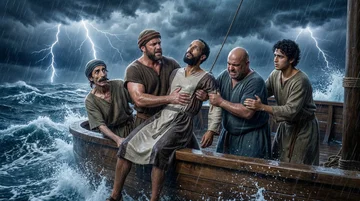
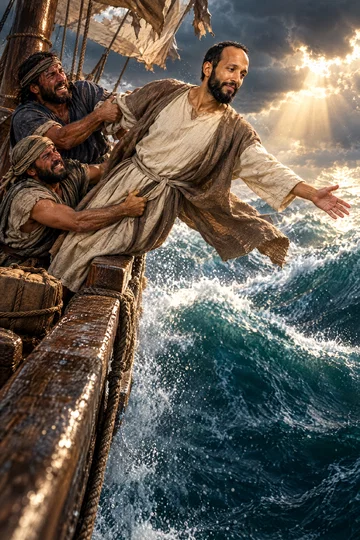
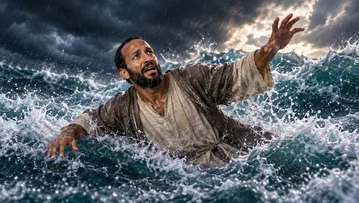
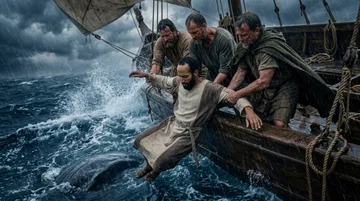
So they took up Jonah, and cast him forth into the sea: and the sea ceased from her raging.
Translations
So they look up Jonah, and cast him forth into the sea: and the sea ceased from her raging.
King James Version, KJV Cambridge Paragraph Bible, Revised Version
So they took up Jonah, and cast him forth into the sea: and the sea ceased from her raging.
So they took Jonah, and cast him into the sea: and the sea ceased from her raging.
So they took up Jonah, and cast him forth into the sea; and the sea ceased from its raging.
And they lift up Jonah, and cast him into the sea, and the sea ceaseth from its raging;
And they took up Jonah, and cast him forth into the sea: and the sea ceased from its raging.
So they took up Jonah and hurled him into the sea,—and the sea, left off, her roaring.
At this, they picked up Jonah and cast him into the sea, and the raging sea grew calm.
Then they picked up Jonah and cast him into the sea, and the raging sea grew calm.
So they took up Jonah and threw him into the sea; and the sea ceased its raging.
So they took Jonah up and put him into the sea: and the sea was no longer angry.
So they tooke vp Ionah, and cast him into the sea, and the sea ceased from her raging.
Douay-Rheims (Challoner revision)
And they took Jonas, and cast him into the sea, and the sea ceased from raging.
Pictures




Cross-references
- Jonah 2:1-2
Then Jonah prayed unto the LORD his God out of the fish’s belly,
Jonah prays from the fish’s belly after being cast into the sea.
- Jonah 2:10
And the LORD spake unto the fish, and it vomited out Jonah upon the dry land.
The Lord commands the fish to release Jonah safely onto dry land.
- Jonah 1:3
But Jonah rose up to flee unto Tarshish from the presence of the LORD, and went down to Joppa; and he found a ship going to Tarshish: so he paid the fare thereof, and went down into it, to go with them unto Tarshish from the presence of the LORD.
Jonah’s flight from his mission led to the storm at sea.
- Jonah 1:4-5
But the LORD sent out a great wind into the sea, and there was a mighty tempest in the sea, so that the ship was like to be broken.
The storm began before Jonah was cast overboard and ceased afterward.
- Jonah 3:1-3
And the word of the LORD came unto Jonah the second time, saying,
After being cast into the sea, Jonah receives God’s commission again and obeys.
- Jonah 1:9
And he said unto them, I am an Hebrew; and I fear the LORD, the God of heaven, which hath made the sea and the dry land.
Jonah testifies before being cast into the sea.
- Jonah 2:6-7
I went down to the bottoms of the mountains; the earth with her bars was about me for ever: yet hast thou brought up my life from corruption, O LORD my God.
Jonah is preserved in the depths, and his prayer is heard.
- Psalms 107:29
He maketh the storm a calm, so that the waves thereof are still.
Both describe the sea becoming calm after a storm.
- Matthew 12:40
For as Jonas was three days and three nights in the whale’s belly; so shall the Son of man be three days and three nights in the heart of the earth.
Both texts refer to Jonah’s time in the great fish.
- Exodus 14:21-22
And Moses stretched out his hand over the sea; and the LORD caused the sea to go back by a strong east wind all that night, and made the sea dry land, and the waters were divided.
God divides the sea and makes its waters stand in walls.
- Luke 11:32
The men of Nineve shall rise up in the judgment with this generation, and shall condemn it: for they repented at the preaching of Jonas; and, behold, a greater than Jonas is here.
Nineveh repented at Jonah’s preaching.
- Jonah 1:2
Arise, go to Nineveh, that great city, and cry against it; for their wickedness is come up before me.
commission whose disobedience led to affliction
- Matthew 8:26
And he saith unto them, Why are ye fearful, O ye of little faith? Then he arose, and rebuked the winds and the sea; and there was a great calm.
Both accounts describe the sea becoming calm after a storm.
Commentary
Each commentary is drawn from primary sources: the writings of Ellen G. White and Adventist pioneers and periodicals. Each commentary is separate. Its own words are not a quotation; follow the references to read the source passages.
Ellen G. White
3 sources
This text belongs to the record of Jonah's experience in Jonah 1-2, in which God in providence used severe affliction to teach the disobedient Jonah the lesson of obedience that enabled him to fulfill God's purpose for the inhabitants of Nineveh, a record worthy of most careful study.RH Oct 18, 1906 The sailors took up Jonah and cast him forth into the sea, and the sea immediately ceased from its raging.RH Dec 4, 1913PK 267.3–268.4 That the storm stopped at once upon his being cast in demonstrates that the tempest was under God's control.RH Dec 4, 1913
The sudden calming of the sea confirmed that Jonah's act had brought the danger upon the sailors.PK 267.3–268.4 Afterward the sailors feared the Lord, offered a sacrifice, and made vows.PK 267.3–268.4
Sources
Pioneers and periodicals
32 sources
On a voyage from Joppa toward Tarshish when God sent a great tempest, the sailors learned by lot that Jonah was at fault and at his own direction very reluctantly cast him into the raging sea after striving to row through and praying not to be held guilty for his life.ST Sep 9, 1913ST Mar 25, 1913ST Feb 4, 1903ST Feb 2, 1915ST Sep 3, 1896 The moment he entered the water the wind and waves at once became calm, showing the storm was under God's control and that the sea has a Master.RH Dec 4, 1913ST Oct 29, 1885ST Mar 25, 1913 God had prepared a great fish beforehand and kept it at hand to swallow him, where he was preserved three days until in contrition he cried in faith for mercy and after repentance was brought safely to land.ST Dec 10, 1894RH Jan 10, 1871ST Sep 17, 1896 The casting did not destroy the rebellious prophet but disciplined him in mercy, teaching that no one can escape trouble by running from duty and that God hears the humble cry from any depth.ST Sep 9, 1913ST Mar 25, 1913ST Dec 10, 1894RH Dec 3, 1867RH Jan 27, 1874 The stilling of the sea also turned the sailors to fear the Lord with sacrifice and vows, and enabled Jonah through obedience learned in affliction to carry God's warning of love to Nineveh.ST Sep 9, 1913ST Mar 8, 1883ST Oct 29, 1885ST Mar 25, 1913RH Mar 5, 1914
Sea Cast and Stillness
The casting took place on the Mediterranean voyage from Joppa toward Tarshish, when the Lord sent a great wind that raised a mighty tempest on the sea.RH Aug 29, 1871ST Feb 2, 1915 Such great winds and mighty tempests still arise off Joppa today, and with the Dead Sea showing divine anger and the Sea of Galilee still subject to sudden storms, the seas there witness to divine truth.RH Aug 29, 1871 The mariners learned Jonah was responsible by casting lots, after praying and facing a raging storm that threatened the lives of all on board.ST Sep 17, 1896ST Feb 2, 1915ST Sep 3, 1896 Casting lots was an ancient custom practiced among many nations, also used to select the goats for the sanctuary cleansing and to divide Christ's clothing.ST Sep 3, 1896
Jonah, son of Amittai, the prophet sent to Nineveh who had refused to obey, admitted in the storm that he was at fault and at his own direction told the sailors to throw him overboard.ST Sep 9, 1913ST Feb 4, 1903ST Dec 10, 1894 The heathen sailors dropped him very reluctantly from the vessel's rail into the boiling sea, shrinking from the act and striving first to row through.ST Mar 25, 1913RH Mar 5, 1914 Before casting him they had heard his ringing testimony to the true God who made heaven and earth and the sea, had bowed in prayer to the God of heaven asking not to perish nor be held guilty for taking life and breaking His divine law, and had shown concern to save the ship rather than malice toward him.ST Mar 25, 1913RH May 9, 1912ST Dec 10, 1894 Driven by self-preservation and mortal terror, they acted to save the ship while testifying by their prayer to the true God.ST Mar 25, 1913RH May 9, 1912
His willingness to accept the consequence of his flight and face what he believed was certain death revealed hidden greatness and a heart true to God, for whom God showed Himself strong, though in smaller trials like the withering gourd and loss of shade in the hot sun he had complained as a disagreeable servant.ST Sep 9, 1913ST Feb 4, 1903 The instant his body touched the sea the boiling sea became calm, the fierce winds died away, and the raging tempest immediately ceased.RH Dec 4, 1913ST Oct 29, 1885ST Mar 25, 1913 That sudden stilling was a miracle showing the sea has a Master, that the tempest was under God's control, that God rules the sea with power over the deep, and that He was dealing seriously with disobedience.RH Dec 4, 1913RH May 9, 1912RH Mar 5, 1914 The still waters then led the sailors to fear the Lord, offer a sacrifice, and make vows, with some perhaps saved through the experience.ST Oct 29, 1885RH Mar 5, 1914
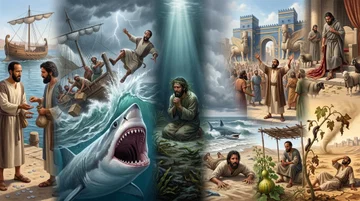
The casting ended Jonah's flight and marked the point where his severe trial and peril began, from which survival required divine intervention.ST Sep 17, 1896ST Dec 22, 1887 God had seen the rebellion from its first inception and had prepared the fish beforehand and kept it at hand in the tempest to catch him, so that it came just in time.ST Dec 10, 1894 Hardly had Jonah touched the sea when a mighty leviathan headed directly toward the ship, his horrified face was seen a moment above the wave and then disappeared within the monster's maw, while the seamen sailed on believing the wicked man had received death as punishment.ST Mar 25, 1913 The fish that could swallow him may have been a white shark found in the Mediterranean, sometimes thirty feet long, with mouth, gullet, and stomach large enough to swallow a man whole.ST Feb 2, 1915ST Apr 25, 1878 “Into” means entering the fish, not merely being near or riding on it, where Jonah was preserved three days until in deep contrition, horror, searching of heart, and prayer he cried in faith for mercy, help, and deliverance to a loving, long-suffering God whom no height or depth can shut out, and after repentance was safely brought to land by miraculous power beyond the ordinary course of nature.ST Mar 25, 1913ST Dec 10, 1894RH Jan 10, 1871ST Apr 25, 1878RH Feb 10, 1903
Mercy Warning and Meaning
Jonah, son of Amittai, meaning dove, was God's prophet sent with a hard mission to a strange people to warn Nineveh, the greatest city on earth at that time, before its threatened overthrow.ST Sep 9, 1913ST Mar 8, 1883ST Dec 15, 1909 He was the same Jonah who had predicted to Jeroboam II his victories over the Assyrians.ST Dec 15, 1909 After he refused and fled, God in providence used severe affliction in Jonah 1-2 to teach the disobedient prophet obedience that enabled God's purpose for Nineveh, a record worthy of most careful study.RH Oct 18, 1906 He was a disagreeable servant who complained over small trials like the withering gourd and loss of shade in the hot sun, yet stood firm in the great test of life, and his book displays God's wonderful mercy and what thorough repentance ought to be.ST Sep 9, 1913
Running away from duty cannot escape trouble, for Jonah made the experiment of fleeing the post assigned by providence and ended taken up and cast into the sea, where all his imitators will in the end find themselves.RH Dec 3, 1867 Choosing his own way brought the consequence of being cast into the raging sea, but after he turned to God's way he went to Nineveh on a mission of love.RH Jan 27, 1874 The difficulties and trials belonging to a God-given post must therefore be manfully met and overcome rather than fled.RH Dec 3, 1867
His frank confession that he was to blame and his direction to cast him overboard revealed hidden greatness and a heart true to God, for whom God showed Himself strong.ST Dec 11, 1901ST Feb 4, 1903 He had been called to a great foreign mission because his character held elements the Spirit could mightily use, yet he had fled to Tarshish from pride, irritability, displeasure with the mission, and desire for glory.ST Dec 11, 1901 In the storm his pride and irritation vanished in greatness of soul, and that self-offering, facing what he believed was certain death when the ship was endangered because of him, so impressed the ignorant heathen sailors that they strove harder to save him and were led to pray to the great Jehovah.ST Dec 11, 1901ST Feb 4, 1903 The best of a man is not always seen on the surface, and God will give victory over pride, irritation, and even the hiding effects of ill health like dyspepsia, catarrh, and indigestion to whoever cooperates with divine power.ST Dec 11, 1901
God in mercy preserved the rebellious prophet rather than seeking his destruction, making the casting a lesson of mercy for Jonah and for all mankind.ST Dec 10, 1894 God had seen the rebellion from its first inception and had prepared the fish beforehand and kept it at hand in the tempest to catch him.ST Dec 10, 1894 His humble cry of faith and earnest prayer for mercy from three days of horror, prayer, searching of heart, and deep contrition in the belly was heard by a loving and long-suffering God whom no height or depth can shut out.ST Mar 25, 1913 This teaches that God seeks the salvation of men, not their destruction, and displays His wonderful mercy and what thorough repentance ought to be.ST Sep 9, 1913ST Dec 10, 1894
The Lord turned the rebellion into teaching for the sailors, who then feared the Lord, offered a sacrifice, and made vows.ST Oct 29, 1885 The still waters led them to make vows, and some of them may have been saved through this experience.RH Mar 5, 1914 At first they sailed on believing the wicked man had received death as punishment.ST Mar 25, 1913
The descent into the deep waters is a descent into sheol, the place or state of the dead beneath the earth.RH Mar 28, 1865 The sea becoming calm pictures God's displeasure becoming calm toward people when they come to Him for Jesus' sake, His beloved Son.RH Oct 29, 1861 Calming the raging sea and keeping Jonah alive in the fish both show God's miraculous power beyond the ordinary course of nature, essential to salvation, demonstrating His power over the deep and teaching the seriousness of disobeying His word.RH Feb 10, 1903RH May 9, 1912 The heathen sailors casting Jonah into the sea contrasts with Nineveh facing being cast into ruin under judgment unless it repented, and Nineveh was moved not chiefly by his escape from the deep but by the warning preached and its own need of deliverance.RH Oct 26, 1911
Removing the source of division can restore peace and allow a mission to reach its destination. When the Jonas is cast out all goes well, for the Jonas is self and self-righteousness, thinking of self all the time and parading one's own goodness while reproving others, and when that self-display is thrown overboard trouble with others ceases and love for them because Christ loves them takes its place, opening a way to speak for the Master without offense.RH Mar 30, 1876 Being cast overboard pictures prisoners and societal outcasts, cast out from society and left despairing and helpless with no pitying glance, yet still under God's care and interest, calling believers as instruments in His hands to rescue them with the gospel.ST Mar 18, 1903 The casting happened as an example written for admonition, containing lessons for those living very near the end of this world in its present condition.ST Mar 23, 1904 It is also a pattern of a faithful servant plunged into punishment for refusing rich living, silk clothing, and flattery of sensual men.RH Jan 10, 1871
The account is disputed, being invoked as part of the historical record that critics reject when they abandon literal truth and dismiss it as legend.ST Oct 15, 1912 By others it is described as allegory rather than accepted as history.ST Jan 30, 1901
Sources