Joshua 6:16
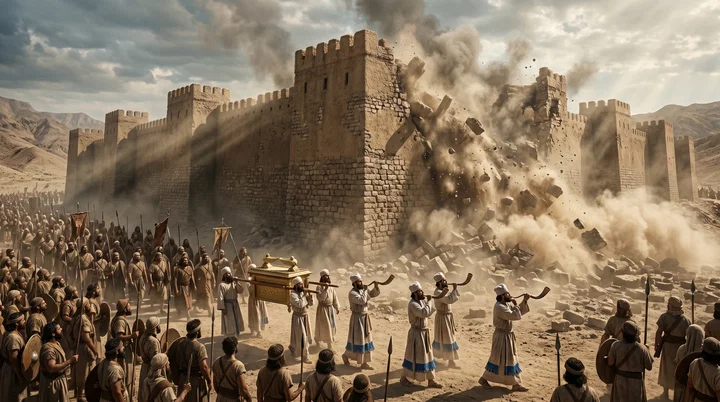
And it came to pass at the seventh time, when the priests blew with the trumpets, Joshua said unto the people, Shout; for the LORD hath given you the city.
Translations
And it came to pass at the seventh time, when the priests blew with the trumpets, Joshua said to the people, Shout; for the LORD has given you the city.
King James Version, Revised Version
And it came to pass at the seventh time, when the priests blew with the trumpets, Joshua said unto the people, Shout; for the LORD hath given you the city.
And it came to pass at the seventh time, when the priests blew with the trumpets, Joshua said unto the people, Shout; for the Lord hath given you the city.
And it came to pass at the seventh time, when the priests blew with the trumpets, Joshua said to the people, Shout; for the LORD hath given you the city.
And it came to pass at the seventh time, when the priests blew the trumpets, Joshua said unto the people, Shout; for Jehovah hath given you the city.
and it cometh to pass, at the seventh time, the priests have blown with the trumpets, and Joshua saith unto the people, 'Shout ye, for Jehovah hath given to you the city;
And it came to pass the seventh time, when the priests blew with the trumpets, that Joshua said to the people, Shout; for Jehovah has given you the city.
And it came to pass, at the seventh time—when the priests blew with the horns, then did Joshua say unto the people—Shout, for Yahweh hath delivered unto you the city.
Berean Standard Bible, Majority Standard Bible
After the seventh time around, the priests blew the horns, and Joshua commanded the people, “ Shout! For the LORD has given you the city!
At the seventh time, when the priests blew the trumpets, Joshua said to the people, “ Shout, for the LORD has given you the city!
And the seventh time, at the sound of the priests' horns, Joshua said to the people, Now give a loud cry; for the Lord has given you the town.
And when the Priests had blowen ye trumpets the seuenth time, Ioshua said vnto ye people, Shoute: for the Lord hath giuen you the citie.
Douay-Rheims (Challoner revision)
And when in the seventh going about the priests sounded with the trumpets, Josue said to all Israel: Shout: for the Lord hath delivered the city to you:
Pictures
Cross-references
- Hebrews 11:30
By faith the walls of Jericho fell down, after they were compassed about seven days.
Israel’s faithful obedience preceded Jericho’s fall.
- Joshua 6:20
So the people shouted when the priests blew with the trumpets: and it came to pass, when the people heard the sound of the trumpet, and the people shouted with a great shout, that the wall fell down flat, so that the people went up into the city, every man straight before him, and they took the city.
The people shout, and Jericho’s walls fall as Israel takes the city.
- Joshua 5:14-15
And he said, Nay; but as captain of the host of the LORD am I now come. And Joshua fell on his face to the earth, and did worship, and said unto him, What saith my lord unto his servant?
The Lord’s captain appears to Joshua before Jericho falls.
- Joshua 6:2
And the LORD said unto Joshua, See, I have given into thine hand Jericho, and the king thereof, and the mighty men of valour.
Joshua proclaims as fulfilled God’s promise to give Israel Jericho.
- 1 Kings 16:34
In his days did Hiel the Beth-elite build Jericho: he laid the foundation thereof in Abiram his firstborn, and set up the gates thereof in his youngest son Segub, according to the word of the LORD, which he spake by Joshua the son of Nun.
Records the fulfillment of Joshua’s curse when Jericho was rebuilt.
- Joshua 6:1
Now Jericho was straitly shut up because of the children of Israel: none went out, and none came in.
Jericho is shut up, yet its fall is assured.
- Judges 7:19-22
So Gideon, and the hundred men that were with him, came unto the outside of the camp in the beginning of the middle watch; and they had but newly set the watch: and they blew the trumpets, and brake the pitchers that were in their hands.
Both show God using feeble means to win a victory.
- Joshua 2:1
And Joshua the son of Nun sent out of Shittim two men to spy secretly, saying, Go view the land, even Jericho. And they went, and came into an harlot’s house, named Rahab, and lodged there.
The spies report on Jericho before its capture.
- Leviticus 27:21
But the field, when it goeth out in the jubile, shall be holy unto the LORD, as a field devoted; the possession thereof shall be the priest’s.
Helps explain Jericho’s status as wholly devoted to God.
- Joshua 6:10
And Joshua had commanded the people, saying, Ye shall not shout, nor make any noise with your voice, neither shall any word proceed out of your mouth, until the day I bid you shout; then shall ye shout.
The people keep silent until Joshua commands them to shout.
- Leviticus 27:28-29
Notwithstanding no devoted thing, that a man shall devote unto the LORD of all that he hath, both of man and beast, and of the field of his possession, shall be sold or redeemed: every devoted thing is most holy unto the LORD.
Cited to explain the meaning of Jericho being devoted.
- Joshua 6:26
And Joshua adjured them at that time, saying, Cursed be the man before the LORD, that riseth up and buildeth this city Jericho: he shall lay the foundation thereof in his firstborn, and in his youngest son shall he set up the gates of it.
A curse was pronounced after Jericho’s capture.
- Joshua 2:9-11
And she said unto the men, I know that the LORD hath given you the land, and that your terror is fallen upon us, and that all the inhabitants of the land faint because of you.
Rahab reports that Jericho had heard of God’s works and knew he had given them the land.
- Joshua 2:23-24
So the two men returned, and descended from the mountain, and passed over, and came to Joshua the son of Nun, and told him all things that befell them:
The spies report on Jericho before its capture.
- 1 Kings 18:43-44
And said to his servant, Go up now, look toward the sea. And he went up, and looked, and said, There is nothing. And he said, Go again seven times.
Both events follow a sevenfold waiting before a decisive sign.
- Judges 7:16
And he divided the three hundred men into three companies, and he put a trumpet in every man’s hand, with empty pitchers, and lamps within the pitchers.
Both describe victory through trumpets and few people.
- Joshua 3:16
That the waters which came down from above stood and rose up upon an heap very far from the city Adam, that is beside Zaretan: and those that came down toward the sea of the plain, even the salt sea, failed, and were cut off: and the people passed over right against Jericho.
The Jordan stopped before Jericho fell.
- Joshua 7:1-5
But the children of Israel committed a trespass in the accursed thing: for Achan, the son of Carmi, the son of Zabdi, the son of Zerah, of the tribe of Judah, took of the accursed thing: and the anger of the LORD was kindled against the children of Israel.
Achan’s sin brought defeat to Israel.
- Judges 7:2-7
And the LORD said unto Gideon, The people that are with thee are too many for me to give the Midianites into their hands, lest Israel vaunt themselves against me, saying, Mine own hand hath saved me.
Both victories show God’s power through a small force.
Commentary
Each commentary is drawn from primary sources: the writings of Ellen G. White and Adventist pioneers and periodicals. Each commentary is separate. Its own words are not a quotation; follow the references to read the source passages.
Ellen G. White
25 sources
On the seventh day, after one silent circuit each day for six days, Israel circled Jericho seven times in perfect order behind the priests and the ark, and at the seventh circuit the priests sounded a long blast and Joshua commanded the whole people to shout together because the Lord had given them the city as the signal for its divinely appointed fall.ST Oct 19, 18881SP 349.24T 161.1ST Apr 14, 1881 At that shout and blast the massive stone walls with their towers and battlements tottered and crashed into ruin, leaving the defenders paralyzed with terror so Israel marched straight in and took possession.4T 161.1ST Apr 14, 1881PP 488.3–491.1 The overthrow was God's work and not Israel's conquest by its own strength, for Christ as Captain of the Lord's host with His angels cast down the walls and delivered the city into their hands while no human hand touched them.ST Oct 19, 1888ST Oct 19, 1888PP 488.3–491.1Ms 143, 1899, par. 22–23 God took the city by deliberately simple means through humble, obedient instruments who marched not to fight with skill but to believe and obey, so that no person would be exalted and the glory would belong to God alone.ST Apr 14, 1881ST Jul 21, 1881Ms 143, 1899, par. 22–23Lt 58, 1895, par. 22–25Lt 63, 1895, par. 34–38 The victory was vouchsafed to a people walking in obedience and faith to the law in the ark, to demonstrate God's power, rebuke unbelief, and call them to trust His gift of the city rather than military strength.ST Oct 19, 1888ST Oct 19, 1888SG4 64.1–21SP 402.3–403.1
The Shout at Jericho
The verse belongs to the overthrow of Jericho, undertaken by Israel marching out from Gilgal, its first encampment in the promised land.ST Jul 27, 1882PP 613.3–614.2
For six days Israel made one silent circuit of Jericho each day in solemn, ordered march.1SP 349.2ST Apr 14, 1881
Then on the seventh day the host rose early about dawning to circle seven times in perfect order and dead silence, with chosen armed men first, then seven priests with trumpets, then the ark borne by priests, then the whole army tribe by tribe under its standards with Joshua at its head.1SP 349.2ST Apr 14, 1881
There was no sound but marching feet and trumpets echoing against the shut and guarded city under its frowning stone walls.1SP 349.2ST Apr 14, 1881
At the seventh circuit the priests made a longer and mighty blast than usual, and Joshua commanded all the people to shout together with a loud united voice because the Lord had given them the city.ST Oct 19, 18881SP 349.24T 161.1ST Oct 19, 1888PP 488.3–491.1
That shout and trumpet blast marked the divinely appointed moment for Jericho to fall despite its massive walls and defenses, and was the signal of certain victory by God's gift.1SP 349.24T 161.1ST Oct 19, 1888PP 488.3–491.1SG4 64.1–2
The order to shout rested on an advance divine gift of Jericho as the first step in conquering Canaan, for after Joshua withdrew to meditate and pray for God to go before Israel, Christ stood before him as the armed Captain of the Lord's host, assured him that Jericho with its king and mighty men of valor was already given into his hand, and instructed him how to take it.PP 487.3
The shout was followed at once by the tottering and crashing fall of the solid stone walls with their towers and battlements into ruin.4T 161.1ST Apr 14, 1881PP 488.3–491.1SG4 63.1
Its inhabitants and men of war were left paralyzed with terror and offered no resistance, so Israel marched in and took possession of the city given to them by the Lord.ST Apr 14, 1881PP 488.3–491.1SG4 63.1
Victory Belongs to God
The shout commanded at the seventh circuit marked a victory that was God's work and not Israel's conquest by its own strength, for Christ as Captain of the Lord's host with His angels brought down the walls and opened the way for the people to enter and take possession.ST Oct 19, 1888ST Oct 19, 1888PP 488.3–491.1SG4 64.1–2 Four heavenly angels always accompanied the ark to guard it from danger and to fulfill every mission connected with it, and Christ followed by angels attended its circuit around Jericho until He cast down the massive walls and delivered the city into Israel's hands.1SP 399.2 No human general devised the plan for taking the city, and no human hand touched the massive walls, for the Captain of the Lord's host gave His orders to the heavenly army and down came the walls.Lt 8a, 1896, par. 8–9
The Lord Himself directed the battle by joining heavenly and human agencies, while keeping the management of His work in His own hands, instructing His servants, planning in His own way how the work shall be done, and working through whom He will.Ms 143, 1899, par. 22–23Lt 58, 1895, par. 22–25Lt 63, 1895, par. 34–38 The mighty General of armies planned the taking of Jericho in such simplicity that no human hand took down the walls, against human desire for too much power and control and for the highest place.Ms 143, 1899, par. 22–23Ms 32, 1897, par. 7–10Lt 51, 1895, par. 8–13 God's work depends on Him even while He uses human agents, and victory came through God's power as His people followed His directions.Ms 32, 1897, par. 7–10Lt 63, 1895, par. 34–38
God took Jericho by deliberately simple means through humble, obedient instruments, for the armed men were placed there not to use skill in warfare but to believe and obey.ST Apr 14, 1881ST Jul 21, 1881Ms 40a, 1890, par. 65–67 Success depends on God working with human effort, and humble trust and obedience with faith are safer and essential in spiritual warfare than human wisdom, skill, might, or power.ST Jul 21, 1881PP 553.2–554.13MR 21.1–22.3 God made even the simple act of blowing trumpets effective in overthrowing the city, so that the victory depended not on the method's apparent strength but on God's power and on carrying out His direction with faith and humility, and He can accomplish a great work and fulfill His purpose through those who obey and trust Him.PP 553.2–554.13MR 21.1–22.3Ms 40a, 1890, par. 65–67
The simplicity of the plan ensured that no person was exalted and no human being could take glory to himself for the victory or claim credit for the work he accomplishes.Ms 143, 1899, par. 22–23Lt 51, 1895, par. 8–13Ms 40a, 1890, par. 65–67 The glory for the victory belongs to God alone, He received the glory because He brought down the walls when the people followed His directions, and He alone is to be magnified.Lt 58, 1895, par. 22–25Lt 63, 1895, par. 34–383MR 21.1–22.3 Jericho's overthrow illustrates that God can accomplish His purpose through humble instruments and simple means, not through human might or power, so the victory was God's work and not a reason for people to exalt themselves.3MR 21.1–22.3Ms 40a, 1890, par. 65–67
The command belongs to a time when Israel was walking in obedience and faith, with the ark borne by holy men in accordance with His express command and the Captain going before the repository of His law, whose arm brought deliverance for them. The divine presence and the blessings God alone can bestow were vouchsafed to an obedient and believing people, not merely the ark which was but a symbol of that presence. The victory did not come from the physical presence of the ark alone but from obedience to the law contained in the ark, which is representative of God Himself.1SP 402.3–403.1
The miracle demonstrated God's power to defeat enemies, strengthened Israel's faith in God's power, rebuked their earlier unbelief, and called them to trust God's promise to give the city rather than depend solely on military strength.ST Oct 19, 1888ST Oct 19, 1888SG4 64.1–24T 148.3 Their later fear about possessing Canaan repeated their earlier failure to trust the God who had already delivered and guided them.4T 148.3
The overthrow was an exhibition of God's power to be kept fresh in memory and repeated by the Israelites to their children, together with the deliverance from Egypt, the water from the rock, the bread from heaven, and the commandments of God.Lt 8a, 1896, par. 8–9 Israel later remembered that victory and its passage over Jordan while carrying the ark and drew hope and courage from it.SG4 105.1–21SP 402.3–403.1 Yet they wrongly concluded that having the ark with them was enough by itself to guarantee triumph, when apart from obedience to God's law and covenant the ark could bring no blessing, their strength came from obedience to the law the ark represented, and the law under the mercy seat condemns disobedience to defeat, disaster, and death.SG4 105.1–21SP 402.3–403.1
Sources
Pioneers and periodicals
76 sources
At the close of the seventh circuit on the seventh day, when the priests gave the long trumpet blast, Joshua commanded the people to shout because the Lord had already given them the city.ST Oct 19, 1888ST Oct 8, 1902RH Apr 21, 1851 The solid stone walls fell flat at once by God's own action through Christ and His angels, not by Israel's weapons, strength, or skill in warfare.ST Oct 19, 1888ST Mar 21, 1911ST Mar 20, 1901 The shout itself did not throw the walls down but was the shout of a faith that dared to claim a finished victory on God's word alone while no victory was yet seen.ST Nov 17, 1898 The victory came only as Israel cooperated by exact, united, persistent obedience to the end, doing what seemed foolish until the final blast on the seventh day.RH Feb 6, 1879RH May 29, 1913 Marching and shouting at God's direct command on those seven consecutive days was religious service in obedience to God, not the people's own work, and the honor God put on the ark bearing His law shows His law remains binding.RH Jan 21, 1862RH Jul 27, 1876RH Apr 11, 1854
Narrative Setting and Details
At the seventh time, when the priests blew with the trumpets on the seventh circuit, the command was given to shout because the Lord had given the city.ST Oct 19, 1888ST Oct 19, 1888ST Oct 8, 1902ST Mar 20, 1901ST Feb 13, 1912 The shout was ordered after the seventh trumpet blast on the seventh day, with the ark before the people, as the walls fell flat and gave Israel the city.RH Apr 21, 1851ST Feb 13, 1912 The announcement treated the city as already given, a gift expressing confidence in the promised victory before entrance and possession.ST Oct 8, 1902ST Mar 20, 1901
Israel circled Jericho once each day for six days and seven times on the seventh day, rising at dawn in the morning for a solemn ordered silent march.ST Oct 19, 1888ST Apr 14, 1881RH Sep 8, 1904 Chosen armed men went in front, seven priests with trumpets next, then the ark borne by priests, then the whole army by tribes, with no sound but marching feet and trumpets.ST Apr 14, 1881 The shout came at God's appointed signal as the culmination of that march, after the ram-horn trumpets sounded at the end of the seventh circuit on the seventh day.RH Sep 8, 1904RH Feb 24, 1910RH Aug 24, 1905ST May 27, 1908 The whole people could share in it, and the capture closed a remarkable siege forty years after the spies visited Rahab.RH Sep 8, 1904RH Aug 24, 1905
At the mighty trumpet blast and loud united shout the solid stone walls with towers and battlements tottered and crashed flat at once into ruin.ST Apr 14, 1881RH Apr 21, 1851RH Feb 24, 1910 The blast shook the earth, and the inhabitants and men of war were paralyzed with terror and offered no resistance.ST Apr 14, 1881 Israel then marched in and took possession, the city falling through God's power with unseen angels sent to bring the walls down.ST Apr 14, 1881RH Feb 24, 1910RH Jul 1, 1873 Even so mighty a display of divine power did not lead most onlookers to believe.RH Jul 1, 1873
The fall was the first victory in the conquest of the land after crossing the Jordan, undertaken by marching out from Gilgal, Israel's first encampment in the promised land.ST Jul 27, 1882ST Mar 21, 1911RH Aug 24, 1905 It began Israel's gradual possession of the promised land according to faith, as Christ the Captain of the Lord's host and His angels gave victory and possession.ST Jan 23, 1907 It belongs to the long deliverance from Egypt through the wilderness to Canaan, in which God defended Israel, stopped the Jordan, caused heathen rulers to flee, drove asunder the usurping nations, and brought His people into vine-clad hills and verdant vales with water-brooks and springs, milk and honey, and every privilege.RH Nov 21, 1854 The victory is part of Joshua's leadership in bringing the people into their homeland and keeping them faithful to God and His law.ST May 27, 1908
The work is marked by seven: seven persons bore seven trumpets for seven days, and on the seventh day they went around seven times, with the walls falling at the end of the seventh round.RH Sep 15, 1874 The seventh day thus brought seven circuits after the priests carried the trumpets and the people circled the city.
The account is actual history and not legend or fiction, belonging to Israel's conquest of Canaan under Joshua in the fifteenth century before Christ.RH Aug 4, 1910ST Apr 20, 1904RH Aug 31, 1905 The people called Habiri who in the Tel el-Amarna tablets are described as making inroads into the country are the Hebrews, and letters from Abdi-Hiba of Jerusalem and other Canaanite rulers imploring the Egyptian king to send troops lest the land be lost to the Habiri were written during that conquest and record the Canaanite side of the invasion that included the taking of Jericho.RH Aug 31, 1905 The unsettled and divided condition of the land among competing powers helps explain how Joshua's people could take it.RH Aug 4, 1910
Victory Comes from God
The walls of Jericho fell through the action of God and His invisible army, not through Israel's weapons, strength, skill in warfare, or fighting.ST Oct 19, 1888ST Mar 21, 1911ST Mar 20, 1901ST Oct 20, 1914 Christ the Captain of the Lord's host and His angels brought down the walls and opened the way for Israel to enter.ST Oct 19, 1888ST Oct 19, 1888ST Mar 21, 1911ST Oct 20, 1914 The capture was God's gift, and the victory depended on trusting Him, showing that He can preserve His people from war when they trust in Him.ST Mar 21, 1911ST Mar 20, 1901ST Oct 20, 1914 It was the first victory in the conquest of the land, and the city with its wealth was devoted to God as the first-fruits of Canaan.ST Mar 21, 1911ST Mar 20, 1901
At the seventh circuit, when the priests sounded the trumpets, Joshua told the people to shout because the Lord had given them the city.ST Oct 19, 1888ST Oct 19, 1888ST Oct 8, 1902ST Mar 20, 1901 The command announced the city as already given, expressing confidence in the promised victory before the people entered and took possession.ST Oct 8, 1902ST Mar 20, 1901RH Mar 21, 1912ST Nov 17, 1898RH Sep 14, 1911 The shout expressed faith in God's promise even though victory was not yet visible, and the conquest that followed was marked by faith, persistence, order, and earnestness.ST Oct 8, 1902RH Mar 21, 1912ST Nov 17, 1898
The trumpets, marching, and shout were feeble instrumentalities by which God accomplished a mighty result, and they did not themselves cause the walls to fall.ST May 6, 1875ST Oct 8, 1902RH Apr 15, 1875 The shout was a sign of faith in God's sure promise, and the secret of victory lay in daring to claim a promised victory on the authority of God's word alone while as yet there were no signs of victory.ST Oct 8, 1902 God's promise when met with implicit faith is as certain as an accomplished fact, so faith reckoned His declaration true and rested on it against all fear of failure and dishonor, and according to their faith He made the walls fall flat.ST Oct 8, 1902 Success is certain when labor is done in God even where the means look weak and the work requires immense severe toil and painful labor, such as putting the truth in print in many languages according to grammar and idiom.ST May 6, 1875RH Apr 15, 1875
The miracle strengthened Israel's faith in God's power and rebuked earlier unbelief.ST Oct 19, 1888ST Oct 19, 1888 Walled cities were no greater obstacle to Him than the Red Sea had been, and the miracles He had already performed should have given confidence in His power and mercy.ST Oct 19, 1888ST Oct 19, 1888ST May 13, 1889 The victory was a pledge that His power would give deliverance and victory throughout the way if Israel obeyed, wholly surrendered, kept sin from the camp, and trusted Him.ST Mar 10, 1909ST Jan 22, 1894ST Mar 10, 1909 Had Israel so surrendered, Jericho's victory would have extended throughout the land, bringing destruction of the nations whose iniquity was complete and ending Satan's kingdom.ST Jan 22, 1894
The ark of the covenant was before them and accompanied the procession around the city, representing God's presence and taking the leading part in the capture as going before His law.RH Apr 21, 1851RH Feb 24, 1910RH Aug 13, 1857RH Dec 11, 1866 When the people shouted as arranged the wall fell flat and gave Israel the city, but the power remained God's and victory came from Him, not from treating the ark as a safeguard.RH Apr 21, 1851RH Feb 24, 1910RH Aug 28, 1856 That earlier victory did not mean the ark itself could protect or bring blessing apart from obedience to God's law and covenant, as shown at Shiloh when the people wrongly trusted its presence while turning from God and were defeated.RH Aug 28, 1856
Faith Obedience and Shout
The shout was the shout of a faith that dared to claim a promised victory on God's word alone while as yet no signs of victory were seen.ST Nov 17, 1898 The force lies in the past tense, hath given, not will give: the city was already given as a finished gift, and the victory was to be celebrated in faith before the walls fell.RH Jan 28, 1902ST Oct 8, 1902 The shout itself did not cause the walls to fall, yet the secret of victory lay in it, for faith reckoned God's declaration true and rested on it against all fear of failure and dishonor, and according to that faith God made the walls fall flat.ST Oct 8, 1902 God's promise, when met with implicit faith, is as certain as an accomplished fact, and Christians must likewise meet temptation and Satan as an already conquered foe because Jesus has overcome him, daring to raise the shout of victory in sight of the foe until every wall falls flat and a straight pathway opens to take the city.RH Jan 28, 1902
Israel was commanded to march seven days around Jericho and to shout at the seventh time, and God asked them to do it without understanding at the time.ST Sep 12, 1895RH Sep 8, 1904ST Nov 17, 1898 Marching with ram's horns and shouting seemed foolish and offered no ordinary way to break down walls, yet Israel obeyed and obeying perfected faith, and then God acted so the walls fell down by faith through His power.ST Sep 12, 1895RH Sep 8, 1904 Because faith rather than military skill or weapons was the means of victory, the whole people including men, women, and children could take part, and humble trust and obedience proved safer than relying on human wisdom or skill.ST Jul 21, 1881RH Nov 22, 1906RH Sep 8, 1904
The walls fell through God's miraculous power, but only with Israel's cooperation in doing exactly what was commanded, for without doing their commanded part the walls would not have fallen.RH Feb 6, 1879RH May 29, 1913 Success came by working exactly in harmony with God's perfect plan, with the right word spoken at the right time in the right place and duty done when and where God directed, like marks showing where each timber belongs so that following joint by joint fits every part for the spiritual temple in character and labor for others.RH Feb 6, 1879RH Apr 8, 1902 The people still had to follow God's instructions with zeal, service, consecration, obedience and trust, carrying out the plan as commanded within seven days, which illustrates practical working faith expressed through action.RH May 29, 1913RH Apr 8, 1902RH Sep 21, 1916 They were drilled in unquestioning, implicit and prompt obedience to do just that one thing at that time, to do it all together and to do it with all their powers, and the city was theirs by God's gift yet they had to act in obedience and trust to take possession of it.RH Aug 12, 1902RH Sep 21, 1916
Victory required faith, persistence, order, earnestness, patience and unwearied application to the seventh day and seventh circuit, with preparation leading to the seventh trumpet blast when Joshua called the people to shout because the city was theirs.RH Mar 21, 1912ST Apr 28, 1914RH Oct 24, 1854 The wall remained intact until the final blast and shout on the seventh day, when as much was accomplished as in the whole previous six days, and if the people had become discouraged after the sixth day's march the victory would not have been recorded.ST Apr 28, 1914RH Oct 24, 1854 Israel rose as one to do God's will in united obedience, organized from least to greatest for finishing the conflict, so that the walls were no barrier and God led them to victory.RH Oct 8, 1908RH Oct 29, 1914 That united shout over the city the Lord had given is a pattern for the end, when a mighty movement embracing every believer from oldest to little children will speedily finish God's work in certain victory.RH Oct 29, 1914
Walking around the walls was easy when done with the Spirit of Christ, and having that same Spirit makes commanded work easy now. Jericho was given because Israel marched on the very days God told them to march, showing that victory comes by trusting God and moving forward promptly at His appointed time. Prompt obedience brings the cooperation of angels, who do what seemed hard easily and quickly for those who obey, while taking one's own time and delaying loses that heavenly help, so when God offers opportunity to do a work it must be done at that time.
Sabbath Law and Ark
The encompassing of the city ran through seven consecutive days, so one of those days must have been the Sabbath, and on the last day the circuit was made seven times even if that day was the Sabbath.RH Jan 21, 1862RH Feb 3, 1852RH Apr 11, 1854 There is no evidence and no reasonable inference that Jericho was taken on the Sabbath, and the Sabbath was not necessarily the day it was taken.RH Jan 21, 1862RH Oct 15, 1872RH Oct 29, 1872 The first day and the seventh day named are the first and seventh days of the compassing of the city, not days of the week, just as the first day and seventh day named for the feasts are days of the feast.RH Oct 15, 1872 Joshua the son of Nun, the successor of Moses, did not break the Sabbath day when at the seventh time he commanded the people to shout after the priests blew the trumpets because the Lord had given them the city.ST Nov 4, 1880
Marching around the city with the ark, blowing trumpets, and shouting at God's direct command was religious service and simply doing God's bidding, not the people's own or servile work.RH Jan 21, 1862RH Jul 27, 1876RH Apr 11, 1854 Doing God's bidding on the Sabbath is no violation of the Sabbath, since the Sabbath forbids our own work, not work God directs.RH Jan 21, 1862RH Jul 27, 1876 Marching around the city on the Sabbath with the ark was not a violation of the law that was in the ark.RH Apr 11, 1854 God's own act of working for Israel on that day by throwing down the walls was not contrary to His own precepts about that day.RH Jan 21, 1862RH Apr 11, 1854
The ark held the ten precepts spoken amid smoke, lightning, and thunder at Mount Sinai and engraved by God's finger on tables of stone, including the fourth commandment.RH Dec 20, 1853RH Aug 11, 1853RH Dec 10, 1861 It was a gold-covered ark set in the Most Holy of the earthly sanctuary as the center of Israel's religious system and the glory of Israel.RH Dec 20, 1853RH Aug 11, 1853 The greatest curses were pronounced for violation of that Sabbath command and the greatest blessings promised for its observance.RH Dec 20, 1853 The honor God put upon the ark in giving Israel victory at Jericho, with the ark present and followed in obedience when the walls fell at the seventh trumpet blast and shout, proves it preposterous and presumptuous to claim He abolished His Sabbath without one plain testimony and to risk eternal salvation on mere inferences, for those commandments remain binding until heaven and earth pass away.RH Dec 20, 1853RH Aug 11, 1853RH Dec 10, 1861
The divine presence was vouchsafed to an obedient and believing people, not to the mere material symbol, for the ark was borne by holy men in accordance with His express command and the Captain of the Lord's host went before the repository of His law and His arm brought deliverance. That earlier victory did not mean the ark itself could protect Israel or bring blessing apart from obedience to God's law and covenant, as shown when at Shiloh wicked men trusted its presence in battle while turning from God and following their own plans in opposition to divine counsel and authority, and were defeated.RH Aug 28, 1856RH Apr 20, 1876 God's cooperation is given only on moral and spiritual conditions, when the sacred principles of His holy law are a part of the very lives of His people, and if iniquity is regarded in the heart the Lord will not hear. The law under the mercy-seat condemns to defeat, disaster, and death those who oppose it while the blessings God alone can bestow come to obedience. The strength was not in the wooden chest itself but in the law of love kept inside it, so keeping that law brings triumph while opposing it leaves men in darkness.ST Jun 10, 1875 The procession with the ark containing the law and covered by the mercy seat showed both the judgment due to sin and God's mercy, and the ark had a leading part in the victory.ST Mar 20, 1901ST Feb 3, 1904
Devotion Judgment and Aftermath
Jericho and all its wealth were devoted to God as the first-fruits of Canaan and consecrated to Him.ST Mar 20, 1901ST Mar 20, 1901ST Oct 8, 1902 The shout at the seventh circuit, when the priests blew the trumpets, announced the city as already given by the Lord, and its capture was His gift rather than the result of Israel's weapons or strength.ST Mar 20, 1901ST Mar 20, 1901 The procession with the ark, containing the law and covered by the mercy seat, displayed both the judgment due to sin and mercy toward the people of the city.ST Mar 20, 1901ST Oct 8, 1902
The seven days of marching gave the city repeated opportunity to yield to God's mercy, and it might have been saved if it had opened to God's people.ST Mar 20, 1901ST Oct 8, 1902 Its closed gates showed refusal to yield and resistance to the opportunity to turn to Him, so the fall followed that refusal and was not an attempt to force the people into service.ST Mar 20, 1901ST Oct 8, 1902 Those who trusted Jehovah could be saved, as Rahab and her household were.ST Oct 8, 1902 At the final shout the opportunity had passed, and God's invisible host brought the walls down to utter destruction carried out through Joshua.ST Mar 20, 1901ST Oct 8, 1902
God met the crisis after Moses by raising up Joshua, who was permitted to lead Israel across Jordan to Canaan while Moses was permitted to lead only to its border, and the walls of Jericho fell before him, proving that in every crisis the Lord has a willing people to meet the issue.RH May 13, 1915 Israel's advance was next checked by Achan's covetousness and disobedience in taking what had been consecrated to God, though he had joined in the triumphant shout at Jericho.ST Feb 14, 1906RH Apr 3, 1913 Once he was punished and the camp was purged, victory followed and the conquest continued, so the Valley of Achor, meaning trouble, recalls both defeat and the decisive judgment that cleared the way for renewed victory, and trouble becomes a door of hope when evil is put away.ST Feb 14, 1906 As Achan brought defeat to the campaign, so those not truly converted can bring defeat in winning converts and in preparing for the heavenly Canaan.ST Feb 14, 1906RH Apr 3, 1913
Practical Applications for Believers
The shout at Jericho shows that victory comes by divine power rather than by fighting, for the heavenly host threw the walls down when the people marched and sounded trumpets as commanded.ST Oct 20, 1914RH Dec 18, 1900 Trust in that direction presents a course for believers facing war, alongside standing still to witness deliverance or taking up arms, with circling the city in obedience as standing by what God directs until He gives the place into their hands.RH Sep 23, 1862RH Sep 23, 1862 The same account proves that a small people can accomplish work far beyond their own strength when the appointed seventh time arrives and the signal is given to shout because the gift is already bestowed.ST Oct 20, 1914RH Dec 18, 1900
The march around the walls and their fall provide a pattern for persistent prayer for a region, continuing to plead and labor in trust that God will bless the effort.RH Aug 3, 1876 The same fall serves as a picture of bold, active labor breaking down religious opposition.RH Sep 5, 1871 The shout from the camp likewise stands as the image of the victory toward which believers are to press on.RH Feb 18, 1915
As the city fell, so deeply entrenched opposition can be brought down, and sins that appear firmly established can be overcome by grace.ST Feb 11, 1889 Meeting a wrong at once with wholehearted purpose and dependence on Christ brings complete victory, while compromise and repeated yielding bring defeat.ST Nov 29, 1910
The command discloses the secret of warfare as a long triumphal progress after entering rest by faith, meeting the first hindrance as Israel met mighty Jericho after entering the land of rest. The force lies in the past tense of the promise, already given rather than to be given, so faith dares to claim victory on the word alone while no signs appear, reckoning the declaration true against all fear of failure and dishonor. Christians are therefore to meet temptation and the adversary as an already conquered foe because Jesus has fought and overcome, and daring to raise the shout of victory in sight of the foe brings every wall down flat and opens a straight pathway to take the city. The shout itself does not cause the fall, yet the secret of victory lies in it, for according to such faith God acts.
The feeble instrumentalities at the siege prove that success is certain when labor is done in God even where the means look weak and the work demands immense severe toil and painful labor, such as putting truth into print in many languages according to grammar and idiom.ST May 6, 1875 The command to compass the city seven times drills in unquestioning, implicit and prompt obedience, doing just that one thing at that time, all together and with all powers, fitting a people for the Lord's coming, and canvassing for Christ's Object Lessons serves as the present means of giving that same training.RH Aug 12, 1902 The approaching walls represent an advance in the work to be joined, and selling books is made easy with Christ's Spirit. The triumph came when all the people were taken and organized from least to greatest for finishing the conflict, patterning a mighty missionary movement embracing every believer from oldest pioneer to little children giving out paper or tract, which will speedily finish the work in certain victory as the Lord is about to appear.RH Oct 29, 1914 Children themselves face real battles and must fight the battle of faith.RH Nov 17, 1910 Taking walled places means winning converts, and marching around the wall of debt courageously until God moves hearts to liberal giving levels it never to rise again, by a strong pull with all pulling together, every one doing what he can, with no talk of discouragement and doubt, nothing about wrong management, and no criticism, since giving quickens conscience in the cause of right and secures a possession in the kingdom when everything earthly falls, while money sacrificed for noise, pleasure-seeking and wild speculation brings only sin, folly, sorrow of heart and remorse.RH Jul 2, 1901
The fall, together with the Jordan, Hai, and Jerusalem, also pictures a campaign to make America dominantly Catholic.RH Nov 2, 1911 In that picture America is the promised land and land of Canaan after the end of the desert, the new Joshuas are successors and missionaries going to take it, their little chapels are fortified camps, and the men sent out are advance-guards pointing the way to fertile fields, gathering souls as sweet grapes.RH Nov 2, 1911
Sources