Translations
American King James Version, King James Version, KJV Cambridge Paragraph Bible, Webster Bible, Revised Version, American Standard Version
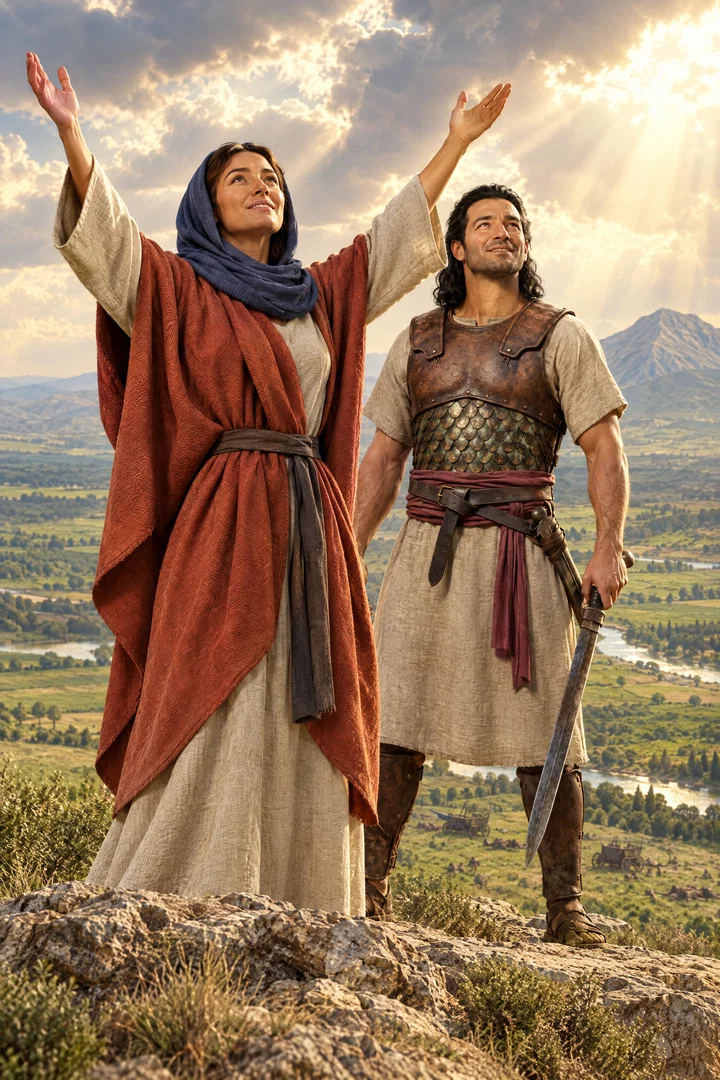
Then sang Deborah and Barak the son of Abinoam on that day, saying,
And Deborah singeth — also Barak son of Abinoam — on that day, saying: —
Then sang Deborah and Barak, the son of Abinoam, on that day, saying,
Then sang Deborah, and Barak, son of Abinoam,—on that day, saying:—
Berean Standard Bible, Majority Standard Bible
On that day Deborah and Barak son of Abinoam sang this song:
Then Deborah and Barak the son of Abinoam sang on that day, saying,
At that time Deborah and Barak, the son of Abinoam, made this song, saying:
Then sang Deborah, and Barak the sonne of Abinoam the same day, saying,
Douay-Rheims (Challoner revision)
In that day Debbora and Barac son of Abinoem sung, and said:
Pictures
Cross-references
- Judges 4:4-10
And Deborah, a prophetess, the wife of Lapidoth, she judged Israel at that time.
Deborah and Barak’s deliverance from Sisera is celebrated in song.
- Exodus 15:1
Then sang Moses and the children of Israel this song unto the LORD, and spake, saying, I will sing unto the LORD, for he hath triumphed gloriously: the horse and his rider hath he thrown into the sea.
Both are songs celebrating victory over an enemy.
- Judges 4:14-16
And Deborah said unto Barak, Up; for this is the day in which the LORD hath delivered Sisera into thine hand: is not the LORD gone out before thee? So Barak went down from mount Tabor, and ten thousand men after him.
The song celebrates the battle and Israel’s victory.
- Judges 5:15
And the princes of Issachar were with Deborah; even Issachar, and also Barak: he was sent on foot into the valley. For the divisions of Reuben there were great thoughts of heart.
It names Issachar among those who joined Deborah in the victory song.
- Judges 5:23
Curse ye Meroz, said the angel of the LORD, curse ye bitterly the inhabitants thereof; because they came not to the help of the LORD, to the help of the LORD against the mighty.
The song curses Meroz for failing to help Israel.
- Exodus 15:20-21
And Miriam the prophetess, the sister of Aaron, took a timbrel in her hand; and all the women went out after her with timbrels and with dances.
Miriam and the women sing to God, celebrating his deliverance.
- Judges 4:3
And the children of Israel cried unto the LORD: for he had nine hundred chariots of iron; and twenty years he mightily oppressed the children of Israel.
It describes the oppression that preceded the song.
- Judges 4:21
Then Jael Heber’s wife took a nail of the tent, and took an hammer in her hand, and went softly unto him, and smote the nail into his temples, and fastened it into the ground: for he was fast asleep and weary. So he died.
Jael kills Sisera with a tent peg.
- Judges 5:7
The inhabitants of the villages ceased, they ceased in Israel, until that I Deborah arose, that I arose a mother in Israel.
Deborah is described as a mother in Israel.
- Judges 5:20-21
They fought from heaven; the stars in their courses fought against Sisera.
The poem describes God’s intervention and the Kishon sweeping away Sisera’s army.
Commentary
Each commentary is drawn from primary sources: the writings of Ellen G. White and Adventist pioneers and periodicals. Each commentary is separate. Its own words are not a quotation; follow the references to read the source passages.
Ellen G. White
Then sang Deborah and Barak the son of Abinoam on that day introduces the sublime and impassioned song celebrating Israel's triumph over Sisera and the Canaanites, a powerful and deeply emotional song of victory. The song gives all the glory for the deliverance to God and calls the people to praise Him for His wonderful works. It calls the kings and princes of the surrounding nations to hear what God did for Israel as a warning not to harm them. It declares that honor and power belong to God and not to men or to their idols.
It recalls God's awesome power and majesty as shown at Sinai. It sets out Israel's helpless and distressed condition under oppression. It tells in vivid and glowing language the history of their deliverance. Following this deliverance the Canaanites were thoroughly and effectually subdued and the land had peace for forty years. Even so, the resulting prosperity did not bring Israel nearer to God.
Pioneers and periodicals
24 sources
Then sang Deborah and Barak the son of Abinoam together on the day of Israel's victory and deliverance from Sisera's army and the Canaanites under Jabin.ST Apr 1, 1913ST May 27, 1913ST May 9, 1916 The song gives all glory for the deliverance to God and calls the people to praise Him for His wonderful works, declaring that honor and power belong to God and not to men or idols.RH Nov 7, 1912RH Apr 1, 1902 It opens a magnificent ode and triumph poem, the earliest poetry of Israel, whose musical language, forceful movement, imagery and lofty melody show the power, beauty and literary value of the Bible.RH Dec 7, 1916ST Feb 10, 1881 Their joint public singing shows that women like men could sing, speak and bear testimony for God in public worship under the Spirit's influence to His glory without usurping authority, so women may help in His work and proclaim His truth in womanly Christian ways.RH Aug 8, 1871ST Dec 8, 1914ST Feb 27, 1901ST Mar 5, 1896 The triumph shows how mightily God can work for His people when they act in faith, urging them to trust Him, pray and act courageously, and the battle in the days of Deborah and Barak stands as an object lesson for the final gathering of the nations at Armageddon.ST May 27, 1913RH Mar 19, 1901ST Mar 24, 1909RH Nov 7, 1912
Setting and Deliverance
Then sang Deborah and Barak the son of Abinoam on that day, introducing the song they sang together on the day of Israel's victory and deliverance from Sisera's army and from the Canaanites under Jabin.ST Apr 1, 1913ST May 27, 1913ST May 9, 1916RH Nov 7, 1912RH Apr 1, 1902 It celebrates the defeat of the Canaanite oppressor and Israel's triumph over Jabin's forces after suffering under renewed heathen influence and distress.RH Nov 7, 1912RH Apr 1, 1902ST The song recounts the differing responses of the tribes to the call for help, calling them to join the battle, praising those who came to help, and condemning Meroz for refusing to help and bringing a curse upon itself for that refusal.RH Nov 7, 1912RH Apr 1, 1902 Deborah directs the way while Barak leads the fighters, the victory comes through God's aid, the people are urged to trust Him, pray, and act courageously, and the triumph shows how mightily God can work for His people.ST Mar 24, 1909RH Nov 7, 1912RH Apr 1, 1902
The verse belongs to the book's record of Israel's experiences between Joshua's death and the raising up of Samuel.STST Apr 1, 1913 It stands in the composite record of Judges 3 to 17 of backsliding from God, consequent suffering, oppression, captivity and servitude, then returning to God, forgiveness and deliverance.ST That history displays the perversity and unbelief of the people and the long-suffering and goodness of God amid awful moral surroundings and the demoralizing influences of the tribes permitted to remain in the land of promise.ST
The victory was won at Megiddo against the enemies of God's people, one of the great battles in Israel's history, after twenty years of oppression.RH Mar 19, 1901RH Feb 2, 1905ST Their deliverance shows that Israel could overcome the iron chariots when they acted in faith.ST May 27, 1913 That victory first gave the Israelites possession of the Plain of Jezreel, though Canaanites retained several towns there until the time of the kings, after which the Canaanites were effectually subdued and the land had peace forty years, though prosperity did not bring Israel nearer to God.ST May 9, 1916 The battle at Megiddo in the days of Deborah and Barak serves as an object lesson for the final gathering of nations at Armageddon under the sixth plague and for study in connection with the sixth and seventh plagues.RH Mar 19, 1901
Song as Literature and Worship
Then sang Deborah and Barak opens a magnificent ode and triumph poem celebrating the victory over Sisera's army.RH Dec 7, 1916 It is the earliest poetry of Israel, rising among the Galilean hills when Barak of Naphtali had triumphed over the Canaanites.ST Feb 10, 1881 Its musical language, forceful movement, and imagery display the power and beauty of the Bible.RH Dec 7, 1916 Its lofty music with wonderful rhythm and melody gives beautiful thoughts in language that plays on sensitive human hearts as skilled fingers play upon a harp.RH Feb 10, 1916 Together with the psalms and the ode of Moses and Miriam it shows the Bible is first in literary value among all books, and its vigor proves the intellectual vigor and mental freshness and force of the Galilean people.ST Feb 10, 1881RH Feb 10, 1916
In both its words and its music the song was composed to memorialize a great event in Israel's national life.RH Apr 22, 1915 Ancient Israel's music was not copied or borrowed from the surrounding nations but was an original expression of the individual and national life of God's chosen people.RH Apr 22, 1915 The singing of Deborah and Barak in praise belongs to the Spirit-inspired music that celebrates God's works.RH Apr 24, 1900
The sublime and impassioned song gives all glory for deliverance to God and calls the people to praise Him for His wonderful works. It declares that honor and power belong to God and not to men or to their idols. It calls the kings and princes of surrounding nations to hear what God did for Israel as a warning not to harm them. It recalls God's awful power and majesty shown at Sinai and sets out Israel's helpless and distressed condition under oppression after suffering under renewed heathen influence.RH Apr 1, 1902 It tells in glowing language the history of their deliverance from Sisera's army and from Jabin king of Canaan after twenty years of oppression, including Jael's part in the deliverance.ST
The song calls Israel's tribes to join the battle, praises those who came to help and took part in the work, and condemns Meroz for refusing to help.RH Nov 7, 1912RH Jan 28, 1902 It recounts the tribes' differing responses to the call for help, contrasting the participation of those who joined the fight with the curse on Meroz for failure to help.RH Apr 1, 1902RH Jan 28, 1902 Deborah directs the way and Barak leads the fighters against Jabin, and the victory comes through God's aid.RH Nov 7, 1912 Afterward the Canaanites were effectually subdued and the land had peace forty years, though prosperity did not bring Israel nearer to God.
The verse shows the prominence placed upon sacred song in early Hebrew history, with Deborah standing with Miriam as a notable example.ST Jun 18, 1885 The song of Deborah and Barak belongs to divine worship as an elementary part of the service of the sanctuary, by which the human creature comes into right relation to the divine Creator in praise and homage.ST Jun 18, 1885 It stands at the beginning of a progressive growth of the Hebrew ritual of worship that led to the elaborate musical ritual established in Jerusalem with harp, instrument of ten strings, high-sounding cymbals, organ, and thousands of chorus voices calling on everything that hath breath to praise the Lord.ST Jun 18, 1885 That worship extends under the Christian dispensation to singing a hymn at the memorial supper and to speaking in psalms and hymns and spiritual songs with melody in the heart and thanksgiving to God.ST Jun 18, 1885
Women Faith and Prophecy
Deborah the prophetess directed the way while Barak led the fighters, and the triumphant people gathered around her to sing together on the day of Israel's victory over Jabin's forces.RH Aug 8, 1871RH Nov 7, 1912ST Jan 2, 1879 The naming of Deborah alongside Barak the son of Abinoam recognizes women's place in God's work and gives an example of God using women in a public capacity to His glory.RH Aug 8, 1871ST Feb 27, 1901ST Apr 15, 1903 The song that follows called the tribes of Israel to join the battle, praised those who came to help, and condemned Meroz for refusing to help.RH Nov 7, 1912
Their joint public singing shows that women, like men, could sing publicly for God under the Spirit's influence.RH Aug 8, 1871ST Dec 8, 1914ST Feb 27, 1901 Deborah's help to Barak shows that women may speak and bear testimony for God in public without usurping authority or acting arrogantly.RH Aug 8, 1871ST Feb 27, 1901ST May 13, 1903ST Apr 15, 1903 Women may therefore bear testimony for Christ, help in His work, and proclaim His truth in womanly, Christian ways.ST Mar 5, 1896 The command for women to keep silence in the churches does not forbid such public part in proclaiming truth, but forbids women being out of place by assuming authority to teach and rule in a blameworthy, disorderly, unwomanly and unscriptural manner.ST Mar 5, 1896
The battle at Megiddo in the days of Deborah and Barak serves as an object lesson for the final gathering of nations at Armageddon under the sixth plague and for study in connection with the sixth and seventh plagues.RH Mar 19, 1901 The song of praise they sang after victory over Sisera and Israel's oppressors shows how mightily God can work for His people.ST May 27, 1913ST Mar 24, 1909RH Nov 7, 1912 Israel could overcome the iron chariots when they acted in faith, for the victory came through God's aid.ST May 27, 1913RH Nov 7, 1912 The triumph urges the people to trust Him, pray, and act courageously.RH Nov 7, 1912
Sources