Judges 9:8
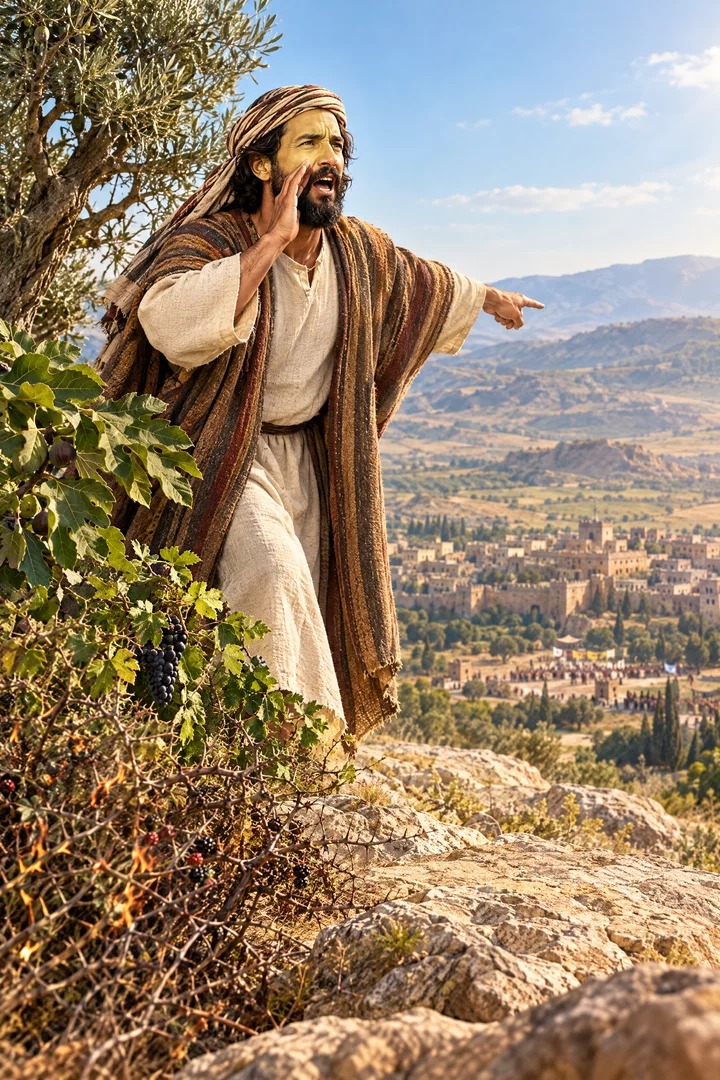
The trees went forth on a time to anoint a king over them; and they said unto the olive tree, Reign thou over us.
Translations
The trees went forth on a time to anoint a king over them; and they said to the olive tree, Reign you over us.
King James Version, KJV Cambridge Paragraph Bible, Revised Version
The trees went forth on a time to anoint a king over them; and they said unto the olive tree, Reign thou over us.
The trees went forth on a time to anoint a king over them; and they said to the olive-tree, Reign thou over us.
The trees went forth on a time to anoint a king over them; and they said unto the olive-tree, Reign thou over us.
'The trees have diligently gone to anoint over them a king, and they say to the olive, Reign thou over us.
The trees once went forth to anoint a king over them; and they said to the olive-tree, Reign over us.
The trees, went their way, to anoint over them, a king,—and they said unto the olive tree—Reign thou over us.
Berean Standard Bible, Majority Standard Bible
One day the trees set out
to anoint a king for themselves.
They said to the olive tree,
‘ Reign over us.’The trees set out to anoint a king over themselves. They said to the olive tree, ‘ Reign over us.’
One day the trees went out to make a king for themselves; and they said to the olive-tree, Be king over us.
The trees went foorth to anoynt a King ouer them, and sayde vnto the oliue tree, Reigne thou ouer vs.
Douay-Rheims (Challoner revision)
The trees went to anoint a king over them: and they said to the olive tree: Reign thou over us.
Pictures
Cross-references
- 2 Kings 14:9
And Jehoash the king of Israel sent to Amaziah king of Judah, saying, The thistle that was in Lebanon sent to the cedar that was in Lebanon, saying, Give thy daughter to my son to wife: and there passed by a wild beast that was in Lebanon, and trode down the thistle.
A thistle speaks to a cedar in a plant parable.
- Judges 9:15
And the bramble said unto the trees, If in truth ye anoint me king over you, then come and put your trust in my shadow: and if not, let fire come out of the bramble, and devour the cedars of Lebanon.
The bramble’s terms for kingship portray Abimelech’s cruel reign.
- Judges 9:19-20
If ye then have dealt truly and sincerely with Jerubbaal and with his house this day, then rejoice ye in Abimelech, and let him also rejoice in you:
The prophecy applies Jotham’s parable, foretelling mutual destruction by fire.
- Judges 9:13
And the vine said unto them, Should I leave my wine, which cheereth God and man, and go to be promoted over the trees?
vine refusal in same parable
- 1 Kings 12:25
Then Jeroboam built Shechem in mount Ephraim, and dwelt therein; and went out from thence, and built Penuel.
Shechem destroyed in Abimelech's history later made capital
Commentary
Each commentary is drawn from primary sources: the writings of Ellen G. White and Adventist pioneers and periodicals. Each commentary is separate. Its own words are not a quotation; follow the references to read the source passages.
Ellen G. White
2 sources
The verse begins Jotham's parable of the trees going out to anoint a king over them and asking the olive tree to reign over them.ST Aug 4, 1881ST Aug 4, 1881 It was spoken from Mount Gerizim to the people of Shechem while they were feasting in honor of Abimelech, to expose the folly and injustice of making him king.ST Aug 4, 1881 The trees seeking a king are Israel seeking a king from among themselves.ST Aug 4, 1881
The olive is asked first and refuses to leave its oil to be promoted, and is joined by the fig tree refusing to leave its fruit and the vine refusing to leave its wine.ST Aug 4, 1881 The olive's refusal pictures unselfish and unambitious conduct, claiming no kingly honors and aspiring to no rank or power, but continuing in useful, self-sacrificing and devoted service to bless fellow men.ST Aug 4, 1881ST Aug 4, 1881 In this sense the olive represents Gideon and his sons, who sought no kingly honor.ST Aug 4, 1881 In this sense the olive also represents noble, upright leaders such as Moses and Joshua, who show what a leader of Israel should be.ST Aug 4, 1881
Their refusal stands in striking contrast to the worthless bramble grasping for honor, which represents Abimelech, who eagerly seized kingship.ST Aug 4, 1881ST Aug 4, 1881 Abimelech was a vile and cruel upstart king, set up by treachery, violence and bloodshed when Israel had fallen low.ST Aug 4, 1881 Jotham's closing words turn the parable into a prophecy of mutual destruction between Abimelech and Shechem.ST Aug 4, 1881
Sources
Pioneers and periodicals
23 sources
The verse opens Jotham's parable of the trees seeking a king, spoken from Mount Gerizim to reprove the men of Shechem for their folly and injustice in choosing Abimelech as ruler after the sons of Gideon were slain.ST Oct 1, 1902ST Aug 25, 1881ST Jun 29, 1904 The trees going forth to anoint a king represent Israel seeking a king from among themselves, with the olive, the fig, and the vine refusing to leave their useful service picturing the unselfish and unambitious conduct of Gideon and his sons, while the worthless bramble eagerly seizing the honor is the cruel Abimelech set up by violence and bloodshed.ST Aug 4, 1881ST Aug 4, 1881ST Oct 1, 1902ST Aug 25, 1881ST Mar 28, 1906 Its closing turns the story into a prophecy of mutual destruction between Abimelech and Shechem, fulfilled when Shechem was destroyed.ST Aug 4, 1881ST Jun 29, 1904 It teaches that those doing the most valuable work do not seek authority over others, and that ambition to be exalted shows a person is unfit to rule.ST Oct 1, 1902 The speaking trees are figurative and not to be taken as fact, so no consciousness or human speech in trees is to be concluded from them, just as making the dead speak and act as though alive in the parable of the rich man and Lazarus does not mean they are alive or conscious in death.ST Aug 19, 1880ST Aug 25, 1881RH Jan 7, 1902RH Mar 16, 1916RH Sep 25, 1913
Parable Form and Setting
The verse opens Jotham's parable, apologue, or fable of the trees going forth to seek a king, spoken from Mount Gerizim to the people of Shechem while they were feasting in honor of Abimelech, to reprove their folly and injustice in choosing him as ruler after his brothers, the sons of Jerubbaal or Gideon, were slain.ST Aug 4, 1881ST Oct 1, 1902ST Aug 25, 1881ST Jun 29, 1904 In the story the trees speak in turn to the olive tree, the fig tree, the vine, and the bramble, with each answering, using a vivid fictitious account of choosing a king to represent the work of kings.ST Aug 25, 1881ST Mar 28, 1906ST Aug 19, 1880 Its moral must be made clear, because parables can attract attention yet mislead when left unexplained.ST Aug 19, 1880 Unlike trees, people can choose and are accountable for their thoughts, desires, and deeds.RH Feb 15, 1870
The form gives fictitious human powers and actions to lifeless, inanimate trees, presenting them as living beings that go forth, meet in council, hold an election, reason, speak to one another, choose a king, and ask the olive to reign over them.ST Aug 19, 1880ST Aug 2, 1910ST Dec 4, 1884ST Jun 30, 1881RH Sep 25, 1913 It is personification in which inanimate things are given human actions and speech, as in the parable of the rich man and Lazarus.ST Jun 30, 1881RH Sep 25, 1913 The imagined and impossible actions and speech are a legitimate figurative means of conveying truth in a striking way and impressing a moral lesson, and do not mislead hearers into treating the story as fact, for they recognize its figurative purpose.ST Aug 19, 1880ST Dec 4, 1884ST May 20, 1886 This figurative speech does not make the speaker false, for it is a legitimate feature of the form and serves its purpose without asserting that the events literally happened.ST Aug 19, 1880
Like blood, stones, beams, or wages said to speak or cry, the trees' talking among themselves and choosing a king is an account of imagined speech by inanimate things that conveys truth through an invented story.ST Dec 4, 1884ST Mar 28, 1906 Their conversation is not a literal account of trees talking, and no consciousness or literal speech in trees is to be concluded from it because it is a parable.ST Aug 25, 1881ST Jun 30, 1881RH Aug 7, 1916 The trees never had consciousness and never will have, yet are represented as talking to show how unjust and oppressive dealings of men are regarded.ST Aug 25, 1881
The verse belongs to the larger record in Judges 3 through 17 of Israel's backsliding from God and the resulting suffering, oppression, and captivity followed by returns to God, forgiveness, and deliverance.ST It stands specifically in the fearfully checkered history of Israel in the time of the judges and in the account of how the family of Gideon degenerated by trusting in things which are seen instead of in power that is unseen.ST Mar 24, 1909 There Abimelech, the son of Gideon's maid, caused Gideon's sons to be slain in order to make himself ruler over Israel, in the course of which Shechem was utterly destroyed before it was later rebuilt as Jeroboam's capital.ST Jun 29, 1904
The verse stands as satirical invective and oration among the great speeches of the Old Testament, showing the intrinsic literary value and eloquence of the Hebrew Scriptures.ST Feb 5, 1885
Meaning and Moral Warning
The going forth of the trees to anoint a king over them is Israel seeking a king from among themselves.ST Aug 4, 1881ST Aug 25, 1881 The trees speak in turn to the olive tree, the fig tree, the vine, and the bramble, with each answering, using a fictitious story about choosing a king to represent the work of kings.ST Aug 4, 1881ST Aug 25, 1881ST Mar 28, 1906 The call for the olive to reign is met by its refusal to leave its oil, joined by the fig refusing to leave its fruit and the vine refusing to leave its wine.ST Aug 4, 1881ST Aug 4, 1881 This pictures the unselfish and unambitious conduct of Gideon and his sons, who sought no kingly honor.ST Aug 4, 1881ST Aug 4, 1881
The olive represents noble, upright leaders such as Moses and Joshua, who show what a leader of Israel should be.ST Aug 4, 1881 Like the olive refusing to leave its useful work to be promoted, they claimed no kingly honors, did not aspire to rank or power, but lived to bless their fellow men in self-sacrificing, devoted service.ST Aug 4, 1881ST Aug 4, 1881 In striking contrast the worthless bramble eagerly seized the honor, which is the vile and cruel Abimelech.ST Aug 4, 1881ST Aug 4, 1881ST Oct 1, 1902 He was an upstart king set up by treachery, violence and bloodshed when Israel had fallen low, the son of Gideon's maid who caused Gideon's sons to be slain in order to make himself ruler, and the choice of such a murderer of his brothers as ruler exposes the folly of the men of Shechem.ST Aug 4, 1881ST Aug 4, 1881ST Oct 1, 1902ST Jun 29, 1904
Jotham's closing words turn the parable into a prophecy of mutual destruction between Abimelech and Shechem.ST Aug 4, 1881 That was fulfilled when Shechem was utterly destroyed, before it was later rebuilt as Jeroboam's capital.ST Aug 4, 1881ST Jun 29, 1904 The parable teaches that those doing the most valuable work in the Lord's cause do not seek authority over their fellow believers, and that ambition to be exalted over others shows a person is unfit to rule.ST Oct 1, 1902 The vivid story was meant to reprove the men of Shechem for choosing Abimelech, but its moral must be made clear, because parables can attract attention yet mislead when left unexplained.ST Oct 1, 1902ST Aug 19, 1880
Doctrinal Use and Application
Jotham's parable beginning here reproves the people who slew his brethren the sons of Jerubbaal, with the trees going to anoint a king and speaking in turn to the olive tree, the fig tree, the vine, and the bramble, with each answering.ST Aug 25, 1881 The trees never had consciousness and never will have, yet are represented as talking to show how God regards unjust and oppressive dealings of men, so no conscious intelligence or human speech in trees is to be concluded from it because it is a parable.ST Aug 25, 1881RH Jan 7, 1902 It is an imaginary scene of a council held and speeches made that teaches a lesson rather than describing events that literally happened, and figurative scenes in parables should not be mistaken for actual narrative.RH Jan 7, 1902RH Mar 16, 1916
A parable or apologue can legitimately give fictitious characters powers and actions they could not naturally possess, so that saying the trees spoke to one another, though trees cannot literally speak, is not false but serves its purpose without asserting that the events literally happened.ST Aug 19, 1880 Here lifeless, inanimate trees are personified as living beings who go forth, hold an election, reason and speak with the sentiments and language of rational beings, as in the parable of the rich man and Lazarus.RH Sep 25, 1913RH May 12, 1874 The same holds for the parable of the rich man and Lazarus, where beings once alive and conscious who will live again at the resurrection are represented as talking in hades-sheol where there is no knowledge nor remembrance.ST Aug 25, 1881 Making the dead thus speak and act as though alive does not mean they are alive or conscious, any more than do the blood of Abel crying, the depth and sea and destruction and death speaking, the stone hearing, the thistle proposing, the trees singing, and the stone and beam answering.ST Aug 19, 1880RH May 12, 1874
People, unlike trees in the fable choosing a king, can choose and are accountable for their thoughts, desires, and deeds.RH Feb 15, 1870 The olive together with the vine stands as an example of bearing good fruit, set against the brier and the thistle as examples of being unprofitable.RH May 17, 1864 Contention between churches should therefore be like the contention of the vine with the olive, which of them shall bear the best fruit, and not like the contention of the brier with the thistle, which of them shall be most unprofitable.RH May 17, 1864
Sources