Leviticus 18:21
And thou shalt not let any of thy seed pass through the fire to Molech, neither shalt thou profane the name of thy God: I am the LORD.
Translations
And you shall not let any of your seed pass through the fire to Molech, neither shall you profane the name of your God: I am the LORD.
King James Version, Webster Bible
And thou shalt not let any of thy seed pass through the fire to Molech, neither shalt thou profane the name of thy God: I am the LORD.
And thou shalt not let any of thy seed pass through the fire to Molech, neither shalt thou profane the name of thy God: I am the Lord.
And thou shalt not give any of thy seed to make them pass through the fire to Molech, neither shalt thou profane the name of thy God: I am the LORD.
And thou shalt not give any of thy seed to make them pass through the fire to Molech; neither shalt thou profane the name of thy God: I am Jehovah.
'And of thy seed thou dost not give to pass over to the Molech; nor dost thou pollute the name of thy God; I [am] Jehovah.
And thou shalt not give of thy seed to let them pass through [ the fire] to Molech, neither shalt thou profane the name of thy God: I am Jehovah.
And none of thy seed, shalt thou deliver up, to cause to pass through to Molech,—that thou profane not the name of thy God, I, am Yahweh.
Berean Standard Bible, Majority Standard Bible
You must not give any of your children to be sacrificed to Molech, for you must not profane the name of your God. I am the LORD.
“‘ You shall not give any of your children as a sacrifice to Molech. You shall not profane the name of your God. I am the LORD.
And you may not make any of your children go through the fire as an offering to Molech, and you may not put shame on the name of your God: I am the Lord.
Also thou shalt not giue thy children to offer them vnto Molech, neither shalt thou defile the name of thy God: for I am the Lord.
Douay-Rheims (Challoner revision)
Thou shalt not give any of thy seed to be consecrated to the idol Moloch, nor defile the name of thy God: I am the Lord.
Pictures
Cross-references
- Leviticus 20:2-5
Again, thou shalt say to the children of Israel, Whosoever he be of the children of Israel, or of the strangers that sojourn in Israel, that giveth any of his seed unto Molech; he shall surely be put to death: the people of the land shall stone him with stones.
Repeats the ban on giving children to Molech and specifies its penalty.
- Deuteronomy 18:12
For all that do these things are an abomination unto the LORD: and because of these abominations the LORD thy God doth drive them out from before thee.
Forbidden practices are called abominations and given as the reason God drove out the nations.
- Leviticus 18:27
(For all these abominations have the men of the land done, which were before you, and the land is defiled;)
The land’s former inhabitants practiced the abominations that include profaning God’s name.
- Deuteronomy 12:31
Thou shalt not do so unto the LORD thy God: for every abomination to the LORD, which he hateth, have they done unto their gods; for even their sons and their daughters they have burnt in the fire to their gods.
Condemns burning children as offerings to other gods.
- Exodus 20:7
Thou shalt not take the name of the LORD thy God in vain; for the LORD will not hold him guiltless that taketh his name in vain.
Both prohibit profaning or taking God’s name in vain.
- 2 Kings 23:10
And he defiled Topheth, which is in the valley of the children of Hinnom, that no man might make his son or his daughter to pass through the fire to Molech.
Describes children being made to pass through fire to Molech at Topheth.
- Jeremiah 7:31
And they have built the high places of Tophet, which is in the valley of the son of Hinnom, to burn their sons and their daughters in the fire; which I commanded them not, neither came it into my heart.
Condemns burning children as offerings at Topheth.
- 2 Kings 17:17
And they caused their sons and their daughters to pass through the fire, and used divination and enchantments, and sold themselves to do evil in the sight of the LORD, to provoke him to anger.
Describes making children pass through fire in idolatrous practice.
- Leviticus 24:16
And he that blasphemeth the name of the LORD, he shall surely be put to death, and all the congregation shall certainly stone him: as well the stranger, as he that is born in the land, when he blasphemeth the name of the LORD, shall be put to death.
Gives the Mosaic penalty for profaning God’s name.
- Judges 11:31
Then it shall be, that whatsoever cometh forth of the doors of my house to meet me, when I return in peace from the children of Ammon, shall surely be the LORD’s, and I will offer it up for a burnt offering.
Jephthah’s vow raises the question of offering his daughter.
- 1 Corinthians 10:20
But I say, that the things which the Gentiles sacrifice, they sacrifice to devils, and not to God: and I would not that ye should have fellowship with devils.
Pagan sacrifices are offered to demons, not to God.
Commentary
Each commentary is drawn from primary sources: the writings of Ellen G. White and Adventist pioneers and periodicals. Each commentary is separate. Its own words are not a quotation; follow the references to read the source passages.
Ellen G. White
12 sources
The verse forbids giving children to Molech by making them pass through fire in idolatrous worship, a rite in which children leapt over an altar fire with escape taken as favor and burning as death to appease an angry god.1SP 267.1–268.1SG3 302.1–303.1 It is an idolatrous abomination of human sacrifice to secure favor from false gods, which profanes the name of God, rejects worship of the true God, and violates the sixth commandment.ST Aug 26, 1889SG3 302.1–303.11SP 74.1PP 337.2–3HM Jun 1889 The same prohibition applies when parents make a costly offering of their children to mammon, wealth, love of the world, worldly custom, and Satan by neglecting their upbringing and religious care and exposing them to harmful influences.5T 320.2CE 234.1–235.3Ms 7, 1899, par. 9 Those who do so reap what selfish neglect has sown, with children growing up unloved and ungodly and showing decided impiety, while home religion instead trains them as members of the Lord's family and protects them from spiritual sacrifice.5T 320.2Ms 7, 1899, par. 9HM Jun 1889
The Forbidden Fire Rite
The command bars letting any of one's offspring pass through fire to Molech as an act of idolatrous worship.1SP 267.1–268.1SG3 302.1–303.1SG3 303.2PP 337.2–3 It rejects this child-harming service of other gods as an idolatrous abomination, warning that to do it profanes God's name, and it was meant to keep His people separate from it.SG3 302.1–303.1PP 337.2–3ST May 27, 1913
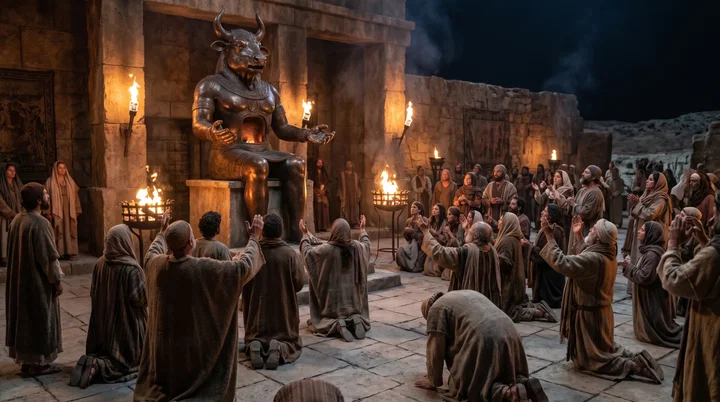
The rite was a heathen custom in which children were made to leap over an altar fire, taking the form of an ordeal or a sacrifice.1SP 267.1–268.1SG3 302.1–303.1 If a child escaped unharmed he was honored as favored by the idol, taken as proof that the god had accepted him and would reward him.1SP 267.1–268.1SG3 302.1–303.1 If he was burned he was killed as a sacrifice, offered to appease the god who was supposed to be angry.1SP 267.1–268.1SG3 302.1–303.1
Some Israelites adopted this custom, with the abomination also taking place among them in times of great apostasy, including apostate Jews giving their children to Molech in this way.1SP 267.1–268.1SG3 303.2PP 337.2–3Ms 119, 1899, par. 16–17 God showed His displeasure at the practice by causing the fire to consume their children as they passed through it, visiting them with this punishment for the abomination.1SP 267.1–268.1SG3 303.2
Idolatry Violates God's Law
The prohibition targets an idolatrous abomination in which children were offered to Molech by making them pass through fire.ST Aug 26, 18891SP 74.1PP 337.2–3ST May 27, 1913 It was human sacrifice performed in idolatrous worship under the belief that the favor of the gods could be secured in that way.1SP 74.1PP 337.2–3 God intended to deliver Israel from these abominations and to keep His people separate from them.ST Aug 26, 1889ST May 27, 1913 That separation was part of His purpose to preserve Israel from the corrupt worship around them.ST Aug 26, 1889ST May 27, 1913
To perform the rite profanes the name of God.SG3 302.1–303.1HM Jun 1889 It rejects the worship of the true God in favor of other gods through worship that harms children.SG3 302.1–303.1 It also violates the sixth commandment, since it takes human life in idolatrous sacrifice.PP 337.2–3
Its warning stands alongside prohibitions against seeking wizards and communing with familiar spirits.ST Aug 26, 1889 Together these prohibitions call the people to holiness and to obedience to God's statutes.ST Aug 26, 1889
Such human sacrifice and idol worship were abominations against God that brought judgment upon those who practiced them.1SP 74.1 Their destruction showed that judgment had come because of these practices.1SP 74.1
Parents Sacrificing Children Today
The prohibition against giving children to Molech applies when parents make a costly offering of their children to mammon, to wealth and love of the world and worldly interests, to worldly social customs, and to Satan.5T 320.2CE 234.1–235.3Ms 7, 1899, par. 9Ms 119, 1899, par. 16–17HM Jun 1889 To sacrifice a child's spiritual welfare in this way is to devote the child to a worldly god rather than to God.CE 234.1–235.3Ms 7, 1899, par. 9HM Jun 1889
This is done by neglecting upbringing and religious care, withholding religious care and the means of grace, and exposing children to harmful influences.5T 320.2CE 234.1–235.3HM Jun 1889 It is done by choosing a home for worldly interests rather than for its moral and social atmosphere, by moving the family into places of temptation, and by not counting God's presence and the means of grace as essential to glory and defense.5T 320.2HM Jun 1889 It is done by letting the world engross time and strength and thought until apathy steals over the soul, and by permitting evil communications that contaminate children and kill tenderness of soul.HM Jun 1889 It is also done by indulging love of display and by surrendering godly discipline.Ms 119, 1899, par. 16–17
Home religion instead trains children as members of the Lord's family rather than as devotees of society, and so protects them from being spiritually sacrificed to its customs.Ms 7, 1899, par. 9 Where parents sow selfish neglect and love of the world, they reap what was sown: children grow up unloved and ungodly and unlovely in character, showing decided impiety and tendency to infidelity.5T 320.2HM Jun 1889 God has promised no miracle to rescue children from temptations their parents chose to place around them, and the professed faith is not to blame for failing to save them.5T 320.2HM Jun 1889
Sources
Pioneers and periodicals
53 sources
The verse forbids giving children to be burned by fire as offerings to Molech as a grave idolatrous abomination that profanes the name of God.ST Aug 26, 1889ST May 6, 1886ST Nov 20, 1884 Its prohibitions are moral and not merely Jewish ritual pollutions, and they remain still in force as the standard by which conduct is shown to be sinful.RH May 17, 1864RH Aug 5, 1852ST Jun 5, 1901 It belongs to a list proving God's law existed, was known, and was binding on humanity long before it was proclaimed at Sinai or given through Moses.RH Dec 25, 1860ST Sep 2, 1875RH Mar 5, 1857 Profaning the name of the Lord by Molech worship violates the third commandment, and the condemnation of the Canaanites for it proves that command was already known, binding, and enforceable before the Exodus.RH Dec 25, 1856ST May 18, 1882RH Mar 19, 1857 The same sin is repeated when parents sacrifice their children to modern idols such as mammon and worldly advantage, fashion, cruel indulgence, and war.HM Jun 1889RH Nov 4, 1873RH Jun 26, 1900
Ancient Rite Described
The law forbids letting any child pass through fire to Molech, also called Moloch, meaning literal burning of children as a sacrifice by fire.ST May 6, 1886ST Nov 20, 1884ST Jan 3, 1905ST Nov 5, 1894ST Jan 22, 1885 That act is a grave idolatrous abomination against God's law and a profaning of the name of God.ST Aug 26, 1889ST May 6, 1886ST Nov 20, 1884ST Jan 22, 1885ST Jun 2, 1898 It belongs among the abominations from which Israel was to be delivered, set alongside seeking wizards and communing with familiar spirits, with Israel called to holiness and obedience to God's statutes.ST Aug 26, 1889RH Oct 18, 1853ST Nov 5, 1894 The prohibition concerns giving children to be burned for Molech and offering them in fire sacrifice as pagan demon worship.ST Jan 3, 1905ST Nov 5, 1894ST Jan 22, 1885
Passing through the fire could take the form of a fiery ordeal or a sacrifice. Survival was taken as proof that the god accepted the person and would reward him, while a child who was burned was offered to appease a supposedly angry god.RH Jan 14, 1904 The children were placed in the idol's red-hot arms at the high places in an attempt to appease the gods, showing how far men had departed from knowing God into cruel superstition from false ideas of His character.ST Jan 3, 1905RH Jan 14, 1904 The cruelty demanded that parents be praised for showing no grief as their children suffered, and the burning could involve adults as well as children alive.ST Jun 2, 1898 This cruelty is linked to the Phoenician and Carthaginian practice of sacrificing infants to Molech.ST Jan 22, 1885RH Jan 14, 1904
The rite was practiced at the high places of the Amorite cities in Canaan when Israel entered the land while Babylonian civilization still remained there.ST Jan 3, 1905 Those cities had massive walls fourteen feet thick and towers twenty-four feet across, and jars filled with the burned bodies of children buried under their ruins show the practice.ST Jan 3, 1905 God commanded the destruction of those high places because children were burned there, and Israel later followed the same Molech custom in Canaan, though not to the extent the Amorites did.ST Jan 3, 1905 When some Israelites adopted the custom, God showed His displeasure by causing fire to consume their children as they passed through it.
The Canaanites let their children pass through the fire to Molech and profaned the name of God, and their burning of children in the fire in idolatry was part of the crimes for which they were destroyed.RH Oct 18, 1853RH Jan 29, 1867RH Jan 20, 1863 Those wrongs defiled the land and brought God's judgment, and the laws containing this command set Israel apart from the pagan customs of the surrounding nations with their grave religious abominations.RH Oct 18, 1853ST Feb 7, 1911 The practices opposed are associated with pagan sun-worship abominable to Heaven and opposed to the truth of God.ST Aug 11, 1909 They prove the Canaanites were not a peaceable and good people but guilty of cruel and defiling practices, so their destruction was just and not cruel.RH Jan 29, 1867
A burning of Jephthah's daughter as a sacrifice would have been sinful and contrary to this law, since offering a human being as a sacrifice was forbidden among God's people.ST May 6, 1886ST Jul 13, 1904 If secretly slaughtered for Molech, such an act would not have been a sacrifice to the Lord.ST May 6, 1886 She could instead be dedicated to the Lord.ST Jul 13, 1904
Universal Moral Law
Leviticus 18 forbids sexual relations between close relatives such as a sister or a daughter, and those prohibitions are moral and not merely Jewish ritual pollutions.RH May 17, 1864RH Aug 5, 1852RH Feb 17, 1852 The acts condemned in the chapter are called abominations because they rest on moral considerations, and for that reason they defiled the land and caused it to vomit out its earlier inhabitants.RH Aug 5, 1852ST Jun 5, 1901RH Feb 17, 1852 The Canaanites were destroyed for those abominations, which shows the chapter contains moral principles binding on all nations and not only Israel.RH May 17, 1864RH Aug 5, 1852 Those prohibitions remain still in force as the standard by which human conduct is shown to be sinful.RH Aug 5, 1852ST Jun 5, 1901
The verse states principles of God's commandments and belongs to a list of practices showing that the nations of Canaan were living in serious sin and were guilty before God.RH Dec 25, 1860ST Sep 2, 1875 That guilt proves they had knowledge of God's law and of the judgment due for breaking it before the law was given to Israel through Moses.RH Dec 25, 1860ST Sep 2, 1875 The moral principles expressed in all ten commandments, including the prohibition against sacrificing children to Molech and the prohibition against profaning God's name, were therefore known and already binding on humanity before Moses and before the formal proclamation at Sinai.RH Mar 5, 1857RH Mar 1, 1864
Giving seed to Molech breaks the first commandment, while the prohibition against passing seed to Molech and profaning the name of God shows that the second and third commandments were already binding during the twenty-five-hundred-year patriarchal age before the giving of the law in classic form on Mount Sinai.ST Dec 27, 1905RH Apr 2, 1867 The Gentiles of Egypt and Canaan committed this sin together with the other sins listed in Leviticus 18-20, and God abhorred them and cast them out of the land because they did all these things.ST Dec 27, 1905RH Apr 2, 1867 This proves the Ten Commandments were binding on all men, that Gentiles were held accountable and punished for violating them before the law was spoken from Sinai, that the law was known to all where conscience was not seared by persistent disobedience, that it was not local or for Israel only then and is not now, and that the Spirit still uses it to convince the world of sin.ST Dec 27, 1905 In that period God's people were careful not to break these commands while wicked men trampled them with audacity, and it belongs to the same law of ten commandments whose transgression is sin and which condemned the men of Sodom as wicked sinners before the Lord exceedingly.RH Apr 2, 1867 Worshipers of Moloch offered human sacrifices with approving consciences even though those acts are condemned by the word of God, and treating the casting of babies into the fire as a religious virtue was immoral and uncivil because it violated the rights of others, so civil government has a duty to prohibit it on that ground.ST Oct 21, 1889ST Jul 8, 1886
Third Commandment Before Sinai
To pass seed to Molech and thereby profane the name of the Lord is an abomination and a breach of the third commandment.RH Dec 25, 1856RH Mar 19, 1857 The principle of that commandment was already in force among the nations dwelling in Canaan before the law was given to Israel, for otherwise their conduct could not have been an abomination for which God could justly punish them.RH Dec 25, 1856RH Mar 19, 1857 Profanity was therefore treated as sin among those nations, not as an act outside the reach of moral law.RH Dec 25, 1856RH Mar 19, 1857
The Canaanites were condemned and destroyed for this profaning of God's name by letting their seed pass through fire to Molech, which proves the prohibition was already known, binding, and enforceable before the Exodus and before it was spoken on Sinai.RH Dec 25, 1856ST May 18, 1882RH Mar 19, 1857ST Jun 10, 1875 It stood among the abominations committed by the nations in Canaan before Israel entered the land, defiling the land and bringing guilt upon its inhabitants.ST May 18, 1882ST May 18, 1882ST Jun 10, 1875 Israel in the pre-Mosaic period was forbidden to follow those defiling practices, showing accountability to God's moral law before its formal giving.ST May 18, 1882ST Jun 10, 1875ST May 21, 1885
The absence of any earlier record in Genesis of the giving of the command against profaning God's name, or of its violation, does not mean the law was unknown or unenforced.ST May 18, 1882ST May 18, 1882ST Jun 10, 1875ST Jun 10, 1875RH Jan 21, 1875 Guilt and defilement of the land demonstrate accountability under a law against profaning God's name before Sinai.ST May 18, 1882ST May 18, 1882ST May 21, 1885ST Jun 10, 1875RH Jan 21, 1875 The condemnation of the Canaanites for violating it proves it was known and binding before it was formally spoken, just as the Sabbath was binding before Sinai though Genesis records no formal command to keep it.ST Jun 10, 1875RH Jan 21, 1875RH Jan 21, 1875 The law was known to all where conscience was not seared by persistent disobedience, was not local or for Israel only then and is not now, and the Spirit still uses it to convince the world of sin.ST Dec 27, 1905RH Jan 21, 1875
Separation and Judgment Required
The Canaanites were not a peaceable and good people but were guilty of cruel and defiling practices, including letting their children pass through the fire to Molech and profaning the name of God, so their destruction by God was just and not cruel.RH Jan 29, 1867RH Jan 20, 1863 Burning children in the fire was an abomination associated with idolatry and stood among the crimes for which they were destroyed.RH Jan 29, 1867RH Jan 20, 1863 The Israelite conquests were justified by those cruel human sacrifices, a precedent later appealed to when the Spaniards were spurred on by what they considered scriptural precedents against the Aztecs' human sacrifices.ST Nov 20, 1884
Israel was commanded to be set apart from the pagan customs of the surrounding nations, whose practices included grave religious abominations, and was called to holiness and obedience to God's statutes.ST Aug 26, 1889ST Feb 7, 1911 The warning against sacrificing to Moloch and making children pass through fire stands alongside prohibitions against seeking wizards and communing with familiar spirits, as among the abominations from which Israel was to be delivered.ST Aug 26, 1889 The evils practiced in Canaan show the destructive possibilities of spiritualism and the consequences of turning from God, warning against the spiritual dangers associated with them.ST Oct 20, 1887ST Nov 13, 1884 Those practices were associated with pagan sun-worship abominable to Heaven and opposed to the truth of God, and with heathen rites and spirit worship that continue in more socially acceptable form.ST Aug 11, 1909ST Nov 21, 1911
Moloch was honored through sacrifice of what people loved most, which provides the comparison for treating tobacco as an idol that people will not give up.RH Aug 2, 1870 Calling tobacco a Moloch applies the language of giving seed to Molech in a fire rite and profaning God's name figuratively to a costly indulgence that consumes money that could support missionary work, not to the literal rite itself.RH Aug 2, 1870
Modern Molechs Condemned
The Canaanite sin is repeated when parents who denounce the Canaanites make a costly offering of their own children to mammon, to worldly interests, and to false religion.HM Jun 1889RH Nov 4, 1873 This is done by choosing a home for worldly advantage rather than for moral and social atmosphere, by letting the world engross time and strength and thought until apathy steals over the soul, and by not counting the ark of God, their glory and defense, and the means of grace as essential.HM Jun 1889 It is done by permitting evil communications that contaminate children and kill tenderness of soul, by moving families into places of temptation, and by neglecting spiritual care so that children are left exposed to temptation and deprived of influences that form faithful character.HM Jun 1889 What is then reaped is what was sown through selfish love of the world, with no miracle to deliver them from temptation: children grow up unloved and unlovely in character, showing decided impiety and tendency to infidelity, and the faith professed is not to blame for failing to save them.HM Jun 1889
The warning applies to sacrificing self and children to the idol of fashion through love of display and costly ornaments. Christians are instead to lay aside these adornments and to teach their children to serve God and seek the inward adornment of a meek and quiet spirit. Modern fashion as Molech ruins body and soul and prompts the mass slaughter of birds as decorations for those who worship at fashion's altar.RH Jun 26, 1900
Molech worship is likened to the cruelty and moral degradation of drunken domestic life, where women and children suffer as victims sacrificed at a bloody altar.RH Aug 23, 1864 It is also the image for deadly electric wires that consume human lives, where treating people as expendable for corporate profit violates God's law and those responsible will answer at God's judgment.ST Dec 30, 1889 The persecuting spirit of religious bigotry is that Molech on earth, a grim idol to whom children are made to pass through fire amid blood, seated on his shrine up to the ears in blood and compelling the children of men to pass through fire to him.ST May 14, 1896 Letting it gain a foothold corrupts morals, pollutes religion, and endangers the safety of a people.ST May 14, 1896
War is portrayed as an awful Moloch to which nations sacrifice human lives, including their youth and Christians, comparing war's destruction and death to that destructive power.ST Nov 17, 1914ST Nov 24, 1914 War as a Moloch consumes lives and brings horrors and debt.ST May 8, 1907 A gift to Molech is gain of war sprung from carnage, a fruit of wrath and seed of strife, which the everlasting victor who shall be crowned of life does not bring.RH Mar 9, 1916 Moloch endures as evil hidden behind a mask of peace.ST Mar 3, 1909
Urging transgressors who know the only condition of forgiveness to beg their brethren to shed their blood, so that its smoke might ascend as an offering to appease wrath kindled against them and that the law might have its course, is the same ancient Moloch teaching.RH Dec 24, 1908 Urging men to offer their lives to atone for their sins, and spilling a neighbor's blood on the earth when he has sinned a sin requiring the shedding of blood in order that he may be saved, as in the Mormon doctrine of blood atonement that teaches murdering a man in order that he may be saved, is its modern counterpart opposed to the meek and lowly Jesus and proving Mormonism is not Christian in any sense.RH Dec 24, 1908RH Jan 14, 1909 Burning people as a sacrifice to Molech was the one heathen practice the apostate church had not yet adopted, though it would later do so.ST Jul 14, 1898
Sources