Leviticus 2:1
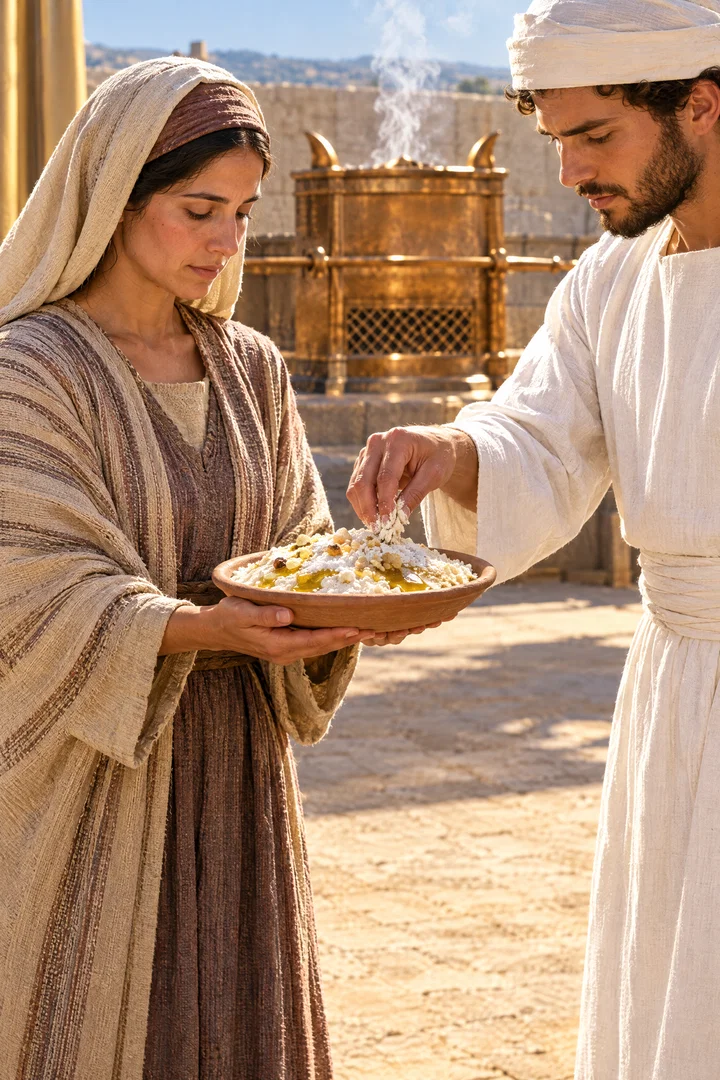
And when any will offer a meat offering unto the LORD, his offering shall be of fine flour; and he shall pour oil upon it, and put frankincense thereon:
Translations
And when any will offer a meat offering to the LORD, his offering shall be of fine flour; and he shall pour oil on it, and put frankincense thereon:
And when any will offer a meat offering unto the LORD, his offering shall be of fine flour; and he shall pour oil upon it, and put frankincense thereon:
And when any will offer a meat offering unto the Lord, his offering shall be of fine flour; and he shall pour oil upon it, and put frankincense thereon:
And when any will offer a meat-offering to the LORD, his offering shall be of fine flour; and he shall pour oil upon it, and put frankincense upon it.
And when any one offereth an oblation of a meal offering unto the LORD, his oblation shall be of fine flour; and he shall pour oil upon it, and put frankincense thereon:
And when any one offereth an oblation of a meal-offering unto Jehovah, his oblation shall be of fine flour; and he shall pour oil upon it, and put frankincense thereon:
'And when a person bringeth near an offering, a present to Jehovah, of flour is his offering, and he hath poured on it oil, and hath put on it frankincense;
And when any one will present an oblation to Jehovah, his offering shall be of fine flour; and he shall pour oil on it, and put frankincense thereon.
But, when any person would bring near as an oblation, a meal-offering, unto Yahweh, of fine meal, shall be his oblation,—and he shall pour out thereon oil, and place thereon, frankincense;
Berean Standard Bible, Majority Standard Bible
“ When anyone brings a grain offering to the LORD, his offering must consist of fine flour. He is to pour olive oil on it, put frankincense on it,
“‘ When anyone offers an offering of a meal offering to the LORD, his offering shall be of fine flour. He shall pour oil on it, and put frankincense on it.
And when anyone makes a meal offering to the Lord, let his offering be of the best meal, with oil on it and perfume:
And when any will offer a meate offering vnto the Lord, his offering shall be of fine floure, and he shall powre oyle vpon it, and put incense thereon,
Douay-Rheims (Challoner revision)
When any one shall offer an oblation of sacrifice to the Lord, his offering shall be of fine flour, and he shall pour oil upon it, and put frankincense,
Pictures
Cross-references
- Leviticus 5:11
But if he be not able to bring two turtledoves, or two young pigeons, then he that sinned shall bring for his offering the tenth part of an ephah of fine flour for a sin offering; he shall put no oil upon it, neither shall he put any frankincense thereon: for it is a sin offering.
Provides a flour offering for those unable to bring birds.
- Genesis 1:29
And God said, Behold, I have given you every herb bearing seed, which is upon the face of all the earth, and every tree, in the which is the fruit of a tree yielding seed; to you it shall be for meat.
Both call plant-based food “meat,” showing the word’s broad meaning.
- Leviticus 2:11
No meat offering, which ye shall bring unto the LORD, shall be made with leaven: for ye shall burn no leaven, nor any honey, in any offering of the LORD made by fire.
It prohibits leaven and honey in the grain offering.
- Leviticus 6:14-18
And this is the law of the meat offering: the sons of Aaron shall offer it before the LORD, before the altar.
gives law for eating the flour offering
- Leviticus 2:10
And that which is left of the meat offering shall be Aaron’s and his sons’: it is a thing most holy of the offerings of the LORD made by fire.
shows remainder of flour offering is most holy food
- Revelation 8:3-4
And another angel came and stood at the altar, having a golden censer; and there was given unto him much incense, that he should offer it with the prayers of all saints upon the golden altar which was before the throne.
Frankincense and incense accompany the prayers of the saints.
- Leviticus 24:5-9
And thou shalt take fine flour, and bake twelve cakes thereof: two tenth deals shall be in one cake.
shows bread belongs outside the most holy place
- Hebrews 8:3-5
For every high priest is ordained to offer gifts and sacrifices: wherefore it is of necessity that this man have somewhat also to offer.
Earthly offerings and sanctuary services were patterns of Christ’s heavenly ministry.
- Exodus 29:40-41
And with the one lamb a tenth deal of flour mingled with the fourth part of an hin of beaten oil; and the fourth part of an hin of wine for a drink offering.
The lamb offerings include accompanying flour and oil offerings.
- Numbers 28:5
And a tenth part of an ephah of flour for a meat offering, mingled with the fourth part of an hin of beaten oil.
Both prescribe flour and oil for a meat offering.
Commentary
Each commentary is drawn from primary sources: the writings of Ellen G. White and Adventist pioneers and periodicals. Each commentary is separate. Its own words are not a quotation; follow the references to read the source passages.
Ellen G. White
1 source
The offering described is formed from fine flour rather than from any slaughtered creature.CTBH 169.5 Oil is poured upon that flour, and frankincense is set upon it to complete the preparation.CTBH 169.5 In this use the word meat therefore denotes food in the general sense of nourishment and provision.CTBH 169.5 It does not mean animal flesh.CTBH 169.5
Sources
Pioneers and periodicals
24 sources
The meat offering is a bloodless food offering of fine flour beaten small and smooth with its chaff removed, with oil poured upon it and frankincense placed upon it, with salt added and leaven and honey excluded.ST Sep 22, 1914ST May 29, 1901RH Jul 22, 1902ST Jun 19, 1907ST Apr 2, 1912 A handful of the flour and oil with all the frankincense was burned as a pleasing offering with the burnt offering, and the priests ate the remainder in the court as most holy, the offering coming after and with the burnt and peace offerings.ST Feb 17, 1890RH Aug 28, 1853 Because it sheds no blood it portrays Christ's life rather than His death, the fine flour picturing Him as the Bread of life whose body was broken and whose life was made pure and tender through suffering.ST Sep 22, 1914ST May 29, 1901 The oil pictures the Holy Spirit poured upon Christ for a life that reveals God and nourishes others, and the frankincense, sweetest in the fire, pictures grateful prayer and a life pleasing to God through trial, while salt marks the preserving power of the covenant.ST May 29, 1901ST Aug 10, 1904ST Aug 1, 1911 Following the burnt offering it is an offering of praise from one freed from sin for the bread of life and power to reflect Christ's character, teaching that heartfelt gratitude and love must enter every act of worship for it to be acceptable.ST Sep 22, 1914ST Jun 10, 1880ST Dec 9, 1897
Terms and Sanctuary Ritual
The word meat in the verse means food in general, not animal flesh, so meal offering or food offering names it more clearly.RH Jul 22, 1902ST Apr 8, 1875RH Aug 1, 1871RH Mar 4, 1875ST The offering takes no life and sheds no blood.ST Sep 22, 1914 It is of fine flour bruised small, with its chaff removed and beaten fine and smooth, with oil poured upon it and frankincense placed upon it.ST May 29, 1901ST Jun 19, 1907ST Apr 2, 1912RH Mar 4, 1875 Salt was also added, while leaven and honey were excluded. The flour with oil and frankincense has meaning in worship, the flour representing Christ as the Bread of life and the oil representing the Holy Spirit poured upon Him.ST May 29, 1901ST Jan 31, 1911
A handful of the flour and oil, together with all the frankincense, was burned with the burnt offering as a pleasing offering to the Lord, and the priests ate the remainder in the tabernacle court as something most holy. The meat offering accompanied the burnt offering and peace offering and came after them. Flour and oil without frankincense were also offered with each morning and evening lamb, one lamb in the morning and one in the evening.ST Feb 17, 1890
The verse belongs to the individual offerings brought through the year in Leviticus 1-8.RH Feb 3, 1853ST Feb 3, 1909ST Nov 28, 1895STST Feb 13, 1912 That work is part of the daily service in the holy place of the first tabernacle performed by the Levitical priesthood.RH Feb 3, 1853 That earthly service of two holy places is the example and shadow of Christ's ministry in the true tabernacle in heaven, and its appointments and offerings typified His priesthood and ministry in the heavenly sanctuary.RH Feb 3, 1853ST Jun 19, 1907ST Nov 28, 1895 Every one of those sacrifices holds something in type concerning the work of Jesus Christ, serving as an object lesson about God's way and Christ's priestly work, showing that sin demands its penalty and expressing faith in the coming Redeemer.ST Jun 19, 1907ST Feb 3, 1909ST Feb 13, 1912ST Apr 2, 1912 An offering made in faith was part of the sanctuary service through which the penitent's sins were represented as transferred to the sanctuary, by the sacrifice's blood or through the priest.ST
The holy and the most holy named in connection with eating the bread of God, the meat offering of fine flour with oil and frankincense whose remainder was eaten by the priests, are grades of holy food, not the holy places of the tabernacle.RH Aug 28, 1853 No bread pertained to or was offered in the most holy place.RH Aug 28, 1853
Christ Portrayed in Symbols
Unlike the sin offering and the burnt offering, the offering takes no life and sheds no blood, and therefore portrays Christ's life rather than His death.ST Sep 22, 1914ST May 29, 1901 The fine flour is Christ as the Bread of life, crushed wheat emblematic of His body to be broken for men.ST Sep 22, 1914ST May 29, 1901ST Aug 1, 1911ST Oct 29, 1912 Bruised small with its chaff removed and beaten fine and smooth, it pictures a life purified from what is worthless and made tender through suffering, like the life of Jesus.
The oil poured upon the flour is the Holy Spirit poured upon Christ, who was anointed with the Spirit and power.ST May 29, 1901 It is the influence of the divine Spirit with the graces the Spirit gives.ST Aug 1, 1911 Joined with pure truth symbolized by unfermented grape juice, it shows that the life that reveals God and nourishes others must bear the Spirit's graces and be sanctified through truth.
The frankincense placed upon it is a blend of sweet gums and spices that releases its sweetest fragrance in the fire. It represents grateful prayer and a life that remains pleasing through trial and reveals God's love and goodness to others.ST Aug 1, 1911 Only a portion of the offering was burned for God while the priests ate the remainder, showing that a life pleasing to God also blesses others, yet all the frankincense went to God alone, picturing Jesus' innermost thoughts formed through suffering and shared with the Father in prayer beyond what any human friend could fully understand.
Salt was added to the grain offering as a sign of the covenant's preserving, uncorrupting nature.ST Aug 10, 1904 The ingredients as products of the ground are presented as pure constituents of an offering.ST Aug 1, 1911 Mercy is mingled with justice by measuring sacrifice according to ability, so that the wealthy bring lambs for sin offerings and the poorer bring pigeons and doves, but in extreme poverty a tenth part of an ephah, about three quarts, of meal or even a handful of flour is accepted as a sufficient oblation.RH Jan 20, 1859ST Oct 29, 1912 This brings the benefits of sacrificial service within reach of the poorest of the poor and gives hope to the destitute sinner sinking in despondency, for with its offering comes the word, Thy sin is forgiven; yet every person must bring something, because every person has sinned.RH Jan 20, 1859ST Oct 29, 1912 The meat offering was an additional voluntary gift to God, distinct from and beyond the required tithe.RH Jul 29, 1862
Praise and Holy Living
Coming after the burnt offering, the meal offering is praise to God for acceptance and freedom from sin.ST Sep 22, 1914 It takes no life and sheds no blood, using no flesh but fine flour with oil poured on it and frankincense placed on it, and is more clearly named a food offering or meal offering.ST Sep 22, 1914 It is the first impulse of one delivered from sin to thank God for the bread of life, for the righteousness of Christ, and for power to reflect His beautiful character in the flesh.ST Sep 22, 1914 Praise should therefore be the first thought of every freed soul, as when only one of the ten lepers healed by Christ returned to give thanks.ST Sep 22, 1914
It accompanies the burnt offering and the peace offering and comes after them, representing the highest and final experience of knowing sacrifice. A handful of the flour and oil, together with all the frankincense, was burned with the burnt offering as a pleasing offering to the Lord, while the priests ate the remainder in the tabernacle court as something most holy. The flour was bruised small, with salt also added, while leaven and honey were excluded. Its spiritual meaning could be shared only by one who already knew the meaning of the other offerings.
Placing frankincense on the altar pictures offering God heartfelt gratitude whose sweet fragrance is pleasing to Him.ST Jun 10, 1880 Like those precious ingredients required by the law, love must enter worship for it to be acceptable.ST Dec 9, 1897 Love must enter every act of true Christian service and worship for it to be acceptable to God.ST Jun 10, 1880ST Dec 9, 1897
Sources