Exodus 29:40
And with the one lamb a tenth deal of flour mingled with the fourth part of an hin of beaten oil; and the fourth part of an hin of wine for a drink offering.
Translations
American King James Version, King James Version
And with the one lamb a tenth deal of flour mingled with the fourth part of an hin of beaten oil; and the fourth part of an hin of wine for a drink offering.
and with the one lamb a tenth deal of flour mingled with the fourth part of a hin of beaten oil; and the fourth part of a hin of wine for a drink offering.
And with the one lamb a tenth-portion of flour mingled with the fourth part of a hin of beaten oil; and the fourth part of a hin of wine for a drink-offering.
and with the one lamb a tenth part of an ephah of fine flour mingled with the fourth part of an hin of beaten oil; and the fourth part of an hin of wine for a drink offering.
and with the one lamb a tenth part of an ephah of fine flour mingled with the fourth part of a hin of beaten oil, and the fourth part of a hin of wine for a drink-offering.
and a tenth [deal] of fine flour, mixed with beaten oil, a fourth part of a hin, and a libation, a fourth part of a hin, of wine, [is] for the one lamb.
And with the one lamb a tenth part of wheaten flour mingled with beaten oil, a fourth part of a hin; and a drink-offering, a fourth part of a hin of wine.
and a tenth part of fine meal mingled with a fourth part of the hin of beaten oil, and, as a drink-offering, a fourth part of the hin of wine,—with the one lamb.
Berean Standard Bible, Majority Standard Bible
With the first lamb offer a tenth of an ephah of fine flour, mixed with a quarter hin of oil from pressed olives, and a drink offering of a quarter hin of wine.
and with the one lamb a tenth part of an ephah of fine flour mixed with the fourth part of a hin of beaten oil, and the fourth part of a hin of wine for a drink offering.
And with the one lamb, a tenth part of an ephah of the best meal, mixed with a fourth part of a hin of clear oil; and the fourth part of a hin of wine for a drink offering.
And with the one lambe, a tenth part of fine floure mingled with the fourth part of an Hin of beaten oyle, and the fourth part of an Hin of wine, for a drinke offring.
Douay-Rheims (Challoner revision)
With one lamb a tenth part of flour tempered with beaten oil, of the fourth part of a hin, and wine for libation of the same measure.
Pictures
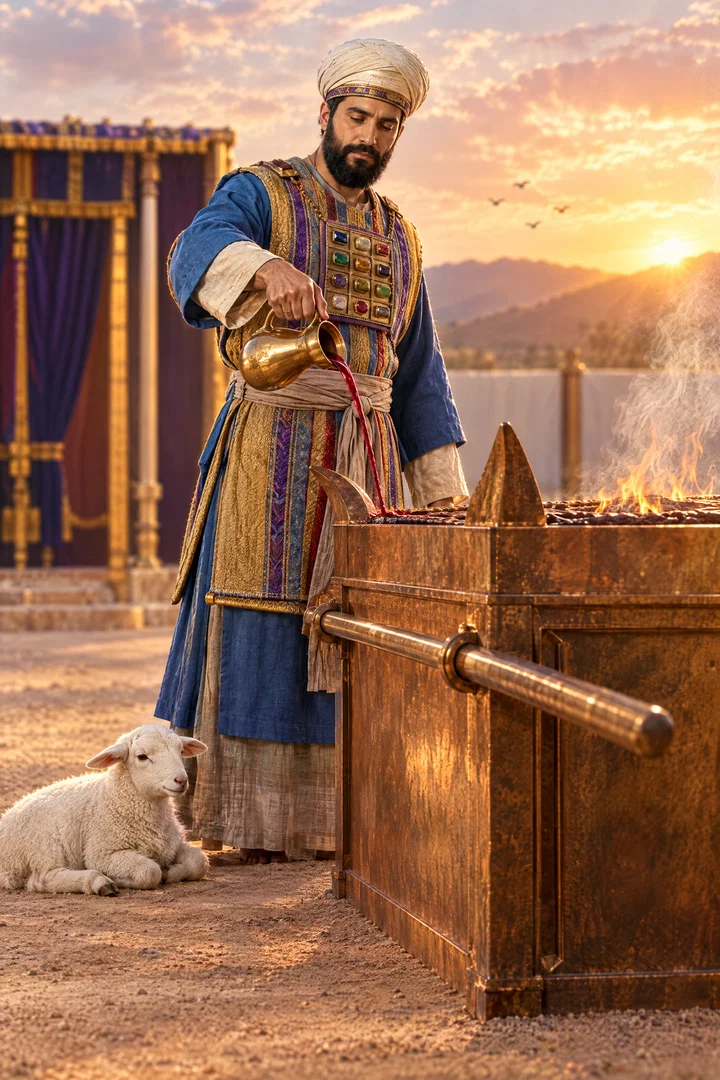
Cross-references
- Numbers 28:3-8
And thou shalt say unto them, This is the offering made by fire which ye shall offer unto the LORD; two lambs of the first year without spot day by day, for a continual burnt offering.
Prescribes the regular morning and evening lamb offerings and their accompanying offerings.
- John 1:29
The next day John seeth Jesus coming unto him, and saith, Behold the Lamb of God, which taketh away the sin of the world.
Jesus is identified as the Lamb who takes away sin.
- 1 Peter 1:19
But with the precious blood of Christ, as of a lamb without blemish and without spot:
The unblemished lamb symbolizes Christ’s perfect purity.
- Hebrews 8:4-5
For if he were on earth, he should not be a priest, seeing that there are priests that offer gifts according to the law:
Earthly offerings are a shadow of heavenly things, while Christ ministers in the true sanctuary.
- Numbers 28:9-10
And on the sabbath day two lambs of the first year without spot, and two tenth deals of flour for a meat offering, mingled with oil, and the drink offering thereof:
The Sabbath offering is distinguished from the continual daily offering.
- Hebrews 10:1
For the law having a shadow of good things to come, and not the very image of the things, can never with those sacrifices which they offered year by year continually make the comers thereunto perfect.
The law’s repeated offerings were a shadow of coming realities fulfilled in Christ’s sacrifice.
- Numbers 29:7-11
And ye shall have on the tenth day of this seventh month an holy convocation; and ye shall afflict your souls: ye shall not do any work therein:
Lists the Day of Atonement offerings, including the continual offering.
- Hebrews 10:19-22
Having therefore, brethren, boldness to enter into the holiest by the blood of Jesus,
The daily offerings pointed to the Mediator through whom sinners approach God.
- Hebrews 10:5
Wherefore when he cometh into the world, he saith, Sacrifice and offering thou wouldest not, but a body hast thou prepared me:
The sacrifices point to the body prepared for Christ.
- Hebrews 10:10
By the which will we are sanctified through the offering of the body of Jesus Christ once for all.
Christ’s once-for-all offering ended the sacrificial offerings.
- Hebrews 10:14
For by one offering he hath perfected for ever them that are sanctified.
Christ’s one offering replaces repeated burnt offerings forever.
- Hebrews 9:10
Which stood only in meats and drinks, and divers washings, and carnal ordinances, imposed on them until the time of reformation.
Describes carnal ordinances imposed until the time of reformation.
- 1 Corinthians 5:7
Purge out therefore the old leaven, that ye may be a new lump, as ye are unleavened. For even Christ our passover is sacrificed for us:
Christ is the Passover Lamb prefigured by the sacrifice.
- Hebrews 2:17
Wherefore in all things it behoved him to be made like unto his brethren, that he might be a merciful and faithful high priest in things pertaining to God, to make reconciliation for the sins of the people.
earthly priestly work types His work
- Leviticus 6:12-13
And the fire upon the altar shall be burning in it; it shall not be put out: and the priest shall burn wood on it every morning, and lay the burnt offering in order upon it; and he shall burn thereon the fat of the peace offerings.
Requires the altar fire for the continual offering to remain burning.
- Leviticus 9:4
Also a bullock and a ram for peace offerings, to sacrifice before the LORD; and a meat offering mingled with oil: for to day the LORD will appear unto you.
A meat offering mingled with oil is presented during the sanctuary dedication.
- Hebrews 9:11
But Christ being come an high priest of good things to come, by a greater and more perfect tabernacle, not made with hands, that is to say, not of this building;
Christ ministers in the greater sanctuary foreshadowed by the ancient service.
Commentary
Each commentary is drawn from primary sources: the writings of Ellen G. White and Adventist pioneers and periodicals. Each commentary is separate. Its own words are not a quotation; follow the references to read the source passages.
Ellen G. White
9 sources
This verse belongs to the directions for the regular morning and evening burnt offering of a year-old lamb upon the altar, each lamb accompanied by flour mingled with oil and by wine for a drink offering.COS 32.1–2PP 352.3CE 220.1–222.1MH 392.2–393.1ST Aug 8, 1878 The offering was made ready when the priests entered the holy place morning and evening.PP 353.3 The altar in the court where this offering was made was an altar of continual atonement set before the holy place, in contrast to the altar of perpetual intercession before the veil of the most holy.PP 353.2 Approach to God was to be by blood and by incense together, both pointing to Christ as the great Mediator through whom alone repentant believing sinners can approach God and receive mercy and salvation.PP 353.2
The lamb represented the death of the Saviour, teaching that Jesus as the Lamb of God would die for the sins of humanity.COS 32.1–2 Its required freedom from blemish symbolized His perfect purity as One who would offer Himself without defect or stain, as a lamb without blemish and without spot.PP 352.3 With its grain offering, the morning and evening lamb symbolized the nation's daily consecration to God and its constant dependence on the atoning blood of Christ.PP 352.3PP 352.2 The sacrifices illustrate what Christ's followers are to become in presenting their bodies as a living sacrifice holy and acceptable to God, giving Him the best service of life and bringing every power of being into harmony with the laws that promote ability to do His will.PP 352.3
The regular sacrifices ordered here continued as usual while Jesus, the antitypical Lamb they prefigured, lay in the tomb, and His death fulfilled the Passover symbolism.ST Aug 8, 1878 The appointed morning and evening hours of this daily service became set times for worship and prayer, observed even by Jews scattered in distant lands.PP 353.3 The daily offering provides the pattern for morning and evening worship in the Christian home, where the father serves in a sense as household priest laying the sacrifice on God's altar while wife and children unite in prayer and praise.CE 220.1–222.1MH 392.2–393.1PP 143.3–144.1
Like the patriarchs' altar wherever the tent was pitched, an altar is to be erected in every dwelling so that every house is a house of prayer.PP 143.3–144.1 Morning and evening worship gives thanks for mercies including sunshine, rain, vegetation and angelic guardianship, and seeks divine help and guidance and the abiding presence of Jesus, who loves to tarry in such a household.PP 143.3–144.1
Sources
Pioneers and periodicals
60 sources
With each daily lamb, morning and evening, was to come a tenth measure of fine flour mingled with a fourth of a hin of beaten oil as a grain offering and a fourth of a hin of wine as a drink offering, the grain burned with the lamb and the drink poured in the Holy Place as a continual burnt offering at the door of meeting.ST Jun 26, 1901RH Aug 15, 1865ST Feb 17, 1890ST Jan 14, 1886ST Feb 17, 1890
It was given to Moses on the mount for the tabernacle to be built exactly by pattern and for the consecration and continual service of Aaron and his sons before God might dwell among Israel.ST Jan 29, 1908ST Mar 25, 1889ST Nov 12, 1894RH Dec 31, 1861
It belonged to the daily ministration in the first apartment through the whole year, apart from the yearly Day of Atonement work in the most holy, by which sin was transferred into the sanctuary and made its cleansing by blood necessary.RH Feb 25, 1858RH Mar 28, 1854ST Jun 26, 1901
Together the lamb with its flour, oil and wine signified the nation's daily consecration to God and constant and complete dependence on Christ's atoning blood, the without-blemish offering pointing forward to the perfect Lamb who alone takes away sin and now ministers in the heavenly sanctuary.ST Nov 19, 1902ST May 29, 1901ST Jul 8, 1886RH Dec 12, 1854ST Apr 1, 1913
The morning and evening sacrifice sets the example for Christians to seek pardon and present requests in morning and evening prayer, and for families to gather twice daily about the family altar with confession, dedication and praise where the Lord will meet them.RH Sep 12, 1871RH Jul 2, 1914ST Apr 1, 1913RH Jul 2, 1914ST Nov 19, 1894
Instructions Setting and Purpose
Exodus 29:40 falls within the detailed instructions concerning the tabernacle and its furnishings that were given to Moses during his forty days and nights on the mountain.ST Mar 25, 1889RH Dec 31, 1861 Those instructions were given after Israel's covenant was ratified, and concerned worship whose purpose was to bring people into harmony with God's holy law.ST Mar 25, 1889 They concerned also the priesthood appointed to minister before the ark.RH Dec 31, 1861
It is part of the very minute, detailed description in Exodus 25-31 and Exodus 25-40 of the worldly sanctuary built in the days of Moses.ST Oct 29, 1894RH Aug 4, 1863ST Nov 14, 1892 Moses was instructed to make it exactly according to the pattern shown him in the mount, and the instructions were given before the sanctuary was built and set up.ST Oct 29, 1894ST Dec 10, 1896 That description is the complete account of the tabernacle to be built from offerings of gold, silver, brass, acacia wood, fine linen, goat's hair and other materials, covering its framework, coverings, rooms, furniture and vessels, in fulfillment of God's command to make Him a sanctuary that He might dwell among them.ST Mar 11, 1886
It belongs to the story told in Exodus 25 to 40 of the building, the inner tabernacle, erected by Israel at God's command in the wilderness, the building generally meant by the sanctuary.ST Jun 19, 1907 That sanctuary was later replaced by Solomon's temple as the center of God's worship on earth, where all earthly worship and service revolved around the holy of holies where the law of God rested beneath the mercy-seat.ST Jun 19, 1907 The full description beginning with Exodus 25 and continuing to the end of the book sets forth the sanctuary and its furnishings and gives the exact formula of the atonement work carried on in its two apartments.ST Mar 10, 1898
It belongs to God's explicit instructions to Moses for preparing the sanctuary's services, which presented on earth God's plan for salvation from sin and His way of dealing with sinners. It is part of the great, multiple object-lesson by forms and rites given after Israel's deliverance from Egyptian bondage to teach the great plan of salvation and the character God required. That marvelously beautiful sanctuary structure was built by workmen specially endowed by God, according to a divine pattern.
Priestly Law and Consecration
The instruction forms part of the ceremony and the account of the services connected with the consecration of the priests.ST Jan 29, 1908ST Nov 12, 1894 It is part of God's directions for the priestly rites committed to Aaron and his sons, and those rites were not for others to perform unless God specially directed them.ST Mar 3, 1914
It prescribes for the high priest the same offerings and consecration required of the cleansed leper, lambs with fine flour mingled with oil and oil. Blood was touched upon the right ear, the thumb, and the toe, and oil was placed upon the blood, meaning hearing and the service of hands and feet consecrated wholly to God. This shows the presence of the Holy Spirit wherever there is cleansing and consecration, so that the humblest child of God must be as devoted and consecrated as Christ.
It is part of the laws given through Moses concerning offerings and sacrifices, including the types that were shadows of the realities of the new dispensation. It belongs to the law of ordinances, which was written out after the moral law.ST May 6, 1875 It is part of the record of ceremonial instructions given to Moses for the people, distinct from the Ten Commandments spoken by God directly from Sinai, and these ceremonies included burdensome ordinances imposed until the time of reformation.ST Apr 15, 1886 It belongs to the ordinances of divine service connected with the first covenant, part of the sanctuary service whose ministration was called a ministration of death.ST Aug 5, 1889 It belongs to the services of the sanctuary concerning a transfer of sins.ST Jun 26, 1901
Daily Offering Details
Two lambs of the first year were offered day by day continually, one in the morning and the other at evening, each with a tenth of an ephah or tenth deal of fine flour mingled with a fourth of a hin of beaten oil and a fourth of a hin of wine for a drink offering.ST Jun 26, 1901ST Jan 14, 1886 It was done according to the morning meal offering and drink offering as a sweet savor, an offering made by fire unto the Lord.ST Jun 26, 1901ST Jan 14, 1886 It was a continual burnt offering throughout generations at the door of the tent of meeting where the Lord would meet to speak.ST Jun 26, 1901
With one lamb and with each lamb came a tenth measure of flour mixed with a fourth of a hin of beaten oil as a grain or meat offering, together with a fourth of a hin of wine, strong wine, as a drink offering.RH Aug 15, 1865ST Feb 17, 1890ST Feb 17, 1890RH Sep 16, 1852RH Mar 8, 1870 One lamb was offered in the morning and the other in the evening, and along with the other lamb offered each day these were part of Israel's regular sanctuary service.ST Feb 17, 1890ST Feb 17, 1890 The grain offering of flour mixed with oil was burned with the lamb, while the drink offering was poured in the Holy Place.RH Sep 16, 1852 These morning and evening burnt offerings with flour, oil, and wine formed the daily service in the earthly sanctuary's first apartment.RH Mar 8, 1870
The regular morning and evening burnt offering belonged to the daily ministration in the holy place, the first apartment of the earthly sanctuary, accomplished by the Levitical priesthood.RH Feb 25, 1858RH Feb 3, 1853 That daily ministration was carried forward through the entire year apart from the yearly Day of Atonement service in the most holy place.ST Oct 25, 1905 It is distinct from the yearly work in the most holy place on the tenth day of the seventh month for the sins of the people and for cleansing the sanctuary.RH Feb 3, 1853 It also embraces the burning of sweet incense, the additional work for Sabbaths, annual sabbaths, new moons and feasts, and the offerings for individuals.RH Feb 25, 1858
The daily continual service consisted of the morning and evening lamb with its meal offering of fine flour mingled with beaten oil and its drink offering of wine, together with Aaron burning sweet incense on the golden altar every morning when dressing the lamps and every evening when lighting them as perpetual incense, and special offerings for individual sins.ST Jan 14, 1886ST Jun 26, 1901ST Jun 26, 1901 It included additional offerings for sabbaths, new moons, and special feasts, and individual sin offerings by which sin was transferred through blood into the sanctuary.RH Mar 28, 1854ST Jun 26, 1901 This whole earthly daily work in the first apartment or holy place shadows Christ's continual priestly service in the heavenly sanctuary as High Priest on behalf of the people, involving the transfer of sin that makes cleansing by blood necessary and made necessary its yearly cleansing.RH Mar 28, 1854ST Jun 26, 1901ST Jun 26, 1901
The offering was made at the entrance and door of the sanctuary where God met the people when they brought their offerings.RH Sep 8, 1904RH May 5, 1851 This shows God is a personal being dwelling in a particular place called the sanctuary, whose personal presence true worship recognizes by bringing offerings there.RH Sep 8, 1904 Its smoke rose in the sanctuary during Israel's Sabbath worship.RH Oct 23, 1866
On the Day of Atonement the continual offering continued, with the evening lamb burning through the night and the morning lamb burning through the day.RH Aug 15, 1865 The lamb of the continual burnt offering was to burn all day, so it was burning during the time the high priest offered the blood of the goat to blot out sins, with the ram also burning at the same time.RH Aug 15, 1865 This proves sacrifices were not all finished before he went in with the blood, and the entire typical day was a day in which pardon might be found with mercy still open during the whole work of blotting out sins.RH Aug 15, 1865RH Aug 15, 1865
Symbol of Christ Service
The daily service with its morning and evening lamb, its incense, and the congregation's prayers kept Christ's sacrifice before the people as the way to approach God.ST Jul 8, 1930RH Feb 19, 1901 The lamb offering belonged together with the priest's incense offering and the people's prayers, whose petitions ascended with the cloud of incense while faith laid hold on the merits of the promised Saviour prefigured by the atoning sacrifice.ST Jul 8, 1930RH Feb 19, 1901 Together the daily lamb and its accompanying tenth of flour mingled with beaten oil and fourth of a hin of wine symbolized the nation's daily consecration to God and to Jehovah and its constant and complete dependence on Christ's atoning blood.ST Nov 19, 1902ST May 29, 1901ST Apr 1, 1913ST Nov 19, 1894ST Nov 19, 1902 Every offering had to be without blemish, which alone could symbolize the perfect purity of Him who offered Himself as a Lamb without blemish and without spot.ST Nov 19, 1894
These sacrifices given through Moses could not take away sin and found their fulfillment in Christ's sacrifice.ST Jul 8, 1886 The Levitical order set apart by Moses to minister before the ark containing the tables of the law in the Most Holy of the typical sanctuary while it continued offered no sacrifice that could take away sin but could only point penitent sinners forward to the great Sacrifice to be offered for men.RH Dec 12, 1854 Participation in that worship followed confession of sin and, when needed, confession of trespass.ST Sep 12, 1900 It represented presenting one's life consecrated to God in Christ's merit, receiving renewal by His power, and giving that life in His service, made possible by Christ's life implanted within.ST Sep 12, 1900ST Sep 12, 1900 One conscious of a trespass could not share in the daily burnt offering until bringing a personal trespass offering, and after being pardoned and reconciled could consecrate life anew to God and find peace.ST Sep 19, 1900
The daily offerings were made morning and evening for the sanctification of the whole congregation, the priests, and the tabernacle, so that God might dwell among Israel.ST May 29, 1901 Their typical purpose is fulfilled in the presentation of believers' bodies as holy, living sacrifices for their sanctification as a dwelling place for Him.ST May 29, 1901 The earthly sanctuary and its rites were object lessons that pointed to Christ and foreshadowed the heavenly sanctuary and its service.ST Jun 26, 1907 The temple service acknowledged Jehovah as Israel's covenant God while prayers and thanksgivings rose with the smoke of incense and sacrifice, and it was a shadow pointing beyond itself to Christ, our priest and advocate in heaven.ST Oct 24, 1900 By its regular blood sacrifice in morning and evening lamb offerings it expressed the need for blood to make atonement for sin. This continual burnt-offering service taught the gospel truths of the true offering for sin, forgiveness, and the continual service owed to God.RH Aug 27, 1908
The tabernacle built by Moses was a shadow of heavenly things whose continual service foreshadowed the outer apartment of the heavenly sanctuary where God's throne is and God sits enthroned.RH Nov 6, 1900 The real work performed there by Christ for people on earth deals with the physical and spiritual nature of man just as the typical work did, enabling people to become the temple of God and be fitted for a habitation of God through the Spirit.RH Nov 6, 1900 When Christ dwells in the heart by faith man is restored to being the temple of the living God, where continual service centered in Jesus is carried forward by the indwelling eternal Son.RH Nov 25, 1902 The prescribed offerings for the ancient tabernacle's sacrificial ministry passed away when Christ suffered and died once for all, and the sanctuary it represented is in heaven where Jesus now ministers.ST Jan 24, 1911 Yet those regular morning and evening sacrifices continued as usual while Jesus, the antitypical Lamb they prefigured, lay in the tomb, His death fulfilling the Passover symbolism.ST Aug 8, 1878 The continual burnt offering with its accompanying offerings symbolizes the unbroken life union and service between God and His people, representing life, light, and power from God; faithful obedience sustains this bond, while transgression breaks it and opens the way for the continual service to be taken away.ST Mar 12, 1912
Daily Worship Pattern
Under the Jewish dispensation the morning and evening sacrifice meant a morning hour and an evening hour for prayer, when the pious Jew offered prayer while the priests interceded through sacrifice and incense and the Levites stood every morning and evening to offer praise and thanksgiving.RH Sep 12, 1871RH Jul 2, 1914 The daily atoning sacrifice was offered every morning and evening upon the altar in the court outside while the priests entered the holy place at the time of incense, with its lamb burned with its appropriate meat offering of flour mingled with beaten oil and wine for a drink offering.RH Sep 12, 1871RH Jul 2, 1914ST Nov 19, 1894 It was a time of intense interest to the worshipers assembled, who engaged in earnest searching of heart and confession of sin and united in silent prayer with faces toward the holy place, their petitions ascending with the cloud of incense while faith laid hold upon the merits of the promised Saviour prefigured by the atoning sacrifice.RH Jul 2, 1914 The hours appointed were regarded as sacred and observed as the set time for worship throughout the nation, and when scattered as captives in distant lands the Jews still at the appointed hour turned toward Jerusalem in petition.RH Jul 2, 1914ST Nov 19, 1894 Those rites are now gone, for by Christ's one offering believers are perfected and God takes no pleasure in burnt offerings for sin, and there is no holy temple for morning and evening worship, but in this custom Christians have an example for morning and evening prayer to seek pardon for sins committed and to present requests for needed blessings.RH Sep 12, 1871RH Jul 2, 1914ST Nov 19, 1894
The verse establishes the pattern for Christian families to gather morning and evening around the family altar with grateful praise and earnest supplication from the whole household, a voice sweeter before the throne of mercy than an offering of sweet savor made by fire, where the Lord will meet His children as He met Israel at the door of the tabernacle.RH Sep 12, 1871 The daily service with its lamb and accompanying grain, oil, and wine symbolized daily consecration and complete dependence, and also provides the example for morning and evening family worship offered twice each day and observed regularly.ST Apr 1, 1913ST Aug 16, 1883ST Nov 19, 1894 The father is in one sense the priest of the household laying the morning and evening sacrifice upon God's altar, and the mother takes this place when he is absent.RH Jul 2, 1914
The home morning and evening sacrifice means confessing to God morning and evening the sins committed through the day by oneself and one's children, both those known and those secret and seen by God's eye alone, and dedicating the children to God.RH Jul 2, 1914 Zealously doing this brings blessings to the family and protects children thus dedicated in the hour of temptation.RH Jul 2, 1914 The morning and evening offerings are pictured as blessed incense whose fragrance a person carries from a home shaped by family worship.ST May 21, 1912
The daily sacrifice offered morning and evening shows that presenting the body as a living sacrifice means denying every harmful thing so God can make the person acceptable, with clear mind and spiritual susceptibility to be transformed by the renewing of the mind to prove the good and acceptable and perfect will of God.RH Oct 23, 1913 The sacrifice is not made once for all time but daily, morning and evening, dying daily in absolute surrender of all that a person is, returning to God what already belongs to Him because people are not their own but are bought with a price.RH Oct 23, 1913 Now is the time to make this covenant by sacrifice before the gathering of the saints.RH Oct 23, 1913
Sources