Leviticus 7:30
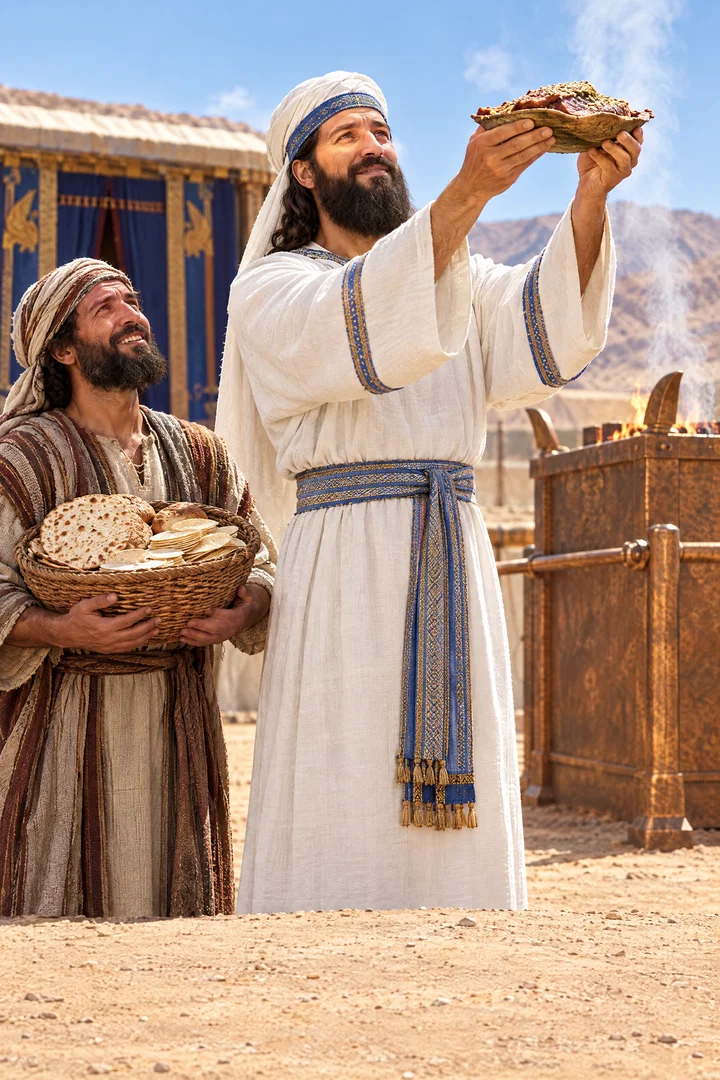
His own hands shall bring the offerings of the LORD made by fire, the fat with the breast, it shall he bring, that the breast may be waved for a wave offering before the LORD.
Translations
American King James Version, King James Version
His own hands shall bring the offerings of the LORD made by fire, the fat with the breast, it shall he bring, that the breast may be waved for a wave offering before the LORD.
His own hands shall bring the offerings of the Lord made by fire, the fat with the breast, it shall he bring, that the breast may be waved for a wave offering before the Lord.
His own hands shall bring the offerings of the LORD made by fire, the fat with the breast, that shall he bring, that the breast may be waved for a wave-offering before the LORD.
his own hands shall bring the offerings of the LORD made by fire; the fat with the breast shall he bring, that the breast may be waved for a wave offering before the LORD.
his own hands shall bring the offerings of Jehovah made by fire; the fat with the breast shall he bring, that the breast may be waved for a wave-offering before Jehovah.
his own hands do bring in the fire-offerings of Jehovah, the fat beside the breast, it he doth bring in with the breast, to wave it — a wave-offering before Jehovah.
His own hands shall bring Jehovah's offerings by fire, the fat with the breast shall he bring: the breast, that it may be waved as a wave-offering before Jehovah.
his own hands shall bring in the altar-flames of Yahweh,—the fat with the breast, he shall bring it in, the breast, to wave it as a wave-offering before Yahweh.
With his own hands he is to bring the offerings made by fire to the LORD; he shall bring the fat, together with the breast, and wave the breast as a wave offering before the LORD.
With his own hands he is to bring the food offerings to the LORD; he shall bring the fat, together with the breast, and wave the breast as a wave offering before the LORD.
With his own hands he shall bring the offerings of the LORD made by fire. He shall bring the fat with the breast, that the breast may be waved for a wave offering before the LORD.
He himself is to take to the Lord the offering made by fire, even the fat with the breast, so that the breast may be waved for a wave offering before the Lord.
His handes shall bring the offerings of the Lord made by fire: euen the fatte with the breast shall he bring, that the breast may be shaken to and from before the Lord.
Douay-Rheims (Challoner revision)
He shall hold in his hands the fat of the victim, and the breast: and when he hath offered and consecrated both to the Lord, he shall deliver them to the priest,
Pictures
Cross-references
- John 1:29
The next day John seeth Jesus coming unto him, and saith, Behold the Lamb of God, which taketh away the sin of the world.
The peace-offering foreshadows Christ, the Lamb whose sacrifice takes away sin.
- Hebrews 8:3-5
For every high priest is ordained to offer gifts and sacrifices: wherefore it is of necessity that this man have somewhat also to offer.
Earthly offerings serve as a pattern of Christ’s heavenly ministry.
- Leviticus 3:3-5
And he shall offer of the sacrifice of the peace offering an offering made by fire unto the LORD; the fat that covereth the inwards, and all the fat that is upon the inwards,
Describes the peace offering and its fat burned to the LORD.
- Hebrews 9:8-12
The Holy Ghost this signifying, that the way into the holiest of all was not yet made manifest, while as the first tabernacle was yet standing:
Contrasts the earthly sanctuary service and its offerings with Christ’s greater priestly work and sacrifice.
- Hebrews 9:23-24
It was therefore necessary that the patterns of things in the heavens should be purified with these; but the heavenly things themselves with better sacrifices than these.
The earthly offering service pictured Christ’s work in the heavenly sanctuary.
- Leviticus 10:14-15
And the wave breast and heave shoulder shall ye eat in a clean place; thou, and thy sons, and thy daughters with thee: for they be thy due, and thy sons’ due, which are given out of the sacrifices of peace offerings of the children of Israel.
The wave breast and heave shoulder are waved before the LORD and given to the priests.
- Numbers 18:11
And this is thine; the heave offering of their gift, with all the wave offerings of the children of Israel: I have given them unto thee, and to thy sons and to thy daughters with thee, by a statute for ever: every one that is clean in thy house shall eat of it.
Both assign the wave offering to the priests and specify who may share in it.
- Leviticus 3:16
And the priest shall burn them upon the altar: it is the food of the offering made by fire for a sweet savour: all the fat is the LORD’s.
Both describe fat being offered to the Lord by fire.
- Leviticus 7:15-21
And the flesh of the sacrifice of his peace offerings for thanksgiving shall be eaten the same day that it is offered; he shall not leave any of it until the morning.
Gives rules for eating the peace offering flesh.
- Hebrews 10:3-4
But in those sacrifices there is a remembrance again made of sins every year.
Repeated animal sacrifices recalled sin but could not remove it.
- Leviticus 3:17
It shall be a perpetual statute for your generations throughout all your dwellings, that ye eat neither fat nor blood.
shows people forbidden to eat any fat
- Deuteronomy 18:3-5
And this shall be the priest’s due from the people, from them that offer a sacrifice, whether it be ox or sheep; and they shall give unto the priest the shoulder, and the two cheeks, and the maw.
defines the flesh portion allowed to priests
- 1 Samuel 2:13-16
And the priests’ custom with the people was, that, when any man offered sacrifice, the priest’s servant came, while the flesh was in seething, with a fleshhook of three teeth in his hand;
Eli’s sons seize sacrificial portions contrary to the offering’s prescribed handling.
- Hebrews 10:1
For the law having a shadow of good things to come, and not the very image of the things, can never with those sacrifices which they offered year by year continually make the comers thereunto perfect.
The earthly service is a shadow, not the full reality.
- Hebrews 9:12
Neither by the blood of goats and calves, but by his own blood he entered in once into the holy place, having obtained eternal redemption for us.
Christ’s once-for-all ministry contrasts with the yearly type.
- Leviticus 6:30
And no sin offering, whereof any of the blood is brought into the tabernacle of the congregation to reconcile withal in the holy place, shall be eaten: it shall be burnt in the fire.
Sin offerings whose blood entered the sanctuary were burned, so priests received no meat.
- Romans 12:1
I beseech you therefore, brethren, by the mercies of God, that ye present your bodies a living sacrifice, holy, acceptable unto God, which is your reasonable service.
Applied in the call to present the body as a living sacrifice.
Commentary
Each commentary is drawn from primary sources: the writings of Ellen G. White and Adventist pioneers and periodicals. Each commentary is separate. Its own words are not a quotation; follow the references to read the source passages.
Ellen G. White
3 sources
Each person was required to bring the Lord's offering with his own hands, a duty that could not be performed by someone else on his behalf.RH May 13, 1902 This is the law of the peace offerings, which were especially an expression of thanksgiving to God.PP 576.1–2 The one bringing the offering was to bring its fat with the breast before the Lord, so that the breast might be waved for a wave offering.ST Oct 14, 1913
The fat belonged to God alone, was to be burned upon the altar to Him first, and was not to be eaten.ST Oct 14, 1913PP 576.1–2 The breast and right shoulder, with certain smaller specified portions, were allotted to and reserved for the priests.ST Oct 14, 1913PP 576.1–2 The remaining and greater part of the meat was returned to the offerer to be eaten by him and his friends in a sacrificial feast.ST Oct 14, 1913PP 576.1–2
The priests had no right to take their portion before the fat had been separated and offered to God, so to demand more than the allotted priestly part and to refuse to wait until the fat was burned was a violation.ST Oct 14, 1913PP 576.1–2 Such misuse turned the solemn symbolic service into self-indulgence.PP 576.1–2 The sacrifices pointed forward to the death of Christ and were designed to preserve faith in the coming Redeemer, directing all hearts in gratitude and faith to the great Sacrifice that takes away the sin of the world.PP 576.1–2 Because of that forward-pointing purpose, the directions had to be strictly heeded in the most solemn manner.PP 576.1–2
Sources
Pioneers and periodicals
19 sources
The law required the worshiper himself to bring with his own hands the fat with the breast of his peace offering, that the breast might be waved before the Lord.ST Oct 14, 1913RH Feb 25, 1904RH Jun 13, 1912 The animal was to be young, healthy and without blemish, slain by the offerer with its blood sprinkled by the priest around the altar, while the great number of such offerings eaten by the worshipers showed the crowds gathered at Jerusalem.RH Mar 31, 1868ST Oct 22, 1896ST Sep 19, 1900 The fat belonged to the Lord and was separated and burned on the altar and never eaten, the waved breast and right shoulder going to the priest and the remaining lean meat to the offerer, so the priests had no right to take meat before the fat was offered to God.ST Oct 14, 1913ST Dec 1, 1881RH Mar 31, 1868ST Sep 19, 1900 These offerings were shadows pointing forward in faith to Jesus Christ and His sacrifice at Calvary as a sweet savor, with the separated fat representing sin which Christ the sinless antitype did not possess, and with the sprinkled blood and the priest's eating leaving forgiven sins in the sanctuary in figure as Christ bears sins in the heavenly sanctuary until its final cleansing.RH Feb 25, 1904RH Jun 13, 1912ST Feb 3, 1909ST Nov 28, 1895ST No one could do this work for another, for as the sinner with his own hands searched the victim and removed every portion of fat, so each person must personally put away sin that sin may be burned without the sinner, a meaning obscured when Hophni and Phinehas seized the meat before the fat was separated and took by force what belonged to the altar.RH May 13, 1902ST Dec 1, 1881RH Feb 25, 1904RH Jun 27, 1912RH Jun 13, 1912
Ritual Directions Given
This belongs to the ceremonial law of sacrifices and offerings instituted in consequence of sin.RH Jan 10, 1916 It is part of the laws concerning Israelite offerings, including sin-offerings, peace-offerings and thank-offerings, which cost the worshiper something according to his wealth or position.ST Aug 16, 1883 It is among the instructions for the particular offerings the people brought during the year as part of the regular ministry of the earthly sanctuary.RH Mar 8, 1870
It directs the peace offering, whose flesh was eaten.ST Oct 22, 1896 The very large number of animals so offered at Jerusalem indicates the great crowd of worshipers gathered there.ST Oct 22, 1896
The offerer himself was to bring with his own hands the offering made by fire to the Lord, the fat with the breast, that the breast might be waved for a wave offering before the Lord.ST Oct 14, 1913ST Dec 1, 1881ST Apr 6, 1888RH Feb 25, 1904RH Jun 13, 1912 He brought the fat and the breast to the priest for this waving before the Lord.ST Oct 14, 1913ST Dec 1, 1881RH Feb 25, 1904
The peace offering had to be without blemish, from young, healthy animals.RH Mar 31, 1868ST Sep 19, 1900 The offerer slaughtered the animal, and the priest sprinkled its blood around the altar.ST Sep 19, 1900
The fat belonged to God and was to be separated and burned on the altar, even over the burnt offering, and was not to be eaten.ST Oct 14, 1913ST Dec 1, 1881ST Sep 19, 1900 The breast and right shoulder, with certain smaller specified portions, were allotted to the priest, and the remaining meat was for the offerers.ST Oct 14, 1913ST Dec 1, 1881 The rest after the priest's portions was eaten by the offerer.ST Dec 1, 1881ST Sep 19, 1900
The meat the priests were allowed to eat from wave and peace offerings was therefore only lean meat left after all the fat was burned to the Lord.ST Oct 14, 1913RH Mar 31, 1868 It came not from burnt offerings nor from any beast whose blood was carried into the sanctuary.RH Mar 31, 1868 The priests had no right to take meat before the fat was separated and offered to God.ST Oct 14, 1913ST Dec 1, 1881ST Apr 6, 1888
Christ Foreshadowed Here
The details of the law of sacrifices and offerings have meaning whose fuller meaning is found in the sacrifice, life, and work of Jesus Christ.ST Feb 7, 1911 They belong to the instructions describing the sanctuary and its service, which was an object lesson in which the earthly service was a type of Christ's priestly work in the heavenly sanctuary, so that studying it helps explain that work.ST Feb 7, 1911ST Jun 19, 1907 The offerings were shadows fulfilled in Jesus Christ, showing God's hatred of sin and that sin demands a penalty.ST Feb 3, 1909 These individual sacrifices brought to the sanctuary continually recalled sin and pointed forward to Christ, and worshipers brought them themselves as an expression of faith in the coming Redeemer.ST Feb 3, 1909ST Apr 2, 1912
The offerer with his own hands was to bring the fat with the breast of the offering made by fire, that the breast might be waved before the Lord.RH Feb 25, 1904RH Jun 13, 1912 In this type the fat separated from the offering represented sin, while Christ the antitype had no sin.RH Feb 25, 1904RH Jun 13, 1912 The sinner personally searched the sacrifice and removed every portion of fat, then gave it to the priest to burn on the altar, representing the separating of sin from the sinner so that sin is burned without the sinner, as a sweet savor to the Lord.RH Feb 25, 1904 The burning of the fat was a type of Christ's sacrifice, for the sacrifice itself represented Christ and His sacrifice at Calvary.ST Dec 1, 1881ST Apr 6, 1888RH Feb 25, 1904 The fat was burned on the altar and was not to be eaten, while the breast and right shoulder with other specified parts belonged to the priest and the rest was eaten by the offerer.ST Dec 1, 1881
The verse shows one of the individual offerings by which a sinner in faith transferred his sin in figure to the sanctuary through the blood of the sacrifice or the person of the priest.ST When the priest sprinkled the blood upon the altar before the ark the forgiven sins were left there in figure in the sanctuary.ST The priests' eating of the designated portions while bearing the people's sins before God pictured Christ bearing sins in the heavenly sanctuary.ST Apr 6, 1888 This transferring work went on through the year until the tenth day of the seventh month, when the high priest cleansed the sanctuary of that accumulated uncleanness and transgression.ST He then confessed all the iniquities of Israel over the goat for Azazel and sent it away, so that every soul who availed himself of the provision stood free from sin.ST The yearly service of the Levitical sanctuary with its priesthood and offerings served as a type of Christ's priesthood and ministry in the heavenly sanctuary, the yearly service representing Christ's once-for-all work and its final-day cleansing of the sanctuary representing the judgment work at the close of His ministry.ST Nov 28, 1895ST
Personal Duty Applied
Each person is responsible to bring the Lord's offering with his own hands, a duty that cannot be performed by another on his behalf.RH May 13, 1902 The offerer himself brings the fat with the breast to the priest, that the breast may be waved before the Lord.RH Feb 25, 1904RH Jun 13, 1912 The sinner personally searches the sacrifice and with his own hands separates and removes every portion of fat, then gives it to the priest to burn on the altar.RH Feb 25, 1904RH Jun 27, 1912 That act pictures personally putting sin away, separating sin from the sinner so that sin is burned without the sinner, as a sweet savor to the Lord.RH Feb 25, 1904RH Jun 27, 1912RH Jun 13, 1912
The fat thus separated represents sin, while Christ the antitype had no sin.RH Jun 13, 1912 The offering represents the offerer and its life stands for his life, and the offerings cost the worshiper something according to his wealth or position.ST Aug 16, 1883ST Sep 19, 1900 Finding peace involves willingly giving one's life to God for service to others.ST Sep 19, 1900 The fat is burned on the altar as a type of Christ's sacrifice, the breast and right shoulder with other specified portions belong to the priest, the rest is eaten by the offerer, and the fat must not be eaten.ST Dec 1, 1881
Hophni and Phinehas violated these directions by demanding the meat before the fat was separated, by claiming the fat for themselves, and by taking by force the portion meant for the altar.ST Dec 1, 1881ST Apr 6, 1888 This robbed the people and dishonored the sacred offering, whose portions had assigned purposes.ST Dec 1, 1881ST Apr 6, 1888 Their irreverence caused the people to despise the offering and obscured its meaning as a type of Christ's sacrifice at Calvary, whereas the priests' eating of the designated portions while bearing the people's sins before God pictured Christ bearing sins in the heavenly sanctuary.ST Apr 6, 1888 The flesh the priests were allowed to eat from wave and peace offerings was strictly limited to a lean portion, the breast brought with its fat to be waved and then with all the fat burned to the Lord, leaving only lean meat for them.RH Mar 31, 1868 That meat came only from young, healthy animals without blemish, not from burnt offerings and not from any beast whose blood was carried into the sanctuary, so the permission gives no license to eat swine's flesh swimming in grease or diseased and fat meat, which remains unwholesome and unfit for feeble men and women, and confirms the teaching on health reform.RH Mar 31, 1868
Sources