Luke 15:6
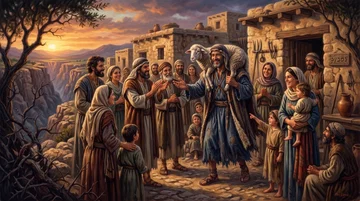
And when he cometh home, he calleth together his friends and neighbours, saying unto them, Rejoice with me; for I have found my sheep which was lost.
Translations
And when he comes home, he calls together his friends and neighbors, saying to them, Rejoice with me; for I have found my sheep which was lost.
King James Version, KJV Cambridge Paragraph Bible
And when he cometh home, he calleth together his friends and neighbours, saying unto them, Rejoice with me; for I have found my sheep which was lost.
And when he cometh home, he calleth together his friends and neighbors, saying to them, Rejoice with me; for I have found my sheep which was lost.
And when he cometh home, he calleth together his friends and his neighbours, saying unto them, Rejoice with me, for I have found my sheep which was lost.
And when he cometh home, he calleth together his friends and his neighbors, saying unto them, Rejoice with me, for I have found my sheep which was lost.
and having come to the house, he doth call together the friends and the neighbours, saying to them, Rejoice with me, because I found my sheep — the lost one.
and being come to the house, calls together the friends and the neighbours, saying to them, Rejoice with me, for I have found my lost sheep.
and, coming unto his house, calleth together the friends and the neighbours, saying unto them—Rejoice with me! because I have found my sheep that was lost!
Berean Standard Bible, Majority Standard Bible
comes home, and calls together his friends and neighbors to tell them, ‘ Rejoice with me, for I have found my lost sheep!’
When he comes home, he calls together his friends and his neighbors, saying to them, ‘ Rejoice with me, for I have found my sheep which was lost!’
And when he gets back to his house, he sends for his neighbours and friends, saying to them, Be glad with me, for I have got back my sheep which had gone away.
And when he commeth home, he calleth together his friendes and neighbours, saying vnto them, Reioyce with mee: for I haue founde my sheepe which was lost.
Douay-Rheims (Challoner revision)
And coming home, call together his friends and neighbours, saying to them: Rejoice with me, because I have found my sheep that was lost?
Pictures








Cross-references 20 of 39
- Luke 15:24
For this my son was dead, and is alive again; he was lost, and is found. And they began to be merry.
The father welcomes and celebrates his repentant son, who was lost and is found.
- Luke 19:10
For the Son of man is come to seek and to save that which was lost.
Christ’s mission to seek and save the lost matches the shepherd’s finding his lost sheep.
- Matthew 18:12-13
How think ye? if a man have an hundred sheep, and one of them be gone astray, doth he not leave the ninety and nine, and goeth into the mountains, and seeketh that which is gone astray?
Both portray the shepherd seeking a lost sheep and rejoicing when he finds it.
- John 10:11
I am the good shepherd: the good shepherd giveth his life for the sheep.
Christ is the Good Shepherd who cares for the lost sheep.
- Luke 15:10
Likewise, I say unto you, there is joy in the presence of the angels of God over one sinner that repenteth.
Both describe joy among God’s angels over a repentant sinner.
- Luke 15:1-2
Then drew near unto him all the publicans and sinners for to hear him.
The sheep story answers the Pharisees’ complaint about Jesus receiving sinners.
- Isaiah 53:6
All we like sheep have gone astray; we have turned every one to his own way; and the LORD hath laid on him the iniquity of us all.
All have strayed like sheep, and their iniquity is laid on the Lord’s servant.
- Hebrews 13:20
Now the God of peace, that brought again from the dead our Lord Jesus, that great shepherd of the sheep, through the blood of the everlasting covenant,
Calls Jesus the great Shepherd of the sheep.
- Ezekiel 34:16
I will seek that which was lost, and bring again that which was driven away, and will bind up that which was broken, and will strengthen that which was sick: but I will destroy the fat and the strong; I will feed them with judgment.
Both describe the Shepherd seeking and restoring the lost.
- Luke 15:32
It was meet that we should make merry, and be glad: for this thy brother was dead, and is alive again; and was lost, and is found.
The father says it is right to celebrate the lost brother’s return.
- Isaiah 40:11
He shall feed his flock like a shepherd: he shall gather the lambs with his arm, and carry them in his bosom, and shall gently lead those that are with young.
Both depict the Shepherd gathering and carrying lambs close to himself.
- Psalms 23:2
He maketh me to lie down in green pastures: he leadeth me beside the still waters.
The Lord leads his sheep to green pastures and still waters.
- John 10:16
And other sheep I have, which are not of this fold: them also I must bring, and they shall hear my voice; and there shall be one fold, and one shepherd.
Christ gathers his lost sheep into one flock under one Shepherd.
- Matthew 10:6
But go rather to the lost sheep of the house of Israel.
Both describe seeking Israel’s lost sheep.
- Zephaniah 3:17
The LORD thy God in the midst of thee is mighty; he will save, he will rejoice over thee with joy; he will rest in his love, he will joy over thee with singing.
Both picture God rejoicing with singing over the rescued.
- John 21:16-17
He saith to him again the second time, Simon, son of Jonas, lovest thou me? He saith unto him, Yea, Lord; thou knowest that I love thee. He saith unto him, Feed my sheep.
Jesus commands Peter to care for his sheep, echoing the gathering of the lost sheep.
- John 10:14
I am the good shepherd, and know my sheep, and am known of mine.
Jesus is the Good Shepherd who knows his sheep.
- Psalms 119:176
I have gone astray like a lost sheep; seek thy servant; for I do not forget thy commandments.
Both picture a wanderer as a lost sheep needing to be sought.
- John 10:3
To him the porter openeth; and the sheep hear his voice: and he calleth his own sheep by name, and leadeth them out.
The shepherd calls his own sheep by name.
- Matthew 18:11
For the Son of man is come to save that which was lost.
Both present Christ’s mission to save the lost.
Commentary part 1 of 2
Each commentary is drawn from primary sources: the writings of Ellen G. White and Adventist pioneers and periodicals. Each commentary is separate. Its own words are not a quotation; follow the references to read the source passages.
Ellen G. White
125 sources
When the shepherd finds his lost sheep he carries it home rejoicing and calls his friends and neighbors together to share his joy because what was lost is found.7T 241.1–26T 124.1–2CT 198.2–3TCBMP 120.1–2Ms 118, 1898, par. 4–5 The story was spoken when publicans and sinners drew near to hear Jesus and the Pharisees and scribes murmured that He receives sinners and eats with them.ST Nov 20, 1893Ms 118, 1898, par. 1–3Ms 102, 1894, par. 12–14 The shepherd is Christ the faithful Redeemer, the lost sheep is the individual sinner who has wandered from God and cannot find the way back, and the friends and neighbors called to rejoice are the angels in heaven and on earth, while those who held it also teach that the one lost sheep is the fallen world and the ninety and nine are the sinless worlds that went not astray.COL 185.1–186.3Ms 165, 1898, par. 15–17Lt 89, 1894, par. 13–14Ms 118, 1898, par. 17–18COL 190.3 That homecoming rejoicing pictures the joy in heaven over one sinner who repents, a joy so great the shepherd cannot bear it alone but his song reaches the heavenly courts where angels take up the strain and the Father rejoices with singing.COS 89.1–5ST Nov 20, 1893RH Jan 19, 19114T 263.3–264.1Ms 17, 1895, par. 8 The call to rejoice shows the infinite worth God places on every lost person purchased by Christ's blood, for whom the Son left heaven for humiliation and death, and it lays upon the church and its ministers the work of leaving the safe fold to seek the straying with tender pitying love and bring them safely home.2T 218.1Ms 24, 1895, par. 18ST Nov 20, 1893AA 370.28T 72.3
Setting and Storyline
The verse belongs to the parable of the lost sheep, spoken because publicans and sinners drew near to hear Jesus and the Pharisees and scribes murmured that He receives sinners and eats with them.ST Nov 20, 1893Ms 118, 1898, par. 1–3Ms 102, 1894, par. 12–14Lt 80, 1898, par. 3–5 The shepherd coming home and calling friends and neighbors to rejoice over the found sheep lays rebuke on the leaders of Israel for neglecting those who needed compassion and tenderness, exposing self-righteous pride that failed to value mercy, goodness and truth.Ms 118, 1898, par. 1–3Ms 102, 1894, par. 12–14Lt 80, 1898, par. 3–511MR 367.3–368.1 The lesson was given gently as a symbol that would not close hearts, so that some hearers could later be convicted and after the ascension join the disciples.11MR 367.3–368.1
The lost-sheep parable stands together with the lost piece of silver and the prodigal son, with the sheep spoken immediately before the silver and then carried still farther by the silver and the prodigal son.Ms 186, 1898, par. 17Lt 71, 1895, par. 27DA 495.4 It was repeated on the last journey, and its call to rejoice expresses Christ's own joy over recovered sinners, a joy the disciples could not fully appreciate until after the outpouring of the Holy Spirit when the ingathering of the Gentiles and the anger of the Jews made its meaning plain.DA 495.4 It is illustrated as a concrete daily scene drawn from common shepherd work, teaching what shapes character, deepens knowledge of God, and concerns conduct in this life and eternity.COL 23.1CT 261.1DA 253.6–254.1 Familiar sights of shepherd and sheep would afterward bring the teaching back to mind, making truth a living reality constantly repeated, linking heaven and earth and preparing men better for everyday duties while revealing God and eternal realities.CT 261.1DA 253.6–254.1
The shepherd leaves the ninety and nine in the fold, in the shelter of the fold, to go into the desert wilderness in dark night, storm and severe tempest, over mountains and valleys.COS 83.6–84.3ST May 24, 189915MR 141.2–3FE 272.2–274.1 He calls the lost sheep by name at every step, listening for its terrified faint dying cry, relieved at its first faint cry and continuing until its much weaker cry shows it ready to die.Ms 118, 1898, par. 14–15ST May 24, 1899 He hunts through dangerous places, tangled briers and pitfalls, climbing the steepest heights at risk of life to the edge of the precipice, using every resource and continuing without rest through frost and sleet until after painstaking effort the lost is found.COS 83.6–84.3Ms 118, 1898, par. 14–15ST May 24, 189915MR 141.2–3 He follows with winning invitations to return, not with harsh words and a whip, and his whole heart and soul and energies are taxed to seek the one that is lost while the ninety and nine that had not strayed do not call for the same sympathy and tender pitying love.FE 272.2–274.1
When found the trembling, frightened, distressed, bruised and wounded sheep is not driven with a whip, scolded, blamed, condemned, left in weakness to walk back, or merely led back.TCBMP 120.1–2Ms 118, 1898, par. 4–5Ms 17, 1895, par. 6–7Lt 109, 1895, par. 14–185T 603.3 It is laid on the shoulders rejoicing, taken in the arms close to the bosom that the shepherd's own vitality and the warmth of his heart may give it life and inspire courage, and carried home rejoicing at every step.COS 83.6–84.3Ms 118, 1898, par. 4–5Lt 109, 1895, par. 14–185T 603.3 There is no complaint about the long hard search and no dwelling on the trouble caused, and no picture is given of a sorrowful shepherd returning without the sheep.COS 83.6–84.3TCBMP 120.1–2FE 272.2–274.1 The recovery outweighs the sorrow, care, perplexity, danger and peril of the search, and the finding cost deep waters crossed and dark night passed through, with blood shed along the mountain track and hands rent and pierced by thorns to bring the fainting, helpless, dying stray back from the desert.TCBMP 120.1–2Lt 109, 1895, par. 14–18
Coming home he calls together his friends and neighbors to rejoice with him because the lost sheep is found, singing instead of mourning and pitying himself.7T 241.1–26T 124.1–2CT 198.2–3ST May 24, 1899Ms 118, 1898, par. 4–5 His joy is too great to bear alone, so he calls for rejoicing at every step of the return and gathers others to share and celebrate the recovery with thanksgiving.Ms 4, 1900, par. 15GW 182.3Ms 118, 1898, par. 14–15ST May 24, 1899 The rejoicing on earth reflects the joy in heaven when one sinner repents, shared by heaven and earth.7T 241.1–2ST May 24, 1899Ms 4, 1900, par. 15GW 182.3Lt 69, 1893, par. 6–8
Symbols and Meaning
The lost sheep is the individual sinner who has wandered from God and strayed from the fold into the wilderness and upon the mountains.COL 185.1–186.3COL 187.3ST Jan 22, 1894COL 193.3–194.1 Like a sheep it is the most helpless of all creatures, unable to find its way back by itself and unable to recover itself, knowing it is lost and separated from God in a cloud of perplexity, mist, humiliation and sore temptation, wandering until it perishes unless divine love comes to its rescue, seeks it, carries it home and meets it with tender sympathetic care rather than contempt.COL 187.3ST Jan 22, 1894GW 183.3–184.1HL 277.1COL 193.3–194.1 Its misery and sin do not repel the Father but make it the object of greater compassion, calling forth earnest longing, patient persevering search, and sacrifice for its return and restoration.COL 185.1–186.3ST Jan 22, 1894
The one lost sheep is also the one fallen world that apostatized and was ruined by transgression of the law of God.COL 190.3ST Apr 6, 1915Ms 118, 1898, par. 11–12COS 118.1–4 This world is only an atom in the vast dominions over which God presides, yet this little fallen world is more precious in His sight than the ninety and nine that went not astray from the fold, and the ninety and nine are the sinless worlds on high that loved Christ and went not astray.COL 190.3ST Apr 6, 1915 To gain the joy of receiving back what was lost, God gave Himself in His Son, the loved Commander in the heavenly courts and Majesty of heaven, who stooped from His high estate, laid aside the glory He had with the Father, left the ninety and nine and the courts where all is purity, happiness and glory, and came to this earth to be wounded and bruised, to pay the redemption price upon the cross of Calvary and bring it back to the Father's fold.COL 190.3HSFM 288.5COS 118.1–4 In Gethsemane He saw the helplessness of man, the power of sin and the woes of a doomed world, and knew He must drink the cup or the world would be lost forever, making the final decision to save man at any cost to Himself and not turn from His purpose.COS 118.1–4 The call to friends to rejoice means calling others to rejoice when Satan has lost his prey and singing when the search is not in vain, and the parable speaks not of failure but of success and joy in the recovery, in which all heaven is interested and for which everyone rescued by Christ is called to work for the salvation of others.ST Apr 6, 1915Ms 118, 1898, par. 11–12Lt 69, 1893, par. 9–10
The shepherd is Christ, the good, faithful and sinless Redeemer, who does not despise one of His little ones when lost but goes out into the desert and searches until He finds it at cost to Himself, then lays it on His shoulders and holds it to His breast of infinite love with rejoicing.Ms 165, 1898, par. 15–17ST May 28, 1912 The friends and neighbors called to rejoice with Him over the recovered sheep are the angels in heaven and on earth, and His song of rejoicing reaches the heavenly courts, where angels take up the glad strain and the Lord Himself joins in the anthem of joy and gladness.Ms 165, 1898, par. 15–17Ms 118, 1898, par. 17–18 When a wanderer returns with the Shepherd and ceases to sin, Christ speaks to the angels in heaven to rejoice with Him because He has found His lost sheep, and their joyful anthem fills all heaven with richest melody.COS 84.7–9 Jesus restores the repentant sinner to the fold and calls His friends and neighbors in heaven and on earth to rejoice when the lost sheep is found, picturing return to the fold and to heaven, and His work is to restore and build up the erring, not to keep them burdened by their past sins.Lt 89, 1894, par. 13–14 Ministers and Christian workers who leave the ninety and nine to hunt for the one until he finds it and returns bearing it on his shoulder with rejoicing show the connection of heavenly angels with the Christian's work for souls, for angels of God have watched his efforts with intense interest and rejoice with him in his success, revealing more joy in the presence of the angels in heaven over one sinner that repents than over ninety and nine just persons who need no repentance, joy with the Father and with Christ and the interest of all heaven in the salvation of man.4T 263.3–264.1
Salvation begins with God seeking the sinner, not with the sinner seeking God, for God reveals His love so that the sinner may repent.COL 189.1 Christ Himself seeks people who are lost in sin, draws them, gives new life and strength to resist temptation to the one who trusts His promises and recognizes that He came to save the lost, and brings them back to God by grace as unearned favor.Lt 98b, 1896, par. 14ST Dec 19, 1892 When a wandering sheep is lost without hope and no human seeks to save him, and when rescue is not accomplished by those appointed to seek the lost, God Himself sees his hopelessness and goes in search of him.Lt 109, 1895, par. 3–5Lt 92, 1899, par. 6–8 God speaks to his soul, inspires hope to rely wholly on Christ for salvation, takes his feet out of the miry clay and sets them on the Rock of Ages, and by His own arm brings salvation, loving the rescued one as His own, guarding and counseling him and giving him work in His vineyard.Lt 109, 1895, par. 3–5Lt 92, 1899, par. 6–8 All the glory belongs to God alone, so the one found should look to God and by faith hang his helpless soul on Jesus Christ rather than look to men of years of experience as counselors and trust in them, for no one can take a step toward spiritual life or justification without Him, and men who felt no burden, had no travail of soul and made no effort to save the lost cannot be expected to have special concern and may view him in a wrong light with distrust and suspicion.Lt 109, 1895, par. 3–5
Joy Over Repentance
The calling together of friends and neighbors pictures the joy in heaven over one sinner who repents, greater than over ninety and nine just persons in their own estimation who need no repentance, a joy shared by heaven and earth with thanksgiving and one it is a privilege to share.RH Jan 19, 19114T 263.3–264.1Ms 17, 1895, par. 8Lt 42, 1893, par. 20–24ST Jan 22, 1894 The lost sheep is one who has fallen under temptation and backslidden from God, and the shepherd is ministers and Christian workers who leave the ninety and nine to hunt for the one until found and return bearing it on the shoulder with rejoicing.4T 263.3–264.1Lt 42, 1893, par. 20–2415MR 191.4–192.4 The call to rejoice reveals the connection of heavenly angels with work for souls and the interest of all heaven in the salvation of man, for angels watch efforts for souls with intense interest and rejoice with the worker in success, and the Father Himself rejoices over the rescued one.RH Jan 19, 19114T 263.3–264.1Ms 17, 1895, par. 8 Seeking and personally restoring a straying person is worth the effort, and the scorn and indifference of scribes and Pharisees should not discourage rejoicing in it.Lt 42, 1893, par. 20–24ST Jan 22, 1894 Perishing souls helpless in sin and liable to be destroyed by the arts and snares of Satan are cared for as a shepherd cares for his flock, for Jesus knows His sheep and gave His life for them and goes to seek them even before they seek Him.15MR 191.4–192.4 It is a lesson of mercy, forbearance, patience and love, showing it is not the will of the Father in heaven that one of these little ones should perish, requiring zeal in encouraging and strengthening the weak and devising ways and means for saving souls, and not grieving them or causing them to stumble by a hard, unforgiving, accusing, proud and condemnatory spirit.15MR 191.4–192.4
Finding is the theme of rejoicing while the straying is not dwelt upon, for the shepherd lifts the found sheep to his shoulder and returns rejoicing, not murmuring or censuring it for the trouble it caused.3T 99.1–2 Calling friends and neighbors to rejoice is a still greater demonstration of joy demanded by the finding, and that joy overbalances the sorrow of loss and the care, perplexity and peril incurred in searching and restoring to safety.3T 99.1–2 The picture is of success and not failure, with no sorrowful shepherd returning without the sheep, and it is a divine guarantee that not even one straying sheep of God's fold is overlooked and not one is left unsuccored or unhelped.COL 188.2COS 84.10–85.2 Every one that will submit to be ransomed Christ will rescue from the pit of corruption and from the briers and wilds of sin.COL 188.2COS 84.10–85.2 To doubt the possibility of salvation is to doubt the saving power of Him who purchased sinners at infinite cost, so faith must take the place of unbelief, looking at the hands pierced for sinners and rejoicing in their power to save, remembering that God and Christ are interested in each sinner and that all the host of heaven are engaged in the work for salvation.COS 84.10–85.2 To fail ninety-nine times in a hundred efforts yet save the one soul from ruin is a noble deed for the Master's cause whose full good cannot be measured in this life and will not lose its reward, requiring humble patient labor especially among the humble and lowly without scorning the simplicity of the work or saying of those who do not meet expectations that they are not worth saving, but working as co-workers with Him who died to save miserable sinners and leaving results with God.4T 132.1–3GW92 399.1
The shepherd's song of rejoicing rises from the mountains through thunder-riven heights and up from the rocky steep to the gate of heaven and the throne, where angels take up the glad strain and the Lord Himself joins the anthem.COS 89.1–5COS 84.7–9Ms 22, 1898, par. 22–25Lt 88a, 1895, par. 10–15 When a wanderer returns with the Shepherd and ceases to sin, Christ calls on the angels to rejoice with Him because He has found His lost sheep, and a joyful anthem from the angelic choir fills all heaven with richest melody.COS 84.7–9 Around the throne they sing rejoice because the Lord brings back His own, and the Father rejoices over the rescued one with singing.COS 89.1–5Ms 22, 1898, par. 22–25Ms 17, 1895, par. 8 The rejoicing follows a costly search far out in the desert for a fainting helpless sheep ready to die, through deep waters crossed and dark night passed through, with blood-drops shed along the mountain track for one gone astray and hands rent and torn and pierced by thorns to bring him back.COS 89.1–5Ms 22, 1898, par. 22–25Lt 88a, 1895, par. 10–15 The soul of man is the prize for which light and darkness contend, with Satan laying every device to counteract God and putting forth desperate efforts to defeat the Shepherd, yet when He at last finds the sheep He gathers it in His arms with rejoicing and bears it back to the fold on His shoulders, and coming home means the harps of heaven are touched and an anthem is sung over the ransom of the wandering and lost sinner.ST Nov 20, 1893 When the lost one wandered with no other arm stretched out to save, His own arm brought salvation.Lt 88a, 1895, par. 10–15
On earth the proper response is to share that joy together, welcoming the return with gladness and thanksgiving instead of pride, jealousy, coldness, sternness or indifference that could keep the stray away or make him feel condemned for leaving.2T 218.2–219.12T 22.2 The rejoicing over the found sheep is rejoicing over humble full confession of sin after taking a wrong position and holding it long without confession, which is victory over the powers of darkness that makes the confessing one free again.Ms 81, 1893, par. 76 Conversion and bringing back to the fold, even to willing baptism, is the finding applied, and those already in the church ought to rejoice when the Lord brings wandering sheep to the fold instead of feeling envious and jealous because more labor is not given to themselves.RH Jul 14, 190321MR 296.5–6 The right response is to rejoice together over the return and not to complain like the elder brother when the prodigal comes home, for the lost sheep belongs with the lost coin and the prodigal son as practical lessons to be carefully studied, involving eternal interests.Lt 71, 1895, par. 27 In practice this means seeking the lost sheep instead of wounding it and driving it away, and making earnest efforts to recover those who have strayed.2T 218.2–219.1Lt 71, 1895, par. 27
Value and Sacrifice
The call to rejoice means God places infinite worth on every lost person, of whatever nation, kindred, tongue, white or black, because each bears the image of God and is the purchase of Christ's blood.ST Nov 20, 189319MR 97.2–99.2 One soul is of more value than a whole world of property, houses, lands and money, because of its creation by God and its redemption by Christ, because of the possibilities before it, the spiritual advantages granted to it, the capabilities it may possess when vitalized by the Word of God, and the immortality it may gain through the gospel and the hope of the Life-giver if obedient.AA 370.2Ms 139, 1898, par. 38–40 Christ would have died for even one person, so labor to bring souls to salvation is never wasted even when few accept grace, and one soul won flashes heaven's light around him, penetrates moral darkness and saves other souls until talents accumulate and double.8T 72.3Ms 139, 1898, par. 38–40 That worth is to be measured by the immense ransom of the life of God's only-begotten Son, rich or poor, black or white alike, so erring souls are to be treated as sick needing a physician to heal them and not cut off as a diseased limb, with tender forbearance, Christian meekness, calmness under injury and kindness in return for abuse.ST Nov 20, 189319MR 97.2–99.2 Contempt or hatred toward any nation reveals Satan's character and demands profound gratitude instead, for Christ became a servant in humble ministry to lift up the lowly, bears long with the guilty who are His property, takes the sins of the guilty upon His divine soul and imputes His own righteousness to them, since if He dealt with men as men deal with one another not one could be saved.ST Nov 20, 189319MR 97.2–99.2 All heaven is interested in that ransom, with ten thousand times ten thousand and thousands of thousands of angels ascending and descending to minister to heirs of salvation, encamping round about those who fear and love God, coming not to denounce and destroy and rule and exact homage but as messengers of mercy cooperating with the Captain of the host and with human agents who go forth to seek and save.ST Nov 20, 1893 To do less than Christ did, and to neglect to work and sacrifice as He worked and sacrificed even as God gave His Son to a shameful death, taxing resources to the utmost and even selling possessions if needed to secure one soul for eternity, is without justification, a betrayal of sacred trust and an insult to God.AA 370.2Ms 139, 1898, par. 38–40
To gain that joy God gave Himself in His Son, who left His home on high and the courts of heaven where all is purity, happiness and glory, and came to a life of humiliation, poverty, self-sacrifice, contempt, rejection and death to save the lost sheep cut off from heaven by sin and without hope.Ms 24, 1895, par. 18ST Nov 20, 1893ST Dec 3, 1885DA 690.2–3ST May 30, 1878 His sympathy led Him to make the infinite sacrifice needed to lift humanity from sin and bring men back to God's fold, joining earth to heaven through humiliation, suffering and death on the cross.ST Dec 3, 1885 The finding cost deep waters crossed and a dark night passed through, with blood shed along the mountain track and hands rent and pierced by thorns to bring the fainting, helpless, dying stray back from the desert.Lt 109, 1895, par. 14–18MH 505 In Gethsemane, seeing that transgressors of the law left to themselves must perish under the Father's displeasure, seeing the power of sin and the utter helplessness of man to save himself and the woes and lamentations and impending fate of a doomed world, His decision was made not to turn from the mission He had chosen but to save man at any cost to Himself, to reach to the very depths of misery to rescue a lost and ruined race, accepting His baptism of blood and becoming the propitiation of a race that has willed to sin so that through Him perishing millions may gain everlasting life.DA 690.2–3ST May 30, 18785RED 18.2–19.3
He seeks with eager, hungering, thirsting perseverance and tender pitying love, compassion and sorrow, until the lost separated from God in mist and cloud of perplexity, in humiliation and temptation is brought back to God.Ms 118, 1898, par. 4–5 He receives the wandering, straying sheep, lifts up one permitted to go very low into wretchedness, misery and helplessness until broken-hearted he calls on the Lord, bears the sinful and unclean, and makes him independent of the encouragement brethren in positions of trust ought to have given while fitting him for his appointed part in saving souls.Ms 17, 1895, par. 6–7Lt 23, 1894, par. 3–5 When found, the frightened, distressed, bruised and wounded sheep, knowing it is lost and unable to help itself, is not driven with a whip, scolded for its trouble, blamed, condemned or left to walk back, but is laid on the shoulders rejoicing, taken in the arms close to the bosom that His own vitality and the warmth of His own heart may give it life and inspire courage, and carried home rejoicing and singing at every step.Ms 118, 1898, par. 4–5Ms 17, 1895, par. 6–7Lt 109, 1895, par. 14–18Lt 23, 1894, par. 3–55T 603.3 Each individual has thus been borne by the Sin-bearer, and not one would ever have entered the fold without the compassionate Shepherd undertaking the painful search in the desert moved by the fact that even one was lost, so no one should keep the erring burdened by past sins or entertain a masterly, self-righteous, criticizing spirit with heartless indifference that drives souls into Satan's snare, but should come close to help and cooperate as a co-laborer with Christ.Ms 17, 1895, par. 6–7Lt 23, 1894, par. 3–5 Finding them calls for joy and not reproach, in union with the universe of heaven and angels around the throne, instead of saying by unbelief and prejudice that the lost one was not worth saving and there is nothing to rejoice over.Lt 69, 1893, par. 6–8Lt 109, 1895, par. 14–18
As restorer and advocate He mediates for the sinner brought to repentance, while Satan stands at the Advocate's right hand resisting His work and pleading that the sinner is His property.CE 159.2 Christ hears and answers him, rebukes Satan, causes iniquity to pass away from the sinner, takes away filthy garments and clothes him with change of raiment and a fair mitre, as strikingly represented by Joshua the high priest.CE 159.2 His shepherd work is for those who are lost and not for those who are faultless and lovely, because His love for souls cannot be measured and He values every soul He purchased with His self-denial, humiliation and crucifixion, with tenderest sympathy especially for children and youth who have inherited unfavorable traits and are in imminent peril through manifold temptations and for whom He sends angels to protect.19MR 329.2–330.2 He rejoices in spirit when Satan is repulsed from controlling mind and will, and calls for living human agencies to cooperate with Him in lifting up and saving souls ready to perish.19MR 329.2–330.2
Rebuke and Welcome
The shepherd's call to rejoice lays rebuke on the leaders of Israel for neglecting the publicans and sinners who drew near to hear and needed all compassion and tenderness.Ms 118, 1898, par. 1–3COL 192.2LSEGW 187.3 They murmured because He received sinners, holding aloof in supposed piety as if themselves safe, while the rejoicing shows the work true shepherds should have done with the great Shepherd for lost sheep bleating outside the fold and not knowing how to get back.Ms 118, 1898, par. 1–3Lt 80, 1898, par. 3–511MR 367.3–368.1 It exposes self-righteous pride that failed to value mercy, goodness and truth, and rebukes despising as worthy only of sneers and hatred the poor sinner after whom the Shepherd seeks, even as the poor blind man was restored by the compassionate Shepherd.ST Nov 20, 1893Lt 80, 1898, par. 3–511MR 367.3–368.1 Refusal to do this seeking work in mercy and love proves claims of piety false, for the Lord's special work is not for those who praise themselves for piety but for those who need help, done with the goodness and mercy revealed in His life.Ms 118, 1898, par. 1–3COL 192.2 The lesson was given by illustration rather than openly lest hearts be closed, so that to some the words could bring conviction, and after the resurrection and ascension the Holy Spirit would come upon such and they would unite with the disciples in the seeking work.11MR 367.3–368.1COL 192.2
Receiving sinners answers the charge, This Man receiveth sinners and eateth with them, meant to imply He loved sinful company and was insensible to wickedness.ST May 28, 1912ST May 24, 1899 The opposite is true, for receiving comes from God so loving the world that He gave His only-begotten Son, that whosoever believeth in Him should not perish but have everlasting life.ST May 28, 1912ST May 24, 1899 Jesus came to recover the lost, not to condemn or destroy them, and the rejoicing over the found sheep reflects the joy of saving those who recognize their need of a Saviour.ST May 28, 1912ST Jan 29, 1894 He ate with publicans and sinners to let light shine on those with Him, sowing seeds of truth with every word as light enlightening, and if a lost sheep is valuable enough to search for until found, a soul straying from God is of far greater value.Ms 118, 1898, par. 13 Even that class on earth could not say that no one cared for their soul, for He does not abandon the straying in misery under temptation but meets them with lovingkindness and tender care and reveals the Father's pitying love.Ms 118, 1898, par. 13Lt 80, 1898, par. 1 By beholding Christ and looking to Calvary and the costly offering given to save an apostate and ruined race, the sinner contemplates the love of God, is deeply moved and becomes repentant, and is changed and transformed in character from glory to glory as he enters the conflict between light and darkness.ST Nov 20, 1893
The call to rejoice means all heaven is interested in the ransom of man, with ten thousand times ten thousand and thousands of thousands of angels ascending and descending to minister to those who shall be heirs of salvation.ST Nov 20, 189315MR 141.2–3 They come not to denounce and destroy and rule and exact homage but as messengers of mercy, encamping round about those who fear and love God, cooperating with the Captain of the Lord's host and with human agents who go forth through frost and sleet and tempest to seek and save the lost sheep at the sacrifice of personal ease and comfort.ST Nov 20, 189315MR 141.2–3 Heaven's resources are thus enlisted to help Christ's laborers, and exceeding joy and gratitude will be manifested by His true servants when one soul is saved from death, answering to joy in heaven over one sinner that repents.15MR 141.2–3 That seeking follows the Good Shepherd's example, who did not confine labor to special time or place but taught in the outer court of the temple that Gentiles might hear, attended the yearly festivals to bring eternity within view of multitudes absorbed in outward ceremony, and proclaimed His message from mountainside, fisherman's boat, desert and thoroughfares of travel wherever any would listen.21MR 98.8–99.4 He brought treasures from the storehouse of wisdom to high and low, rich and poor, comforted the poor and lowly with assurance of God's love in language so simple they could not fail to understand, lifted minds to the heavenly Father full of grace and tenderness, and with tender courteous grace ministered to those in sorrow and affliction and to the sin-sick soul, bringing healing and strength.21MR 98.8–99.4
The homecoming with the found sheep pictures Christ's own joy in recovering those who have strayed, seeking the lost sheep, carrying it back and restoring it to the fold.Lt 26, 1897, par. 29–31DA 495.4 The beautiful parable was repeated on His last journey and then carried still farther by the lost piece of silver and the prodigal son.DA 495.4 The disciples could not fully appreciate that joy at the time but entered into it after the outpouring of the Holy Spirit, when the ingathering of the Gentiles and the envious anger of the Jews made its meaning plain.DA 495.4 It is the same rejoicing over the finding of the one lost sheep, which is the fallen world, announced when the plan of redemption formed to bring unity and peace to men at war with the law of God and at enmity with their Maker was heralded by angels commissioned to tell watching shepherds of His birth at the appointed time, as Jesus came to make overtures of peace.RH Jan 16, 1900
Seeking the Lost Today
The lesson is to be learned and practiced toward those who have strayed from the fold, for the homecoming with rejoicing shows the joyful work of seeking and restoring them.2T 218.12T 20.2–21.3 The church is responsible to go to straying souls where they are instead of waiting for them to return, seeking the weak and those who have left the truth in order to welcome them back into the fold.2T 20.2–21.3Ms 16, 1868, par. 2–3LSEGW 187.2 Those entrusted with children and youth are to seek them with winning invitations rather than harsh words or force, following Christ who left the ninety-nine to seek and save the one who was lost.CT 198.16T 21.2–22.1 That example calls followers to diligent search with travail, prayer, personal house-to-house labor, books for this time, medical missionary work, and outreach to new districts, cities, and foreign lands, even leaving home comforts and risking life, because each soul is precious and reclaiming even one sinner is blessed work over which heaven rejoices, while neglect leaves members accountable and can hinder the lost from being reached.2T 20.2–21.3Ms 16, 1868, par. 2–36T 21.2–22.1
Faithful shepherds are co-workers with Christ whose search is sacred and succeeds only through toil and sacrifice.AA 362.1AA 169.2 Every minister and every Christian teacher of old and young and of children and youth is to follow one who strays not with harsh words and a whip but with winning invitations to return, spending whole heart and soul and energies to seek the lost because the one that caused greatest anxiety engrosses sympathy more than the ninety and nine that have not strayed.CE 158.2–159.1Lt 50, 1892, par. 7–9 The faithful shepherd does not study ease, convenience, comfort, or wages, but labors for the interest of the sheep with one object to save the lost and wandering at whatever expense to himself, forgetting self so that weariness, cold, and hunger are not felt amid toil, privation, and danger.2T 341.1–2AA 362.1AA 169.2 He learns the flock's condition through personal visits, presents truth in a way suited to bring a backslider to conviction, watches for souls with tender persevering care, talks and prays personally, refuses to give up after ninety-nine failures, taxes resources to the utmost, and leaves results with God, having received commission from the Majesty of Heaven and expecting reward when the work entrusted is done.2T 341.1–2Lt 50, 1892, par. 7–9 There is no picture of a sorrowful shepherd returning without the sheep, for the lesson is success in bringing sheep and lambs back, a divine guarantee that not one straying sheep or lamb that will submit to be ransomed is overlooked or left unsuccored, with mercy and compassion as a golden chain around every imperiled soul whom Christ linked to His eternal throne by offering His own life, so the human agent must cooperate and not disregard the soul ready to perish.CE 158.2–159.1GW92 65.3
The work must be done with pitying tenderness, forgiveness, love, patience, meekness, and soothing encouragement rather than scolding, reproach, criticism, condemnation, suspicion, jealousy, contempt, humiliation, rejection, or driving away.Ms 34, 1893, par. 53–57Lt 45, 1894, par. 21–24ST Apr 1, 1889 Teachers and Christians are to seek straying children and youth with tender invitations and love, persisting until they are brought back, for the sheep is precious to the true Shepherd and its recovery calls for patience toward those not yet ready to share the joy.Ms 34, 1893, par. 53–57Lt 89, 1894, par. 4–5 Erring people are to be sought and treated with love and kindness, and when the lost are sought and return the church should rejoice and receive them warmly, not meet them with a cold, stern, or indifferent response that could keep them away or push them farther off.2T 22.2ST Apr 1, 1889 Neglect leaves the lost to perish and brings accountability, while grumbling at the labor of rescue repeats the Pharisees.MH 505.12T 22.2
Those found are to be carried back to the fold on the shoulder and remain there under the shepherd's care, not return to wandering, for remaining with the shepherd is the response to His love.Ms 3, 1877, par. 918MR 282.5Ms 98, 1901, par. 17–20 His love encircles lost people, brings them back, and gives them the privilege of sitting together with Him in heavenly places, where the blessed light of the Sun of Righteousness brings rest in peace and joy.Ms 133, 1897, par. 6–9Ms 139, 1898, par. 91 Restoration involves pardon, peace, healing, telling the story, and consecration of self and all possessed to God not in words only but in praise and giving, with the found learning to seek others so that one soul won flashes light and saves more.6T 479.4Ms 139, 1898, par. 91 Men and women who stray become cold and indifferent until they lose all disposition to return and will not come after help, so believers must go to them where they are; indifference, silence, or failure to show the way of life to a soul in peril with possibility of immortal life provokes righteous anger, while compassionate action pleases Him who loves the world.Ms 3, 1877, par. 9Ms 133, 1897, par. 6–918MR 282.5
The image applies to church members who have strayed, backsliders, the weak, the tempted, children and youth in peril, parents laboring for children with cheerful homes, recent converts to be welcomed into homes, the poor and sick, those of all races including the Southern field, those without shepherds hungering for truth, opposers convicted such as Sister Martin, Martha, Edson White and two Sabbath-keepers returned, travelers feared lost, and school conversions where wandering sinners are brought back to loyalty to the Maker through the power of truth.LSEGW 188.3–189.1ST Dec 10, 18856T 190.2Ms 44, 1895, par. 11TBC1872 11.2 The sinner sought by the compassionate Shepherd is called to look to the cross and see love in the costly sacrifice, and recognizing that love leads to repentance and gathering into the fold, with thousands now wandering able to be gathered through work in places without churches.ST May 8, 1907Ms 44, 1895, par. 11 The work is to bring lost souls back to the fold for their salvation, refusing to be turned aside by what they say against the worker and putting away reports about them as having nothing to do with saving them.18MR 281.3
Sources