Translations
American King James Version, King James Version, KJV Cambridge Paragraph Bible, Webster Bible
I fast twice in the week, I give tithes of all that I possess.
Revised Version, American Standard Version
I fast twice in the week; I give tithes of all that I get.
I fast twice in the week, I give tithes of all things — as many as I possess.
I fast twice in the week, I tithe everything I gain.
I fast twice in the week, I give a tenth of whatsoever things I gain!
Berean Standard Bible, Majority Standard Bible
I fast twice a week and pay tithes of all that I acquire.’
I fast twice a week. I give tithes of all that I get.’
Twice in the week I go without food; I give a tenth of all I have.
I fast twise in the weeke: I giue tithe of all that euer I possesse.
Douay-Rheims (Challoner revision)
I fast twice in a week: I give tithes of all that I possess.
Pictures


Cross-references
- Matthew 23:23
Woe unto you, scribes and Pharisees, hypocrites! for ye pay tithe of mint and anise and cummin, and have omitted the weightier matters of the law, judgment, mercy, and faith: these ought ye to have done, and not to leave the other undone.
Both describe religious tithing; Jesus also rebukes neglect of weightier matters.
- Malachi 3:8
Will a man rob God? Yet ye have robbed me. But ye say, Wherein have we robbed thee? In tithes and offerings.
The Pharisee’s tithes contrast with withholding tithes from God.
- Romans 10:3
For they being ignorant of God’s righteousness, and going about to establish their own righteousness, have not submitted themselves unto the righteousness of God.
The Pharisee’s boast exemplifies self-made righteousness instead of submitting to God’s righteousness.
- Leviticus 27:30-32
And all the tithe of the land, whether of the seed of the land, or of the fruit of the tree, is the LORD’s: it is holy unto the LORD.
Cited as a basis for giving a tenth.
- Matthew 9:14
Then came to him the disciples of John, saying, Why do we and the Pharisees fast oft, but thy disciples fast not?
John’s disciples ask Jesus why his disciples do not fast.
- Luke 5:33
And they said unto him, Why do the disciples of John fast often, and make prayers, and likewise the disciples of the Pharisees; but thine eat and drink?
Records the same question about fasting and Jesus’ disciples.
- Mark 2:18
And the disciples of John and of the Pharisees used to fast: and they come and say unto him, Why do the disciples of John and of the Pharisees fast, but thy disciples fast not?
Records the question about why Jesus’ disciples do not fast.
- 1 Samuel 16:7
But the LORD said unto Samuel, Look not on his countenance, or on the height of his stature; because I have refused him: for the Lord seeth not as man seeth; for man looketh on the outward appearance, but the LORD looketh on the heart.
Outward piety does not commend to God, who looks on the heart.
- Acts 26:5
Which knew me from the beginning, if they would testify, that after the most straitest sect of our religion I lived a Pharisee.
Both texts describe Pharisaic religious practice and strict observance.
Commentary
Each commentary is drawn from primary sources: the writings of Ellen G. White and Adventist pioneers and periodicals. Each commentary is separate. Its own words are not a quotation; follow the references to read the source passages.
Ellen G. White
60 sources
The verse is the proud Pharisee's self-praising prayer in the parable, in which he holds up his fasting twice a week and tithing all he possesses as proof of his own goodness and righteousness.COL 150.1–152.221MR 60.5–61.1Lt 7a, 1860, par. 48–50 It was spoken to those who trusted in themselves, were conceited in their own righteousness, and despised others, setting the boastful Pharisee against the humble tax collector who felt unworthy and cried for mercy.Ms 123, 1909, par. 11ST Feb 26, 1885ST Feb 6, 1901 It exposes a religion of outward acts that never reaches the soul, measured by a human standard rather than God's character, springing from self and not from Christ, with a heart unshaped by grace, love and mercy.COL 150.1–152.2ST Mar 23, 1915BS 9.23T 172.2 Centered on self, it lifts up I, I, I in haughty self-sufficiency and pride, with no conviction of sin or sense of need, leaving no room for Jesus and reaching no higher than self.21MR 60.5–61.1Lt 53, 1887, par. 165T 538.3Lt 52, 1886, par. 4–5COL 158.2 Such boasting does not justify or win God's favor and cannot buy entrance to heaven, but the one who humbles himself in contrition and trusts alone in the merits of the crucified and risen Saviour goes home justified and exalted.ST Oct 21, 1897LS 212.1RH Feb 28, 1907Lt 12, 1890, par. 15–183T 172.2
Words and Parable Setting
Luke 18:12 is the Pharisee's self-praising prayer, in which he lists his fasting twice in the week and his giving tithes of all that he possesses as grounds for confidence in his own goodness and righteousness.COL 150.1–152.221MR 60.5–61.1ST Oct 21, 1897ST Oct 21, 1897ST Oct 21, 1897 His record of religious deeds is an expression of self-righteousness and haughty self-sufficiency, not of humility and reverence before God, and his prayer, centered on himself, reaches no higher than himself.21MR 60.5–61.1Lt 7a, 1860, par. 48–50 These practices form part of his trust in his own righteousness and his contempt for others, set in contrast to the publican's humility and sense that he has no claim on God's mercy or approval.ST Oct 21, 1897ST Oct 21, 1897ST Oct 21, 1897
The verse belongs to a parable spoken to those who trusted in their own righteousness, were self-conceited, and looked down on and despised others.Ms 123, 1909, par. 11ST Feb 26, 188512MR 116.3–117.2 It contrasts the proud Pharisee, who presents his fasting twice a week and his tithing of everything he acquired as grounds for self-exaltation, with the humble tax collector.Ms 123, 1909, par. 11ST Feb 6, 1901 The lesson is that a person must humble himself to learn from God, for the one who humbles himself will be exalted, while the self-righteous spirit that parades virtues yet remains blind to sin and serious defects of character is offensive to God, who sees the heart and its motives.Ms 123, 1909, par. 11ST Feb 26, 188512MR 116.3–117.2
Fasting twice a week was practiced as an act of merit, and the most rigid Jews fasted two days each week.DA 276.3–4Lt 8, 1867, par. 9–10 This rigorous fasting was self-imposed, with which God has nothing to do, so those who practice it are not sustained.Lt 8, 1867, par. 9–10 The tithing claim is a boast of tithing everything acquired and possessed and of good works generally, a pharisaical righteousness that springs not from Christ but has its foundation in self alone.Ms 123, 1909, par. 11Lt 8, 1867, par. 9–10
Outward Religion Without Heart
The fasting twice in the week and tithing of all possessed is listed as ground for self-praise and evidence of righteousness, yet the religion it shows concerns outward actions and conduct and does not reach the soul.COL 150.1–152.2ST Mar 23, 1915 It is not seeking a Godlike character or a heart filled with love and mercy and shaped by grace upon the heart, but is satisfied with outward conduct.COL 150.1–152.2ST Mar 23, 1915 The same boast reveals the spirit of false sanctification, which is entirely ignorant of the work of grace upon the heart.BS 9.2 That spirit will bear no contradiction, lays aside reason and judgment, depends wholly on feeling and on emotions once experienced, and stubbornly urges tenacious claims of holiness with many words but no precious fruit as proof.BS 9.2 Such boasting deludes its own soul, misleads earnest seekers who desire to conform to the will of God, speaks in repeated claims of being led and taught by God and living without sin, and reveals a dark mysterious something altogether unlike Christ, the only true pattern.BS 9.2
The righteousness claimed is from one's own works and from self, not the righteousness that comes from Christ.COL 150.1–152.2ST Mar 23, 19153T 172.2 It is judged and measured by a human standard rather than by God's character.COL 150.1–152.2ST Mar 23, 1915 Religious practices such as fasting and prayer and duties such as fasting and tithing become Pharisaical when relied on as one's own righteousness to earn salvation and to claim superior righteousness and acceptance with God.3T 172.215MR 271.1 Sinners must instead rely on the merits of the crucified and risen Saviour.3T 172.2 A profession of humility can conceal inward pride, and confidence in devotional practices does not make a person receptive to correction.15MR 271.1
The prayer that recites twice-weekly fasting and tithing of all possessed as proof of goodness has no value because it expresses haughty self-sufficiency, pride and self-reliance rather than humility, reverence, dependence on God and reaching for His power.21MR 60.5–61.1Ms 84b, 1897, par. 17–21Lt 40, 1899, par. 19 Centered on self, it reaches no higher than self.21MR 60.5–61.1Ms 84b, 1897, par. 17–21 In contrast the publican's prayer was heard because it showed humble dependence reaching for God's power, and those who seek God must count self as shame and rely on Him.Lt 40, 1899, par. 19RH Oct 30, 190021MR 44.3 The Pharisee exemplifies the proud, self-assured attitude that boasts in religious practices instead of recognizing need as a sinner and longing to draw nearer to God.ST Feb 20, 1896 True faith and prayer are like arms by which a needy person lays hold of God's love, and faith also recognizes the value of making peace with God, while self-reliance gives way to shame.21MR 44.3
The prayer shows no conviction of sin, no self-knowledge leading to contrition.COL 158.2 It belongs to those who trust in their own righteousness and look down on others, parading virtues and spreading fasting, tithing and other virtues before God to recommend self to favor, while remaining blind to sin and serious defects of character.ST Feb 26, 1885Lt 35, 1885, par. 11–14 God does not judge as men judge; He sees the heart and its motives, and His eye reads the intents and purposes of the soul.ST Feb 26, 1885Lt 35, 1885, par. 11–14 It exposes thinking little of one's sins and much of one's virtues, exalting self, growing angry when spoken against instead of closely investigating whether the unfavorable impression is deserved, turning away from reproof of sin while not ceasing to sin, and refusing the unpleasant work of soul cleansing, bruising of self and close critical self-examination on which health of soul depends.Lt 35, 1885, par. 11–14 Such pride is rebuked by Christ as cruel in influence and a fatal spell that makes men deaf and blind to compassion, mercy and truth, even while friends praise and flatter them and they trust their good works will be accepted, and the warning is not to slumber in imperfection until the second death but to learn meekness and lowliness, wear His yoke, behold Him steadfastly, become one with Him and think little of self.Lt 35, 1885, par. 11–14 Self-righteousness encases the soul in armor that shuts out the Holy Spirit and that the arrows of God cannot penetrate, so there is no pardon and peace, and only the one who knows himself to be a sinner, knows his real condition and danger, feels his need and the pain of his wounds, and flees to the refuge for healing can be saved.COL 158.2 The Pharisee considered himself morally superior though spiritually blind, and the warning stands that religious practices and a high opinion of standing before God do not replace seeking the Lord as a sinner.Lt 31a, 1893, par. 11–12
The verse means lifting up self and talking of self with I, I, I, congratulating self and appropriating all glory to personal smartness, wisdom and ability.Lt 53, 1887, par. 16 It swells self into importance to fill the whole temple of the soul, leaving no room for Jesus, who is put on the lower seat and kept in the background with an inferior place.Lt 53, 1887, par. 165T 538.3Lt 52, 1886, par. 1–2 When self is hidden in Christ it is no longer brought forward for praise, but here self claims credit for efforts and glorifies self rather than honoring God, making prayer a display of self-praise and one's own righteousness instead of worship.5T 538.3Ms 34, 1903, par. 15 It is a formal, spiritless, self-righteous prayer in which a man thanks God he is not as other men are, extortioners and adulterers and the like, while building himself up as liberal, kindhearted, ever ready to do a good work and anxious to win praise and commendation.Lt 52, 1886, par. 4–5 It means living in past good works, magnifying what has been done, covering defects and mistakes and undone duties with ingenious excuses to make them appear as virtues, counting one's own ways faultless, bringing in I whenever there is chance and leaving Christ out, making self the center, the alpha and omega.Lt 52, 1886, par. 4–5Lt 52, 1886, par. 1–2 Such self-complacency, self-esteem, parading of self for notice, and cherishing a high estimate of self is abhorrent, excludes Christ from the thoughts, takes human mind and will as strength and sufficiency so the glory of the Redeemer is not seen and the heart is not bound up with His heart, and leaves the soul without the power out of and above self that it needs.Lt 52, 1886, par. 4–5Ms 103, 1901, par. 2 This spirit kills spiritual life, keeps a man in spiritual darkness satisfied with himself, bars his usefulness so it is unsafe for the Lord to bless his labors lest the instrument take the glory, and refusal to relinquish self-estimate and to humble the heart before God and cast oneself wholly on the mercy of Christ places a barrier between the soul and the Saviour.Lt 53, 1887, par. 16Lt 52, 1886, par. 4–5Ms 103, 1901, par. 2 Anchored to a rock and entrenched in a fortress, while there neither God nor man can do anything for him, he has no knowledge of how to seek the Lord, surrender himself and grasp the promises, the Spirit of God is grieved and departs, and he is left in dense darkness far from God.Lt 52, 1886, par. 1–2 Persisted in, this I finally falls into grievous sins while presuming that because it is I the Lord will not hold to strict account.Lt 53, 1887, par. 16 The remedy is for I to die and for self to be hid in Christ so self is not brought to the front, to see self as it is, become conscious of weakness, put forth determined effort for divine aid and be filled with all the fulness of God, with the walls broken down by wrestling with God till victory is gained and the soul freed in a present experience of what Jesus is doing now, for unless converted from this self-conceit a man will never see the King of heaven.Lt 53, 1887, par. 16Lt 52, 1886, par. 4–5Lt 52, 1886, par. 1–2
Humility and Justification
The fasting and tithing boast does not make the one who prays it justified, for the self-righteous prayer is unanswered and is not heard.ST Oct 21, 1897LS 212.1RH Feb 28, 1907ST Feb 6, 1901ST Mar 15, 1899 The one who goes home justified instead is the tax collector who feels unworthy and sinful, with no claim on mercy, and who in grief and shame humbly asks for mercy.ST Oct 21, 1897LS 212.1RH Feb 28, 1907ST Feb 6, 1901 Such self-confident comparison of religious deeds with another's unworthiness shows a mind that counts itself sinless and therefore feels no need of forgiveness, nor of wisdom and light and strength, nor of continued growth in grace.LS 212.1ST Mar 15, 1899 The lesson is that whoever humbles himself will be exalted.Ms 123, 1909, par. 11 Humility is necessary to learn from God and to receive Christ's presence and enter heaven, while outward religious acts do not secure God's blessing when a person trusts in himself.Ms 123, 1909, par. 11ST Feb 26, 1885Ms 37, 1890, par. 24 The tax collector rather than the Pharisee represents those whom God justifies, for the Pharisee's deeds are not the example of humility, and it is the humble and contrite approach that receives the promised blessing.Ms 123, 1909, par. 11ST Feb 26, 1885Ms 37, 1890, par. 24
Religious acts and self-reliance do not take the place of humble faith and prayer, since the boastful prayer has no value because it expresses no dependence on God.Lt 40, 1899, par. 19RH Oct 30, 190021MR 44.3 By contrast the tax collector's prayer is heard because it shows humble dependence reaching out for divine power.Lt 40, 1899, par. 19RH Oct 30, 190021MR 44.3 Those who seek God must count self as shame and rely on Him, laying hold of His love as with arms, and faith of this kind also recognizes the value of making peace with God.RH Oct 30, 190021MR 44.3 Fasting, tithing, and other works joined to self-exaltation and contempt for others are false righteousness that cannot earn grace.Lt 12, 1890, par. 15–183T 172.2Ms 84, 1894, par. 16Lt 8, 1867, par. 9–10 This righteousness comes from self and not from Christ, yet it presents itself as a claim to righteousness and entitlement to heaven, trusting in good works to earn salvation and to buy entrance into heaven.Lt 12, 1890, par. 15–183T 172.2Ms 84, 1894, par. 16Lt 8, 1867, par. 9–10 Such entrance rests only on the offering made for all who believe, so sinners must rely alone on the merits of the crucified and risen Saviour and on His blood, rather than thinking to buy heaven by meritorious acts.3T 172.2Ms 84, 1894, par. 16Lt 8, 1867, par. 9–10 The rigorous fasting boasted of here is self-imposed, having nothing to do with God, so that those who practice it are not sustained, and the boasted tithing and good works are a pharisaical righteousness springing not from Christ but founded on self alone.Lt 8, 1867, par. 9–10 Outward observance of this kind is a loveless, Christless deception put in place of true godliness.Ms 84, 1894, par. 16
The same boast displays the spirit of false sanctification, which is entirely ignorant of the work of grace upon the heart.BS 9.2 It will bear no contradiction, lays aside reason and judgment, depends wholly on feeling and on emotions once experienced, and stubbornly urges tenacious claims of holiness, of being led and taught by God, and of living without sin.BS 9.2 It uses many words but shows no precious fruit as proof, deluding its own soul and misleading many who earnestly desire to conform to the divine will.BS 9.2 The spirit it reveals is altogether unlike Christ, the only true pattern.BS 9.2
Contempt and Comparison
The fasting and tithing boast is the voice of self-esteem, pride and hardness of heart that trusts in its own righteousness, stands apart, and looks down on those it regards as sinners with contempt and scorn.ST Oct 21, 1897MH 164.212MR 116.3–117.2ST Mar 15, 1899Lt 110, 1893, par. 10 It regards brethren as inferior and scarcely tolerable, strives for superiority, and cherishes self-conceit while despising others.Lt 46, 1900, par. 34–3812MR 116.3–117.2Lt 110, 1893, par. 10 Such self-exaltation joined to religious practice is false righteousness that cannot earn God's grace, and the attitude itself is one Christ rejects and will not countenance, leaving the proud prayer unheard.MH 164.2Lt 12, 1890, par. 15–1812MR 116.3–117.2ST Mar 15, 1899
Inwardly the boast says it is not as other men, feeling its own richness, keener perception, and ideas far in advance of others, with a high estimate of its own abilities, value and management of the work.Lt 46, 1900, par. 34–38 That heart feels whole and in need of nothing, will receive no counsel, and remains closed against Christ by pride and self-exaltation so that there is no room for Jesus.Lt 46, 1900, par. 34–38 It stays full yet destitute of His precious revealings, which are given to the meek and lowly in heart.Lt 46, 1900, par. 34–38
Comparing religious conduct, work, zeal or outwardly better behavior with others does not prove righteousness, a yielded heart, following Jesus, or the influence of the Spirit.ApY 68.113MR 35.1STMW7 15.1–16.1RCOC 74.3 Doing better than others and displaying zeal after the Pharisee's manner is not of Christ, is not commended, and reflects pride rather than the meekness and humility He teaches.ST Feb 26, 1885STMW7 15.1–16.1RCOC 74.3Ms 23b, 1896, par. 16 Flattering oneself as righteous by such comparison and trusting in religious accomplishments must give way to seeking divine grace and salvation through Christ.ApY 68.1ST Feb 26, 188513MR 35.1
The boast spreads virtues before God to recommend self to favor, thinking little of sins and much of virtues while exalting self and criticizing and depreciating a brother instead of esteeming others better than self.Lt 35, 1885, par. 11–14Lt 15, 1888, par. 10Ms 1, 1874, par. 28 It flatters its own methods and work as best, refuses to blend and cooperate with brethren in harmony, and insists on being first.Lt 15, 1888, par. 10Ms 1, 1874, par. 28 Where self is crossed it turns everything said or done, even what is under God's special direction, into a wrong meaning, viewing things in a perverted light with envy, jealousy, suspicion, fault-finding and false witness, making a man an offender for a word where often there is no actual sin.Lt 15, 1888, par. 10 Such criticism proves the Spirit of God is not with the critic, and its leaven spreads to others, destroying unity and sweet fellowship, dishonoring God, degrading truth, and marring and dwarfing Christian experience.Lt 15, 1888, par. 10Ms 1, 1874, par. 28
Warning and Remedy
The boast of fasting and tithing warns against Phariseeism, self-sufficiency and complacent self-righteousness that counts every act as meritorious while far from the right spirit toward God and toward brethren.ST Feb 26, 1885Lt 15, 1888, par. 10Ms 27, 1889, par. 16Lt 168, 1897, par. 1–2 It warns against treating religious practices and outwardly better behavior as proof of righteousness before God, and against finding self-righteous pleasure in recounting and listing good deeds.4T 575.1ApY 68.1ST Feb 26, 1885 Comparing oneself favorably with others does not replace yielding the heart to God, following Jesus, and receiving the influence of His Spirit.ApY 68.113MR 35.1 Relying on fasting and tithing as grounds for self-approval and exalting one's own good deeds must give way to seeking divine grace and salvation through Christ rather than trusting in religious accomplishments and standing.ST Feb 26, 1885Ms 27, 1889, par. 16 That self-sufficient spirit wants to be first, cherishes self-esteem and criticizes others because it is not first, with envy, jealousy, suspicion, fault-finding and false witness, turning everything said or done even under God's special direction into a wrong meaning.Lt 15, 1888, par. 10 It belongs to unconsecrated hearts that view things in a perverted light under strong temptation, please the enemy by criticism and by making a man an offender for a word where often there is no actual sin, the suspicion coming only from the condition of the mind that entertains it, so that when one crosses their track there is no more unity or sweet fellowship but only disgust at all he says or does, with those who trust them sharing their feelings and a secret spirit of retaliation at work while still claiming to be firm believers in the truth, and the leaven of their evil surmisings permeates the company, dishonoring God, degrading the principles of truth, and marring and dwarfing Christian experience.Lt 15, 1888, par. 10
The verse means boastful exalting of self and recounting good deeds and virtually thanking God for not being as other men, while falling short of the perfect and entire obedience the law of God requires, since halfway obedience avails nothing.1T 416.1–417.1 Outward religious acts of fasting and tithing do not prove obedience when words and conduct are self-righteous and dishonest and when a person does not do God's will.1T 416.1–417.1SG4 312.2–313.2Lt 55, 1886, par. 1 Such professors hear the sayings of Christ but do them not, being crafty and overreaching in business dealings, with wrong words and acts and fruit that is not good.1T 416.1–417.1 Their bad fruit disgusts unbelievers instead of convicting them that God is with His people, yet they are blinded to their destitute, wretched condition and believe they are right and doing a great religious work when they are wrong.1T 416.1–417.1
The verse exposes living in past good works, magnifying what has been done, and covering defects with ingenious excuses to make them appear as virtues.Lt 52, 1886, par. 4–5Ms 3, 1862, par. 6–7 It exposes citing fasting and tithing as grounds for confidence in one's own goodness, pointing to one's own righteousness, prayerful life and devotion and depending on one's own merits for salvation, while refusing to acknowledge faults and wrongdoing.Lt 7a, 1860, par. 48–50LJAHS 22.2Ms 3, 1862, par. 6–7 It means building self up as liberal, kindhearted, ever ready to do a good work and anxious to win praise, bringing in I whenever there is chance and leaving Christ out.Lt 52, 1886, par. 4–5 It exposes thinking little of sins and much of virtues, exalting self and spreading fasting, tithing and other virtues before God to recommend self to favor, growing angry when spoken against instead of closely investigating whether the unfavorable impression is deserved, turning away from reproof of sin as from a disagreeable picture while not ceasing to sin, and refusing the unpleasant work of soul cleansing, bruising of self and close critical self-examination on which health of soul depends.Lt 35, 1885, par. 11–14 Those exalted in their own opinion look back to past experience when God led them, yet refuse to learn and despise further instruction through His servants, and when people become just in their own eyes they are left to their own ways to be deceived about themselves, lacking the humility that must mark followers of Jesus and having no union with His meek spirit.Ms 3, 1862, par. 6–7
This self-encased condition shuts out the Holy Spirit as armor that the arrows of God cannot penetrate, so there is no pardon and peace.COL 158.2 It is a proud, boasting self-sufficiency in which self is lifted up and talked about with I, I, I, congratulating self and appropriating all glory to personal smartness, wisdom and ability, swelling self into importance to fill the whole temple of the soul and leaving no room for Jesus, who is put on the lower seat.Lt 53, 1887, par. 16 Anchored to a rock and entrenched in a fortress, a man magnifies all the good he has done, talks of himself and exalts himself, keeps Jesus in the background, counts his own ways faultless, covers mistakes and undone duties with excuses, and makes self the center, the alpha and omega.Lt 52, 1886, par. 1–2 While there neither God nor man can do anything for him, he has no knowledge of how to seek the Lord, surrender himself and grasp the promises, the Spirit of God is grieved and departs, and he is left in dense darkness far from God.Lt 52, 1886, par. 1–2 Such self-complacency and parading of self for notice is abhorrent to Jesus, kills spiritual life, keeps a man in spiritual darkness satisfied with himself, and bars his usefulness so it is unsafe for the Lord to bless his labors lest the instrument take the glory.Lt 53, 1887, par. 16Lt 52, 1886, par. 4–5 Persisted in, this I finally falls into grievous sins while presuming that because it is I the Lord will not hold to strict account.Lt 53, 1887, par. 16
Acceptable approach to God requires humility of mind, careful searching of heart, confession of need of pardon and Christ's righteousness, and putting right wrongs done to others before bringing an offering.Ms 93, 1898, par. 9–1217MR 312.2–3 To come with little reverence and human superiority, praising and adoring self in pride and self-sufficiency while demeriting those regarded as sinners, is to be like the Pharisee, and prayers offered in that spirit the Lord will not hear.Ms 93, 1898, par. 9–12 Outward acts of devotion do not make a person righteous when pride and refusal to face sin bar the way to heaven.17MR 312.2–3 Doing better than others does not show that the heart has been yielded to God or that a person is following Jesus under the influence of the Holy Spirit, and those who have received much light and instruction should examine whether they have responded to it as fully as they should.13MR 35.1 The heart must be softened and subdued by the Holy Spirit to embrace the simplicity of humble, genuine religion, to reveal defects of character and to keep it from vanity, and a person must not deceive self into thinking faults are less than those of the people judged.ST Jan 19, 1882Ms 13a, 1891, par. 19–23
The remedy is for I to die and for self to be hid in Christ so that self is not brought to the front for praise.Lt 53, 1887, par. 165T 538.3 Looking unto Jesus wonderfully diminishes self-righteous ideas and high self-estimate, giving a sense of spiritual poverty and leading to the prayer of a sinful man for cleansing and taking away of sin.Lt 46, 1900, par. 34–38 The warning is not to slumber in imperfection until the second death, but to learn meekness and lowliness of heart from Christ, wear His yoke, behold Him steadfastly, become one with Him, and think little of self.Lt 35, 1885, par. 11–14 The walls must be broken down by wrestling with God till victory is gained and the soul is freed, with a present experience of what Jesus is doing now, until a man sees himself as he is, becomes conscious of weakness, puts forth determined effort for divine aid, and is filled with all the fullness of God, for unless converted from this self-conceit he will never see the King of heaven.Lt 52, 1886, par. 4–5Lt 52, 1886, par. 1–2 Only sin-sick, penitent souls who feel they will perish without help, who know there is nothing good in themselves and that they cannot save themselves or of themselves do any righteous thing unless worked by the Holy Spirit, will appreciate Christ's help, for these are the poor in spirit who are blessed, whom Christ first makes penitent through the Holy Spirit convincing of sin.Lt 46, 1900, par. 34–38
Sources
Pioneers and periodicals
74 sources
The boast is that he fasts twice in the seven-day week and pays tithe on everything he gains.ST Oct 21, 1889ST Mar 27, 1879ST Aug 4, 1881 It is the second half of the temple prayer of a strict observer of rites who stands apart to thank God he is not like extortioners, the unjust, adulterers, or the tax-collector beside him.ST Feb 19, 1885ST Apr 23, 1896RH Oct 10, 1871RH Dec 13, 1853 He lists his own performances as the proof and ground of his righteousness, measuring himself against other men rather than against God's character.RH Aug 11, 1904ST Apr 23, 1896ST Jan 29, 1894 His outward fasting and tithing are in themselves good duties, but made into merit they leave the heart unchanged, without humility, love, mercy, and pardon.ST Mar 23, 1915ST Sep 14, 1888 The humble tax-collector who confesses sin and pleads for mercy goes home justified rather than he, for acceptance comes by faith in Christ's merits and not by religious achievement.ST Jul 23, 1885ST Aug 27, 1894ST Nov 27, 1901ST Sep 22, 1881
Sabbaton Means Seven Days
The Greek word behind the phrase about fasting twice is sabbaton, and here it means week, the seven-day period or interval from one Sabbath to the next, not only the Sabbath day itself.ST Oct 21, 1889RH Sep 25, 1856ST Apr 3, 1879ST Apr 10, 1907 The whole period took its name from the Sabbath as its principal day, the day that ended it and gave the week its reference.ST Oct 21, 1889RH Oct 9, 1860ST Apr 10, 1907 Days had no separate names like Sunday or Monday but were counted as first day toward the Sabbath, second day toward the Sabbath, and so on, with the sixth day as Sabbath eve and the seventh day as Sabbath.ST Apr 10, 1907 The proud claim is therefore to have fasted twice in that seven-day period, which proves sabbaton cannot mean one day only.RH Jan 28, 1862RH May 31, 1864
Grammar requires week here, for when sabbaton follows a numeral, as in twice, it is rendered week.RH Nov 28, 1871ST Apr 10, 1907RH Jun 20, 1871 To read it as the Sabbath day would make the boast to fast twice within one Sabbath day itself, twice in a single Sabbath day or between meals, which is nonsense.ST Oct 21, 1889ST Jan 30, 1879RH May 31, 1864RH May 31, 1864ST Apr 10, 1907 Nor does the word mean that he fasts twice on the Sabbath or twice every Sunday.ST Mar 24, 1887ST Mar 24, 1887 The twice-weekly fast was observed on two days of the week, identified as the second and fifth days of the week.RH May 31, 1864RH May 31, 1864
This use proves week as an established sense of sabbaton and supports rendering the same word as week in other passages.ST Jan 30, 1879ST Mar 24, 1887ST Jul 23, 1896RH Jun 20, 1871 Because the Sabbath was the principal day of the seven-day period, the period itself was also called Sabbath, while the seventh day was simply called the Sabbath; thus first day of the Sabbath means the first day of the week.ST Jan 30, 1879RH Oct 9, 1860 The same Greek word is found in Mark 16:9 and the other accounts of the first day of the week, where the grammatical construction demands that it be translated week and not Sabbath.ST Jul 23, 1896 The statement about fasting twice in the week does not make that phrase synonymous with the first day of the week, and translating sabbaton alone as Sabbath reads more into the word than the phrase warrants, rather than identifying the first day as sacred.RH Oct 9, 1860RH Jun 20, 1871
The tithing clause means tithing everything acquired, not everything possessed as a static estate.ST Aug 4, 1881 This rendering makes the boast consistent with the Bible teaching about tithing.ST Aug 4, 1881
Fasting and Tithing Background
The twice-weekly fast was kept on the second and fifth days of the week, called Monday and Thursday.ST Mar 27, 1879RH May 31, 1864RH May 31, 1864ST Apr 3, 1879ST Nov 24, 1881 Those days were chosen because Moses went up Mount Sinai to receive the tables of the law on the second day and came down on the fifth day on account of the idolatry of the golden calf.ST Nov 24, 1881 Fasting twice rather than continuously avoided injury to health, and those days served for both public fasts and private fasting.ST Nov 24, 1881 To read the boast otherwise, as fasting twice within one Sabbath day or between meals on one day, is nonsense, for the word for the interval means the whole week.ST Mar 27, 1879RH May 31, 1864RH May 31, 1864ST Apr 3, 1879RH Dec 13, 1870
Other reckonings name Wednesday and Friday, with some adding Saturday, kept as a means of grace under a curse for failure. The law appointed only one fast day in the year, with other fasts marking great national calamities.ST Apr 23, 1896ST Aug 27, 1894 Pharisees fasted on Mondays and Thursdays during specified periods of the year, and this practice expressed excessive, self-righteous confidence in their own righteousness.ST Apr 23, 1896ST Aug 27, 1894 Rabbinical interpretations multiplied what God ordained for good into a burden, multiplying the law rather than magnifying it.ST Apr 23, 1896
Giving tithes of all meant willingly paying a tenth for the services of his own religion, which he was proud and glad to pay, distinct from unwilling government tenths paid to foreign rulers through hated tax-collectors. The verse supports tithing all income rather than only what remains after living expenses, with the Lord's tenth reserved for Him while personal needs are met from the other nine-tenths.RH Mar 2, 1876 Pharisees carefully tithed even small garden herbs, yet outward exactness did not mean keeping the spirit of religion, for they neglected mercy and judgment.RH Mar 31, 1863 In outward tithing the Pharisee did not rob God and was more faithful than those who tithe irregularly or give nothing, and the act of tithing itself is not condemned but only the self-righteousness.RH Oct 10, 1871RH Apr 9, 1914RH Oct 10, 1871
The speaker belongs to a Jewish group known for strict observance of religious rites and traditions, who knew the true God and did not treat His word lightly.RH Oct 10, 1871 His claims about fasting twice a week and giving tithes of everything possessed could be truthfully made and were probably true as outward performance.ST Feb 27, 1901ST Apr 1, 1897 Yet such religious duties did not prove living faith or godly character, since outward devotion could coexist with failure in humility, justice, love, and mercy.ST Feb 27, 1901
Parable Setting and Contrast
The verse is the second half of the Pharisee's temple prayer in the parable spoken to those who trusted in themselves that they were righteous and despised others.ST Feb 19, 1885ST Apr 23, 1896RH Dec 13, 1853 Two classes of worshipers come to the temple at the hour of public prayer professedly to worship God.ST Feb 19, 1885 The Pharisee stands and prays with himself, thanking God that he is not as other men are, extortioners, unjust, adulterers, or as the publican beside him.ST Feb 19, 1885ST Apr 23, 1896 His religious observances do not make him righteous when he lacks love for God and his neighbor, for high profession without truth and love and meekness is empty.RH Dec 13, 1853 His fluent self-satisfaction stands in contrast to the other man's humble petition for mercy.ST Nov 24, 1881
Standing there he lists his own religious performances, fasting twice in the week and tithing all he acquires, as proof and grounds of his righteousness.ST Feb 19, 1885ST Oct 21, 1897ST Apr 23, 1896 These are the good points he claims for himself and the good qualities by which he distinguishes himself from others.ST Apr 23, 1896ST Apr 23, 1896 His fasting and tithing express confidence in his own righteousness, in contrast to the publican's humility and sense that he has no claim on God's mercy or approval.ST Oct 21, 1897ST Oct 21, 1897 The parable's contrast is with the publican, who confesses himself a sinner and is justified through faith in Jesus' blood.ST Jan 29, 1894 To parade virtues in prayer while remaining blind to sin and serious defects of character is a self-righteous spirit offensive to God, for God sees the heart and its motives.ST Feb 26, 1885 That human estimate of the Pharisee as eminent for piety and of great excellence of character, and the high estimate he places on himself, is false and the exact opposite of the estimation in Heaven.ST Feb 19, 1885 Both the Pharisee and the publican are under the eye of the heart-searching God who is no respecter of persons, and wealth and titles and talent and reputation are no recommendation to His favor, because He looks not on outward appearance as man does but on the heart and on the motives and feelings expressed in prayer.ST Feb 19, 1885
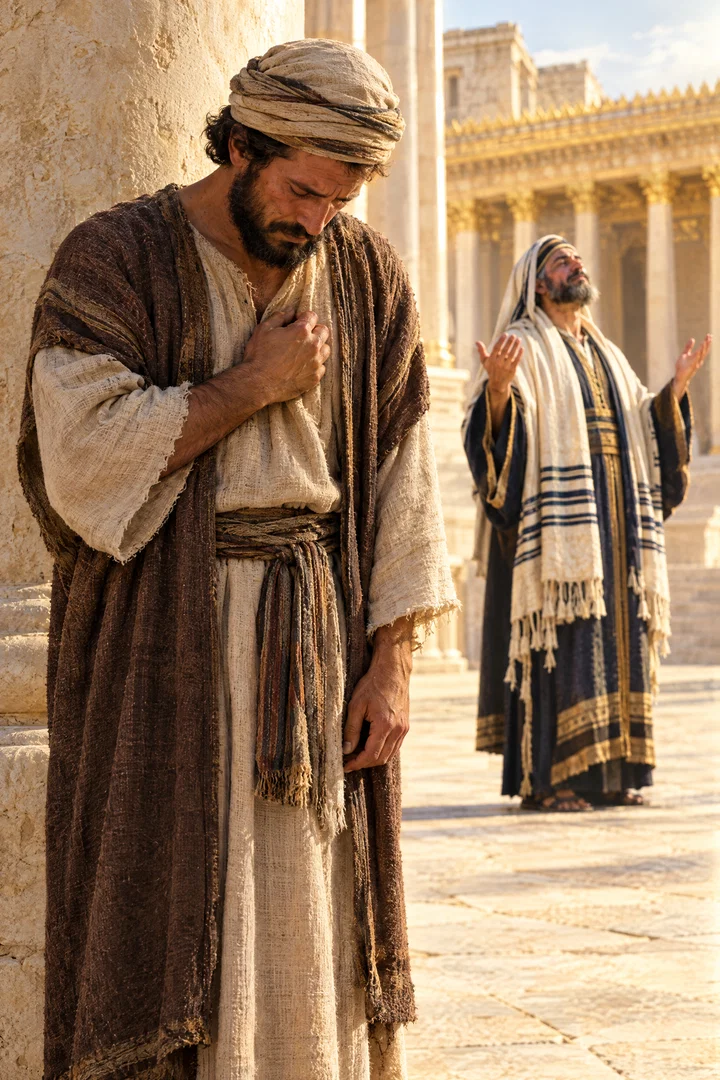
The picture was taken from life and matches boastful prayers that thank God for superiority over other men while listing fasting and tithing as merit. The same spirit appears in thanking God for a part with those who sit in the academy and not with money-changers and traders at the corners, for rising early to the words of the law and not to vain things, for labor that receives a reward, and for running to the life of the world to come and not to the pit of destruction. It appears in asking not to be judged as those who dwell in big towns given to robbery and uncleanness and vain and false swearing, even to claiming that if there were only two righteous men in the world they were a certain rabbi and his son, and if only one it was he himself. Against this stands the publican, who stands afar off, will not lift his eyes, smites his breast, confesses himself a sinner, and pleads for mercy.LS 212.1RH Aug 22, 1865RH Oct 2, 1856 His humble prayer shows true repentance, oppressed by guilt and grieved over sin, humbly seeking God's mercy to cleanse and pardon and save, making no claim of good works or personal merit, accepting just condemnation, and purposing to abandon his sins.RH Oct 2, 1856 The Hottentot hearer recognizes that the Pharisee's boasting contrast with other people is not his own way of praying, but identifies instead with the publican who asks God for mercy as a sinner and goes home saved and happy.RH Aug 22, 1865 The publican went home justified rather than the Pharisee, showing that one who considers himself sinless does not feel need of Christ's forgiveness and wisdom and light and strength and continued growth in grace.LS 212.1 The proud, self-satisfied Pharisee with his polished prayer is not the Christian gentleman, for Jesus points instead to the humble publican who bows his head and asks for mercy.RH Nov 26, 1872 The publican rather than the self-righteous Pharisee represents those whom God justifies, for humility is necessary to receive Christ's presence and enter heaven.ST Feb 26, 1885
Self-Righteous Boasting Exposed
The boast lists twice-weekly fasting and tithing of all that is gained as grounds of righteousness, treating outward obedience as meritorious piety that justifies rather than service from pure love.ST Jul 23, 1885ST Aug 27, 1894ST Nov 27, 1901 It is self-praise that trusts in own righteousness and despises others, resting religion on works while thanking God for superiority over other men.ST Aug 27, 1894ST Nov 27, 1901ST Dec 2, 1886 No pardon is asked and no sin is confessed, for the worshiper feels no need, presenting a record of deeds instead of a plea for mercy.ST Jul 23, 1885ST Aug 27, 1894ST Dec 2, 1886 Such observance does not make a person right with God when joined to pride, and the humble penitent who confesses himself a sinner goes home justified rather than the boaster.ST Aug 27, 1894ST Nov 27, 1901ST Dec 2, 1886
The standard is other men rather than God's character and law, with favorable comparison to sinners, extortioners, the unjust, adulterers, and the publican who stands afar off and will not lift his eyes.ST Feb 19, 1885ST Feb 19, 1885RH Aug 11, 1904 Thanking God for not being as others are becomes the same self-congratulation as boasting today about keeping the Sabbath, living health reform, paying tithes and giving liberally while despising a saloon-keeper or other open sinner.RH Aug 11, 1904ST Feb 27, 1901 The eye is sharp-sighted to others' faults and to supposed own excellencies, contemplating others with pity or derision and self with admiration, overlooking own faults while magnifying those of others.ST Feb 19, 1885RH Aug 11, 1904ST Nov 24, 1881RH Jun 3, 1858 That self-complacency, contempt, and self-exaltation give a false rating and false measure of spiritual worth, flattering and deceiving the soul and leaving the boaster unjustified compared with the humble sinner who pleads for mercy.ST Feb 19, 1885ST Feb 19, 1885RH Aug 11, 1904RH Jun 3, 1858
The religion does not reach the soul and does not change the heart toward godliness, love, and mercy, being satisfied with outward conduct measured by a human standard while taking merit in own works.ST Mar 23, 1915 Worship becomes an act of merit seeking divine favor, judging righteousness by what seems best in society rather than by a Godlike character and a heart filled with love and mercy.ST Mar 23, 1915ST Feb 19, 1885 Fasting and paying tithes are good when done with sanctified knowledge and intelligent faith, and in themselves are duties not worthy of censure.ST Sep 22, 1881ST Aug 14, 1884 They become Pharisaical when they foster self-righteousness, manufacture righteousness by acts with no vital relation to character, and neglect mercy, judgment, and the spirit of religion, for God regards the state and motive of the heart more than outward acts and reads what man cannot see.ST Sep 22, 1881ST Aug 14, 1884
Outward devotion can coexist with failure in humility, justice, love, and mercy, and a person may appear righteous and confident in holiness while unaware of the sin and judgment the law reveals.ST Feb 19, 1885ST Sep 14, 1888ST Feb 27, 1901ST Nov 24, 1881 It is the form of godliness without its power, the practical influence on heart and life such as dominion over sin, sense of pardon, communion with God, spirit of prayer, patience under suffering, victory over death, and joyful hope of blessed immortality.ST Feb 19, 1885RH Sep 2, 1858 Such exact observance can be produced by early education, regard for standing in society, or the goadings of an awakened conscience while the heart is far from God, leaving even strict fasting and multiplied prayers still needing the new birth.ST Sep 14, 1888ST Nov 24, 1881RH Sep 2, 1858 This self-esteem is mistaken for holiness yet blinds to sin and defects, covers sins from sight, and keeps from genuine humility and improvement, burning incense to own goodness as if deeds made one acceptable.ST Feb 19, 1885ST Nov 24, 1881RH Jun 3, 1858 Before Heaven it is only a filthy rag, more offensive than open wickedness, a cloak hiding deep depravity where profession is not possession.ST Feb 19, 1885RH Jun 3, 1858RH Sep 2, 1858
Justified by Faith Not Works
Fasting twice in the week and giving tithes of all that is acquired are set forth as the grounds of a self-righteous prayer, and those religious acts do not make the one who trusts in his own righteousness right with God.ST Jul 23, 1885ST Aug 27, 1894ST Nov 27, 1901ST Jan 29, 1894 The keeping they display is outward keeping of the law, offered in boastful comparison with others and in thanks for superiority over other men, while the sinner stands afar off, will not lift his eyes, and pleads for mercy.ST Aug 27, 1894ST Nov 27, 1901 The humble publican who confesses himself a sinner goes down to his house justified rather than the self-exalting Pharisee who boasts of his deeds.ST Jul 23, 1885ST Aug 27, 1894ST Nov 27, 1901 That justification comes through confessing sin, grieving over it, purposing to abandon it, accepting just condemnation, and seeking cleansing and pardon through faith in Jesus' blood.ST Jan 29, 1894 Acceptance is not by religious achievement nor by prescribed degrees of feeling, sorrow, or repentance, but by faith in Christ's blood and merits and God's power to save, hating sin, desiring grace, and entering the Christian race.ST Jan 29, 1894
The act of tithing itself is not condemned; the self-righteousness, not the tithing, is the point at issue.ST Sep 22, 1881ST Aug 14, 1884RH Apr 9, 1914 Fasting and paying tithes are in themselves duties and not worthy of censure, yet service displeases God when it lacks the spirit that makes service acceptable, for God regards the state and motive of the heart more than outward acts and reads what man cannot see.ST Sep 22, 1881ST Aug 14, 1884 They are good when done with sanctified knowledge and intelligent faith, and even great outward service like the Pharisee's would be acceptable with the right spirit of charity drawn out for others' good, laboring not for earthly reward but for the salvation of fellow men.ST Aug 14, 1884 The parable belongs among the parables showing salvation from sin offered to different kinds of sinners, available even to a Pharisee despite his religious standing and practices, from the Pharisee to the prodigal.ST Jan 15, 1902ST Jan 29, 1902
That self-trusting, self-satisfied spirit is the condition of Laodicea, which calls itself rich and increased with goods and in need of nothing.RH Nov 6, 1860 It regards itself as well off in the world and well to do in the spiritual kingdom, wins golden opinions from the public and from itself, decks one another with titles, mistakes gifts for graces, and holds only imaginary treasures in spiritual lunacy.RH Nov 6, 1860 Unlike open acknowledgment of transgressions ever before the face, it feels nothing of its true condition and treats such confessions as extreme statements, so that to this same class Christ no longer speaks in parable but speaks plainly in judgment that He will spue them out of His mouth.RH Nov 6, 1860 It is the principle of Babylon, present even among professed believers, and it must be eradicated by the straight testimony of the True Witness revealing the true wretched, miserable, poor, blind, naked condition and bringing righteousness by faith.RH Nov 6, 1860
Prayer and Present Warning
The prayer lists twice-weekly fasting and tithing of all acquired as a prayer offered with himself rather than to God.RH Jul 1, 1858RH Mar 22, 1870ST Nov 24, 1881 It is cold and formal worship of the lips and not of the heart, a pompous, self-conceited address marked by fluent self-satisfaction, without realized dependence on God and without desire to enjoy His presence.RH Jul 1, 1858ST Nov 24, 1881ST Nov 24, 1881 It contains no petition, no sense of want, need, or dependence, no confession of sin, no love and gratitude, and no presenting of needs, but only informing God how good a life is led by a record of virtues with which the speaker goes away satisfied with himself.RH May 2, 1907ST Nov 24, 1881RH Sep 9, 1902 Such self-lauding, self-righteous prayer centered on religious deeds rather than on God is vain, the name of God in it empty and ineffective because it serves no true purpose for the petitioner.RH Mar 22, 1870RH May 2, 1907RH Sep 9, 1902 God spurns that hypocritical prayer because the heart is unchanged and proud, and merely changing the outward form to sound penitent, beating the breast, bowing, groaning, and owning sins without feeling them while proud of humility, is still rejected.RH Sep 9, 1902 It is not heard, has no value, leaves the offerer destitute of blessing and unjustified, while the short, humble, self-abasing, God-exalting plea for mercy arising from awareness of sin and need goes down to the house justified; everyone who so exalts himself shall be abased and he who humbles himself shall be exalted.RH Jul 1, 1858RH Mar 22, 1870ST Nov 24, 1881 Length or brevity by itself neither makes prayer acceptable nor condemns it, for God commends only truthful prayer, whether tears of shame from a sinner or joyful thanks for a new life from a changed man.RH Mar 22, 1870RH Sep 9, 1902
The fasting and tithing boast, joined to thanking God for not being as other men are, exposes conscientious, scrupulously careful daily life set as what seemed best in society against what seemed worst.RH Aug 11, 1904 It means the same self-congratulation as boasting today about keeping the Sabbath, living health reform, paying tithes and giving liberally, while despising a saloon-keeper or other open sinner, overlooking one's own faults and magnifying the faults of others.RH Aug 11, 1904 The same Pharisaic spirit seldom spoken so plainly is always dangerous and must be guarded against in conversation as much as in prayer, for self-confidence mistaken for faith God does not hear, while God resists the proud but gives grace to the humble.ST Apr 27, 1882 It appears when people loudly condemn the faults of others so hearers will think them free from such failings, which is the secret of all gossip about scandals, with those prone to evil dwelling on and magnifying a neighbor's faults to lose sight of their own and to make their own shortcomings seem small by comparison, and no one should think more highly of himself than he ought lest the mighty God become his adversary.ST Apr 27, 1882 It is echoed in the modern Pharisee who thanks God that he feasts while other people are made to fast, applying religious self-congratulation to economic selfishness where the few enjoy plenty while the many go without.ST Aug 3, 1904 It is the mark of a Pharisaical spirit that judges others in matters of conscience and coerces them into its own views of keeping the Sabbath holy, claiming religious superiority while looking down on others as publicans who are able to keep their own consciences without such aid. It is the pattern of grandiloquent, self-complacent, self-congratulatory speech, full of complimentary boasting about one's own goodness, as in brilliant week-long congress speeches identifying nationality with religion and congratulating the people on race, language, and religion.RH Oct 3, 1912
The boast of listing good deeds instead of confessing sin means a claim to have no sins needing forgiveness, exactly parallel to refusing to ask God to forgive trespasses, and the Pharisees as a class are not extinct.ST May 17, 1883 Putting Christianity on exhibition for show is display Christianity that comes short of the Christian standard, for ostentatious display has no place in it and the parable rebukes display religion.ST Oct 29, 1902 Frequent fasting and tithing can become a source of pride, and virtue seasoned with pride is worse than a fault followed by penitence.ST Jan 27, 1876 Pointing to fasting and tithing as grounds for confidence in goodness does not excuse selfishness or neglect of others, as when religious practices are listed while looking down on the poor, ignoring neighbors in need, and treating one's own household harshly.ST Dec 12, 1911 Praying as though religious practices made one blameless warns that prayer for an enemy must not assume that one is entirely right and the other entirely wrong.ST May 21, 1885 Recognizing one's own sins is more acceptable to God than condemning others, warning against a harsh, fault-finding spirit.ST Dec 19, 1900
The contrast teaches that acceptable worship is humility, genuine repentance, and lowliness before God rather than exaltation of worthiness and scornful boasting.RH Oct 2, 1856 True repentance is oppressed by guilt, grieved over sin, humbly seeking God's mercy to cleanse, pardon, and save, making no claim of good works or personal merit, accepting just condemnation, and purposing to abandon sins, and God accepts and justifies such a one.RH Oct 2, 1856 Outward fasting, tithing, giving, and prayer are duties and not in themselves worthy of censure, yet service is not pleasing to God when it lacks the spirit that makes service acceptable, for God regards the state and motive of the heart more than outward acts and reads what man cannot see.ST Sep 22, 1881ST Aug 14, 1884 With the right spirit of charity drawn out for others' good, laboring not for earthly reward but for the salvation of fellow men, even great outward service would be acceptable.ST Aug 14, 1884 The Pharisaic idea of righteousness is artificial and false, an attempt to manufacture righteousness by outward things having no vital relation to heart and character while living under a law of works, counting self-flattering virtues and austerities as intrinsically meritorious and claiming credit from God to the full extent of their worth, making religious life a commercial affair apart from real spirituality.ST Jun 5, 1884 Fasting twice each week and tithing everything are mere externals, the form of godliness without its power, and the power is the practical influence of religion on heart and life — dominion over sin, a sense of pardon, communion with God, the spirit of prayer, patience under suffering, victory over death, and joyful hope of blessed immortality — which can be absent while outward observance remains regular and exact.RH Sep 2, 1858 Such outward sanctity is only a cloak hiding deep depravity of heart, for profession is not possession, and it can be produced by early education, regard for standing in society, or the goadings of an awakened conscience rather than gospel influence, while the heart is far from God and even strict fasting and multiplied prayers leave a person still needing to be born again as a new creature in Christ Jesus.RH Sep 2, 1858 Exactness in fasting and paying a tenth of everything possessed helps show how high the Saviour's standard is, for righteousness must go beyond such outward obedience and reach the spirit and reality of biblical religion.
Sources