Luke 18:19
And Jesus said unto him, Why callest thou me good? none is good, save one, that is, God.
Translations
And Jesus said to him, Why call you me good? none is good, save one, that is, God.
King James Version, KJV Cambridge Paragraph Bible
And Jesus said unto him, Why callest thou me good? none is good, save one, that is, God.
And Jesus said to him, Why callest thou me good? none is good, save one, that is God.
Revised Version, American Standard Version
And Jesus said unto him, Why callest thou me good? none is good, save one, even God.
And Jesus said to him, 'Why me dost thou call good? no one [is] good, except One — God;
But Jesus said to him, Why callest thou me good? There is none good but one, God.
But Jesus said to him—Why, callest thou me, good? None, is good, save one—God.
Berean Standard Bible, Majority Standard Bible
“ Why do you call Me good?” Jesus replied. “ No one is good except God alone.
Jesus asked him, “ Why do you call me good? No one is good, except one: God.
And Jesus said to him, Why do you say that I am good? No one is good, but only God.
And Iesus said vnto him, Why callest thou me good? none is good, saue one, euen God.
Douay-Rheims (Challoner revision)
And Jesus said to him: Why dost thou call me good? None is good but God alone.
Pictures
Cross-references
- Matthew 19:17
And he said unto him, Why callest thou me good? there is none good but one, that is, God: but if thou wilt enter into life, keep the commandments.
Jesus says none is good but God and directs the inquirer to keep the commandments.
- Mark 10:17-18
And when he was gone forth into the way, there came one running, and kneeled to him, and asked him, Good Master, what shall I do that I may inherit eternal life?
The parallel encounter records Jesus’ reply that only God is good.
- Mark 10:21
Then Jesus beholding him loved him, and said unto him, One thing thou lackest: go thy way, sell whatsoever thou hast, and give to the poor, and thou shalt have treasure in heaven: and come, take up the cross, and follow me.
Jesus loved the ruler and tested his willingness to follow him.
- Romans 3:10-12
As it is written, There is none righteous, no, not one:
Both deny human goodness and righteousness.
- Romans 3:23
For all have sinned, and come short of the glory of God;
All have sinned and lack goodness.
- John 10:11
I am the good shepherd: the good shepherd giveth his life for the sheep.
Jesus calls himself the Good Shepherd, giving added weight to his words about goodness.
- Psalms 53:3
Every one of them is gone back: they are altogether become filthy; there is none that doeth good, no, not one.
Both texts declare that no one does good.
- Psalms 14:3
They are all gone aside, they are all together become filthy: there is none that doeth good, no, not one.
Both declare that no one is good.
- Romans 3:12
They are all gone out of the way, they are together become unprofitable; there is none that doeth good, no, not one.
Both deny any human goodness.
- Matthew 19:23-24
Then said Jesus unto his disciples, Verily I say unto you, That a rich man shall hardly enter into the kingdom of heaven.
Riches make entering God’s kingdom difficult.
- John 17:3
And this is life eternal, that they might know thee the only true God, and Jesus Christ, whom thou hast sent.
Eternal life is knowing the only true God and Jesus Christ.
- Hebrews 4:15
For we have not an high priest which can not be touched with the feeling of our infirmities; but was in all points tempted like as we are, yet without sin.
Jesus is described as without sin.
- Luke 6:43-45
For a good tree bringeth not forth corrupt fruit; neither doth a corrupt tree bring forth good fruit.
Good fruit comes from a good tree; evil comes from an evil heart.
- 1 John 3:5
And ye know that he was manifested to take away our sins; and in him is no sin.
Cited as evidence that there was no sin in Jesus.
- Mark 12:28-34
And one of the scribes came, and having heard them reasoning together, and perceiving that he had answered them well, asked him, Which is the first commandment of all?
A parallel account of Christ answering a question about the law.
- Philippians 2:6-8
Who, being in the form of God, thought it not robbery to be equal with God:
Christ humbled himself and relinquished glory to save humanity.
- John 1:1-14
In the beginning was the Word, and the Word was with God, and the Word was God.
Identifies Christ as God, whom the young man needed to recognize.
Commentary
Each commentary is drawn from primary sources: the writings of Ellen G. White and Adventist pioneers and periodicals. Each commentary is separate. Its own words are not a quotation; follow the references to read the source passages.
Ellen G. White
30 sources
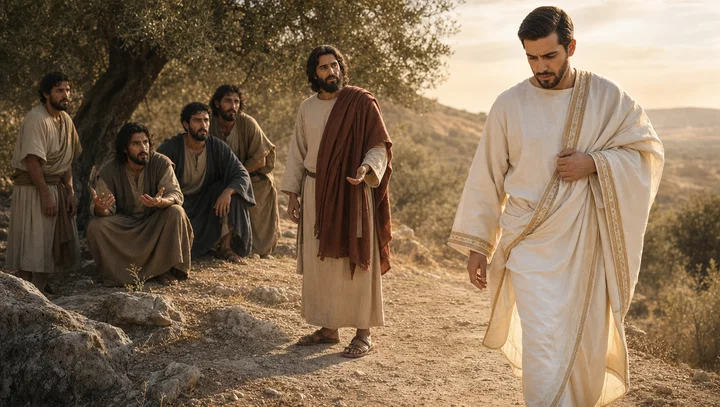
Jesus asks the ruler why he calls Him good and affirms that no one is good except God, challenging his way of addressing Him.DA 518.1–3DA 518.6 The question tests his sincerity and draws out whether he recognizes the speaker as the Son of God, turning attention from good as a mere title for an honored teacher to the goodness of God, so that to acknowledge Jesus as truly good is to receive Him as God's Son and representative.DA 518.1–3Lt 116, 1896, par. 14–17DA 518.4COL 390.2–391.1RH Jan 12, 1905 The saying stands in an encounter where the ruler asks what to do to inherit eternal life, and Jesus answers with keeping God's commandments and following Him as the condition of discipleship.DA 719.3Ms 84, 1886, par. 24 Though the ruler claims to have kept the commandments from his youth, Jesus exposes his self-deception by calling him to sell his possessions, give to the poor, and follow Him, showing that true keeping reaches beyond outward compliance to supreme love for God and love for neighbor as self.Lt 116, 1896, par. 14–17ST Oct 29, 1912COL 392.1ST Oct 22, 1894DA 519.2 His riches are his idol, loved more than their Giver, so clinging to them keeps him from obeying in spirit and he goes away sorrowful, choosing earthly wealth over heavenly treasure and fellowship with Christ.RH Feb 18, 1902CET 164.3ST Oct 28, 19084T 49.3–50.1CET 166.2
Question and Context
Jesus asks the ruler why he calls Him good, and affirms that none is good except God alone, thereby challenging the ruler's way of addressing Him.DA 518.1–3DA 518.6 The question tests sincerity and draws out how the ruler regards Jesus, whether he understands who is speaking to him and recognizes Him as the Son of God.DA 518.1–3DA 518.4RH Jan 12, 1905 It lifts attention from good as a mere title for an honored rabbi to the goodness of God, so that to acknowledge Jesus as truly good is to receive Him as God's Son and representative.Lt 116, 1896, par. 14–17COL 390.2–391.1
The saying belongs to the account of the rich young ruler told also in Matthew 19 and Mark 10 and joined to the parable of the laborers in the vineyard in Matthew 20.COL 390 The ruler who calls Jesus good has a high estimate of his own righteousness and supposes himself defective in nothing, yet he is not satisfied and feels the want of something he does not possess.DA 518.5 He hopes Jesus will bless him as He blessed the little children and satisfy his soul-want.DA 518.5
Eternal Life and Surrender
Luke 18:19 belongs to Jesus' encounter with the rich young ruler, in which the question of what must be done to inherit eternal life is answered by keeping God's commandments and following Him, thus presenting the condition of discipleship.DA 719.3Ms 84, 1886, par. 24 A true knowledge of Christ in this encounter does not make a person useless in this world but equips wholehearted servants to show His love and bless those around them.Ms 84, 1886, par. 24 The ruler claimed to have kept the commandments from his youth, but his self-deception was exposed when he was told to sell his possessions, give to the poor, and follow Jesus, showing that knowing and keeping God's commandments reaches beyond outward compliance to the depth and significance of their precepts.ST Oct 29, 1912ST Oct 22, 1894 Claiming to keep God's law does not prove that a person understands its depth or lives by it.ST Oct 22, 1894
His claim did not show the heart devotion and Christian goodness he lacked, for his self-love showed he lacked the love for God and others that is the spirit and life of the law.COL 392.1DA 519.2 Jesus directed him away from using good as a mere title toward recognizing that goodness belongs fully to God, beginning to expose his mistaken confidence in his own goodness and obedience.COL 392.1 What he needed was a humble, contrite heart giving God supreme love and relying on Christ's perfection.DA 519.2 Jesus responded with love yet exposed his failure to love his neighbor as himself, for his riches were his idol and he loved God's gifts more than their Giver.ST Oct 28, 19084T 49.3–50.1 His attachment to riches kept him from following Christ and obeying the commandments in spirit.4T 49.3–50.1
The call to sell what he owned, give to the suffering poor, and follow Jesus made sacrifice and help for the poor the test of his obedience.Lt 116, 1896, par. 14–17Lt 354, 1905, par. 27 His property was entrusted to him by God to relieve human need and required faithful stewardship, so inheriting eternal life required more than claiming to have kept the commandments; it required surrendering wealth and becoming a faithful steward.Lt 116, 1896, par. 14–17RH Feb 18, 1902 Receiving Christ as the bread of life means He becomes the soul's sustaining, circulating life.Lt 354, 1905, par. 27 Jesus set before him the choice between giving up his possessions and receiving eternal life and heavenly treasure, or keeping them and losing it.CET 164.3DA 520.22T 680.2 Holding on to worldly possessions would weaken moral strength and draw affections away from God, and the encounter shows that love of riches can outweigh love for God, neighbor, and eternal life.DA 520.22T 680.2
The young man was willing to keep the commandments, but love of possessions kept him from giving up what he lacked in order to follow Jesus.RH Feb 18, 1902CET 166.2 He valued riches more than heavenly treasure, so the demand chilled his desire to follow Christ and he went away sorrowful, choosing earthly wealth and standing among people over fellowship with Christ and heavenly treasure.RH Feb 18, 1902CET 164.3ST Oct 28, 1908 He was world-loving, wanting heaven and immortal life while desiring to retain wealth and treasure on earth, and he gave up immortal life for love of money and power, a miserable exchange.4T 50.2DA 523.1 Holding selfishly to possessions rather than using them as God expects makes a person unfit for the eternal riches, the kingdom of God, and the treasure in heaven, showing the danger of refusing Christ as leader when following requires surrender.RH Feb 18, 19024T 50.2DA 523.1 Many who profess to keep all God's commandments do the same, holding wealth while claiming obedience and showing by it how poorly they return God's love.4T 50.2
In detail, Jesus told him to keep the commandments, he declared he had done so, Jesus answered he yet lacked one thing to go sell all he had and give to the poor so he would have treasure in heaven, and he went away sorrowful because he had great possessions.1T 207.2 This exposes a close and covetous spirit that tithes small things but neglects weightier matters, stretches economy into meanness, and lacks the true spirit of sacrifice acceptable to God.1T 207.2 The dealing serves as an object lesson that the obedience God requires is not outward rule-keeping alone but obedience expressed in life and character, showing the cost of refusing Christ's conditions and the need to surrender all to Him.DA 523.2 Self-surrender and obedience are required of Christ's disciples, so whatever would corrupt must be given up, and receiving the life of God requires willingness to give up everything, even family and life itself, rather than cling to earthly treasure.DA 523.4Ms 87, 1897, par. 18
Jesus loved the ruler and hoped he would become His co-worker, seeking to develop and sanctify his character through close union with Him so he could reflect God's likeness and serve in the work of salvation.DA 519.3 Understanding Christ's costly sacrifice to save and ennoble humanity leads people to value their souls, turn from worldly attractions, surrender all they are and possess to Christ, and make obedience to His word their highest aim.Ms 10, 1885, par. 4 The same choice confronts those who weigh Christ against the world, whether they will choose fellowship with Christ and heavenly treasure over wealth and standing among people.ST Oct 28, 1908
Sources
Pioneers and periodicals
47 sources
Only God is good in the absolute, supreme and original sense, and every goodness found in any person is only God working in him.ST Sep 13, 1899RH Dec 3, 1914ST Jan 9, 1896ST Dec 5, 1895 Jesus was Himself without sin and without unrighteousness, so His question did not deny His own goodness or divinity.ST Aug 27, 1894ST Aug 27, 1894ST Feb 10, 1898 He asked it to test whether the rich young ruler who called Him Good Master understood who He was, and to turn him from what good deed he could do to the goodness of God, for if Jesus is good then He is God.RH Jan 12, 1905ST Aug 27, 1894ST Feb 10, 1898 He then directed the inquirer to God and to God's commandments as the enduring rule of life for inheriting eternal life.RH Oct 10, 1865ST Jan 16, 1912RH Jul 29, 1909 The ruler confidently claimed to have kept them all, yet his love of his great possessions was his idol and proved he had not fulfilled his duty to God and to his fellow men.ST Oct 29, 1912ST Oct 28, 1908RH Feb 17, 1859ST Apr 15, 1880
Encounter and Setting
The verse opens Jesus' reply to a rich young ruler who came to Him on the way, ran to Him, kneeled before Him, addressed Him as Good Master, and asked what good thing he must do to inherit eternal life and be saved.ST Sep 26, 1906ST Feb 10, 1898ST Apr 15, 1880RH Dec 2, 1873 He regarded Jesus as merely a human prophet and divinely commissioned teacher who could show the way to eternal life, and feeling the reproof in the question about goodness he dropped the title Good and answered only Master while still claiming to have kept the commandments from childhood and asking what he lacked.RH Dec 2, 1873ST Feb 14, 1884 The exchange leads directly to Jesus exposing the man's attachment to his property and telling him to give it up and follow Him.ST Feb 14, 1884
The ruler was virtuous and is described as good, confident he had kept God's commandments from his youth, eager in coming, believing he had done all that a person could do, yet wanting to become a disciple while holding on to his wealth.RH Feb 17, 1859ST Mar 24, 1881ST Apr 15, 1880RH Jul 3, 1856RH Jul 31, 1856 His confident claim did not reveal his true spiritual condition, and the conclusion of the account shows he was still attached to his riches and therefore had not fulfilled his duty to God and fellow people.RH Feb 17, 1859ST Apr 15, 1880RH Aug 15, 1871 His goodness and commandment-keeping did not remove his need to give his wealth to God and use it to relieve the distressed rather than spend it on luxury and vain pleasures, for commendable conduct and much effort do not make obedience to God's requirement optional.RH Jul 31, 1856RH Aug 15, 1871 The demands made of him were not unusually hard conditions imposed on him alone but taught the temper necessary for Christianity and required generally, namely renouncing attachment to the world and setting the affections on heaven.RH Jul 3, 1856
He represents the respectable wealth-loving people of every age and land, and the words spoken to him are eternal truth containing practical lessons for every age with special importance for days of peril.ST Feb 10, 1898 Jesus pitied him and loved him and saw possibilities for good in him, yet would not accept discipleship on his terms or make the way easier for him.ST Mar 24, 1881ST Sep 26, 1906RH Aug 15, 1871 He told him the one thing he lacked and called him to sell what he had, distribute to the poor and needy and receive their blessing, lay up treasure in heaven where it is forever safe, and come follow Him.ST Sep 26, 1906
The same chapter also presents the Pharisee and the publican as contrasting examples of outward religious confidence and humble awareness of sin and need for mercy.RH Mar 22, 1870ST Sep 14, 1888 The Pharisee presents himself as holy and praises God with a long self-praising prayer before the law exposes sin, while the publican offers a brief, direct, humble plea addressed to God rather than turned into display for people.RH Mar 22, 1870ST Sep 14, 1888
Meaning of Goodness
Goodness in its highest and absolute sense belongs to God alone, who alone is good inherently, essentially, supremely, originally and absolutely.ST Sep 13, 1899RH Dec 3, 1914ST Aug 27, 1894RH Dec 2, 1873 The reply was drawn out by a ruler who addressed Jesus as good, and it turns attention from what good deed a person can do toward the goodness of God.ST Sep 13, 1899 It was spoken to one who did not believe Jesus to be God and who supposed that human teachers could show the way to eternal life by good deeds, and it answers him from his own assumption that Jesus was merely human, a prophet or divinely commissioned teacher.ST Nov 15, 1883RH Dec 2, 1873 On that assumption pure goodness is rightly ascribed only to God, which gives added significance to the words that Jesus is the good Shepherd, and the reproof corrected a low view of Christ so that the ruler dropped the title Good and answered only Master.ST Nov 15, 1883RH Dec 2, 1873 The question did not imply that Jesus Himself was not good, for He is without sin and guile, and it does not assert or deny His own goodness or divinity in that accommodated form.ST Aug 27, 1894ST Nov 15, 1883RH Dec 2, 1873 Because Mary is human and not divine, she cannot be declared sinless from the moment of conception in the way reserved for God, while Scripture makes no such claim about His mother.RH Dec 3, 1914
The weight of teaching holds that this absolute goodness belongs to God, while those who held a distinct view taught that the Father alone is good in the supreme absolute sense as self-existent and absolutely immortal, with Christ and the angels good and perfect within their respective spheres but dependent on the Father for life and existence.RH Nov 14, 1854 There is no goodness in this world except in God, because He is the source of all goodness.ST Dec 5, 1895ST Dec 3, 1902ST Feb 10, 1898 Any goodness in a person is not that person's own but is God working in that person, and goodness and righteousness cannot exist apart from God's life.ST Dec 5, 1895ST Dec 3, 1902ST Feb 10, 1898 Good can come only from good, so people cannot produce good by themselves, and what comes from humanity apart from God is wickedness.ST Jan 9, 1896 Claiming to do good deeds by one's own goodness therefore treats good as coming from evil, and refusing to confess oneself a sinner places oneself above God, who alone can make an evil person good.ST Jan 9, 1896 The Son of God's life and teachings provide the standard of complete unselfishness, exposing how far people fall short when self-interest is found at the root of their acts.ST Jul 14, 1898 Since all have sinned, whatever goodness the ruler had, if he had any, was God's goodness, and he owed everything to God.ST Feb 10, 1898
No human person is truly good or righteous, since some imperfection is found in all humanity.ST Jan 9, 1896ST Dec 3, 1902ST Feb 10, 1898 All human goodness and righteousness is only relative, and people count one another as good or better only because they compare themselves among themselves and measure by imperfect human standards.ST Dec 3, 1902 True righteousness is perfect harmony with a straight, undeviating standard, which is God's eternal unchangeable law of righteousness, perfectly shown in the Son of God who walked the earth in human form and flesh.ST Dec 3, 1902
Because only God is good in the absolute sense, no person has any ground for boasting or for claiming preeminence over another.RH Jul 30, 1914 No living soul has been given a place with the right to sit in judgment on any other living soul.RH Jul 30, 1914 Judging is excluded, not by works but by faith, and it is far better to trust than to judge.RH Jul 30, 1914
Aim of the Question
The question did not suggest that Jesus himself was not good, nor did it deny his goodness or divinity, for he is without sin and without any unrighteousness and is absolutely good.ST Aug 27, 1894ST Aug 27, 1894ST Feb 10, 1898 He challenged the ruler's use of the word good in order to test whether the ruler understood who he was and truly regarded him as the Son of God.RH Jan 12, 1905 That challenge turned attention away from what good deed a man might do and toward the goodness of God.RH Jan 12, 1905 It was meant to lead the young man to recognize that Jesus is God, since only God is good, so that if Jesus is good then he is God.ST Aug 27, 1894ST Feb 10, 1898 Any goodness the ruler possessed was therefore not his own but God's goodness at work, and he owed everything to God.ST Feb 10, 1898
Jesus spoke from the ruler's own assumption that he was merely a human teacher, a prophet, a divinely commissioned teacher who could point out the way to eternal life through good deeds.ST Nov 15, 1883RH Dec 2, 1873RH Apr 4, 1871 On that assumption absolute goodness, supreme and original and essential goodness, belongs to God alone.ST Nov 15, 1883RH Dec 2, 1873RH Apr 4, 1871 Taken in that accommodated sense, the words neither assert nor deny his own goodness or divinity.ST Nov 15, 1883RH Apr 4, 1871 They affirm that pure goodness is rightly ascribed only to God, which gives added significance to his declaration that he is the good Shepherd.ST Nov 15, 1883RH Apr 4, 1871
Feeling the reproof that corrected his low view of Christ, the ruler dropped the title Good and answered only Master, while still claiming to have kept the commandments from childhood and asking what he still lacked.RH Dec 2, 1873 Recognition of his deity was not made a condition of following him or of regeneration.ST Nov 23, 1915
Commandments and Obedience
After the question about goodness Jesus directed the inquirer to God as holy ruler and to God's commandments and law as the enduring standard and rule of life for inheriting eternal life.ST Jan 16, 1912RH Jul 29, 1909RH Dec 31, 1908 Those commandments were already known and belonged to the former dispensation rather than being given as a new law.RH Oct 10, 1865 They are God's enduring law, valid for all time and never needing alteration.ST May 27, 1908
Jesus named enough commandments to identify the law He meant, doubtless naming those the ruler was especially transgressing.RH Oct 26, 1911 He then tested whether the ruler truly kept them by telling him to give his wealth to the poor and follow Him.RH Jul 29, 1909 His not naming the Sabbath or the other first commandments does not show the Sabbath is no longer binding and does not give permission to break them.RH Oct 26, 1911RH Oct 21, 1851ST Feb 27, 1912 Omitting a commandment cannot prove it abolished, for the law was still in force and leaving out one commandment cannot prove it was no longer binding any more than leaving out the others would abolish them.RH Oct 21, 1851ST Feb 27, 1912
By the same reasoning the commandments against worshiping other gods, making images, and taking God's name in vain would also have to be considered no longer binding.RH Oct 26, 1911 The commandments hang on love to God and neighbor, so Follow me cannot exclude the Sabbath commandment.ST Dec 6, 1883 Knowing and keeping God's commandments reaches beyond outward compliance to the depth and significance of their precepts.ST Oct 29, 1912ST Oct 22, 1894 Claiming to keep God's law does not prove a person understands its depth or lives by it.ST Oct 29, 1912ST Oct 22, 1894
The ruler's confident claim to have kept all the commandments was self-deception and did not reveal his true spiritual condition.ST Oct 29, 1912ST Oct 22, 1894RH Feb 17, 1859ST Apr 15, 1880 Jesus did not admit that the ruler had kept them, and the conclusion of the account shows he was still attached to riches, covetous, and therefore had not fulfilled his duty to God and fellow people.RH Feb 17, 1859 His later test exposed his selfish heart and his lack of devotion to God, which nullified his other virtues and undermined his confidence in divine favor and in his own goodness and holiness.ST Apr 15, 1880 His sorrow in turning away revealed that his confidence was misplaced.
A right heart cannot coexist with neglect of a known command, so obedience to God's revealed will is necessary and outward religious deeds cannot replace it.ST May 30, 1878 Commendable conduct and much effort do not make obedience to God's requirement optional, for Jesus loved the eager young man who believed he had done all a person could yet sent him away sorrowful because he lacked one thing.RH Aug 15, 1871 Amiable character alone does not make a person a Christian, for he lacked the one thing needful and remained lost despite being useful to the church.RH May 18, 1876
Salvation Wealth and Life
The ruler's question betrayed the mistaken idea that eternal life can be earned by doing some good thing, as if human teachers could point out the way and human deeds could purchase it.ST Sep 26, 1906ST Nov 15, 1883RH Apr 4, 1871 Good can come only from good, so fallen people cannot produce goodness by themselves, and whatever comes from humanity apart from God is wickedness.ST Jan 9, 1896 To claim to do good deeds by one's own goodness is therefore to make good come out of evil, and to refuse to confess oneself a sinner is to set oneself above God, who alone can make an evil person good.ST Jan 9, 1896
God alone is good in the absolute sense, so no merely human person can be declared sinless from the moment of conception in the way that belongs to God.RH Dec 3, 1914 Mary was human and not divine, and therefore could not be so declared free from original sin, whereas Jesus is without sin and guile, a claim Scripture never makes about His mother.RH Dec 3, 1914
The exchange exposed the ruler's selfish attachment to his possessions and his lack of devotion to God, which nullified his other virtues.ST Apr 15, 1880 His riches were his idol, for he loved God's gifts more than their Giver.ST Oct 28, 1908ST Apr 15, 1880 Jesus told him the one thing he lacked: to sell what he owned, distribute to the poor and needy and receive their blessing, lay up treasure in heaven where it is forever safe, and come follow Him in a self-denying life.RH Feb 18, 1902RH Jul 29, 1909ST Mar 24, 1887ST Sep 26, 1906
His property had been entrusted to him by God, and the choice was his.RH Feb 18, 1902 Wealth must not be spent on luxury and vain pleasures but must be given to God, used to do good and relieve the distressed.RH Feb 18, 1902RH Jul 29, 1909RH Jul 31, 1856 Money spent as the Lord directs brings its reward, while wanting to do as one pleases with money and still have the credit of giving oneself to the Lord brings only loss, and estimating God's favors by the money value of offerings brings shame and contempt.ST Feb 14, 1884
He refused to surrender his possessions and turned away sorrowful, choosing earthly wealth, position, and praise of men over heavenly treasure and fellowship with Christ.RH Feb 18, 1902ST Oct 28, 1908ST Mar 24, 1887ST Sep 26, 1906 The lust of gold and gain bound his heart fast, making a sad decision perhaps for eternity, and because he refused he lost eternal life.ST Mar 24, 1887ST Sep 26, 1906 Selfish holding of possessions rather than using them as God expects makes a person unfit for the eternal riches, and selfish possession of wealth is a barrier to entering the everlasting kingdom.RH Feb 18, 1902ST Aug 27, 1902
A covetous love of this world makes people turn back from Christ, like a bird with a string tied round its leg that can fly so far and no farther; Christ said to cut that string, but he could not do it.RH Nov 4, 1873 What became of him is not known; he drops from sight like a stone in the midst of the ocean.RH Nov 4, 1873 His name is not found among the saints and the fellowship of the apostles and prophets, not mentioned with Peter, Paul, Thomas, and John, and there is no crown or throne for him where the apostles shall reign, because he went away sorrowful for he had great possessions.RH Nov 4, 1873
The demands made of him were not unusually hard conditions imposed only on him, but taught the temper necessary for Christianity and required generally: renouncing attachment to the world and setting affections on heaven.RH Jul 3, 1856 They call for wise investment of means rather than doing as one pleases with money while claiming credit for giving oneself to the Lord.ST Feb 14, 1884 Jesus spoke plainly and did not spare even a wealthy and generous member when presenting the gospel's demands, and the same choice confronts all who weigh Christ against the world.ST Oct 28, 1908RH Feb 3, 1910 The Son of God's life and teachings provide the standard of complete unselfishness, exposing how far people fall short when they examine their motives and find self-interest at the root of their acts.ST Jul 14, 1898
Sources