Luke 2:46
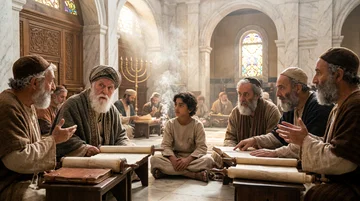
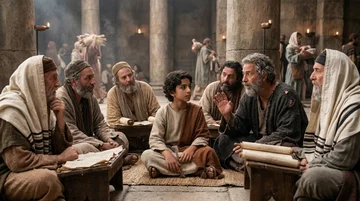
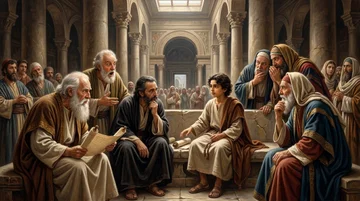
And it came to pass, that after three days they found him in the temple, sitting in the midst of the doctors, both hearing them, and asking them questions.
Translations
And it came to pass, that after three days they found him in the temple, sitting in the middle of the doctors, both hearing them, and asking them questions.
King James Version, KJV Cambridge Paragraph Bible, Webster Bible
And it came to pass, that after three days they found him in the temple, sitting in the midst of the doctors, both hearing them, and asking them questions.
And it came to pass, after three days they found him in the temple, sitting in the midst of the doctors, both hearing them, and asking them questions:
And it came to pass, after three days they found him in the temple, sitting in the midst of the teachers, both hearing them, and asking them questions:
And it came to pass, after three days, they found him in the temple, sitting in the midst of the teachers, both hearing them and questioning them,
And it came to pass, after three days they found him in the temple, sitting in the midst of the teachers and hearing them and asking them questions.
And it came to pass, that, after three days, they found him in the temple, sitting amidst the teachers,—both hearkening unto them, and questioning them.
Berean Standard Bible, Majority Standard Bible
Finally, after three days they found Him in the temple courts, sitting among the teachers, listening to them and asking them questions.
After three days they found him in the temple, sitting in the middle of the teachers, both listening to them and asking them questions.
And after three days they came across him in the Temple, seated among the wise men, giving ear to their words and putting questions to them.
And it came to passe three dayes after, that they found him in the Temple, sitting in the mids of the doctours, both hearing them, and asking them questions:
Douay-Rheims (Challoner revision)
And it came to pass, that, after three days, they found him in the temple, sitting in the midst of the doctors, hearing them, and asking them questions.
Pictures


Cross-references
- Luke 2:52
And Jesus increased in wisdom and stature, and in favour with God and man.
It follows the temple visit with Jesus increasing in wisdom and favor.
- Luke 2:51
And he went down with them, and came to Nazareth, and was subject unto them: but his mother kept all these sayings in her heart.
After the temple visit, Jesus returns home and is subject to his parents.
- Luke 2:40
And the child grew, and waxed strong in spirit, filled with wisdom: and the grace of God was upon him.
Describes Jesus’ growth before the temple visit.
- Luke 2:41
Now his parents went to Jerusalem every year at the feast of the passover.
Jesus’ parents went to Jerusalem for the yearly Passover feast.
- John 7:15
And the Jews marvelled, saying, How knoweth this man letters, having never learned?
People marvel at Jesus’ knowledge despite his lack of formal schooling.
- Luke 2:42
And when he was twelve years old, they went up to Jerusalem after the custom of the feast.
Gives Jesus’ age during the temple visit.
Commentary
Each commentary is drawn from primary sources: the writings of Ellen G. White and Adventist pioneers and periodicals. Each commentary is separate. Its own words are not a quotation; follow the references to read the source passages.
Ellen G. White
60 sources
After three days of sorrowful searching, Joseph and Mary found twelve-year-old Jesus in the temple court at the Passover, sitting among the learned doctors and teachers of the law, listening to them and asking questions.LC1 26.1–27.21RED 26.1–28.1 He had tarried behind in Jerusalem unknown to them when the returning company left for Galilee, and they sought Him first among kinsfolk in the crowd before turning back.Ms 37, 1898, par. 4Ms 183, 1903, par. 5 Though taking the humble place of a learner, His questions turned the teachers to the prophecies of the Messiah's birth, humiliation, suffering and death, and He opened the Scriptures to show the plan of salvation centered in Himself as the Lamb who takes away the sin of the world.Ms 78, 1893, par. 40–45ST Apr 2, 1896 His wisdom astonished all who heard Him, for He had never learned in the rabbis' schools but was taught by His mother and continually by His Father in heaven from the pure word of God.LC1 26.1–27.21RED 26.1–28.1STE 178.1–2FE 400.1–2 His being lost to them three days and then found foreshadowed His death for the sins of the world, when He would be separated from them three days and then reveal Himself again as Redeemer and Advocate.ST Dec 9, 18802SP 36.2LC1 30.2 Their one day of neglect and three days of anxious search show that careless talking, visiting and neglect of prayer can lose the sense of Jesus' presence, which is regained only by sorrowful seeking, watchfulness and prayer.ST Oct 4, 18772SP 31.2–32.1
Setting and Finding
Luke 2:46 belongs to Jesus' Passover visit to Jerusalem at age twelve, when a Hebrew boy reached the dividing line between childhood and youth and was called a son of the law and a son of God, receiving at that age special opportunities for religious instruction and being expected to take part in sacred feasts and observances.DA 75.1 He tarried behind in Jerusalem without Joseph and Mary knowing it and was lost from them in the multitude of travelers returning toward Galilee, and it took only one day of neglect to lose Him.Ms 37, 1898, par. 4Ms 183, 1903, par. 5 He was first sought among kinsfolk in the crowd traveling toward Galilee before His parents had to acknowledge He was lost.Ms 183, 1903, par. 5
After three days of anxious, sorrowful searching His parents found Him in the temple, in its court, sitting in the midst of the grave and learned doctors, scribes, rabbis and teachers of the law, both hearing them and asking questions.LC1 26.1–27.21RED 26.1–28.1ST Dec 9, 18802SP 33.1 This was on a special public teaching occasion where teachers instructed the people, in schools that held daily studies much like Bible studies.LC1 26.1–27.21RED 26.1–28.1ST Dec 9, 1880ST Oct 4, 1877 The finding took place at the Passover, whose solemn significance and rites became clearer to Him day by day.Ms 78, 1893, par. 40–45DA 78.1–2IRCUP 10.1DA 77.2 Watching the white-robed priests performing their solemn ministry and witnessing the impressive paschal service, He saw every act as bound up with His own life and mission.DA 78.1–2IRCUP 10.1DA 77.2 The Passover lamb, unleavened bread, and firstfruits represented the Saviour, and Israel's deliverance from Egypt illustrated redemption, while the mystery of His mission and the work He was to accomplish for the children of Abraham, Isaac, and Jacob began to dawn upon His mind.DA 78.1–2IRCUP 10.1DA 77.2
His well-known voice, serious and earnest yet marked with solemn melody and full of melody, arrested His parents in the crowd.DA 81.1–3 They were gratified to see Him thus honored, and finding Him again brought them great joy after sorrowful hearts and great fear.COS 35.1–6 They searched remembering how Herod had tried to kill Him in infancy and dreading that some evil had now befallen Him.COS 35.1–6 Yet His way of acting remained a mystery to them.DA 89.6
His early life that prepared Him for this engagement included godly home training at Nazareth, where He made His home for thirty years living unhonored and unknown.Ms 181, 1897, par. 8–11RH Oct 30, 1900 Nazareth was proverbial for wickedness and bad reputation, considered the worst in Palestine, a town from which it was thought a wonder if any good thing could come.Ms 181, 1897, par. 8–11 By becoming a citizen there amid moral darkness and misery He set His own feet upon the paths the poor and neglected souls must tread, and as the Light of the world poured contempt upon human pride of place, station, honor, and fame.Ms 181, 1897, par. 8–11 He might have made His home in places of renown but did not, lest His followers compelled to live in lowly places should frame an excuse for their sins and for rough, hard, discourteous character, thus demonstrating that any place, however hard and lowly, if it is the post of duty, can be made honorable by fidelity.Ms 181, 1897, par. 8–11
Questions and Teachings
He took the humble place of a learner in the temple, listening with eagerness to gain knowledge, yet His questions led the teachers to consider the prophecies concerning the Messiah's birth, childhood, youth, humiliation, suffering and death.Ms 78, 1893, par. 40–45 He explained the Scriptures to them, revealing the light of the plan of salvation and identifying the Messiah with the Lamb who takes away the sin of the world. The setting was the Passover after three days of sorrowful searching, whose solemn significance pointed to the feast itself and to the responsibility laid upon His parents toward Him.Ms 78, 1893, par. 40–45
As a child in the temple school He sat among the teachers asking about the prophets and about the meaning of Isaiah's prophecy of the Saviour's death.COS 33.1–4 His questions showed deep understanding of Scripture joined with modesty and a sincere desire to learn.COS 33.1–4 His inquiries centered on Isaiah's prophecies of the Messiah's first appearing and on the prophecies, events and promises foretelling the Messiah's coming as centered in Himself, showing that He knew His work and what lay before Him.Lt 213, 1902, par. 14–17Ms 143, 1906, par. 22
Those questions brought out deep, vital truths that had been lost from the teachings of the day, each carrying a divine lesson and presenting truth in a new light.ST Apr 2, 1896Lt 213, 1902, par. 14–17 They challenged the expectation of personal and national exaltation at the Messiah's coming and turned attention to the humiliation of His first advent, so that willing hearers might understand His true mission. Though the questions challenged the learned teachers, He spoke with modesty, gentleness and humility.ST Apr 2, 1896
While listening He was also giving light to their darkened minds, for His respectful, childlike questioning opened their minds to God's Word and Scripture in a familiar setting and gave them opportunity to receive spiritual truth and lessons to consider.RH Mar 13, 1900Ms 22a, 1895 [Copy 1], par. 24–27Ms 22c, 1895 [Copy 3], par. 25–26Ms 22b, 1895 [Copy 2], par. 28DA 80 He did this without openly claiming to teach them and without making them suspect He was trying to teach them, since they would have rejected Him.Ms 22a, 1895 [Copy 1], par. 24–27Ms 22c, 1895 [Copy 3], par. 25–26Ms 22b, 1895 [Copy 2], par. 28 His learning astonished them though He had not attended their schools, revealing His interest in heavenly truth and His early understanding of His relation to His Father.RH Mar 13, 1900Ms 145, 1906, par. 28–31
His questions astonished the doctors of the law, who could not always answer Him, and puzzled the wise men because their practices did not harmonize with the Scriptures and they lacked the wisdom that comes from God.IRCUP 10.2FE 439.3 Though the rabbis had not taught Him, He was more learned than they, revealing insight into the Scriptures concerning the Messiah that the teachers had not seen, and His conduct revealed perfection of character.STE 67.1IRCUP 10.2STB 449.1–2 He had asked questions as if a learner while refusing to become their student or to follow popular customs, so that even those displeased recognized His education as of a higher type than their own.FE 439.3
Wisdom and Its Source
Both His questions and His answers in the temple displayed superior wisdom, discernment, penetration, mature judgment, and superior knowledge that astonished all who heard Him.LC1 26.1–27.21RED 26.1–28.1ST Dec 9, 18802SP 33.1ST Oct 4, 1877 The astonishment was the greater because His parents were poor and He had never learned nor received formal education.LC1 26.1–27.21RED 26.1–28.1ST Dec 9, 18802SP 33.1ST Oct 4, 1877 His words opened up subjects of deep importance and showed a knowledge of sacred things surpassing what the schools had taught.ST Jun 7, 1905Lt 232, 1903, par. 28–30 This was although He had not been taught in the rabbis' schools and had not learned from rabbinical schools or human teachers.ST Jun 7, 1905Lt 232, 1903, par. 28–30
He had not learned from the schools of the prophets, but was taught first by His mother and continually by His Father in heaven.FE 400.1–2FE 439.3 God instructed Him, and He studied the pure uncorrupted words of God under the Divine Teacher, together with the book of nature.STE 178.1–2FE 439.3 Thus saith the Lord was ever on His lips, and It is written was His reason for every act that varied from family customs.FE 439.3 He had access to the tree of life and to a source of knowledge unknown to those around Him, a source likened to the tree of life.STE 178.1–2FE 400.1–2Lt 232, 1903, par. 28–30
His wisdom developed as His abilities, talents, and faculties were exercised, without pride or desire for greatness.STE 178.1–2FE 400.1–2 The Holy Spirit was upon Him, and He was already conscious of the work He had come to do. He showed interest in heavenly truth and early understanding of His relation to His Father.Ms 145, 1906, par. 28–31 Very soon the Word of God was plainly opened to Him, so that as a boy He stood before priests and rulers interpreting the Scriptures.Ms 117, 1909, par. 34–35
Even in childhood and youth He followed the Lord's instruction rather than the counsel of priests and rulers.FE 439.3Lt 62, 1911, par. 2–3 Though obedient to His parents, He began at a very early age to act for Himself in forming character.FE 439.3 He stood by God's word rather than accepting human traditions as authoritative, and He brought a purer atmosphere into the home life.FE 439.3ST Aug 6, 1896 He had come down from heaven to become a little child watched by angels and kept by the Lord in His younger days.Ms 117, 1909, par. 34–35 He passed through every stage from infancy to manhood without committing sin because God protected Him, and He did His work faithfully and with great pains.Ms 77, 1910, par. 29 Afterward He returned home to work with His father as a carpenter helping support His family, showing that education should include useful work as well as intellectual training.Ms 73, 1895, par. 6
Foreshadowing Death and Resurrection
His separation from His parents on the return and their sorrowing search for three days until He was found foreshadowed His being slain for the sins of the world, when He would be separated from them and lost to them for three days and then would reveal Himself to them and be found of them.ST Dec 9, 18802SP 36.2LC1 30.21RED 30.2ST Oct 4, 1877 This was appointed so that their faith would rest on Him as the Redeemer of the fallen race and the Advocate with the Father in their behalf.ST Dec 9, 18802SP 36.2LC1 30.21RED 30.2ST Oct 4, 1877
He knew the hearts of the crowd returning from Jerusalem and knew there would be much talking and visiting without humility and grace that would leave the Messiah and His mission nearly forgotten.ST Dec 9, 18802SP 36.2 He therefore deliberately separated from His parents and chose to return from Jerusalem with them alone.ST Dec 9, 18802SP 36.2 In that retirement His father and mother would have more time for reflection and meditation on the prophecies of His future sufferings and death, so that the painful events of His offering up His life for the sins of the world would not come to them new and unexpected.ST Dec 9, 18802SP 36.2
The finding in the temple marks the beginning of His mission as it opened to Him there, and He wished to leave Jerusalem quietly with His parents and turn their thoughts to the prophecies of the suffering Saviour.DA 82.3–4 His being lost to Mary for three days foreshadowed His being lost to her in death for three days and then rising, when her sorrow would turn to joy.DA 82.3–4 Understanding the Scriptures He was directing her to would have prepared her to endure His death.DA 82.3–4
Years later this scene of the twelve-year-old in the temple among the learned teachers of the law, asking questions that astonished them, returned vividly to the rulers' minds as they planned His death.DA 539.2 Mary's three days of anguish when she thought Him lost made her anxious as she awaited His return.DA 144.3–145.1
Losing and Finding Presence
Joseph and Mary left twelve-year-old Jesus behind in Jerusalem after only one day of neglect, absorbed in talking and visiting and in vain talking, jesting, joking, evil speaking, and neglect of prayer. It then cost them three days of anxious, sorrowful searching to find Him again and to regain peace of mind and the consolation of His grace. When found, His reply, How is it that ye sought me, modestly turned their censure back upon themselves, showing that had they been mindful of duty and of the sacred trust entrusted to them they would not have departed without Him. His further word, Wist ye not that I must be about my Father's business, meant He was engaged in the work of His Father Jehovah, not Joseph, while they had neglected the work His Father had entrusted to them.
That one day of neglect with its long search illustrates that neglect of prayer, watchfulness, and attention to God in following Christ can cause the sense of Jesus' presence to be lost.ST Oct 4, 18772SP 31.2–32.1DA 83.1–3 Finding Him again and recovering peace and comfort may then require days of sorrowful seeking.ST Oct 4, 18772SP 31.2–32.1DA 83.1–3 Even a single day's neglect of Him led to that prolonged three-day search.ST Dec 9, 1880
Followers of Christ can likewise journey on without Jesus when careless in company and in words and actions, passing along without marking His absence and engaging in conversation with no reference to their Redeemer.ST Oct 4, 1877 Jesus and the angels who do His commands withdraw from those careless of His presence and will not be found where His presence is neither desired nor noticed.ST Oct 4, 1877 What remains is mourning, grief, discouragement, gloom, and suffering of mind, without the cheering divine light, peace, joy, and light that come from Him, and the fault for that darkness lies in themselves.ST Oct 4, 1877
Retaining Jesus is the privilege of all, yet it requires gracious words seasoned with grace and disciplined thoughts meditating on heavenly and divine things.ST Oct 4, 1877 It calls for meditation, watchfulness, and prayer after meetings of devotion and on the return home, instead of talking, jesting, and visiting away the heavenly Guest and then complaining of others or murmuring against God.ST Oct 4, 1877
His remaining in Jerusalem was meant to awaken His parents not to take His presence and their charge of Him for granted and to keep them from indifference to it.2SP 35.1 Though He lived among them in many ways like other children, He was the Son of God with divinity veiled in humanity, and His presence was a precious blessing.2SP 35.1 Losing Him thus led them to recognize their responsibility toward Him and the sacred mission entrusted to them.Ms 78, 1893, par. 40–452SP 35.1
The verse appeals to all fathers and mothers never to lose sight and companionship of their boys and girls.Ms 183, 1903, par. 5 It warns against exchanging a country home like Galilee for the city with its crowds, lest through careless inattention sons and daughters become ensnared by the world and be lost and never found again.Ms 183, 1903, par. 5 That loss can even occur without parents knowing they are lost.Ms 183, 1903, par. 5
Example for Believers
At twelve years old, lost from Joseph and Mary in the multitude of travelers returning from the Passover and found after three days of searching in the court of the temple sitting in the midst of the doctors hearing them and asking them questions with a grace that charmed these learned men, the scene was the commencement even in childhood of His work manifesting what God could do for afflicted bodies and souls from a life wholly the Lord's, pure and undefiled.Ms 37, 1898, par. 4 In the temple among the teachers He listened and asked questions about the promises centered in Himself, and His questions showed that He knew His work and what lay before Him, for even from childhood His life was an example.Ms 143, 1906, par. 22 His example taught without controversy, and He lived as one set apart, finding happiness in solitude with nature and God.DA 89.6 He regularly withdrew from His work to meditate, search the Scriptures, and pray, often early in the morning, then returned to His duties and patient labor.DA 89.6
He questioned the learned rabbis about prophecy and events that foretold the Messiah's coming, and His questions carried deep truths and helped open the teachers' minds to God's Word.Lt 213, 1902, par. 14–17 The verse illustrates how asking questions can help teach truth and give people an opportunity to receive light.Lt 213, 1902, par. 14–17 At twelve years old He was already a teacher while coming before the rabbis and doctors of the law as a learner, listening and asking questions that surprised the learned doctors and showed eagerness to obtain information, and by every question He poured light into their darkened minds.4MR 51.1–53.1 He did not let them suspect He was trying to teach them, or they would have spurned Him, and this was His way through life: by purity, humility, gentleness, and meekness He rebuked sin without giving those around Him anything to blame, while His humble manner in questioning let Him pour light into minds without open controversy.4MR 51.1–53.1
At twelve years old He attended the temple school of the priests and rabbis, where studies were conducted daily much like Bible studies.6T 74.3–75.2 He asked questions as a learner, yet His questions gave the learned teachers new matters to consider.6T 74.3–75.2 His example supports joining religious gatherings not to argue, but to search Scripture and raise helpful questions.6T 74.3–75.2 As a child in the temple He engaged the teachers in a way that revealed truths they had not discerned and astonished those who heard Him, solving mysteries that priests and rulers had not discerned.6T 202.2CT 176.1–3Ms 53, 1898, par. 10–11 The verse serves as a pattern for the closing work of the earth, when children who receive a right Christian education will speak simply about truth and astonish people who pride themselves on and boast of higher education.6T 202.2CT 176.1–3Ms 53, 1898, par. 10–11
His example teaches established believers who enter worldly colleges to live the truth, respect the rules, avoid open controversy, and spread light by godly lives and by asking questions upon Bible doctrines.4MR 51.1–53.1 Yet He was at work all the time, even in His own home until He had no home, and His lot was no more pleasant than that of young people today who try to walk in His footsteps.4MR 51.1–53.1 Because Christ was once a little child, children are to be honored and dealt with gently as a sacred charge and as God's property whom He loves.Ms 34, 1899, par. 5 They are not to be indulged, petted, and idolized, but to be taught to live a pure, noble life, with mothers cooperating with God in helping them to form perfect characters.Ms 34, 1899, par. 5 He came into the world as an infant and passed through every stage of life from infancy to manhood without committing sin because the God of salvation protected Him, doing everything with all faithfulness when He began to work and taking great pains in His work so that children asked Him why, and answering by singing songs of heaven until all around joined in singing, which calls parents to put away harsh unjust rule with an iron rod and to seek Christ, pleasant voices, and salvation every day.Ms 77, 1910, par. 29
Sources
Pioneers and periodicals
82 sources
At twelve, on His first attendance at the Passover, after a day's journey, the return, and a day's search, He was found after three days in a school in the temple courts, sitting among the rabbis and teachers of the law, hearing them and asking questions.ST Sep 17, 1894ST Sep 15, 1898ST Aug 27, 1912ST May 3, 1910ST Dec 23, 1903 He took the place of a learner at their feet, listening and asking discreetly with modesty and humility, not disputing or presuming to teach.ST Apr 2, 1896ST Aug 12, 1897ST Aug 27, 1912 His understanding and answers astonished all who heard, though He had never learned in their schools, for He was divine yet truly human, growing in wisdom with God as His Teacher by constant study of Scripture.ST Dec 9, 1880ST Oct 4, 1877ST Jan 29, 1894ST Aug 27, 1912 His questions concerned the prophecies of the Messiah's humiliation, suffering, and death, opening the plan of salvation and challenging the hope of personal and national exaltation.ST Apr 2, 1896ST Jun 14, 1899ST May 24, 1910 His being separated from His parents, sought sorrowing three days, and then found foreshadowed His being slain for sin and lost to them for three days before revealing Himself again.ST Dec 9, 1880ST Oct 4, 1877 One day of neglect through careless talking and journeying without Him can cost three days of anxious search to regain His presence, so retaining Him requires watchfulness, meditation, and prayer.ST Oct 4, 1877ST Dec 9, 1880ST Oct 4, 1877ST Jul 1, 1875
Setting and Search
The visit belongs to Jesus at twelve years of age, on His first recorded attendance at the Passover, a feast His parents attended each year.ST Sep 17, 1894ST May 3, 1910ST May 22, 1907 Jewish boys were not expected at the feasts before that age, when they received special instruction in the law and their religion.ST May 22, 1907 This was His first visit to Jerusalem since His dedication as a babe.ST Jun 14, 1899
Twelve was the age at which Jewish custom recognized a boy as a son of the law, responsible to God and accountable to follow God's instruction.ST Jun 17, 1913ST Jan 10, 1906 At that age He became eligible to attend the festival with the privileges of manhood, presenting Himself in the temple.ST Jun 17, 1913ST May 3, 1910 His parents brought Him to Jerusalem for this reason, as the law had required His circumcision when He was eight days old. It was a critical age when He consciously took up the work of forming His character and serving God as His life unfolded.ST Jan 10, 1906
He was found after three days, after an anxious search, spending three days in the temple.ST Jan 11, 1899ST Aug 27, 1912ST May 24, 1910 The three days count the day of the northward journey, the return journey, and the whole day spent searching in Jerusalem.ST Aug 27, 1912 Mary and Joseph discovered He was missing from the returning Passover company, searched among relatives and acquaintances, and returned toward Jerusalem to look for Him.ST May 17, 1910 Pilgrim custom explains the delay, for travelers began the first day's return near sunset and camped within a few miles of the start, so His absence was discovered at the first halt and not after unknowingly traveling a long distance.RH Sep 17, 1872
He was found in a school conducted in the temple courts, a chamber or porch used as a free school.ST Sep 15, 1898ST Jun 14, 1899ST Jul 16, 1894 There He sat among the rabbis, the teachers of the law, and the learned doctors gathered at the feast.ST Sep 15, 1898ST Dec 23, 1903ST Jul 16, 1894 Those teachers discussed important matters and instructed the people, and He was engaged with religious teaching in His Father's house and about His Father's business.ST Dec 23, 1903ST Jul 16, 1894
The event is dated to A.D. 8, when at twelve years old He astonished the teachers with His understanding and answers.RH Dec 12, 1907 The Passover season may explain why several rabbis were present, yet the verse does not identify which teachers were there, so their identities cannot be established from it.ST Dec 9, 1880 He appeared there as the Child of Nazareth, a simple Lad of tender years, within the Temple walls in lordly and priestly halls among the doctors.ST Jun 30, 1909 That childhood belonged to Nazareth, where He spent most of His earthly life, studying the Scriptures with the surrounding land and its Old Testament sites in view.ST May 19, 1898
The account stretches from the annunciation to Mary to the permanent residence at Nazareth.ST Mar 12, 1896 It connects with His birth of Mary in Bethlehem during the reign of Augustus by the power of the Highest.RH Nov 14, 1854 His talk with the teachers belongs to the childhood, youth, and early manhood recorded by Luke among accounts not found in the other Gospels.ST Sep 20, 1905 The verse shows His development as He increased in wisdom and stature and in favor with God and man, in obedience to His parents and as an example to children.ST Mar 12, 1896
Listening Asking Learning
After three days He was found in the temple on a special public teaching occasion, sitting in the midst of the grave and learned doctors and scribes, lawyers and members of the Sanhedrin, both hearing them and asking questions.ST Sep 15, 1898ST Jun 15, 1904ST Aug 17, 1904ST May 31, 1910 He was in a school conducted in the temple courts, seated with other youth at the feet of the rabbis and teachers of the law, attentive to their instruction and actively seeking understanding.ST Sep 15, 1898ST Jun 15, 1904ST Aug 17, 1904ST Jun 14, 1899 His attention to their teaching and His questions showed keen interest in learning and engagement.ST Sep 15, 1898ST Jun 15, 1904ST Aug 17, 1904
He took the place of a learner, listening to gain knowledge as every hearer was expected to do.ST Aug 12, 1897ST Aug 27, 1912 Following the custom of the time, His questions led the teachers to question Him in turn.ST Aug 27, 1912 His hearing and questioning, along with answering, displayed engagement with His Father's work, whether He had remained through deep interest in the studies or by choice.ST May 30, 1911ST Jan 10, 1906RH Apr 10, 1866
He was not disputing, putting Himself forward, showing off, presuming to teach the learned teachers, showing disrespect, or doing anything unbecoming for a child of twelve.ST Aug 12, 1897 Though His questions challenged the learned teachers, He asked discreetly and spoke with modesty, gentleness, humility, and solemn melody.ST Apr 2, 1896ST Aug 12, 1897 His presence there reflected love for the Word, concern to be in His Father's house and about His Father's business, and consciousness already of His holy mission.ST May 30, 1911ST Jan 10, 1906RH Apr 10, 1866
More wisdom can be shown in a learner's questions than in a teacher's instruction, and His questions asked for information revealed marvelous perception and grasp of truth greater than that of the teachers.ST Aug 12, 1897 When the teachers examining the mysteries of Scripture could not answer, He answered Himself, being exact in doctrines, prophecies and laws.RH Mar 13, 1900ST Jun 7, 1905ST Jul 29, 1880 In so doing He gave light to their darkened minds and opened subjects of deep importance and knowledge of sacred things that astonished them.RH Mar 13, 1900ST Jun 7, 1905ST Jul 29, 1880
Wisdom and True Mission
His understanding, answers, reasoning and mature judgment astonished all who heard Him and drew a crowd around Him in the temple.ST Dec 9, 1880ST Oct 4, 1877ST Jun 7, 1905RH Apr 10, 1866 The astonishment was the greater because His parents were poor and He had never learned in the rabbinical schools nor studied in their schools, yet He gave manifest proofs of superior wisdom, penetration and knowledge of sacred things and opened subjects of deep importance.ST Dec 9, 1880ST Oct 4, 1877ST Jun 7, 1905 He was about twelve years old and already conscious of His holy mission and committed to being about His Father's business.RH Apr 10, 1866
His wisdom was divine, yet He lived as a real human being never separated from divinity.ST Jan 29, 1894 Though perfect and divine, He still grew and learned in His human life, with God as His Teacher.ST Aug 27, 1912ST Jun 14, 1899 His mother was His first human teacher, and His preparation came through godly home training, through instruction in the fields and woods, and through constant study of Scripture in its true meaning rather than accepting human traditions as authoritative.ST Aug 6, 1896RH Oct 30, 1900ST Jun 14, 1899 His education was of a higher kind, for He had access to the tree of life, the source of knowledge unknown to the rabbis.
His questions concerned Isaiah's prophecies of the Messiah's first appearing. Through them He led the teachers to consider the Messiah's humiliation, suffering and death, explained the Scriptures to them, revealed the light of the plan of salvation, and identified the Messiah with the Lamb who takes away the world's sin. In this way He helped willing hearers understand the Messiah's true mission. His questions challenged the expectation of personal and national exaltation at the Messiah's coming, brought out deep saving truths vital to salvation that had been lost from the teachings of the day, presented truth in a new light with each question offering a divine lesson, and flashed truths concerning the long-expected Messiah into their minds.ST Apr 2, 1896ST Jun 14, 1899
He did not agree with even the most learned teachers.ST May 24, 1910 Surrounded by blindness, He alone held the truth, and His teaching was regarded as strange by those expecting the Messiah to free the nation from its sorrows and bring national deliverance.ST May 24, 1910ST Mar 22, 1899 His words were heavenly and wise, yet the learned men did not recognize Him as the Paschal Lamb.ST May 22, 1907 His reasoning brought condemnation to proud Pharisee hearts, confounded the wisdom of learned men, and baffled Pharisaic subtlety with understanding, though He was already deeply familiar with religious teaching.RH Dec 8, 1859ST Oct 28, 1930RH Oct 3, 1907 During the Passover rites the ceremonies increasingly impressed upon Him His mysterious connection with them and that the lessons He received and carried out bore on the destiny of the earth, and the Holy Spirit was upon Him as one already conscious of the work He had come to do.ST May 17, 1910
Growth Obedience and Humanity
He was a real human being, as real as any other child, born of Mary at Bethlehem under Augustus by the power of the Highest.RH Nov 14, 1854ST Apr 9, 1902 Though He was the Creator, He took human nature and shared Abraham's family line in sympathy and love, and His words in the temple among the teachers were heavenly and wise though the learned did not recognize Him as the Paschal Lamb.ST May 22, 1907 The scene in the temple belongs to the account stretching from the annunciation to Mary to the permanent residence at Nazareth, showing His development as He increased in wisdom and stature and in favor with God and man, His obedience to His parents, and His example to children.ST Mar 12, 1896 He grew in body, mind, and spirit to fit Himself to be the great teacher, and though perfect and divine He still needed to grow and sought help from men and God.ST Jul 1, 1880 His sitting among the teachers treats the teachers' meeting as a necessity for growth, joining learning from men with prayer to God as soil is joined with sun, so that a teacher who neglects teachers' meetings or his closet declares he does not need to grow or can grow without the aids his Divine Master needed.ST Jul 1, 1880 His growth in wisdom and in stature in His youth parallels Moses being learned in all wisdom, proving Him the prophet like Moses, like Moses in wisdom as in His other offices.RH Feb 19, 1861
Though He at twelve years old understood better than most what it meant to be about His heavenly Father's business, He remained subject to His parents and was content to do ordinary labor until He was thirty.ST Mar 16, 1904 Before this little is recorded except His growth in wisdom and stature and His obedient submission to His parents, and after astonishing the priests in the temple by the knowledge shown in His questions and in His answers to their difficult problems, He honored the humble occupation of a carpenter working with Joseph until He entered His public labors.GSAM 60.2 He had never attended a rabbinical school, but had grown and waxed strong in spirit, filled with wisdom through His mother as His first human teacher and through God as His Teacher in the fields and woods, with the grace of God upon Him.ST Jun 14, 1899 At twelve He was already deeply familiar with Jewish religious teaching, sitting among the teachers in the Jerusalem temple, listening to them and asking questions, astonishing and baffling them with His understanding.ST Jun 14, 1899ST Oct 28, 1930
After astonishing the learned teachers in the temple with His questions and answers, He returned home with His parents and submitted to them.RH Aug 12, 1875 Though He was the Son of God, He did not consider submission to authority beneath His dignity, and His example shows that cheerful obedience to parents and other rightful authority is fitting even for a child of great wisdom.RH Aug 12, 1875 The visit teaches that youth should be subject and obedient to their parents, and that true progress and wisdom come through submission to God.ST Sep 17, 1894 Twelve was the age at which Jewish custom recognized a boy as a son of the law, responsible to God, and from then on accountable to follow God's instruction, yet His remaining subject to His parents shows that obedience to godly parents is compatible with serving God fully.ST Jun 17, 1913
Though able to instruct the Jewish teachers, He at twelve years of age was in the temple among them listening to them and asking questions, attending to show respect for the Sabbath, to support the worship of God, and to set an example for others.RH May 5, 1874 The same Jesus who as a mere child in the temple among the learned doctors and lawyers heard them and asked questions with mental power able to confound them was a helpful assistant to His father at the carpenter's bench.RH Sep 30, 1902 Great mental gifts give no excuse for avoiding physical work, and He leads His followers into physical exercise as surely as into mental effort, to overcome selfishness and slothfulness, for there is no lazy Christian.RH Sep 30, 1902
He was there about His Father's business, yet He did not remain for further instruction, because the teaching of the Levites who should have educated youth had degenerated into cold formalism that would have starved rather than fed Him, so He returned to Nazareth and was subject unto His parents until the days of His baptism.ST Jun 14, 1899 His knowledge of Scripture came from constant study, and He understood and presented it in its true meaning.ST Aug 6, 1896 From that time His course was a mystery to His parents, as He stood by God's word rather than accepting human traditions as authoritative.ST Aug 6, 1896
Three Days Foreshadowing Death
The three days of separation, sorrowful seeking, and finding foreshadowed His being slain for the sins of the world.ST Dec 9, 1880ST Oct 4, 1877 He would then be separated from them and lost to them for three days, and afterward reveal Himself to them and be found of them.ST Dec 9, 1880ST Oct 4, 1877 Their faith would then rest on Him as the Redeemer of the fallen race and the advocate with the Father in their behalf.ST Dec 9, 1880ST Oct 4, 1877
He knew the hearts of the crowd returning from Jerusalem.ST Dec 9, 1880 He knew there would be much talking and visiting without humility and grace that would leave the Messiah and His mission nearly forgotten.ST Dec 9, 1880 He therefore chose to return from Jerusalem with His parents alone.ST Dec 9, 1880 In that retirement His father and mother would have more time for reflection and meditation on the prophecies of His future sufferings and death.ST Dec 9, 1880 So the painful events of His offering up His life for the sins of the world would not be new and unexpected to them.ST Dec 9, 1880
Warning and Present Duty
One day of neglect, when engrossed by talking and visiting and by vain talking, jesting, joking, evil speaking, and neglect of prayer, cost three days of anxious, sorrowful search to find again and to regain peace of mind and the consolation of grace.ST Oct 4, 1877ST Dec 9, 1880 Carelessness can forfeit God's blessing in a moment, while prayer and faithful seeking may take many anxious hours to recover it.ST Oct 4, 1877ST Jul 16, 1894 Neglect of watchfulness and prayer causes loss of the sense of His presence, and recovering the peace and comfort of His grace requires an anxious search.ST Oct 4, 1877ST Oct 4, 1877
Believers can lose Jesus on the way home by mingling with the company, journeying on without marking His absence, and engaging in conversation with no reference to Him.ST Jul 1, 1875 He will not be found in the company of those careless of His presence, and He and the angels who do His commands withdraw from where His presence is neither desired nor noticed.ST Oct 4, 1877 That withdrawal leaves mourning, grief, discouragement, and gloom, without the cheering divine light, peace, and joy of His presence.ST Oct 4, 1877 Losing Christ out of the heart in one day's journey by indulgence in light conversation then requires three or more days of sorrowing search to find Him again, with days occupied in returning and searching for Him who should have been retained every moment.ST Jul 1, 1875
Retaining Jesus is the privilege of all, but it requires select words seasoned with grace, disciplined thoughts meditating on heavenly and divine things, meditation, watchfulness, and prayer after meetings of devotion and on the return home.ST Oct 4, 1877 Words should be gracious and thoughts centered on heavenly things, taking Him into the home and shunning a careless, jovial spirit and careless talk.ST Oct 4, 1877ST Jul 1, 1875 The fault for darkness and suffering of mind lies in themselves, not in complaining against others or murmuring against God for talking, jesting, and visiting away the heavenly Guest. Parents likewise are taught by the missing from the company and the return to Jerusalem to know where their children are and to watch over their whereabouts and companions rather than assuming they are safe with relatives or acquaintances.
As a boy reasoning and talking with learned men in the temple He did missionary work before His great work of preaching and healing began, conversing with teachers of the law as one example of service to people from every class.RH Nov 19, 1908RH Oct 3, 1907RH Feb 24, 1910 His meeting with the wise men of Israel was a trial of the preparation gathered in childhood, testing His tackle for His work as a fisher of men before He stood complete and ready to cast the gospel line into the changing stream of humanity.ST Oct 31, 1916 Already conscious of His holy mission and committed to His Father's business, His words are a lesson to be about the Father's business as well.RH Apr 10, 1866 His courage in staying for His Father's business instead of hastily rejoining the returning company means that when conscience dawns a person should go forth to definite duty with definite motive and will, without indulging doubt or hesitating for lack of guidance, even while His reasoning brought condemnation to proud Pharisee hearts.ST Jul 15, 1880RH Oct 3, 1907
In the temple He solved mysteries that priests and rulers had not discerned, with wisdom great enough to confound and baffle the wise men of His time.RH Sep 21, 1916RH Feb 6, 1908RH Feb 27, 1900 His early wisdom did not end His preparation, for He continued for eighteen years to grow in wisdom and in favor with God and people before beginning His work, spending thirty years in preparation for three and one-half years of ministry.RH Feb 6, 1908 His example points to rightly educated children who in the closing work of the earth will in simplicity speak pure, Christlike words that astonish those who boast of higher education.RH Sep 21, 1916RH Nov 17, 1910RH Feb 27, 1900RH Jan 4, 1906 When older workers are prevented from presenting the truth, the Spirit will empower children to proclaim the final warning and lift their voices to give the last message to a perishing world, with gentle and winning voice, pure words free from corrupt slang, and a face and life in harmony with God's purpose.RH Jan 4, 1906RH Sep 5, 1907
The same work is illustrated by a child answering with His Father's Word when asked why children are tried, calling children to do as He would do.ST Apr 9, 1902 His years of childhood and youth mean He knows how to sympathize with children in their trials and difficulties.ST May 15, 1907 His mother treasured His remarkable words in the temple, marveling and pondering the destiny before Him.RH Dec 15, 1859 His sitting among the teachers, after counting the day of the northward journey, the return journey, and the whole day spent searching in Jerusalem, shows He listened to instruction and, following the custom of the time, asked questions that led the teachers to question Him.ST Aug 27, 1912
Growth to fit Himself to be the great teacher required joining learning from men with prayer to God as soil with sun, though perfect and divine He still needed to grow and sought help from men and God.ST Jul 1, 1880 Meditation on God's law and obedience to His word bring wisdom and understanding, for true education must put God first and form right, enduring character.ST Aug 27, 1912 A teacher should be expected to be at teachers' meetings as He was expected to be found there, and a teacher who neglects teachers' meetings or the closet declares he does not need to grow or can grow without the aids his Divine Master needed.ST Jul 1, 1880 Hearing and questioning, along with answering, are important elements of teaching and should be developed in teachers and their classes.ST Dec 22, 1881
The account is not only a display of His wisdom, for He lived as a human being never separated from divinity, and as an example the same heavenly wisdom may be ours when He dwells in hearts by faith.ST Jan 29, 1894 Things hidden from the worldly-wise and prudent are revealed to babes, so that any child may know the wonderful knowledge of the Word as Timothy did.ST Aug 12, 1897 A child who meditates on God's testimonies and keeps His precepts can have more understanding than teachers and more than the ancients.ST Aug 12, 1897 This brings praise not to the child but to the Word itself.ST Aug 12, 1897
He was not driven from the temple, as claimed, but was called by His parents and quietly left the room when His mother wished to speak with Him.ST Jun 14, 1910ST Jun 14, 1910ST Jun 14, 1910 His conversation held the attention of those present, and His mother had been anxiously longing to hear His voice.ST May 24, 1910 His well-known voice marked with solemn melody arrested them in the crowd, and His parents were gratified to see Him thus honored. His answer modestly reflected censure back upon themselves to show that mindfulness of duty and of the sacred trust of the Saviour intrusted to them would have kept them from leaving without Him, for He was engaged in the work of His Father Jehovah, not Joseph, while they had neglected the work His Father intrusted to them.
In poetic portrayal He hears debate over what brings rest and answers that true rest comes from looking ahead rather than seeking fame, power, wealth, or a home, and from loving others as oneself.ST Sep 30, 1880 He used the occasion to teach about the coming Messiah, teaching learned teachers of the law and astonishing them with wisdom and understanding of Scripture.ST Nov 14, 1906 His questions and insight display an exceptional gift for teaching even before His public ministry.ST Jul 30, 1912ST Jun 3, 1897
Sources