Luke 2:41
Now his parents went to Jerusalem every year at the feast of the passover.
Translations
American King James Version, King James Version, KJV Cambridge Paragraph Bible, Webster Bible
Now his parents went to Jerusalem every year at the feast of the passover.
Revised Version, American Standard Version
And his parents went every year to Jerusalem at the feast of the passover.
And his parents were going yearly to Jerusalem, at the feast of the passover,
And his parents went yearly to Jerusalem at the feast of the passover.
And his parents used to journey yearly into Jerusalem, at the feast of the passover.
Berean Standard Bible, Majority Standard Bible
Every year His parents went to Jerusalem for the Feast of the Passover.
His parents went every year to Jerusalem at the feast of the Passover.
And every year his father and mother went to Jerusalem at the feast of the Passover.
Nowe his parents went to Hierusalem euery yeere, at the feast of the Passeouer.
Douay-Rheims (Challoner revision)
And his parents went every year to Jerusalem, at the solemn day of the pasch,
Pictures
Cross-references 20 of 23
- Exodus 12:14
And this day shall be unto you for a memorial; and ye shall keep it a feast to the LORD throughout your generations; ye shall keep it a feast by an ordinance for ever.
The Passover was kept yearly as a memorial of Israel’s deliverance from Egypt.
- Luke 2:51
And he went down with them, and came to Nazareth, and was subject unto them: but his mother kept all these sayings in her heart.
records His return to Nazareth in subjection after Passover
- Deuteronomy 16:16
Three times in a year shall all thy males appear before the LORD thy God in the place which he shall choose; in the feast of unleavened bread, and in the feast of weeks, and in the feast of tabernacles: and they shall not appear before the LORD empty:
It requires Israelite males to appear before God at the appointed feasts.
- Deuteronomy 16:1
Observe the month of Abib, and keep the passover unto the LORD thy God: for in the month of Abib the LORD thy God brought thee forth out of Egypt by night.
Commands Israel to observe Passover each year.
- Exodus 23:15
Thou shalt keep the feast of unleavened bread: (thou shalt eat unleavened bread seven days, as I commanded thee, in the time appointed of the month Abib; for in it thou camest out from Egypt: and none shall appear before me empty:)
Commands the annual observance of the feast.
- Exodus 12:1-13
And the LORD spake unto Moses and Aaron in the land of Egypt, saying,
Describes the first Passover, whose feast Jesus attends.
- Luke 2:49
And he said unto them, How is it that ye sought me? wist ye not that I must be about my Father’s business?
Jesus explains that his Father’s business kept him in Jerusalem.
- Luke 2:46-47
And it came to pass, that after three days they found him in the temple, sitting in the midst of the doctors, both hearing them, and asking them questions.
Jesus is found among the teachers, listening and speaking with them.
- Exodus 12:15
Seven days shall ye eat unleavened bread; even the first day ye shall put away leaven out of your houses: for whosoever eateth leavened bread from the first day until the seventh day, that soul shall be cut off from Israel.
It describes the feast’s days of observance.
- Luke 2:48
And when they saw him, they were amazed: and his mother said unto him, Son, why hast thou thus dealt with us? behold, thy father and I have sought thee sorrowing.
His mother has been anxiously searching for him.
- Psalms 122:2
Our feet shall stand within thy gates, O Jerusalem.
The pilgrims sing of arriving at Jerusalem.
- Exodus 12:11
And thus shall ye eat it; with your loins girded, your shoes on your feet, and your staff in your hand; and ye shall eat it in haste: it is the LORD’s passover.
Describes the first Passover in Egypt.
- Luke 22:1
Now the feast of unleavened bread drew nigh, which is called the Passover.
same word heorte for feast of unleavened bread
- John 13:1
Now before the feast of the passover, when Jesus knew that his hour was come that he should depart out of this world unto the Father, having loved his own which were in the world, he loved them unto the end.
same word heorte for feast of the passover
- 1 Corinthians 5:7
Purge out therefore the old leaven, that ye may be a new lump, as ye are unleavened. For even Christ our passover is sacrificed for us:
The Passover feast pointed to Christ, our sacrificed Passover.
- Psalms 118
O give thanks unto the LORD; for he is good: because his mercy endureth for ever.
Psalm 118 was sung at the close of the Passover meal.
- John 2:23
Now when he was in Jerusalem at the passover, in the feast day, many believed in his name, when they saw the miracles which he did.
same word heorte for Passover feast day
- Acts 18:21
But bade them farewell, saying, I must by all means keep this feast that cometh in Jerusalem: but I will return again unto you, if God will. And he sailed from Ephesus.
same word heorte for keeping the feast
- Luke 2:27-28
And he came by the Spirit into the temple: and when the parents brought in the child Jesus, to do for him after the custom of the law,
Says Jesus’ parents acted according to the law’s custom.
- Psalms 113
Praise ye the LORD. Praise, O ye servants of the LORD, praise the name of the LORD.
Psalm 113 was chanted during the feast.
Commentary
Each commentary is drawn from primary sources: the writings of Ellen G. White and Adventist pioneers and periodicals. Each commentary is separate. Its own words are not a quotation; follow the references to read the source passages.
Ellen G. White
24 sources
His parents went up to Jerusalem every year for the Passover feast as devout keepers of the Jewish law, and this yearly journey sets the scene for the visit when Jesus was twelve.DA 75.1Ms 78, 1893, par. 40–45 At twelve He went with them for the first time, the customary age when a Hebrew boy became a son of the law and shared in the sacred feasts and instruction.DA 75.11RED 26.1–28.1 The feast recalled God's deliverance of Israel from Egypt and His mercy and loving-kindness, and was meant to turn minds from the world to trust in God and to Christ as the coming Saviour and redemption through Him.Ms 78, 1893, par. 40–451RED 29.2Ms 183, 1903, par. 6–7 In the temple He beheld its services and rites for the first time, and day by day their meaning grew clearer as bound up with His own life and mission, with the mystery of His work for the children of Abraham beginning to open to Him.DA 78.1–2IRCUP 10.1STB 449.1–2 When the services ended He lingered behind, so His parents lost Him on the return and found Him only after three days of sorrowful search, a separation that foreshadowed His death for sin when He would be lost to them for three days and then be found again.DA 78.1–21RED 30.2IRCUP 10.2 Their one day of neglect through engrossing talk and visiting cost three days of anxious search to regain His presence, showing that careless feasting and frivolity can lose the company of Christ even in a single hour.Ms 183, 1903, par. 6–7
Yearly Passover Journey
His parents went up to Jerusalem every year at Passover as devout observers in obedience to Jewish law, and this yearly going provides the setting for the account of Jesus at twelve.DA 75.11RED 26.1–28.12SP 31.2–32.1ST Oct 4, 1877 When He was twelve they took Him with them, for that was the customary age when a Hebrew boy became a son of the law and was expected to take part in the sacred feasts and receive special religious instruction.DA 75.11RED 26.1–28.12SP 31.2–32.1ST Oct 4, 1877
The journey took several days in spring near the end of March or the beginning of April, with families and pilgrims from across Palestine and from other countries traveling together to Jerusalem.DA 75.2COS 31.1–2 As they traveled they remembered God's past acts for Israel and sang psalms.DA 75.2COS 31.1–2
The Passover recalled God's deliverance of Israel from Egypt and His miracles, mercy, and loving-kindness.1RED 29.2DA 77.2 Remembering these works was meant to turn the people from worldly concerns, deepen love and reverence for God, and lead them to trust Him in trials.1RED 29.2 It was meant to carry solemn significance and prompt reflection on the prophecies concerning Jesus' birth and youth, and to call attention to Christ as the coming Saviour and to redemption through Him.Ms 78, 1893, par. 40–45Ms 183, 1903, par. 6–7DA 77.2
By His time many observed the feast as a mere formality, pastime, form, or ceremony, but it held deep significance for Him.Ms 78, 1893, par. 40–45DA 77.2 Its ceremonies revealed the meaning of His mission.DA 77.2
His early life belonged to the humble home at Nazareth, where He received the kind of instruction given in Hebrew homes.RH Oct 30, 1900 That town was proverbial for wickedness and considered the worst in Palestine.Ms 181, 1897, par. 8–11
Jesus at Twelve in Jerusalem
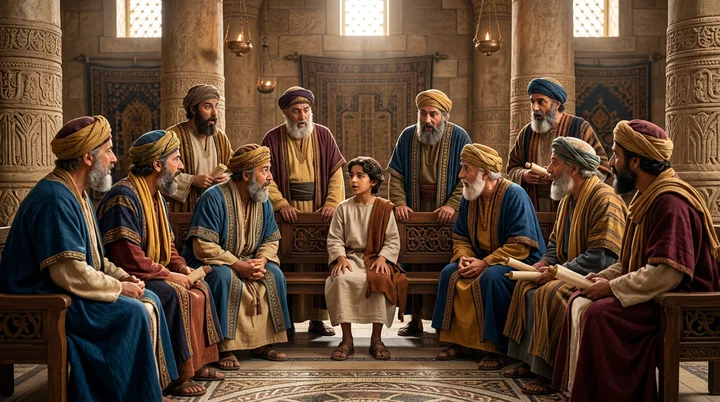
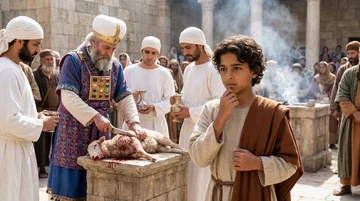
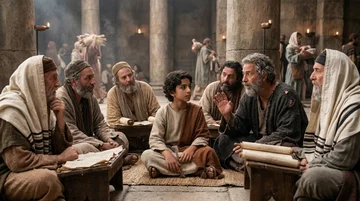
For the first time He looked upon the temple itself, the sacrificial victim, the white-robed priests in their solemn ministry, the prayer and incense, and the impressive rites of the paschal service.DA 78.1–2IRCUP 10.1STB 449.1–2 Day by day as He considered them their meaning became clearer, until He saw every act as bound up with His own life and mission.DA 78.1–2IRCUP 10.1STB 449.1–2 There the mystery of His mission began to open to Him, and the work He was to do for the children of Abraham, Isaac, and Jacob, the appointed heirs of the covenant promises, began to dawn upon His mind.IRCUP 10.1STB 449.1–2 New impulses awakened within Him as He silently and absorbedly studied out the great problem.IRCUP 10.1 When the Passover services ended He remained behind and lingered in the temple courts when the worshipers left Jerusalem, so that on the halt to rest on the return journey Joseph and Mary discovered He was missing.DA 78.1–2IRCUP 10.2DA 80
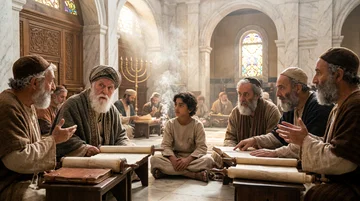
In the temple He presented Himself before the learned rabbis and doctors of the law in the attitude of a humble learner, plying them with questions regarding the coming of the Messiah.IRCUP 10.2 The doctors were astonished at His questions and could not always answer Him, though He had not been taught by them, for He was more learned than they and revealed perfection of character.IRCUP 10.2 He showed eagerness to obtain information, yet by every question He poured light into their darkened minds as a teacher without letting them suspect He was trying to teach them.4MR 51.1–53.1 By purity, humility, and meekness He rebuked sin while leaving nothing for which to blame Him.4MR 51.1–53.1
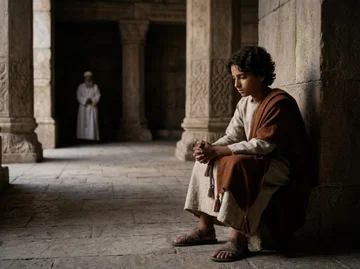
On the return His parents lost Him and searched for Him sorrowing for three days until they found Him.Ms 78, 1893, par. 40–451RED 30.2Ms 145, 1906, par. 28–31DA 80 In that experience Mary endured three days of anguish thinking Him lost to her.1RED 30.2DA 144.3–145.1 He knew this separation foreshadowed His death for the sins of the world, when He would be lost to them for three days and then reveal Himself and be found.1RED 30.2 The experience prepared them for His suffering and death and pointed to their faith in Him as Redeemer and advocate with the Father.1RED 30.2 His stay in Jerusalem reminded His parents of their duty and of the special favor of having the Son of God entrusted to their care, as He grew up under God's care and the guidance of a pious mother.2SP 35.1Ms 145, 1906, par. 28–31
Warnings and Practical Lessons
Joseph and Mary lost Jesus for one day of neglect on the return from the yearly Passover, when with minds engrossed by talking and visiting they supposed Him to be with the company until His absence was found at the close of the day. Inquiry and search among acquaintances and relatives found no trace, and they hastened back to Jerusalem heavy, sad and fearful. That one day cost three days of anxious sorrowful search to find Him again and regain peace of mind and the consolation of His grace. The loss came through vain talking, jesting, joking, and evil speaking, or even neglect of prayer, for the confusion of much talk led even those especially honored and entrusted with the sacred charge of the Saviour to forget for an entire day Him whom they should not have forgotten for a moment.
He was lost amid festivities, reunions, hilarity, and glee, though the Passover was a religious feast meant to call attention to Christ as the coming Saviour.Ms 183, 1903, par. 6–7 Recreation and innocent enjoyments carefully guarded are no sin, but such feasting leads to frivolity and indulgence of appetite and puts religious, thoughtful conversation aside for another time.Ms 183, 1903, par. 6–7 No one can be loose and lax in banqueting enjoyment where there is danger of losing the company of Jesus Christ for even a single hour.Ms 183, 1903, par. 6–7
As He at twelve went in before the rabbis and doctors of the law as a learner, asking questions that surprised them, showing eagerness to obtain information, and by every question pouring light into their darkened minds as a teacher without letting them suspect He was trying to teach them, those established, rooted and grounded in truth should enter worldly colleges as students in the same way.4MR 51.1–53.1 By purity, humility, and meekness He rebuked sin while leaving nothing for which to blame Him, and so they are to respect all rules, live principle, keep the Sabbath, and tell Bible doctrine in simple language when questioned, so the leaven works and light shines forth to save souls.4MR 51.1–53.1 He was at work all the time, working even in His own home until He had no home, with a lot no more pleasant than that of young people today walking in His footsteps.4MR 51.1–53.1
Because He was once a little child and lived from infancy to manhood without committing sin, as the God of salvation protected Him and He worked with all faithfulness in everything He did, children are for His sake to be honored and dealt with gently as a sacred charge belonging to God and loved by Him.Ms 77, 1910, par. 29Ms 34, 1899, par. 5 They are not to be indulged, petted, and idolized but to be taught to live a pure, noble life, with mothers cooperating with Him to help them form perfect characters, while He drew other children to Himself by singing songs of heaven with a pleasant voice.Ms 77, 1910, par. 29Ms 34, 1899, par. 5 Parents are given an example in Him to lay aside harsh ruling with an iron rod and to seek salvation every day with pleasant speech and song.Ms 77, 1910, par. 29Ms 34, 1899, par. 5
By making His home among the people of Nazareth for thirty years, living there unhonored and unknown in a town proverbial for wickedness and considered the worst in Palestine, from which it was thought a wonder if any good thing could come, He became a citizen of that lowly place.Ms 181, 1897, par. 8–11 He commenced His great and mighty work to uplift and regenerate the whole human soul there amid moral darkness and misery, setting His own feet upon the paths the poor and neglected souls must tread.Ms 181, 1897, par. 8–11 He might have made His home in places of renown but did not, lest followers compelled to live in lowly places should frame an excuse for their sins and for rough, hard, uncourteous characters.Ms 181, 1897, par. 8–11 By dwelling among those far down in popularity and morality He poured contempt upon human pride of place, station, honor, and fame, and demonstrated that any place, however hard and lowly, if it is the post of duty, can be made honorable by fidelity.Ms 181, 1897, par. 8–11
Sources
Pioneers and periodicals
41 sources
His parents went up to Jerusalem every year for the feast of the Passover, and when Jesus was twelve he went with them.ST Jan 29, 1894ST Jan 29, 1894ST Jan 11, 1899 Their yearly going was an established custom in keeping with Jewish law, kept by devout parents careful to obey both moral and ceremonial commandments.ST Aug 20, 1912RH Dec 12, 1871ST Jan 10, 1906 At twelve years, in his thirteenth year, it was probably his first attendance, for a boy then became a son of the law, responsible to God and expected to go up to the great feasts and take part in the Passover service.ST Aug 20, 1912ST May 22, 1907 After fulfilling the days he tarried behind and after three days was found in the temple sitting among the doctors, hearing them and asking questions as a learner seeking knowledge, yet with marvelous perception and grasp of truth greater than theirs.ST Aug 12, 1897ST May 24, 1910ST May 15, 1907 The Passover rites pointed to Christ himself as the Paschal Lamb and his future atoning sacrifice, and his subjection to his parents on returning to Nazareth is the example of obedience for every youth and child.ST Sep 17, 1894ST Jun 17, 1913ST May 22, 1907ST May 30, 1911ST May 17, 1910
Words and Yearly Custom
His parents went up to Jerusalem every year for the feast of the Passover, and when Jesus was twelve he went with them.ST Jan 29, 1894ST Jan 29, 1894ST Jan 11, 1899ST Jan 11, 1899ST Jun 15, 1904 Their going was a regular religious custom, the yearly custom of the Jewish people, and after the feast they began the journey home with their company.ST Jan 11, 1899ST Jan 11, 1899ST Jun 15, 1904RH Aug 17, 1876 The record belongs to the setting of the promised Messiah's coming.RH Aug 17, 1876
Their yearly going was an established custom in keeping with Jewish law, for verse 42 adds that they went according to the custom of the feast.ST Aug 20, 1912RH Dec 12, 1871 They were devout parents careful to observe all the commandments of the Lord both moral and ceremonial.ST Aug 20, 1912 The father was expected to attend three yearly feasts, while the mother was required to attend the Passover.ST Jan 10, 1906ST Jan 10, 1906
The word translated feast is the Greek heorte for the Passover.ST Mar 25, 1875ST Jul 29, 1875RH Nov 7, 1854 It is uniformly rendered feast in twenty-six of its twenty-seven New Testament uses.ST Mar 25, 1875
The family lived in the humble home at Nazareth, from which they made the pilgrimage to Jerusalem every year to attend the Passover.RH Oct 30, 1900ST May 22, 1907ST May 19, 1898 They went with other pious families, and he received the kind of instruction given in Hebrew homes.RH Oct 30, 1900ST May 22, 1907 The surrounding country then seen from its hills was greener and more populous than later.ST May 19, 1898
His parents were Jews, of the family of David and the tribe of Judah.ST Apr 23, 1894
The setting was quiet with no local wars or uprisings, with Quirinus as Roman governor of Syria, Coponius as procurator at Jerusalem, and Annas as high priest.ST Aug 20, 1912 Alive at the time were Hillel, his son Rabban Simeon and his grandson Gamaliel then only a boy, with Shammai long dead and Annas son of Seth just appointed.ST Aug 20, 1912ST Dec 9, 1880 Together with them were Jochanan Ben Zacchai, Jonathan Ben Uzziel, Ben Buta, Dosithai, Zadok, Boethus, Nicodemus, and Joseph of Arimathea.ST Dec 9, 1880
Jesus at Twelve Years
This Passover visit came when Jesus was twelve years old, in his thirteenth year, and was probably his first attendance.ST Aug 20, 1912ST May 22, 1907ST May 3, 1910 By Jewish custom a boy at that age became a son of the law, peculiarly responsible to God and reckoned as a true Israelite who must meet the obligations required of those older and go up to the great annual feasts.ST Aug 20, 1912ST Jun 17, 1913ST May 3, 1910 Jewish law and regulation did not permit boys to attend until they reached that age, when they entered conscious religious responsibility and the privileges of manhood.ST May 22, 1907ST May 3, 1910ST May 30, 1911 At that age he was expected to attend, receive special instruction in the law and religion, and take part in the usual Passover service, while yet subject to his parents in all things with obedience expressed in service to God.ST Aug 20, 1912ST May 22, 1907ST Jun 17, 1913ST May 30, 1911
After fulfilling the days he tarried behind in Jerusalem unknown to them, and after three days was found in the temple sitting in the midst of the doctors, hearing them and asking them questions.ST Aug 12, 1897ST May 24, 1910ST May 15, 1907 His listening and questioning was the expected conduct of a learner seeking knowledge, not disputing, not putting himself forward, not showing off, not presuming to teach the learned doctors, and not showing disrespect.ST Aug 12, 1897 Yet his questions asked for information revealed marvelous perception and grasp of truth greater than that of the doctors.ST Aug 12, 1897ST May 15, 1907 There he saw the sacrifices, incense, priestly chants, and prayers, and understood the meaning of the service more deeply than those around him through wisdom given by the Spirit, while in his human life he was still learning, taught by God.ST Aug 27, 1912ST May 30, 1911
Lingering after the multitude departed for various quarters, he entered a school conducted in the temple court and with other youth took his place at the feet of the learned doctors, surprising them with wisdom in questions and answers flashing truths concerning the long-expected Messiah.ST Jun 14, 1899ST May 24, 1910ST Apr 21, 1881 This was his first visit to Jerusalem since his dedication as a babe, made without ever having attended a rabbinical school.ST Jun 14, 1899 The rites, the paschal lamb and its blood, the incense, the perfection required of the offerings, and the removal of leaven impressed him with his connection to them and with the significance of his mission for the destiny of the world.ST May 17, 1910ST Apr 21, 1881 With his mind on his Father's business he did not remain for further instruction but returned to Nazareth and was subject unto his parents until the days of his baptism, because rabbinical teaching had degenerated into cold formalism that would have starved rather than fed his life and spirit, and the Levites had failed the original plan that youth should be educated by them in sacred truth.ST Jun 14, 1899
Passover and Its Meaning
The first Passover was kept at Rameses in Egypt on the night Israel was delivered from bondage.ST May 22, 1907 Its name recalls the angel passing over the homes marked with blood and sparing their firstborn.ST May 22, 1907 The Passover was the central Jewish festival, celebrated in Jerusalem with household preparations for unleavened bread and the sacrifice and meal of the lamb.ST Apr 21, 1881
Its rites pointed to Christ and His future atoning sacrifice.ST May 30, 1911 Jesus Himself is presented as the Paschal Lamb in the temple, with national and gospel meaning understood through the Spirit's wisdom.ST May 22, 1907ST May 30, 1911 The paschal lamb and its blood, the incense, the required perfection of the offerings, and the removal of leaven impressed upon Him His connection with them and the significance of His mission.ST May 17, 1910 The lessons He received there and carried out through His life concern the destiny of the world.ST May 17, 1910
The annual visit provided the occasion for His spiritual questions and teaching in the temple. His absorption of the sacred books of the Scriptures made the occasion one of more than ordinary interest.ST Aug 20, 1912 The entire journey could therefore be given to conversation and meditation on the purpose and object of the Passover gathering.ST Aug 20, 1912
Doctrine and Scripture Connections
The same Greek word rendered feast here for the Passover is rendered holy day in Colossians 2:16, and its uniform rendering as feast in twenty-six of its twenty-seven New Testament uses proves that the holy day there means a festival day, not the weekly Sabbath of the fourth commandment, but one of the abolished Jewish feast days.ST Mar 25, 1875RH Nov 7, 1854 The use of feast for the Passover in this verse shows that identification directly.ST Mar 25, 1875RH Nov 7, 1854 The same use of heorte for a feast day, specifically the Passover feast kept by going up to Jerusalem every year, bears on the exposition of the abolished ordinances in Ephesians 2:14-15.ST Jul 29, 1875
The verse belongs to Luke's account of the Boy Jesus in Luke 2:40-52, whose central event is the visit to the temple at twelve years old.ST Sep 17, 1894ST Mar 12, 1896ST May 15, 1907 It is to be studied with the whole connection from the annunciation to Mary to the permanent residence at Nazareth and with parallel passages.ST Mar 12, 1896 That connection records the losing of Jesus and the finding of Him in the temple, where He asked and answered questions, and shows His development, His obedience to His parents, His increase in wisdom, and His example to children and to every youth, since submission to God is the truest way to progress and true wisdom.ST Sep 17, 1894ST Mar 12, 1896ST May 15, 1907
Within the record of the promised Messiah's coming, the account of His birth and early life to which this yearly Passover going belongs shows that the Son of God became a real human being.RH Aug 17, 1876RH Nov 14, 1854 He was conceived by the power of the Highest and born of Mary in Bethlehem during the reign of Augustus Caesar, a real child as real as children now, who knew the trials children face and met them by His Father's Word, giving the pattern for children now to do as He would do and to keep pure through the Father.RH Nov 14, 1854ST Apr 9, 1902 He grew in wisdom and in stature, answering to Moses being learned in all wisdom and proving Him a prophet like Moses in a superior degree.ST Apr 9, 1902RH Feb 19, 1861 This Passover visit when He was twelve was His first visit to Jerusalem since His dedication as a babe in the temple, made without ever having attended a rabbinical school, His early training being the instruction given in Hebrew homes in the humble home at Nazareth.RH Oct 30, 1900ST Jun 14, 1899
Example for Family Life
The visit belongs to the account of the youth of Jesus whose central event is the temple visit at twelve, showing his development, his obedience to his parents, and his example to children.ST Sep 17, 1894ST Jun 17, 1913ST Mar 12, 1896 That account teaches subjection and obedience to parents as the example for every youth and child, together with increase in wisdom.ST Sep 17, 1894ST Jun 17, 1913ST Mar 12, 1896 Though at twelve he had become responsible to God and to follow God's teaching as a son of the law, he was still subject to his parents in all things, with obedience to them expressed in service to God.ST Sep 17, 1894ST Jun 17, 1913 Submission to God is the truest way to progress and true wisdom.ST Sep 17, 1894
In childhood he was a real child as real as children now, and when but old as a child of ten he knew the trials children face and met them with his Father's Word.ST Apr 9, 1902 His reply from his Father and his way of acting give the pattern for children now to do as he would do and to keep pure through the Father as he did, meeting trials by that Word.ST Apr 9, 1902 The record of the Passover visit was written for the learning of parents. Their going every year had made the feast familiar and meaningful to him, so he was eager to go when he was old enough to travel with them.RH May 14, 1914RH May 14, 1914 At twelve they trusted him to remember when they were leaving and which road to take, placing responsibility on him rather than keeping him under constant watch.RH May 14, 1914
After the feast they began the homeward journey with the company, supposing him to be with acquaintances and relatives in the large company, not realizing at first that he was not with them.ST Jun 15, 1904RH Nov 18, 1862 They traveled a day's journey without seeing him before they became alarmed at his absence at the close of the day.RH Nov 18, 1862 On the reckoning that the custom was to stop early on the first day, they had gone only a few miles to the first evening stop when the discovery was made.RH Sep 17, 1872 Not finding him with friends in the company after inquiry and search among acquaintances and relatives, they spent another day in alarmed search and a further day returning to Jerusalem, hastening back heavy, sad and fearful.RH Nov 18, 1862
The loss came through minds engrossed by talking and visiting, supposing him to be with the company. It came through vain talking, jesting, joking, and evil speaking, and through the confusion of much talk, or even through neglect of prayer. Thus Joseph and Mary, though especially honored and entrusted with the sacred charge, forgot for an entire day him whom they should not have forgotten for a moment. For one day of neglect they lost him from their company, and it cost three days of anxious sorrowful search to find him again and regain peace of mind and the consolation of his grace. His remaining in the temple to be about his Father's business while the returning company started home took courage.ST Jul 15, 1880 When conscience begins to dawn, that courage is the pattern to follow by going at once about the Father's business instead of indulging doubt and moral hesitation and hastily rejoining the returning company.ST Jul 15, 1880
Sources