Luke 2:42
And when he was twelve years old, they went up to Jerusalem after the custom of the feast.
Translations
American King James Version, King James Version, KJV Cambridge Paragraph Bible
And when he was twelve years old, they went up to Jerusalem after the custom of the feast.
And when he was twelve years old, they went up to Jerusalem according to the custom of the feast.
Revised Version, American Standard Version
And when he was twelve years old, they went up after the custom of the feast;
and when he became twelve years old, they having gone up to Jerusalem, according to the custom of the feast,
And when he was twelve years old, and they went up [ to Jerusalem] according to the custom of the feast
And, when he became twelve years, and they went up, according to the custom of the feast,
And when He was twelve years old, they went up according to the custom of the Feast.
And when He was twelve years old, they went up to Jerusalem according to the custom of the Feast.
When he was twelve years old, they went up to Jerusalem according to the custom of the feast;
And when he was twelve years old, they went up, as their way was, to the feast;
And when hee was twelue yeere olde, and they were come vp to Hierusalem, after the custome of the feast,
Douay-Rheims (Challoner revision)
And when he was twelve years old, they going up into Jerusalem, according to the custom of the feast,
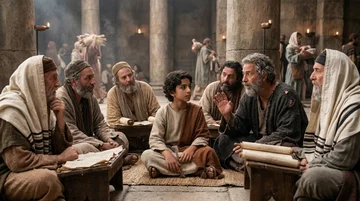
Pictures
Cross-references
- Luke 2:46-47
And it came to pass, that after three days they found him in the temple, sitting in the midst of the doctors, both hearing them, and asking them questions.
Continues the account of Jesus among the teachers at Jerusalem.
- Exodus 12:1-14
And the LORD spake unto Moses and Aaron in the land of Egypt, saying,
The Passover feast commemorated Israel’s deliverance from Egypt.
- Luke 2:49
And he said unto them, How is it that ye sought me? wist ye not that I must be about my Father’s business?
Jesus explains his stay in the temple as being about his Father’s business.
- Luke 2:51
And he went down with them, and came to Nazareth, and was subject unto them: but his mother kept all these sayings in her heart.
After the temple visit, Jesus returns to Nazareth and is subject to his parents.
- Deuteronomy 16:16
Three times in a year shall all thy males appear before the LORD thy God in the place which he shall choose; in the feast of unleavened bread, and in the feast of weeks, and in the feast of tabernacles: and they shall not appear before the LORD empty:
Requires Israelite males to appear at the appointed feasts.
- Exodus 23:17
Three times in the year all thy males shall appear before the Lord GOD.
Israel’s males were to appear before the Lord at the annual feasts.
- Deuteronomy 16:1
Observe the month of Abib, and keep the passover unto the LORD thy God: for in the month of Abib the LORD thy God brought thee forth out of Egypt by night.
Israel was commanded to keep the Passover each year.
- Luke 2:52
And Jesus increased in wisdom and stature, and in favour with God and man.
Describes Jesus continuing to grow in wisdom, stature, and favor.
- Luke 2:48
And when they saw him, they were amazed: and his mother said unto him, Son, why hast thou thus dealt with us? behold, thy father and I have sought thee sorrowing.
Mary questions Jesus after searching for him sorrowfully.
- Exodus 12:24-27
And ye shall observe this thing for an ordinance to thee and to thy sons for ever.
The Jerusalem visit followed the customary Passover observance.
- Psalms 122:2
Our feet shall stand within thy gates, O Jerusalem.
Pilgrims sing of arriving at Jerusalem’s gates.
- Luke 2:50
And they understood not the saying which he spake unto them.
notes His mother understood Him not
- John 11:56
Then sought they for Jesus, and spake among themselves, as they stood in the temple, What think ye, that he will not come to the feast?
Cited as another use of “the feast” for Passover.
- John 5:1
After this there was a feast of the Jews; and Jesus went up to Jerusalem.
Its “feast” is identified as Passover.
- John 4:45
Then when he was come into Galilee, the Galilæans received him, having seen all the things that he did at Jerusalem at the feast: for they also went unto the feast.
Cited as another use of “the feast” for Passover.
- John 12:12
On the next day much people that were come to the feast, when they heard that Jesus was coming to Jerusalem,
Cited as another use of “the feast” for Passover.
- Leviticus 23:24-39
Speak unto the children of Israel, saying, In the seventh month, in the first day of the month, shall ye have a sabbath, a memorial of blowing of trumpets, an holy convocation.
The feast days are distinguished from the weekly Sabbath.
- 1 Corinthians 5:7
Purge out therefore the old leaven, that ye may be a new lump, as ye are unleavened. For even Christ our passover is sacrificed for us:
The Passover lamb points to Christ.
- Luke 2:27
And he came by the Spirit into the temple: and when the parents brought in the child Jesus, to do for him after the custom of the law,
Cited as another custom Luke explicitly identifies.
- Luke 22:1
Now the feast of unleavened bread drew nigh, which is called the Passover.
Both verses refer to the feast of unleavened bread.
Commentary
Each commentary is drawn from primary sources: the writings of Ellen G. White and Adventist pioneers and periodicals. Each commentary is separate. Its own words are not a quotation; follow the references to read the source passages.
Ellen G. White
24 sources
When He was twelve, Jesus went up with Joseph and Mary to Jerusalem for the Passover, as they did every year in obedience to the law, twelve being the age when a Hebrew boy passed from childhood to youth and was expected to take part in the feasts.DA 75.1Ms 78, 1893, par. 40–45 The journey drew great companies from Nazareth and beyond over several days, with families recalling God's deliverance and singing psalms as they approached the city for one of the three yearly feasts appointed to turn hearts from the world to trust and reverence toward God.Ms 78, 1893, par. 40–45DA 75.2COS 31.1–21RED 29.2 On that first visit what He saw in the temple worship and paschal rites opened to His mind that those services pointed to His own life, that He was to be the sacrifice for sin foretold in Isaiah 53 and to do His Father's work for the heirs of the covenant promises.Ms 183, 1903, par. 1–2DA 78.1–2IRCUP 10.1STB 449.1–2 He began that work by listening and asking questions of the doctors of the law, surprising them and shedding light on the coming Messiah while still coming as a learner.Ms 183, 1903, par. 1–2IRCUP 10.24MR 51.1–53.1 His staying behind when His parents started home, so that one day of neglect cost them three days of sorrowful search, warns followers to stay watchful in prayer lest carelessness lose the sense of His presence and require painful seeking to recover it.DA 78.1–2ST Dec 9, 1880ST Oct 4, 1877
Passover Setting and Journey
When He was twelve years old Jesus went with Joseph and Mary to Jerusalem, for twelve marked a Hebrew boy's passage from childhood to youth.DA 75.1 At that age he was called a son of the law and a son of God, received special opportunities for religious instruction, and was expected to take part in the sacred feasts and observances.DA 75.1 His mind was developing along spiritual lines.
They went up to Jerusalem after the custom of the feast, for Joseph and Mary went every year in obedience to Jewish law, taking Jesus with them at twelve on the customary Passover journey.DA 75.1Ms 78, 1893, par. 40–45DA 75.2Ms 183, 1903, par. 1–2 The Passover was one of three annual feasts at which Israel's men were commanded to appear before the Lord in Jerusalem, drawing worshipers from across Palestine and other lands where Jews lived.DA 75.2 The trip from Nazareth was about seventy miles and took several days on foot or on oxen or asses.DA 75.2COS 31.1–2 It fell near the close of March or the beginning of April, when Palestine was bright with flowers and glad with birdsong.COS 31.1–2
Families and those from the same place traveled together in a large company.DA 75.2COS 31.1–2 Along the way they recalled Israel's history and God's deliverance from Egypt, parents telling their children of His miracles, mercies and loving-kindness.DA 75.2COS 31.1–21RED 29.2 As they approached Jerusalem travelers often sang together some of the beautiful psalms of David.DA 75.2COS 31.1–2 The feast was meant to turn the people from worldly concerns, strengthen their love and reverence for God, and teach them to trust Him rather than turn to other gods.1RED 29.2 It had solemn significance connected with Jesus, though for many it had become only a form and ceremony.Ms 78, 1893, par. 40–45DA 77.2
After the services ended Jesus remained in the temple while His parents began the return journey.DA 78.1–21RED 26.1–28.1LC1 26.1–27.2 After a day's journey at a rest stop they discovered He was missing from their company, supposing He was with relatives and acquaintances.ST Dec 9, 1880ST Oct 4, 1877 After inquiry and search among relatives and acquaintances they hastened back to Jerusalem with heavy sorrowful hearts.ST Dec 9, 1880 They found Him only after three days of anxious search, with Mary fearing she had lost Him forever, so that one day of neglect cost three days of sorrowful search.ST Dec 9, 1880ST Oct 4, 18771RED 30.2
Jesus' Mission Revealed
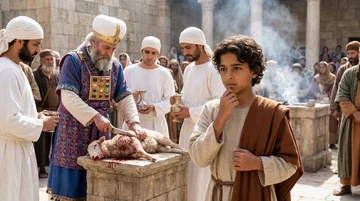
This was His first visit to the temple in childhood, and what He saw and heard there awakened His understanding of His mission.Ms 183, 1903, par. 1–2IRCUP 10.1STB 449.1–2 The worship, the incense, the white-robed priests in solemn ministry, the sacrificial victim, and the impressive rites of the paschal service helped Him see day by day that those rites pointed to His own life and mission, and He bound every act to His own life.DA 78.1–2IRCUP 10.1STB 449.1–2 Silent and absorbed, new impulses awakened within Him as He studied out the great problem, and the mystery of His mission opened to Him.IRCUP 10.1STB 449.1–2
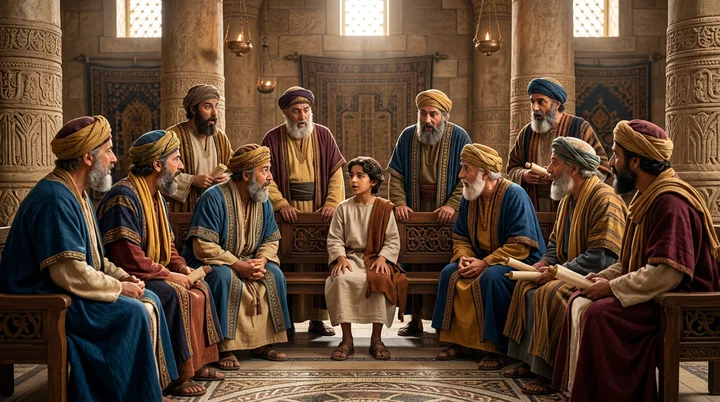
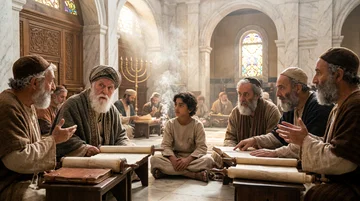
He recognized that He was to be the great sacrifice for sin in fulfillment of Isaiah 53, and that as God's prophet He was to proclaim the acceptable year of the Lord.Ms 183, 1903, par. 1–2 The work He was to accomplish for the children of Abraham, Isaac, and Jacob as the appointed heirs of the covenant promises began to dawn upon His mind.IRCUP 10.1STB 449.1–2 His work began as He listened to Scripture read and questioned the teachers, and this visit brought His first recorded exchange with them about the coming Messiah.Ms 183, 1903, par. 1–2IRCUP 10.2 He went in before the rabbis and doctors of the law as a learner, asking questions with eagerness to obtain information.Ms 183, 1903, par. 1–24MR 51.1–53.1
His questions surprised the learned doctors, and by every question He poured light into their darkened minds, teaching them without letting them suspect He was trying to teach them, for they would have spurned Him.4MR 51.1–53.1 At twelve He began to make clear that He knew His work and what lay before Him, and He showed His concern for His Father's work.1RED 26.1–28.1Ms 143, 1906, par. 22 He was growing under God's care and the guidance of a pious mother, and in the humble home at Nazareth He received the religious and practical training given to Hebrew children.Ms 145, 1906, par. 28–31RH Oct 30, 1900 There parents taught God's requirements and His dealings with Israel, and daily life was connected with God and the hope of eternal things, and His childhood is an example of a life lived as humanity should live.Ms 143, 1906, par. 22RH Oct 30, 1900
His separation from His parents on the return and their searching for Him for three days foreshadowed His later separation from them in death for the sins of the world and His revealing Himself to them after three days.1RED 30.2 Finding Him again taught them to rely on Him as the Redeemer of fallen humanity and their advocate with the Father.1RED 30.2 His staying behind gently reminded them not to let an ordinary view of Him as their child obscure His divine mission and the great privilege of caring for the Son of God, lest they grow indifferent and lose sight of God's favor and their duty.1RED 30.22SP 35.1
Behind this visit lies His making His home in Nazareth for thirty years, living there unhonored and unknown.Ms 181, 1897, par. 8–11 Nazareth was proverbial for wickedness, its people considered the worst in Palestine, a town from which no good thing was thought possible to come, so that the great work of uplifting and regenerating the whole human soul began in that place of bad reputation and moral darkness and misery.Ms 181, 1897, par. 8–11 By becoming a citizen there and leaving the courts of heaven to live a pure human character among those far down in popularity and morality, He set His own feet on the paths the poor and neglected must tread.Ms 181, 1897, par. 8–11 As the Light of the world He poured contempt on human pride of place, station, honor, and fame, and He demonstrated that any place, however hard and lowly, if it is the post of duty, can be made honorable by fidelity.Ms 181, 1897, par. 8–11 He could have lived in places of renown but chose the lowly place, so that His followers compelled to live in lowly places would have no excuse for sin and rough, hard, discourteous character.Ms 181, 1897, par. 8–11
Lessons for Believers
Jesus was twelve years old when He accompanied His parents on their yearly journey to Jerusalem for the feast, in keeping with Jewish law.ST Oct 4, 1877 After the family had traveled a day on the return journey, His parents discovered He was missing from their company.ST Oct 4, 1877 Their neglect of their sacred responsibility shows that those who follow Christ must remain watchful and prayerful.ST Oct 4, 1877 Carelessness can lead to losing the sense of His presence, and recovering the peace and comfort of His grace may take sorrowful searching.ST Oct 4, 1877
The religious feast was meant to call attention to Christ as the coming Saviour, yet festivities, reunions, hilarity and glee were more or less the order of the day.Ms 183, 1903, par. 6–7 Recreation and feasting lead to frivolity and indulgence of appetite, and religious, thoughtful conversation is set aside for another time.Ms 183, 1903, par. 6–7 Recreation and innocent enjoyments, when carefully guarded, are no sin, but believers must never be loose and lax in banqueting enjoyment where there is danger of losing the company of Jesus Christ for a single hour.Ms 183, 1903, par. 6–7 At twelve years old He was already a teacher who went in before the rabbis and doctors of the law as a learner, asking questions with eagerness to obtain information.4MR 51.1–53.1 His questions surprised the learned doctors, and by every question He poured light into their darkened minds, teaching them without letting them suspect He was trying to teach them, for they would have spurned Him.4MR 51.1–53.1 By His purity, humility and meekness He rebuked sin while giving no cause for blame, working constantly even in His own home until He had no home, leaving a pattern of hardship and faithful witness for young people today who enter worldly schools to live the truth and diffuse light.4MR 51.1–53.1
Because Christ was once a little child, mothers are to deal gently with their little ones and honor the children for His sake.Ms 34, 1899, par. 5 Children are to be looked upon as a sacred charge and as God's property whom He loves.Ms 34, 1899, par. 5 They are not to be indulged, petted and idolized, but to be taught to live a pure, noble life.Ms 34, 1899, par. 5 Mothers are to co-operate with God in helping them to form perfect characters.Ms 34, 1899, par. 5
Sources
Pioneers and periodicals
58 sources
At twelve years old He went up with His parents from Nazareth to Jerusalem for the Passover, after the yearly custom of the feast, for the first time since His dedication as a babe.ST Dec 9, 1880ST Jan 11, 1899ST Apr 23, 1894ST Aug 17, 1904ST Aug 27, 1912 At that age a Hebrew boy passed from childhood to youth and became a son of the law, personally responsible to God for character and service, expected to attend the feasts and take part in the Passover.ST Jan 11, 1899ST Jun 17, 1913ST May 3, 1910ST Dec 23, 1903ST Aug 20, 1912 In the temple He beheld the priests and sacrifices and grasped their meaning, recognizing that the lamb and its blood pointed to Himself as the Lamb of God who would give His life to atone for sin.RH Sep 19, 1912ST Aug 27, 1912ST May 30, 1911ST May 17, 1910 Lingering after the feast He sat in the temple school among the doctors, hearing them and asking questions with marvelous perception, not disputing or presuming to teach, yet His understanding and answers astonished them and flashed truth concerning the Messiah into their minds.ST Aug 12, 1897ST Jun 15, 1904ST Aug 17, 1904ST Jun 14, 1899ST May 30, 1911 The visit shows His human growth in wisdom and stature and His obedience to His parents, setting an example for children and youth in submission, self-control, and being about His Father's business.ST Sep 17, 1894ST Mar 16, 1904ST Mar 12, 1896ST Apr 11, 1878RH Apr 2, 1914
Words and Feast Custom
The word rendered feast is the Greek heorte, meaning a feast day, a festival, or a festival holiday.ST Jul 29, 1875RH Nov 7, 1854 Its use for the yearly going up to Jerusalem proves that the holy day in Colossians 2:16 means a festival day of the Jewish ritual that expired with that ritual, and not the weekly Sabbath of the fourth commandment; it is translated feast in twenty-six other places.ST Mar 25, 1875 The feast by way of eminence is the Passover, whose celebration began on Nisan 14 and included the feast of Unleavened Bread.RH Dec 19, 1907ST Apr 21, 1881
The verse describes a customary, regular observance rather than a one-time event, for Luke marks customary acts as such.ST Apr 1, 1875RH Mar 11, 1875 His parents were Jews, of the tribe of Judah and the family of David, who yearly visited Jerusalem in accordance with Jewish law and the custom of the feast.ST Dec 9, 1880ST Oct 4, 1877ST Apr 23, 1894 All males were required to attend each year, and many women went as well.ST Dec 23, 1903 They were devout and careful to keep all the commandments of God, both moral and ceremonial, attending the Passover at Jerusalem every year.ST Aug 20, 1912
The visit is dated to A.D. 8, giving His age as twelve without giving the calendar date of His birth, as His age of thirty-three when He finished His mission is also stated without a birth date.RH Dec 12, 1907 It happened when Quirinus was Roman governor of Syria, Coponius was procurator at Jerusalem, and Annas was high priest, in quiet times with no local wars or uprisings, so the whole journey could be given to conversation and meditation on the purpose and object of the Passover gathering.ST Aug 20, 1912 The family's return began according to an ancient travel custom in which a party left only a few hours before sunset on the first day and camped within sight of the place left, so it could go back for anything forgotten or needed.RH Sep 17, 1872 This explains how Joseph and Mary could discover at sunset that Jesus was not with them while still only a few miles from Jerusalem.RH Sep 17, 1872
The journey from Nazareth to Jerusalem belongs to the setting of worship at the temple.ST May 8, 1901 The Jerusalem then visited has since been buried beneath layers of debris from repeated sieges.ST May 8, 1901 His childhood in Nazareth connects with the real landscapes and places of Galilee He would have seen.ST May 19, 1898
Twelve Years Old
He was twelve years old, in His thirteenth year, when a Hebrew boy was regarded as passing from childhood to youth and awakening into manhood.RH Sep 19, 1912ST Jan 11, 1899ST Jan 10, 1906ST Aug 20, 1912 This was a critical age and turning point for consciously entering the responsibilities of serving God and gaining deeper knowledge of divine things.ST Jan 10, 1906ST Jan 10, 1906 At twelve, under Jewish custom, a child became a son of the law and became peculiarly and legally responsible to God.ST Jun 17, 1913ST Dec 23, 1903ST Sep 15, 1898ST Jan 10, 1906 He was recorded at the temple and doubtless entered in the synagogue records as a member, expected to take conscious responsibility for forming character and serving God and to meet the obligations required of those older.ST Jun 17, 1913ST Aug 20, 1912ST Jan 10, 1906 By Jewish custom a boy became a son of the law at thirteen, so His coming at twelve placed Him at the threshold of standing as a man before God and being reckoned as a true Israelite.ST Aug 20, 1912
That responsibility did not prevent Him from remaining subject to His parents, for His obedience to them meant service consistent with serving God.ST Jun 17, 1913 By twelve a Hebrew boy had received instruction at home and at synagogue school, where he learned to read and write with Scripture as a leading subject.ST Dec 23, 1903 There he received special instruction in the Jewish law and ancestral religion, and was expected to begin learning a trade and studying the Scriptures.ST Dec 23, 1903ST May 22, 1907ST Sep 15, 1898 At twelve Jewish boys were expected to begin attending the feasts and were first permitted to take part in the Passover services, when they received the privileges of manhood.ST Jan 11, 1899ST May 3, 1910ST May 30, 1911ST May 22, 1907ST Sep 15, 1898 Twelve was also an age when boys destined for priestly service could begin instruction under the rabbis, yet He had never attended a rabbinical school.ST Jan 11, 1899ST Jun 14, 1899
First Passover Journey
This was His first attendance at the annual feast with His parents and family, going up after the custom of the feast when He was twelve years old.ST Jan 11, 1899ST Aug 17, 1904ST Jun 14, 1899ST May 3, 1910ST May 22, 1907 He went up from Nazareth to Jerusalem for the yearly Passover, His first recorded attendance, entering Jerusalem at twelve for His first Passover as a son of the law.ST Jan 11, 1899ST Aug 27, 1912ST May 3, 1910ST May 22, 1907 It was His first time in Jerusalem since His dedication there as a babe, and probably His first time in the temple, where He listened to the teachers of the law and asked them questions.ST Aug 17, 1904ST Jun 14, 1899 Jewish boys were expected to begin attending the feasts from age twelve, when they received special instruction in the Jewish law and their ancestral religion and received the privileges of manhood.ST May 3, 1910ST May 22, 1907 At this age His mind was developing along spiritual lines, and He was entering consciously into the responsibilities of serving God and gaining a deeper knowledge of divine things.ST Jan 10, 1906 The journey was therefore more than an incidental visit because of His absorption of the sacred books of the Scriptures.ST Jan 10, 1906ST Aug 20, 1912
There He saw the temple, the white-robed priests, the sacrifices, the incense, and the worship.RH Sep 19, 1912ST Aug 27, 1912 He took part with His parents in the usual Passover service, and the Passover and its preparations and the temple rites and symbols impressed Him.RH Sep 19, 1912ST Aug 27, 1912ST Apr 21, 1881 Especially the Passover lamb, its blood, the incense, and the removal of leaven drew His attention to the mystery of His own mission.RH Sep 19, 1912ST May 17, 1910 During the days there those rites led Him to recognize that He was connected with them and with the work they represented.ST May 17, 1910
He had studied the rites and through the Spirit's wisdom grasped their national and Gospel meaning.ST May 30, 1911 The sacrifices pointed to Him as the Lamb of God who would give His life for humanity and atone for sin.ST May 30, 1911 The lessons He received there were bound up with the destiny of the world.ST May 17, 1910 The Paschal Lamb was present in the temple in His person, though the learned teachers did not recognize Him.ST May 22, 1907 Though He was still learning in His human life, God was His teacher.ST Aug 27, 1912
Temple Encounter With Teachers
This was the occasion of His stay in the temple after the multitude left for home and for Palestine.ST Jun 15, 1904ST Jun 14, 1899 Lingering after the feast, He entered a school in the temple court and with other youth sat at the feet of the learned doctors.ST Jun 14, 1899 He showed courage as the Child in the temple by remaining to be about His Father's business instead of hastily rejoining the first returning company.ST Jul 15, 1880 In the temple in the midst of the doctors of the law He heard them and asked them questions on their teaching, listening to and speaking with the teachers, just as every listener was expected to do.ST Aug 12, 1897ST Jun 15, 1904ST Aug 17, 1904ST May 24, 1910ST May 15, 1907
He was not disputing with the doctors, putting Himself forward, showing off, presuming to teach the learned doctors, or showing disrespect to them, and nothing He did was unbecoming in a child of twelve.ST Aug 12, 1897 He was seeking knowledge to gain information, and His questions showed marvelous perception and grasp of truth.ST Aug 12, 1897 Among the Council He probed the deep and hidden mysteries of Holy Scripture in doctrines, prophecies, and laws, fixing them with large luminous eyes and a steadfast searching gaze and asking in a silvery voice questions such as no man much less a child had conceived.ST Jul 29, 1880 When they failed to answer He answered them Himself with exact knowledge that filled them with amaze and left them mute, marking Him as no ordinary mortal child of whom the world would surely hear some day.ST Jul 29, 1880 His understanding and answers astonished and baffled the rabbis and teachers of the law, though He had been brought up Jewish and knew His mother's religion thoroughly.RH Dec 12, 1907ST Oct 28, 1930 His knowledge of the prophets astonished a rabbi.ST May 24, 1910
The school where He was found may have had several rabbis present because it was Passover season, but their identities cannot be known.ST Dec 9, 1880 His understanding surpassed that of the teachers in the temple instruction about the meaning of the annual services.ST May 30, 1911 The wisdom of His questions and answers flashed truths concerning the long-expected Messiah into the minds of the doctors.ST Jun 14, 1899 His words revealed heavenly wisdom.ST May 22, 1907 From the first time the church teachers beheld Him as a child of twelve until He died on the cross they felt the pulsings of His divine nature, so that even truth-hardened teachers whose work knew nothing but the dead emptiness of cold church formalism had their lives modified and subdued by mere contact with Him through His princely humility, sincerity, and gentleness, though He was a despised Galilean.ST Jun 13, 1916
At that age He understood better than most men what it meant to be about His heavenly Father's business.ST Mar 16, 1904 He knew He must be about it and knew how to do it.ST Jun 21, 1905 Even at twelve He could instruct the Jewish teachers in the temple.RH May 5, 1874 His presence there is evidence that He attended to the worship of God from childhood.RH May 5, 1874
Growth and Quiet Years
The verse belongs to the story of the Boy Jesus from the annunciation to Mary to the permanent residence at Nazareth, showing His development in wisdom and stature and in favor with God and man, His obedience to His parents, and His example to children.ST Mar 12, 1896 His bodily growth traced to age twelve confirms that He experienced human development.ST Apr 11, 1878 That growth in wisdom and stature matches Moses being learned in all wisdom, showing Him to be a prophet like Moses in superior degree.RH Feb 19, 1861
His growth in strength of spirit and wisdom was not the result of earthly instruction.ST Jun 14, 1899 His mother, yielded to the control of the Spirit of God, was His first human teacher after the Jewish custom, and God was His Teacher as He wandered in the fields and woods holding converse with the works of His own hands, with the grace of God upon Him.ST Jun 14, 1899 He grew up in the humble home at Nazareth, where He received the religious and practical training given to Hebrew children, in which parents taught God's requirements and dealings with Israel and daily life was connected with God and the hope of eternal things.RH Oct 30, 1900
Rabbinical and Levitical teaching had degenerated into cold formalism that would have starved rather than fed Him, though the original plan was for the Levites to educate youth so that He might have sat as a learner at their feet; instead of remaining for further instruction He returned to Nazareth.ST Jun 14, 1899 Afterward He returned to Nazareth with His parents and remained subject to them.ST Jun 14, 1899 He lived at home helping His father in the carpenter shop, obeying His parents in all things as an obedient, humble carpenter sharing fallen human nature and Abraham's lineage in sympathy and love, while studying and becoming acquainted with the Scriptures and preparing for His work until His heavenly Father indicated it was time to commence ministry.ST May 22, 1907ST Jun 14, 1899ST May 12, 1914
The account gives no further details of His childhood before His baptism, when He was about thirty and began His public ministry. The Bible says practically nothing from age twelve until He started to preach, a silence left by divine inspiration.ST May 12, 1914 Scripture leaves His life unrecorded from going up to Jerusalem at twelve until His baptism by John.ST Sep 3, 1894 Any account filling the years between age twelve and His baptism from a Buddhist monastery manuscript in Tibet is discredited, with its intimation that the morals and doctrines He taught were received from Buddhism being a weak borrowing to gain prestige that will arouse brief curiosity and then fall dead.ST Sep 3, 1894
The account of His birth and early life marks the fulfillment of the Old Testament gospel promises and establishes His Messiahship. The verse records the day of Christ's birth as a memorable day in His history, but it does not identify that day as the Lord's day; Christ did not claim it as His.ST Apr 6, 1882
Example and Application
The visit at twelve is the central event of the account of His youth, showing His development in wisdom and stature and in favor with God and man, His obedience to His parents and submission, and His example to children and young people, including faithful self-control beginning in childhood with control of appetite.ST Sep 17, 1894ST Mar 12, 1896RH Apr 2, 1914 His childhood and youth mean He knows how to sympathize with children in their trials and difficulties.ST May 15, 1907 He was a real child just as old as other children, tried as children are tried and facing wayward steps and pleasant allurements as a youth, and He met childhood trial by answering with His Father's Word and kept pure as a youth by holding His Father high and drawing strength from His Father's presence, calling children and youth to do as He did and seek strength from the Father to stay pure.ST Apr 9, 1902 His age illustrates that a boy of twelve can be trusted with responsibility, such as remembering when to start and which road to take, so parents should trust a boy's common sense and conscience rather than constantly watch him.RH May 14, 1914 His parents' yearly custom and talk about the journey could make Him eager to go before He was old enough, showing how parents can nurture a child's interest in worship and church life.RH May 14, 1914
After the feast the people started home without Him, and after a day's journey His parents missed Him, supposing He was with the company among relatives, acquaintances, and friends.ST Dec 9, 1880 They gave themselves no concern until, seeing nothing of Him and not finding Him, they became alarmed after inquiry and search.ST Dec 9, 1880 They hastened back to Jerusalem with heavy sorrowful hearts, spending another day searching and finding Him only after three days of anxious search, so that one day of neglect in losing Him from their company cost three days of anxious sorrowful search to find Him, and the scene shows His parents' distress and His presence among the learned teachers.ST Dec 9, 1880ST May 24, 1910
The record of His mother's reproof and His reply was written to give parents a lesson, and their neglect of sacred responsibility teaches that those following Christ must remain watchful and prayerful, for carelessness can lead them to lose their sense of His presence, and recovering the peace and comfort of His grace may take sorrowful searching.ST Oct 4, 1877 His courage in remaining condemns moral hesitation and doubt, teaching that when conscience dawns a person should go forth with definite motive about the Father's business rather than indulge doubt.ST Jul 15, 1880 This childhood event belongs to His life as a missionary.RH Nov 19, 1908
Sources