Luke 21:5
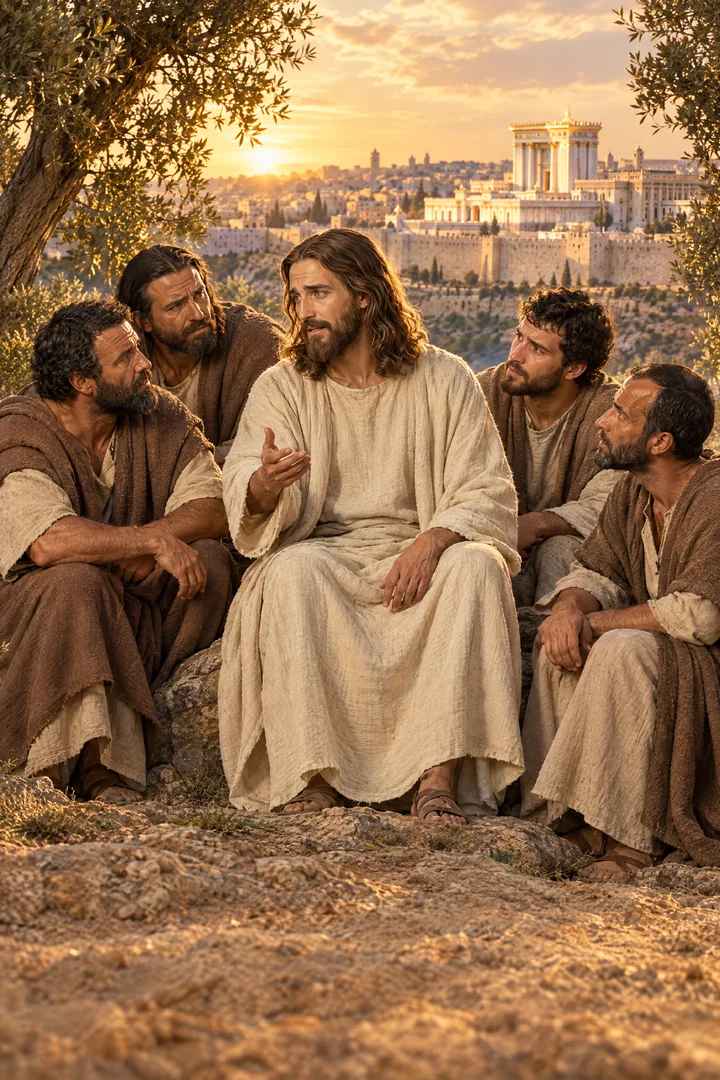
And as some spake of the temple, how it was adorned with goodly stones and gifts, he said,
Translations
And as some spoke of the temple, how it was adorned with goodly stones and gifts, he said,
King James Version, KJV Cambridge Paragraph Bible
And as some spake of the temple, how it was adorned with goodly stones and gifts, he said,
And as some spoke of the temple, that it was adorned with goodly stones, and gifts, he said,
Revised Version, American Standard Version
And as some spake of the temple, how it was adorned with goodly stones and offerings, he said,
And certain saying about the temple, that with goodly stones and devoted things it hath been adorned, he said,
And as some spoke of the temple, that it was adorned with goodly stones and consecrated offerings, he said,
And, certain saying, of the temple—With beautiful stones and offerings, hath it been adorned! he said—
Berean Standard Bible, Majority Standard Bible
As some of the disciples were remarking how the temple was adorned with beautiful stones and consecrated gifts, Jesus said,
As some were talking about the temple and how it was decorated with beautiful stones and gifts, he said,
And some were talking about the Temple, how it was made fair with beautiful stones and with offerings, but he said,
Nowe as some spake of the Temple, how it was garnished with goodly stones, and with consecrate things, he sayd,
Douay-Rheims (Challoner revision)
And some saying of the temple, that it was adorned with goodly stones and gifts, he said:
Pictures
Cross-references
- Matthew 24:1-2
And Jesus went out, and departed from the temple: and his disciples came to him for to shew him the buildings of the temple.
Both recount Jesus’ departure from the temple and prediction of its destruction.
- Mark 13:1-2
And as he went out of the temple, one of his disciples saith unto him, Master, see what manner of stones and what buildings are here!
Both texts introduce Jesus’ prophecy prompted by the temple’s impressive stones.
- Matthew 24:3
And as he sat upon the mount of Olives, the disciples came unto him privately, saying, Tell us, when shall these things be? and what shall be the sign of thy coming, and of the end of the world?
The disciples’ question about the temple prompts Jesus’ discourse on his coming and its signs.
- Mark 13:24-37
But in those days, after that tribulation, the sun shall be darkened, and the moon shall not give her light,
This is the lesson’s parallel account of Jesus’ prophetic discourse.
- Matthew 23:38
Behold, your house is left unto you desolate.
Jesus declares Jerusalem’s house desolate before warning of the temple’s destruction.
- Matthew 24:29-30
Immediately after the tribulation of those days shall the sun be darkened, and the moon shall not give her light, and the stars shall fall from heaven, and the powers of the heavens shall be shaken:
Both describe celestial signs followed by the Son of man coming in the clouds.
- Daniel 9:26
And after threescore and two weeks shall Messiah be cut off, but not for himself: and the people of the prince that shall come shall destroy the city and the sanctuary; and the end thereof shall be with a flood, and unto the end of the war desolations are determined.
The prophecy of Jerusalem’s destruction connects with Jesus’ prediction.
- John 2:20
Then said the Jews, Forty and six years was this temple in building, and wilt thou rear it up in three days?
Gives the time spent building the temple seen in Christ’s day.
- Micah 3:12
Therefore shall Zion for your sake be plowed as a field, and Jerusalem shall become heaps, and the mountain of the house as the high places of the forest.
The prophecy says Jerusalem and the temple mount will be laid waste.
- Luke 21:20-24
And when ye shall see Jerusalem compassed with armies, then know that the desolation thereof is nigh.
The passage identifies Jerusalem surrounded by armies with the Roman destruction under Titus.
- Matthew 24:4-14
And Jesus answered and said unto them, Take heed that no man deceive you.
Christ warns the disciples about events leading to the end.
Commentary
Each commentary is drawn from primary sources: the writings of Ellen G. White and Adventist pioneers and periodicals. Each commentary is separate. Its own words are not a quotation; follow the references to read the source passages.
Ellen G. White
7 sources
As they were leaving the temple, the disciples called attention to its strength and beauty, speaking of how it was adorned with goodly stones and gifts.DA 627.1–3Ms 40, 1897, par. 34–36Lt 90, 1902, par. 2–4Ms 1, 1906, par. 1–63SP 69.3–70.1 Its magnificent buildings were of pure white marble, with enormous stones and massive pillars, enriched with costly gifts and offerings, and they seemed lasting and enduring.DA 627.1–3ST Dec 19, 19003SP 69.3–70.1 That splendor was a source of national pride, so they could not understand a warning of its ruin.ST Dec 19, 19003SP 69.3–70.1 In reply came the declaration that for these things they beheld, the days will come when the temple will be completely thrown down and there shall not be left one stone upon another that shall not be thrown down.DA 627.1–3Ms 40, 1897, par. 34–36Lt 90, 1902, par. 2–4Ms 1, 1906, par. 1–63SP 69.3–70.1
The verse begins the discourse answering their questions about when these things shall be and what sign shall mark them, concerning both the destruction of the temple and the coming.DA 627.1–3Ms 1, 1906, par. 1–6 What their eyes rested upon was made a lesson book about the great calamity to come upon Jerusalem in its destruction.Ms 40, 1897, par. 34–36 That prophecy of Jerusalem's fall was blended with events reaching to the close of this earth's history, when not merely nations will be destroyed but the whole world.DA 627.1–3Ms 40, 1897, par. 34–36 Many of these judgments came upon Jerusalem, but the words were not of Jerusalem alone.Lt 90, 1902, par. 2–4
They look past the destruction of Jerusalem down the ages to the time at the end of this earth's history when the great and final visitation of wrath will be seen.Lt 90, 1902, par. 2–4 Then costly mansions and marvels of architectural skill will be destroyed without a moment's notice when it is seen that the owners have passed the boundaries of forgiveness.Lt 90, 1902, par. 2–4 The destruction by fire of stately buildings supposed to be fireproof illustrates how in a short time the earth's architecture will lie in ruins.Lt 90, 1902, par. 2–4 Anxious curiosity about the secret time of the coming was not satisfied.Ms 1, 1906, par. 1–6
Instead hearers were told to take heed to the words, prepare themselves for that great event, perform faithfully their individual duty, and give to others the warnings that had been given them.Ms 1, 1906, par. 1–6 This is a solemn message of warning that the people of God must heed.Ms 1, 1906, par. 1–6 The words spoken to the disciples at that time leave lessons especially applicable to the time upon whom the ends of the world are come.Ms 40, 1897, par. 34–36 The declared destruction of the admired temple means that in the closing days of this earth's history many cities will be cast down because of their sins and their lofty buildings destroyed, so those who believe this should build only a neat, modest but roomy place for worship as a witness to that belief.Lt 132, 1908, par. 5
Sources
Pioneers and periodicals
67 sources
As He was leaving the temple and sitting on the Mount of Olives viewing Jerusalem, some including the disciples drew His attention to how it was adorned with fine beautiful stones and gifts or offerings.ST Nov 15, 1899RH Sep 27, 1906GSAM 67.2–68.1RH Nov 10, 1863ST Nov 15, 1899 Those gifts were splendid votive offerings hung in its portico and seen at a distance, including a golden table, immense golden vines with clusters as tall as a man, spoils taken by Herod, and precious stones, while the building itself was magnificent white marble with massive pillars and seemingly lasting foundations.ST Dec 19, 1900RH Nov 10, 1863ST Apr 22, 1889ST Dec 20, 1910 In reply to that admiration He declared the buildings seen would be utterly thrown down, with not one stone left upon another.ST Nov 15, 1899ST Oct 8, 1894 The remark opens His great prophetic discourse recorded in Matthew 24, Mark 13 and Luke 21, which together must be compared to obtain its full meaning, tracing the history of His people and the gospel age from His own day to the consummation.RH Dec 10, 1903ST Jan 17, 1906RH Sep 27, 1906RH Jan 7, 1904 That discourse closely joins the destruction of Jerusalem, fulfilled when the city fell to the Romans under Titus in A.D. 70 after God had already left the house, with tribulation, signs in sun moon and stars, and His personal coming in clouds with power and great glory to gather His people and establish the kingdom.STRH Jun 2, 1851ST Nov 5, 1912 It therefore directs the mind away from perishing visible glory to the lasting glories of the world to come, giving light by which those living near the end may know His coming is near even at the doors and be ready.ST Apr 19, 1910ST Jun 30, 1909RH Oct 25, 1870RH Aug 17, 1869
Temple Setting and Wording
As Jesus was speaking, some people, including His disciples, drew His attention to the temple by admiring how it was adorned with fine, beautiful, goodly stones and gifts or offerings.ST Nov 15, 1899RH Sep 27, 1906GSAM 67.2–68.1RH Oct 25, 1870 As He was leaving the temple they pointed out its fine stones and gifts, and this admiration provides the setting for His prediction of its destruction.ST Nov 15, 1899RH Sep 27, 1906ST Nov 15, 1899 The disciples admired it along with the Jews, pointing out its goodly stones and gifts.GSAM 67.2–68.1RH Oct 25, 1870
The gifts were splendid votive offerings strictly so called, suspended in the portico of the temple and visible at a distance.RH Nov 10, 1863ST Apr 22, 1889 They included a golden table given by Pompey, several golden vines of exquisite workmanship and immense size with clusters as tall as a man, and spoils and trophies taken by Herod from barbarians and Arabians.RH Nov 10, 1863 Precious stones added to its remarkable splendor.RH Nov 10, 1863ST Apr 22, 1889 The gifts also included money cast into its treasury for its repair and maintenance.RH Dec 3, 1867
Herod's temple was a magnificent building of pure white marble with massive pillars, walls and foundations that seemed solid and lasting.ST Dec 19, 1900ST Apr 22, 1889ST Dec 20, 1910ST Nov 5, 1912 Its pure white marble stones and massive pillars made the buildings seem lasting, and its massive marble walls and foundations seemed so solid.ST Dec 19, 1900ST Dec 20, 1910 The setting is Jesus sitting on the Mount of Olives viewing Jerusalem and its temple, while His disciples called His attention to the temple and pointed out the gifts with which it was adorned.RH Nov 10, 1863ST Aug 25, 1887ST Jan 13, 1887ST Jun 27, 1906 These offerings were visible at a distance from the Mount of Olives, and people were speaking about Jerusalem's temple as they viewed it while He answered.RH Nov 10, 1863ST Nov 15, 1899 His great prophecy outlining the history of the Christian dispensation, including the siege and overthrow of Jerusalem and the destruction of the temple, was given while He viewed Jerusalem from the Mount of Olives.ST Aug 25, 1887ST Jan 13, 1887ST Jun 27, 1906
In reply to this admiration Jesus declared that the buildings seen would be completely destroyed, with not one stone left upon another that would not be thrown down.ST Nov 15, 1899ST Oct 8, 1894RH Jun 17, 1915 After viewing the great stones of its construction He declared there shall not be left one stone upon another that shall not be thrown down.ST Nov 15, 1899ST Oct 8, 1894 The disciples could not understand the warning because the construction seemed so lasting, and they thought its destruction would mean the destruction of the world.ST Dec 19, 1900ST Dec 20, 1910
Opening the Olivet Discourse
Luke 21:5 opens Christ's great prophetic discourse on the temple and the events He foretold, given in response to remarks about the temple adorned with fine stones and gifts.RH Dec 10, 1903RH Sep 27, 1906RH Jan 7, 1904RH Apr 12, 1915ST Apr 21, 1909 It introduces His teaching about the destruction of Jerusalem and His second coming, and about signs that mark the nearness of His coming.RH Sep 27, 1906ST Apr 21, 1909 After some, including disciples, spoke to Jesus about the temple and viewed its great stones of construction, He declared that not one stone would be left upon another that would not be thrown down.RH Apr 12, 1915 That declaration gave rise to the questions of four disciples asking when these things would be and what would be the sign of His coming and of the end of the age.ST Jan 17, 1906ST Jul 21, 1898ST Jun 27, 1900
The discourse answering the questions about the temple's destruction, His coming, and the end of the age is recorded in three parallel accounts in Matthew 24, Mark 13 and Luke 21.ST Jan 17, 1906RH Jun 23, 1904ST Aug 14, 1893ST Nov 1, 1910 Luke's account gives part of that answer, while Matthew 24 and Mark 13 also preserve portions, and all three together with other prophecies of the same period of world history must be studied and compared to obtain its full meaning, clear information, and correct application.ST Jan 17, 1906ST Jul 21, 1898 Each supplements the others without contradiction, with Matthew 24 the most complete.ST Aug 14, 1893 The prophecy gives literal signs of His coming in simple form that unlearned people can grasp apart from long lines of prophecy requiring knowledge of history, and it presupposes that people living just before His return will know other prophecies about events leading to the same climax.ST Aug 14, 1893 Every prophecy in Luke 21 together with Matthew 24 and Mark 13 is fulfilled in consecutive order in history and can be illustrated and explained in brief study.RH Jun 23, 1904
The Saviour's discourse traces the history of His people and their changing duties and trials from His own day to the end. It gives waymarks by which they can recognize the times and act in harmony with God's word. It is Christ's own foretold outline history of the world and of the Christian dispensation or gospel age from His time to the consummation, beginning the foretold prophetic history carried forward to the end of the great controversy and to the consummation of His kingdom.RH Jan 7, 1904RH Jun 23, 1904RH Feb 6, 1855RH Dec 15, 1904ST Aug 5, 1913 Its line of prophecy runs from the overthrow of Jerusalem in A.D. 70 through Vesuvius and Pompeii and on to present political, social and religious disturbances, with every prophecy fulfilled from His time to ours except the final act which remains future and may occur at almost any time.RH Jan 7, 1904ST Dec 24, 1912RH Dec 15, 1904ST Jun 28, 1905
Prophetic Scope and Fulfillment
Luke 21 belongs to the Lord's predictions covering the time from Jerusalem's destruction to the second advent, closely joining the destruction of Jerusalem with Christ's second coming and the end of the world.STST Feb 7, 1906ST Nov 28, 1900ST Jun 3, 1897 It is the great prophecy of Christ's second coming recorded in Luke 21 alongside Matthew 24 and Mark 13, one of several prophetic lines that converge on the second coming.STST Nov 28, 1900 Its teaching about Jerusalem's destruction, persecution of followers, and signs of the nearness of the end belongs to that whole span from Jerusalem's destruction and tribulation under the Romans to the end.STST Feb 7, 1906ST Jun 3, 1897 It gives literal signs of His coming and presupposes that people living just before His return will know other prophecies about events leading to the same climax.ST Feb 7, 1906 It clearly predicted Jerusalem's destruction, whose warning the Jews ignored while the disciples who heeded it escaped the city and were saved.
Every prophecy in the chapter is fulfilled in consecutive order in history from His time to ours except the final act, from the overthrow of Jerusalem in A.D. 70 through Vesuvius and Pompeii and on to present political, social and religious disturbances.RH Dec 22, 1904RH Dec 24, 1903RH Dec 10, 1903RH Jan 7, 1904RH Jun 23, 1904 It is Christ's outline of future events, whose prophecies are presented as fulfilled in historical events from the overthrow of Jerusalem in A.D. 70 to contemporary disasters and political and social upheavals.RH Dec 22, 1904RH Dec 24, 1903RH Dec 31, 1903 It introduces His discourse on the temple and the events He foretold, whose historical fulfilment runs from the destruction of Jerusalem in A.D. 70 through later world events, while its final act remains future.RH Dec 24, 1903RH Dec 31, 1903RH Dec 10, 1903 Every prophecy in Luke 21 together with Matthew 24 and Mark 13 is fulfilled in consecutive order in history and can be illustrated and explained in a few minutes' study.RH Jan 7, 1904RH Jun 23, 1904
The prediction of the temple's destruction was fulfilled when Jerusalem fell to the Romans under Titus in A.D. 70, when the Jews were scattered among the nations.RH Jun 2, 1851ST Nov 5, 1912RH Jun 17, 1915 This occurred despite Titus's efforts to spare the temple, after the people rejected God's protection and persisted in transgression against light received.RH Jun 17, 1915 Herod's temple was a magnificent building, adorned and impressive, but its splendor did not prevent God from leaving it when Christ died.ST Nov 5, 1912 After the veil was torn its services became hollow, and the building was later destroyed by the Romans in 70 A.D.ST Nov 5, 1912RH Jun 17, 1915
The capture of the holy city by Titus was a real but only partial fulfillment of those predictions, the nearer event furnishing the colors for the distant future and the end of the age.RH Feb 17, 1916RH Apr 12, 1915ST Aug 21, 1893 Jerusalem's fall did not bring the people of God deliverance, punishment of God's enemies, or the predicted sign of the Son of man in heaven, so the discourse also points to Christ's future return.RH Feb 17, 1916RH Apr 12, 1915 The predictions in Luke 21 belong to events beyond Jerusalem's destruction in A.D. 70: Christ's coming and the gathering of His people, the predicted conflicts among nations, and the signs later recorded in Revelation cannot be explained as events preceding that destruction.RH Apr 12, 1915ST Aug 21, 1893 The destruction of Jerusalem therefore did not fulfill the promise of Christ's coming, proving the discourse points to a still future literal, visible, bodily return of Christ and cannot be limited to events before A.D. 70.RH Feb 17, 1916RH Apr 12, 1915
The prophecy is not necessarily fulfilled in the order in which it is given, and its statements must be compared with other Scriptures to determine their application.ST Sep 16, 1889ST Nov 27, 1879 The prophecy was not all fulfilled when Jerusalem was destroyed, and Christ's second coming did not occur then.ST Oct 20, 1909ST Sep 16, 1889 The destruction of Jerusalem serves as a type of Christ's second coming, and the chapter gives signs that precede His return.ST Jun 3, 1897ST Oct 20, 1909 The conditions surrounding Jerusalem's destruction are presented as similar to those that will prevail at the second advent.ST Jun 3, 1897ST Oct 20, 1909
The discourse requires wars and rumors of wars with nation rising against nation and kingdom against kingdom, which were not manifest or possible under Roman rule then, and these are only the beginning of sorrows, for the end is not yet.ST Jul 30, 1902 It requires the destruction of Jerusalem to come, the great tribulation to run its course, and false christs and false prophets to do their deceiving work including Mormonism and Spiritualism.ST Jul 30, 1902 It requires definite signs in the sun, the moon, and the stars with trouble and perplexity spread over the world and men's hearts failing for fear as the powers of heaven are shaken, and then the Son of man seen coming in a cloud with power and great glory.ST Feb 7, 1906ST Jul 30, 1902 The generation that sees the culmination of these things will not pass away till all is fulfilled and Christ comes, with this used as elsewhere for a future time and not for those then living.ST Jul 30, 1902
Luke 21 belongs to literal prophecy, in which predictions are stated in simple, plain language so clearly that only those who refuse can fail to understand.ST Aug 14, 1893ST Sep 26, 1895ST Apr 9, 1896 It stands at the opening of Christ's specific instructions to His disciples about the destruction of Jerusalem and His second coming, giving proof that His coming is near in a form that simple and unlearned people can understand apart from long lines of prophecy requiring knowledge of history.ST Aug 14, 1893ST Apr 9, 1896 Their fulfillment is evidence of the divine authority of Scripture.ST Aug 14, 1893ST Sep 26, 1895
It is part of Jesus' lesson to His disciples about Jerusalem's destruction and His coming, explaining that Christ would not come in the disciples' day and that the definite time of His coming could not be known.ST Dec 3, 1874ST Feb 14, 1906ST Mar 3, 1909 It points to Christ's future second coming, not to a coming expected during the disciples' lifetime; the coming would be at an undetermined time and might seem long delayed.ST Feb 14, 1906ST Mar 3, 1909 Its prophetic warnings that the time is unknown apply to the last generation, making the passage a strong objection to setting a definite date for the Second Advent.ST Dec 3, 1874RH Jan 21, 1873 Its signs, warnings, and assurances also instruct later people who see these things, including the present generation.ST Dec 3, 1874ST Feb 14, 1906
Christ's Return and Kingdom
Luke 21 gives Jesus' prophetic teaching about His personal coming in His kingdom and glory to close earthly events and end the present age.RH Feb 10, 1910RH Jun 30, 1874 He will descend to earth in the clouds with the heavenly hosts after His work in the heavenly sanctuary is finished, and send His angels to gather His people to Himself, including the sleeping saints gathered home.RH Nov 1, 1870 The beginning of its signs shows the kingdom of God is near, placing its establishment and the saints' entrance into it at the close of the present age.RH Jun 30, 1874
It foretells literal signs in the heavens to indicate the approach of the end, alongside other prophecies of events leading to the same climax.ST Feb 7, 1906 Those signs mark the last days of earth's sorrow and travail with particular distinctness and show that the Saviour's return is near.ST Nov 8, 1905 Nearly all these signs are fulfilled, all but one having already occurred while the foretold conditions are evident.ST Feb 7, 1906
These signs are meant to be understood and followed, so that God's children living near the end can know by seeing them that His coming is near, even at the doors, and be ready to meet Him.ST Apr 19, 1910ST Jun 30, 1909ST Mar 1, 1899 While the day and hour shall not be made known, the signs show when He is nigh, even at the doors, and teach that the end of this world's history is near and Christ's coming is at the door.RH Sep 9, 1915 In connection with the unsealed prophecies of Daniel and John their object was that His people might know His coming was nigh, even at the doors, and only the generation able to see these signs and know this nearness could give the judgment-hour message.RH Dec 9, 1851
The chapter plainly delineates the future that follows backsliding of the church and her union with the world and the corruption and extravagance of the nations.ST Jan 2, 1907 It shows the church will seek more and more political power till church and state are united again with Dark Ages persecutions against those who do God's will, and that national corruption betokens disintegration and destruction.ST Jan 2, 1907 This proves the last days are present and the Master's coming is near, even at the doors.ST Jan 2, 1907 The line of prophecy culminates in the everlasting gospel being given to the world and the second coming of Christ, carrying the reader forward to the consummation of His kingdom.ST Dec 24, 1912ST Aug 5, 1913 It presents the last days as evil, and its final events may occur at almost any time.ST Dec 24, 1912ST Jul 1, 1908
Spiritual Lessons and Application
The adornment with gifts shows the temple was maintained by gifts cast into its treasury for its repair and maintenance.RH Dec 3, 1867 The poor widow casting two mites into the treasury gave her all for that purpose, casting in all the living that she had.RH Dec 3, 1867 Christ commended her gift as surpassing all the gifts of ostentatious wealth.RH Dec 3, 1867 Since the temple was a type of Christ, her offering according to her light placed Him first and expressed the same grateful love as Mary's alabaster box.RH Dec 3, 1867 Her two mites were just as much as Mary's three hundred pence, for she did what she could, proving that costliness is not estimated by human standards.RH Dec 3, 1867
As some pointed out the temple's goodly stones and gifts, which disciples admired along with the Jews, Christ directed their attention to its coming destruction.RH Oct 25, 1870RH Aug 17, 1869 He thereby taught them to view earthly things in the light of prophecy and to set their affections not on visible things that perish but on invisible things that remain.RH Oct 25, 1870 He saw beyond its earthly glory to its approaching destruction.RH Aug 17, 1869 The verse thus warns against being captivated by the fading glory of this world and directs the mind toward the lasting glories of the world to come.RH Aug 17, 1869
The great prophecy to which the verse belongs gives light to God's people throughout the Christian age and especially in the last days.ST Oct 16, 1893 Its object, in connection with the unsealed prophecies of Daniel and John, was that His people might know that His coming was nigh, even at the doors, by Christ giving signs of His coming and of the judgment.RH Dec 9, 1851 Only the generation able to see these signs and know this nearness could give the judgment-hour message.RH Dec 9, 1851 This generation lives in the days of the coming of the Son of man taught in Luke 21, and Jesus must find His people living in the purity of His everlasting gospel when He comes, with the work begun by the reformers completed by leaving every tradition and commandment of men.ST Jan 9, 1893 The discourse warns believers not to let the cares of life dull their readiness for His coming.RH May 15, 1913 Christ's words about the signs of His coming are a subject for careful study of Scripture and a source of hope.ST Jan 13, 1914
Sources