Daniel 9:26
And after threescore and two weeks shall Messiah be cut off, but not for himself: and the people of the prince that shall come shall destroy the city and the sanctuary; and the end thereof shall be with a flood, and unto the end of the war desolations are determined.
Translations
And after three score and two weeks shall Messiah be cut off, but not for himself: and the people of the prince that shall come shall destroy the city and the sanctuary; and the end thereof shall be with a flood, and to the end of the war desolations are determined.
King James Version, KJV Cambridge Paragraph Bible
And after threescore and two weeks shall Messiah be cut off, but not for himself: and the people of the prince that shall come shall destroy the city and the sanctuary; and the end thereof shall be with a flood, and unto the end of the war desolations are determined.
And after sixty and two weeks shall Messiah be cut off, but not for himself: and the people of the prince that shall come shall destroy the city and the sanctuary; and its end shall be with a flood, and to the end of the war desolations are determined.
And after the threescore and two weeks shall the anointed one be cut off, and shall have nothing: and the people of the prince that shall come shall destroy the city and the sanctuary; and his end shall be with a flood, and even unto the end shall be war; desolations are determined.
And after the threescore and two weeks shall the anointed one be cut off, and shall have nothing: and the people of the prince that shall come shall destroy the city and the sanctuary; and the end thereof shall be with a flood, and even unto the end shall be war; desolations are determined.
And after the sixty and two weeks, cut off is Messiah, and the city and the holy place are not his, the Leader who hath come doth destroy the people; and its end [is] with a flood, and till the end [is] war, determined [are] desolations.
And after the sixty-two weeks shall Messiah be cut off, and shall have nothing; and the people of the prince that shall come shall destroy the city and the sanctuary; and the end thereof shall be with an overflow, and unto the end, war, — the desolations determined.
And, after the sixty-two weeks, shall the Anointed One, be cut off, and have, nothing,—and, the city and the sanctuary, will one destroy with the Prince, and so will his own end come with an overwhelming flood, howbeit, up to the full end of the war, are decreed astounding things.
Berean Standard Bible, Majority Standard Bible
Then after the sixty-two weeks the Messiah will be cut off and will have nothing.Then the people of the prince who is to come will destroy the city and the sanctuary. The end will come like a flood, and until the end there will be war; desolations have been decreed.
After the sixty-two weeks the Anointed One will be cut off, and will have nothing. The people of the prince who come will destroy the city and the sanctuary. Its end will be with a flood, and war will be even to the end. Desolations are determined.
And at the end of the times, even after the sixty-two weeks, one on whom the holy oil has been put will be cut off and have no...; and the town and the holy place will be made waste together with a prince; and the end will come with an overflowing of waters, and even to the end there will be war; the making waste which has been fixed.
And after threescore and two weekes, shall Messiah be slaine, and shall haue nothing,, and the people of the prince that shall come, shall destroy the citie and the Sanctuarie, and the end thereof shalbe with a flood: and vnto the end of the battell it shalbe destroyed by desolations.
Douay-Rheims (Challoner revision)
And after sixty-two weeks Christ shall be slain: and the people that shall deny him shall not be his. And a people with their leader that shall come, shall destroy the city and the sanctuary: and the end thereof shall be waste, and after the end of the war the appointed desolation.
Pictures
Cross-references 20 of 77
- Daniel 8:14
And he said unto me, Unto two thousand and three hundred days; then shall the sanctuary be cleansed.
The seventy weeks are identified as the first part of the 2,300 days.
- Ezra 7:11-26
Now this is the copy of the letter that the king Artaxerxes gave unto Ezra the priest, the scribe, even a scribe of the words of the commandments of the LORD, and of his statutes to Israel.
Artaxerxes’ decree to Ezra supplies the prophecy’s starting date.
- Ezekiel 4:6
And when thou hast accomplished them, lie again on thy right side, and thou shalt bear the iniquity of the house of Judah forty days: I have appointed thee each day for a year.
God appoints each prophetic day to represent a year.
- Matthew 24:15
When ye therefore shall see the abomination of desolation, spoken of by Daniel the prophet, stand in the holy place, ( whoso readeth, let him understand:)
Jesus identifies Daniel’s abomination as a warning sign of Jerusalem’s coming desolation.
- Ezra 7:7-8
And there went up some of the children of Israel, and of the priests, and the Levites, and the singers, and the porters, and the Nethinims, unto Jerusalem, in the seventh year of Artaxerxes the king.
Artaxerxes’ seventh-year decree supplies the starting date for the prophetic timeline.
- Numbers 14:34
After the number of the days in which ye searched the land, even forty days, each day for a year, shall ye bear your iniquities, even forty years, and ye shall know my breach of promise.
Each prophetic day is counted as a year.
- Luke 21:20
And when ye shall see Jerusalem compassed with armies, then know that the desolation thereof is nigh.
Jerusalem surrounded by armies signals its coming desolation.
- Isaiah 53
Who hath believed our report? and to whom is the arm of the LORD revealed?
both describe Messiah slain without justice
- Matthew 23:38
Behold, your house is left unto you desolate.
Jesus declares Jerusalem’s house desolate, fulfilling the predicted desolation.
- Mark 1:15
And saying, The time is fulfilled, and the kingdom of God is at hand: repent ye, and believe the gospel.
Jesus declares the prophetic time fulfilled as he begins his ministry.
- Matthew 27:51
And, behold, the veil of the temple was rent in twain from the top to the bottom; and the earth did quake, and the rocks rent;
The torn veil marks the end of the temple’s sacrificial system at Jesus’ death.
- John 1:41
He first findeth his own brother Simon, and saith unto him, We have found the Messias, which is, being interpreted, the Christ.
Identifies Jesus as the Messiah, the Anointed One.
- Luke 19:43-44
For the days shall come upon thee, that thine enemies shall cast a trench about thee, and compass thee round, and keep thee in on every side,
Both foretell Jerusalem’s destruction and the devastation of its city and temple.
- Nehemiah 2:1-8
And it came to pass in the month Nisan, in the twentieth year of Artaxerxes the king, that wine was before him: and I took up the wine, and gave it unto the king. Now I had not been beforetime sad in his presence.
Dates Artaxerxes’ authorization for Jerusalem’s restoration in his twentieth year.
- Genesis 49:10
The sceptre shall not depart from Judah, nor a lawgiver from between his feet, until Shiloh come; and unto him shall the gathering of the people be.
Identifies Daniel’s Messiah as Shiloh from Judah.
- Matthew 24:2
And Jesus said unto them, See ye not all these things? verily I say unto you, There shall not be left here one stone upon another, that shall not be thrown down.
Both foretell the destruction of Jerusalem and its temple.
- John 1:29
The next day John seeth Jesus coming unto him, and saith, Behold the Lamb of God, which taketh away the sin of the world.
Jesus is identified as the Messiah and Lamb who takes away sin.
- Daniel 9:2
In the first year of his reign I Daniel understood by books the number of the years, whereof the word of the LORD came to Jeremiah the prophet, that he would accomplish seventy years in the desolations of Jerusalem.
Daniel studies Jeremiah’s prophecy of Jerusalem’s desolation and the captivity’s end.
- Luke 21:24
And they shall fall by the edge of the sword, and shall be led away captive into all nations: and Jerusalem shall be trodden down of the Gentiles, until the times of the Gentiles be fulfilled.
Both describe Jerusalem’s destruction and its trampling by Gentiles.
- Isaiah 53:8
He was taken from prison and from judgment: and who shall declare his generation? for he was cut off out of the land of the living: for the transgression of my people was he stricken.
The Messiah is cut off and stricken for the transgression of his people.
Commentary part 1 of 2
Each commentary is drawn from primary sources: the writings of Ellen G. White and Adventist pioneers and periodicals. Each commentary is separate. Its own words are not a quotation; follow the references to read the source passages.
Ellen G. White
47 sources
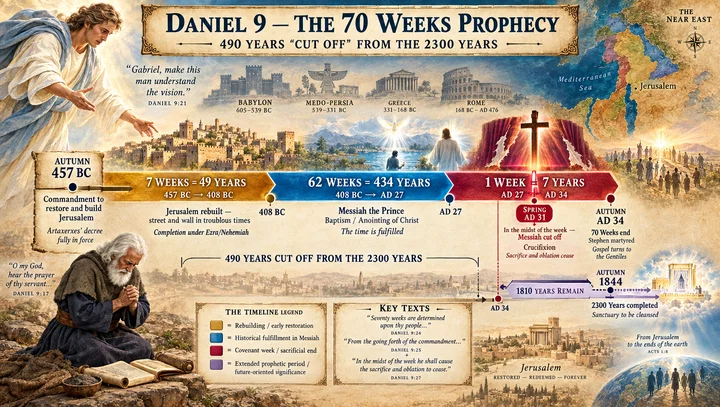
After the seven weeks and sixty-two weeks together, making sixty-nine weeks or 483 years from the decree to restore Jerusalem in 457 B.C., Messiah the Prince, the Anointed One, appeared in autumn A.D. 27 when Jesus was baptized and anointed by the Holy Spirit.PK 698.1GC88 409.1–410.1GC 410.1–2GC 327.1–328.24SP 493.2–494.1 In the middle of the final week, three and a half years later in spring A.D. 31, He was cut off, put to death by crucifixion in sacrifice rather than enthroned as an earthly ruler.GC 325.2–326.3GC88 409.1–410.1GC 410.1–2GC88 351.1–352.3GC 345.1–4 His death was wholly vicarious and not for Himself, for though innocent He died the just for the unjust as Substitute and Surety, bearing the curse of others that sinners might be clothed with His righteousness.GC 325.2–326.3ST Dec 8, 1898 His sacrifice made reconciliation for iniquity, brought in everlasting righteousness, and fulfilled and ended the significance of the ceremonial offerings that had pointed to Him.GC 325.2–326.3GC88 409.1–410.111MR 101.2–3 The destruction of the city and sanctuary by the people of the prince is the judgment destruction of Jerusalem upon those who rejected Him, with war and determined desolations unto the end.Ms 8, 1874, par. 4–5
Revelation and Historical Setting
The promise that after sixty-two weeks Messiah would be cut off was brought to Daniel in vision by ministering angels as a direct communication from God.Ms 93, 1900, par. 27 It came in answer to Daniel's earnest prayer with fasting and affliction of soul, with tears and confession and humiliation, and his prayer was heard and not in vain.Ms 93, 1900, par. 27 That answered prayer opened to him great future events extending to the advent of the world's Redeemer.BS 41.3
It was given while Israel was in captivity with the Temple destroyed and the Temple service suspended.4MR 122.1–123.1 Israel's religion had centered in the ceremonies of the sacrificial system, making outward forms all-important while losing the spirit of true worship.4MR 122.1–123.1 Their services had been corrupted with the traditions and practices of heathenism, and in performing the sacrificial rites they did not look beyond the shadow to the substance nor discern Christ the true offering for the sins of men.4MR 122.1–123.1
The Lord brought the people into captivity and suspended the services so that outward ceremonies would not become the sum total of their religion.4MR 122.1–123.1 He did this so their principles and practice would be purged from heathenism, so ritual service would cease in order that heart service might be revived, and so outward glory would be removed that the spiritual might be revealed.4MR 122.1–123.1 In the land of captivity, as the people turned to the Lord with repentance, He manifested Himself to them without the outward representation of His presence.4MR 122.1–123.1 Then visions were given unfolding the overthrow of the oppressors of God's people, the coming of the Redeemer, and the establishment of the everlasting kingdom.4MR 122.1–123.1
It belongs to Daniel's prophecies about future events whose meaning was not fully understood by Daniel himself.PK 547.1 Those writings were sealed until the time of the end.PK 547.1 Within that prophecy it forms part of the angel's explanation of the time period left unexplained in Daniel's earlier vision, placing the cutting off of Messiah after the seven weeks and sixty-two weeks.GC88 325.1–2
Meaning of Key Phrases
“Messiah” means “the Anointed One.”GC 327.1–328.24SP 493.2–494.1 Sixty-nine weeks, or 483 years, from the decree to restore and rebuild Jerusalem reach to His coming, ending in the autumn of A.D. 27.GC 325.2–326.3GC 327.1–328.24SP 493.2–494.1 Then Jesus was baptized and anointed with the Holy Spirit, after which He began preaching and declared that the time was fulfilled.GC 327.1–328.24SP 493.2–494.1 The seventy weeks are part of the 2,300-year period, and both periods begin together with that decree.GC 325.2–326.3 The final week ran from A.D. 27 to A.D. 34, with the gospel directed especially to the Jews, and in the middle of that week, at sixty-nine and a half weeks, three and a half years after His baptism, in spring A.D. 31, Christ was crucified.GC 325.2–326.3GC 327.1–328.24SP 493.2–494.1 His sacrifice fulfilled the sacrificial types and ended the significance of the ceremonial offerings that had pointed to Him.GC 327.1–328.2
To be cut off after the sixty-two weeks, following the first seven weeks, means the Messiah would be put to death rather than enthroned as an earthly ruler.GC88 351.1–352.3GC 345.1–4GC88 344.4–345.3 His cutting off was in sacrifice by crucifixion, the great center revealed in answer to fervent prayer.GC 345.1–4GC88 344.4–345.311MR 101.2–3 By His sacrifice on the cross of Calvary He made reconciliation for iniquity and brought in everlasting righteousness.11MR 101.2–3 That truth becomes effectual when acted upon, and by the humiliation of the cross He brings everlasting deliverance to all who walk after Him and give positive evidence of separation from the world.11MR 101.2–3 It was this redeeming death that Moses and Elijah discussed with Him at His transfiguration.11MR 101.2–3 The first disciples based their announcement that the time was fulfilled and God’s kingdom was at hand on the seventy weeks, giving the right message at the right time, yet because they expected an earthly kingdom and empire they did not recognize that the same prophecy foretold His suffering and death on the cross, and that expectation blinded them to its meaning.GC88 351.1–352.3GC 345.1–4GC88 344.4–345.3
“Not for Himself” means His death was wholly vicarious.ST Dec 8, 1898 Though innocent and undeserving of punishment, He died the just for the unjust to bring many sons and daughters to God.ST Dec 8, 1898 As Substitute and Surety He came under the curse and condemnation belonging to others, taking defiled human garments so that sinners may be clothed with His glorious righteousness.ST Dec 8, 1898 What appeared to be a hellish triumph over His humanity was a full and broad and deep victory encompassing the world.ST Dec 8, 1898 The people of the prince that shall come destroy the city and the sanctuary, and its end comes like a flood, which is the destruction of Jerusalem and its sanctuary as the king’s judgment on those who rejected the invitation to the wedding feast, with war and determined desolations to the end.Ms 8, 1874, par. 4–5
Prophetic Time Periods
The verse belongs to the seventy weeks, or 490 years, which are cut off from the 2,300-year period and specially allotted to the Jews.4SP 493.1GC88 326.1 The seventy weeks are divided into seven weeks, sixty-two weeks, and one week, which together make seventy weeks.GC 323.2–324.2GC88 323.2 They form part of the 2,300 days, provide the key to the commencement of the 2,300 years in Daniel 8, and begin together with the 2,300 years.GC 351.1LS 44.2GC88 326.1 The events bounded by those times were fulfilled as predicted.GC 323.2–324.2GC88 323.2
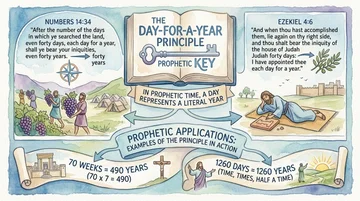
The periods are reckoned by the day-year principle, in which a day stands for a literal year.GC 688.4–5 They are reckoned from the command to restore and rebuild Jerusalem, the decree of Artaxerxes completed in his seventh year in 457 B.C. and reckoned from autumn.GC 687.4GC88 681.1–682.14SP 495.1 Reverent labor to determine the beginning and ending dates is proper and intended to lead to full understanding.GC 688.4–5 Beginning both periods in 457 B.C. yields 1843 by simple subtraction, while counting from autumn places the end of the 2,300 days in autumn 1844.4SP 495.1
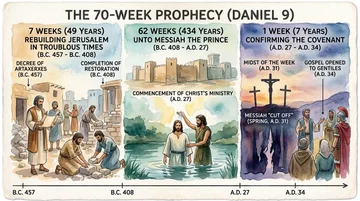
The seven weeks and sixty-two weeks join to make sixty-nine weeks, or 483 years, from the going forth of the commandment to Messiah the Prince.GC88 409.1–410.1GC 410.1–2LS 47.2–48.3 Reckoned from autumn B.C. 457 they reach to autumn A.D. 27.GC88 409.1–410.1GC 410.1–2GC 327.1–328.2 Then Jesus was baptized, anointed by the Holy Spirit, and began preaching that the time was fulfilled.PK 698.1GC88 409.1–410.1GC 410.1–2GC 327.1–328.2
The cutting off occurs in the final week, which ran from A.D. 27 to A.D. 34 with the gospel directed especially to the Jews.GC 325.2–326.3GC 327.1–328.2 In the middle of that week, at sixty-nine and a half weeks, three and a half years after His baptism, in spring A.D. 31, Christ was crucified.GC 325.2–326.3GC88 409.1–410.1GC 410.1–2GC88 681.1–682.14SP 494.2–3 His sacrifice fulfilled the sacrificial types and ended the significance of the ceremonial offerings that had pointed to Him.GC 327.1–328.2
The seventy weeks expire in A.D. 34 with the sealing of the Jewish rejection of Christ by persecution of His disciples and the turning of the apostles to the Gentiles.GC88 409.1–410.1GC 410.1–24SP 494.2–3 The remaining 1,810 years then extend from A.D. 34 to 1844 for the cleansing of the sanctuary.GC88 409.1–410.1GC 410.1–2GC88 328.2GC88 328.3 Every preceding specification was fulfilled at the appointed time.GC 410.1–2
Fulfillment in Jesus Christ
The verse identifies Jesus as the Messiah, the promised one whose coming Daniel foretold.COS 96.2–97.10DA 578.2–579.54RED 127.22SP 395.2 It belongs to a prophecy that definitely pointed out the time of Christ's coming, His anointing by the Holy Spirit, His death, and the giving of the gospel to the Gentiles.DA 233.3–234.2 The Jewish people had the privilege of understanding that prophecy and recognizing its fulfillment in Jesus' mission, and Christ urged His disciples to study it.DA 233.3–234.2
By His sacrifice on Calvary He made reconciliation for iniquity and brought in everlasting righteousness.11MR 101.2–3 That truth becomes effectual when acted upon, and by the humiliation of the cross He brings everlasting deliverance to all who walk after Him and give positive evidence that they are separated from the world.11MR 101.2–3 It was this redeeming death that Moses and Elijah talked with Him about at His transfiguration.11MR 101.2–3
The appointed hour for His advent was fixed and determined in heaven, and the prophetic period extending to His coming was revealed as the time of Christ's coming.DA 98.4DA 133.2–3DA 31.2–3PK 699.3–700.2 When that period was nearly ended in the days of Zacharias and John, Zacharias prayed for the Messiah's advent, and Gabriel — the messenger who had given Daniel the prophecy — came to announce its fulfillment.DA 98.4 John's ministry fell when the seventy weeks were nearly ended, and his preaching was a direct announcement that the Messiah's coming was near.DA 133.2–3 When the fullness of the time was come God sent forth His Son, and Jesus was born in Bethlehem to redeem those under the law, although the message was not rightly interpreted by all and many did not comprehend the words of the prophets concerning His appearing.DA 31.2–3PK 699.3–700.2
The scribes knew from prophetic history that the appointed time of waiting for the Messiah's advent had passed.ST Apr 11, 1878 Yet the leaders rejected Him and plotted to kill Him, and He was the heir cruelly slain.ST Apr 11, 1878 The prophecies that foretold Christ's coming were meant to awaken the people and help them understand the events then unfolding.ST Apr 11, 1878
Misunderstanding and Rejection
The announcement that the time was fulfilled and the kingdom of God was at hand rested on the seventy weeks, of which this verse forms part with the 2,300-day period, and it gave the right message at the right time in fulfillment of God's will.GC 351.1GC88 351.1–352.3GC 352.3 Yet the first disciples did not recognize that the same prophecy that gave the time also foretold the Messiah's death.GC88 351.1–352.3GC 352.3 After the period leading to Messiah the Prince He was to be cut off, put to death rather than enthroned as an earthly ruler, but because they expected an earthly kingdom and empire that expectation blinded them to the foretold suffering and death of Christ on the cross.GC88 351.1–352.3GC 345.1–4GC88 344.4–345.3 They were mistaken in expecting the kingdom to be set up at the end of the seventy weeks, holding popular errors that blinded the mind to the truth, and through their own misapprehension of their message they suffered disappointment.GC 352.3
The light unmistakably pointed to the time of Messiah's coming and directly foretold His death, and this light was given to the Jewish people.GC88 377.3–378.2GC 377.3–378.2 By devotion to the world and forgetfulness of God and His word their understanding was darkened, leaving them in ignorance concerning Messiah's advent, and in pride and unbelief they rejected the Redeemer.GC 377.3–378.2 Study of the prophecy was discouraged, and finally the rabbis pronounced a curse on all who should attempt a computation of the time.GC88 377.3–378.2GC 377.3–378.2 Those who rejected this truth lost all desire for the gift of Heaven, putting darkness for light and light for darkness until the light in them became darkness, and how great was that darkness.GC 377.3–378.2
The testimony by which the time and manner of Christ's first appearing could have been recognized was misread by attributing to His first appearing the glory and power belonging to His second appearing.Ms 41a, 1896, par. 3320MR 241.5–242.2 They failed to recognize Christ or to understand the significance of their own actions, and in rejecting and mistreating Him they fulfilled what Scripture had foretold.Ms 41a, 1896, par. 33 Although the exact time of the first advent was made known and the hour fixed and determined, not all rightly interpreted the message and many did not comprehend the words of the prophets concerning His appearing.PK 699.3–700.2 The pure and simple who were willing to receive the light, waiting to catch its first gleams and searching the Scriptures earnestly, could understand when Messiah should appear, while priests and rulers, lofty in their own estimation and occupied and hurried with their own interests, were unprepared to recognize God and to understand the teaching of the Scriptures in regard to Christ's coming.PK 699.3–700.2Ms 27, 1898, par. 1
Sources
Pioneers and periodicals
374 sources
After seven weeks and threescore and two weeks, 483 years from 457 B.C., Messiah the Prince is manifested at Jesus' baptism in autumn A.D. 27 when he was anointed with the Holy Spirit, and in the middle of the seventieth week after three and a half years of ministry he is cut off in crucifixion at Calvary in spring A.D. 31.STST Mar 14, 1878RH Feb 20, 1900ST Dec 18, 1907RH Dec 23, 1852 The Messiah cut off is Jesus Christ, the Anointed One, seized, condemned and slain on the cross without Jerusalem's gates under the Roman power in the reign of Tiberius Caesar.ST Mar 14, 1878RH Dec 3, 1908RH Apr 17, 1855 But not for himself means he died not for his own sin but vicariously for others, bearing their sins and curse as innocent Substitute to make atonement and bring everlasting righteousness within reach.RH Jul 15, 1873RH Dec 3, 1908RH Apr 17, 1855 He confirms the covenant with many for the whole seventieth week by his teaching and death, causing sacrifice and oblation to cease in meaning before God and transferring ministry from the earthly temple at Jerusalem to the true tabernacle in heaven.RH Mar 1851ST Sep 2, 1913ST Aug 31, 1915RH Jan 20, 1853ST May 23, 1878 The people of the prince that shall come are the Romans under Titus who destroyed the city and sanctuary at Jerusalem in A.D. 70 with flood-like desolation, and the seventy weeks cut off from the 2300 days form their first 490 years, leaving 1810 years to the cleansing of the heavenly sanctuary and investigative judgment in 1844.ST May 13, 1880RH Oct 11, 1915ST Aug 31, 1915RH Apr 4, 1912ST Mar 25, 1913
Words and Phrasing
The Messiah who is cut off is Jesus Christ, the Anointed One, the Prince of the covenant and Prince of princes.ST Mar 14, 1878RH Jul 1, 1873ST Feb 12, 1880 His being cut off is His seizure, scourging, derision, condemnation, lifting up on the cross at Calvary without the gates of Jerusalem, and slaying by crucifixion under the Roman power in the reign of Tiberius Caesar.ST Mar 14, 1878ST Mar 26, 1912 John began in the fifteenth year of Tiberius and Christ about six months later, and after three and a half years He was crucified, placing His ministry at the end of the 483 years and His death within the final week.ST Mar 14, 1878RH Jul 1, 1873 That death was the crucifixion of the Lord of glory when the Jews cried Away with Him and We have no king but Caesar, the true Paschal Lamb foreshadowed in Egypt, through whom God would gather His scattered children.RH Apr 17, 1855RH Jul 1, 1873ST Mar 26, 1912
He was cut off but not for Himself, meaning not for His own sake or sin but vicariously for others, for all people and humanity.RH Jul 15, 1873RH Dec 3, 1908RH Oct 11, 1915 As innocent Substitute and Surety He bore their sins, curse and condemnation, wounded for transgressions and bruised for iniquities, shedding His blood to make atonement, satisfy justice, magnify the law, banish sin, redeem Israel, bring everlasting righteousness within reach and gather the scattered children of God.RH Jul 15, 1873RH Apr 17, 1855RH Oct 11, 1915 Animal blood could only represent penalty, but His offering took away sin and ended the need for typical offerings.ST Aug 31, 1915 For the sin of murdering Him the murderers would lose principality and priesthood and suffer perpetual exile and utter desolation of city and sanctuary, a punishment mentioned but not comprised in the 490 years.RH Jul 15, 1873
The same phrase is also rendered slain and have nothing, slain and have no justice and be left with nothing.ST Mar 26, 1912ST Aug 31, 1915STST Mar 25, 1913ST Jul 17, 1901 It means slain without justice in an unjust trial after accomplishing His work, followed by resurrection and ascension.ST Mar 25, 1913ST Apr 9, 1912 It can also be read they shall be no more His people, meaning Jerusalem and the sanctuary would no longer be His and the Jews would be no more His people.ST Mar 25, 1913 The cutting off happens in the midst of the last seventieth week, when by offering Himself He caused sacrifice and oblation to cease in purpose and virtue, shown by the veil rent from top to bottom, though outward rites continued in form.ST Aug 31, 1915ST
The word translated midst means middle or half, fixing the cutting off at the halfway point of the week, three and a half years after manifestation.RH Jan 7, 1858 The cry that the middle of the week had come connects the death with that stated time, when the temple veil was torn and the appointed time arrived at the crucifixion.ST Jan 24, 1911ST Jan 24, 1911 Being cut off in its midst is the same as causing the sacrifice and oblation, the Jewish ordinances pointing to His death, to cease at His cross where they virtually ended.RH Jan 7, 1858
The end thereof shall be with a flood, and unto the end of the war desolations are determined, means destruction comes as a sweeping flood with continuing desolations, destruction and irrecoverable ruin through the war to the appointed end.RH Dec 23, 1852RH Dec 3, 1908RH Jul 21, 1863ST Nov 1, 1877ST After the sixty-two weeks Messiah is cut off, the people of a coming prince destroy the city and the sanctuary, and war brings continuing desolations until its appointed end.RH Jul 21, 1863ST Nov 1, 1877 The seventy weeks including this cutting off are allotted to Daniel's people and holy city.RH Jul 21, 1863ST
Weeks means groups of seven, sevens of years, and the word translated determined literally means cut off and divided.ST Jan 24, 1878RH Jun 4, 1908RH Jul 16, 1914 This shows the seventy weeks are cut off, divided, separated and set apart from another period, namely the 2300 days, being their first 490 years and beginning together with them, since there is no other period from which they can be taken.ST Jan 24, 1878RH Jun 10, 1852RH Jul 16, 1914 The event occurred in the middle of the final week of years, not a week of days, and by His crucifixion He made the sacrifices and offerings of the earthly temple ineffective, in which prophetic days represent years.RH Jun 10, 1852STST Aug 8, 1878
The sanctuary in the verse means the temple, the earthly temple of God at Jerusalem, the sanctuary of the first covenant that Daniel knew.RH Dec 30, 1873ST Nov 27, 1879RH Jan 6, 1853 It is distinct from the ground on which it stood and from Canaan which was only the place where it stood, in harmony with Hebrews 9:1-5.ST May 1, 1879RH Dec 30, 1873ST May 1, 1879RH Jan 6, 1853 It is one of two places in Daniel where the term is so applied to tabernacle or temple, here the sanctuary destroyed by fire to desolation and burned to the ground.ST May 1, 1879RH Dec 30, 1873ST May 1, 1879 Since prophecy extends over the whole new-covenant dispensation with cleansing at its very conclusion, that cleansing must pertain to the new-covenant sanctuary, not to this old-covenant sanctuary some 1800 years after it ceased.RH Dec 30, 1873
The prince that shall come is distinct from Messiah the Prince who remains the leading subject.ST Jan 8, 1902ST He is identified as Titus Vespasian with his people as the Romans, who in A.D. 70 captured and destroyed both Jerusalem and the temple or sanctuary to the letter and scattered the people.RH May 7, 1867ST Dec 3, 1894STRH Jun 17, 1915 The promised Messiah corrects the hope of an earthly empire ruling from Jerusalem at that time, and must be distinguished from a future restored Israel covenant with Gentile nations, the decree concerning rebuilding Jerusalem not establishing the New Jerusalem in the new earth.ST Jan 8, 1902 He must also be distinguished from Antiochus Epiphanes who died 164 years before Jesus was born, from a Jewish high priest, and from any second dying since Christ can never be put to death again.ST Feb 12, 1880ST
Vision Setting and Giving
Daniel 9 is the resumption and continued work of the vision of Daniel 8, an appendix that takes up the ram and goat and little horn again to supply the understanding of time left incomplete there.RH Dec 23, 1852RH Nov 8, 1864ST Feb 18, 1886ST May 17, 1877 Gabriel's explanation completes what Daniel had not understood in chapter 8, giving the starting point of the 2300 days in the seventy weeks which are cut off as their first part, so that with the seventy weeks expired the 2300 days are expired and the present is the time of the cleansing of the sanctuary.RH Nov 8, 1864ST May 17, 1877RH Aug 23, 1870 It corrects Daniel's mistaken linking of the end of the seventy years of captivity with the cleansing of the sanctuary at the end of the 2300 days, and it is continued work to make him understand what should be in the last end of the indignation, though even after it some points still remained for further light.RH Aug 23, 1870RH Dec 20, 1870
Gabriel had been charged to make Daniel understand that vision, but he left its duration unexplained when Daniel fainted and was sick certain days and remained astonished and understood nothing, so the commission remained unfulfilled.RH Dec 31, 1857RH May 26, 1853ST Apr 1, 1880 The same Gabriel seen in the vision at the beginning returned three years later in answer to prayer and fasting, while Daniel was praying over Jeremiah's seventy years and the desolation of Jerusalem, charged to give skill and understanding and bidding him consider the vision again.RH Dec 31, 1857RH May 26, 1853ST Apr 1, 1880 He did not repeat the ram and goat and little horn already made plain in Daniel 8, but took up the one point there omitted, namely time, showing the seventy weeks cut off and divided from the 2300 days as a branch of that longer period running from the decree to restore and build Jerusalem unto Messiah the Prince, after which Jerusalem is made desolate until the consummation.RH Dec 31, 1857RH May 26, 1853ST Jan 24, 1878 The word rendered determined literally means cut off and divided, and there is no other period from which the seventy weeks can be taken, so both periods begin together; after subtracting 490 from 2300 there remain 1810 years, which added to the ending of the seventy weeks in A.D. 33 reach to about 1843 for the end of the vision.ST Jan 24, 1878
The vision of Daniel 8 and the explanation of Daniel 9 belong close together, the former in Belshazzar's third and last year and the latter in Darius's first year when Babylon was overthrown by Medo-Persia, here dated to B.C. 538 and only weeks or months apart.ST Dec 24, 1894RH May 12, 1910ST Jan 20, 1904 One reckoning places Daniel's vision of chapter 8 in that same year rather than fifteen years earlier, while the exact interval cannot be settled and is not essential to interpreting the prophecy.RH May 12, 1910ST Mar 11, 1889RH May 12, 1910 Together they form a clear and comprehensive line of prophecy from Daniel's time till the close of earthly rule, revealing the time of the judgment when Christ enters upon the closing service of his ministry in the true tabernacle.ST Dec 24, 1894 Its weeks date from the decree of Artaxerxes in B.C. 457 because the decrees of Cyrus, Darius, and Artaxerxes together constitute the commandment to restore and build Jerusalem, complete only with the last, and its fulfillment at the end of the prophetic period in the autumn of 1844 is the cleansing of the heavenly sanctuary, not the destruction of the earth by fire at the second coming.ST Jan 20, 1904
The instruction respecting the seventy weeks was given in the first year of Darius in B.C. 538, four years before the revelation of Daniel 10 in the third year of Cyrus in B.C. 534, nineteen years after the vision of the ram, he-goat, little horn and twenty-three hundred days in the third year of Belshazzar in B.C. 553, and twenty-one years after the vision of the four beasts in the first year of Belshazzar in B.C. 555.RH Dec 20, 1870
Through the Spirit of Christ testifying through Daniel the verse reveals suffering in the seventieth prophetic week, that after the sixty-two weeks Messiah would be cut off and in the middle of the week cause sacrifice and offering to cease.ST Sep 17, 1874ST Mar 1, 1877 It shows the cutting off of Messiah without justice and the destruction of Jerusalem and the holy city, and then closes with no comfort except God's power to foretell the future.ST Apr 9, 1912 It left Daniel sad and perplexed and without hope about the ultimate issue and the eventual triumph of the Prince and His people, not yet knowing all that was comprehended in the vision, and made him more solicitous for God's people while praying for their return to the homeland and the fulfillment of Jeremiah's prediction.ST Apr 9, 1912ST Apr 9, 1912 His desire for more light on that outcome drove his prayer and humbling with three weeks of mourning and simple fasting from pleasant bread, flesh, wine, and anointing, distinct from the weeks of years, and in answer comfort was sent by the angel in the third year of Cyrus in the further explanatory vision of Daniel 10-12, which covers the same ground as Daniel 8 and 9 with more minute information respecting the events included in those great outlines.ST Apr 9, 1912ST Apr 9, 1912RH Dec 20, 1870
The explanation in Daniel 9 does not answer how long the vision of the host being trampled would last, nor reveal what would befall Daniel's people at the end of the indignation, and the apostasy and persecution to come upon them are left for Daniel 10.RH Jan 10, 1856ST Apr 23, 1912 The latter part of Daniel 9 concludes the exposition of Daniel 8:2-12 begun in Daniel 8:19-26, and as part of the 2300-day period it forms the connecting link between shadow and substance, between the typical sanctuary on earth and the true sanctuary in heaven, between God's calling of His ancient people from physical bondage in Chaldea and the final calling of the remnant church from the errors, darkness, and sins of spiritual Babylon, pointing forward to the time of making final award, deciding for eternity the destiny of souls, when the Lord discerns between the righteous and the wicked, between him that serves God and him that serves Him not.RH Oct 11, 1915
The verse belongs to the revelation given by angelic message after Daniel prayed for his exiled people, disclosing the course of world history from Judah's captivity to the first advent of Messiah and the coming of Messiah.RH Nov 22, 1906ST Dec 25, 1901ST Jul 29, 1913 It gave Daniel knowledge of Zion's restoration and set out prophetic waymarks reaching to the end of time.RH May 9, 1865 The seventy weeks, divided into seven weeks, sixty-two weeks, and one week and treated as four hundred ninety years, are counted from the command to restore and rebuild Jerusalem, not from the time Daniel received the message or the year of Jeremiah's prophecy, and look beyond the immediate end of the captivity to the future destiny of Daniel's people and city with a pledge reaching across about five centuries.RH Feb 27, 1908RH Feb 27, 1908
Measuring Time and Decree
Prophetic days stand for literal years, for seventy weeks of literal days could never reach the coming of Messiah, and on that reckoning seventy weeks are 490 years or solar years, sixty-nine weeks are 483 years, sixty-two weeks after seven are 434 years, the final week is seven years whose middle is three and a half years, and the 1260 days are likewise years.RH Feb 27, 1908ST Feb 7, 1884SMV 25.1 The seventy weeks determined upon the Jews were fulfilled in 490 years, proving each prophetic day stands for a year and proving the days of the 2300-day vision are years, with the 490 years ending in A.D. 33 or at Christ's death and leaving 1810 years to cleansing in 1843.SMV 25.1RH Apr 18, 1854 The 2300 days are therefore 2300 years, and the seventy weeks cut off from them are seventy weeks of years, with seven weeks and threescore and two weeks, 69 prophetic weeks or 483 years, reaching from the going forth of the commandment to restore and build Jerusalem unto Messiah the Prince at his manifestation.ST Feb 7, 1884
Only four acts can answer to that commandment to restore and rebuild Jerusalem then in ruins: the decree of Cyrus in 536 B.C. for rebuilding the house of God, the decree of Darius in 519 B.C. for prosecuting the hindered work, the decree of Artaxerxes to Ezra in 457 B.C., and the commission to Nehemiah from the same king in his twentieth year in 444 B.C. The right commandment must include all that restore and build Jerusalem means, authorizing civil as well as religious life, and must let the seventy weeks dated from its going forth reach the events named in the prophecy.RH Sep 13, 1870 The calculation narrows the possible starting decrees to those granted to Ezra or Nehemiah, placing the cutting off after the sixty-two weeks that follow the seven weeks within seventy weeks reckoned as 490 years.RH Sep 13, 1870
The starting decree is Artaxerxes' decree in his seventh year dated to 457 B.C., the third Persian grant given to Ezra in Ezra 7, originated by Cyrus, reaffirmed by Darius and completed in completest form by Artaxerxes Longimanus son of Xerxes.RH Mar 20, 1856RH Jun 29, 1911RH Feb 22, 1870ST Oct 4, 1899 It fully authorized civil, political, judicial and religious restoration and rebuilding of city, street and wall, not merely temple worship, while the other proposed decrees do not meet requirements or chronology.RH Jun 29, 1911RH Feb 22, 1870ST Oct 4, 1899 The seventy weeks begin with that command and expire in A.D. 34, leaving 1810 years of the 2300 days still to be fulfilled from A.D. 34 to 1844, when the sanctuary shall be cleansed, and fulfillment of the Messiah prophecies confirms that the 2300-day period begins in 457 B.C. and ends in 1844.RH Mar 20, 1856ST Aug 12, 1875RH Jun 29, 1911
God's purpose was carried out through successive decrees of Cyrus, Darius and Artaxerxes together constituting the complete commandment, complete only with the last, and Ezra by the king's commission setting magistrates to govern by God's law and the king's law made the dispersed Jews again a people and a city, a body politic with government of their own.ST Jan 20, 1904ST Apr 15, 1880RH Nov 14, 1865 That commission fully empowered Ezra to proceed with building the city and the wall, and the restoration it accomplished fulfilled the conditional prophecies concerning the people.ST Apr 15, 1880RH Nov 14, 1865 The work begun under Ezra was later finished by Nehemiah in the twentieth year, so the thirteen years spent doing the work do not shift the start or the end, for the seventy weeks are counted from the issuing of the decree to Ezra, not from completion of the rebuilding.RH Jul 23, 1857ST Apr 22, 1880RH Aug 1, 1865
The date 457 B.C. is fixed by historical records checked against astronomy, from a lunar eclipse in Cambyses' seventh year fixed to B.C. 523, then by Cambyses, Darius thirty-six years and Xerxes twenty-one years bringing Artaxerxes' first year to B.C. 464 or 464-463 and his seventh to B.C. 457.RH Jan 14, 1858ST Oct 25, 1883ST Apr 15, 1880 It is confirmed by Ptolemy's canon proved by more than twenty calculated eclipses, with the reign beginning in B.C. 464 proved by agreement of eclipses, so it cannot be moved.RH Jan 14, 1858ST Apr 15, 1880RH Jan 17, 1856 That chronology anchors the seventy weeks and 2300 days whose counting begins with the decree concerning Jerusalem given to Ezra, with crucifixion in the spring in the first Jewish month in A.D. 31, three and a half years before the seventy weeks end in the seventh month in autumn A.D. 34.RH Jan 21, 1858ST Oct 25, 1883
The seventy weeks began in autumn 457 B.C., not in spring when Ezra left Babylon but when work actually started after arrival in the fifth month and settlement no earlier than the seventh month, with formal publication perhaps toward autumn as summer ended.ST Sep 18, 1901RH Jan 21, 1858 Because the command went forth partway through the year the fraction must be counted, bringing 483 full years to late A.D. 27 and the 2300 years to autumn 1844 from seventh month to seventh month.RH Jan 21, 1858ST Apr 1, 1886 Joined with Ezra 7 this fixes the beginning in autumn 457 B.C. so that the period ends in autumn A.D. 1844, when the advent movement climaxes; the prophecy gives no specific statement that the period began in autumn, but it naturally began then as it ended on the tenth day of the seventh month corresponding to cleansing.ST Sep 18, 1901ST Nov 7, 1916 Since the crucifixion occurred in spring, the week began and ended in autumn, placing the beginning and ending of the seventy weeks and therefore the end of the 2300-year period in autumn.RH Mar 31, 1868
Reckoning from Nehemiah's permission in the twentieth of Artaxerxes in 444 or 445 or 446 B.C. is rejected because it puts manifestation in A.D. 39-40, midpoint in A.D. 44, end in A.D. 46-47 with nothing to mark it, thirteen years too late after crucifixion, resurrection and ascension.RH Dec 23, 1852ST Apr 22, 1880RH Mar 21, 1854RH Jan 14, 1858 The two proposed starting points in that reign are his seventh year, which would place the end no later than A.D. 34, or his twentieth year, which would place it no earlier than A.D. 46-47.RH Dec 23, 1852 Nehemiah's letters to provincial governors were not a single decree with the form and scope of a royal decree, and the walls were already being rebuilt before he arrived, while the decree to Ezra already authorized rebuilding city and walls; dating from Nehemiah makes the 483 years reach A.D. 39-40 rather than baptism in A.D. 27 and the midpoint fall in A.D. 44 rather than A.D. 31.RH Sep 13, 1870 The first two edicts are too early to reach even Christ's birth, and even 444 B.C. would extend 2300 days only to 1857 not 1854.ST Apr 22, 1880RH Sep 13, 1870
Other rejected reckonings are sixty-nine weeks ending A.D. 58 with cutting off in A.D. 62, crucifixion at the end of the sixtieth week to move 2300 days to spring 1850, seventieth week ending A.D. 45 with Paul and Barnabas confirming covenant and cross in A.D. 38 at age thirty-eight, crucifixion in A.D. 28 not 37 making Christ 34, sixty-nine weeks reaching merely birth, 458 B.C. to A.D. 39, shifting thirteen years to preserve the earth as sanctuary, moving to 1854 or 1857, or placing the end far in the future.RH Oct 30, 1855RH Oct 4, 1870RH Jan 10, 1854RH Oct 21, 1858 After sixty-nine weeks reaching to Messiah the Prince, meaning either birth or beginning of public ministry, Messiah would be cut off in the midst of the last seventieth week in spring A.D. 31, not in A.D. 62, and by offering himself as antitype he brought sacrifices to an end at the cross, not by the Romans in A.D. 70.RH Oct 4, 1870 The seventy weeks form the first 490 days of the 2300-day vision and are mutually dependent with it, so separating them obscures their purpose, and the dates of ministry and crucifixion should not be shifted thirteen years to preserve the claim that the earth is the sanctuary.RH Oct 30, 1855RH Apr 30, 1857 The wording after sixty-two weeks raises why the angel did not say after sixty-two weeks and a half if midpoint reckoning applied.RH Jan 10, 1854
The 483 years are treated as years of at least 365 days rather than 360-day years, determinable closely enough without proving exact solar measure, placing Messiah's appearance at the end of 483 years from the starting period.RH Apr 9, 1908 The 69 weeks of years reach the fall of A.D. 27, when baptism and beginning of public ministry mark the end, within 70 weeks cut off from 2300 years dated to fall A.D. 34.RH Feb 17, 1853 The first seven weeks or forty-nine years are allotted to restoration of street and wall in troublous times described in Ezra and Nehemiah, ending in 408 B.C. when restoration begun under Ezra is fully completed.RH Apr 2, 1908ST Apr 22, 1880RH Sep 13, 1870 The threescore and two weeks are 434 literal years, seven literal years for each prophetic week, and counted from 408 B.C. they end in fall A.D. 27, marking the time for Messiah revealed when Jesus at thirty was baptized and anointed, already thirty because the Christian era was fixed four years late.ST Aug 31, 1915 Restoration means rebuilding the city and restoring civil, political and judicial order, not merely temple worship, and the verse's reference to rebuilding in troubled times is applied to Ezra and associates rebuilding walls and gates amid opposition.RH Dec 23, 1852ST Feb 23, 1882
Messiah Comes and Dies
After seven weeks and threescore and two weeks, 483 years from the fall of 457 B.C., Messiah the Prince is manifested at the baptism of Jesus in autumn A.D. 27, about A.D. 26 or 27, when about thirty years old He was anointed with the Holy Spirit, declared God's Son and beloved Son, and began public ministry preaching that the time is fulfilled as in Mark 1:15.STST Mar 14, 1878RH Feb 20, 1900RH Jun 17, 1915ST Oct 11, 1905 Messiah means Anointed, as Hebrew Messias and Greek Christos after the anointing of kings, and Andrew had this prophecy in view when telling Simon they had found Messias.STST Mar 14, 1878RH Jun 17, 1915 The sixty-nine weeks end at that baptism and beginning of ministry at the predicted time.RH Jun 17, 1915ST Oct 11, 1905ST Sep 2, 1913
John began in the fifteenth year of Tiberius and Christ about six months later, each at thirty according to the law of the priesthood, John in spring and Christ in autumn A.D. 27, Christ being six months younger than John.ST Mar 14, 1878RH Jan 31, 1871 The years waiting in Nazareth preceded the appointed time, and Shiloh of Jacob must appear as in John's preaching, in Rome 779-780 in Pilate's first year and Antipas's thirtieth under Tiberius when the days were fulfilled.ST Mar 14, 1878RH Jan 31, 1871ST Jun 7, 1910ST Jun 7, 1910 In one calculation the sixty-nine weeks ended in A.D. 26 at baptism and beginning of ministry at the predicted time, and the Christian era being fixed four years late explains His being already thirty.ST Feb 18, 1913ST Aug 31, 1915
The cutting off occurs after the sixty-two weeks following the first seven, that is after sixty-nine weeks in all, not at their exact end but in the midst of the following seventieth week, three and a half years after manifestation, within the seventy-week period when offered for sins.RH Feb 20, 1900RH Jan 7, 1858RH Sep 6, 1870RH Mar 1851 It is expressed as before another week had passed, as cleansing begins without another day passing at the end of the 2300 days.RH Mar 1851ST Oct 11, 1905 The word translated midst means middle or half, fixing the event at the halfway point of the week.RH Jan 7, 1858
He was cut off in the middle of the seventieth week after preaching three and a half years, in spring A.D. 31 at Passover in the first Jewish month, three and one-half years after the autumn A.D. 27 baptism, at the end of sixty-nine and a half weeks or 486.5 years from the command.ST Dec 18, 1907RH Dec 23, 1852ST Apr 27, 1882RH Dec 3, 1908RH May 1, 1866 The week began with baptism in A.D. 27 and His ministry lasted that long after anointing.ST Dec 18, 1907ST Jul 1, 1897 His ministry lasted about three and a half years, more than three years, measured by four Passovers attended from first to last, with John 2:13 as first in A.D. 28 and John 5:1 counted as Passover in A.D. 29.RH Oct 11, 1915RH Apr 4, 1854RH Jan 10, 1854RH Apr 2, 1908ST Mar 18, 1886 Beginning public work about thirty with first Passover six months later places birth in the fruitage season rather than December 25.RH Apr 4, 1854ST Dec 23, 1897
He confirms the covenant with many for the whole seventieth week of seven years, by personal teaching and healing in the first half and through the apostles in the second, offering life on the cross for the world's sins and ratifying the new covenant while the old remained.RH Mar 1851ST Sep 2, 1913ST Aug 31, 1915RH Oct 11, 1915RH Apr 28, 1853 So covenants overlapped and the new was preached to Israel during its week.ST Aug 31, 1915ST May 23, 1878ST Mar 18, 1886 The Lord Himself carries on the work in person for the first half, and in the midst of the week He is cut off by offering up Himself, providing the sacrifice of the new covenant whose own blood takes away sin which the blood of bulls and goats through fifteen hundred years could never do.RH Apr 28, 1853ST May 23, 1878
His death as true sin offering, Passover sacrifice and antitype caused sacrifice and oblation to cease in effective purpose, meaning, virtue and significance before God, superseding typical services as shown by the veil rent from top to bottom and God's departure.STRH Jan 7, 1858RH Mar 1851ST Sep 2, 1913 Outward rites continued in form until A.D. 70, though virtually ended at the cross.RH Jan 7, 1858 Types met reality at the cross not by the Romans, and ascension began real mediatorial service.STST Jun 26, 1907
At that point transfer is made from the earthly worldly sanctuary of the first covenant made with hands to the true tabernacle in heaven which the Lord pitched, introducing the new-covenant heavenly sanctuary with its anointing, its sacrifice and its minister.RH Jan 20, 1853ST May 23, 1878RH Mar 2, 1852 There bulls and goats give place to the great sacrifice, the Levitical priesthood is superseded by that of the order of Melchizedek, and example and shadow is terminated by more excellent ministry.RH Jan 20, 1853ST May 23, 1878 The Messiah's being cut off, not for Himself, is the new-covenant sacrifice and brings the new-covenant Mediator into view.ST Jun 10, 1880RH Aug 18, 1863RH Nov 10, 1863
The same lowly suffering Messiah cut off in death for sins not His own as servant, man of sorrows with nowhere to lay head, visage marred, despised and rejected, tender plant with no comeliness, is distinct from His glorious coming to receive kingdom and exalt the redeemed to reign as Zion's reigning King.RH Jun 20, 1854ST Feb 14, 1911ST Mar 19, 1894 His suffering came before entering glory.RH Jun 20, 1854ST Feb 14, 1911 The Jews failed heeding the suffering Saviour expecting a conquering worldly power, and ruin followed.ST Mar 19, 1894
The remaining three and a half years complete the seventy weeks in autumn A.D. 34, when special work among the Jews ended, Stephen's martyrdom and Sanhedrin persecution marked formal second rejection repeating the crucifixion cry, believers were scattered winning souls, Paul was converted and raised up next year, and the message turned to Gentiles including Samaritans and Cornelius about seven years later with equal privileges.RH May 1, 1866RH Oct 6, 1904RH May 14, 1867ST Nov 28, 1895RH Jul 23, 1872 The seventy weeks begin in the middle of 457 B.C. and the remaining 1810 years bring the 2300-year period to autumn 1844.RH May 14, 1867RH Jul 23, 1872RH Nov 5, 1908
The new covenant dates from His death, began with Hebrews alone then admitted Gentiles to full participation with individuals not nation, Jews and Gentiles one without special national privileges.RH May 19, 1863ST Nov 10, 1881 It marks the close of the old covenant, earthly sanctuary and Jewish church pre-eminence, with blessing to Gentiles through Jesus under the gospel covenant.RH Jun 4, 1857RH Feb 18, 1858 The gospel was therefore preached first to the Jews so prophecy could be fulfilled, then after confirmation to many in Israel and Judah the apostles turned to the Gentiles.RH Feb 18, 1858ST Nov 10, 1881
Christ's death when sacrifices virtually ceased in mid-week marks the point when the Jewish age ended as dividing line between ages, ending the typical dispensation.ST Mar 18, 1875RH Apr 1, 1875RH Sep 2, 1873 Yet shadow and substance met without leaving sinners without way of faith, for the seventy weeks still had three and a half years to run after the cross.RH Feb 25, 1862RH Aug 3, 1876 The seven years embrace Sabbath history, miracles, teaching, death and resurrection, proving the fourth-commandment Sabbath stood unweakened at the Gentile opening.RH Feb 25, 1862
Sources