Matthew 24:1
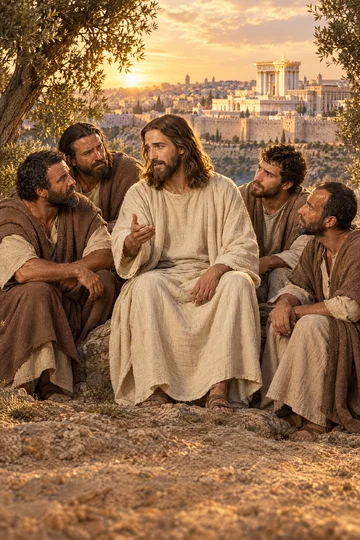
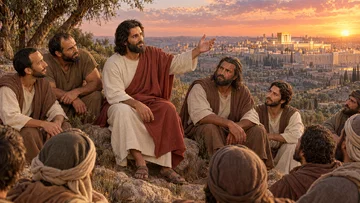
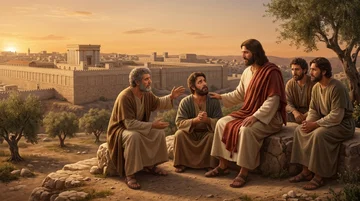
And Jesus went out, and departed from the temple: and his disciples came to him for to shew him the buildings of the temple.
Translations
And Jesus went out, and departed from the temple: and his disciples came to him for to show him the buildings of the temple.
King James Version, KJV Cambridge Paragraph Bible
And Jesus went out, and departed from the temple: and his disciples came to him for to shew him the buildings of the temple.
And Jesus went out, and departed from the temple: and his disciples came to him to show him the buildings of the temple.
And Jesus went out from the temple, and was going on his way; and his disciples came to him to shew him the buildings of the temple.
And Jesus went out from the temple, and was going on his way; and his disciples came to him to show him the buildings of the temple.
And having gone forth, Jesus departed from the temple, and his disciples came near to show him the buildings of the temple,
And Jesus went forth and went away from the temple, and his disciples came to [ him] to point out to him the buildings of the temple.
And, Jesus coming forth, from the temple, was taking his departure, when his disciples came forward to point out to him the buildings of the temple.
Berean Standard Bible, Majority Standard Bible
As Jesus left the temple and was walking away, His disciples came up to Him to point out its buildings.
Jesus went out from the temple, and was going on his way. His disciples came to him to show him the buildings of the temple.
And Jesus went out of the Temple, and on the way his disciples came to him, pointing out the buildings of the Temple.
And Iesus went out, and departed from the Temple, and his disciples came to him, to shewe him the building of the Temple.
Douay-Rheims (Challoner revision)
And Jesus being come out of the temple, went away. And his disciples came to shew him the buildings of the temple.
Pictures
Cross-references 20 of 24
- Mark 13:1-4
And as he went out of the temple, one of his disciples saith unto him, Master, see what manner of stones and what buildings are here!
A parallel account of the temple prediction and the disciples’ questions.
- Luke 21:5-7
And as some spake of the temple, how it was adorned with goodly stones and gifts, he said,
Parallel account of Jesus’ temple prediction and the disciples’ questions.
- Matthew 23:38
Behold, your house is left unto you desolate.
Jesus declares Jerusalem’s house desolate before leaving the temple.
- Luke 21:20-21
And when ye shall see Jerusalem compassed with armies, then know that the desolation thereof is nigh.
Armies surrounding Jerusalem signal its approaching desolation and the need to flee.
- Luke 19:41-44
And when he was come near, he beheld the city, and wept over it,
Jesus weeps over Jerusalem and foretells its destruction.
- Daniel 9:26
And after threescore and two weeks shall Messiah be cut off, but not for himself: and the people of the prince that shall come shall destroy the city and the sanctuary; and the end thereof shall be with a flood, and unto the end of the war desolations are determined.
Foretells the destruction of Jerusalem and its sanctuary.
- Matthew 24:16-18
Then let them which be in Judaea flee into the mountains:
Those who recognize the fulfillment must act by leaving.
- Luke 13:35
Behold, your house is left unto you desolate: and verily I say unto you, Ye shall not see me, until the time come when ye shall say, Blessed is he that cometh in the name of the Lord.
Both texts connect Jerusalem’s temple with the judgment that leaves its house desolate.
- Mark 13:24-27
But in those days, after that tribulation, the sun shall be darkened, and the moon shall not give her light,
Signs preceding the Son of Man’s coming in the parallel prophetic discourse.
- Micah 3:12
Therefore shall Zion for your sake be plowed as a field, and Jerusalem shall become heaps, and the mountain of the house as the high places of the forest.
The prophecy of Zion and Jerusalem’s devastation supports Jesus’ prediction of the temple’s destruction.
- 2 Chronicles 36:19
And they burnt the house of God, and brake down the wall of Jerusalem, and burnt all the palaces thereof with fire, and destroyed all the goodly vessels thereof.
Records the burning and destruction of Jerusalem’s temple.
- Mark 13:2
And Jesus answering said unto him, Seest thou these great buildings? there shall not be left one stone upon another, that shall not be thrown down.
Jesus predicts the destruction of the temple buildings.
- Mark 13:3
And as he sat upon the mount of Olives over against the temple, Peter and James and John and Andrew asked him privately,
Jesus sits opposite the temple as his disciples approach him.
- Luke 19:44
And shall lay thee even with the ground, and thy children within thee; and they shall not leave in thee one stone upon another; because thou knewest not the time of thy visitation.
Jesus warns Jerusalem of its coming destruction.
- Luke 21:6
As for these things which ye behold, the days will come, in the which there shall not be left one stone upon another, that shall not be thrown down.
records Jesus' statement about complete destruction of the temple that prompted the question
- Haggai 2:7
And I will shake all nations, and the desire of all nations shall come: and I will fill this house with glory, saith the LORD of hosts.
Compares the temples and promises glory for the latter house.
- Hebrews 8:1-2
Now of the things which we have spoken this is the sum: We have such an high priest, who is set on the right hand of the throne of the Majesty in the heavens;
Christ ministers in the true heavenly sanctuary beyond the ended temple service.
- Matthew 23:34-36
Wherefore, behold, I send unto you prophets, and wise men, and scribes: and some of them ye shall kill and crucify; and some of them shall ye scourge in your synagogues, and persecute them from city to city:
immediate warning before leaving the temple
- John 2:15-16
And when he had made a scourge of small cords, he drove them all out of the temple, and the sheep, and the oxen; and poured out the changers’ money, and overthrew the tables;
Christ drives merchants and animals from the temple.
- Haggai 2:3
Who is left among you that saw this house in her first glory? and how do ye see it now? is it not in your eyes in comparison of it as nothing?
Compares the temples and promises glory for the latter house.
Commentary
Each commentary is drawn from primary sources: the writings of Ellen G. White and Adventist pioneers and periodicals. Each commentary is separate. Its own words are not a quotation; follow the references to read the source passages.
Ellen G. White
32 sources
Jesus leaves the temple for the last time after declaring its house left desolate, with His disciples following Him toward the Mount of Olives, and as they go they point Him to its massive stones and grandeur as if it must stand forever.DA 627.1–3ST May 9, 1878Lt 18a, 1906, par. 8–1521MR 79.9–80.3ST Nov 20, 1884 He answers that not one stone shall remain upon another, a word fulfilled about forty years later when Roman legions destroyed the city and more than a million perished.DA 627.1–3Lt 18a, 1906, par. 8–15ST Dec 19, 1900 The departure opens the discourse of Matthew 24 and 25, given privately on Olivet in answer to their question about the temple's overthrow and the sign of His coming and the end of the world.GC 393.2–394.1GC88 393.1–394.14SP 39.1 The account of Jerusalem's downfall is mingled with the destruction of the world, so that the city's fate typifies the more terrible final destruction by fire and the judgment when earthly history ends.Ms 77, 1899, par. 4–5RH Oct 8, 1901ST Feb 20, 1901 In departing and foretelling its end He shows that true religion does not depend on its forms and ceremonies, for He Himself is greater than the temple in whom all its services find fulfillment, and that no towering human building is secure when an impenitent people rejects His mercy and warnings.Lt 18a, 1906, par. 8–1521MR 79.9–80.3FE 398.1–399.1Ms 9, 1896, par. 5–8Lt 132, 1908, par. 5
Leaving the Temple
Jesus went out and departed from the temple after declaring its house left desolate, pronouncing woes upon Jerusalem and lamenting over it and denouncing the hypocrisy of the Jewish rulers.Lt 18a, 1906, par. 8–15ST Dec 19, 1900GC 23.1 His disciples accompanied Him as He left toward the Mount of Olives, and two days before the Passover He sat on its slope overlooking Jerusalem and looked again at the city and its magnificent temple standing like a crown on the sacred mount.4SP 39.1GC 23.1 This was after a wearying day's work speaking at length in answer to the Pharisees' questions with predictions and warnings, a short time before entering Gethsemane to bear the sins of the world.ST Nov 20, 1884 The prophecy that follows was spoken to His disciples from Olivet and looks ahead to Jerusalem's fate and His second coming, and to the suffering and persecution His followers would meet as their Master did from His departure until His return to deliver them.4SP 39.1
As they left, the disciples came to Him to show Him the buildings of the temple and drew His attention to their strength, grandeur and beauty.DA 627.1–3ST May 9, 18783SP 69.3–70.1 They pointed to its massive, finely fitted stones and imposing construction, thinking the grand, beautiful structure must stand forever.Lt 18a, 1906, par. 8–1521MR 79.9–80.33SP 69.3–70.1 They were amazed at His warning that it would be left desolate, unable to imagine how its stones could be overthrown or how such destruction could come, and concerned about what His words meant.DA 627.1–3ST May 9, 1878Lt 18a, 1906, par. 8–1521MR 79.9–80.3ST Dec 19, 1900
In answer He declared that not one stone would be left upon another, that the temple would be torn down.DA 627.1–3Lt 18a, 1906, par. 8–15ST Dec 19, 1900 That destruction was later carried out by the Roman legions about forty years afterward, when more than a million people perished in the siege and the nation's rejection of the Son of God decided its fate.ST Dec 19, 1900ST Dec 19, 1900
Paul later returned to Jerusalem and viewed the city and the temple with changed views, knowing that God's retributive judgment was hanging over them.3SP 319.2AC1 51.2SLP 35.1
Prophecy of Jerusalem and End
This departure from the temple opens the discourse of Matthew 24 and 25, spoken privately from Olivet in answer to the disciples' question about the destruction of the temple and the sign of His coming and of the end of the world.GC 393.2–394.1GC88 393.1–394.14SP 39.1ST Feb 20, 1901 The question was prompted by His prediction of desolation, and the answer looks forward both to the fate of Jerusalem and to His second coming.4SP 39.1ST Feb 20, 1901 It also looks ahead to the suffering, humiliation, reproach and persecution His followers would meet from His departure until His return to deliver them.4SP 39.1
The chapter traces the important events from His first advent to His second.GC 393.2–394.1GC88 393.1–394.1 It foretells the destruction of Jerusalem, the persecution and suffering of the church, the preaching of the gospel throughout the world, flight from Judea when the abomination of desolation stands in the holy place, signs in the heavens, and His coming with power and great glory in His kingdom to gather His elect.ST Apr 21, 1898Ms 77, 1899, par. 4–5GC 393.2–394.14SP 39.1 It warns to watch and be ready because the day and hour of that coming are unknown.ST Apr 21, 1898 The Sabbath taught in connection with that flight remains the creation Sabbath, with no new Sabbath announced after the crucifixion.Ms 77, 1899, par. 4–5
The description of Jerusalem's downfall also foresees the destruction of the world, mingling the two events together.Ms 77, 1899, par. 4–5ST Feb 20, 1901 The destruction of Jerusalem and its temple represents, typifies and points to the more terrible final destruction of the world by fire, the final judgment and the destruction of the earth when the history of this earth is swallowed up in endless eternity.Ms 77, 1899, par. 4–5ST Feb 20, 1901Ms 78, 1897, par. 30Lt 98, 1900, par. 31–33Ms 89, 1903, par. 3 Jerusalem was lost because its people refused truth and light and mercy, persisted in rebellion, and had God's protection withdrawn, and those who continue to refuse God's truth and mercy will likewise face punishment.RH Oct 8, 1901Ms 78, 1897, par. 30Lt 98, 1900, par. 31–33 Thus the prophetic words about Jerusalem reach beyond that historical event to warn those living in earth's final days.ST Feb 20, 1901
In this brief compass the prophecy covers the whole dispensation to the complete restitution of all things, dwelling especially on the thrilling and momentous closing scenes of this world's history.GC88 bC.14SP iii.1–2 It follows the church in her warfare and sufferings on to promised redemption, the final triumph of the people of God, the destruction of Satan and all his followers, the total and eternal extirpation of evil from the universe, and the renovation of the earth as the everlasting inheritance of the saints when the great controversy is concluded.GC88 bC.1 It is presented as the beginning of that history of the church's conflict through to its final redemption.4SP iii.1–2
The second advent taught here is still future and was not fulfilled at the destruction of Jerusalem.LS 56.1–57.3 The predictions of the great Teacher are being fulfilled today, showing that His coming is at hand.Ms 62, 1903, par. 9–12 They are to be studied and brought before believers and unbelievers, presented by ministers and teachers above matters of lesser consequence, because the truths they contain decide eternal destiny, and their unmistakable fulfilment calls the church to arouse to questions of eternal importance.Ms 62, 1903, par. 9–12
The chapter gives an outline of what is to come upon the world, including the perils of the last days now being lived in and the judgments approaching the wicked.Lt 90, 1902, par. 5–910MR 220.1–2 It lays urgency upon warning those perishing in sin and giving the last message of mercy.Lt 90, 1902, par. 5–910MR 220.1–2 Nearness is to be learned at the doors from signs as from the fig tree, for His words will not pass away.Lt 90, 1902, par. 5–9 All are to watch and be ready because the hour of the Lord's coming and of the Son of man's coming in an unexpected hour is unknown.ST Apr 21, 1898Lt 90, 1902, par. 5–9 The faithful and wise servant gives meat in due season, while the evil servant who says his lord delays his coming and smites his fellow servants and eats and drinks with the drunken will be cut asunder and appointed with the hypocrites.Lt 90, 1902, par. 5–9 Eternal riches come only through self-denial and sacrifice of earthly riches, through much tribulation and giving all to Christ, with means entrusted by the Lord invested in gospel work rather than spent in self-gratification, for earthly riches trusted as the chief good will crumble into dust.Lt 90, 1902, par. 5–9
Judgment and Present Warning
Matthew 24:1 shows Jesus going out and departing from the temple after pronouncing woes upon Jerusalem, lamenting over it and warning of coming calamities, as His disciples come to show Him the buildings of the temple.Lt 18a, 1906, par. 8–1521MR 79.9–80.3 They point to its massive stones and its grand, beautiful, imposing buildings, thinking the structure must stand forever, and they are amazed at His warning of desolation because they cannot yet imagine its overthrow.Lt 18a, 1906, par. 8–1521MR 79.9–80.3 In answer He declares that not one stone will be left upon another, teaching that even the most solid, towering human buildings and grand cities cannot stand when God sends judgment upon an impenitent city and people that have rejected His messengers, appeals and warnings.Lt 18a, 1906, par. 8–1521MR 79.9–80.3 That apparent permanence is like San Francisco, whose towering buildings its inhabitants likewise expected to endure until calamity fell upon it, as seen also in the destruction of Jerusalem.Lt 18a, 1906, par. 8–1521MR 79.9–80.3 In contrast to the modest chapel proposed for Loma Linda, in the closing days of earth's history many sinful cities and their lofty buildings will be destroyed.Lt 132, 1908, par. 5
The warning over Jerusalem also pointed to and represents the more terrible destruction of the world at the end of its history, when earth's history is swallowed up, typifying that final destruction and marking the end of God's long forbearance toward persistent rejection of His law and His Son.RH Oct 8, 1901Ms 78, 1897, par. 30Ms 105, 1894, par. 31 Jerusalem was brought low and lost because its people refused the truth and light, rejected Christ's mercy, chose Barabbas, persisted in rebellion against His way, law and Son, and chose their own course until God's protection was withdrawn.RH Oct 8, 1901Ms 78, 1897, par. 30Lt 98, 1900, par. 31–33Ms 105, 1894, par. 31 Its downfall followed about forty years later, when more than a million people perished in the siege, proving that the nation's rejection of the Son of God decided its fate.ST Dec 19, 1900 Those who continue to refuse God's mercy and truth will likewise face punishment, and rejecting God's holy memorial, the Sabbath, brings grave consequences.Ms 78, 1897, par. 30ST Dec 19, 1900Lt 98, 1900, par. 31–33
In departing from the temple and foretelling its end He taught that true religion did not depend on its forms and ceremonies, making them of none effect and purifying religion from dependence on them.FE 398.1–399.1Ms 9, 1896, par. 5–8 He announced Himself greater than the temple, proclaiming Himself the Way, the Truth and the Life in whom all Jewish ceremony and typical service was to find its fulfillment.Ms 9, 1896, par. 5–8 He stands forth in the place of the temple, with all the offices of the church centered in Himself alone.FE 398.1–399.1Ms 9, 1896, par. 5–8
Because that greater destruction, the destruction of the world, is near at hand and of great consequence, members of God's church have no time to spend in dissension and strife.Ms 89, 1903, par. 3 They have no time for criticizing and condemning one another, and no call to sit in judgment upon others or to pass sentence upon brethren.Ms 89, 1903, par. 3 That work Christ alone can do.Ms 89, 1903, par. 3
Sources
Pioneers and periodicals
194 sources
Jesus went out and left the temple, and his disciples came to him to point out its buildings.ST Oct 10, 1900ST Jun 27, 1900ST Nov 15, 1899 It was his final departure after pronouncing the house left desolate, at the close of his public teaching there, two days before the Passover when he was betrayed, as he went to the Mount of Olives opposite the temple.ST Mar 30, 1915RH Apr 15, 1909RH Jan 8, 1901 They called his attention to the buildings because they admired their imposing beauty, strength and grandeur, supposed the temple would stand forever, and reflected Jewish pride in its future.ST May 9, 1878ST Mar 13, 1893ST Dec 20, 1910 The action opens his discourse on the destruction of Jerusalem, the end of the world, and the signs of his second coming. That prophecy concerns two distinct events far apart in time, the destruction of the temple and the second advent, mingled together so that the nearer supplies imagery for the distant and Jerusalem's overthrow typifies the final destruction.ST Sep 9, 1889ST Aug 14, 1893ST Nov 27, 1879
Leaving Temple Setting
Jesus went out and departed from the temple, and his disciples came to him to show him the buildings of the temple, and this literal action sets the scene for the prophecy that follows.ST Oct 10, 1900ST Jun 27, 1900ST Nov 15, 1899ST May 11, 1904ST Sep 13, 1910 This showing leads to his prediction that the temple will be completely demolished with not one stone left upon another, and to the disciples' questions about when it will happen and about his coming and the end of the world, which he answers with teaching reaching from then until his coming and the end.ST Oct 10, 1900ST Nov 15, 1899ST May 11, 1904ST Sep 13, 1910 The setting is to be studied together with the parallel accounts in Mark 13 and Luke 21, of which Matthew's is the most complete, and the chapter is thus a study of prophecy including prophecies already fulfilled.ST Jun 27, 1900ST May 11, 1904
The departure was his final departure from the temple after declaring your house is left unto you desolate, at the close of his public ministry and his final words and teaching there as a teacher.RH Apr 15, 1909RH Jan 8, 1901RH Jan 20, 1853ST Mar 3, 1914RH Sep 2, 1852 It took place two days before the Passover when the Son of man was betrayed and crucified, in the crucifixion week that completed his earthly work for redemption, shortly before the cross.ST Mar 30, 1915RH Apr 15, 1909RH Jan 8, 1901 He went to the Mount of Olives opposite and overlooking Jerusalem to the west, where the temple and its courts and a large part of the city could be seen, late in the afternoon of the third day of that week, with the disciples looking over the city with him.ST Mar 30, 1915RH Jan 29, 1914
The disciples pointed out the buildings because they admired their imposing beauty and wealth and their strength and grandeur and great stones, and thought Jesus had failed to appreciate them.ST May 9, 1878ST Mar 13, 1893ST Dec 20, 1910 Their attention reflected Jewish pride in the temple and their hopes for Israel's future, and their confidence in their religious system and accomplishments rather than in God's power and worthiness, so that even in the Saviour's presence they found it difficult to stop thinking about their own achievements and supposed worthiness.ST Mar 13, 1893RH Oct 25, 1870RH Nov 30, 1916 The massive construction seemed to them likely to endure, and they supposed the temple would stand forever.ST Mar 13, 1893ST Jan 14, 1875RH Dec 20, 1870
In showing the buildings they expressed disbelief and inability to believe that so massive a structure could be destroyed and left desolate and overthrown.ST Jan 14, 1875RH Jan 8, 1901RH Dec 20, 1870 They had in view stones forty feet long, eight feet wide and ten feet thick cemented in the days of Solomon, and foundations settled in the very rocks of the mountain with massive walls of huge marble blocks.RH Jan 8, 1901ST Dec 20, 1910 Like people who trust in the apparent permanence of the world, they judged by what they saw rather than by God's word, and because the temple seemed so solid and substantial they concluded its destruction must mean the destruction of the world.ST Dec 20, 1910RH Sep 21, 1916RH Nov 15, 1870
Its foundations were settled in the rocks with massive marble blocks some twenty-five cubits long, twelve cubits broad and eight cubits high, and it was exceptionally strong and magnificent with enormous white stones and immense stones and buildings.RH Jun 17, 1915ST Dec 20, 1910ST Mar 30, 1888 It had been built by Herod the Great to win the Jews' favor, and stood in the restored grandeur Herod had given it, with years and treasure spent on it and the people's confidence that it would endure.ST Nov 28, 1900ST Mar 30, 1888RH Jul 21, 1868 Yet Christ pronounced its sentence before it was completed, and the people's splendor could not overturn the sure word of prophecy that it would be utterly destroyed.RH Jun 17, 1915ST Nov 28, 1900
Leaving after declaring the house desolate fittingly marks his withdrawal from the temple whose sacrifices and services pointed to him, and the end of its being God's dwelling place where his presence had abode from the tabernacle in the wilderness through the whole history of the temple.RH Apr 15, 1909RH Jan 20, 1853ST Nov 5, 1912 It was Israel's sanctuary under the former covenant and the center of their religious system, and at this transition between the typical and the new covenant he directs his disciples toward the heavenly sanctuary, the Father's house, where their affections and interests would center.ST Mar 3, 1914RH Sep 2, 1852 With a great noise the glorious veil of Herod's magnificent building was rent from top to bottom at the cross when the types celebrated for four thousand years met their Antitype, as the Lord left the temple forever.ST Nov 5, 1912 Before that the services were directed of God, but afterward, though the rites continued and the empty building remained standing until destroyed by the Romans in A.D. 70, they were only a hollow mockery because God had departed, and the deeper loss was that the people did not know God.RH Jan 29, 1914ST Nov 5, 1912
The things pointed out by the disciples means the temple buildings, whose utter destruction is described in the next verse.ST Feb 3, 1881 His departure precedes the temple's destruction and illustrates that buildings and sacred objects have no lasting value when the life of God is absent.ST May 14, 1902 It warns that professed churches and their religious buildings will perish if Christ's life is not manifest in believers.ST May 14, 1902
Questions Prompting Discourse
Matthew 24:1 begins the discourse on the destruction of Jerusalem, the end of the world, and the signs of the second coming.ST Jan 7, 1889ST May 20, 1908 It belongs to the chapter containing that discourse, introducing Jesus' departure from the temple and the disciples drawing His attention to its buildings.STST May 20, 1908 It begins the prophetic address on the Mount of Olives concerning the time and manner of the Second Advent.ST Jan 7, 1889 It begins the discourse on the destruction of Jerusalem, the end of the world, and the signs of the second coming to reward His children.ST Sep 27, 1910STST Aug 22, 1911 It opens one of the most striking chapters in the New Testament, Christ's great discourse on the destruction of Jerusalem, the end of the world, and the special signs of His second coming to reward His children, with fulfilled facts confirming its truth.ST Sep 27, 1910ST Oct 13, 1909ST Sep 22, 1909
Jesus left the temple after addressing the people and condemning the sins of the scribes and Pharisees and declaring the doom of the Jews, their city, and their temple.ST Jan 14, 1875RH Jan 8, 1901RH Dec 20, 1870 This was His final departure from the temple after declaring your house left desolate, as part of one continued discourse in Matthew 24 and 25 given two days before the Passover when the Son of man was betrayed and crucified.ST Jan 14, 1875RH Jan 8, 1901RH Dec 20, 1870 The disciples failed to understand the desolation words because they expected Christ to sit upon the throne of David in Jerusalem, and though they wanted to ask Him further they felt restrained.ST Jan 14, 1875RH Jan 8, 1901 In coming to show Him the buildings they expressed disbelief that so massive a structure could be destroyed and left desolate, supposing the temple would stand forever and pointing out its magnificent and strong buildings as though its destruction could not happen.ST Jan 14, 1875RH Jan 8, 1901RH Dec 20, 1870 They had in mind stones forty feet long, eight feet wide and ten feet thick cemented in the days of Solomon, which they thought could never be overthrown.ST Jan 14, 1875RH Jan 8, 1901
Having foretold the temple's destruction, the disciples were astonished and connected the end of the earthly temple with the end of the world when they asked about the sign of His coming and the end.RH Aug 24, 1914ST Dec 20, 1910RH Sep 21, 1916ST Mar 30, 1888 They called Him to look at the buildings while His saying that not one stone would be left on another rested on their minds, having in view foundations settled in the very rocks of the mountain and massive walls of huge marble blocks, some twenty-five cubits long, twelve cubits broad, and eight cubits high.RH Aug 24, 1914ST Dec 20, 1910RH Sep 21, 1916 Because the temple seemed so solid and substantial, built by Herod the Great to win the Jews' favor and exceptionally strong and magnificent with enormous white stones, they concluded its destruction must mean the destruction of the world, and its destruction was associated in people's minds with the end of the world.RH Aug 24, 1914ST Dec 20, 1910ST Mar 30, 1888 Those who came to Him and pointed out the temple buildings identify the disciples, not the Jews generally, as those addressed at the start of the chapter.RH Mar 17, 1859RH Sep 27, 1906RH Dec 23, 1902 Their showing prompts two distinct questions answered distinctly and separately, the first relating to when the temple and city of Jerusalem will be destroyed and the second to what will be the sign of His coming and of the end of the world or age.ST Jun 27, 1900RH Mar 17, 1859RH Sep 27, 1906RH Dec 23, 1902RH May 7, 1867
The departure and showing sets the scene for Jesus' prophecy that the temple will be completely demolished with not one stone left upon another, and for the disciples' questions about when it will happen and about His coming and the end of the world.ST Oct 10, 1900ST Nov 15, 1899ST Feb 19, 1885ST Mar 18, 1889RH May 2, 1854 His answer addresses the time from then until His coming and the end, laying out the world's history and the great events connected with the people of God from His first advent down to His second coming.ST Oct 10, 1900RH Sep 27, 1906RH May 7, 1867 Verses 5 to 15 give a brief statement of events before the end, with verse 15 beginning the answer to the first question about Jerusalem's destruction before He addresses the separate question about His coming and the end of the world.RH May 2, 1854ST Jul 29, 1913RH May 7, 1867 The setting is linked with the parallel accounts in Mark 13 and Luke 21, which answer questions about when the foretold events would occur, the sign of Jesus' coming, and the end of the age.ST Jun 27, 1900RH Jun 23, 1904ST Jan 13, 1914 Matthew's is the most complete of three complementary accounts, and Luke's account omits some details in Matthew and includes other points, including signs among the nations and in the sea before Christ's coming, so they are to be studied together for additional information.ST Jun 27, 1900ST Aug 14, 1893RH Jun 23, 1904ST Apr 3, 1893
The verse opens the great prophecy and last discourse continued in Matthew 25, a connected discourse extending through Matthew 25:14 whose chapter division was added later.RH Sep 24, 1857RH Jun 9, 1851RH May 7, 1867 It begins the setting for a private interview with the disciples on the Mount of Olives, tracing important events involving the Christian Church from the First Advent to the Second Advent, including Jerusalem's destruction, the 1260-year papal persecution, and the signs of Christ's return.RH Jun 17, 1915RH Sep 24, 1857RH Jun 9, 1851 It belongs to Christ's prophecy about events fulfilled in history, including Jerusalem's destruction in A.D. 70 and later events, with the final act remaining future and reaching to the consummation of Christ's kingdom.RH Dec 10, 1903ST Feb 10, 1914GSAM 117.1–3 In this chapter Jesus exercises the office of a prophet, which He sustained in its full extent as the Messiah.RH Nov 18, 1862
Scope Across Two Ages
Matthew 24 opens as Jesus leaves the temple with the disciples pointing to its buildings, and the discourse that follows answers their first question about the temple's overthrow while reaching far beyond to his future coming and the end of the world.ST Sep 9, 1889ST Aug 14, 1893ST Jul 4, 1878RH Aug 1, 1865 It addresses both the destruction of Jerusalem and the temple and events connected with Christ's coming and the end of the world or age.ST Sep 9, 1889ST Aug 14, 1893RH Aug 1, 1865ST Mar 30, 1888 These are distinct events, separated by a long period and marked by different signs, spoken in the same connection although far apart in time.ST Sep 9, 1889ST Mar 30, 1888 Matthew's account is the most complete of three complementary accounts to be studied together for additional information.ST Aug 14, 1893
Its statements are not necessarily fulfilled in the order in which they are given, and some require comparison with other scriptures to determine their application.ST Sep 16, 1889ST Nov 27, 1879 The description mingles the two events, with the nearer supplying imagery for the distant.ST Nov 27, 1879ST Mar 30, 1888ST Apr 22, 1889 Jerusalem's destruction symbolizes, typifies and serves as a miniature and partial fulfillment of the final destruction at the second coming.ST Mar 30, 1888RH Apr 15, 1909ST Apr 22, 1889
The prophecies were not all fulfilled when Jerusalem was destroyed, for the coming in the clouds with power and great glory described in the chapter did not occur then and has not yet occurred.ST Sep 16, 1889ST Nov 27, 1879RH Apr 4, 1854 Its words mean just what they say and must be taken in their literal and natural sense to produce the solemn impression they were designed to give, reaching beyond to the literal coming of the Son of man.RH Sep 3, 1872 To claim the second coming occurred at Jerusalem's destruction in A.D. 70, forty years after the first advent, would make two separate events count as the second coming.RH Jun 18, 1861 That coming is instead compared to the days of Noah, with signs showing it is near though the day and hour are not revealed.
The sermon reviews the world's history from Christ's time to the end, including events after his ascension, the tribulation, signs before his coming, and the final establishment of his kingdom. It covers the entire Christian age and dispensation, outlining its history through the time of the end when sin is no more and the great controversy is forever ended.RH Dec 24, 1903RH Dec 24, 1872ST Jan 6, 1887 Its prophecies about Jerusalem's siege and overthrow and the destruction of the temple and sanctuary have been fulfilled, while the final act remains future.RH Dec 24, 1903ST Jan 6, 1887
The answer is a continuous prophecy progressing in order through the intervening centuries until his return in glory.RH Apr 15, 1909 It gives particular attention to two generations whose experiences are parallel because both rejected a message about Christ's coming: the generation that rejected his first advent and witnessed the destruction of its nation, and the last generation which would reject his second advent and witness the end of the world.RH Jun 30, 1904RH Apr 15, 1909 The experiences leading to Jerusalem's destruction serve as a type of the events leading to the world's destruction, so the prophecy about Jerusalem also has a secondary fulfillment in the last generation.RH Apr 15, 1909ST Apr 22, 1889 The instructions given to the disciples about the nearer event therefore apply to disciples in every age, who are to watch for the end.ST Apr 22, 1889
The prophecy concerns events significant to God's purpose and the establishment of his kingdom, not a general outline of history.RH Apr 15, 1909 It explains the woes pronounced on that generation, whose climax was the political, civil and religious destruction of the Jewish nation and the end of that dispensation in Jerusalem's destruction.RH Sep 3, 1872RH Apr 15, 1909 At the same time it prophetically describes the establishment of the Christian dispensation and the coming of the Son of man.RH Sep 3, 1872
Its language as prophecy can speak of future events as though they were already present or past, so wording alone should not be treated as proof that the events had already occurred.ST May 6, 1880ST Nov 18, 1889 It is literal prophecy of Christ's literal coming, which had not yet taken place, giving definite knowledge concerning future as well as past events.ST Nov 18, 1889ST Apr 15, 1903 That knowledge includes persecution of the church, famines and pestilences, earthquakes and tidal waves, darkening of the sun, falling of the stars, amassing of wealth, labor troubles and distress of nations, each exactly fulfilled in history, and presupposes that people living just before the end would know other prophecies about events leading to the same climax.ST Apr 15, 1903
Christ here teaches in plain language, without symbols or figures.ST May 6, 1889 It is an example of God revealing his will directly, though he also sometimes taught by parables.ST May 6, 1889
Jerusalem Destruction Fulfilled
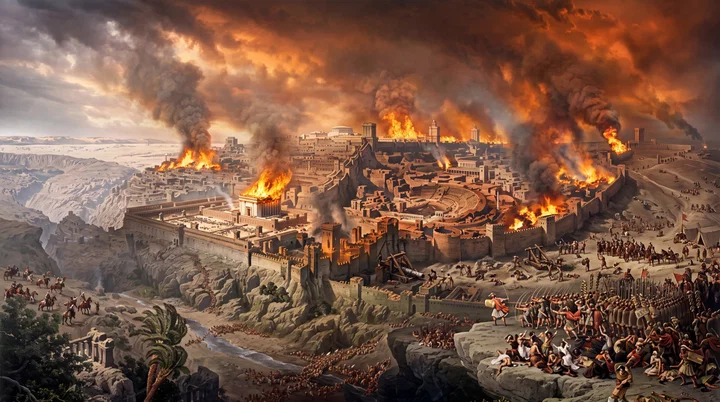
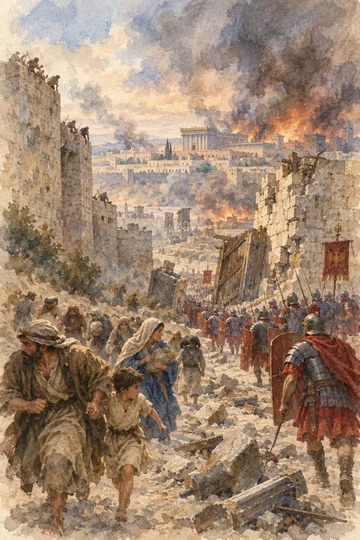
Matthew 24:1-2 foretells the utter destruction of Jerusalem and its temple and sanctuary, fulfilled about forty years later in A.D. 70 when the Romans under Titus captured, burned and demolished the city and temple.RH Jan 20, 1853ST Dec 3, 1894RH Sep 18, 1856 The departure from the temple after declaring the house desolate marks that it was no longer God's dwelling place, and the disciples' pointing to its buildings draws the declaration that it would be thrown down.RH Apr 15, 1909RH Jan 20, 1853ST Apr 3, 1879 The prophecy was fulfilled when the temple fell in the Roman siege despite Titus's efforts to preserve it, and the destruction followed after the Jews rejected the warning while the disciples who heeded it escaped when Jerusalem was surrounded by armies.ST Apr 6, 1915RH Jun 17, 1915 The verse belongs to that part of the prophecy referring largely to Jerusalem's destruction, fulfilled when the Romans captured the city in A.D. 70 and the Jews were scattered among the nations.ST Apr 6, 1915
The overthrow was fulfilled literally when Roman forces tore up foundations and burned city and temple, leaving scattered stones and ruins within less than forty years.RH Apr 15, 1909RH Sep 18, 1856RH Jul 21, 1868 The temple that had once resounded with songs of praise was reduced to ruins, and Jerusalem's former joy and glory departed after rejecting light.RH Sep 18, 1856 Jesus left the temple and from the Mount of Olives east of the city looked down on Jerusalem and foretold it would become desolate, and his final departure declared the house desolate and predicted its complete destruction a few years later.ST Dec 19, 1900RH Jul 21, 1868ST Apr 3, 1879 Its destruction occurred on the same month and day as the Babylonian destruction of Solomon's temple about 650 years earlier.RH Sep 18, 1856
More than a million perished in the siege, and the nation's rejection of the Son of God decided its fate.ST Dec 19, 1900 The prediction was fulfilled with the scattering of the Jews and possession of their land by other peoples, and the Mosque of Omar stood on the former temple site.ST Apr 6, 1915RH Sep 18, 1856 The empty building remained standing until 70 A.D. when destroyed by the Romans, after the veil of Herod's magnificent building was rent from top to bottom at the cross and the services afterward became only a hollow mockery because God had departed, and today the sacred spot is covered by a Mohammedan mosque.ST Nov 5, 1912 Jerusalem stands today in Moslem hands with a mosque honoring Mohammed where the temple stood, and all subsequent plans and power to make those words of none effect have failed because the words of Jesus were mightier.ST Jun 17, 1913
Those few words foretold lasting desolation, and the temple's later destruction with the failed attempt to rebuild it demonstrates that his words were fulfilled and could not be thwarted by rulers or peoples.ST Feb 11, 1913ST Jun 17, 1913 Written first in the Word and written again in fulfilled event, they form a twofold witness that could not be collusive.ST Jun 17, 1913 The ruin is connected with the nation's rejection of Jesus, for false ideas about the Sabbath led the Jews to reject and persecute Jesus, and rejecting him the Lord of the Sabbath brought loss of place and nation.ST Nov 21, 1900 Jerusalem was brought low because its people rejected Christ's mercy, chose Barabbas and persisted in rebellion, after which God's protection was withdrawn, and the city's destruction followed the Jews' many crimes and apostasy including responsibility for the Messiah's blood as an example of judgment falling when wickedness reaches its height.RH Oct 8, 1901RH Jun 17, 1915RH Mar 30, 1869 The destruction is a warning that rejecting God's holy memorial the Sabbath brings grave consequences.ST Dec 19, 1900
The destruction could have been avoided had they received him as king, for the scene introduces the warning that if the Jews rejected and crucified Christ the temple would be burned and Jerusalem destroyed.ST Apr 19, 1883 Christ gave signs by which people could know it was near so they had opportunity to repent and the righteous could escape, and his warning that followers should flee Jerusalem when armies surrounded the city gave practical guidance so those who heeded it could escape.ST Mar 3, 1881ST Sep 9, 1880 The Jews' decisions when Jesus and the apostles preached determined whether they would escape the ruin hanging over them and their city, yet few decided in a way that would save them.RH Dec 23, 1858 The Christians of Judea had been taught to expect the soon destruction of Jerusalem and its temple, and they mourned the loss of the temple and its worship. The account of the destruction opening as Jesus departs from the temple while the disciples point him to its buildings evidences the fierceness with which Satan contested Christ's claims in the long contest between Christ and Satan, between truth and error, between light and darkness. This introduces the chapter's signs whose first great sign is the destruction of Jerusalem, belonging to the departure from doomed Jerusalem from which the missionaries set out.ST Nov 17, 1914RH Jan 25, 1912
Signs Foretelling Coming
Matthew 24:1 opens a chapter devoted largely to signs of the second advent, in which the disciples ask what shall be the sign of coming and thirty-two verses are occupied with the answer, with verse 29 speaking of signs to occur not at random but at definite periods.ST Apr 16, 1894 The answer embraces wars between nations and kingdoms, rumors of wars, famines, pestilences, great earthquakes in various places, tidal waves, distress among nations with perplexity, crime, scoffers, amassed wealth, labor troubles, and religious, social, moral and physical portents, which are only the beginning of sorrows and not the end, the later wars of kingdoms rising against kingdoms not being fulfilled merely by provincial insurrections.ST Sep 16, 1889ST May 23, 1906ST Jun 27, 1906 God has reserved the sure and terrible ending of all things sinful for a definite time in purpose, and in faithfulness to merciful character gives warning of its direct approach through these signs, the chapter concerning future events as well as past, including persecution of the church, darkening of the sun, falling of stars, famine, pestilence, earthquake and tidal wave, with exact historical fulfillments, and including political turmoil among the nations marked by anger, distress and perplexity.ST May 23, 1906ST Jul 4, 1900ST Mar 29, 1899RH Feb 19, 1861
The first really great earthquake since the prediction was Lisbon in 1755, and since then earthquakes and volcanic eruptions have come with ever-increasing rapidity, including Stromboli, Mount Pelee, Vesuvius destroying towns, Charleston, disturbances in South and Central America, and the unheralded catastrophe in California breaking down important centers of industry.ST May 23, 1906 These are a sure indication that the end of the world is approaching according to the prediction itself, and are premonitions of the great and terrible earthquake before which all the cities of the nations will fall, with accompanying fires of the last day completing the destruction of all sinful things.ST May 23, 1906 The same phenomena are those of John's vision of a great earthquake with the sun becoming black as sackcloth of hair, the moon becoming as blood, and the stars of heaven falling to earth as untimely figs shaken by a mighty wind, fulfilled by Lisbon in 1755 as the greatest earthquake known to history, by the darkening of the sun and reddening of the moon in 1780, and by the falling meteors in 1833.ST May 2, 1906
Signs in sun, moon and stars were to follow the long tribulation and persecution of the church, and were minutely fulfilled by the darkening of the sun and moon on May 19, 1780 with the moon as blood that night, and by the falling of the stars on November 13, 1833.RH Nov 3, 1874RH Apr 3, 1866RH Feb 19, 1861ST Dec 25, 1901 The tribulation is that of the Dark Ages, ending around 1776 when persecution ceased, after which came the Dark Day and darkened moon of 1780 and the meteor shower of 1833, joined so closely to the coming of the Son of man in power and great glory as to leave no room for many years to intervene.RH Sep 10, 1857RH Feb 19, 1861ST Dec 25, 1901 When these begin followers are to look up because redemption draws near, and their occurrence calls for serious attention rather than ridicule, proving the coming near.RH Nov 3, 1874RH Sep 10, 1857
Looking forward the first event is the destruction of Jerusalem in A.D. 70, followed by tribulation of the Christian church by pagan persecuting powers and then 1260 years of papal supremacy, and then the special signs ending with the falling stars in 1833.RH Jun 9, 1851RH May 7, 1867ST Apr 15, 1903 That tribulation is reckoned as 538-1798, more than sixteen hundred years in sequence, with Vesuvius and Pompeii in A.D. 79 standing early in the outline from the first advent to the second, and with Mount Pelee and St. Pierre, the Dark Day, and the latest political, social and religious disturbances continuing the fulfillment down to the present, every prophecy fulfilled except the final act.RH Jun 9, 1851RH Jan 7, 1904RH Dec 15, 1904ST Apr 15, 1903 The connected discourse extends through Matthew 25:14, laying out the great events for professed followers from first advent to second, with verses 5-15 giving events before the end and the parable of the budding fig tree proving that in 1833 Christ was near even at the doors.RH May 7, 1867RH Jan 7, 1904
All but one of the heavenly signs have already occurred, the darkening of sun and moon in 1780 and falling of stars in 1833 being past, and the remaining shaking of the powers of heaven belongs to the scene of Christ appearing in the clouds.RH Nov 3, 1874RH Apr 3, 1866RH Feb 19, 1861 The powers of heaven are the sun, moon and stars, shaken by God's voice at the last great day as an incident of the coming rather than a preceding sign, placed after the falling stars in immediate connection with coming, and the sign of the Son of man is the clouds attending Him whose glory grows brighter as they approach, the next event to be expected.RH Nov 3, 1874ST Mar 27, 1893RH Apr 3, 1866ST Dec 25, 1901 The prophecy thus places the signs of the end after the church's tribulation, which is shortened for the sake of the elect.RH Sep 10, 1857ST Dec 25, 1901RH Apr 27, 1916
This gospel of the kingdom, the proclamation of that portion of the gospel relating to the coming and kingdom of Christ and the good tidings of the reign, shall be published through all the world for information of all nations as a testimony, and then shall come the end.RH Dec 27, 1870 That sign is now accomplished through Christian missionaries penetrating all principal heathen countries, with tens of thousands of laborers, thousands of teaching centers and congregations, schools for hundreds of thousands of youths, and over a million converts across China, Japan, India, Africa, Greenland, Madagascar and the Pacific isles, so the thickening signs call for readiness.RH Dec 15, 1874 Against deception it is taught that false christs and false prophets will perform great signs and wonders, including Mormonism and Spiritualism, with Mohammed included among false prophets as one falsely claiming divine commission toward the Messianic kingdom and more broadly any who lead astray by wrong religious teaching.ST Mar 6, 1884ST Oct 7, 1930ST Jul 30, 1902 The true Christ comes openly as lightning shining from east to west, in clouds of heaven with power and great glory, with all holy angels and with great sound of trumpet so that every eye sees Him, and any christ who does not come in this conspicuous manner is false, with the claim Lo here or there in desert or secret chamber not to be believed, while claims to be Christ with attracted followers are a partial fulfillment of the warning.ST Jun 8, 1904ST Dec 24, 1912RH May 19, 1903 The long sequence shows the second coming was not expected 1800 years ago but after Jerusalem's destruction, the great tribulation run its course, false christs and prophets, definite signs in sun, moon and stars, and worldwide trouble with men's hearts failing for fear while powers are shaken, and the generation seeing the culmination, this generation, shall not pass till all be fulfilled, meaning a future generation witnessing the signs.ST Jul 30, 1902
Nature and Nearness of Coming
The chapter opened by this departure teaches the personal, literal second coming of this same Jesus, as literal as the first, coming in the clouds with power and great glory to gather the elect with angels and trumpet blast and to reward people and raise the hope of the resurrection, and it cannot be confined to the destruction of Jerusalem or to death or be spiritualized away.LS 56.1–57.3ST Apr 1, 1875RH May 2, 1854ST Oct 29, 1894RH Mar 17, 1853 It introduces the last discourse in Matthew 24-25 whose theme is that coming and whose promise is return to reign gloriously in the world, clear even where details of interpretation remain uncertain, set forth as the glorious appearing and blessed hope to be shared with those who do not know it.ST Oct 29, 1894RH Mar 17, 1853RH Apr 24, 1913 Its references to the coming of the Son of man and the gathering of the elect concern the future personal advent, not the arrival of the Roman army at Jerusalem. To place the second coming at the destruction of Jerusalem in A.D. 70, forty years after the first advent, would wrongly make two separate events count as the second coming.RH Jun 18, 1861
The chapter rejects that the coming took place at Jerusalem's destruction or relates wholly to it, and those who so limit it conclude the Second Advent already occurred about 1,800 years earlier.ST Feb 27, 1879 It compares the coming to the days of Noah and Lot, teaching that as violence filled the land and widespread corruption characterized the earth before the Flood, so violence and corruption will again characterize the earth when the coming is near, the next great event at the end of this world's history to be studied and compared with facts in harmony with all other prophetic declarations.ST Jun 17, 1913ST Jul 1, 1908 The end of the world so taught means the end of the age, the gospel age or dispensation, reaching its utmost limit after this gospel of the kingdom is preached in all the world for a witness to all nations, not the destruction of the earth itself except as to its states or conditions.ST Dec 4, 1879ST Nov 20, 1879 It is not the end of the Jewish age, whose peculiarities were nailed to the cross and whose age ended before preaching to the nations commenced, with the Christian dispensation fully opened by apostolic preaching on Pentecost and afterward by turning to the Gentiles, not by Jerusalem's destruction; and the kingdom of God shown by the fall of Jerusalem, the treading down of the city, the fulfilling of the times of the Gentiles, and the signs in sun, moon and stars to be near at hand is still future, not set up on Pentecost.ST Nov 20, 1879RH Apr 17, 1866
The coming was not impending in the apostles' day but comes after a long period and sequence, written not only for that time but for people living at the end of the age when servants give meat in due season according to the prophetic word.ST Oct 17, 1900ST Feb 6, 1896ST Jun 29, 1904 Wars and rumors of wars with nation rising against nation and kingdom against kingdom were not manifest or possible then under Roman rule, and of them it is said the end is not yet and all these are the beginning of sorrows; after that must come Jerusalem's destruction, the running of its course by the great tribulation, a falling away and revelation of the man of sin, the work of false christs and false prophets deceiving many including Mormonism and Spiritualism, definite specific signs in sun, moon and stars, and worldwide trouble and perplexity with hearts failing for fear while powers of heaven are shaken, and then the Son of man seen coming in a cloud with power and great glory.ST Jul 30, 1902ST Feb 6, 1896 This generation that shall not pass till all be fulfilled means the future generation that witnesses the culmination of these things, just as this generation in Psalm 95:10 referred to a generation five centuries before, this night in Exodus 12:12 referred to a night two weeks away, and this day in Psalm 2:7 met its application a thousand years later.ST Jul 30, 1902
Fulfilled signs in the heavens and other predicted events command Christians to know the coming is near, even at the doors, as certainly as summer is known by leaves, with no more doubt than that the stars fell in 1833; when seen, the Son of man and the kingdom are near, though the day and hour are unknown.ST Sep 9, 1886ST May 20, 1880GSAM 117.1–3 The generation identified in the prophecy has been reached so that all it requires may be fulfilled at any moment, its final events belonging to signs-of-the-times teaching pointing to the near coming and able to occur at almost any time.ST Sep 14, 1882RH Jan 11, 1870ST Dec 24, 1912 All but one of the heavenly signs had occurred, the darkening of sun and moon and falling of stars referring to events after the long persecution of the Dark Ages and not to every such phenomenon, and the generation seeing these signs and bearing the last message of mercy will witness the coming and will not pass before all foretold things are fulfilled.ST Feb 7, 1906
The instruction spoken to the disciples then was written for later admonition, given so they would know Jerusalem would be destroyed, Christ would not return in their day, and no definite time could be known, while also benefiting later generations.RH Nov 26, 1914ST Feb 14, 1906ST Feb 6, 1896 Its signs, warnings, dangers, deceptions and assurances especially guide the generation that sees these things, assuring them Christ is near and his word will not fail, with fulfillment showing the coming King is near.RH Nov 26, 1914ST Feb 14, 1906 Every sign that was to precede the second coming is fulfilled, proving earth's last generation has been reached, and nearly all prophecy concerning human probation is fulfilled with little remaining before Christ comes.RH May 11, 1916RH May 2, 1907 All except the shaking of the powers of heaven and the sign of the Son of man in heaven have passed, showing the great day is near.ST May 19, 1881
The prophecies spoken by the Lord about the future carry fulfillment proving the divine stamp upon the canon and divine authority, and the verse-by-verse study of the chapter is to be read alongside history of events and conditions connected with it and compared with facts.ST Apr 9, 1912ST Sep 26, 1895 The chapter refers to the closing scenes of this dispensation and the same period as Revelation 13, 14, 16, Matthew 13:38-39 and Joel 3:9-15, covering devil miracles to deceive, gathering to Armageddon, coming as thief, reaping the harvest, overthrow of God's enemies and blessing on the watcher, made clearer than Old Testament prophecies and further illuminated in Revelation, closely connected with Daniel and Revelation to reveal the future so God's people discern signs and know what to do.ST Dec 2, 1889ST Jul 25, 1878ST Nov 27, 1879 Its teaching that Christ will come and gather saints is linked with the coming and gathering in 2 Thessalonians 2 placed after revealing of the man of sin.ST Nov 27, 1879
Its object is not to prove the coming literal, personal and visible even as the first coming was, for no question about the nature of the coming was asked and the disciples did not ask whether he would actually come again to be beheld personally as then seen.ST Sep 9, 1886ST Dec 2, 1889ST May 20, 1880 The question concerns a certain event and the time of its fulfillment, what shall be the sign of his coming and of the end of the world, and the answer is direct to that alone, tracing events and signs so followers may know when it is near, even at the doors, though not the day or hour.ST Sep 9, 1886ST May 20, 1880 Its prophetic scope extending from the first advent to the second makes warnings that the time is unknown especially forceful against attempts to set a definite date for the return.RH Jan 21, 1873
Warnings and Faithful Living
Jesus' first and chief warning in the chapter is to take heed against deception, for many will come in his name claiming to be Christ and will deceive many, and these last-day deceptions must be guarded against.ST May 1, 1884ST Jun 8, 1904ST Mar 6, 1884ST Oct 7, 1930ST Jul 30, 1902 The true coming needs no announcement of Lo here or there, for it will be open as lightning shining from east to west, visible across the sky and not hidden in a desert or secret chamber, in the clouds of heaven with power and great glory and with all the holy angels and a great sound of a trumpet, so that every eye sees him.ST Jun 8, 1904ST Dec 24, 1912 Any christ who does not come in this conspicuous manner is false, and the claim Lo here or there is not to be believed.ST Jun 8, 1904ST Dec 24, 1912 False prophets warned against mean especially those who falsely claim a divine commission to lead others toward the hope and realization of the Messianic kingdom, and more broadly anyone who leads people astray through wrong religious teaching, including Mohammed, Mormonism and Spiritualism.ST Oct 7, 1930ST Jul 30, 1902
The discourse extends across the entire Christian age and applies to the present time, when false christs and false prophets deceive people about the second advent.ST Jun 11, 1874ST Jan 18, 1877ST Jan 27, 1876 After leaving the temple and being shown its buildings, Jesus framed warning that the future includes the church's growing pursuit of political power, union of church and state, and persecution of those who do God's will, as signs that the Master's coming is near.ST Jan 2, 1907 The chapter foretells religious persecution arising when religious things and institutions are exalted above people, including persecution of Christ's followers in the past and a final fulfillment beginning in the present age through Sunday laws, growing intolerance and persecution.ST Oct 29, 1896
The chapter aims to prepare Christ's people to meet him and to keep them watching and waiting, with its signs prompting examination of truths about his coming.ST May 27, 1880RH Oct 14, 1858ST Apr 19, 1910 Its signs make it possible and necessary to know when the coming is near, and they are meant to be understood and followed, with warnings applying to the present generation whose world conditions fulfill what was foretold and which is urged to prepare for the Saviour's coming.ST May 27, 1880ST Apr 19, 1910RH Feb 26, 1914 The signs and the apparent delay must not become familiar and lose their power to awaken faith and readiness.RH May 15, 1913 Failing to know the time and to heed this warning is as fatal as ignoring the warning before the Flood.ST May 27, 1880ST Mar 26, 1885
When much time passed since the signs were fulfilled, some object that the coming is delayed and act like the evil servant who says in his heart that his lord delays his coming.RH Jun 9, 1853ST May 29, 1884ST Jun 23, 1887 His return will be questioned or put off though he is near, and when he comes some will watch faithfully while others live for worldly pleasures and say their Lord is delaying.ST May 29, 1884 They oppose the teaching of his coming, reproach its preachers, and turn to worldly company and practices.ST May 1, 1884 This applies to people within the Advent body after 1844, when some who had expected his return at a definite time became worldly and acted as though his coming were delayed.RH Jun 9, 1853
The teaching about watching belongs to the period just before the advent, when believers must stay awake, watch, pray, be ready and remain ready until Christ comes, because the day and hour are unknown, describing his second coming to the world with power and great glory to gather his elect.ST Apr 21, 1898RH Oct 15, 1872 The teaching closes with four parables showing the importance of watching, the first teaching that the goodman of the house is not a hypocrite, unbeliever or sinner in the general sense but one who stops watching because the Lord did not come as soon as expected, and who is not ready when his case comes up before God in the investigative judgment.RH Jan 15, 1901
Understanding the signs means living out the practical Christianity shown in Matthew 25 by caring for people in need, joined to proclaiming the warning about the judgment hour.RH Apr 14, 1910 The gospel message of Christ's last great discourse points to his second coming, so that present social and industrial unrest calls for attention to his return rather than a chiefly social message.ST Jun 30, 1914 Its warnings, read alongside present events, show the time is near for Christ to return and take his waiting people home, renew the earth and destroy sin.ST Dec 10, 1902
The great prophecy gives light for God's people throughout the Christian age, especially in the last days.ST Oct 16, 1893 Beginning with Jerusalem's destruction and ending with Christ's return in the clouds, its course shows the church is to expect sorrow and tribulation, not triumph or earthly prosperity, until Christ returns, describing temptation, tribulation and death before the signs of his coming.RH Apr 7, 1874ST Mar 1, 1877RH Dec 27, 1853 Its successive waymarks signal changes in their work: the surrounding of Jerusalem calls for flight, persecution calls for patience, worldwide gospel preaching calls them to bear witness, and the signs of nearness call them to act on their lessons and rejoice in approaching redemption, including the cry announcing the Bridegroom's coming and the response of those who go out to meet him.
The chapter shows prophecy already fulfilled and proves that the generation now living is the last one before Christ comes to this earth again.ST May 11, 1904ST Aug 10, 1904ST May 25, 1904 It calls that living generation to be ready without spot, putting away evil since unconfessed sin separates but confessed sins are forgiven.ST Dec 10, 1902RH Apr 14, 1910 It was expounded to show Christ at the door, presenting a timetable from destruction to coming traced to present-day events and to the King of kings when sin ends, answering when these events will occur without setting an exact date, with history cited in evidence of accurate fulfillment and with the comparison with Noah's days when people carried on ordinary life without heeding warning until the flood came.ST Jul 24, 1884RH Jun 22, 1905ST Apr 7, 1881 It is the setting for instruction meant especially to show the church when his return is near, even at the doors, confirming that he will come again and answering about his second coming and the end of the Christian age.ST Apr 7, 1881ST Sep 13, 1910
The disciples' admiration for the temple buildings reflects Jewish pride in them, but prophecy reveals that the buildings they admire will soon be destroyed.RH Oct 25, 1870 Earthly things destined to perish should not command lasting affection, and apparent permanence of the world is not to be trusted.RH Oct 25, 1870
Scripture Connections Outlined
The later signs stand in the same order as Revelation 6, with the sun and moon darkened and the stars falling, then the powers of heaven shaken before the Son of man comes in glory, reaching to the end of time and the day of judgment when probation has ended and the wicked seek to hide from Christ's wrath.ST Nov 25, 1889 They belong to the closing scenes of this dispensation and to the same period as Revelation 13, 14, 16, Matthew 13:38-39, and Joel 3:9-15, covering the working of miracles by spirits of devils to deceive, the gathering of kings and peoples to the battle of the great day of God Almighty which is the day of the Lord, the day of His wrath and anger immediately succeeding the day of salvation, His appearing coming as a thief, the reaping of the harvest of the earth, the fighting of the battle, the overthrow of God's enemies, and blessing on the one who watches, with Christ's coming and gathering of the saints placed after the revealing of the man of sin as described in 2 Thessalonians 2.ST Dec 2, 1889ST Nov 27, 1879 The chapter gives full instruction about the times and seasons of His coming.ST Nov 1, 1883 That instruction shows the return is not unknowable to watchful believers, with Old Testament prophecy and especially Daniel giving further light about its timing.ST Oct 28, 1889
The words about the earth's future are those Peter had likely heard before describing the coming Day of the Lord and the destruction of the heavens and earth by fire.ST The discourse continues through Matthew 25 as a connected history of important events involving the Christian church down to the Second Advent, and the signs in the sun, moon, and stars must occur and be presented before the Advent movement represented by the virgins going forth.RH Jun 9, 1851RH Nov 12, 1857 The parable of the ten virgins is a further illustration of the subject in the last part of the discourse and of events connected with the Advent movement, applying in connection with the experience just related.RH Nov 12, 1857
The disciples ask about His coming, the end of the world, and its signs, and He warns of last-day deceptions, gives signs and further instruction, and uses the fig tree to show that His words and signs make its approach knowable and to be heeded, with the generation seeing the signs remaining until all is fulfilled, while warning by the flood example and by servants who oppose the teaching of His coming, reproach its preachers, and turn to worldly company and practices.ST May 1, 1884 The connected discourse traces important events from the First Advent to the Second, including Jerusalem's destruction, the 1260-year papal persecution, and the signs of the return.RH Jun 9, 1851 It lays out the great events for God's people from the first advent to the second, pointing out the destruction of Jerusalem in A.D. 70, then tribulation by pagan powers and 1260 years of papal Rome for more than sixteen hundred years, then the special signs of the darkened sun and moon in A.D. 1780 and the falling stars in A.D. 1833, with the budding fig tree proving that then, in 1833, Christ was near even at the doors.RH May 7, 1867 The prophecy foretells world history from His time onward, answered by history from the overthrow of Jerusalem in A.D. 70 and Vesuvius and Pompeii in A.D. 79 to Mt. Pelee and St. Pierre and the latest political, social, and religious disturbances, with every prophecy fulfilled except the final act.RH Jan 7, 1904RH Dec 15, 1904 The signs in sun, moon, and stars were to follow the church's tribulation of the Dark Ages ending around 1776 and show the second coming near, identified with the Dark Day and darkened moon of 1780 and the meteor shower of 1833.ST Dec 25, 1901
Sources