Translations
American King James Version, Webster Bible, World English Bible
Behold, your house is left to you desolate.
King James Version, KJV Cambridge Paragraph Bible, Revised Version, American Standard Version
Behold, your house is left unto you desolate.
Lo, left desolate to you is your house;
Behold, your house is left unto you desolate;
Lo! your house is left to you;
Berean Standard Bible, Majority Standard Bible
Look, your house is left to you desolate.
See, your house is made waste.
Beholde, your habitation shalbe left vnto you desolate,
Douay-Rheims (Challoner revision)
Behold, you house shall be left to you, desolate.
Pictures
Cross-references 20 of 45
- Matthew 24:2
And Jesus said unto them, See ye not all these things? verily I say unto you, There shall not be left here one stone upon another, that shall not be thrown down.
Jesus predicts the temple’s complete destruction after declaring the house desolate.
- Luke 19:44
And shall lay thee even with the ground, and thy children within thee; and they shall not leave in thee one stone upon another; because thou knewest not the time of thy visitation.
Jesus foretells Jerusalem’s destruction because its people did not recognize their time of visitation.
- Luke 13:34-35
O Jerusalem, Jerusalem, which killest the prophets, and stonest them that are sent unto thee; how often would I have gathered thy children together, as a hen doth gather her brood under her wings, and ye would not!
Luke records the parallel lament and the house left desolate.
- Daniel 9:26
And after threescore and two weeks shall Messiah be cut off, but not for himself: and the people of the prince that shall come shall destroy the city and the sanctuary; and the end thereof shall be with a flood, and unto the end of the war desolations are determined.
Foretells Jerusalem’s destruction and the sanctuary’s desolation after the Messiah is cut off.
- Matthew 27:51
And, behold, the veil of the temple was rent in twain from the top to the bottom; and the earth did quake, and the rocks rent;
The torn temple veil at Christ’s death signaled the end of the temple services.
- Luke 21:20-24
And when ye shall see Jerusalem compassed with armies, then know that the desolation thereof is nigh.
Jerusalem’s surrounding by armies signals its coming desolation and destruction.
- Matthew 21:43
Therefore say I unto you, The kingdom of God shall be taken from you, and given to a nation bringing forth the fruits thereof.
The kingdom is taken from those who reject Christ and given to a fruitful nation.
- Matthew 21:38-39
But when the husbandmen saw the son, they said among themselves, This is the heir; come, let us kill him, and let us seize on his inheritance.
The tenants’ killing of the heir illustrates the leaders’ rejection of the Son.
- Matthew 24:15-16
When ye therefore shall see the abomination of desolation, spoken of by Daniel the prophet, stand in the holy place, ( whoso readeth, let him understand:)
The desolation judgment warns Jesus’ followers to flee Judea.
- Ezekiel 10:18-19
Then the glory of the LORD departed from off the threshold of the house, and stood over the cherubims.
God’s glory departs from the temple, leaving it desolate.
- Luke 21:6
As for these things which ye behold, the days will come, in the which there shall not be left one stone upon another, that shall not be thrown down.
Jesus foretells the temple’s destruction after declaring its desolation.
- Haggai 2:7-9
And I will shake all nations, and the desire of all nations shall come: and I will fill this house with glory, saith the LORD of hosts.
The latter temple’s promised greater glory came through Christ’s presence.
- 1 Kings 8:10-11
And it came to pass, when the priests were come out of the holy place, that the cloud filled the house of the LORD,
God’s glory once filled the temple, contrasting with its later desolation.
- Micah 3:12
Therefore shall Zion for your sake be plowed as a field, and Jerusalem shall become heaps, and the mountain of the house as the high places of the forest.
Both describe Jerusalem left desolate and reduced to ruins.
- Matthew 21:12-13
And Jesus went into the temple of God, and cast out all them that sold and bought in the temple, and overthrew the tables of the moneychangers, and the seats of them that sold doves,
The temple’s cleansing anticipates the judgment that leaves the house desolate.
- 2 Chronicles 36:15-16
And the LORD God of their fathers sent to them by his messengers, rising up betimes, and sending; because he had compassion on his people, and on his dwelling place:
The people rejected God’s messengers until judgment left their dwelling desolate.
- Luke 19:42
Saying, If thou hadst known, even thou, at least in this thy day, the things which belong unto thy peace! but now they are hid from thine eyes.
Jerusalem failed to recognize what would bring it peace, and those things are now hidden from its eyes.
- John 2:16
And said unto them that sold doves, Take these things hence; make not my Father’s house an house of merchandise.
Jesus calls the temple his Father’s house before it is left desolate.
- Mark 13:1-2
And as he went out of the temple, one of his disciples saith unto him, Master, see what manner of stones and what buildings are here!
Jesus predicts the temple’s destruction as he leaves it.
- Luke 21:24
And they shall fall by the edge of the sword, and shall be led away captive into all nations: and Jerusalem shall be trodden down of the Gentiles, until the times of the Gentiles be fulfilled.
Jerusalem is left desolate and trodden down by Gentiles.
Commentary
Each commentary is drawn from primary sources: the writings of Ellen G. White and Adventist pioneers and periodicals. Each commentary is separate. Its own words are not a quotation; follow the references to read the source passages.
Ellen G. White
60 sources
Spoken weeping on His last day in the temple as His farewell to the city He loved, the words declare that the temple was no longer His Father's dwelling but left to the Jews themselves.DA 610.1–611.2AA 145.2Ms 13, 1892, par. 26–28Ms 29, 1885, par. 303SP 57.1 Desolate means God's presence and glory departed forever when Christ went out from its walls, leaving its beautiful services a mockery and its ceremonies meaningless after their fulfillment in Him.AA 145.2ST May 2, 1878GC88 23.1–24.24SP 23.1–24.2ST May 9, 1878 This abandonment came only after long mercy, because Jerusalem killed the prophets, at last slew the Son, and stubbornly refused His repeated longing to gather and heal her children.Ms 36, 1897, par. 15Ms 13, 1892, par. 26–2810MR 154.3–4Ms 78, 1897, par. 21–22Ms 13, 1892, par. 29–31 The divine withdrawal doomed temple, city and nation to ruin by Rome, with not one stone left upon another, a judgment that also points to the final destruction of the world when mercy is likewise refused.Ms 13, 1892, par. 26–28Ms 78, 1897, par. 21–22Lt 18a, 1906, par. 8–15DA 627.1–3Lt 98, 1900, par. 31–33 The same ruin warns all later readers, cities and generations given great light that to reject truth and the Spirit's appeals is to be left without protection to desolation.Ms 5, 1882, par. 14–16Lt 18a, 1906, par. 8–1516MR 276.3DA 587.1–3Lt 16, 1895, par. 12
Setting and Wording
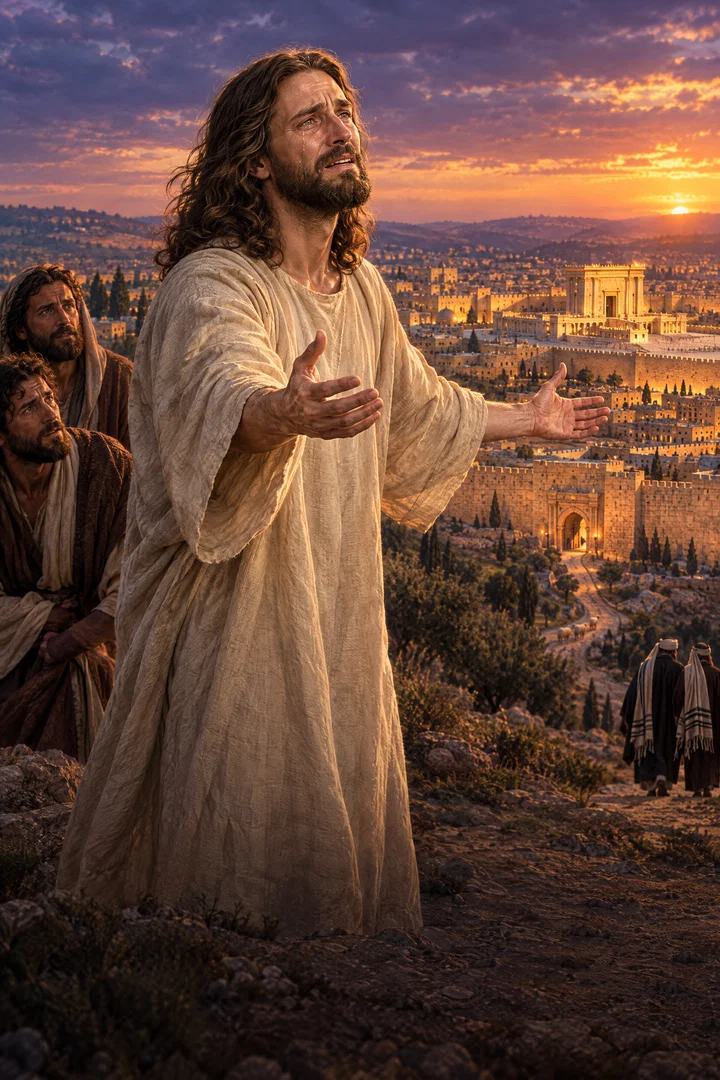
The words were spoken on Jesus' final day of teaching in the temple, when He warned the people against their leaders, exposed their conduct, and denounced the hypocrisy of the priests, scribes, rulers, Pharisees and elders.DA 610.1–611.23SP 57.1GC 23.1 That denunciation was meant not only for those present but for people of every age and nation.3SP 57.1 He then left the temple for the last time before Passover and looked over Jerusalem and its temple from the Mount of Olives.GC 23.1
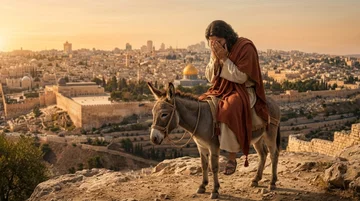
He spoke them weeping in very great grief and weeping love, with His body swaying as a tree before the tempest in agony over the rejecters of His mercy.Ms 13, 1892, par. 26–28Ms 29, 1885, par. 30Ms 13, 1892, par. 29–31 They were His farewell to Jerusalem, the city of His love, and His final and irrevocable sentence upon Jerusalem and the Jewish nation.Ms 13, 1892, par. 26–28Ms 13, 1892, par. 29–31PP 475.2–3 He felt His people's rejection as done to Himself, and the words are fearful words of sorrow bringing anguish and bitter tears in sympathy with the sorrow of the Son of God.Ms 13, 1892, par. 26–28PP 475.2–3
Until then He had called the temple His Father's house, but here He called it theirs, which means it was no longer God's dwelling place.AA 145.2 The house left desolate is the temple, the city and the nation with all their privileges, also described as the Jewish nation and Israel's religious house, abandoned and destined for desolation.Ms 13, 1892, par. 26–2810MR 154.3–4DA 627.1–3 Though still outwardly beautiful with gold and precious stones and still sought by worshipers from every nation, Jehovah was no longer to be found there, for as the Son of God went out from its walls God's presence was withdrawn forever from the building made for His glory because Israel as a nation had separated from God.AA 145.2
The hearers were filled with fear and wondered whether the magnificent building would soon be ruined.3SP 69.3–70.1 The disciples were amazed at its massive stones and apparently unshakable walls, its immense size and beauty, even as He declared that not one stone would remain upon another.Lt 18a, 1906, par. 8–15DA 627.1–3 They heard His lament over Jerusalem but did not grasp that this judgment would come before the end of the world, and wrongly connected it with His personal return and the overthrow of Roman rule.Ms 78, 1897, par. 54–57
The chapter describes people blinded to relative importance, including neglecting the weightier matters of God's law.Lt 165, 1901, par. 11–14 Its denunciation of the scribes and Pharisees and its warning against following their blind leadership was recorded as an admonition to future generations.GC88 595.3–596.1
Abandonment by God
Desolate means that God's presence and glory departed from the temple forever when Christ went out from its walls.AA 145.2GC88 23.1–24.24SP 23.1–24.2GC 24.2AA 145.3 He was the true glory of the second temple, fulfilling the promise that its glory would exceed that of the first, and when He left its courts that glory departed permanently.GC88 23.1–24.24SP 23.1–24.2GC 24.2 Until then He had called it His Father's house, but in speaking these words near the close of His earthly ministry, when He looked for the last time upon its interior, He called it theirs, for it was no longer God's dwelling place or honored dwelling.AA 145.24SP 23.1–24.2AA 145.3 Though the building remained outwardly beautiful with gold and precious stones, splendid as when the shekinah had glorified it, and was still sought by worshipers from every nation, Jehovah was no longer to be found there because Israel as a nation had separated from God.AA 145.2AA 145.1 With that separation the temple was left desolate, its glory gone forever.GC 24.2AA 145.3AA 145.1
With God's presence withdrawn, the temple's services henceforth became a mockery and its ceremonies meaningless.ST May 2, 18783SP 69.2 The temple and its animal sacrifices would no longer serve their purpose after Jesus offered His life for the sins of the world, when the sacrificial types met their fulfillment in the Lamb of God.ST May 9, 1878 Jerusalem's time of probation had ended.ST May 2, 18783SP 69.2 The Son of God spoke a shut door to the unbelieving Jews of that generation, leaving their house desolate and without hope.Ms 4, 1883, par. 24ST May 2, 1878Ms 17, 1885, par. 10 By rejecting God's warnings they were left without His favor and presence, for God withdrew His Spirit and left them to the deceptions they chose and to the consequences of those deceptions.4SP 270.2GC88 431.1GC 431.1 While the door was shut to the people of Jerusalem who disbelieved, it stayed open to the humble who believed and obeyed God.Ms 17, 1885, par. 10
The chosen nation, honored and favored above all people, was as a nation divorced from God and left desolate.Ms 71, 1897, par. 17–19Ms 13, 1892, par. 35–36 The words are Christ's lamentation in which the very heart of God pours itself forth in His representative, the separation struggle and mysterious farewell of long-suffering, abused and rejected love after every resource has been exhausted, spoken in the most terribly momentous period of the Jewish nation while Jesus was in their midst.Ms 71, 1897, par. 17–19 Though He loved them and labored for them and bore insult, mockery, and rejection from them, and did all that was possible to save them from ruin, they refused Him, and He had exhausted the resources of infinite love and could do no more.Ms 71, 1897, par. 17–19Ms 13, 1892, par. 35–36 As the natural branches of the olive tree they were cut off to receive eternal retribution for refusal of Christ, with destruction lying at their own door by their own responsibility.Ms 71, 1897, par. 17–19 Their salvation would have been the joy of Christ and the rejoicing of the angels, but they would not, for no one will be saved against his will.Ms 13, 1892, par. 35–36
As a general principle, when Jesus withdraws His presence from a house, home, or household that does not have Him abiding in it, it is left desolate.Ms 4, 1882, par. 1–2ST Feb 23, 1882HL 289.3 A home becomes desolate when its people refuse Christ and turn from His sacred influence to the sinful customs and amusements of the world, for Christ will not remain to guide and bless such a household, and His departure leaves it desolate because His presence has been withdrawn.ST Feb 23, 1882 God does not dwell with those who reject His truth, and rejecting truth means rejecting and dishonoring its Author.Ms 4, 1882, par. 1–2HL 289.3 Without divine enlightenment people cannot rightly or correctly understand God's plans and ways, and may deny His existence or limit His power to fit their finite views.Ms 4, 1882, par. 1–2HL 289.3
Reasons for Rejection
Jerusalem had killed the prophets and stoned those sent to her, beating, scourging, crucifying and persecuting the wise men and scribes sent to her, rewarding good with evil and love with hatred, so that all righteous blood from Abel to Zacharias came upon that generation.Ms 36, 1897, par. 15Ms 13, 1892, par. 26–28 She had been the murderer of the prophets, and when the Son of God came to His own His own received Him not, but cast the heir out of the vineyard and rejected and slew Him.Ms 13, 1892, par. 26–28SLP 206.2–207.1 This was the ground of the final and irrevocable sentence pronounced in weeping love, because Christ personally identified with His people and felt their rejection as done to Himself.Ms 13, 1892, par. 26–28
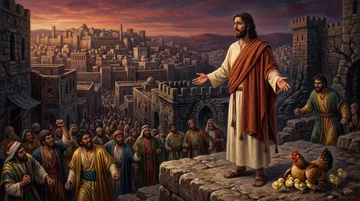
Though He had labored for years to convince the Jews, entreating blind priests and unbelieving Pharisees while denouncing their wickedness, He had often longed and repeatedly desired and invited to gather her children together as a hen gathers chickens under her wings to save, protect, heal and bless them.Ms 36, 1897, par. 15Ms 29, 1885, par. 30Lt 18a, 1906, par. 8–15Ms 77, 1899, par. 1–3Ms 69, 1912, par. 35–39 They would not be gathered and stubbornly refused His gathering love, sheltering care and the help God sent, and therefore their house — the Jewish nation, no longer a sacred dwelling protected by His presence — was left to them desolate and its destiny made certain.10MR 154.3–4Ms 78, 1897, par. 21–22Ms 29, 1885, par. 30Ms 77, 1899, par. 1–3Ms 69, 1912, par. 35–39 The desolation was the calamity that came upon the nation after it rejected the means that would have brought it light and knowledge.Lt 18a, 1906, par. 8–15Ms 77, 1899, par. 1–3
They rejected the light of divine truth sent through prophets and the Son, refused the Spirit's appeals, scorned His love, and did not know the time of their visitation.Ms 5, 1882, par. 14–16Ms 13, 1892, par. 26–28RH Jul 6, 1911ST Jun 8, 1882 They rejected the powerful evidence of His works that He was the Son of God and Messiah, persisting in obstinate unbelief despite that evidence, and as a proud unbelieving nation they professed to exalt and honor God's law while disregarding His commandments.RH Jul 6, 1911ST Jun 8, 18823SP 274.2–37RED 11.2–3Lt 195, 1899, par. 6 For this refusal to hear Christ and opposition to the gospel, Jerusalem and its temple were left desolate, a destruction that need not have come if His teachings had been obeyed.Ms 5, 1882, par. 14–16RH Jul 6, 1911Lt 195, 1899, par. 6
This rejection stood against what Jerusalem might have been, holiness unto the Lord.Ms 13, 1892, par. 29–31 For Judah had for ages been the repository of sacred truth where the knowledge of Jehovah was cherished, its streets trodden by angel feet, its soil sacred, its temple sending prayer and praise to God and its bleeding altar testifying to guilt and pointing to the Lamb of God, with prophets sent with warning, reproof, consolation and promise.Ms 13, 1892, par. 29–31 Sentence came only after long mercy, represented in the parable of the unfruitful tree with the gardener pleading that the nation be spared yet one more year for new experiments of mercy and grace.Ms 13, 1892, par. 29–31 After Christ had done all that could be done, clothing His divinity with humanity for their sake and searching from highest bough to lowest for fruit and finding none, the Sun of Righteousness having shed divine beams of light upon the doomed city and the light having been persistently rejected, the irrevocable sentence fell.Ms 13, 1892, par. 29–31
Like the pretentious fig tree with rich foliage but only leaves when searched from topmost bough to lowest branches, which withered by the next morning under His curse, Israel had profession without fruit and would wither, its doom sudden and certain.Ms 13, 1892, par. 29–31Ms 111, 1897, par. 19–21 The desolation prefigured by the blighting of the fig tree was connected with the second cleansing of the temple when buyers and sellers were dispersed for desecrating the place set apart for a holy purpose, showing the righteous anger of God.Ms 111, 1897, par. 19–21 The priests standing as representative men of the nation were corrupting the people by false principles, leaving the people fruitless and desolate.Ms 13, 1892, par. 29–31Ms 111, 1897, par. 19–21
Destruction Foretold
Desolation means abandonment by God followed by ruin and destruction, a final and irrevocable sentence upon Jerusalem spoken in weeping love as Christ came near the city for the last time, leaving its temple, city and nation with all their privileges abandoned to ruin.Ms 13, 1892, par. 26–28Lt 18a, 1906, par. 8–15 The house left desolate is the temple and Jerusalem's religious house, left because the people rejected Christ, and its coming destruction fulfills that warning.DA 627.1–3DA 628.1–2 Its hearers were filled with fear and wondered whether the magnificent building would soon be ruined, and Jesus clarified that despite its immense size and beauty and apparently unshakable walls that amazed the disciples with their massive stones, not one stone would remain upon another.Lt 18a, 1906, par. 8–15DA 627.1–33SP 69.3–70.1 That desolation came because Jerusalem killed the prophets and stoned those sent to her and would not be gathered as a hen gathers her chickens, after Christ had labored for years to convince the Jews that great calamities would come unless they repented, entreating blind priests and unbelieving Pharisees while denouncing their wickedness and pronouncing the woes upon Jerusalem.Ms 13, 1892, par. 26–28Lt 18a, 1906, par. 8–15 It came because they killed and crucified and scourged and persecuted the prophets and wise men and scribes He sent, so that all righteous blood from Abel to Zacharias came upon that generation, and because they rejected the light of divine truth and did not know the time of their visitation.Ms 13, 1892, par. 26–28
The warning foretold that Jerusalem and its temple stood under judgment, no longer a sacred dwelling protected by Christ's presence after He left the temple, with the city's later destruction by Roman forces as the consequence of its course in rejecting Christ and those sent to it.Ms 78, 1897, par. 21–22ST Dec 19, 1900 It points ahead to when its walls would be broken and its temple stones thrown down.ST Dec 19, 1900 The disciples soon learned that not one stone would remain upon another, and the temple and its animal sacrifices would no longer serve their purpose after Jesus offered His life for the sins of the world, when the sacrificial types met their fulfillment in the Lamb of God.ST May 9, 1878
Had the people opened their hearts to the appeals of God's Spirit, they would have recognized Christ as the fulfillment of their sacrifices, sympathized with His work, accepted His teaching and repented, and been spared that doom.Ms 127, 1899, par. 61–62RH Feb 13, 1900 Jerusalem grieved Jesus because it could have accepted Him, been healed and delivered, and received the peace and destiny God offered; instead, refusing His gathering love and efforts to save, it was doomed.RH Feb 13, 1900DA 575.3–576.1 If its people had received Him and welcomed the Spirit's appeals, they could have escaped the doom He pronounced and received deliverance from Roman rule.RH Feb 13, 1900Lt 16, 1895, par. 12 The city, which had been under His care, would soon be destroyed for rejecting Christ, whereas if its people had received Him Jerusalem could have endured and become a center of peace and blessing to the nations, but their refusal of the Messiah and pursuit of their own course led to destruction.COS 95.3–6Lt 16, 1895, par. 12
This warning introduced Jesus' teaching about Jerusalem's destruction, which extended beyond that event to the final judgment of the world.DA 627.1–3 Christ's prediction of Jerusalem's destruction also pointed to the destruction of the world, because people would continue to refuse God's mercy after rejecting His appeals and persisting in rebellion, choosing their own way until they lost His protection and brought humiliation and destruction upon themselves.Lt 98, 1900, par. 31–33 Jerusalem's destruction marked the end of God's long forbearance toward the nation, coming when the nation's transgression had reached its full measure as the consequence of Israel's rejection of the light Jesus had given, and that destruction typifies the destruction of the world.Ms 105, 1894, par. 31 Retributive judgment was hanging over Jerusalem and its temple, which Paul recognized when he returned to the city.ST Dec 19, 1878
Warning for Later Readers
The desolation of Jerusalem and its temple was judgment for rejecting the light sent through prophets and the Son, and all who follow that same course and refuse the light given to them will likewise face divine rebuke.Ms 5, 1882, par. 14–16Lt 16, 1895, par. 12 The warning reaches people today who have received great light and have seen power, goodness and mercy yet have not fulfilled the divine purpose, for refusal of the Messiah and pursuit of their own course leads to destruction.Lt 16, 1895, par. 12Ms 106, 1902, par. 27 Those who hear the voice of God, serve Him and walk humbly receive blessing, while those who forget instruction and follow their own way dishonor Him, lose protection and must face humiliation and destruction as the result of their choices.Ms 106, 1902, par. 27
Because Israel refused repeated invitations their house was left desolate, and this was the final warning to the impenitent nation.16MR 276.3 The rejection of the message of salvation that brought destruction upon the Jewish people warns those given great light and opportunity in the generation before the second advent not to reject light and suffer the same ruin and desolation.16MR 276.36T 145.3
The same pattern holds for impenitent cities, for the Lord sends messengers with reproof and warning, and when those messengers are despised and abused and patience and forbearance will not turn hearts to Him, He sends judgments.Lt 18a, 1906, par. 8–15 So it was with San Francisco, whose inhabitants trusted their grand towering structures against destruction, yet no human power can stand against the mandates of Jehovah.Lt 18a, 1906, par. 8–15
Jerusalem was left desolate after its people rejected warnings and the help offered through the Spirit, having reached the end of mercy with hearts hardened until they no longer responded and final pleadings could not deliver them.DA 587.1–3 Its judgment warns people in every age that rejecting the reproofs of the Spirit brings condemnation.DA 587.1–3 The door was shut to the disbelieving people of Jerusalem, leaving them without hope, while it stayed open to the humble who believed and obeyed, and this closing belongs to the same pattern as Noah, Sodom and Tyre that will be repeated at the end of time when the door is shut to all who are not ready.Ms 17, 1885, par. 10
Its fate also warns that the same evils could come upon a place that concentrates too much power and responsibility in one center, a danger facing Battle Creek if the warning was ignored.7MR 351.1 The grief over hearts turned from light and life, over children who would not be gathered as a hen gathers her brood under wings, rebukes complaint when neglect is met in work for God.Ms 29, 1885, par. 30
Sources
Pioneers and periodicals
108 sources
As He departed from the temple for the last time, never to enter again, Jesus declared that the temple with Jerusalem, its worship and nation was no longer owned as God's house but left as their own house, desolate without its Saviour.ST Nov 1, 1899RH May 10, 1915ST Mar 3, 1914ST Apr 22, 1889 It was left desolate because though He longed to gather and shelter them as a hen gathers her brood, they would not be gathered, rejecting and killing the prophets and at last the Son Himself while trusting in outward forms without inward life.ST Nov 1, 1899STRH Jul 1, 1873ST Feb 5, 1902 Desolation means His presence, glory and Spirit withdrew forever, leaving the once beautiful house dark, empty and dead, its services continuing only as lifeless form without power.ST May 2, 1878ST Nov 1, 1899RH Jan 20, 1853ST Oct 5, 1904 The sentence was fulfilled when the veil was torn at His death ending the typical sacrifices, and about forty years later when the Romans under Titus destroyed temple and city in A.D. 70, showing the earthly sanctuary of the old covenant set aside for Christ's ministry in the heavenly sanctuary.RH Apr 15, 1909ST Jan 28, 1886RH Mar 28, 1854RH Apr 6, 1869 In this Israel was cast off as a nation and the kingdom taken from them, which stands as a warning that professed churches and individual lives that reject Christ and cling to form without power will likewise be left desolate.RH Mar 6, 1855ST Jun 14, 1905RH Oct 25, 1864RH Sep 23, 1909
Words and Immediate Setting
The declaration stands as the close of Jesus' final and forceful rebuke and woes against the scribes and Pharisees.ST Mar 23, 1888RH Jun 2, 1859RH Jan 29, 1914ST Jan 6, 1887ST Oct 19, 1915 Those leaders kept outward religious observance with an air of self-righteousness while pride, covetousness, greed, oppression and hypocrisy concealed hearts far from God and profound inward evil.ST Mar 23, 1888RH Jun 2, 1859ST Jan 6, 1887 Their resistance when exposed shows how truth provokes those who hate it, and their religious claims without Christlike character prove that belief is shown in life, not merely professed.RH Jun 2, 1859ST Sep 15, 1887 The woes contrast the blessings spoken on the mountain, showing the gospel brings blessing to the faithful but condemnation to the faithless, especially to hypocrites whose influence ruins others.ST Mar 23, 1888
Your house is the temple with its massive buildings of great stones, together with Jerusalem, its religious order and the nation.RH May 10, 1915ST Mar 3, 1914RH Jan 8, 1901RH Sep 3, 1872ST Mar 23, 1888 It is the earthly Jerusalem house now rejected, not the Father's house in heaven where the Father's throne stands and where Christ sits on the Father's throne and where the Father promised to settle David's seed and establish his throne forevermore.RH Aug 14, 1856 Jesus left it with His disciples, and His departure expressed the loss of divine favor and left it a place without its Saviour.ST Mar 3, 1914ST Mar 23, 1888
Calling it your house means it is no longer owned as God's house.ST Apr 22, 1889ST Oct 5, 1904ST Mar 22, 1899 The people had forgotten the Father, corrupted worship into selfishness and hypocrisy, trusted in forms, dead ritual, tradition and display, and rejected the Lord of the temple, so God no longer owned or recognized it.ST Apr 22, 1889ST Oct 5, 1904 It retained only outward form without His life and presence, the substance gone leaving only the shadow, and cherishing that lifeless form opened the church to Satan's influence.ST Oct 5, 1904ST Mar 22, 1899 A divinely ordained institution or ordinance, when perverted and abused, ceases to be God's and faces judgment, as shown when the veil's tearing from top to bottom revealed God no longer regarded the most holy place as His dwelling.ST Apr 22, 1889ST Oct 5, 1904
The words were His last words and last day of teaching in the temple, spoken as He finally departed from the temple precincts never to enter again.RH Apr 27, 1911RH Jan 29, 1914RH Jan 8, 1901RH Sep 3, 1872 He left with His disciples, leaving it without its Saviour, two days before the Passover at which He was betrayed and crucified.RH Jan 8, 1901 When Christ left near the end of His earthly ministry God's presence was withdrawn from it forever, and though it remained splendid and still drew worshipers, Israel had separated itself from God.RH Apr 27, 1911ST Nov 1, 1899 That departure marks the withdrawal of His presence from the city because its people refused His repeated efforts to gather and protect them and rejected the messengers sent to them.ST Nov 1, 1899 From then on the tearing of the veil at His death marked the end of the earthly sanctuary's role, for after ascending to heaven He began ministry in the heavenly sanctuary whose way into the holiest was made manifest, superseding earthly sacrifices and priestly services.
The sentence follows His tearful lament over Jerusalem that kills the prophets and stones those sent to her. He grieved for the city's coming distress and not for Himself, foresaw its awful destiny and wept over it, and pleaded in love and mercy for sinners to turn to Him and be saved.STST Sep 3, 1902ST Dec 3, 1912ST Jun 16, 1898 Though He often would have gathered her children as a hen gathers her brood under her wings to shelter, enlighten and protect them, they would not accept His protection.ST Oct 18, 1899 The passage adds they will not see Him again until they say, Blessed is He that cometh in the name of the Lord, and warns that their time of visitation was passing and swift judgment near.ST Dec 3, 1912
That lament is the same as in Luke 13:34-35. It was spoken after the Pharisees failed to trap Him on divorce and then warned Him to leave because Herod wanted to kill Him. To that He answered He would keep casting out devils and healing and must go on His way because a prophet cannot perish outside Jerusalem.
The disciples did not understand because they expected Christ to sit upon David's throne in Jerusalem.RH Jan 8, 1901 As they left they pointed to the solid foundation, durable stones and massive temple buildings as if so great a structure could never be overthrown.RH Jan 8, 1901RH Sep 3, 1872 That led Him to foretell utter destruction with not one stone left upon another, a doom upon the Jews, their city and their temple that preceded the fuller prediction in Matthew 24.ST May 9, 1878RH Jan 8, 1901RH Sep 3, 1872RH Dec 20, 1870 Restrained from asking further at the time, they afterward asked Him privately on the Mount of Olives when these things would be and what would be the sign of His coming and of the end of the world.RH Jan 8, 1901
Cause of the Judgment
The house was left desolate because the people would not be gathered, though Christ repeatedly desired to gather, shelter, enlighten, heal and protect them as a hen gathers her brood.ST Nov 1, 1899STRH Jul 1, 1873ST Jun 14, 1883ST Nov 1, 1899 They refused His teaching and followed Him not, resisted His gracious efforts and prevented the blessings He wished to give.ST Nov 1, 1899RH Jul 1, 1873ST Jun 14, 1883ST Nov 1, 1899RH Aug 17, 1876 Their rejection of His efforts to gather and protect them made the desolation the sorrowful result of their own refusal, for which He grieved not for Himself but for what would come upon them.STST Nov 1, 1899RH Aug 17, 1876
They rejected and killed the prophets and messengers sent to them, and the judgment falls on the generation that persecuted God's messengers.ST Nov 1, 1899ST Feb 5, 1902 They claimed they would not have joined their fathers in that violence, yet took part in it themselves, revealing submission to Satan's power and openness to deception and darkness.RH May 19, 1851 When the Son was sent to seek fruit from the vineyard they plotted to kill Him, demanded His crucifixion, and afterward condemned and persecuted His apostles and people, which filled up the measure of guilt.RH May 10, 1915ST Feb 5, 1902 Even when they recognized that the vineyard parable described them, they did not repent.ST Feb 5, 1902
Their outward religion did not save them, for vital Christianity was weak while denominational religion could not replace personal piety and individual godliness.RH Jul 13, 1916ST Sep 15, 1887 They made converts, honored prophets' tombs, built places of worship and prayed at length, studied the Scriptures and had zeal for God, yet remained hypocritical, covetous, proud, unbelieving, blind and disobedient.ST Mar 10, 1898RH Jul 13, 1916ST Sep 15, 1887RH Dec 16, 1902 They taught for doctrine the traditions of men, trusted in forms of temple worship and in wealth, birth and authority, broke God's covenant and law, adopted self-salvation by works, and in obstinate blindness and arrogant self-righteousness could not discern their time of visitation and what would bring peace.ST Mar 10, 1898RH Dec 2, 1909RH Dec 16, 1902 They rejected the One to whom the services pointed and crucified Him, chose Caesar rather than Christ, persecuted those who would show them their error, and regarded Christ as their enemy though He healed and freed sinners.ST Mar 10, 1898RH Dec 2, 1909 In ingratitude they turned a deaf ear to prophet after prophet, construed long-suffering mercy as license for sin and as making God responsible for its continuance, and the temple in which they trusted could not save them but was desecrated by heathen hands after the veil was torn.ST Mar 10, 1898RH Dec 2, 1909
By persistent transgression their iniquity came to the full and filled up the measure of guilt, reaching the point where there was no remedy.RH May 10, 1915ST Feb 18, 1886ST Feb 5, 1902ST Feb 10, 1898 The desolation followed the demand for the crucifixion and the rejection of the prophets and of the One who sent them, marking the culmination of accumulated wrongdoing against the earthly house where God had established the symbol of His government.ST Feb 18, 1886RH Jan 18, 1912RH Nov 19, 1903 God in long-suffering mercy leaves nations and overthrows no people until transgression is full and there is no more hope of good from them, so the judgment was just.ST Feb 5, 1902ST Feb 10, 1898
Nature of the Desolation
Desolation means the divine presence, glory, Spirit and power withdrew from temple and city forever.ST May 2, 1878ST Nov 1, 1899RH Jan 20, 1853ST Sep 28, 1882 Christ departed and the Shekinah left, the connection with the glory manifested there was severed, and His presence and power no longer comforted or blessed it.ST Nov 1, 1899RH Jan 20, 1853ST Sep 28, 1882 The once beautiful house became dark, empty and dead, forsaken and left to centuries of moral darkness by its own fault and not God's.ST Sep 28, 1882RH Sep 3, 1872 This abandonment was pronounced because the people refused repeated efforts to gather and protect them and rejected the messengers sent to them, so the temple was no longer God's dwelling and utter ruin became their portion.ST Nov 1, 1899RH Jan 20, 1853RH Sep 3, 1872 The sentence was spoken as the close of terrible maledictions upon the nation, especially upon the scribes and Pharisees, as the last words the Lord spoke in the temple into which He never again entered.RH Sep 3, 1872 The disciples who heard understood that fulfillment involved utter destruction of nation and temple, and as they left they pointed to its solid foundation and durable stones as if fulfillment were impossible, prompting the answer that not one stone would be left upon another.RH Sep 3, 1872
Its services henceforth were mockery, meaningless and lifeless.ST May 2, 1878ST Jun 14, 1905ST Oct 5, 1904ST Feb 28, 1906 The substance was gone leaving only the shadow, for they continued the old ceremonial services despite the torn veil and the loss of the living sacrifice, having chosen dead ritual, tradition and display over Christ.ST Jun 14, 1905ST Oct 5, 1904 The holy place was opened to public view and the holy of holies exposed to the multitude, showing God no longer regarded the most holy place as His dwelling.ST Oct 5, 1904ST Feb 28, 1906 The word your marks it as theirs rather than God's, no longer recognized as His house, with former glory departed and worship continuing in dead form without spiritual life or power.ST Oct 5, 1904ST Feb 28, 1906RH Jan 23, 1913 Rejecting Christ the tried cornerstone made Him a stone of stumbling to that system, which withered into dead ceremonies, while those who accepted Him became living stones built into God's spiritual house.ST Feb 28, 1906
Jerusalem's probation ended and its day of opportunity ended as the consequence of refusing Christ's offer to gather and save the city which He lamented.ST May 2, 1878ST Apr 29, 1875ST Jun 22, 1882 As Jesus mourned over the city after its rejection of His care, mercy and warnings, its day of grace was nearly over and swift judgment was near, yet while He pleaded it was still possible to repent and be saved.ST Jun 22, 1882 He in tears over Jerusalem gleaming in sunshine on her hills pronounced her end while she still looked splendid and peaceful, showing beauty did not spare her and fame did not win forgiveness.RH Aug 18, 1874 What happened warns every person that there is a too-late, when the door can shut without a sound, doom be sealed without a sight, and life be over before death comes.RH Aug 18, 1874 This does not happen because God loses mercy or turns away or is unwilling to do more, but because people lose capacity for accepting it and paralyze their own power of turning back, willingly choosing sin until left to eat its fruit, and a final appeal still comes to individuals and in times of crisis to nations and generations where accepting means salvation and rejecting or slighting brings loss from respect for human free will.RH Aug 18, 1874RH Mar 20, 1913
The words are fearful words pronounced upon those who had rejected all light and blessing and were about to crucify their King after refusing His offer to gather them.RH Jan 23, 1855ST Jul 15, 1908 They are a sorrowful warning of coming destruction, by which the disciples were also warned to escape when they saw the city surrounded by armies.RH Jan 23, 1855 They express the severe warning and judgment marking the close of ministry, yet belong to continual appeals to sinners springing from love and mercy, meant not merely to condemn but to lead them to turn and be saved and to seek God's kingdom and righteousness.ST Sep 3, 1902ST Feb 10, 1898 Jesus' love for Jerusalem did not prevent Him from being condemned as its enemy, for standing for righteousness and truth could be mistaken for hostility toward the people He sought to help.ST Oct 9, 1907
The judgment falls on the generation that persecuted God's messengers and refused God's invitation and would not be gathered.ST Nov 1, 1899ST Jul 8, 1930ST Jul 7, 1898 This refusal illustrates willful rejection of God culminating in unpardonable sin, since the chief priests rejected the only one who could save them and thereby rejected the means of salvation.ST Jul 8, 1930 The house of the nation that rejected Jesus and His messengers was left desolate when judgment was pronounced at the close of His earthly work.ST Jul 7, 1898 That judgment on the Jews foreshadowed the rejection of the gospel and judgment at Christ's second coming.ST Jul 7, 1898
Fulfillment in Jerusalem's Fall
The declaration foretells the overthrow of Jerusalem and the utter destruction of the temple with not one stone left upon another.ST May 9, 1878RH Jan 20, 1853RH Sep 18, 1856RH Jan 23, 1855ST Sep 17, 1902 The warning is closely joined to the prediction in Matthew 24, spoken as Jesus withdrew from the temple and looking down from the Mount of Olives.RH Jan 20, 1853RH Sep 18, 1856RH Apr 15, 1909 It warned the disciples to escape when they saw the city surrounded by armies.RH Jan 20, 1853RH Jan 23, 1855 Because the people rejected Jesus and refused His desire to gather, enlighten and heal them, the temple was no longer God's dwelling and was abandoned to desolation.ST May 9, 1878RH Jan 20, 1853RH Sep 18, 1856RH Apr 15, 1909RH Jan 23, 1855
The desolation was fulfilled when enemies surrounded the city and destroyed it, leaving no stone upon another.RH Apr 15, 1909ST Jan 28, 1886ST Sep 17, 1902RH May 7, 1872 The Romans under Titus ruined temple and city in A.D. 70, about forty years later and within less than forty years.RH Apr 15, 1909ST Jan 28, 1886RH May 7, 1872 Many perished, some by starvation in the siege, others were taken captive and sold into slavery, the city was sacked and burning and the nation was broken and scattered.RH Apr 15, 1909ST Jan 28, 1886RH May 7, 1872 Strange sights in the heavens and a voice crying woe beforehand showed that great judgment does not fall without signs.RH Apr 15, 1909ST Sep 17, 1902 One account places the city's overthrow seven years after the warning.RH Sep 20, 1870
Rejection was distinct from destruction, which was deferred for a considerable time.RH Mar 6, 1855RH Aug 4, 1863RH Dec 9, 1851ST May 20, 1880 The house was pronounced desolate and fell as a nation before its ruin nearly forty years later.RH Mar 6, 1855RH Aug 4, 1863RH Dec 9, 1851 Though it continued nominally for a short time, with services continuing only briefly until the veil was torn at the crucifixion, it was ultimately destroyed by Roman soldiers in A.D. 70 and was never rebuilt.RH Aug 4, 1863RH Dec 9, 1851ST May 20, 1880 The destruction was conditional and could have been averted.RH Feb 13, 1900RH Jul 6, 1911ST Aug 7, 1901 Had they welcomed the Spirit's appeals, recognized Christ as the fulfillment of their sacrifices, accepted His teaching and repented with all the heart, they could have escaped doom and received deliverance from Roman rule and become a joy to the world.RH Feb 13, 1900RH Jul 6, 1911ST Aug 7, 1901
The prediction could not be overturned: Julian's attempt to rebuild with Roman resources and military protection was stopped by fire bursting from the ground.RH Nov 4, 1862 Retributive judgment was already hanging over Jerusalem and its temple, which Paul recognized when he returned to the city.ST Dec 19, 1878 One lesson treats the temple as finally forsaken by God in fulfillment of the declaration and asks when it happened, but gives no date.RH Nov 3, 1863
End of Earthly Sanctuary
The house pronounced desolate is the earthly sanctuary of the old and first covenant, erected by Moses and recognized for fifteen hundred and twenty years as the Holy Spirit's sanctuary, now set aside and succeeded by the true. RH Jan 20, 1853RH Apr 6, 1869RH Mar 1, 1870RH Aug 18, 1863 Because Jerusalem rejected Jesus, the temple was no longer God's dwelling, and His departure from it marked its abandonment and foretold its being left in ruins by the Romans. RH Jan 20, 1853RH Sep 18, 1856ST Jan 28, 1886RH Aug 18, 1863ST Apr 3, 1879 Its role as the sanctuary of the old covenant had ended, its typical sanctuary forsaken as its services ended to give way to the true sanctuary in heaven, so that the earthly sanctuary ceases to be the subject of prophecy and the heavenly sanctuary is introduced. RH Apr 6, 1869RH Mar 1, 1870RH Aug 18, 1863RH Feb 18, 1858ST Apr 3, 1879 Its animal offerings were types that ceased when Christ the true offering died on Calvary, and the torn veil confirmed its services were finished. ST May 9, 1878RH Mar 28, 1854ST Jun 1, 1904RH Aug 18, 1863RH Feb 18, 1858 God left the earthly sanctuary with its typical system set aside as the seventy weeks ended and the heavenly ministration was about to begin. RH Apr 6, 1869RH Mar 10, 1874RH Dec 30, 1873ST Aug 15, 1878
The desolation was demonstrated at Christ's death when the veil was torn from top to bottom, proving the services in the two apartments were forever finished. ST Jan 28, 1886ST Jun 1, 1904RH Aug 17, 1916RH Feb 18, 1858 The typical system, sacrifices and offerings of goats and calves, ceased to have significance because the great sacrifice to which they pointed had been offered, the types giving way to Christ the true sacrifice whose blood takes away sin and meeting fulfillment in the Lamb of God who offered His life for the sins of the world. ST May 9, 1878RH Mar 28, 1854RH Aug 17, 1916RH Feb 18, 1858RH Dec 3, 1908 Without Him whom their atonement rituals pointed to those services were in vain, and the loss of sacred standing pronounced on the temple was followed by the rending of its veil and later by destruction by the Roman army under Titus in A.D. 70. ST May 9, 1878ST Jan 28, 1886ST Jun 1, 1904RH Aug 17, 1916 That rending signified the end of the special services and the transfer of the priesthood from Levi to Judah, with Christ become high priest forever in the order of Melchizedek. RH Mar 28, 1854ST Jun 1, 1904RH Aug 17, 1916RH Mar 1, 1870
From henceforth salvation and pardon are to be sought only through blood ministered in the heavenly sanctuary of the new covenant. RH Mar 28, 1854ST Jun 1, 1904RH Mar 1, 1870RH Aug 18, 1863RH Feb 18, 1858 Ascending to heaven He began ministry there, the way into the holiest was made manifest and opened, superseding Jewish earthly sacrifices and priestly services. RH Mar 28, 1854ST Jun 1, 1904RH Aug 17, 1916RH Mar 1, 1870 To that Father's house the sorrow of the disciples was directed. RH Mar 28, 1854ST Jun 1, 1904
This change came in close proximity to the end of the seventy weeks, when the typical system gave place to good things to come and the earthly gave place to the heavenly. RH Mar 10, 1874RH Dec 30, 1873ST Aug 15, 1878RH Dec 3, 1908 Fulfilled in the middle of the final week, when the temple sacrifices as shadows of His sacrifice no longer had meaning and the tearing of the veil signified the departure of God's Spirit, it proves the anointing of the most holy predicted for the close of the seventy weeks cannot apply to the earthly sanctuary but must apply to its antitype, the heavenly sanctuary. RH Mar 10, 1874RH Dec 30, 1873ST Aug 15, 1878RH Dec 3, 1908 Thus the first 490 days of the 2300 days pertain to the earthly sanctuary and the remainder pertains to the sanctuary of the new covenant. RH Mar 10, 1874RH Dec 30, 1873
Because the Jewish sanctuary had been left desolate and was no longer the sanctuary, with its desolation preceding its destruction by the Romans around A.D. 70, it could not be the sanctuary of Daniel 8:14 at the end of the 2300 days. RH Jan 20, 1853ST Jan 28, 1886RH Apr 6, 1869RH Aug 18, 1863RH May 5, 1851
The verse marks where the old covenant gives place to the new, for the type cannot reach beyond its antitype and the shadow ceases when the substance comes. RH Sep 18, 1856RH Mar 1, 1870RH Feb 18, 1858RH Sep 23, 1909ST Apr 3, 1879 The covenant with its ordinances of divine service and worldly sanctuary was drawing to a close because the great offering for the world was soon to die on Calvary, yet though He had often desired to gather the children of Jerusalem, enlighten the blindness of their minds and heal their backslidings, they would not, so He declared their house abandoned and as He departed declared it would be thrown down with not one stone left upon another. ST May 9, 1878RH Sep 18, 1856RH Mar 1, 1870RH Aug 18, 1863RH Feb 18, 1858 The Sinai-established order and theocratic system, repeatedly broken, was discontinued never to return in this world, its ancient ritual finding fulfillment in Christ's sacrifice and priestly ministry, with rule to be restored only when God gives Christ the kingship of the kingdoms of the world. RH Sep 18, 1856RH Dec 30, 1873RH Feb 18, 1858RH Sep 23, 1909ST Apr 3, 1879
Rejection of Israel and Kingdom
The declaration marks the time when Israel was cast off as a nation and cut off as God's people, the Jewish church being rejected and its house left desolate.RH Mar 6, 1855RH Dec 9, 1851RH Apr 6, 1869RH Apr 5, 1864 The measure of iniquity had been reached, and the people who were already far from the Lord were finally cut off when they rejected Christ as their rightful King and declared allegiance to Caesar.RH May 27, 1909RH Dec 9, 1851RH Apr 6, 1869 Jerusalem had remained the regarded center of worship only until the people rejected the Saviour, and from that point the temple was no longer the Lord's sanctuary nor their place of worship in the prophetic sense at its destruction in A.D. 70.RH Apr 6, 1869RH Apr 5, 1864 This rejection was distinct from destruction, which was deferred for a considerable time, with fall as a nation followed nearly forty years later by ruin.RH Mar 6, 1855RH Dec 9, 1851 Those who so hold add that from the casting off until the kingdom is set up and a new nation is raised up under a new law, God has no people on earth only if it is accepted that God cannot have a people unless a nation or kingdom has been established.
The theocratic system established at Sinai was thereby discontinued, never to return in this world.RH Sep 23, 1909RH May 27, 1909 After Israel repeatedly broke its covenant with God and its leaders turned from the Lord to Caesar, the house was left desolate and the theocracy ended.ST Nov 7, 1895RH Sep 23, 1909RH May 27, 1909 The declaration followed the tearing of the temple veil from top to bottom, showing the Sinai order set aside.RH Sep 23, 1909 The kingdom of God was taken from them and given to a nation that would produce its fruits, and there would be no national or world-wide rule of the kingdom until God gives Christ the kingship of the kingdoms of the world when the rightful ruler comes.ST Nov 7, 1895RH Sep 23, 1909RH May 27, 1909 That judgment meant God allowed the Romans to destroy their city and kingdom and scatter the people.ST Jun 30, 1909
The desolation did not mean that God had forgotten His promise or changed His plan. God had arranged for the word to be preached first to the Jewish people after giving them opportunity and high calling, intending to use them to bring light to the Gentiles. People of every nation who strive to overcome through Christ belong to true Israel, while the gospel turned to the Gentiles.RH Oct 8, 1857 The Jews were left of God in hardness of heart and blindness of mind and in spiritual famine, and because they rejected Jesus they suffered judgments and were scattered among the nations for eighteen hundred years.RH Dec 26, 1865ST Feb 11, 1875RH Oct 8, 1857 They are not the elect for whose sake the days of tribulation are shortened, since the elect are Christ's followers who had fled from Jerusalem to the mountains and were absent from the tribulation upon the Jews in the city.ST Feb 11, 1875RH Oct 8, 1857
The promise of possessing literal Canaan with peace in the land and the permanence of Jerusalem was conditional on keeping God's commandments, walking perfect before Him, and obedience.RH Apr 23, 1857 Because Israel disobeyed, the desolation of their house with dispersion and destruction of their city ended that conditional promise, leaving no promise that Israel shall enjoy literal Canaan this side of that desolation.RH Apr 23, 1857 The kingdom stands overturned until Christ comes whose right it is.RH Apr 23, 1857 The Jews have no further claim upon Abraham for religious favors.RH Sep 9, 1858 The judgment on that nation for rejecting Christ and His messenger, pronounced at the close of Jesus' earthly work, left its house desolate under a curse and devoted to destruction as a historical judgment, while also serving as a type of the final judgment on the unrepentant peoples of the world and foreshadowing the rejection of the gospel and judgment at Christ's second coming.ST Jun 14, 1910ST Jul 7, 1898
Warnings Beyond Jerusalem
The same sentence stands as a pattern for the professed Christian church in the last days, which when it reaches the point of rejecting Christ will have its fall announced as Babylon's fall.RH Mar 10, 1859 As the Jews continued their old ceremonial services after the veil was torn and the living sacrifice was gone, so churches that rejected the judgment-hour message continued formal worship while losing its living spiritual reality.ST Jun 14, 1905 Christ leaves a church desolate when it refuses to be cleansed of hypocrisy and sin, departing in the person of His true disciples and leaving its house to judgment.ST Jun 27, 1900 Rejecting newly revealed truth brings greater accountability, for what was once ignorance becomes presumption once light has been given, and this warning applies to religious bodies that reject the Sabbath message, whose rejection is joined to a growing dearth of the Holy Spirit. Those who see clear light about God's Sabbath commandment and reject it will be left desolate for refusing obedience after receiving that light.RH Jun 10, 1852
A house or life is left desolate when people see Christ walking about, hear of His wondrous works, listen to His gracious words of healing and lifting the fallen and saying to the sin-sick soul go and sin no more, yet neglect Him and His Word.ST Sep 6, 1899 Since attitude toward the Word is attitude toward God and Christ, hurried or neglected Bible reading treats the Father and the Son as a neglected guest, refuses to listen to the voice of One who spoke as man never spoke, and chooses the company that went back and walked no more with Him, placing such people in the position of the Jews, scribes and Pharisees on whom the woes in Matthew 23 were pronounced.ST Sep 6, 1899 When a sinner neglects the inward call of God's Spirit and fails to open the heart, the Spirit withdraws and leaves that life empty and ruined, giving last knocks at the heart whose refusal extinguishes light as vital as a last match to an Arctic traveler and bars an open door to heaven, and joined with neglected Sabbaths, neglected offers of grace and neglected duties it sinks the impenitent into perdition.RH Oct 25, 1864 Refusing Christ's loving invitation can leave a person's house desolate, for the things belonging to peace may be hidden from the eyes if acceptance is delayed too long. Those who know the Lord's will but refuse to obey are left without refuge and their house is desolate, for refusing the light makes the light within them darkness and leaves them in spiritual famine where they seek the word of the Lord but cannot find it.RH Nov 10, 1868
Refusing Christ's final appeal brings His withdrawal and leaves a person to the hardness of heart chosen, so that calling for the Savior when death comes will be too late and the house is left desolate.ST May 15, 1879 The same warning falls on those who deride those sounding an alarm about danger and refuse to heed God's Word.ST Jul 16, 1902 When God has withdrawn from the holy place to the most holy place, the rebellious house seeking Him where He is not receives no answer to prayer and is liable to fall into deception and share the fate of Saul, for the rebellious house of Israel is left desolate because it rejects God's saving truth.RH Oct 28, 1852
A home becomes desolate when its people refuse Christ and turn from His sacred influence to the sinful customs and amusements of the world, for Christ will not remain to guide and bless such a household and His departure leaves it desolate because His presence has been withdrawn.ST Feb 23, 1882 A house of God is made desolate when Christian travelers quarrel, drive away their minister and leave themselves without the means of grace, a neglect that includes unkept Sabbaths. A house may likewise be left desolate when Christ's efforts to cleanse it do not succeed, and this warns sanitariums that fail to follow Christ's principles, which He will leave while raising up others to carry on the work.
The most highly favored people on earth were abandoned to centuries of groping in moral darkness, not by God's fault but by their own, because God had given them His Word and sent prophet after prophet to warn and plead while they turned a deaf ear, as the masses today do when the claims of His law are presented.ST Mar 10, 1898 Though religious and having a zeal for God, they taught for doctrine the traditions of men and persecuted those who would show them their error, and in ingratitude they construed God's long-suffering mercy as making Him responsible for the continuance of sin, despite Christ's earnest desire that Jerusalem should receive light.ST Mar 10, 1898 Jerusalem left desolate when Jesus departed from it for the last time illustrates the earth's condition during the thousand years, uninhabited and desolate while Satan is confined there by circumstances.
The house of the Protestants is left unto them desolate, like the house of the enemies of God who slew the Lord Jesus Christ.ST Jun 25, 1896 A house left desolate also pictures the bereavements and forlorn hours every person must face, which when borne submissively under God's light can become blessings, for God heals the wounds He makes and what He sends becomes rich in mercy.ST Nov 15, 1899 Jerusalem's house left desolate before its destruction also served as an image that came to mind while viewing New Richmond after the cyclone had devastated the city, as a place laid waste.ST Jul 12, 1899
Sources