John 2:20
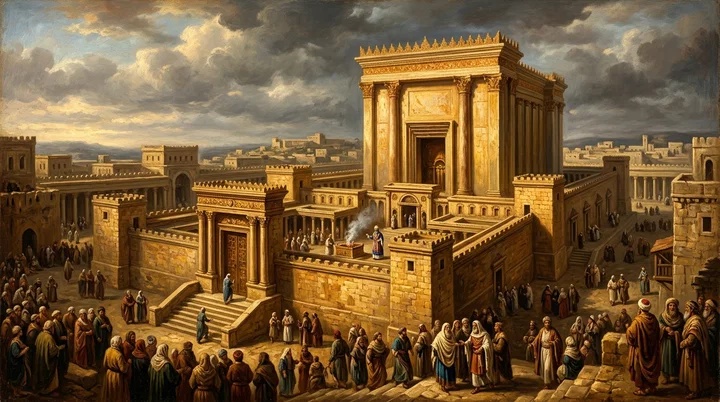
Then said the Jews, Forty and six years was this temple in building, and wilt thou rear it up in three days?
Translations
Then said the Jews, Forty and six years was this temple in building, and will you raise it up in three days?
King James Version, KJV Cambridge Paragraph Bible, Webster Bible
Then said the Jews, Forty and six years was this temple in building, and wilt thou rear it up in three days?
Revised Version, American Standard Version
The Jews therefore said, Forty and six years was this temple in building, and wilt thou raise it up in three days?
The Jews, therefore, said, 'Forty and six years was this sanctuary building, and wilt thou in three days raise it up?'
The Jews therefore said, Forty and six years was this temple building, and thou wilt raise it up in three days?
The Jews, therefore, said—In forty and six years, was this shrine built. And, thou, in three days, wilt raise it!
Berean Standard Bible, Majority Standard Bible
“ This temple took forty-six years to build,” the Jews replied, “ and You are going to raise it up in three days?”
The Jews therefore said, “ It took forty-six years to build this temple! Will you raise it up in three days?”
The Jews said, The building of this Temple took forty-six years; and you will put it up in three days!
Then said the Iewes, Fourtie and sixe yeeres was this Temple a building, and wilt thou reare it vp in three daies?
Douay-Rheims (Challoner revision)
The Jews then said: Six and forty years was this temple in building; and wilt thou raise it up in three days?
Pictures
Cross-references 20 of 32
- Matthew 26:61
And said, This fellow said, I am able to destroy the temple of God, and to build it in three days.
Witnesses misrepresented Jesus’ saying about destroying and rebuilding the temple.
- 1 Corinthians 3:16
Know ye not that ye are the temple of God, and that the Spirit of God dwelleth in you?
God’s people are God’s temple, as Christ is the true temple.
- Mark 14:58
We heard him say, I will destroy this temple that is made with hands, and within three days I will build another made without hands.
False witnesses distort Jesus’ saying about rebuilding the temple in three days.
- Hebrews 9:11-12
But Christ being come an high priest of good things to come, by a greater and more perfect tabernacle, not made with hands, that is to say, not of this building;
Christ is the greater sanctuary, entering by his own blood to obtain redemption.
- John 10:18
No man taketh it from me, but I lay it down of myself. I have power to lay it down, and I have power to take it again. This commandment have I received of my Father.
Jesus has power to lay down his life and take it again.
- Ephesians 2:19-22
Now therefore ye are no more strangers and foreigners, but fellowcitizens with the saints, and of the household of God;
Believers are built together in Christ as God’s holy temple.
- Zechariah 6:12-13
And speak unto him, saying, Thus speaketh the LORD of hosts, saying, Behold the man whose name is The BRANCH; and he shall grow up out of his place, and he shall build the temple of the LORD:
The Branch builds the Lord’s temple, pointing to Christ building the greater temple.
- 1 Corinthians 6:19
What? know ye not that your body is the temple of the Holy Ghost which is in you, which ye have of God, and ye are not your own?
Christ dwells in believers by the Spirit
- Matthew 27:51
And, behold, the veil of the temple was rent in twain from the top to the bottom; and the earth did quake, and the rocks rent;
The torn temple veil marks the end of the sacrificial system at Jesus’ death.
- Haggai 2:7
And I will shake all nations, and the desire of all nations shall come: and I will fill this house with glory, saith the LORD of hosts.
The prophecy of the Desire of all nations is applied to Jesus coming to the temple.
- Matthew 27:40
And saying, Thou that destroyest the temple, and buildest it in three days, save thyself. If thou be the Son of God, come down from the cross.
His words about raising the temple were repeated as a taunt on the cross.
- John 2:13
And the Jews’ passover was at hand, and Jesus went up to Jerusalem,
It places the temple incident at Passover in Jerusalem.
- John 20:9
For as yet they knew not the scripture, that he must rise again from the dead.
The empty tomb confirms Jesus rose from the dead, though the disciples had not yet understood this.
- Hebrews 8:1-2
Now of the things which we have spoken this is the sum: We have such an high priest, who is set on the right hand of the throne of the Majesty in the heavens;
Connects Christ’s work to the true sanctuary.
- Matthew 12:40
For as Jonas was three days and three nights in the whale’s belly; so shall the Son of man be three days and three nights in the heart of the earth.
Both texts refer to a three-day period before Jesus rises.
- Mark 11:15-17
And they come to Jerusalem: and Jesus went into the temple, and began to cast out them that sold and bought in the temple, and overthrew the tables of the moneychangers, and the seats of them that sold doves;
Given as a parallel account of Jesus cleansing the temple.
- Matthew 17:23
And they shall kill him, and the third day he shall be raised again. And they were exceeding sorry.
Jesus is said to rise on the third day.
- Luke 24:6-8
He is not here, but is risen: remember how he spake unto you when he was yet in Galilee,
The disciples remembered Jesus’ words after events fulfilled them.
- Acts 10:40
Him God raised up the third day, and shewed him openly;
Jesus says the temple will be raised in three days; God raised him on the third day.
- Mark 10:34
And they shall mock him, and shall scourge him, and shall spit upon him, and shall kill him: and the third day he shall rise again.
Both texts refer to Jesus rising on the third day.
Commentary
Each commentary is drawn from primary sources: the writings of Ellen G. White and Adventist pioneers and periodicals. Each commentary is separate. Its own words are not a quotation; follow the references to read the source passages.
Ellen G. White
22 sources
When the Jews demanded a sign of His authority to cleanse the temple, they took His word temple to mean only the earthly building at Jerusalem that had been forty-six years in building and dismissed raising it in three days as impossible, but He was speaking of His own body to be destroyed by death and raised in three days by resurrection.DA 154DA 163.4–164.3Ms 52, 1897, par. 7–10ST Jan 4, 1877LC1 80.3–81.1
The weight of the teaching holds that He meant His body as the earthly temple of the Son of God, while those who held the double sense teach that He meant both the temple at Jerusalem and His own material body.DA 154DA 163.4–164.3Ms 52, 1897, par. 7–10ST Jan 4, 1877LC1 80.3–81.1
The hidden meaning was not to be understood then even by His disciples, but after His resurrection they remembered and understood that He had foretold in figurative language His own death and resurrection, His conflict and victory.2SP 121.2–122.1ST Jan 4, 1877LC1 80.3–81.13SP 118.1–2ST Jun 27, 1878
He knew beforehand that His enemies would twist the saying into a false accusation at His trial and a taunt at Calvary, yet when He was rejected and put to death type met antitype, the sacrificial system lost its significance forever, and at His crucifixion the inner veil was rent from top to bottom.Ms 52, 1897, par. 7–10ST Aug 4, 1909ST Jan 4, 1877DA 164.4–165.2Lt 164, 1902, par. 28
The temple was an object lesson of God's purpose for every created being and every human body to be His dwelling place, so sin having defiled humanity, saving grace through His incarnation makes the heart His temple again and requires living in harmony with the laws of health in temperance in all things.STBk 126.2ST Jul 28, 1909
Words, Setting and Misunderstanding
The forty-six years answer was given at the cleansing of the temple, when the chief priests and elders demanded a sign of authority to cleanse it, though that cleansing act itself had already given the strongest proof of divine commission.ST Jan 4, 1877LC1 80.3–81.1 They answered with indignation, astonishment and unbelieving rejection, counting the three-days word as apparent presumption and as proof He had no right to challenge their beliefs, while they were plotting His death and hating Him for disrupting their gain-getting.DA 163.4–164.3Ms 37, 1894, par. 14ST Jan 4, 1877LC1 80.3–81.1 They took “temple” to mean only the physical building at Jerusalem, the Jewish temple, the earthly building.DA 154DA 163.4–164.3Ms 52, 1897, par. 7–10Ms 37, 1894, par. 14DA 705.2–3
They pointed to its forty-six years in building and dismissed rebuilding it in three days as impossible.DA 154DA 163.4–164.3Ms 52, 1897, par. 7–10Ms 37, 1894, par. 14ST Aug 4, 1909 That building was highly revered by Jews and Romans, and the Romans had engaged in rebuilding and adorning it and took great pride in it as a work of science and art.DA 705.2–35RED 36.3–38.23SP 116.3–117.2 Jesus was speaking of His own body as the earthly temple of the Son of God, its destruction by His death and its raising in three days by His resurrection, showing His power to lay down His life and take it again.DA 154DA 163.4–164.32SP 121.2–122.1ST Jan 4, 1877LC1 80.3–81.1
His saying held a double meaning, referring both to the temple at Jerusalem and to His own material body, given because no further evidence would convince those unconvinced by the cleansing, and He fully knew the path before Him to the end.ST Jan 4, 1877LC1 80.3–81.11RED 80.3–81.1 The hidden meaning was not meant to be understood then, even by His disciples, but after His resurrection the disciples remembered the words and understood them correctly.2SP 121.2–122.1ST Jan 4, 1877LC1 80.3–81.11RED 80.3–81.1 The cleansing announced His mission as the Messiah and the beginning of His work, and its report spread to Galilee and helped prepare people to receive Him, with many hoping His power to drive out the rulers marked Him as the promised Deliverer.2SP 151.2ST Jul 28, 1909
The cleansing took place during the day before His night meeting with Nicodemus on the Mount of Olives.ST Apr 15, 1886 Through that entire day He healed the sick, relieved the afflicted, received the poor and oppressed with compassion and sent no suppliant away unrelieved, instructed the people, reasoned with the scribes, and silenced the rulers by wisdom.ST Apr 15, 1886 Nicodemus saw this compassion, healing and wisdom, heard His words, and searched the prophecies pointing to Him as the looked-for Messiah.ST Apr 15, 1886
Prophecy, Trial and Fulfillment
The saying foretold in figurative prophetic language His own death and resurrection, His conflict and victory.3SP 118.1–2ST Jun 27, 1878 He was the foundation and life of that temple, so His crucifixion would virtually destroy it, and its services, priesthood, sacrificial offerings and connected offerings, which were types pointing to His future sacrifice, lost their significance when He was rejected and put to death.ST Aug 4, 1909ST Jan 4, 1877Lt 164, 1902, par. 28 When the Jews killed Him, type met antitype in His perfect offering, the whole system of burnt-offerings and blood of beasts became valueless forever, and at His crucifixion the inner veil was rent from top to bottom, signifying that the ceremonial system was at an end forever in the one great and final sacrifice of the Lamb of God slain for the sins of the world.ST Jan 4, 1877
The temple where He taught, including in the outer court so Gentiles could hear Him, was soon to become the tomb of the departing Jewish dispensation, for its sacrifices and offerings pointed to Him and at His death the symbols met their fulfillment and the need for those sacrifices ceased.Lt 164, 1902, par. 28 He knew beforehand that His words would be misused as an accusation at His trial and a taunt at Calvary, yet after His resurrection their meaning would become clear and provide many people with convincing evidence of His divinity.Ms 52, 1897, par. 7–10DA 164.4–165.2 His enemies twisted the saying to support a false accusation, and of all He had said this was the only saying the priests could use against Him.5RED 36.3–38.23SP 118.1–23SP 116.3–117.2 At His trial bribed false witnesses twisted it to suit their purpose, including one corrupt man who put Christ on a level with himself testifying that He claimed to be able to destroy the temple of God and build it in three days.3SP 118.1–2
The priests counted on Roman indignation to unite Romans and Jews, Pharisees and Sadducees against Him, since all held the temple in great veneration.3SP 116.3–117.2 His words were truth while the evidence against Him was false and malicious, and reported exactly as spoken they contained nothing offensive, so that even as the words of a mere man they would only have indicated an unreasonable, boastful spirit and could not have been construed into blasphemy.3SP 118.1–2 Those destroying the true temple were Satan and the people acting under his influence.Ms 52, 1897, par. 7–10 Read with the surrounding sayings about the temple of His body, His death was the apparent destruction of the temple and the apparent bruising of His head, but that appearance concealed victory: through suffering and death He completed the work appointed before creation, defeated Satan and the powers of earth and hell, restored humanity from the position lost through temptation and sin, and by perfect obedience to God's law placed humanity on vantage ground and broke Satan's hold over millions.ST Mar 26, 1894
Temple Meaning for Life
The temple stands as an object lesson of God's purpose that every created being should be a dwelling place for Him.ST Jul 28, 1909 Sin defiled humanity so that the human heart no longer reflected God's glory.ST Jul 28, 1909 Through the incarnation God dwells in humanity, and by saving grace the heart is made His temple again.ST Jul 28, 1909
The temple therefore illustrates that the human body is sacred to God and must be kept in harmony with the laws of health, while those who learn this are to teach others the better way.STBk 126.2 This education is to proceed line upon line and precept upon precept, keeping the subject fresh and never passing it over as non-essential.STBk 126.2 Conscience is to be aroused to the duty of practicing true reform, with temperance in all things in order to be susceptible to the sanctifying influence of truth.STBk 126.2
Sources
Pioneers and periodicals
55 sources
The Jews are answering Jesus' word about raising the temple in three days by taking Him to mean the stone house at Jerusalem, pointing to its forty-six years in building and challenging how He could rear it up in three days.ST Feb 22, 1899ST Aug 20, 1894ST Feb 22, 1899 Their question is literal-minded astonishment at an apparent impossibility, spoken with indignation, unbelief and a charge of presumption.ST Jan 4, 1877ST Aug 20, 1894ST Aug 20, 1894 He was not speaking of that building but of the temple of His body and of His resurrection on the third day.ST May 7, 1902RH Sep 23, 1902RH Sep 1, 1904 The forty-six years belong to Herod's rebuilding begun after the return from captivity, and place the saying at Jesus' first Passover in the spring of A.D. 28, showing He began His public ministry in A.D. 27.RH Dec 19, 1907RH Sep 18, 1856ST Jan 28, 1886 That earthly house with its worship and offerings was a shadow of His life, sacrifice and priesthood, and lost its meaning when He was rejected and put to death, when the veil was rent and the whole system of blood offerings became valueless forever in His one final sacrifice.ST Aug 4, 1909ST Jan 4, 1877ST Aug 23, 1910
Setting and Misunderstanding
The reply comes in answer to Jesus' words about raising the temple in three days, which the Jews take to mean the building at Jerusalem.ST Feb 22, 1899ST Aug 20, 1894ST Feb 22, 1899ST Jul 9, 1896ST May 5, 1909 They point to its forty-six years in building and challenge how He could rear it up in three days.ST Feb 22, 1899ST Aug 20, 1894ST Feb 22, 1899ST Jul 9, 1896ST May 5, 1909 Their reading is literal-minded, for He was speaking of the temple of His body, as the next verse explains, and of His resurrection.ST Feb 22, 1899ST Aug 20, 1894ST Feb 22, 1899ST Jul 9, 1896 He stood in the place of the temple, in whom Israel's ceremonies and services found their fulfillment.
Their question expresses astonishment at apparent impossibility.ST Jan 4, 1877ST Aug 20, 1894ST Aug 20, 1894 It is answered with indignation, astonishment, and unbelief, counting His words apparent presumption.ST Jan 4, 1877ST Aug 20, 1894 Their unbelieving minds could not discern that He referred to His own body as the earthly temple of the Son of God.ST Jan 4, 1877ST Aug 20, 1894 They had asked for a sign of His authority to cleanse the temple, though that cleansing act itself had already given the strongest proof of His divine commission.ST Jan 4, 1877
The exchange belongs to Jesus' first cleansing of the temple.ST Apr 14, 1898 It took place at the first Passover He attended in Jerusalem.ST Apr 14, 1898 It is included among the works He did at the feast, which the Galileans had seen and which helps explain why they received Him when He came to Galilee.ST Mar 15, 1899
That cleansing took place in the daytime before His night meeting with Nicodemus on the Mount of Olives.ST Apr 15, 1886 Through the whole day after it He healed the sick and relieved the afflicted, receiving the poor and oppressed with pitying compassion and sending no suppliant away unrelieved.ST Apr 15, 1886 Through that same day He instructed the people, reasoned with the scribes, and silenced the rulers by His wisdom.ST Apr 15, 1886 Nicodemus saw this compassion, healing, and wisdom and heard His words.ST Apr 15, 1886 What he saw and heard led him to search the prophecies pointing to Jesus as the looked-for Messiah.ST Apr 15, 1886
History and Chronology
The temple in question is Herod's rebuilding after the return from captivity, begun in 19 B.C. after the earlier house, which had fallen short of Solomon's in magnificence and had suffered decay and damage from enemies, was pulled down to its foundation.RH Sep 18, 1856ST Jan 28, 1886 The forty-six years named by the Jews places their remark at Jesus' first Passover in the spring of A.D. 28, and this dating supports the conclusion that He began His public ministry in A.D. 27.RH Dec 19, 1907RH Jan 7, 1858 That reckoning counts from Herod's preparations begun two years before the work commenced in B.C. 19.RH Dec 19, 1907 Another calculation starts with A.U. 735 as the eighteenth year of Herod from his conquest of Jerusalem and the death of Antigonus and adds forty-six years to reach A.U. 781, or A.D. 28, with counting from the beginning in Kislev making A.D. 28 probable, though the exact way the construction years were counted may be disputed.RH May 16, 1912
Another reckoning counts back from no later than spring A.D. 28 to place the start in B.C. 18, which supports that Jesus was born no later than B.C. 4 and was about thirty when baptized by John.RH Dec 23, 1852 Still another reckoning counts back from the first Passover Jesus attended to place the start in 17 B.C., the year Herod began rebuilding, with the main work continuing ten years yet left unfinished for Herod Agrippa to complete many years afterward, so the forty-six years runs from rebuilding begun in 17 B.C. to about A.D. 29 when the words were spoken.RH Mar 1851 This same dating places Him at about thirty when John baptized Him.RH Mar 1851 On yet another counting the forty-six years are the building years of Zerubbabel's temple from 536 to 459 B.C. with the intermissions left out, because Herod's temple is not to be recognized.
The state of the building is set forth as completed the year before, in A.D. 27, when Jesus began His public ministry. It is also set forth as begun in 19 B.C. and completed in A.D. 28, forty-six years later, and as begun in 19 B.C. and completed in A.D. 27 before the words were spoken at the first Passover in the spring of A.D. 28.ST Dec 3, 1894ST Jan 28, 1886 At that Passover in the spring of A.D. 28, when Jesus first went to Jerusalem after His baptism, the temple had been under construction for forty-six years and was still unfinished.RH May 16, 1912 The long period is explained because work on renovation and beautification continued beyond the original nine-year project, as it was kept being enlarged and ornamented, and because Herod spent forty-six years repairing Zerubbabel's temple into a magnificent building larger and more magnificent than the one it replaced.RH Nov 10, 1863ST Dec 3, 1894ST Nov 5, 1912
Its glory was greater than Solomon's because Christ was personally present there and taught, even though the sacred ark, Urim and Thummim, altar fire, and shekinah were absent.ST Dec 3, 1894 By the time the Jews spoke, the Desire of all nations foretold by Haggai had come to this temple.ST Jan 28, 1886 It was a grand, costly, massive structure, whose building period is given as forty-three years, not the forty-six years stated in the verse.ST Mar 13, 1893
Christ's Body Raised
Jesus was not speaking of the stone building but of the temple of His body, as the next verse explains, and of His resurrection.ST Dec 4, 1879ST Oct 14, 1889ST May 7, 1902RH Sep 23, 1902RH Sep 1, 1904 The temple building was the setting and symbol, while Jesus in the flesh was the meeting place between God and humanity.ST May 7, 1902ST May 7, 1902 The Jews took His words about rebuilding in three days to mean the Jerusalem temple, which had been under construction for forty-six years, and disbelieved it could be raised in three days.RH Sep 23, 1902RH Sep 1, 1904RH Mar 4, 1902 He used “temple” in a new way to refer to His body, in which divine Spirit and power dwelt.RH Sep 1, 1904RH Mar 4, 1902
Christ Himself is the true, living temple of God in human flesh.ST Mar 4, 1897ST May 14, 1902RH Mar 4, 1902RH Jul 29, 1902 He is the dwelling place of God’s glory and Shekinah by the Holy Spirit, the house not made with hands; the material temple could be destroyed, but the greater temple was manifested in Him.ST May 14, 1902RH Mar 4, 1902RH Jul 29, 1902 His body was God’s temple because God’s law lived in His heart as the Spirit of life, not as dead writing.RH Sep 23, 1902 The sanctuary and its temple therefore represented Christ in His fullness, and the temple and its services pointed to Him and found their fulfillment in Him.ST Mar 4, 1897RH Jul 29, 1902 Though people reject Him and continue building grand temples, through Him other lives can become temples of the same Spirit.ST May 14, 1902
The reference to the temple’s long construction contrasts its physical structure with the temple He would raise in three days—His own body.ST May 7, 1902ST May 7, 1902 That contrast identifies the incarnation of the Son of God as the truth being taught: in becoming human, Christ became the meeting place between God and humanity and the foundation of the true temple.ST May 7, 1902ST May 7, 1902 His words about raising up that temple in three days served as proof of His divine mission.RH Sep 23, 1902
His resurrection was bodily and literal: He rose from the grave on the third day.ST Dec 4, 1879ST Oct 14, 1889 His empty tomb and wounded hands and feet showed that the risen Jesus was the same person who had died.ST Dec 4, 1879 His bodily resurrection guarantees that His followers will also be raised bodily, when their mortal bodies will put on immortality.ST Dec 4, 1879 His resurrection was implied in the decree that Christ would die for the sins of the world, and it demonstrated God’s power to restore life and defeat death.
“Three days” denotes a period ending on the third day, not necessarily three complete days and nights, ending with the first part of the resurrection day.ST Sep 25, 1893 “Day” here is an example of a succession of days denoting a full twenty-four-hour period of night and daylight.RH Dec 12, 1871
Prophecy and Aftermath
His veiled words about destroying and raising the temple foretold His own death and resurrection, His conflict and victory.ST May 27, 1889ST May 27, 1889ST Jun 27, 1878 That foretelling, together with His foretelling of Peter's denial, tested and proved His knowledge of the heart, both the erring heart and the penitent heart.ST May 1, 1901 The saying was His often-repeated promise that He would rise again on the third day.ST Oct 4, 1899ST Jun 9, 1898 It fulfilled messianic prophecy and stood as evidence of His Messiahship and proof of His divine mission.RH Sep 23, 1902ST Oct 4, 1899
The words were not meant to be understood at the time, not even by the disciples.ST Jan 4, 1877 Their meaning became clear only after fulfillment, when after His resurrection the disciples remembered them and believed them together with the Scripture and with His saying that He had power to lay down His life and take it again.ST Jan 4, 1877ST Jan 9, 1912 The disciples forgot the promise and did not expect the resurrection, while His enemies remembered it and asked Pilate to secure the tomb against the claim that He had risen.ST Jun 9, 1898 The saying holds a double meaning, referring both to the temple at Jerusalem and to His own material body as the earthly temple of the Son of God.ST Jan 4, 1877ST Jul 9, 1896ST Jul 9, 1896 Christ was the foundation and life of that house, so His crucifixion would virtually destroy it, and His death would destroy the true temple in the sense that He would be killed and raised in three days.ST Jan 4, 1877ST Jul 9, 1896ST Jul 9, 1896 His death ended the sacrificial system and the earthly temple's sacredness, while His resurrection opened the true ministry in God's heavenly sanctuary.ST Jul 9, 1896ST Jul 9, 1896
His death was the apparent destruction of the temple and the apparent bruising of His head, but that appearance concealed victory.ST Mar 26, 1894 Through suffering and death He completed the work appointed before creation, defeated Satan and the powers of earth and hell, restored humanity from the loss through temptation and sin, and by perfect obedience placed humanity on vantage ground and broke Satan's hold over millions.ST Mar 26, 1894 His hearers misconstrued the saying as a claim about the Jewish building under reconstruction for forty-six years, and His enemies twisted it into an accusation that He could rebuild the Jerusalem temple in three days if torn down.ST May 27, 1889ST Jun 27, 1878ST Dec 1, 1898 Reported exactly, the words contained nothing offensive and gave no grounds for condemnation, and if He had been only a man the claim would have sounded unreasonable and boastful but could not have been construed as blasphemy.ST May 27, 1889ST Dec 1, 1898 Their misunderstanding confirmed their rejection of Him.ST Aug 4, 1909 Prizing outward grandeur and costly materials, they failed to recognize Him as the true glory and Temple of God, and in rejecting Him they lost the building they trusted, whose services pointed to His sacrifice and whose meaning and offerings lost significance when He was rejected and put to death.ST Aug 4, 1909ST May 14, 1902
Temple Typology and Believers
The wilderness sanctuary and Solomon's temple, with their buildings, priestly worship, services, ceremonies and furnishings, were given to teach God's willingness to dwell among people and to show in types how He can dwell in sinful human flesh.ST Aug 23, 1910ST Sep 13, 1910 They served as shadows of His life, ministry, sacrifice, priesthood and work, the temple as a whole representing His body.ST Aug 23, 1910ST Sep 13, 1910 Their work centered in cleansing God's building from sin's impurity to make it a fit dwelling for Him, depending on divine power, and pointed to Christ as that temple.
The Jerusalem temple was a prophecy of Christ as the greater temple, which the Jews sought to destroy by killing Him.RH Jan 14, 1904 Money given for its repair and maintenance was given to honor Christ Himself, so the poor widow casting in her two mites gave expression, according to her light, to the same grateful love that puts Christ first as Mary showed in anointing Jesus for burial.RH Dec 3, 1867 The temple's services pointed to Christ's sacrifice, and the temple's meaning and the offerings connected with it lost their significance when Christ was rejected and put to death.ST Aug 4, 1909ST Jan 4, 1877 Christ was the foundation and life of that temple, so His crucifixion would virtually destroy it, because its priesthood, sacrificial offerings and services were types pointing to the future sacrifice of the Son of God, and when the Jews killed Him type would meet antitype in His perfect offering.ST Jan 4, 1877ST Jul 9, 1896ST Jul 9, 1896 When Christ was crucified the inner veil was rent from top to bottom, signifying that the whole system of burnt-offerings and blood of beasts became valueless forever in the one great and final sacrifice of the Lamb of God slain for the sins of the world.ST Jan 4, 1877 His death thus brought the sacrificial system to an end and ended the ceremonial system and the earthly temple's sacredness, while His resurrection opened the true ministry in God's heavenly sanctuary.ST Jan 4, 1877ST Jul 9, 1896ST Jul 9, 1896
He stood in the place of the temple, and Israel's ceremonies and services found their fulfillment in Him, for the temple and its services pointed to Him and His great sacrifice, of which He was the true foundation and originator.ST Jan 27, 1881RH Jul 29, 1902 The temple's divisions also marked the exclusion of Gentiles, while Jesus brought them salvation through His grace.ST Jan 27, 1881 The temple was an object lesson of God's purpose for every created being to be a dwelling place for Him.ST Jul 28, 1909 Sin defiled humanity and made the human heart no longer reflect God's glory, but through the incarnation God dwells in humanity, and saving grace makes the heart His temple again.ST Jul 28, 1909
Jesus used temple in a new way to refer to His body, in which divine Spirit and power dwelt, the Holy Spirit, God's Shekinah, dwelling fully in Him as the true Temple in human flesh.RH Sep 1, 1904ST May 14, 1902 He is first and foremost the living temple of God, and man becomes God's temple by partaking of Him.RH Jan 14, 1904 Believers can be the temple of God and His dwelling-place only as they partake of Christ and by the new birth become members of His body, of His flesh and of His bones.RH Jan 14, 1904 Through Him other lives can become temples for the same Spirit.ST May 14, 1902 His cleansing work teaches the necessity of preparing and cleansing the human heart and flesh from sin's impurity as the dwelling-place of Jehovah, whom God created for His own dwelling.
Sources