Luke 22:71
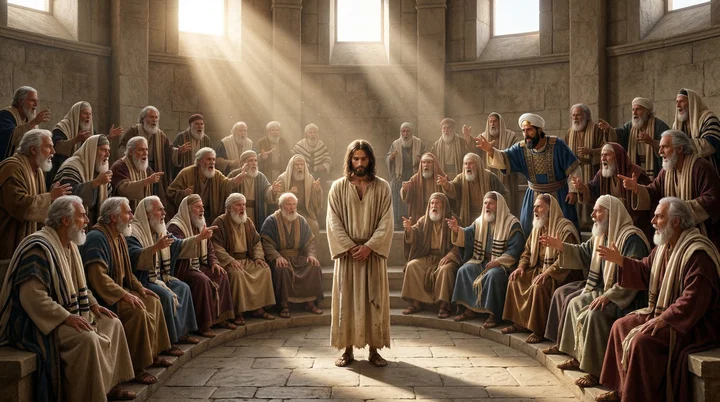
And they said, What need we any further witness? for we ourselves have heard of his own mouth.
Translations
American King James Version, King James Version, KJV Cambridge Paragraph Bible
And they said, What need we any further witness? for we ourselves have heard of his own mouth.
And they said, What need have we of any further testimony? for we ourselves have heard from his own mouth.
Revised Version, American Standard Version
And they said, What further need have we of witness? for we ourselves have heard from his own mouth.
and they said, 'What need yet have we of testimony? for we ourselves did hear [it] from his mouth.'
And they said, What need have we any more of witness, for we have heard ourselves out of his mouth?
And, they, said—What, further, need have we, of witness? We ourselves, have heard it from his mouth.
Berean Standard Bible, Majority Standard Bible
“ Why do we need any more testimony?” they declared. “ We have heard it for ourselves from His own lips.”
They said, “ Why do we need any more witness? For we ourselves have heard from his own mouth!”
And they said, What more need have we of witness? we have the very words of his mouth.
Then sayd they, What neede we any further witnes? for we our selues haue heard it of his owne mouth.
Douay-Rheims (Challoner revision)
And they said: What need we any further testimony? for we ourselves have heard it from his own mouth.
Pictures
Cross-references
- Matthew 26:63-65
But Jesus held his peace. And the high priest answered and said unto him, I adjure thee by the living God, that thou tell us whether thou be the Christ, the Son of God.
Caiaphas and the council treat Jesus’ answer as grounds for condemnation.
- Mark 14:61-64
But he held his peace, and answered nothing. Again the high priest asked him, and said unto him, Art thou the Christ, the Son of the Blessed?
Jesus answers the high priest, and the council condemns him for blasphemy.
- John 18:13-27
And led him away to Annas first; for he was father in law to Caiaphas, which was the high priest that same year.
Recounts Jesus’ preliminary hearing before Annas and Peter’s denial.
- Psalms 110:1
The LORD said unto my Lord, Sit thou at my right hand, until I make thine enemies thy footstool.
Jesus declares he will sit at God’s right hand, prompting the council’s response.
- Luke 23:1
And the whole multitude of them arose, and led him unto Pilate.
It continues the account of Jesus being brought before the authorities.
- Daniel 7:13
I saw in the night visions, and, behold, one like the Son of man came with the clouds of heaven, and came to the Ancient of days, and they brought him near before him.
Jesus uses the Son of man title in describing His exaltation.
Commentary
Each commentary is drawn from primary sources: the writings of Ellen G. White and Adventist pioneers and periodicals. Each commentary is separate. Its own words are not a quotation; follow the references to read the source passages.
Ellen G. White
9 sources
Luke 22:71 belongs to the formal hearing before the Sanhedrin, where the leaders were seeking grounds to condemn Jesus for blasphemy and to secure His death.DA 698.1–700.5 It is part of the account of Jesus before Annas and the court of Caiaphas.DA 698 He had been brought before the full council so that all could hear His claim to be the Messiah and Son of God.DA 714.1–4 At that hearing the leaders were intent on finding cause for condemnation and death.DA 698.1–700.5
After asking whether He was the Christ and the Son of God, they treated His answer that the Son of man would be seen sitting at the right hand of God's power as sufficient witness, saying they needed no further witness because they themselves had heard Him.Ms 104, 1897, par. 26–2719MR 170.1–2 They treated His own declaration of His identity as sufficient evidence to condemn Him and judged Him guilty of death.Ms 51, 1897, par. 23–249MR 108.1–109.1DA 714.1–45RED 39.3–40.2Ms 107, 1893, par. 2 This use of His answer about being the Son of God was the third condemnation by the Jewish authorities.Ms 51, 1897, par. 23–24
They construed His claim as a political charge against Him.DA 714.1–4 Under Roman rule the Sanhedrin could judge a prisoner but could not carry out a death sentence.DA 698.1–700.5 They expected Pilate and the Roman authorities to ratify their condemnation and hand Him over to them.Ms 51, 1897, par. 23–24DA 714.1–4 The proceedings violated their own rules requiring that a person be treated as innocent until proved guilty.DA 698.1–700.5
The condemnation did not rest on reliable testimony, for the witnesses contradicted one another, and Pilate later declared that he found no fault in Him.Ms 107, 1893, par. 2 The scene shows religious leaders acting through envy, jealousy, and bigotry, in alliance with evil against good.9MR 108.1–109.1
Sources
Pioneers and periodicals
5 sources
Luke 22:71 belongs to the account showing that Jesus celebrated the breaking of bread on Thursday evening, proving that the breaking of bread was done on a weekday evening and was not tied to the first day of the week.ST Jan 13, 1881 After Jesus directly affirmed that he is the Son of God in answer to the council's question whether he is the Son of God, the council declared that no further witness was needed because they had heard it from his own mouth.ST Jan 17, 1900ST Nov 12, 1894ST Mar 15, 1877ST Nov 12, 1894 The Jewish leaders took his answer as sufficient evidence that he claimed to be the Son of God and accused him of blasphemy, convicting him under Jewish law.ST Mar 15, 1877
The council used his own answer as sufficient evidence to condemn him even though his accusers had brought false charges against him.ST Jan 17, 1900 Blasphemy was not a crime under Roman law, so although the council sought his execution, Jesus was ultimately sentenced by Pilate on the political charge of treason against Caesar.ST Mar 15, 1877 By condemning and abusing Christ, the priests and rulers chose the side of the great apostate and fixed their eternal destiny.ST Jan 17, 1900
At Christ's second coming those rulers will see him as heaven's King escorted by angels, and will remember the judgment-hall scene and understand whom they had opposed.ST Jan 17, 1900
Sources