Mark 14:61
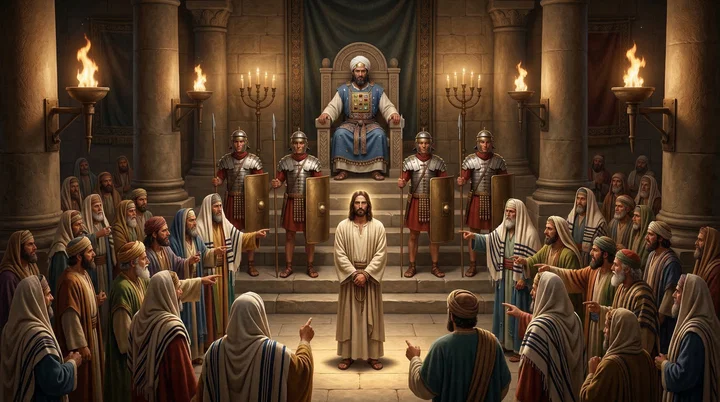
But he held his peace, and answered nothing. Again the high priest asked him, and said unto him, Art thou the Christ, the Son of the Blessed?
Translations
But he held his peace, and answered nothing. Again the high priest asked him, and said to him, Are you the Christ, the Son of the Blessed?
King James Version, KJV Cambridge Paragraph Bible
But he held his peace, and answered nothing. Again the high priest asked him, and said unto him, Art thou the Christ, the Son of the Blessed?
But he held his peace, and answered nothing. Again the high priest asked him, and said to him, Art thou the Christ, the Son of the Blessed?
Revised Version, American Standard Version
But he held his peace, and answered nothing. Again the high priest asked him, and saith unto him, Art thou the Christ, the Son of the Blessed?
and he was keeping silent, and did not answer anything. Again the chief priest was questioning him, and saith to him, 'Art thou the Christ — the Son of the Blessed?'
But he was silent, and answered nothing. Again the high priest asked him, and says to him, Thou art the Christ, the Son of the Blessed?
But, he, was silent, and answered, nothing. Again, the High-priest was questioning him, and saith unto him—Art, thou, the Christ the Son of the Blessed?
Berean Standard Bible, Majority Standard Bible
But Jesus remained silent and made no reply.Again the high priest questioned Him, “ Are You the Christ, the Son of the Blessed One?”
But he stayed quiet, and answered nothing. Again the high priest asked him, “ Are you the Christ, the Son of the Blessed?”
But he kept quiet and said nothing. Again the high priest questioning him said, Are you the Christ, the son of the Holy One?
But hee helde his peace, and answered nothing. Againe the hie Priest asked him, and sayde vnto him, Art thou that Christ the Sonne of the Blessed?
Douay-Rheims (Challoner revision)
But he held his peace, and answered nothing. Again the high priest asked him, and said to him: Art thou the Christ the Son of the blessed God?
Pictures
Cross-references
- Matthew 26:63-64
But Jesus held his peace. And the high priest answered and said unto him, I adjure thee by the living God, that thou tell us whether thou be the Christ, the Son of God.
The high priest asks whether Jesus is the Christ, and Jesus answers about his identity and glory.
- Isaiah 53:7
He was oppressed, and he was afflicted, yet he opened not his mouth: he is brought as a lamb to the slaughter, and as a sheep before her shearers is dumb, so he openeth not his mouth.
The suffering servant’s silence before his accusers is echoed in Jesus’ trial.
- Daniel 7:13-14
I saw in the night visions, and, behold, one like the Son of man came with the clouds of heaven, and came to the Ancient of days, and they brought him near before him.
Jesus’ answer points to the Son of Man coming with the clouds and receiving dominion.
- Luke 22:67-70
Art thou the Christ? tell us. And he said unto them, If I tell you, ye will not believe:
The council asks whether Jesus is the Christ and Son of God.
- John 18:19-23
The high priest then asked Jesus of his disciples, and of his doctrine.
Jesus is questioned by the high priest and calmly answers despite being struck.
- John 4:25-26
The woman saith unto him, I know that Messias cometh, which is called Christ: when he is come, he will tell us all things.
Jesus identifies himself as the expected Messiah.
- Matthew 27:12-14
And when he was accused of the chief priests and elders, he answered nothing.
Jesus gives no reply to the accusations at his trial.
- Psalms 110:1
The LORD said unto my Lord, Sit thou at my right hand, until I make thine enemies thy footstool.
Jesus’ claim to sit at God’s right hand echoes the verse.
- Matthew 16:15-17
He saith unto them, But whom say ye that I am?
Peter confesses Jesus as the Christ.
- John 10:36
Say ye of him, whom the Father hath sanctified, and sent into the world, Thou blasphemest; because I said, I am the Son of God?
Jesus speaks of himself as the Son of God.
- John 19:9-11
And went again into the judgment hall, and saith unto Jesus, Whence art thou? But Jesus gave him no answer.
another trial questioning Jesus answered differently
- John 1:41
He first findeth his own brother Simon, and saith unto him, We have found the Messias, which is, being interpreted, the Christ.
Andrew identifies Jesus as the Messiah, meaning the Anointed.
- John 10:24-25
Then came the Jews round about him, and said unto him, How long dost thou make us to doubt? If thou be the Christ, tell us plainly.
The Jews demand a plain statement that Jesus is the Christ.
- Mark 15:1
And straightway in the morning the chief priests held a consultation with the elders and scribes and the whole council, and bound Jesus, and carried him away, and delivered him to Pilate.
Cited as the continuation of the proceedings.
- John 18:23
Jesus answered him, If I have spoken evil, bear witness of the evil: but if well, why smitest thou me?
another trial question Jesus answered differently
- John 18:33-37
Then Pilate entered into the judgment hall again, and called Jesus, and said unto him, Art thou the King of the Jews?
another trial questioning Jesus answered differently
- Matthew 22:44
The LORD said unto my Lord, Sit thou on my right hand, till I make thine enemies thy footstool?
The Messiah is identified with the one seated at God’s right hand.
- Luke 24:25-27
Then he said unto them, O fools, and slow of heart to believe all that the prophets have spoken:
Jesus explains that the prophets foretold the Messiah’s suffering and glory.
- 1 Peter 2:21-22
For even hereunto were ye called: because Christ also suffered for us, leaving us an example, that ye should follow his steps:
Christ’s footsteps are given as the pattern for believers.
Commentary
Each commentary is drawn from primary sources: the writings of Ellen G. White and Adventist pioneers and periodicals. Each commentary is separate. Its own words are not a quotation; follow the references to read the source passages.
Ellen G. White
7 sources
But he held his peace while false witnesses accused him before Caiaphas and the council, whose verdict was already decided, since no evidence worthy of death had been given and the rulers hoped he would say something they could use to condemn him.Ms 102, 1897, par. 1–35RED 39.1–2 He stood calm, serene, majestic and dignified at the foot of the throne of judgment, with the eyes of the multitude upon him amid wild excitement.5RED 39.1–25RED 35.3–36.23SP 115.3–116.2 His bearing stood in sharp contrast to the excitement, hostility and malignant behavior around him and of Annas and Caiaphas.5RED 35.3–36.23SP 115.3–116.2 When Caiaphas in sneering, haughty tones demanded that he work one of his mighty miracles before him, he held his peace and acted as if he had not heard, giving no answer to that demand.5RED 35.3–36.23SP 115.3–116.2
His silence gave his accusers no advantage, for he would not retaliate or use divine power to force recognition, but patiently endured the trial and abuse as part of his mission to bear humanity's sin and suffering.DA 698.1–700.5 He also withheld the statement they sought because he knew they wanted him to repeat his claim to be the Son of God so they could twist it into a political charge.Ms 51, 1897, par. 19–22 His silence fulfilled Isaiah's prophecy of the suffering servant who did not open his mouth, like a lamb led to slaughter and like a sheep before its shearers.5RED 39.1–2 His calm bearing sent forth a holy influence that moved even the hardened multitude to wonder whether a man of God-like presence should be sentenced as a common criminal.3SP 115.3–116.2 It struck Caiaphas with sudden admiration and conviction that he was akin to God, which Caiaphas at once banished in scorn and then hastened the trial from his throne with judges on either side and Roman soldiers ranged below.3SP 115.3–116.2
Though clad in coarse, homely garb and tried for his life at an earthly throne, he was the one who had reigned in the courts of heaven, crowned and clothed in brightness and attended by holy angels.3SP 115.3–116.2 The rulers' effort to force condemnation in this setting violated the principle that a person must be treated as innocent until guilt is established.Ms 51, 1897, par. 19–22 The verse then records the high priest directly asking him whether he is the Christ, the Son of the Blessed, which is the same as asking whether he is the Christ, the Son of God, and which sets up his solemn answer and public claim to be God's Son.Ms 102, 1897, par. 1–3DA 698.1–700.55RED 39.3–40.2 He answers that solemn question because he is adjured in God's name and respects the law.5RED 39.3–40.2 His answer, given in the following verse, declares that he will sit at God's right hand and come in heaven's clouds, so that though he stands before judges at this trial, he will be the Judge when every secret thing is revealed.Ms 102, 1897, par. 1–3
Sources
Pioneers and periodicals
18 sources
On the night of his betrayal Jesus was brought to the judgment hall before Caiaphas the high priest with the chief priests, scribes and elders gathered, after first being taken to Annas.ST May 27, 1889ST Mar 14, 1906RH Aug 29, 1871 It was a hurried and unjust trial on a capital charge of blasphemy, where death had already been decided and false witnesses were accepted though their testimony did not agree.ST May 27, 1889ST May 25, 1904ST Dec 1, 1898 To those false and contradictory accusations he held his peace and answered nothing, since such testimony required no answer and would not change the sentence already determined.ST May 6, 1897ST Oct 26, 1882ST Dec 1, 1898 When the high priest put him directly to the question whether he is the Christ, the Son of the Blessed, he answered truthfully and openly affirmed that he is the Messiah, the Son of God and Saviour, though he knew the declaration would secure his condemnation.ST May 6, 1897RH Aug 29, 1871RH Mar 1851ST Oct 26, 1882ST Mar 31, 1887 In that affirmation he declared his divinity and preexistence, and added that they would see the Son of Man coming in glory on the clouds to the Ancient of Days to receive dominion and an everlasting kingdom.ST Feb 21, 1878RH Nov 30, 1869ST Nov 26, 1896ST Jan 10, 1911
Trial Before High Priest
This verse belongs to Jesus' appearance before the Sanhedrin immediately after his arrest, an informal and unjust proceeding presided over by Caiaphas, who regarded Jesus as a rival.ST May 27, 1889 It was on the night of his betrayal, before Caiaphas the high priest with the chief priests, scribes and elders gathered, and the high priest asked whether he is the Christ, the Son of the Blessed.RH Aug 29, 1871 He had first been taken to Annas, the former high priest and father-in-law of Caiaphas, before the leaders' proceedings against him.ST Mar 14, 1906 The questioning took place in the judgment hall.ST Mar 14, 1906
The trial before the Jewish council was hurried, and the charge was blasphemy, a capital offense requiring two agreeing witnesses to condemn him.ST May 25, 1904 Two false witnesses were accepted, though their testimony did not agree.ST May 25, 1904ST Dec 1, 1898 The charges had been sought to justify a death sentence already decided on.ST Dec 1, 1898
While accused by false and contradictory witnesses he held his peace and answered nothing, because such testimony required no answer and a reply would not change the death already determined.ST Oct 26, 1882 His dignified silence made an impression on people and bore fruit.ST Oct 26, 1882 This raises the question why he answered some questions at his trial and refused to answer others.ST May 6, 1897
When the high priest directly put him under oath and asked whether he claimed to be the Son of the Most High, he answered truthfully.ST Dec 1, 1898 His silence did not keep him from openly bearing witness to the truth, even at the risk of men's anger.ST Oct 26, 1882 He made the declaration knowing that this announcement would secure his condemnation.ST May 27, 1889 The priests had thus gained their object, for the high priest called the statement blasphemy and the judges pronounced him guilty of death.ST May 27, 1889
Christ's Acknowledged Identity
On the night of his betrayal Jesus stands before Caiaphas the high priest with the chief priests, scribes, and elders gathered, and is asked whether he is the Christ, the Son of the Blessed.RH Aug 29, 1871 Paired with his answer in the following verse, the question shows his open acknowledgment before the Sanhedrin and high priest of himself as the Messiah and Son of God, and so as the Saviour.RH Aug 29, 1871ST Mar 31, 1887 His affirmation to the high priest that he is the Christ confirms his identity as the Anointed One.RH Mar 1851ST Mar 31, 1887ST Nov 15, 1910
In declaring before the high priest that he is the I AM, he makes a clear declaration of his divinity and preexistence, taking to himself Jehovah's incommunicable name.ST Nov 26, 1896 In answering that the claim is true he adds that they will see the Son of Man coming in glory on the clouds.ST Jan 10, 1911 He is the Messiah though born in Bethlehem and later living in Nazareth, and proclaiming him as the Christ is the stranger's mission.ST Nov 15, 1910
Prophecy Doctrine and Application
The question whether he is the Anointed One, the Son of the Blessed, together with his answer, identifies Jesus as the one like the Son of Man in Daniel's vision who comes to the Ancient of Days.ST Feb 21, 1878RH Nov 30, 1869 That coming is his coming before God the Father at the judgment to receive dominion and an everlasting kingdom.ST Feb 21, 1878RH Nov 30, 1869 In that opening scene it is the Father who presides while the Son comes before him, showing Father and Son to be distinct.ST Feb 21, 1878RH Nov 30, 1869 When charged judicially by the high priest and adjured by the living God, he did not object to the oath but gave the truthful answer, I am.RH Mar 9, 1916 His conduct in so answering establishes the acceptance of a judicial oath as distinct from the swearing that is forbidden in ordinary conversation.RH Mar 9, 1916
The setting in the judgment hall, with the high priest questioning him whether he is the Christ, the Son of the Blessed, frames the warning not to follow Jesus from afar.ST Mar 14, 1906 The call instead is to remain close to him under every circumstance.ST Mar 14, 1906 The same scene shows Christ mocked and rejected, where hollow homage stands only one step from open outrage against him.RH Dec 29, 1863
Sources