Matthew 26:63
But Jesus held his peace. And the high priest answered and said unto him, I adjure thee by the living God, that thou tell us whether thou be the Christ, the Son of God.
Translations
But Jesus held his peace, And the high priest answered and said to him, I adjure you by the living God, that you tell us whether you be the Christ, the Son of God.
King James Version, KJV Cambridge Paragraph Bible
But Jesus held his peace. And the high priest answered and said unto him, I adjure thee by the living God, that thou tell us whether thou be the Christ, the Son of God.
But Jesus held his peace. And the high priest answered and said to him, I adjure thee by the living God, that thou tell us whether thou art the Christ the Son of God.
But Jesus held his peace. And the high priest said unto him, I adjure thee by the living God, that thou tell us whether thou be the Christ, the Son of God.
But Jesus held his peace. And the high priest said unto him, I adjure thee by the living God, that thou tell us whether thou art the Christ, the Son of God.
and Jesus was silent. And the chief priest answering said to him, 'I adjure thee, by the living God, that thou mayest say to us, if thou art the Christ — the Son of God.'
But Jesus was silent. And the high priest answering said to him, I adjure thee by the living God that thou tell us if thou art the Christ the Son of God.
But, Jesus, was silent. And, the High-priest, said unto him: I put thee on oath, by the Living God, that, to us, thou say—Whether, thou, art the Christ, the Son of God.
Berean Standard Bible, Majority Standard Bible
But Jesus remained silent.Then the high priest said to Him, “ I charge You under oath by the living God: Tell us if You are the Christ, the Son of God.”
But Jesus stayed silent. The high priest answered him, “ I adjure you by the living God that you tell us whether you are the Christ, the Son of God.”
But Jesus said not a word. And the high priest said to him, I put you on oath, by the living God, that you will say to us if you are the Christ, the Son of God.
But Iesus helde his peace. Then the chiefe Priest answered, and saide to him, I charge thee sweare vnto vs by the liuing God, to tell vs, If thou be that Christ the Sonne of God, or no.
Douay-Rheims (Challoner revision)
But Jesus held his peace. And the high priest said to him: I adjure thee by the living God, that thou tell us if thou be the Christ the Son of God.
Pictures
Cross-references 20 of 31
- Isaiah 53:7
He was oppressed, and he was afflicted, yet he opened not his mouth: he is brought as a lamb to the slaughter, and as a sheep before her shearers is dumb, so he openeth not his mouth.
Jesus’ silence under accusation fulfills the servant’s foretold silence.
- Mark 14:53-72
And they led Jesus away to the high priest: and with him were assembled all the chief priests and the elders and the scribes.
parallel account of same examination
- Daniel 7:13-14
I saw in the night visions, and, behold, one like the Son of man came with the clouds of heaven, and came to the Ancient of days, and they brought him near before him.
Jesus identifies himself with Daniel’s Son of Man coming with the clouds and receiving dominion.
- John 18:19-23
The high priest then asked Jesus of his disciples, and of his doctrine.
Jesus answers the high priest’s questioning during his trial.
- Luke 22:66-71
And as soon as it was day, the elders of the people and the chief priests and the scribes came together, and led him into their council, saying,
Jesus is questioned by the council about being the Christ and Son of God.
- Luke 22:67-70
Art thou the Christ? tell us. And he said unto them, If I tell you, ye will not believe:
The council asks whether Jesus is the Christ and Son of God.
- Matthew 16:16
And Simon Peter answered and said, Thou art the Christ, the Son of the living God.
Peter’s confession is the confession demanded of Jesus under oath.
- Matthew 26:67-68
Then did they spit in his face, and buffeted him; and others smote him with the palms of their hands,
Jesus is abused and mocked after remaining silent before the high priest.
- 1 Samuel 14:24
And the men of Israel were distressed that day: for Saul had adjured the people, saying, Cursed be the man that eateth any food until evening, that I may be avenged on mine enemies. So none of the people tasted any food.
Saul adjures the people with an oath.
- Matthew 27:12
And when he was accused of the chief priests and elders, he answered nothing.
Jesus remains silent when accused before Pilate.
- 1 Peter 2:23
Who, when he was reviled, reviled not again; when he suffered, he threatened not; but committed himself to him that judgeth righteously:
Jesus endured insults without retaliation and entrusted his cause to God.
- John 10:30
I and my Father are one.
Jesus declares his unity with the Father, explaining his claim to be the Son of God.
- Psalms 110:1
The LORD said unto my Lord, Sit thou at my right hand, until I make thine enemies thy footstool.
Jesus speaks of the Son of man seated at God’s right hand.
- Matthew 5:34
But I say unto you, Swear not at all; neither by heaven; for it is God’s throne:
Its prohibition of swearing is compared with Jesus answering under oath.
- Mark 15:3-5
And the chief priests accused him of many things: but he answered nothing.
Jesus remains silent under accusation during his trial.
- 1 Kings 22:16
And the king said unto him, How many times shall I adjure thee that thou tell me nothing but that which is true in the name of the LORD?
The verse is cited to explain adjuring as putting someone under oath.
- Luke 23:9
Then he questioned with him in many words; but he answered him nothing.
Jesus remains silent when questioned during his trial.
- Matthew 26:68
Saying, Prophesy unto us, thou Christ, Who is he that smote thee?
Mocking follows condemnation.
- Hebrews 4:14
Seeing then that we have a great high priest, that is passed into the heavens, Jesus the Son of God, let us hold fast our profession.
Jesus is the Son of God and the true High Priest who represents humanity.
- Mark 14:56
For many bare false witness against him, but their witness agreed not together.
false witnesses did not agree
Commentary
Each commentary is drawn from primary sources: the writings of Ellen G. White and Adventist pioneers and periodicals. Each commentary is separate. Its own words are not a quotation; follow the references to read the source passages.
Ellen G. White
25 sources
Jesus stood silent before Caiaphas and the council when false witnesses accused Him, then when the high priest put Him under solemn oath by the living God He broke His silence and plainly declared that He is the Christ, the Son of God.Ms 51, 1897, par. 12Ms 102, 1897, par. 1–3Ms 111, 1897, par. 1–412MR 399.2–400.1 His holding His peace fulfilled Isaiah's picture of the suffering servant as a lamb led to slaughter that does not open its mouth, and it was deliberate to keep His accusers from twisting His words into a political charge before the Romans.Ms 51, 1897, par. 12COS 128.1–4DA 698.1–700.53SP 119.3–120.15RED 39.1–2 Though He knew the priesthood was corrupt and the priest unworthy, He answered out of respect for the law and for the highest authority acting in the name of the Most High.Ms 111, 1897, par. 1–412MR 399.2–400.15RED 39.3–40.2 That confession claimed His divine power and oneness with the Father, spoken calmly with a flash of divinity through humanity, and joined to it the declaration that His hearers would hereafter see Him seated at the right hand of power and coming in the clouds of heaven as supreme Judge.Ms 51, 1897, par. 12Ms 102, 1897, par. 1–3Lt 52a, 1896, par. 43SP 119.3–120.1ST Jun 27, 1878 He knew affirming His Sonship would make His death certain, yet He would not deny His relation to God, and His resurrection proved His claim true while leaving His followers the example to confess Him before men even at the cost of suffering.Ms 51, 1897, par. 12Lt 52a, 1896, par. 45RED 39.3–40.2ST Jun 27, 1878Ms 203, 1898, par. 3–6
Trial Setting and Silence
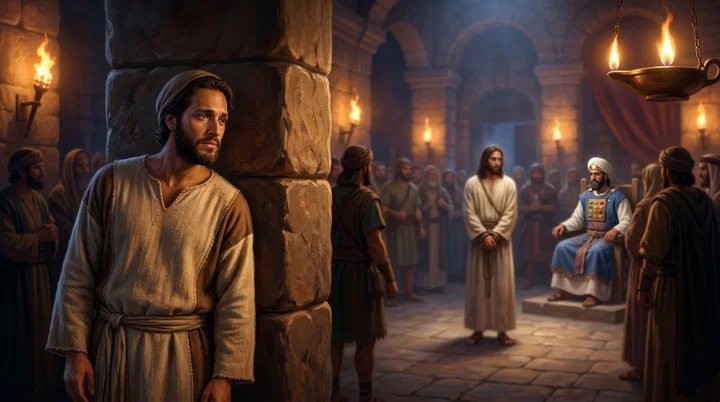
Matthew 26:63 belongs to the formal trial before Caiaphas and the Jewish council in the judgment hall, held as a hurried mock examination in the early dark morning after Jesus was brought through dark streets by an armed band.DA 698.1–700.55RED 35.3–36.25RED 27.1 Caiaphas hastened the trial from the throne of judgment in gorgeous robe, tiara and breastplate, with judges on either side and Roman soldiers ranged below, while Jesus stood at its foot in coarse clothing.5RED 35.3–36.23SP 115.3–116.2 That silent prisoner at the foot of an earthly throne to be tried for His life was the One who had reigned crowned in the courts of heaven in garments of brightness attended by holy angels.5RED 35.3–36.23SP 115.3–116.2 The questioning was conducted under secrecy so the people could not bring testimony about His mighty works to vindicate Him, condemn the Sanhedrin's actions, and secure His release.5RED 33.1 While He endured coarse accusation, insult and mockery from persecutors and the whole assembly, His heart was pierced more deeply by hearing His beloved disciple deny Him with cursing and swearing than by anything His enemies could inflict.5RED 27.1
The rulers sought grounds to condemn Him for blasphemy and death, being jealous of His authority and fearing He would become king, and they arranged false testimony and pursued His death rather than accept Him as king.Ms 51, 1897, par. 12DA 698.1–700.5ST Feb 5, 1880 Witnesses brought charges that conflicted or would not satisfy the Roman authorities, including the charge about destroying the temple made with hands and building another made without hands in three days, which did not prove a charge worthy of death.COS 128.1–4Ms 102, 1897, par. 1–35RED 39.1–2 The scribes and Pharisees planned His betrayal and brought false statements and accusations against Him, making Him appear in the worst possible light.Lt 50, 1889, par. 6–9 Their conduct shows the spirit that stirs people against Christ and dishonors Him even while claiming to defend truth, though God overruled their actions to make Christ the Redeemer of the world.ST Feb 5, 1880Lt 50, 1889, par. 6–9
Jesus held His peace and answered nothing, refusing defense when questioned and giving no answer to the demand for a mighty miracle.Ms 102, 1897, par. 1–35RED 39.1–2ST Jun 13, 1878 He remained calm and silent because He knew His sentence had already been decided and the evidence did not prove a capital charge.3SP 119.3–120.15RED 39.1–2 His silence fulfills Isaiah's picture of the suffering servant as a lamb led to slaughter who does not open his mouth.COS 128.1–4 His silence and endurance show His submission to suffering as the Sin-bearer, rather than using His divine power to force His accusers to acknowledge Him.DA 698.1–700.5
Standing calm, serene and majestic amid wild excitement while the eyes of the multitude were upon Him, His quiet, dignified bearing and holy influence contrasted with the excited, malignant, sneering manner of Annas and Caiaphas and the turmoil around Him.5RED 35.3–36.23SP 115.3–116.2ST Jun 13, 1878 A holy influence emanated from Him and pervaded the atmosphere, revealing a majesty belonging to heaven even as He stood on trial before an earthly court.5RED 35.3–36.2ST Jun 13, 1878 Caiaphas himself was struck with sudden admiration for His dignified bearing and convicted that He was akin to God, then banished the thought and hastened the trial.5RED 35.3–36.23SP 115.3–116.2 Even the hardened multitude compared their deportment with His and questioned whether a man of God-like presence should be sentenced as a common criminal.5RED 35.3–36.23SP 115.3–116.2
His continued silence was deliberate, since His accusers hoped to make Him speak so they could condemn Him.5RED 39.1–2 He knew His accusers wanted Him to repeat His words about being the Son of God so they could twist them into a political charge, and by remaining silent He kept them from using His testimony for that purpose before the Roman tribunal.Ms 51, 1897, par. 19–22 The high priest feared their case would fail unless Jesus answered the contradictory accusations.Ms 51, 1897, par. 12
Oath and Confession
The high priest, acting as the nation's highest acknowledged authority and first magistrate, solemnly put Jesus under oath by the living God according to the Jewish form, with raised hand toward heaven, adjuring Him to tell whether He is the Christ, the Son of God.Ms 111, 1897, par. 1–45RED 39.3–40.23SP 119.3–120.1ST Jun 27, 1878 That oath directly challenged His relation to the Father and His identity and mission.Ms 111, 1897, par. 1–4ST Jun 27, 1878DA 706.3–707.1 Jesus had remained silent while false witnesses failed to establish a charge, but this appeal to the highest authority in the nation called for an answer.Ms 51, 1897, par. 125RED 39.3–40.23SP 119.3–120.1 Though He fully knew the high priest's unworthiness, He broke His silence and answered out of proper respect for the law and for the highest authority acting in the name of the Most High.Ms 111, 1897, par. 1–45RED 39.3–40.23SP 119.3–120.1ST Jun 27, 1878DA 706.3–707.1
The priesthood had become corrupt, with religion as a cloak for a hard, cruel heart, lording over the people and making supposed godliness a source of gain, priest after priest performing religious duties as an actor in a theater.Ms 111, 1897, par. 1–412MR 399.2–400.1 The high priest himself was never accepted by God as a typical high priest, his fitness for the priesthood ending with the covering garment he wore, incapable and unworthy, one the people detested.Ms 111, 1897, par. 1–412MR 399.2–400.1 Jesus fully knew that unworthiness and that God could not connect with his character, yet He responded.Ms 111, 1897, par. 1–412MR 399.2–400.1 In that moment the true High Priest stood before the false priest to be criticized.Ms 111, 1897, par. 1–412MR 399.2–400.1
He might have glorified Himself there and shown power to make His judges quail, knowing He was appointed to His office by God.Ms 111, 1897, par. 1–412MR 399.2–400.1 Instead He concealed His divinity in a garb of humanity, and being found in fashion as a man He humbled Himself to be qualified to represent man in the heavenly courts, taking not even the nature of angels.Ms 111, 1897, par. 1–412MR 399.2–400.1 Though the highest of all angels, He girded Himself with a towel to wash His disciples' feet, mourning and weeping over the perversity and transgression of men.Ms 111, 1897, par. 1–4 Not rending His robe but with rent soul, His garment of human flesh was rent as He hung on the cross as the sin-bearer of the human race, and by His suffering and death a new and living way was opened by which He was to enter upon His priestly office forever, with no longer a wall of partition between Jew and Gentile, entering the Holy Place as the High Priest for the whole world.Ms 111, 1897, par. 1–4
His reply was a voluntary, public confession under the most solemn oath plainly declaring His character and mission, affirming that He is the Christ, the Son of God.Ms 102, 1897, par. 1–35RED 39.3–40.23SP 119.3–120.1ST Jun 27, 1878DA 706.3–707.1 Thereby He claimed Sonship with God as Lord of life and glory, claiming His own divine power and Godhead and oneness with the Father, so that to see Him is to see the Father.Lt 52a, 1896, par. 43SP 119.3–120.1ST Jun 27, 1878 The high priest understood exactly what it comprehended.Lt 52a, 1896, par. 4 He spoke calmly and with dignity, in a calm voice with dignified manner, with a heavenly light on His face illuminating Him and a momentary flash of divinity through humanity.3SP 119.3–120.1ST Jun 27, 1878 With a penetrating, heart-searching look He quailed the high priest, read his hidden thoughts and burned into his heart.3SP 119.3–120.1ST Jun 27, 1878
By submitting to this judicial oath rather than refusing or reproving it, He shows that giving testimony under oath in a lawful setting, calling God to witness that testimony is true, is not wrong.1T 202.3SG4 201.3 His answer in the following verse shows that He accepted the charge to respond. Such a lawful judicial oath is distinct from casual or evasive oath-taking.
Coming Judge and Witness
In the same answer He declared a complete reversal of roles, that hereafter His hearers would see the Son of man seated at the right hand of power as supreme Judge of heaven and earth with no appeal, and coming in the clouds of heaven with power and great glory escorted by legions of angels, instead of standing as a prisoner surrounded and abused by a mob headed by priests and judges.Ms 51, 1897, par. 12Ms 102, 1897, par. 1–33SP 119.3–120.1ST Jun 27, 1878 He who then stood before His judges will return as Judge to pronounce the sentence of His enemies.Ms 102, 1897, par. 1–33SP 119.3–120.1ST Jun 27, 1878 When He returns as Judge, every secret thing will be set in the light of God's countenance, sinners will see their sins unveiled in hideousness and will desire to be hidden under mountains or in the ocean to escape the wrath of the Lamb.Ms 102, 1897, par. 1–33SP 119.3–120.1ST Jun 27, 1878
He knew that affirming His Sonship would make His death certain, while denial would stain His humanity, yet because His character and His relation to the Father were at stake there was a time to speak as well as to be silent, and He would not deny His relationship with God.ST Jun 27, 1878DA 706.3–707.1ST Jul 4, 1878 His declaration gave the designing priests exactly what they sought, so they called it blasphemy and condemned Him to death.Ms 51, 1897, par. 125RED 39.3–40.2ST Jun 27, 1878DA 706.3–707.1 His resurrection proved His assertion that He was the Son of God true, so that if the soldiers' testimony of the resurrection went forth the people would believe it.Ms 203, 1898, par. 3–6Ms 94, 1897, par. 17–21 Therefore Caiaphas and the priests would not permit it to go forth but silenced the soldiers and sustained themselves in sin by denying undeniable facts and bribing the Roman guard to suppress the truth with a lying report.Ms 203, 1898, par. 3–6Ms 94, 1897, par. 17–21
His course leaves an example that His followers should confess Him before others and not apostatize from faith to escape suffering or even death, keeping His declaration that whoever confesses Him before men He will confess before His Father in heaven.DA 706.3–707.1ST Jul 4, 1878 Having spoken truth and without guile amid insult and scorn and mockery and rejection and shame, His words and promises are fully trustworthy to be rested in and honored by faith.Lt 52a, 1896, par. 4
Sources
Pioneers and periodicals
59 sources
Jesus stood bound and alone before Caiaphas and the Sanhedrin while false witnesses sought grounds to put Him to death, and He held His peace and answered nothing to their accusations.RH Nov 17, 1868ST Mar 6, 1901ST Mar 14, 1906ST Dec 1, 1898 When the high priest put Him under solemn judicial oath by the living God to say whether He was the Christ, the Son of God, He broke His silence out of respect for God and lawful authority and openly confessed that He is.ST May 27, 1889ST Jun 27, 1878RH Mar 9, 1916RH Sep 27, 1864ST Sep 30, 1886 That confession was a true claim to divinity and equality with God, for which the court condemned Him as a blasphemer worthy of death and then sought Pilate to confirm the sentence.ST May 27, 1889RH Oct 27, 1874ST Dec 2, 1889ST Apr 6, 1915ST Dec 24, 1912 His silence under accusation fulfilled the prophecy of the lamb brought to the slaughter who opens not his mouth, showing meek and dignified endurance that strengthens believers under opposition.RH Nov 18, 1862ST Oct 12, 1904RH Oct 17, 1854 His answering under oath shows that an oath required by proper authority in court is lawful and not forbidden, unlike careless and voluntary swearing in ordinary speech, and His refusal to deny His Sonship leaves His followers an example to confess Him and stand firm rather than deny Him to escape suffering.RH Mar 9, 1916RH Sep 27, 1864ST Oct 1, 1896ST Jan 20, 1909ST Sep 30, 1886
Setting of the Trial
The hearing took place in the house of Caiaphas the high priest before the Sanhedrin, the celebrated highest court of the Jewish nation, with the scribes and elders and the whole council gathered.ST Mar 6, 1901ST Feb 3, 1909RH Feb 16, 1911 Priests, elders, scribes, and representatives of both Sadducees and Pharisees were present in an assembly described as especially vindictive.ST Mar 27, 1901 Jesus stood as an accused culprit before the highest court of His own nation with Caiaphas sitting as judge at its head, and the trial was not a passing incident but an event of world-wide and ages-long importance holding vital lessons in the name, character, mission, and end of each of the two men.ST Mar 6, 1901
He was alone after all the disciples forsook Him and fled in the Garden, bound though the binding was an utterly needless precaution.ST Mar 14, 1906 He was first taken to Annas the former high priest and father-in-law of Caiaphas, examined before Annas, and then taken to Caiaphas who then held the office.ST Mar 14, 1906ST Mar 28, 1906 The leaders plotting against Him sought to allay all jealousy and unite all possible force against Him.ST Mar 14, 1906
The council was seeking false witness to put Him to death, with hired and suborned witnesses whose testimony did not agree though two agreeing witnesses were needed.ST Mar 6, 1901ST Dec 1, 1898 The testimony that He had said He could rebuild the pulled-down temple in three days was not enough to condemn Him.ST Dec 1, 1898 He held His peace and answered nothing to the false testimony and accusations and to the high priest's challenge about what the witnesses said against Him.RH Nov 17, 1868ST Mar 6, 1901ST Dec 1, 1898 His condemnation was already decided, yet long watching by spies had failed, and silent until then He was put under oath by the high priest before the living God and demanded to state whether He claimed to be the Christ, the Son of God and Son of the Most High, in hope of forcing a statement that could be labeled a civil offense.ST Dec 1, 1898
They opposed Him from jealousy of His authority and fear He would become king, and they arranged false testimony and pursued His death rather than accept Him as their king.ST Feb 5, 1880 They opposed Him because He had reproved the priests' greed and selfishness, branded the elders' hypocrisy, exposed the scribes' ignorance, and condemned the doctrines of both parties.ST Mar 27, 1901 His holy life and pure teaching convicted His accusers of sin, and rather than repent and be changed by that conviction they rebelled and attacked the one whose life exposed their wickedness.ST Sep 2, 1889 Their crime remained heinous even though God overruled their actions to make Christ the Redeemer of the world.ST Feb 5, 1880
The hearing before the chief priests and elders occurred on the day Christ was crucified, the day before the Sabbath.RH Feb 13, 1872 When arraigned before the high priest He was accused and condemned on one charge only, blasphemy, not Sabbath-breaking.ST Dec 6, 1883 The statement that a Sabbath-breaking charge was brought against Him at that trial is false, for that accusation had been made at other times for healing the sick on that day, which He had answered by declaring it lawful to do well on the Sabbath days so that lawful action could not violate the law and He was not a Sabbath-breaker.ST Dec 6, 1883ST Dec 6, 1883 His silence did not make the blasphemy accusation true.ST Dec 6, 1883ST Dec 6, 1883
Caiaphas condemned Him for blasphemy but had no power to enforce the death sentence.ST Dec 24, 1912 That charge of calling Himself the Son of God embarrassed the rulers when Pilate asked for a formal accusation, because blasphemy was not a crime known to Roman law and alleging it would have led Pilate to dismiss the matter with scorn.ST Jun 7, 1899 From pride that clung to the delusion that their court was competent to condemn and ignored the plain fact of their subjection to Rome, they stood on dignity and demanded that Pilate carry out their sentence at their bidding.ST Jun 7, 1899
Silence of Jesus
Jesus met the questioning with silence, holding his peace and giving no answer to the accusations brought against him.ST Jun 13, 1878ST Mar 6, 1901 When the high priest demanded that he perform a miracle, he remained calm and answered nothing, and his quiet, dignified bearing stood in contrast to the high priest's sneering manner and the turmoil around him.ST Jun 13, 1878 That calm revealed a majesty belonging to heaven even while he stood on trial before an earthly court.ST Jun 13, 1878 Only after this silence did the high priest change his approach to a solemn demand under oath by the living God for a direct answer about whether he was the Messiah, God's Son.ST Mar 6, 1901
At first he referred to his teaching and work, but then he held his peace because he knew his sentence was already decided and his condemnation determined.ST May 27, 1889ST Dec 1, 1898ST Mar 6, 1901 He had been secured through the treachery of a professed follower, long watching by spies had failed, and hired false witnesses did not agree when two agreeing witnesses were needed.ST Dec 1, 1898 The testimony that he had said he could rebuild the pulled-down temple in three days was not enough to condemn him, so the false witnesses offered no valid grounds.ST May 27, 1889ST Dec 1, 1898 Since further words would do no good, he committed his cause to God and remained silent until addressed in the name of God.ST May 27, 1889ST Mar 6, 1901
His silence under oppression and accusation, both before the council and before Pilate, fulfills the prophecy that though oppressed and afflicted he opened not his mouth in complaint.RH Nov 18, 1862ST Oct 12, 1904 He was brought as a lamb to the slaughter and as a sheep dumb before her shearers, and this identifies him as the Lamb of God.RH Nov 18, 1862ST Oct 12, 1904 His was a flawless meekness excelling even the meekness of Moses, for Jesus held his peace before his accusers.ST Oct 12, 1904 Yet that meekness gave him no inheritance of the earth during his earthly pilgrimage, just as meekness and humility do not give those who follow his example landed possessions or other evidences of this world's riches.ST Oct 12, 1904
His silence was dignified restraint under sharp provocation and abuse, a vindication more eloquent than words. Though innocent and able to call on angels or answer with power, he did not revile his accusers. He kept silent before the priests who accused and mocked him, bearing sinners' hostility with meek endurance while carrying out his mission to save them.RH Oct 17, 1854 His example in this gives weary Christians strength to endure scoffing and opposition.RH Oct 17, 1854
Oath and Affirmation
Frustrated by silence, the high priest shifted tactics to a solemn demand under oath, adjuring by the living God whether the prisoner was the Christ, the Son of God.ST Jun 27, 1878RH Mar 9, 1916RH Sep 27, 1864 With right hand raised toward heaven this was the regular form of judicial oath, binding and not to be refused.ST Jun 27, 1878ST Mar 6, 1901 Jesus had first pointed to His teaching and work and then held His peace, knowing condemnation was already determined and further words would do no good.ST May 27, 1889ST Mar 6, 1901 He remained silent under accusation and questioning until plainly asked whether He was the Son of God.ST May 27, 1889ST Jul 4, 1878ST Sep 30, 1886
He knew an affirmative answer would make His death certain, while denial of His relationship with God would stain His humanity.ST Jul 4, 1878ST Sep 30, 1886 He broke silence only after being addressed in the name of God, out of respect for the law and for the highest acknowledged authority in the nation acting in the name of the Most High.ST May 27, 1889ST Jun 27, 1878 His earlier silence followed by reply after the oath shows this kind of oath-taking was not rejected, and He gave a truthful answer rather than rebuking the demand.RH Mar 9, 1916RH Sep 27, 1864
That reply, given in the next verse as I am, was an express, voluntary, public confession under the most solemn oath affirming that He is Israel's promised Messiah, the Christ, the Son of God.ST Jun 27, 1878RH Oct 27, 1874ST Mar 31, 1887 It was spoken in a calm voice with dignified manner while heavenly light illuminated His face and divinity flashed through humanity.ST Jun 27, 1878 His penetrating, heart-searching look made the high priest quail.ST Jun 27, 1878 When put under oath He thus declared Himself to be the Son of God.ST Jan 10, 1911ST Mar 28, 1906
In the same answer He declared that hereafter they would see the Son of man seated at the right hand of power as Lord of life and glory and coming in the clouds of heaven with power and great glory escorted by legions of angels.ST May 27, 1889ST Jun 27, 1878ST Jan 10, 1911 They would meet Him and their sins at the judgment.RH Nov 24, 1868 Sitting at God's right hand means exaltation to great power and authority, not a fixed bodily location, compatible with Christ serving as priest on the throne and ministering in the heavenly sanctuary.RH Dec 2, 1909
Claim and Condemnation
Standing before the Jewish Sanhedrin on a charge of blasphemy for claiming divinity, Jesus was pressed by Caiaphas to say whether He was the Christ, the Son of God.ST Dec 2, 1889ST Apr 6, 1915ST Mar 31, 1887 His declaration that He was the Son of God was an assertion of His own divinity, making Himself equal with God, as His judges correctly and logically reasoned.ST Dec 2, 1889ST Mar 31, 1887ST Feb 20, 1901 He presented Himself as the Christ, the Son of God, as well as the Son of man in proper eternal divinity, and that fact of His divine Sonship is the very foundation of hope.ST Dec 9, 1880ST Feb 20, 1901
He was condemned as a blasphemer because He persistently declared Himself to be the Son of God, though people knew Him as the carpenter's son of Nazareth and knew His earthly brothers. His claim to be Son of God and Savior did not mean that evil could not befall Him, for He would be crucified.ST May 8, 1879
To deny His divinity is to call Him a liar and hypocrite and to destroy His moral purity and holiness.ST Dec 9, 1880 It makes His whole life false and His dealing with His disciples on the last night before His crucifixion duplicity.ST Dec 9, 1880 It makes the gospel worthless and the Bible an imposture, and admits that the Jews and Pilate justly condemned Him as an impostor.ST Dec 9, 1880
The high priest treated this true claim as blasphemy, although Jesus was blameless.RH Oct 27, 1874 Caiaphas responded by tearing his robes in anger and calling the declaration blasphemy, and the judges pronounced Jesus guilty and worthy of death.ST May 27, 1889ST Jan 10, 1911ST Aug 21, 1907 That act of rending his clothes disqualified Caiaphas from the priesthood, since Leviticus 10:6 forbids priests to rend their clothes.ST Aug 21, 1907
Jesus knew this declaration would secure His condemnation, and it gave the designing priests exactly what they sought to condemn Him before the people.ST Jun 27, 1878ST May 27, 1889 Condemnation came at last from His own declaration, since the frivolous accusation of the false witnesses had given them no ground for condemnation.ST Dec 1, 1898ST Feb 20, 1901 His truthful answer was at once declared sufficient evidence of guilt with no further proof needed, so the case was taken to the Roman tribunal to have the judgment confirmed.ST Dec 1, 1898
His public confession presents the reversal of the trial, declaring that hereafter His accusers will see Him as the Son of man seated at the right hand of power as Lord of life and glory and coming in the clouds of heaven with power and great glory escorted by legions of angels.ST May 27, 1889ST Jun 27, 1878RH Nov 24, 1868 The accused Jesus will be the supreme Judge of heaven and earth from whose decision there is no appeal, pronouncing sentence on His enemies instead of being surrounded and abused by a mob.ST May 27, 1889ST Jun 27, 1878 They would meet Him and their sins at the judgment.RH Nov 24, 1868
His suffering and humiliation in the mock trial are past and He will never undergo it again, for He is coming again in glory to reign forever.ST Dec 7, 1904 Their crime remained heinous even though God overruled their actions to make Christ the Redeemer of the world.ST Feb 5, 1880 That adjudging of His declaration as blasphemy worthy of death formed one of the critical moments when the rulers of a nation write its doom.ST Mar 28, 1906
His claims were rejected without a fair examination of Scripture and prophecy.RH Oct 27, 1874RH Oct 27, 1874RH Oct 27, 1874 The failure lay in the court's misinterpretation of the law and its mistaken expectations about how the Messiah would come, not in the law itself.RH Oct 27, 1874 It illustrates how people may be denounced for reading the Bible differently from church authorities even when they appeal to the sacred text and seek to honor it.RH Oct 27, 1874
Lawfulness of Judicial Oaths
When the high priest adjured Him by the living God to say whether He was the Christ, the Son of God, He did not rebuke him or refuse the oath but gave a truthful answer affirming that He was.RH Mar 9, 1916RH Sep 27, 1864RH Apr 7, 1859 His earlier silence while accused and questioned, followed by His reply after being placed under oath, shows He did not reject this kind of oath-taking.RH Mar 9, 1916RH Sep 27, 1864 His answer in the following verse is to be understood as an answer given under that oath.RH Mar 9, 1916RH Sep 27, 1864RH Apr 7, 1859
His testimony about Himself after being formally put under oath in a judicial hearing is an example of giving sworn testimony when called upon by proper authority.RH Sep 27, 1864RH Aug 23, 1870ST Jan 20, 1909ST May 6, 1913ST Jul 14, 1898 An oath required by proper legal authority, by lawful authorities in a legal court before proper officials on a proper occasion, may therefore be taken and is not forbidden but proper and right.ST Oct 1, 1896RH Aug 23, 1870ST Jan 20, 1909ST May 6, 1913ST Jul 14, 1898 He remained silent or answered little during informal questioning, but answered when formally placed under the usual judicial oath.RH Sep 27, 1864ST Jan 20, 1909ST May 6, 1913ST Jul 14, 1898
This solemn courtroom and judicial oath at His trial was distinct from the careless, emphatic, casual, unnecessary, voluntary, self-imposed, or extra-judicial swearing in ordinary conversation to emphasize statements or ordinary assertions, which He prohibits.RH Mar 9, 1916ST Oct 1, 1896ST Jan 20, 1909ST May 27, 1908ST Nov 19, 1912 It was a legally administered oath, not a voluntary oath used to emphasize ordinary statements.ST Oct 1, 1896ST Nov 19, 1912 As a solemn answer under oath before the high priest, it does not forbid every oath but leaves judicial oaths unforbidden.RH Mar 9, 1916ST May 27, 1908ST Nov 19, 1912
His response in the judicial tribunal is also an example of testifying under oath when doing so can benefit others by helping bring about justice.RH Sep 27, 1864
Example for Believers
The trial before the Sanhedrin and the chief priests presents the Saviour's example under accusation.ST Feb 3, 1909 There is a time to be silent and a time to speak, and He held His peace until He was plainly asked whether He was the Son of God.ST Jul 4, 1878ST Sep 30, 1886 He knew an affirmative answer would make His death certain, while denial of His relationship with God would stain His humanity.ST Jul 4, 1878ST Sep 30, 1886 When directly challenged, with His character at stake to be vindicated, He did not deny His faith to escape suffering or even death.ST Jul 4, 1878ST Sep 30, 1886 In answering He kept His own declaration that whoever confesses Him before men He will confess before His Father in heaven, leaving an example to stand firm under threat and not apostatize from faith.ST Jul 4, 1878ST Sep 30, 1886
The setting warns followers not to follow Him only from a distance or deny Him, but to remain close and faithful under every circumstance, even in the judgment hall and on the way to Calvary.ST Mar 14, 1906 Peter first tried to defend Jesus with a sword and later denied Him, showing that aggressive action is not true courage or evidence of a regenerated life.RH Feb 5, 1914 Going to the palace of proud Caiaphas on His cross-bearing way to suffering defines the path believers must be willing to follow through suffering and humiliation.RH Aug 14, 1860RH Jul 30, 1867 Christian perfection does not consist in uninterrupted praise, ceaseless rapture, ecstasies, or building a tabernacle and abiding in rare sights upon Mount Tabor.RH Aug 14, 1860RH Jul 30, 1867 It consists in resolutely taking up the cross and following Christ to Caiaphas, and onward to the judgment hall of Pilate and to Calvary.RH Aug 14, 1860RH Jul 30, 1867
The verse stands between Christ mocked and Christ rejected.RH Dec 29, 1863 There hollow homage saying Hail, Master mocks the Lord and quickly passes into smiting and buffeting in open outrage.RH Dec 29, 1863 This shows the sure though invisible connection between lip-confession joined to life-denial in mere outward profession and the broader denial by which all such profession is decided.RH Dec 29, 1863 Only a single step lies between the two.RH Dec 29, 1863
Sources