Luke 22:70
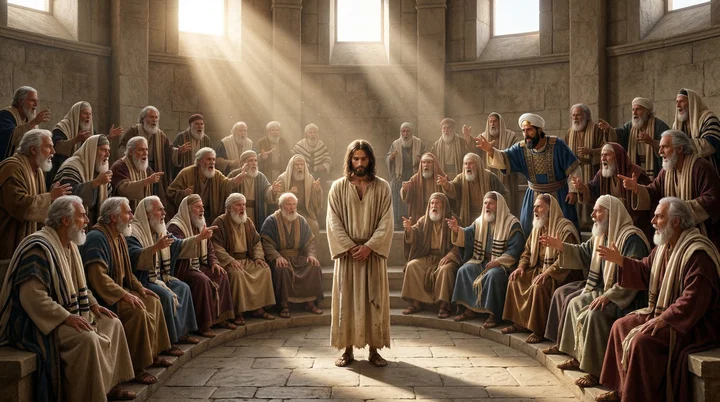
Then said they all, Art thou then the Son of God? And he said unto them, Ye say that I am.
Translations
Then said they all, Are you then the Son of God? And he said to them, You say that I am.
King James Version, KJV Cambridge Paragraph Bible
Then said they all, Art thou then the Son of God? And he said unto them, Ye say that I am.
Then said they all, Art thou then the Son of God? And he said to them, Ye say that I am.
Revised Version, American Standard Version
And they all said, Art thou then the Son of God? And he said unto them, Ye say that I am.
And they all said, 'Thou, then, art the Son of God?' and he said unto them, 'Ye say [it], because I am;'
And they all said, Thou then art the Son of God? And he said to them, Ye say that I am.
And they all said—Thou, then, art the Son of God? And, he, unto them said—Ye, say [it],—because, I, am.
Berean Standard Bible, Majority Standard Bible
So they all asked, “ Are You then the Son of God?”He replied, “ You say that I am.”
They all said, “ Are you then the Son of God?”He said to them, “ You say it, because I am.”
And they all said, Are you then the Son of God? and he said, You say that I am.
Then sayd they all, Art thou then ye Sonne of God? And he sayd to them, Ye say, that I am.
Douay-Rheims (Challoner revision)
Then said they all: Art thou then the Son of God? Who said: You say that I am.
Pictures
Cross-references
- Matthew 26:63-66
But Jesus held his peace. And the high priest answered and said unto him, I adjure thee by the living God, that thou tell us whether thou be the Christ, the Son of God.
Jesus answers that he is the Son of God, and the council condemns him for blasphemy.
- Mark 14:61-64
But he held his peace, and answered nothing. Again the high priest asked him, and said unto him, Art thou the Christ, the Son of the Blessed?
Jesus affirms his identity before the council, which condemns him for blasphemy.
- Daniel 7:13-14
I saw in the night visions, and, behold, one like the Son of man came with the clouds of heaven, and came to the Ancient of days, and they brought him near before him.
The Son of man’s coming in the clouds and authority echo this vision.
- Luke 23:3
And Pilate asked him, saying, Art thou the King of the Jews? And he answered him and said, Thou sayest it.
Jesus gives Pilate the same answer when asked if he is king of the Jews.
- Matthew 26:64
Jesus saith unto him, Thou hast said: nevertheless I say unto you, Hereafter shall ye see the Son of man sitting on the right hand of power, and coming in the clouds of heaven.
Jesus affirms his identity and speaks of coming in the clouds.
- Psalms 2:7
I will declare the decree: the LORD hath said unto me, Thou art my Son; this day have I begotten thee.
Jesus’ trial question identifies him as the Son declared in the psalm.
- Luke 22:66
And as soon as it was day, the elders of the people and the chief priests and the scribes came together, and led him into their council, saying,
The council’s questioning takes place at its hearing of Jesus.
- Luke 23:2
And they began to accuse him, saying, We found this fellow perverting the nation, and forbidding to give tribute to Cæsar, saying that he himself is Christ a King.
council uses confession to accuse him before Pilate
- Matthew 10:32
Whosoever therefore shall confess me before men, him will I confess also before my Father which is in heaven.
Jesus promises to confess before the Father those who confess him before others.
- Luke 23:1
And the whole multitude of them arose, and led him unto Pilate.
The council then leads Jesus to Pilate.
- John 18:13-27
And led him away to Annas first; for he was father in law to Caiaphas, which was the high priest that same year.
A parallel account of Jesus’ hearing and Peter’s denial.
- Psalms 110:1
The LORD said unto my Lord, Sit thou at my right hand, until I make thine enemies thy footstool.
Jesus says he will sit at God’s right hand.
Commentary
Each commentary is drawn from primary sources: the writings of Ellen G. White and Adventist pioneers and periodicals. Each commentary is separate. Its own words are not a quotation; follow the references to read the source passages.
Ellen G. White
11 sources
Luke 22:70 belongs to Jesus' examination before Annas and the court of Caiaphas, that is, His hearing before the Jewish authorities.DA 698DA 698.1–700.5 At that hearing a charge of blasphemy was sought to secure His condemnation.DA 698.1–700.5 The Sanhedrin did condemn Him to death, but the sentence could not be carried out without Pilate's confirmation.Ms 107, 1893, par. 2
When the council all directly asked Him whether He is the Son of God, He answered affirmatively in the words, Ye say that I am.Ms 104, 1897, par. 26–27Ms 51, 1897, par. 23–24 That reply was His confession that He is the Christ, the long-awaited Messiah, the only begotten Son of God.19MR 170.1–2Ms 111, 1897, par. 5–109MR 108.1–109.1 His answer was calm, public and respectful, made under solemn oath in response to the high priest's appeal to God.Ms 111, 1897, par. 5–105RED 39.3–40.2 It claimed the divine character and prerogatives of the Son of God, spoken without intimidation by the judges' anger and with the conviction of one who knows His identity.Ms 111, 1897, par. 5–10
The rulers treated that answer from His own mouth as sufficient testimony needing no further witness.19MR 170.1–2DA 714.1–4 They used it to condemn Him as a blasphemer, having sought to turn His claim into an accusation.Ms 51, 1897, par. 23–24Ms 111, 1897, par. 5–10 They construed His messianic claim as a political claim against Rome.DA 714.1–4 In the same answer He pointed to a coming reversal of roles, when He will sit at God's right hand and come in the clouds as judge, and His judges and all who rejected Him will face Him and receive sentence.Ms 111, 1897, par. 5–105RED 39.3–40.2
His identity as the only begotten Son of God places Him at the center of the conflict between Christ and Satan.9MR 108.1–109.1 In the trial He endured abuse without using His divine power to force His accusers to acknowledge Him.DA 698.1–700.5 Though He knew that answering yes would make His death certain, He did not deny the truth to escape suffering, thereby upholding His character and setting an example of remaining faithful under threat even when faithfulness may lead to death.3SP 127.1
Sources
Pioneers and periodicals
8 sources
Luke 22 stands in a chapter in which the breaking of bread took place on Thursday evening, which proves it was done on a weekday and carries no requirement to break bread on the first day of the week.ST Jan 13, 1881 The verse belongs to the account of the trial before the crucifixion, when Jesus stood before the Sanhedrin council of assembled elders, chief priests, and scribes after daybreak.ST Nov 12, 1894ST Oct 28, 1913 The leaders put to Him the direct question whether He was the Son of God, and He answered them.ST Nov 12, 1894ST Oct 28, 1913
That question about Son of God followed their question whether He was the Christ or Messiah.ST Nov 12, 1894ST Dec 17, 1896 It also followed His declarations that telling them would not be believed and that from henceforth the Son of Man shall be seated at the right hand of the power of God.ST Jan 17, 1900ST Nov 12, 1894 His reply was affirmative, directly claiming the title and not disowning it, with His accusers understanding His words as a direct claim.ST Jan 17, 1900ST Nov 12, 1894ST Jun 18, 1912ST Nov 12, 1894 Those who held this teaching stressed that He did not disown the title Son of God.ST Dec 17, 1896
The leaders distinguished the two titles, since they could accept a Messiah as God's appointed representative without accepting that He was truly divine, so His claim to be the Son of God was a claim to more than ordinary Messiahship.ST Dec 17, 1896 The rulers treated His words from His own mouth, together with His statement about the Son of Man at God's right hand, as sufficient testimony against Him needing no further witness.ST Jan 17, 1900ST Nov 12, 1894ST Nov 12, 1894 His answer was treated as a confession of blasphemy under Jewish law and as grounds to condemn Him and declare Him guilty of death, a charge punishable by death.ST Mar 15, 1877ST Jun 18, 1912ST Dec 17, 1896
On that basis the whole company rose to bring Him before Pilate, accusing Him of saying that He Himself is Christ a king.ST Nov 12, 1894 The council sought to have Pilate carry out that death sentence, but the charge did not constitute a crime under Roman law.ST Mar 15, 1877 The rulers will remember this scene when Christ returns in glory as heaven's King, and will recognize whom they had opposed.ST Jan 17, 1900
Sources