Luke 23:27
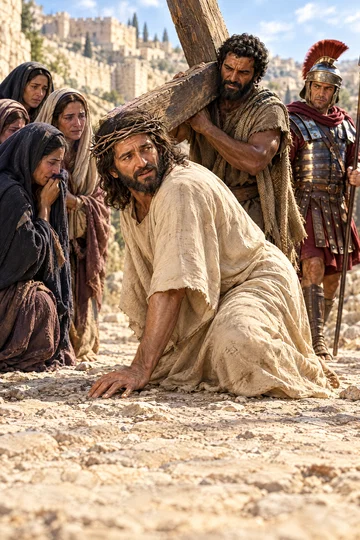
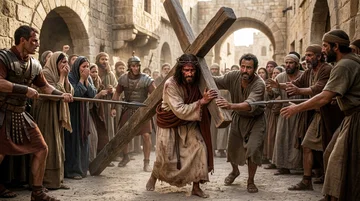
And there followed him a great company of people, and of women, which also bewailed and lamented him.
Translations
American King James Version, King James Version, KJV Cambridge Paragraph Bible
And there followed him a great company of people, and of women, which also bewailed and lamented him.
And there followed him a great company of people, and of women, who also bewailed and lamented him.
Revised Version, American Standard Version
And there followed him a great multitude of the people, and of women who bewailed and lamented him.
And there was following him a great multitude of the people, and of women, who also were beating themselves and lamenting him,
And a great multitude of the people, and of women who wailed and lamented him, followed him.
And there was following him a great throng of the people, and of women, who were smiting themselves and lamenting him.
Berean Standard Bible, Majority Standard Bible
A great number of people followed Him, including women who kept mourning and wailing for Him.
A great multitude of the people followed him, including women who also mourned and lamented him.
And a great band of people went after him, and of women making signs of grief and weeping for him.
And there followed him a great multitude of people, and of women, which women bewailed and lamented him.
Douay-Rheims (Challoner revision)
And there followed him a great multitude of people, and of women, who bewailed and lamented him.
Pictures
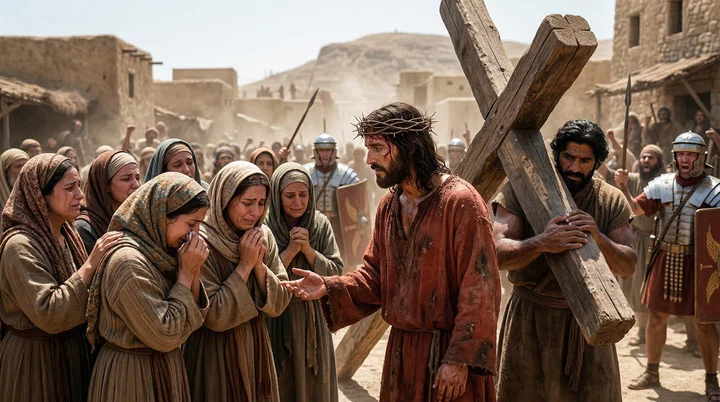
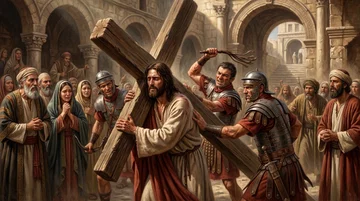
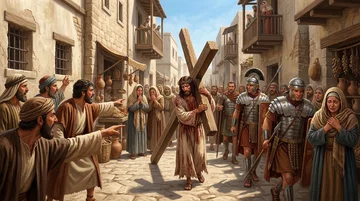
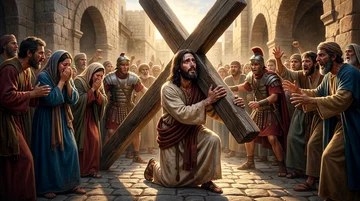
Cross-references
- Luke 24:1
Now upon the first day of the week, very early in the morning, they came unto the sepulchre, bringing the spices which they had prepared, and certain others with them.
Records the women’s visit to the tomb on the first day.
- Luke 23:56
And they returned, and prepared spices and ointments; and rested the sabbath day according to the commandment.
The women rested on the Sabbath after Jesus’ burial.
- Luke 23:33-46
And when they were come to the place, which is called Calvary, there they crucified him, and the malefactors, one on the right hand, and the other on the left.
Jesus is crucified and dies, continuing the account of his suffering.
- Mark 15:20-21
And when they had mocked him, they took off the purple from him, and put his own clothes on him, and led him out to crucify him.
Both describe Jesus’ journey to the cross, including Simon carrying it.
- John 19:17
And he bearing his cross went forth into a place called the place of a skull, which is called in the Hebrew Golgotha:
Jesus was led out bearing the cross.
- Matthew 27:32
And as they came out, they found a man of Cyrene, Simon by name: him they compelled to bear his cross.
Simon carries Jesus’ cross on his journey to crucifixion.
- Luke 23:21
But they cried, saying, Crucify him, crucify him.
The crowd cries out for Jesus to be crucified.
Commentary
Each commentary is drawn from primary sources: the writings of Ellen G. White and Adventist pioneers and periodicals. Each commentary is separate. Its own words are not a quotation; follow the references to read the source passages.
Ellen G. White
12 sources
From Pilate's judgment hall toward Calvary He was followed by a great crowd after news of His condemnation spread through Jerusalem, drawing people of every class and rank.DA 741.4–742.1DA 741.3 Disciples and believers from the city and the surrounding region joined the throng because His enemies had promised not to harm His followers if He Himself were surrendered, while He bore the cruel cross.DA 741.3Ms 6, 1889, par. 45–46 That cross was the one prepared for Barabbas, laid on bruised and bleeding shoulders.DA 741.4–742.1
He had taken neither food nor drink since the Passover supper, had agonized in Gethsemane, had been betrayed and deserted by His disciples, had been taken to Annas and Caiaphas and Pilate and Herod and back to Pilate, and had endured insult, mockery, and two scourgings through the night.DA 741.4–742.1 A crown of cruel thorns pierced His temples and left blood upon His face, yet He bore Himself as a voluntary sacrifice until human nature could bear no more.DA 741.4–742.1Ms 95, 1897, par. 14 He staggered and fell fainting beneath a burden too heavy for Him, and when it was laid on Him again He fell fainting again, weak and fainting as the hostile crowd hurried Him on amid shouts and jeers toward continued mockery and crucifixion.DA 741.4–742.1COS 155.1Ms 95, 1897, par. 14Lt 1a, 1861, par. 2–5
The watching crowd showed no compassion for His weak and staggering steps but taunted and reviled Him because He could not carry the heavy cross.DA 741.4–742.1 Others in the same multitude wept, praised Him, spoke of His works in healing the sick and raising the dead, and asked why He was treated as a criminal and what crime deserved such treatment.DA 741.4–742.1ST Nov 16, 1882ST Oct 7, 1886 Many in the crowd had praised Him with hosannas and palm branches only a few days earlier at His entry into Jerusalem and then joined the cry for His crucifixion, having praised Him when doing so was popular.ST Nov 16, 1882ST Oct 7, 1886
The lamenting women were the women of Jerusalem, the daughters of Jerusalem, who were undesignedly in that procession and whose hearts were stirred with pity so that they bewailed, lamented and wailed as He bore the cross.Ms 95, 1897, par. 143SP 184.1–185.2 They are the same women who prepared spices before the Sabbath and came early on the first day of the week to anoint His body at the tomb.ST Aug 22, 1878 Because He clearly could not carry the cross farther, His persecutors sought someone else to bear the humiliating load, which the Jews themselves would not bear because defilement would keep them from the Passover and which none of the mob would stoop to bear.DA 741.4–742.1
Their bewailing happened as Christ approached the cross and descended into the depths of humiliation.ST Jul 7, 1898 His followers saw Him in whom their hopes of eternal life were centered in the hands of wicked men, heard His own nation clamoring for His blood, saw Herod and his soldiers plait the crown of thorns for His brow, saw Him clad in the purple robe with His persecutors bowing before Him and striking Him with the reed placed in His hand, saw Him whom they thought would take His place on David's throne scourged as the worst of criminals while the murderous Barabbas was chosen in place of their beloved Teacher, and saw Him lifted up on the cross dying as a malefactor.ST Jul 7, 1898 That sight marked the time when the Bridegroom was taken away and His followers could rightly mourn and fast, and it tried their faith and made their hope and courage fail in days of trial and temptation when the presence of the Comforter was not clearly discerned.ST Jul 7, 1898 The scene belongs to His suffering under the power of the Jewish priests and rulers who forced the Roman governor to do their will, and His endurance to the cross stands as an example of God's Word triumphing over human power used to support evil.RH Dec 24, 1908
Sources
Pioneers and periodicals
16 sources
A great company of people followed Jesus as he was led to execution at Calvary, including women followers from Galilee who bewailed and lamented him in the sorrow of his final hours.ST Sep 3, 1902ST Sep 20, 1899ST Nov 19, 1894ST Apr 8, 1903 After he broke down under terrible strain and could not carry his cross all the way, a stranger met on the way was compelled to carry it while the women followed expressing sympathy.ST May 17, 1905 Their grief arose from what they saw of his physical suffering, for they had hoped for much from him, yet they did not understand that his suffering foretold greater trouble coming upon Jerusalem and their children, so on the journey he told them to weep for themselves and their children instead.ST May 17, 1905ST Apr 4, 1906ST Nov 19, 1894ST Apr 8, 1903 The crowd was divided, with some mocking him while others wept, praised his works of healing the sick and raising the dead, and asked what crime deserved such treatment, and many who had praised him with hosannas at his entry into Jerusalem only days before now joined the cry for his crucifixion when praise was no longer popular.ST Nov 16, 1882ST Oct 7, 1886 The women who bewailed him followed him to his burial, saw where his body was laid, prepared spices and ointments to anoint him, then rested on the Sabbath according to the commandment before coming early on the first day of the week to find the tomb empty and Jesus risen, and their bewailing on the way to Calvary was itself a way of serving the Lord in rightful mourning when the Bridegroom was taken away.ST Jul 7, 1898ST Sep 20, 1899
Following to Calvary
A great company of people followed Jesus as he was led to execution at Calvary, including women who bewailed and lamented him, marking the sorrow of his final hours.ST Sep 20, 1899ST Nov 19, 1894ST Apr 8, 1903RH Dec 30, 1862RH Jun 28, 1870 They were the same women who afterward prepared spices and ointments and then rested before coming to the tomb on the first day of the week.ST Sep 20, 1899 The crowd was divided, for some mocked him while others wept, praised his works of healing the sick and raising the dead, and asked what crime deserved such treatment.ST Nov 16, 1882ST Oct 7, 1886 Many who had praised him with hosannas and palm branches at his entry into Jerusalem only days before now joined the cry for his crucifixion when praise was no longer popular.ST Nov 16, 1882ST Oct 7, 1886 The mourning women included followers who had come with him from Galilee.ST Sep 3, 1902
The setting was after Jesus broke down under terrible strain and could not carry his cross all the way, so a stranger met on the way was compelled to carry it, while the women of Jerusalem followed expressing sympathy by bewailing and lamenting him.ST May 17, 1905 Their grief arose from what they saw of his physical suffering, for these weeping friends had hoped for much from him and grieved over his fate.ST Apr 4, 1906ST Apr 8, 1903 They did not understand that his suffering also foretold greater trouble and distress coming upon Jerusalem, its people, and their children.ST Apr 4, 1906ST Nov 19, 1894 To these sympathizing women Jesus spoke on the journey, telling them to weep for themselves and their children instead because of the terrible fate awaiting them.ST May 17, 1905ST Nov 19, 1894
He bore the surrounding taunts silently and submissively without answering, in the saddest tragedy in history, carried out by a hardened, bloodthirsty mob.RH Jun 28, 1870 He suffered under Jewish priests and rulers who forced the Roman governor to do their will, and his endurance on the cross stands as God's Word triumphing over human power used to support evil.RH Dec 24, 1908 The women openly mourned and pressed through the hostile crowd to the foot of the cross, unlike Peter who followed at a distance.RH Dec 14, 1911 The women in tears stayed with his followers after his death and stood behind Joseph of Arimathea when he knelt weeping in the Praetorium, where the stairs were still stained with Jesus' blood, to beg Pilate for permission to bury Jesus of Nazareth.RH Jul 16, 1861 Pilate granted it and guarded it by soldiers against profanation, and a few days afterward the sepulcher was found empty as the disciples published that he had risen as he foretold.RH Jul 16, 1861
Sabbath and Empty Tomb
The great crowd that trailed Jesus toward execution included women mourning and lamenting him, and those same women are identified in what follows as the ones who prepared spices and ointments and then rested on the Sabbath according to the commandment before coming to the tomb on the first day of the week.ST Aug 22, 1878ST Sep 20, 1899 They were the women who had come with him from Galilee, who afterward followed Joseph, saw where the body was laid, and kept the Sabbath rest. Their lamenting walk to Calvary thus continued to his burial, and their preparation of spices before the Sabbath was joined to their early coming on the first day to anoint his body.ST Aug 22, 1878ST Sep 20, 1899
He was laid in the tomb on preparation day, Friday. The women then started for home, stopped in the city on the way to buy sweet spices to anoint him at a future time, rested the Sabbath day, and came to the sepulcher early on the first day of the week expecting to anoint his body. When they arrived they found the stone rolled away and Jesus risen.
The record of the crucifixion and resurrection names the seventh day and the first day in immediate connection.ST Feb 1, 1905 The two days have traveled side by side ever since.ST Feb 1, 1905 If Sunday is kept in true succession from the cross, the identity of the seventh day from the cross to the present is equally certain, with no loss of the day's identity between the crucifixion and the present time.ST Feb 1, 1905
Mourning and Serving Christ
The bewailing and lamenting took place when the Bridegroom was taken away, the time when his followers could rightly mourn and fast.ST Jul 7, 1898 It happened as Christ approached the cross and descended into the depths of humiliation.ST Jul 7, 1898 The disciples witnessed him in whom their hopes of eternal life were centered in the hands of wicked men, and heard his own nation clamoring for his blood.ST Jul 7, 1898 They saw Herod and his soldiers plait the crown of thorns for his brow, saw him clad in the purple robe with his persecutors bowing before him and striking him with the reed placed in his hand, and saw him whom they thought would take his place on David's throne scourged as the worst of criminals while the murderous Barabbas was chosen in place of their beloved Teacher.ST Jul 7, 1898 They saw him lifted up on the cross dying as a malefactor, and that sight gave cause to mourn and fast, tried their faith, and made their hope and courage fail in days of trial and temptation when the presence of the Comforter was not clearly discerned.ST Jul 7, 1898
The anonymous women following Jesus on the way to Calvary bewailing and lamenting him were by that following and mourning serving the Lord Jesus.
Sources