Translations
American King James Version, King James Version, KJV Cambridge Paragraph Bible
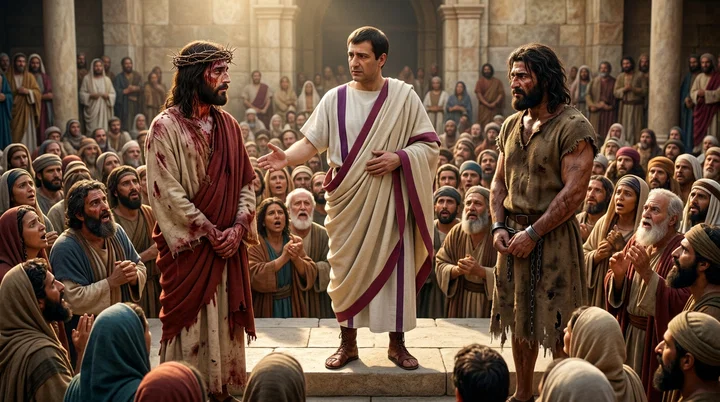
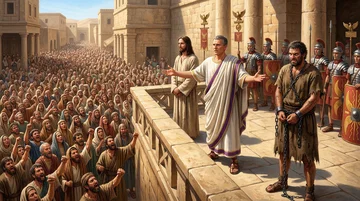
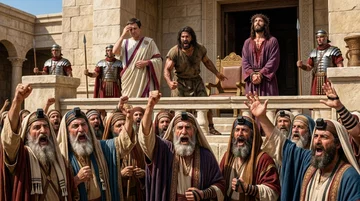
But they cried, saying, Crucify him, crucify him.
But they cried, saying, Crucify, crucify him.
Revised Version, American Standard Version
but they shouted, saying, Crucify, crucify him.
but they were calling out, saying, 'Crucify, crucify him.'
But they cried out in reply saying, Crucify, crucify him.
But, they, called out in return, saying—Crucify! crucify him!
Berean Standard Bible, Majority Standard Bible
but they kept shouting, “ Crucify Him! Crucify Him!”
but they shouted, saying, “ Crucify! Crucify him!”
But crying out they said, To the cross with him!
But they cried, saying, Crucifie, crucifie him.
Douay-Rheims (Challoner revision)
But they cried again, saying: Crucify him, crucify him.
Pictures
Cross-references 20 of 32
- Matthew 27:22-23
Pilate saith unto them, What shall I do then with Jesus which is called Christ? They all say unto him, Let him be crucified.
The crowd demands Jesus’ crucifixion.
- Mark 15:13-14
And they cried out again, Crucify him.
The crowd cries for Jesus to be crucified despite Pilate asking what evil he has done.
- John 19:15
But they cried out, Away with him, away with him, crucify him. Pilate saith unto them, Shall I crucify your King? The chief priests answered, We have no king but Cæsar.
The crowd demands that Jesus be crucified.
- Matthew 27:24
When Pilate saw that he could prevail nothing, but that rather a tumult was made, he took water, and washed his hands before the multitude, saying, I am innocent of the blood of this just person: see ye to it.
Pilate washes his hands and yields to the crowd despite declaring Jesus innocent.
- John 19:6
When the chief priests therefore and officers saw him, they cried out, saying, Crucify him, crucify him. Pilate saith unto them, Take ye him, and crucify him: for I find no fault in him.
The chief priests and officers cry out for Jesus’ crucifixion.
- Matthew 27:17
Therefore when they were gathered together, Pilate said unto them, Whom will ye that I release unto you? Barabbas, or Jesus which is called Christ?
Pilate presents Christ and Barabbas for the people to choose between.
- Matthew 27:19
When he was set down on the judgment seat, his wife sent unto him, saying, Have thou nothing to do with that just man: for I have suffered many things this day in a dream because of him.
Pilate’s wife warns him against condemning Jesus.
- John 18:28-40
Then led they Jesus from Caiaphas unto the hall of judgment: and it was early; and they themselves went not into the judgment hall, lest they should be defiled; but that they might eat the passover.
Jesus faces Pilate, and the crowd rejects him.
- Acts 3:14
But ye denied the Holy One and the Just, and desired a murderer to be granted unto you;
The people rejected Jesus and chose a murderer to be released.
- Matthew 27:2
And when they had bound him, they led him away, and delivered him to Pontius Pilate the governor.
Jesus is delivered to Pilate for judgment before his execution.
- Matthew 27:25
Then answered all the people, and said, His blood be on us, and on our children.
The crowd’s cry and its declaration about Jesus’ blood are linked.
- Acts 2:23
Him, being delivered by the determinate counsel and foreknowledge of God, ye have taken, and by wicked hands have crucified and slain:
Peter charges his listeners with crucifying Jesus.
- Mark 15:15
And so Pilate, willing to content the people, released Barabbas unto them, and delivered Jesus, when he had scourged him, to be crucified.
Pilate releases Barabbas and delivers Jesus to be crucified.
- Luke 23:14
Said unto them, Ye have brought this man unto me, as one that perverteth the people: and, behold, I, having examined him before you, have found no fault in this man touching those things whereof ye accuse him:
Pilate found no fault in Jesus before the demand for crucifixion.
- Luke 23:4
Then said Pilate to the chief priests and to the people, I find no fault in this man.
Pilate declares Jesus innocent before the crowd demands his crucifixion.
- John 19:1-5
Then Pilate therefore took Jesus, and scourged him.
Pilate scourges Jesus and presents him wearing a crown of thorns.
- Matthew 27:42-43
He saved others; himself he cannot save. If he be the King of Israel, let him now come down from the cross, and we will believe him.
The priests’ taunts at the cross accompany their demand to crucify Jesus.
- Luke 23:33
And when they were come to the place, which is called Calvary, there they crucified him, and the malefactors, one on the right hand, and the other on the left.
The crowd’s demand leads to Christ being crucified as a malefactor.
- Matthew 27:20-21
But the chief priests and elders persuaded the multitude that they should ask Barabbas, and destroy Jesus.
The crowd chooses Barabbas over Christ.
- Luke 23:25
And he released unto them him that for sedition and murder was cast into prison, whom they had desired; but he delivered Jesus to their will.
Barabbas, guilty of murder, was chosen instead of Jesus.
Commentary
Each commentary is drawn from primary sources: the writings of Ellen G. White and Adventist pioneers and periodicals. Each commentary is separate. Its own words are not a quotation; follow the references to read the source passages.
Ellen G. White
68 sources
The shout was the frenzied, repeated demand of an immense mob before Pilate to put Jesus to death on a cross while freeing Barabbas in His place.Ms 25, 1896, par. 17–18Ms 11, 1896, par. 5–6Ms 78, 1893, par. 55–56Ms 51, 1897, par. 26–27 It set the innocent, holy Son of God, whose life showed mercy and the Father's character, against a notorious thief, murderer and wicked man, a choice of Satan personified before Christ.Lt 59a, 1895, par. 27–28Ms 25, 1896, par. 17–18Ms 11, 1896, par. 5–616MR 259.3–260.1ST Apr 15, 1897 It was driven by satanic frenzy and hatred working through priests, rulers and the persuaded multitude, from envy at His goodness and works and hatred of His righteousness and truth that exposed their sin.Lt 59, 1895, par. 31–33Ms 78, 1893, par. 55–56Ms 39, 1894, par. 15–16Ms 5, 1882, par. 5–81RED 59.1 That climax of Satan's effort to turn men against Jesus exposed his malice before the loyal universe, yet Christ endured without retaliation and proved Satan's charges false, and God overruled the killing for human redemption without lessening the guilt of the killers.4SP 321.1–2GC 500.4–501.21SP 157.2–158.2GC88 501.1–2Lt 12, 1911, par. 8–11 The same cry is repeated whenever people now reject light and choose another leader before Christ, and it will stand as condemning evidence against the lost when priests and rulers recall it with horror at the final judgment.Ms 25, 1896, par. 17–18Ms 23, 1900, par. 7–9Ms 40, 1897, par. 30–33Ms 77, 1906, par. 13–14
Trial Setting Before Pilate
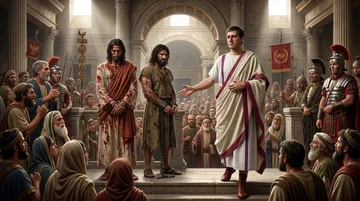
The cry belongs to the hearing before Pilate in a judgment hall ringed with soldiers and spectators, while the priests, rulers and elders of the Sanhedrin who had already condemned Jesus stood outside pressing Pilate to confirm and carry out the sentence.DA 723.1–724.1 Pilate repeatedly held Jesus up as innocent and declared he found no fault in Him, and he set Jesus beside Barabbas for the crowd to choose between them.Ms 16, 1893, par. 13DA 735.1–5Lt 12, 1911, par. 8–11 Barabbas was notorious for robbery, cruelty and great wickedness and even claimed to be Christ, and Pilate expected the contrast between his guilt and Jesus' innocence to move the people to pity and to choose Jesus.Ms 16, 1893, par. 13DA 735.1–5Ms 112, 1897, par. 33–34 Their demand for crucifixion rejected that appeal and exposed a determined rejection of an innocent, suffering Savior who showed mercy and compassion without reproaching His enemies.Ms 16, 1893, par. 13DA 735.1–5Ms 112, 1897, par. 33–34
Pilate had Jesus scourged and then displayed Him wounded and suffering, hoping punishment would satisfy the crowd.5RED 63.1ST Jul 11, 1878 They would not be moved to pity by His wounds or by His patient, dignified bearing, but persisted in demanding crucifixion.5RED 63.1ST Jul 11, 1878 Pilate's indecision further inflamed them, and the cry grew louder whenever he spoke of releasing Jesus, becoming a demand for condemnation rather than any weighing of evidence of innocence.DA 733.1–4
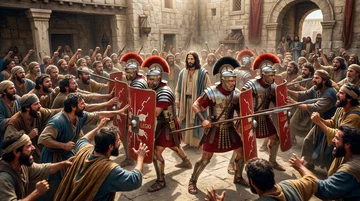
The demand came as a repeated, frenzied roar, a deafening outcry from an immense mob outside the hall whose worst passions had been aroused.Ms 11, 1896, par. 5–6Ms 78, 1893, par. 55–56Ms 51, 1897, par. 26–27 The rulers crowded inside around Pilate with fierce and determined faces, clamoring for condemnation with hatred and malignity that showed humanity had dropped from their hearts, while Jesus stood as the sad central figure with His face lit as if in communion with the Father.Ms 51, 1897, par. 26–27 The priests hurried the matter because they feared the people would take Jesus out of their hands, and as soon as rumor reached the crowd outside that He was found guilty they raised the cry though He was not yet condemned and no guilt had been found in Him.Ms 51, 1897, par. 26–27 To the priests that shout for His death was delightful, while Pilate stretched out his hands trying to silence the tumult.Ms 51, 1897, par. 26–27 Their hoarse cries, driven by satanic frenzy, rejected Christ and chose Barabbas the thief and murderer in His place.Ms 11, 1896, par. 5–6Ms 78, 1893, par. 55–56
Those crying out were the Jews, the priests and the people, a mixed, poor and ignorant multitude persuaded and instigated by priests, rulers, Pharisees and religious teachers to ask for Barabbas and cry out against Christ.Ms 136, 1899, par. 30–33Ms 52, 1897, par. 11–16ST Nov 2, 1882 Many in the mob had never looked upon Jesus until urged by high priests, rulers and Pharisees to bear testimony against Him.Ms 52, 1897, par. 11–16 Satan with his angels in human form mingled in the crowd uttering words that met the sentiments of the dignitaries.Ms 52, 1897, par. 11–16 All heaven heard the cry as the people's own sentence against Jesus.Ms 136, 1899, par. 30–33
Many who demanded crucifixion had praised Him at His entry into Jerusalem only days earlier, having followed what was popular, and their swift turn from acclaim to hostility shows the fickleness of popular support.ST Oct 7, 1886ST Nov 16, 18824RED 102.2–103.1 The same voices that cried out against Jesus later praised Herod as a god.ST Jun 5, 18793SP 343.2AC1 76.3–77.1 Yet not all joined the condemnation, for people Jesus had healed and raised from the dead testified to His works, spoke in His defense, and questioned why He was being treated as a criminal.ST Oct 7, 1886ST Nov 16, 1882
Christ Against Barabbas
The shout was the crowd's answer to what should be done with Jesus, demanding His crucifixion while asking for the release of Barabbas instead.Ms 25, 1896, par. 17–18Ms 11, 1896, par. 5–6Ms 78, 1893, par. 55–56Ms 16, 1893, par. 1319MR 277.1–278.1 Barabbas was a notorious criminal, a thief, robber and murderer, a man of cruelty and great wickedness who claimed to be Christ.Ms 11, 1896, par. 5–6Ms 78, 1893, par. 55–56Ms 16, 1893, par. 13Ms 39, 1894, par. 15–1619MR 277.1–278.1 Their hoarse, repeated cries rejected Christ even though Pilate presented Him as innocent and offered the choice between them.Ms 11, 1896, par. 5–6Ms 78, 1893, par. 55–56Ms 16, 1893, par. 13Ms 39, 1894, par. 15–16 The cry was driven by satanic frenzy and demonic influence, rejecting the Son of God to stand on Satan's side.Ms 78, 1893, par. 55–56Ms 39, 1894, par. 15–1619MR 277.1–278.1
In contrast Jesus is the innocent, pure and holy Son of God, the Son of the infinite God who made the world and all things therein.Lt 59a, 1895, par. 27–28Ms 25, 1896, par. 17–18Ms 40, 1897, par. 30–3319MR 277.1–278.1 His humanity bore the impress of the divine, and His face expressed the Father's image and the personification of the only true God.Ms 11, 1896, par. 5–6Ms 78, 1893, par. 55–56Ms 40, 1897, par. 30–33 He possessed goodness, mercy, compassion and untiring love, with a heart ever touched with human woe, and He did not reproach His enemies.Ms 16, 1893, par. 13Ms 40, 1897, par. 30–33 To reject the divine Son of God so described and accept a murderer in His place shows what humanity does when not controlled by God's Spirit and when the restraining Spirit is removed.Lt 59a, 1895, par. 27–28Ms 40, 1897, par. 30–3319MR 277.1–278.1
Barabbas placed beside Jesus stands for Satan personified, so calling for Christ to be crucified chose Satan before the Son of God and gave Satan exaltation.Ms 25, 1896, par. 17–1816MR 259.3–260.1ST Apr 15, 1897 It was a united, frenzied choice of the robber and murderer over Christ when the people were asked what to do with Jesus which is called Christ.ST Apr 15, 1897 That choice between Barabbas and Jesus reveals whom people accept as king, and each person individually demonstrates by conduct and life whom he is choosing.Ms 25, 1896, par. 17–18Ms 11, 1896, par. 5–616MR 259.3–260.1
Motives Behind Demand
The shout to crucify Him was driven by Satan inspiring the priests and the people, working through human agents to turn them against Jesus and make them reject His love.Ms 78, 1893, par. 55–56Ms 39, 1894, par. 15–164SP 321.1–2GC 500.4–501.2GC88 501.1–2 It was uttered under demonic influence and satanic frenzy, with hatred and malignity, and it laid bare the deceiver's malice and hatred toward Jesus.Ms 78, 1893, par. 55–56Ms 39, 1894, par. 15–164SP 321.1–2GC 500.4–501.2GC88 501.1–2 That malice was aimed at One whose mercy and compassion represented God's character to the world.GC 500.4–501.2GC88 501.1–2 In choosing Barabbas, a thief, robber, murderer and man of cruelty, over Christ, whose humanity bore the impress of the divine, the crowd rejected the Son of God and stood on Satan's side.Ms 78, 1893, par. 55–56Ms 39, 1894, par. 15–16
The leaders and crowd acted in blind rage, though they could point to no act in His life worthy of condemnation.1RED 59.1LC1 59.11SP 157.2–158.2 His humility, goodness and works drew the attention of the people and provoked their jealousy, envy and hatred.1RED 59.1LC1 59.1 The Jewish leaders demanded His crucifixion from jealousy and from a desire to stop His teaching and authority, though His life was righteous and He was innocent.Ms 5, 1882, par. 5–81SP 157.2–158.2 That same murderous hostility toward Christ remains and will be directed against His followers.Ms 5, 1882, par. 5–8
Their demand expressed hatred of His righteousness, teaching and example, and their rejection at the final test was a choice of disobedience and death over obedience and eternal life.Ms 23, 1900, par. 7–9Ms 55, 1886, par. 26–27 His spotless, self-denying life, holiness, guileless speech and plain truth exposed the character of those who professed religion but lived for the world.RH Jun 10, 1852SCEV 26.5–27.3 His pure life and holy teaching convicted them of sin and condemned them, and His life and mission exposed the roots of a religion whose claims concealed a spirit opposed to Him and love for the world.Ms 55, 1886, par. 26–27STE 59.3 They wanted Him out of the way, and rather than be corrected by Him they tried to trap Him in His words and rejected Him.RH Jun 10, 1852
The cry reveals what humanity does when not under the control of God's Spirit and when rejecting God's grace and light.Lt 59a, 1895, par. 27–28Lt 59, 1895, par. 31–33Ms 53, 1894, par. 26–2719MR 277.1–278.1 Human nature under evil influence and inspired by Satan turns against Christ, so that rejecting light leaves people under Satan's control to treat good as evil.Ms 53, 1894, par. 26–271RED 59.119MR 277.1–278.1LC1 59.1 It becomes violent, fierce, cruel and implacable, giving itself to cruelty and opposition to Christ, caring nothing for suffering, agony or murder.Lt 59a, 1895, par. 27–28Ms 52, 1897, par. 11–16 Though Pilate presented Jesus as innocent, pure and holy and offered the choice between Him and the notorious, cruel robber Barabbas, the crowd chose Barabbas, while Jesus showed mercy and compassion without reproaching His enemies.Lt 59a, 1895, par. 27–28Ms 16, 1893, par. 1319MR 277.1–278.1 The scene proves that human nature cannot be trusted apart from Christ's grace, and that human guidance cannot be trusted in place of loyalty to Him.Ms 16, 1893, par. 13Ms 53, 1894, par. 26–27
The cry reveals what rebellion against God's law means: lawless liberty, transgression and sin, loss of tender compassion for those differing in religious faith, and false religion leading men to do Satan's works against the Son of God.Ms 52, 1897, par. 11–16 It came from a poor, ignorant, mixed multitude who had never looked upon Jesus until urged by high priests, rulers, Pharisees and teachers to testify against Him and to ask for Barabbas and cry out against Christ, while Satan with his angels in human form uttered words that met the sentiments of those dignitaries.Ms 52, 1897, par. 11–16 It shows how religious prejudice, envy, malice and deception can lead people who have turned from the light into hatred and extreme acts, with words spoken at His trial witnessed and recorded by God.Ms 23, 1885, par. 10 Their religious claims concealed a spirit opposed to Christ that His life and mission exposed.Ms 55, 1886, par. 26–27
Cosmic Controversy Revealed
The final shout for crucifixion was the climax of Satan's work through human agents to turn the people against Jesus and make them reject His love.4SP 321.1–2GC 500.4–501.2GC88 501.1–2 He stirred and inspired the priests and the people together to demand death instead of mercy.4SP 321.1–2GC 500.4–501.2GC88 501.1–2 That cry laid bare his malice and hatred toward the Redeemer, whose mercy and compassion were showing the world the character of God.4SP 321.1–2GC 500.4–501.2GC88 501.1–2 In this exposure of the deceiver's true character, amazement and indignation were stirred throughout the loyal universe.GC88 501.1–2
Satan himself stood at the head of those who reviled Christ, leading the cruel mob to put Him to open shame.Lt 12, 1911, par. 8–11ST Apr 15, 1897 With fierce determination he and his band of evil confederated with the priests and rulers of the Jewish nation to destroy the champion of God and of truth.ST Apr 15, 1897 By one desperate act they sought to cut off all communication between the world and heaven.ST Apr 15, 1897 The heavenly universe watched the outcome with intense interest, while angels beheld their Commander in the hands of a merciless power, insulted, mocked, derided and scourged, staggering under the burden of His own cross and hanging in shameful humiliation and agony without help from heaven.Lt 12, 1911, par. 8–11ST Apr 15, 1897
The abuse was aimed to provoke Christ to retaliation or to drive Him to work a miracle to free Himself and thereby break up the plan of salvation.Lt 12, 1911, par. 8–11 One stain, one failure to endure the test, would have made the Lamb an imperfect offering and made redemption a failure.Lt 12, 1911, par. 8–11 By a command He could have brought the heavenly hosts to His aid, and by His divine majesty He could have driven the mob in terror from His sight, yet He submitted with perfect calmness to the coarsest insults and outrage.Lt 12, 1911, par. 8–11 By suffering a cruel death of shame He proved the falsity of Satan's charges against God and vindicated God before the angels in heaven as One willing to make in man's behalf the greatest sacrifice that could be made.Lt 12, 1911, par. 8–11
The people's choice and sentence brought sorrow and indignation to the angels, but they could not interfere.Ms 136, 1899, par. 34 In the great controversy between good and evil, Satan's principles had to be allowed to become fully visible, so that the heavenly universe and humanity could see the righteousness of God's purposes.Ms 136, 1899, par. 34 Those under Satan's control were therefore permitted to reveal the principles of his rule.Ms 136, 1899, par. 34 By killing Him the leaders brought about the very outcome they sought to prevent, for Christ became Redeemer of mankind, Saviour of the fallen race, and ruler over the world.1SP 157.2–158.2 God overruled their deed for His own glory and for humanity's good, but this did not lessen the guilt of those who crucified Him.1SP 157.2–158.2
Judgment and Last Days
On the road to Calvary the shouts and jeers demanding crucifixion were interrupted by the sight of Judas's mangled body, and afterward mockery diminished and many faces showed fear, as retribution for Jesus' blood seemed already to be falling on the guilty.DA 722.5 After He lay in the tomb those who had joined the demand realized the calamity that had fallen upon them, and the mourning cries of the suffering and dying brought home to thousands the conviction that a great light had gone out of the world.DA 775.3–777.1 Without Christ the earth was blackness and darkness, and they felt their need of the Healer they had condemned and would as eagerly have demanded Jesus alive again.DA 775.3–777.13SP 188.3–190.1 Some who had cried for His execution recognized the calamity they had brought about and would eagerly have asked for Jesus if He were still alive.3SP 188.3–190.1
The cry will be heard again at the final judgment, when the lost see the condemnation as a reality and face their own rejection of the light and blessings God offered.Ms 77, 1906, par. 13–14 Those who rejected light and refused obedience will then recognize the sacrifice and love they rejected, and will hear that cry as evidence of their condemnation.RH Nov 22, 1906 The demand to crucify Him expressed hatred of His righteousness, teaching, and example in choosing disobedience and death over obedience and eternal life, and the decision made at the final test will stand as evidence against them when the judgment record is opened.Ms 23, 1900, par. 7–9
At the judgment the priests and rulers who joined that cry recall it with horror, and their present cry of agony is louder than the shout they once raised against Him.4SP 461.1–462.1 They remember that cry and their mockery of Him, and recognize that their own actions place them among the wicked who deserve the vineyard lord's sentence.GC 643.3–4 Their later confession that Jesus is the Son of God and the true Messiah is louder than their former demand for His death.GC 643.3–4 That rejection is rejection of Christ as the only provision for cleansing from sin, and it will be brought to account before God at the final judgment. A righteous God must avenge the death of His Son, an innocent man who is the Son of the infinite God killed because He told men truths they did not want to hear, and the world is soon to be judged for it.Lt 31, 1898, par. 13
The hatred in the cry was hatred of the carnal heart against Christ and His principles, at enmity with the law of God and instigated by Satan, and it was not an isolated outburst.RH Feb 9, 1911 It was the same hatred that persecuted the disciples and later consigned men and women to prison, exile, torture, the Inquisition, the massacre of St. Bartholomew, and the fires of Smithfield.RH Feb 9, 1911 That same hatred still works with malignant energy in unregenerate hearts and children of disobedience today, proving human nature today is no more in harmony with the principles of Christ than in past ages.Ms 23b, 1896, par. 1–3RH Feb 9, 1911 The same murderous hostility driven by envy and jealousy remains and will be directed against His followers, especially when civil law withdraws its protection from those who keep God's law.Ms 5, 1882, par. 5–8
The same choice to crucify Christ while releasing Barabbas is being made today by the world and the churches and will be reenacted on an immense scale in the closing scenes of earth's history.Ms 40, 1897, par. 30–33 The scenes enacted at the cross are being reenacted in churches departed from truth and righteousness, revealing what human nature will be and do when the love of God is not an abiding principle in the soul.Ms 40, 1897, par. 30–33 Rejecting the divine Son of God, who possessed goodness, mercy and untiring love with a heart ever touched with human woe, and accepting a murderer in His place shows what humanity does when not under the control of God's Spirit and when the restraining Spirit is removed and men are under the control of the great apostate.Lt 59a, 1895, par. 27–28Ms 40, 1897, par. 30–33 In the great crisis before us those aligned with the powers of darkness will give themselves to cruelty and oppose Christ, representing the spirit of the opponents believers will face and requiring greater faith to endure that test.Lt 59a, 1895, par. 27–28Lt 59, 1895, par. 31–3319MR 277.1–278.1
If He came again in the same humble manner, reproving sin and commending virtue and holiness, thousands in this age would raise the same cry of hatred and rejection.LC1 60.2 His coarse and often travel-stained garments covered a heart of divine love rich with meekness, yet eyes blinded by sin refused to see the Lord of life and glory under His humble exterior even though His power was revealed in works that no mere man could do.RH May 4, 1911 The rebellion and hatred shown then remain in human hearts, and disbelief that He is Messiah and Saviour will grow before His second coming.LC1 60.2 Only a few years after the Jews demanded His crucifixion, some of the same voices that called for it were glorifying Herod as a god at Caesarea, ready to bow down and worship the haughty Herod whose splendid silver and gold garments covered a corrupt and cruel heart.RH May 4, 1911
Present Warning and Application
That same choice between Barabbas and Jesus is being made in the world now, repeated today whenever people cry for Barabbas and for Christ to be crucified.Ms 25, 1896, par. 17–18Ms 40, 1897, par. 30–3316MR 259.3–260.1 Barabbas placed beside Jesus stands for Satan personified, so calling for Christ to be crucified chooses Satan before the Son of God who made the world and all things therein, and gives Satan exaltation.Ms 25, 1896, par. 17–1816MR 259.3–260.1 Each person individually demonstrates by conduct and by life whom he is choosing, and by every action those who give affections to any leader but Christ repeat the cry for Barabbas to be released and Christ to be crucified.Ms 25, 1896, par. 17–18Ms 40, 1897, par. 30–3316MR 259.3–260.1 That rejection is the response of those who reject truth and light presented to them, rejecting Christ, the only provision for cleansing from sin, and crucifying Him afresh, and it will be brought to account before God at the final judgment.Ms 40, 1897, par. 30–33 It is going over the same ground as the Jewish priests and rulers in their treatment of Christ, who murdered an innocent man, the Son of God, the Son of the infinite God, because He told men truths they did not want to hear.Lt 31, 1898, par. 13Lt 93, 1893, par. 20–22
Those who make that choice are filled with the attributes of Satan and controlled body, soul, and spirit by an entrancing infatuation that turns souls from hearing truth to believe a lie.Ms 40, 1897, par. 30–33 The scenes enacted at the cross are being reenacted in the world and in churches departed from truth and righteousness, and will be reenacted on an immense scale in the closing scenes of earth's history, revealing what human nature will be and do when the love of God is not an abiding principle in the soul.Ms 40, 1897, par. 30–33 Rejecting the divine Son of God, the personification of the only true God who possessed goodness, mercy and untiring love and whose heart was ever touched with human woe, and accepting a murderer in His place shows what human nature can and will do when the restraining Spirit of God is removed and men are under control of the great apostate.Ms 40, 1897, par. 30–33 To the degree light is refused and rejected there will be misconception, ruinous deception, misrepresentation and false witness, the evil eye making the whole body full of darkness, trampling God's law with the same spirit as those who insulted and betrayed Jesus.Ms 40, 1897, par. 30–33 That standing rejection of Christ by people who would not receive or confess Him remains the pattern for the world's continuing opposition to Him and its iniquity.Lt 93, 1893, par. 20–22 A righteous God must avenge the death of His Son for which the world is soon to be judged, so all who have united in a course of action wrong in principle must make a decided reformation and forever after walk humbly with God.Lt 31, 1898, par. 13
Disloyal people who reject and deny their Saviour would make the same demand for His death if Christ stood among them on earth today in human form.Ms 108, 1905, par. 23–25STB 358.3–4MWISDAP 15.3–4 Their disloyalty dishonors God and denies the Saviour.STB 358.3–4 People who outwardly honored Christ could still be His enemies, filled with anger and bitterness when not obeyed, like those who demanded His crucifixion.Ms 53, 1886, par. 7–11 His spotless, self-denying life, holiness, guileless speech, and plain truth exposed the character of those who professed religion but lived for the world, who wanted Him out of the way and would try to trap Him in His words and reject Him rather than be corrected by Him.RH Jun 10, 1852 Those who profess to await Christ but live for worldly approval would likewise reject the meek, self-denying Jesus because His life and truthful words expose and condemn their character, and rejecting plain truth while holding to popular error reveals the same resistance to truth that would have led them to join the crowd crying for His crucifixion.Ms 73, 1908, par. 11SCEV 26.5–27.3
The enmity in that cry also opposes His followers, so those who persecute them would treat Christ the same way if He were in their place.Ms 55, 1886, par. 28–30 They will say crucify Christ in the person of His saints, doing to His followers what was done to Him.Lt 31, 1898, par. 13 Adding influence to the popular cry of crucify him, crucify him, when a man loaded down with responsibilities is fighting the battle with almost everything against him, is to show the Satan side of character and to work as Satan's agent to oppress, to accuse, to wound and bruise the soul.TBC1882b 19.1–21.1 It is torturing and persecuting with the tongue, with strong prejudices and jealousies, suspicions, envies, censuring, backbiting and falsehood, adding suspicion, envy, jealousy and faultfinding to the burdens of someone already under strain, making one victim after another suffer, murdering character, crushing the burdened to the earth, and even sending others to death, repeating the satanic spirit behind that popular cry.TBC1882b 19.1–21.1Ms 7, 1882, par. 24–25 Instead of joining that cry the law of kindness and the law of love require practicing kindness, dwelling upon good traits of character, cultivating a tender, pitiful, kind and compassionate spirit, and rejoicing in the truth rather than rejoicing in iniquity.TBC1882b 19.1–21.1Ms 7, 1882, par. 24–25
The cry belongs to Jesus on trial and on the cross while the Jewish priests and rulers forced the Roman governor to do their will.RH Nov 11, 1915 It belongs to His approach to the cross and descent into humiliation, together with the plaiting of the crown of thorns for His brow, clothing Him in the purple robe, bowing before Him in mockery and striking Him with the reed placed in His hand, scourging Him as the worst of criminals, choosing the murderous Barabbas in place of their Teacher, and lifting Him up on the cross to die as a malefactor, while His own nation clamored for His blood as He who held the disciples' hopes of eternal life was in the hands of wicked men.ST Jul 7, 1898 The disciples would see their own nation demand His death while murderous Barabbas was chosen instead of their beloved Teacher, then see Jesus treated as a criminal and crucified, testing their faith and causing hope and courage to fail.Ms 3, 1898, par. 20–21ST Jul 7, 1898 That taking away of the Bridegroom gives the disciples cause to mourn and fast.ST Jul 7, 1898 The crowd's change from hailing Him as king to demanding His crucifixion shows the fickleness of public favor, yet He prepared His faithful disciples for this ordeal so that rejection, betrayal and death would not take them by surprise or overturn their faith.4RED 102.2–103.1
His followers should not expect popularity, for the demand for His crucifixion during His trial was part of the abuse, rejection, and shame He endured before dying as a condemned man.5T 501.2 They are to be meek and lowly like their Master and may share His sufferings as condemned sufferers before sharing His glory.5T 501.2
Sources
Pioneers and periodicals
75 sources
The crowd answered Pilate's renewed appeal to release a man he had examined and repeatedly pronounced innocent with a united and urgent demand for His execution.ST Mar 13, 1901ST Mar 13, 1901ST Nov 19, 1894ST Oct 27, 1898ST May 31, 1899 The shout was driven by blind fury, envy, malice and unreasoning cruelty, stirred by the leaders and wrought by Satan to destroy the champion of God.RH Dec 15, 1863ST Oct 27, 1898ST Oct 7, 1886RH Sep 7, 1911RH Jun 15, 1911 They chose Barabbas, a convicted robber, murderer and hardened desperado, over the innocent Lamb of God set beside him to move their pity.ST Jan 17, 1911ST Oct 7, 1886 In that demand they rejected Jesus as King and as the only provision for cleansing from sin and the gracious offer of salvation.RH Jun 29, 1916ST May 14, 1902 Their loud insistence prevailed over Pilate's willingness to release Him, proving that majorities are as a rule on the wrong side and that popular agreement is no proof a cause is righteous or on God's side.RH Jun 10, 1862ST May 31, 1899ST Sep 9, 1889ST Jun 28, 1905ST Feb 10, 1887 The hardened demand fulfilled prophecy and brought its invoked guilt back upon Jerusalem in destruction and dispersion, while warning that those who reject light will at His coming recognize the love rejected and in vain seek to hide from His wrath.RH Jul 15, 1875ST Apr 12, 1883ST Mar 8, 1910RH Sep 3, 1857RH Aug 19, 1873
Trial Setting Before Pilate
The shout for crucifixion came as the direct answer to Pilate's renewed appeal to release Jesus, after he had examined Him and found nothing in Him worthy of death.ST Mar 13, 1901ST Mar 13, 1901ST Nov 19, 1894 Pilate spoke again because he desired to release Him and proposed His release, but the people rejected the proposal and answered with the demand that He be crucified.ST Mar 13, 1901ST Nov 19, 1894ST Mar 13, 1901 When Pilate asked what evil He had done, the crowd only cried out more insistently for crucifixion, shutting their ears to the reminder of His innocence.RH Dec 15, 1863 Their demand for death by crucifixion grew more urgent as Pilate tried to evade his duty, and his wavering encouraged the anger of the mob.ST Mar 13, 1901
Pilate had repeatedly pronounced Jesus innocent and just, and both he and Herod had declared Him worthy of no punishment, yet he yielded to the mob and surrendered his authority.ST Mar 27, 1901ST Oct 27, 1898ST Aug 20, 1896 His vacillating course compromised his dignity and judgment, violated conscience step by step, and left him almost helpless in the hands of the Jews after he submitted the sentence to a lawless and infuriated mob though convinced of Jesus' innocence.ST Mar 27, 1901ST Oct 7, 1886 He had Jesus scourged in the presence of the multitude in the vain hope of exciting pity so that would be accepted as sufficient punishment, ordering a cruel scourging of the innocent.ST Mar 27, 1901ST Oct 7, 1886 Prejudice turned him away from the truth to heed the cries, and after the final appeal through his wife's dream he refused to identify with the suffering Innocent One, washed his hands to escape responsibility, and delivered Jesus to be handed over.ST Oct 27, 1898ST Aug 20, 1896
The demand was a united double shout of priests and mob for the most dreaded of deaths, answering Pilate's question what to do with Jesus who is called Christ.RH Jul 16, 1861ST Oct 7, 1886 It was incited by the priests and rulers and joined by chief priests' pressure, stirred up by ambitious religious and political leaders until popular opinion stood against God and prevailed over Pilate's effort and willingness to release Him.ST Nov 2, 1882ST May 31, 1899ST Mar 26, 1912 It was malignity that would yield neither to law nor justice nor to pity at the sight of Jesus scourged, beaten, bruised and bleeding yet unresentful and unresisting under indignity and insult.ST Oct 27, 1898 It paled Pilate because he had not expected that a man he had repeatedly pronounced innocent and just would be consigned to such a death through envy and malice.ST Oct 7, 1886
The crowd chose Barabbas and demanded his release instead of Jesus, though Pilate had declared Jesus innocent.ST Jan 17, 1911 Barabbas was a robber chief whose every feature proclaimed a debased and hardened desperado, a wicked murderer actually convicted of the same crime with which they charged Jesus and for which they demanded His death by crucifixion, while they sought freedom for the one actually convicted of it.ST Oct 7, 1886RH Dec 24, 1867 They chose a robber and murderer rather than the Son of God, the innocent Lamb of God, exposing the insincerity and inconsistency of freeing the guilty and demanding crucifixion for the innocent.ST May 17, 1899RH Jun 24, 1915 Pilate placed Jesus side by side with Barabbas to make the contrast move the multitude to sympathy, and put the innocent Jesus on a par with Barabbas by leaving His fate to the choice of His avowed enemies.ST Oct 7, 1886
The cry was raised in a dangerous Passover tumult, with Jerusalem inundated by crowds from the mountains of Nazareth and all Judea pouring in until the place looked like a besieged citadel and the marble stairs groaned under the multitude.RH Jul 16, 1861RH Jul 16, 1861 Relations were volatile because Pilate had violently suppressed a Galilean protest in Jerusalem, killing many and stirring widespread anger, and the temple treasury had been used to bribe the clamoring people.RH Jul 16, 1861ST Feb 16, 1882 A sentence from Pilate was necessary before execution could proceed because the power of life and death was vested in the Roman governor, and political pressure brought Pilate and Herod together against Jesus to His crucifixion.RH Feb 11, 1862ST Apr 15, 1889 Before the cry Pilate's wife warned him not to touch the holy man, and Pilate first ordered Jesus scourged as a way to save His life and then washed his hands before the multitude to show disapproval of the deed.RH Jul 16, 1861
The derision, the scourging before giving Him up to be crucified, the written accusation fixed to the cross in three languages, the bearing of His cross, and the giving up of His body to be buried at the request of friends all agree with the customs, opinions, political facts and institutions of that time.RH Feb 11, 1862 The minute accuracy and circumstantial manner of the account, its consistency with other authors and sources, and its natural and undesigned allusions with nothing out of place or forced in to give probability prove the truth of the narrative.RH Feb 11, 1862
Their vociferations shook the palace to its foundations, while Jesus alone stood calm in the tumult like a statue of innocence, peaceful and answering nothing without a murmur.RH Jul 16, 1861ST Nov 5, 1912RH Mar 9, 1905 After suffering mockery and scourging He was handed over to His persecutors and led away to endure cruelty and be lifted up on the cross.ST Mar 13, 1901RH Jun 10, 1862 His life was sacrificed so that human lives might be saved, suffering He freely bore to save humanity by the sacrifice of His own.ST Mar 13, 1901RH Jun 24, 1915
Motives Behind the Demand
The cry arose from blind fury and groundless hatred, from envy, malice and unreasoning cruelty, persisting even after good works and healing and clamoring for innocent blood.RH Dec 15, 1863ST Oct 7, 1886RH Mar 12, 1872 Pilate's question about what evil He had done exposed those motives and recalled His innocence, yet they shut their ears and cried out more insistently for crucifixion.RH Dec 15, 1863ST Oct 27, 1898 Their malignity would yield neither to law nor justice, though both Pilate and Herod had declared Him innocent and worthy of no punishment, nor to pity at the sight of Jesus scourged, beaten, bruised and bleeding yet unresentful and unresisting under indignity and insult.ST Oct 27, 1898ST Oct 7, 1886 It was the united demand of priests and mob for the most dreaded of deaths against One repeatedly pronounced innocent and just, showing the result of violated conscience and failure to judge with equity.ST Oct 27, 1898ST Oct 7, 1886
Pride and spiritual blindness led to rejection because His humble, suffering, travel-stained appearance contradicted proud expectation of a Messiah who would deliver from subjection, make them rulers, and reign as political deliverer and king.RH May 4, 1911RH Jul 6, 1868ST Oct 4, 1910 Prophecies of the future immortal state were misapplied to the first advent, and eyes blinded by sin could not see the Lord of life and glory under a humble exterior even though His power was revealed in works that no mere man could do.RH May 4, 1911RH Jul 6, 1868 Against that expectation stood the hope that if Jesus would not establish a political kingdom, deliverance might come through Barabbas instead.ST Oct 4, 1910 The same rejection is likened to what those who condemn the Jews might themselves have done had He come among them in humility, denouncing the Pharisees and associating with publicans and the lower orders, for many seek crown and glory without first accepting cross and suffering.RH Jul 6, 1868RH Jun 6, 1871
Many who uttered the cry had praised Him at the triumphal entry into Jerusalem and hailed Him as king only days before, but their praise followed what was popular and quickly turned to hissing and reviling.ST Oct 7, 1886ST Nov 16, 1882ST Oct 8, 1896 The crowd that had hailed Him as king now joined in calling for crucifixion after betrayal and condemnation.ST Oct 7, 1886ST Oct 8, 1896 Those He had healed and raised from the dead testified to His works and questioned why He was being treated as a criminal, while the moment tested His followers and those whose faith was weak were overwhelmed with fear and disappointment.ST Oct 7, 1886ST Nov 16, 1882ST Oct 8, 1896
His spotless, self-denying life, holiness, guileless speech and plain truth exposed those who professed religion but lived for the world, and they sought to trap Him in His words and reject Him rather than be corrected, wanting Him out of the way.RH Jun 10, 1852RH Dec 9, 1862 His holiness as the one pure and untarnished example reproached human wickedness so deeply that men demanded His crucifixion.RH Jun 10, 1852RH Dec 9, 1862 Because His teachings did not conform to their religious beliefs, the demand arose from a desire for uniformity and stands as persecution carried out to enforce conformity in matters of faith.RH Sep 1, 1910
The cry came from Satan working with fierce determination with his band of evil to destroy the champion of God and of truth and by one desperate act to cut off all communication between the world and heaven, confederating with the priests and rulers to kill Christ.ST Apr 15, 1897RH Feb 9, 1911RH Jan 16, 1900 It was expressed in terrible, demon-like howling led by elders and chief priests and in violent, satanic passion, showing the madness and folly of sin, the cruelty of the world's master, and the hatred of the carnal heart at enmity with the law of God and instigated by Satan.RH Feb 9, 1911RH Sep 7, 1911RH Jun 15, 1911RH Jun 10, 1862 The same spirit that moved the mob against Stephen remains active on earth and is held in check only by God's restraining power.RH Jan 16, 1900RH Sep 7, 1911 The hatred was not an isolated outburst but the same hatred that persecuted the disciples and later consigned men and women to prison, exile, torture, the Inquisition, the massacre of St. Bartholomew and the fires of Smithfield, and it still works with malignant energy in unregenerate hearts and children of disobedience today.RH Feb 9, 1911RH Jan 16, 1900
Both Jews and Gentiles were responsible for His death after the Roman governor declared he found no fault in Him, but the Jews bore the greater responsibility.ST Mar 28, 1911RH Apr 16, 1867 Their unbelief and stubbornness of heart as the once highly favored people bore fruit in leading them on from one degree of impenitence to another, until they could bear false witness against the innocent Son of God on the night of betrayal and apprehension and, preferring the life and companionship of a murderer to the Saviour, greedily thirst for His blood and hurry forward mock trial and sentence to die as a condemned criminal on the cross.ST Mar 28, 1911RH Apr 16, 1867 They demanded crucifixion because they did not know the time of their visitation, having rejected the preparatory work of John the Baptist who came in the spirit and power of Elias to prepare the way of the Lord and turn the people to the wisdom of the Just.RH May 1, 1900ST Nov 15, 1899 Those who rejected John's warning were unprepared to receive the Lord, and John stands as representative of those living in the last days to whom God has entrusted the same divine agency and the same work to prepare a people for the second coming of Christ.RH May 1, 1900ST Nov 15, 1899
Rejecting King and Saviour
The shout was a rejection of Jesus as king and a demand for his death by crucifixion.RH Jun 29, 1916ST May 14, 1902 It was the bitter result of choosing a human ruler over God, though Jesus is the rightful King of love whose kingdom is everlasting.RH Jun 29, 1916 It expressed the choice of Caesar instead of the Lord who had come to bring salvation to the world.ST May 14, 1902
The same cry reveals what people do when they reject God's grace, for the same hostility to Christ remains in human hearts and human guidance cannot be trusted above loyalty to Christ. It represents the choice of all who reject the truth and light presented to them, rejecting Christ as the only provision for cleansing from sin and crucifying him afresh, a rejection that will be brought to account before God at the final judgment. It was made despite Scriptures and the types, shadows and sacrifices that had pointed to his coming, ministry, suffering and death, preferring a murderer to the Son of God when release was offered, and expressing refusal of his gracious offer of salvation that brought judgment including Jerusalem's destruction, mass slaughter and dispersion.RH Aug 19, 1873
Some of the same voices that cried out against Jesus in frenzied demand for crucifixion later praised Herod as a god.ST Jun 5, 1879RH May 4, 1911 That refusal would not acknowledge Christ because his coarse and often travel-stained garments covered a heart of divine love rich with meekness, and eyes blinded by sin would not see the Lord of life and glory under his humble exterior even though his power was revealed in works that no mere man could do.RH May 4, 1911 The same people were ready to bow down and worship the haughty Herod, whose splendid silver and gold garments covered a corrupt and cruel heart, only a few years before his death at Caesarea.RH May 4, 1911
The cry was a united, frenzied choice of Barabbas the robber and murderer over Christ the Son of God when the people were asked what to do with Jesus which is called Christ.ST Apr 15, 1897 It came from Satan working with fierce determination with his band of evil to destroy the champion of God and of truth and by one desperate act to cut off all communication between the world and heaven, confederating with the priests and rulers of the Jewish nation to kill Christ.ST Apr 15, 1897 The heavenly universe watched the result with intense interest, with angels seeing their Commander in the hands of a merciless power, insulted, mocked, derided, scourged, staggering under the burden of his own cross, and hanging on the cross in shameful humiliation and agony without help from heaven, raising what man would receive for this satanic work.ST Apr 15, 1897 His own nation clamoring for his blood belonged to his approach to the cross and descent into humiliation, together with the plaiting of the crown of thorns for his brow, clothing him in the purple robe, bowing before him in mockery and striking him with the reed placed in his hand, scourging him as the worst of criminals, choosing the murderous Barabbas in place of their Teacher, and lifting him up on the cross to die as a malefactor.ST Jul 7, 1898 That taking away of the Bridegroom gives disciples cause to mourn and fast, while their faith is tried and their hope and courage fail.ST Jul 7, 1898
Majority Against God
The shout for crucifixion was not the voice of God but the voice of the crowd standing against the voice of God.RH Jun 10, 1862ST May 31, 1899ST Jun 28, 1905 It was loud and insistent, and it swayed the ruler to condemn the One who is Himself the Voice of God.ST Jun 28, 1905 Pilate had stated his finding that no wrong had been done and was willing and making effort to release Him, yet the demand, joined by the pressure of the chief priests, prevailed over that effort to release Him.ST May 31, 1899
The cry proves that majorities as a rule are on the wrong side.RH Oct 5, 1911 A Jerusalem mob crying for crucifixion shows a majority can be unjust and tyrannical.ST Feb 10, 1887 Popular agreement is no proof that a cause is righteous or that the majority is on God's side.ST Sep 9, 1889 Popular approval does not make a decision right or divine, and the voice of the people is not the voice of God.ST Feb 10, 1887RH Oct 5, 1911
Majorities do not decide moral questions, even when led by rabbis and priests and by leaders of religious thought.ST Oct 30, 1884RH Apr 25, 1912 The multitude loudly demanding death under that lead proves that majorities, even religious leaders, can be wrong.ST Oct 30, 1884 What everybody does may be right but is just as likely to be wrong, with no presumption for or against a practice because it is popular.ST Oct 30, 1884 Each soul must look for itself rather than follow the flock, and the cry of the multitude must not silence conscience, for the quiet voice of conscience is louder than noisy clamor and what most people do is no reliable measure of what is morally right.ST Oct 30, 1884RH Apr 25, 1912
The crucifixion followed a popular demand stirred up by ambitious religious and political leaders, showing how an inflamed mob can commit injustice and persecute its very benefactor and the one who serves the people.ST Mar 26, 1912 Public opinion turned against Christ and public sentiment supporting injustice helped bring about His death.ST Jun 17, 1903ST May 10, 1910
The cry began as the voice of the leaders of religious thought in that day and became the voice of the masses.RH Jun 4, 1908 Pilate, as the government in that instance, ratified the will of the people by yielding to the demand.RH Jun 4, 1908 That stands as a fatal parallel to government enforcement of Sunday at the demand of religious leaders and the masses.RH Jun 4, 1908 The same demand to punish the teacher of a strange religion is heard when the Adventist who works with a saw on Sunday is condemned and imprisoned while customary Sunday activities are tolerated.ST Dec 18, 1893
Judgment Foretold and Coming
The hardened, unbelieving people fulfilled prophecy when they demanded crucifixion, though they did not understand what they were fulfilling.ST Apr 12, 1883 Jesus foresaw this rejection as He looked upon Jerusalem, yet He felt compassion for its people and grieved over the destruction that would follow their refusal to repent and accept His warning.ST Jun 3, 1897
The demand for His crucifixion, joined with invoking His blood guilt upon themselves and their children, fell back upon those who made it in the destruction of Jerusalem.RH Sep 3, 1857 Then they and their children were slaughtered, dispersed, and themselves crucified around the walls of the burning city in such vast numbers that many were nailed to the same cross until no space remained to plant a cross and no wood remained to make one, while unparalleled famine ravaged the crowded streets.RH Sep 3, 1857 Christians who watched for the sign of Jerusalem compassed with armies had fled to Pella and were not there.RH Sep 3, 1857 The cry rejected Jesus and preferred a murderer to the Son of God despite Scriptures and the types, shadows, and sacrifices that had pointed to His coming, ministry, suffering, and death, and when Pilate would have released Him it expressed rejection of His gracious offer of salvation, bringing judgment in Jerusalem's destruction, mass slaughter, and dispersion.RH Aug 19, 1873
The cry warns that pride, fear, and sin can lead people to deny Christ at His coming.ST Mar 8, 1910 Those who rejected light and refused obedience will then recognize the sacrifice and love they rejected, and will hear that cry as evidence of their condemnation.RH Nov 22, 1906 The united cry condemning Jesus and demanding Barabbas released in His place will meet His wrath in the last day, when those who condemned Him will cry for the rocks and mountains to fall on them to hide them from Him.RH Jul 15, 1875 The same cry is made louder today by actions that put away the commandments of God and choose the traditions of the man of sin, and those who do so will also cry in vain for rocks and mountains to fall on them, with no escape from the wrath of the soon-coming Lord, for to gain a home in the earth made new requires keeping both the commandments of God and the faith of Jesus.RH Jul 15, 1875
Over and over Pilate had pronounced Jesus innocent and just, and he was all the more troubled when he heard that Jesus had claimed to be the Son of God, knowing Jesus was different from any man he had ever met, yet the terrible, demon-like howling of the mob led by elders and chief priests prevailed in the crisis and Pilate permitted Jesus to be led away and crucified.RH Jun 15, 1911 Those who led the cry cruelly treated God's beloved Son and murdered Him, yet God the Father marvelously loved even these murderers and sent His risen Son to bless them first by turning every one of them away from their iniquities.RH Jun 15, 1911
Doctrine Practice and Persecution
The shout for crucifixion came after repeated efforts to release an innocent prisoner whom both Pilate and Herod had declared worthy of no punishment, a malignity that would yield neither to law nor justice nor to pity at the sight of a scourged, beaten, bruised and bleeding sufferer bearing indignity and insult without resentment or resistance.ST Oct 27, 1898 That confrontation was the presentation of the gospel in glorious perfection to great Rome in the person of Pilate, for the dignity and innocence of the accused convinced the governor He was more than man and pressed the appeal to do right whatever the consequences.ST Oct 27, 1898 Pilate feared the accusers and remained undecided, and after the final appeal through his wife's dream he refused to identify with the suffering Innocent One, delivering Him to the mob while trying to escape responsibility by washing his hands.ST Oct 27, 1898
The cry belongs to the taking away of the Bridegroom toward the cross and descent into humiliation, with the plaited crown of thorns for His brow, the purple robe, the mock bowing, the striking with the reed placed in His hand, the scourging as the worst of criminals, the choosing of murderous Barabbas in place of the Teacher, and the lifting up to die as a malefactor.ST Jul 7, 1898 That removal gives disciples cause to mourn and fast, while their faith is tried and hope and courage fail.ST Jul 7, 1898 It reveals what people do when they reject God's grace, for the same hostility to Christ remains in human hearts, so human guidance cannot be trusted above loyalty to Christ. Human judgment condemned God's consecrated One though He was innocent and chose a wicked murderer instead, and faithful people may likewise be misunderstood, rejected and treated as vile.RH Dec 24, 1867
The same spirit that demanded crucifixion attacks those who teach the binding obligations of God's law, abuses Sabbath-keepers and seeks to suppress truth and abuse its advocates.RH Jan 3, 1907RH Jun 26, 1860 As the accusers condemned Jesus and delivered Him to Pilate while claiming innocence of His death, so the apostate church instigated civil rulers to kill His martyrs while disclaiming responsibility.RH Jul 9, 1867 The violent, satanic passion in the cry is the same that moved the mob against Stephen, and it remains active on earth held in check only by God's restraining power.RH Sep 7, 1911 That hatred was not an isolated outburst but carnal hatred against Christ and His principles, at enmity with God's law and instigated by Satan, the same hatred that persecuted the disciples and later consigned men and women to prison, exile, torture, the Inquisition, the massacre of St. Bartholomew and the fires of Smithfield, and it still works with malignant energy in unregenerate hearts and children of disobedience today, proving the world is no more in harmony with Christ now than then.RH Feb 9, 1911RH Jan 16, 1900
Feeling sorry yet continuing in wrongdoing, as seen around Pilate and Herod, is not the heartbroken repentance God values.RH Sep 22, 1863 The words supply a figure for putting the old selfish nature to death, as when acquisitiveness is resisted by generosity and the reclaimed gift is not only restored but increased with warning that further protest will cost the old nature still more.RH Jan 1, 1861 The hostile demand still marks worldly companions given to dance and wine-cup, so that a professed follower who calls Christ Lord and God yet makes merry with them is inconsistent, will be despised by them as hypocrite and traitor, and will cause others to stumble over the inconsistency and perish.RH Dec 3, 1867 The united shout is heard again when a nation sick of liberty after testing democratic ideas demands from everywhere that liberty itself be crucified.RH Dec 3, 1908 The rejection arose because a humble, suffering appearance contradicted proud expectation of a deliverer from subjection who would make His people rulers, with prophecies of the future immortal state misapplied to the first advent, illustrating how people seek crown and glory without first accepting cross and suffering.RH Jul 6, 1868 The same cry is made louder today by putting away God's commandments and choosing the traditions of the man of sin, and to gain a home in the earth made new requires keeping both the commandments of God and the faith of Jesus.RH Jul 15, 1875
Sources