Mark 15:20
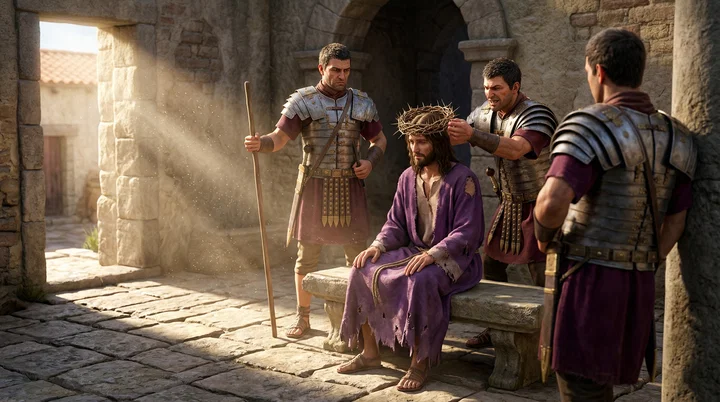
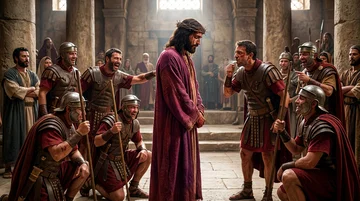
And when they had mocked him, they took off the purple from him, and put his own clothes on him, and led him out to crucify him.
Translations
American King James Version, King James Version, KJV Cambridge Paragraph Bible, Webster Bible
And when they had mocked him, they took off the purple from him, and put his own clothes on him, and led him out to crucify him.
Revised Version, American Standard Version
And when they had mocked him, they took off from him the purple, and put on him his garments. And they lead him out to crucify him.
and when they [had] mocked him, they took the purple from off him, and clothed him in his own garments, and they led him forth, that they may crucify him.
And when they had mocked him, they took the purple off him, and put his own clothes on him; and they lead him out that they may crucify him.
And, when they had mocked him, they put off him, the purple, and put on him, his own garments. And they lead him forth, that they may crucify him.
Berean Standard Bible, Majority Standard Bible
After they had mocked Him, they removed the purple robe and put His own clothes back on Him. Then they led Him out to crucify Him.
When they had mocked him, they took the purple cloak off him, and put his own garments on him. They led him out to crucify him.
And when they had made sport of him, they took the purple robe off him and put his clothing on him. And they took him out to put him to death on the cross.
And whe they had mocked him, they tooke the purple off him, and put his owne clothes on him, and led him out to crucifie him.
Douay-Rheims (Challoner revision)
And after they had mocked him, they took off the purple from him, and put his own garments on him, and they led him out to crucify him.
Pictures
Cross-references 20 of 24
- Matthew 27:27-31
Then the soldiers of the governor took Jesus into the common hall, and gathered unto him the whole band of soldiers.
The soldiers mock Jesus, dress him in a robe, and lead him away to be crucified.
- John 19:2-3
And the soldiers platted a crown of thorns, and put it on his head, and they put on him a purple robe,
Jesus is dressed in purple and mocked by the soldiers before his crucifixion.
- John 19:17
And he bearing his cross went forth into a place called the place of a skull, which is called in the Hebrew Golgotha:
Jesus is led out carrying his cross to be crucified.
- Luke 23:26
And as they led him away, they laid hold upon one Simon, a Cyrenian, coming out of the country, and on him they laid the cross, that he might bear it after Jesus.
Simon is made to bear the cross behind Jesus.
- Luke 23:11
And Herod with his men of war set him at nought, and mocked him, and arrayed him in a gorgeous robe, and sent him again to Pilate.
Herod and his soldiers mocked Jesus and dressed him in royal clothing.
- Luke 23:21
But they cried, saying, Crucify him, crucify him.
The crowd demands that Jesus be crucified.
- Matthew 27:32
And as they came out, they found a man of Cyrene, Simon by name: him they compelled to bear his cross.
Simon is compelled to carry Jesus’ cross.
- Matthew 26:67-68
Then did they spit in his face, and buffeted him; and others smote him with the palms of their hands,
Jesus is struck and mocked before being led out to crucifixion.
- Psalms 22:16-18
For dogs have compassed me: the assembly of the wicked have inclosed me: they pierced my hands and my feet.
Foretells pierced hands and feet and the dividing of garments by lot.
- Matthew 27:35
And they crucified him, and parted his garments, casting lots: that it might be fulfilled which was spoken by the prophet, They parted my garments among them, and upon my vesture did they cast lots.
Both describe Christ being led out and crucified.
- Matthew 27:29-30
And when they had platted a crown of thorns, they put it upon his head, and a reed in his right hand: and they bowed the knee before him, and mocked him, saying, Hail, King of the Jews!
Both describe the mockery and humiliation of Jesus before his crucifixion.
- John 19:23-24
Then the soldiers, when they had crucified Jesus, took his garments, and made four parts, to every soldier a part; and also his coat: now the coat was without seam, woven from the top throughout.
Jesus’ garments are divided and lots are cast for his vesture, fulfilling prophecy.
- Mark 15:24-25
And when they had crucified him, they parted his garments, casting lots upon them, what every man should take.
Jesus was crucified after being led away.
- Mark 15:15
And so Pilate, willing to content the people, released Barabbas unto them, and delivered Jesus, when he had scourged him, to be crucified.
both show customary pre-execution scourging and mocking
- Mark 15:27
And with him they crucify two thieves; the one on his right hand, and the other on his left.
Two thieves were crucified alongside Jesus.
- John 19:15
But they cried out, Away with him, away with him, crucify him. Pilate saith unto them, Shall I crucify your King? The chief priests answered, We have no king but Cæsar.
The crowd rejects Jesus as king and demands his crucifixion.
- John 19:19-22
And Pilate wrote a title, and put it on the cross. And the writing was, JESUS OF NAZARETH THE KING OF THE JEWS.
Describes the title placed over Jesus on the cross.
- Isaiah 53:7
He was oppressed, and he was afflicted, yet he opened not his mouth: he is brought as a lamb to the slaughter, and as a sheep before her shearers is dumb, so he openeth not his mouth.
Jesus bears abuse without complaint.
- Mark 15:26
And the superscription of his accusation was written over, THE KING OF THE JEWS.
both show customary affixed crime on cross
- Matthew 27:26
Then released he Barabbas unto them: and when he had scourged Jesus, he delivered him to be crucified.
same scourging before crucifixion
Commentary
Each commentary is drawn from primary sources: the writings of Ellen G. White and Adventist pioneers and periodicals. Each commentary is separate. Its own words are not a quotation; follow the references to read the source passages.
Ellen G. White
16 sources
After the soldiers had mocked Him as a king with a purple robe, a crown of thorns, a reed for a scepter, derisive homage and blows that drove the thorns into His brow till blood streaked His face, they stripped the purple from Him, put His own clothes on Him again, and led Him out from the judgment hall to be crucified.DA 741.4–742.1DA 741.1–25RED 58.1–23SP 138.1–2ST Jul 7, 1898 This took place in Pilate's judgment hall early in the morning, where He stood bound as a prisoner before the governor while the priests, rulers and mob who had already condemned Him remained outside to avoid defilement for the Passover.DA 723.1–724.1 He had already been scourged as the worst of criminals though innocent, while Barabbas the murderer was released in His place, and the cross prepared for Barabbas was laid on His bruised shoulders till, weakened by loss of blood and suffering, He fell beneath it and another was compelled to bear it to Calvary outside the gate.DA 741.4–742.1EW 143.33SP 143.1–2COS 155.1ST Jul 7, 1898 He bore all this abuse with meekness, patience and dignity, refusing to complain or to use His divine power to escape, and as humanity's substitute suffered outside the city and was lifted up as a malefactor to bear the curse of the law and redeem men from it.DA 741.1–25RED 58.1–2EW 138.13SP 143.1–2ST Jul 7, 1898 His mocking and leading away was the culmination of His humiliation and rejection, which tested His disciples to the utmost as their hope that He would take David's throne seemed to fail, yet they had been prepared not to ground their faith on the changing approval of the world.4RED 102.2–103.1ST Jul 7, 1898Ms 3, 1898, par. 20–21
Trial Setting and Sequence
Early in the morning the scene is the judgment hall of Pilate the Roman governor, where Christ stands bound as a prisoner with a guard of soldiers about Him while the hall fast fills with spectators.DA 723.1–724.1 The judges of the Sanhedrin, priests, rulers, elders and the mob remain just outside the entrance, for to enter would defile them under ceremonial law and keep them from the feast of the Passover.DA 723.1–724.1 They have already condemned Jesus and have come to have Pilate confirm and execute the sentence.DA 723.1–724.1 Pilate himself has been called hastily from his bedchamber to examine Him with magisterial severity and with no friendly eyes.DA 723.1–724.1 Yet he sees marks of goodness and nobility, a calm and dignified bearing with no guilt or fear or boldness or defiance, and the signature of heaven, which rouses his better nature as he remembers what his wife told him and the rumors he has heard of the Galilean prophet curing the sick and raising the dead.DA 723.1–724.1
He is mocked as a king with a purple robe, a crown of thorns, a reed for a scepter, derisive bows, insults, jeers and blows.5RED 58.1–23SP 138.1–2ST Jul 7, 1898 He is held in the hands of wicked men while His own nation clamors for His blood.ST Jul 7, 1898 When He is struck on the head with the reed the thorns are pressed in, leaving His face and beard streaked with blood.5RED 58.1–23SP 138.1–2ST Jul 7, 1898
After the mockery His tormentors remove the purple robe they have put on Him, dress Him again in His own clothes, hand Him over to the people, and lead Him out from the judgment hall to be crucified amid shouts and jeers.DA 741.4–742.1DA 741.1–25RED 58.1–23SP 148.1Lt 1a, 1861, par. 2–5 He has been scourged as the worst of criminals, a punishment Pilate hoped would satisfy the crowd, though Jesus is innocent and the priests remain set against Him.3SP 143.1–2ST Jul 7, 1898 The murderous Barabbas has been chosen in His place.ST Jul 7, 1898
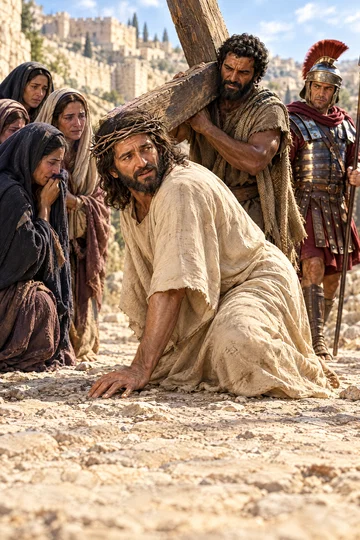
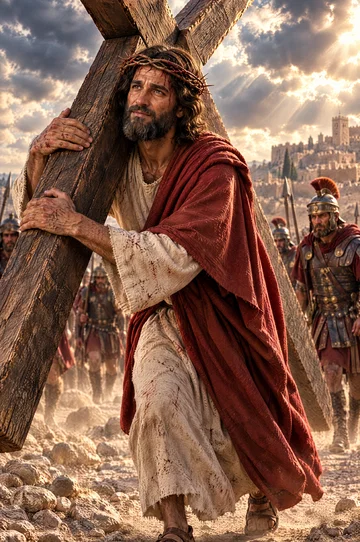
A cross prepared for Barabbas is laid on His bruised, bleeding shoulders.DA 741.4–742.1COS 155.1 Pale, weak and fainting from the night's suffering, a second scourging, weariness, pain, blows and loss of blood, He cannot carry its weight and falls fainting beneath the heavy cross.DA 741.4–742.1EW 143.3COS 155.1Lt 1a, 1861, par. 2–5 He faints three times beneath it, until a believing follower is seized and made to carry it to the place of execution.EW 143.3 He is led to Calvary outside Jerusalem's gate at the place where criminals are executed, to be raised on the central cross of three on a rocky hill with two thieves also led out to die with Him.DA 741DA 741.3DA 741.1–2COS 155.1 He is followed by a vast multitude, for the news of His condemnation has spread throughout Jerusalem and people of all classes and all ranks flock toward the place of crucifixion.DA 741.3 Because the priests and rulers have promised not to molest Christ's followers if He Himself is delivered to them, the disciples and believers from the city and the surrounding region join the throng that follows the Saviour, with crowds gathered on the slope and grieving followers kneeling and praying in the foreground.DA 741DA 741.3
Purpose and Disciples' Testing
After the soldiers had mocked Him as a king with a crown of thorns, a reed striking His head, jeers, and a scourging that Pilate hoped would satisfy the crowd though He was innocent and the priests remained set against Him, they stripped off the purple robe, put His own clothes back on Him, and led Him away to be crucified.5RED 58.1–23SP 143.1–2 He endured those insults with meekness and patience and dignity, and His suffering did not hide His noble character.5RED 58.1–23SP 143.1–2 The abuse was meant to provoke Him to complain or to use His divine power to escape, but He did not do so, and the plan of salvation did not fail.5RED 58.1–2EW 138.1
As humanity's substitute He suffered beyond the city's boundary at the place where criminals were executed outside Jerusalem's gate, bearing the curse of the law to redeem people from it.DA 741.1–2 He descended into the depths of humiliation, held in the hands of wicked men while His own nation clamored for His blood, crowned with thorns, clothed in purple, mocked by bowing and struck with the reed, scourged as the worst of criminals while the murderous Barabbas was chosen in His place, then led out to be lifted up on the cross to die as a malefactor.DA 741.1–2ST Jul 7, 1898 His being mocked and led away was the culmination of the humiliation and rejection He faced at His trial.4RED 102.2–103.1 The disciples had been prepared for this ordeal, so the crowd's insults and the rejection by people who had once followed Jesus did not take them by surprise or make them base their faith on the world's changing approval.4RED 102.2–103.1
The disciples had centered their hopes of eternal life in Him and thought He was to take His place on David's throne, so witnessing His shame and suffering gave them cause to mourn and fast.ST Jul 7, 1898 That humiliation which they witnessed tested their faith and caused their hope and courage to fail.ST Jul 7, 1898Ms 3, 1898, par. 20–21
Sources
Pioneers and periodicals
25 sources
After the sentence to crucify him, the soldiers stripped off the royal-colored robe they had put on him in mockery, put his own clothes back on him, and led him away from the judgment hall toward Calvary to be crucified.RH Nov 5, 1872ST Mar 13, 1901ST Oct 31, 1916ST Sep 23, 1889 The mockery was a painful pretended coronation as king, dressing him in scarlet, crowning him with platted thorns, putting a reed as a scepter in his right hand, bowing and hailing him, spitting on him and smiting him on the head so the thorns pierced him.ST Jul 7, 1898RH Dec 9, 1858RH Oct 25, 1870 Pilate had him scourged before the multitude in hope of exciting pity, leaving him stripped to the waist, pale and bleeding from cruel stripes with blood trickling from his temples, yet he bore the shame and abuse meekly without anger though he could have delivered himself.RH Nov 5, 1872ST Oct 7, 1886RH Dec 9, 1858 Exhausted from agony, loss of sleep and wounds, he sank beneath the heavy cross he was made to carry through the city, so the soldiers compelled Simon of Cyrene to bear it behind him to Golgotha.ST Nov 16, 1882RH Dec 9, 1858ST Jul 14, 1881 His lowly endurance revealed his true royal dignity, and his being stretched on the tree beneath the load of human sin gives the clearest discovery of the exceeding sinfulness of sin and of his self-emptying love to redeem the ruined race.ST Sep 23, 1889ST Dec 17, 1912RH May 27, 1873RH Oct 25, 1870RH Jun 10, 1862
Setting and Journey
The verse belongs to the trial before Pilate, where he called together the chief priests, rulers and people and declared that he had examined Jesus and found no fault in him touching the accusations, nor had Herod found anything worthy of death, proposed to chastise and release him, was answered by the united cry to away with Jesus and release Barabbas who lay in prison for insurrection and murder, again desired to release Jesus and was answered with crucify him, a third time asked what evil Jesus had done and found no cause of death in him, was overcome when the loud voices demanding crucifixion prevailed, and gave sentence that what they asked should be done, so that after mocking Jesus was led out to be crucified.ST Mar 13, 1901
After the sentence and after a night of humiliation, abuse and scourging, the soldiers removed the purple or royal-colored robe they had put on him to mock his kingship, put his own clothes back on him, and led him away to be crucified before he was taken to Calvary at Jerusalem, the city where he lived and died.RH Nov 5, 1872ST Oct 31, 1916ST Sep 23, 1889ST Dec 17, 1912ST Jan 23, 1907 Treating him as a ruler of earthly political power in that way repeated the mockery of those who offered royal honors while inflicting suffering and leading him to the cross.ST Jan 23, 1907ST Nov 13, 1893
The journey from Pilate's judgment hall to Calvary was probably north of Jerusalem through the Damascus Gate, about half a mile or more, though the exact site is unknown.ST Apr 4, 1906 He was made to carry the heavy cross through the city toward the place of death amid insult, derision and abuse from the surrounding multitude, bearing it while ready to sink under its weight.RH Dec 9, 1858ST Jul 14, 1881ST Apr 4, 1906 Exhausted from the agony in the garden, loss of sleep, scourging wounds and brutal treatment by the mob and Roman soldiers, he was too weak to bear it, fell and collapsed beneath its weight and could not continue alone, so the soldiers compelled Simon of Cyrene to carry it behind him, which is indicated by the later wording that they brought him to Golgotha.ST Nov 16, 1882RH Dec 9, 1858ST Jul 14, 1881ST Apr 4, 1906
The royal robe and mockery imitated the Roman soldiers' yearly festival of Saturn, in which a mock king was chosen, clothed in royal robes, allowed to direct wild carousing for a certain number of days, and then put to death, and making riotous mockery of condemned criminals and others handed over to the executioners and others who had displeased the soldiers was a favorite amusement and they were treated as objects of sport in that manner.ST Jun 8, 1904 As he entered the Passover service as the true high priest, he refused the fermented, intoxicating wine mixed with myrrh offered to him, because ferment represented decomposition and death and had no place in that service whose purpose was to displace death with life.RH Jun 25, 1914 The mocking and leading out shed his blood on the stairs of the Praetorium and ended in his death, after which Joseph of Arimathea knelt weeping before Pilate to beg permission to bury Jesus of Nazareth, Pilate granted the request and ordered soldiers under Manlius to superintend the burial lest it be profaned, and a few days afterward the sepulcher was found empty while his disciples published everywhere that he had risen from the dead as he had foretold.RH Jul 16, 1861
Mockery and Suffering
His humiliation was a painful mock coronation as a pretended king: stripped and dressed in an old robe of royal color or scarlet, crowned with a platted crown of thorns, given a flimsy reed as a scepter in his right hand, mocked by bowing the knee and crying Hail, king of the Jews, spit upon, smitten on the cheek and on the head with the reed so the thorns pierced on every side, and covered in purple over the wounds of his tormentors.ST Jul 7, 1898RH Dec 9, 1858RH Oct 25, 1870ST Apr 3, 1928 The royal robe was then taken off, his own clothes were put back on him, and he was led away to be crucified.RH Dec 9, 1858RH Oct 25, 1870 The insults, robe, reed and crown displayed his kingship through lowliness and suffering, and his meek endurance revealed his royal dignity.ST Sep 23, 1889ST Dec 17, 1912
Pilate had him scourged in the presence of the multitude in the vain hope of exciting pity so the people would decide the punishment was enough, leaving him pale and stripped to the waist with long cruel stripes from which blood flowed freely, exhausted, wounded, and disfigured with blood trickling from his temples over a face stained with blood and marked by exhaustion and pain.ST Oct 7, 1886RH Dec 9, 1858 In that suffering condition he was placed beside Barabbas, where his noble character stood in marked contrast to the robber chief whose every feature showed a debased and hardened desperado, for he was scourged as the worst of criminals while the murderous Barabbas was chosen in his place.ST Jul 7, 1898ST Oct 7, 1886 When he was brought out before the people in hope of pity, priests and people cried Crucify him, and Pilate, fearing a charge of treason before the suspicious and jealous Tiberius Caesar if he let him go, resisted conscience for worldly interest and ordered the execution to proceed.RH Dec 9, 1858
He bore the shameful mocking and abuse meekly, without anger or resentment, though he could have delivered himself, enduring it for the salvation of sinners.RH Nov 5, 1872 With his sacred body wounded at Pilate's bar, he was led out to Calvary and stretched on the tree fainting and crushed beneath the load of human sin to redeem the ruined race.RH May 27, 1873 His clothes later taken from him again at the execution left him deprived of everything as part of his self-emptying love.RH Oct 25, 1870 This suffering gives the clearest discovery of the dreadful evil and exceeding sinfulness of sin as a manifestation of God's just displeasure against sin and displays the cruelty and madness of sin.RH May 27, 1873RH Jun 10, 1862
He descended into the depths of humiliation as he approached the cross, held in the hands of wicked men while his own nation clamored for his blood and he was led out to be lifted up on the cross to die as a malefactor.ST Jul 7, 1898 Because the disciples had centered their hopes of eternal life in him and thought he was to take his place on David's throne, seeing him so shamed and suffering gave them cause to mourn and fast, and their faith was tried and their hope and courage failed.ST Jul 7, 1898
Evidence and Application
Mockery before and during execution was the customary practice of that time toward condemned criminals.RH Feb 11, 1862 Scourging before crucifixion, fastening the accusation to the instrument of punishment, writing public notices in three languages at Jerusalem, making the condemned bear his cross, requiring sentence from the Roman governor who alone held the power of life and death, and giving up the body for burial at the request of friends unless the criminal was infamous, were the usual law and constant practice of that period.RH Feb 11, 1862 These small details occur together within a single page of history, coming in accidentally and naturally out of the progress of the narrative with nothing forced or out of place, and they maintain consistency with the manners and institutions of that time.RH Feb 11, 1862 Their minute and circumstantial accuracy gives strong evidence that the account of the trial, execution and burial is true, since an inventor of a false story would not hazard so many circumstances each giving a chance of detection nor blend truth so artfully with falsehood.RH Feb 11, 1862
The stripping of the purple, the restoring of his own clothes, and the leading away to crucify him is a picture and pattern of what is done to Christianity when earthly and temporal power claims authority over her.ST Jan 23, 1907ST Nov 13, 1893ST May 21, 1912ST Jan 24, 1906ST Feb 22, 1910 To treat Christ as a ruler of earthly political power repeats the mockery of those who offered him royal honors while inflicting suffering and leading him to the cross.ST Jan 23, 1907ST Nov 13, 1893ST May 21, 1912ST Feb 22, 1910 Rulers offer outward honor and authority with gestures of homage while inflicting harm, humiliating and wounding what they claim to honor, with cruelty concealed beneath homage and the cross as its end.ST Jan 23, 1907ST May 21, 1912ST Jan 24, 1906ST Feb 22, 1910 She is therefore in far greater danger of being corrupted by the alliance of power than of being crushed by its opposition.ST Jan 23, 1907ST Jan 24, 1906ST Feb 22, 1910
His humiliation in the purple robe stands in contrast to the fashionable display of his professed followers.RH Jun 20, 1871 It serves as a pattern of bearing reproach rather than avoiding the cross for fear of contempt.RH Jun 20, 1871 After anguish and abuse he was too weak to bear the heavy cross alone and collapsed beneath its weight, so the soldiers compelled Simon of Cyrene to carry it behind him.ST Apr 4, 1906 Bearing Christ's cross willingly after that example is blessed.ST Apr 4, 1906
Sources