Luke 7:13
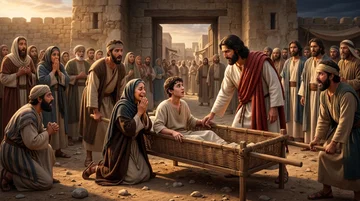
And when the Lord saw her, he had compassion on her, and said unto her, Weep not.
Translations
American King James Version, Webster Bible
And when the Lord saw her, he had compassion on her, and said to her, Weep not.
King James Version, KJV Cambridge Paragraph Bible, Revised Version, American Standard Version
And when the Lord saw her, he had compassion on her, and said unto her, Weep not.
And the Lord having seen her, was moved with compassion towards her, and said to her, 'Be not weeping;'
And the Lord, seeing her, was moved with compassion for her, and said to her, Weep not;
And, beholding her, the Lord, was moved with compassion over her, and said to her—Be not weeping!
Berean Standard Bible, Majority Standard Bible
When the Lord saw her, He had compassion on her and said, “ Do not weep.”
When the Lord saw her, he had compassion on her and said to her, “Don’ t cry.”
And when the Lord saw her, he had pity on her and said to her, Be not sad.
And when the Lord sawe her, he had compassion on her, and said vnto her, Weepe not.
Douay-Rheims (Challoner revision)
Whom when the Lord had seen, being moved with mercy towards her, he said to her: Weep not.
Pictures


Cross-references
- 1 Kings 17:22
And the LORD heard the voice of Elijah; and the soul of the child came into him again, and he revived.
Elijah’s prayer restores a widow’s dead child to life.
- John 11:35-44
Jesus wept.
Jesus shares the mourners’ grief and raises Lazarus, as he comforts the widow at Nain.
- 2 Kings 4:32-37
And when Elisha was come into the house, behold, the child was dead, and laid upon his bed.
Elisha raises the Shunammite woman’s son from the dead.
- Hebrews 4:15
For we have not an high priest which can not be touched with the feeling of our infirmities; but was in all points tempted like as we are, yet without sin.
Christ is touched by human infirmities and feels compassion for the suffering.
- John 11:35
Jesus wept.
Both show Jesus’ compassion toward mourners facing death.
- Luke 8:50-55
But when Jesus heard it, he answered him, saying, Fear not: believe only, and she shall be made whole.
The raising at Nain assured Jairus before Jesus restored his daughter to life.
- Matthew 20:34
So Jesus had compassion on them, and touched their eyes: and immediately their eyes received sight, and they followed him.
Jesus is moved with compassion and heals the blind men.
- Isaiah 63:9
In all their affliction he was afflicted, and the angel of his presence saved them: in his love and in his pity he redeemed them; and he bare them, and carried them all the days of old.
God shares his people’s affliction and compassionately saves them.
- Mark 5:41-42
And he took the damsel by the hand, and said unto her, Talitha cumi; which is, being interpreted, Damsel, I say unto thee, arise.
Jesus raises Jairus’s daughter.
- Psalms 103:13
Like as a father pitieth his children, so the LORD pitieth them that fear him.
Compares Jesus’ pity with a father’s pity for his children.
- Matthew 9:36
But when he saw the multitudes, he was moved with compassion on them, because they fainted, and were scattered abroad, as sheep having no shepherd.
Jesus is moved with compassion for the people.
- Lamentations 3:22
It is of the LORD’s mercies that we are not consumed, because his compassions fail not.
The Lord’s unfailing compassion brings hope to the sorrowful.
- John 5:25
Verily, verily, I say unto you, The hour is coming, and now is, when the dead shall hear the voice of the Son of God: and they that hear shall live.
The widow’s son hears Christ’s voice and lives.
- John 11:39-40
Jesus said, Take ye away the stone. Martha, the sister of him that was dead, saith unto him, Lord, by this time he stinketh: for he hath been dead four days.
Both texts recount a real resurrection.
- John 20:11-16
But Mary stood without at the sepulchre weeping: and as she wept, she stooped down, and looked into the sepulchre,
Christ comforts a weeping woman.
- Isaiah 53:4
Surely he hath borne our griefs, and carried our sorrows: yet we did esteem him stricken, smitten of God, and afflicted.
Christ bears human griefs and sorrows.
- Isaiah 61:1
The Spirit of the Lord GOD is upon me; because the LORD hath anointed me to preach good tidings unto the meek; he hath sent me to bind up the brokenhearted, to proclaim liberty to the captives, and the opening of the prison to them that are bound;
The Messiah’s work includes binding up the brokenhearted.
- Luke 8:54-55
And he put them all out, and took her by the hand, and called, saying, Maid, arise.
Both describe Christ raising the dead.
- Ephesians 2:4-5
But God, who is rich in mercy, for his great love wherewith he loved us,
Christ’s compassion in raising the dead reflects God bringing sinners dead in sin to life.
Commentary
Each commentary is drawn from primary sources: the writings of Ellen G. White and Adventist pioneers and periodicals. Each commentary is separate. Its own words are not a quotation; follow the references to read the source passages.
Ellen G. White
14 sources
When the Lord met the widow of Nain as she followed her only son to burial, who had been her sole earthly support, He was moved with tender compassion, came beside her in concern for her loss, and asked her to cease grieving to comfort her.DA 318.3–5DA 318.1–2STST Mar 23, 1882DA 512.2
By His word He raised the young man to life and gave him back alive to his mother, so that sorrow was turned to joy and the people rejoiced and praised God.DA 318.3–5DA 318.1–2Ms 1, 1867, par. 44–47COS 86.2–87.2
The son was restored only to mortal life and remained subject to death and decay, without receiving immortality, unlike those raised at Christ's resurrection who were given everlasting life.ST Feb 3, 1914Ms 115, 1897, par. 17–20DA 786.1–3
The raising also points to the future resurrection, when His voice will call the dead in Christ from their tombs to immortal life to be with the Lord.COS 86.2–87.2
That same tender sympathy is still present with every mourner today, for He is touched by the grief of bereaved mothers and remains a living Saviour ready to comfort and help all who trust in Him.STDA 319.1–320.1ST Mar 23, 1882DA 512.2
Widow's Loss and Compassion
The woman was the widow of Nain, whose only son had died and was being carried to burial while she followed him to the grave, and he had been her sole earthly support.DA 318.3–5ST Mar 23, 1882DA 512.2COS 86.2–87.2ST Aug 20, 1902 When the Lord saw her, He was moved with tender compassion and came beside her, showing His tender concern for the bereaved.DA 318.3–5DA 318.1–2STST Mar 23, 1882DA 512.2 That same compassion remains His attitude toward grieving mothers in sorrow and need today.STMH 41.4–42.4
He gently told her not to weep, and the command was an expression of tender sympathy and comfort.DA 318.3–5DA 318.1–2 He spoke it even though He was about to restore her son to life and turn her grief to joy.DA 318.3–5DA 318.1–2
By His word He raised the young man to life, taking him by the hand and giving him back alive to his mother.Ms 1, 1867, par. 44–47COS 86.2–87.2 The people returned home rejoicing and praising God.COS 86.2–87.2 His word thus brings comfort and life, doing what human effort cannot do.Ms 1, 1867, par. 44–47
Mortal Raising and Future Resurrection
The raising at Nain restored the widow's son to mortal life, not to immortality, and he remained subject to death and decay.ST Feb 3, 1914Ms 115, 1897, par. 17–20DA 786.1–3 He was brought back to the life he had before, without being given the incorruptible life that removes dying forever.ST Feb 3, 1914Ms 115, 1897, par. 17–20DA 786.1–3 This is unlike those raised when Christ rose, who were given immortality and everlasting life.ST Feb 3, 1914Ms 115, 1897, par. 17–20DA 786.1–3 The difference is that the raisings during His ministry left the restored ones still under death, while the raisings at His own resurrection carried them beyond it.ST Feb 3, 1914Ms 115, 1897, par. 17–20DA 786.1–3
Jesus met the widow as her dead son was being carried to the grave, took the young man by the hand, raised him to life, and gave him back alive to his mother.COS 86.2–87.2 The people then returned home rejoicing and praising God for what His word had done.COS 86.2–87.2 That restoration also points forward to the future resurrection, when Christ's voice will call the dead in Christ from their tombs to immortal life.COS 86.2–87.2 Then they will be raised no longer to die again, but to be with the Lord forever.COS 86.2–87.2
Comfort for Mourners Today
The same tender sympathy felt for the grieving mother at Nain is present with every mourner now, and the power to give life remains effective, for he is still a living Saviour to all who believe in him.DA 319.1–320.1 He is touched by the grief and sorrow of bereaved mothers, and he remains ready to comfort and help mothers in sorrow and need today and all who trust in him.STST Mar 23, 1882DA 512.2MH 41.4–42.4
He knows the burden of every mother and is touched by the woe of the bereaved mother today.ST Aug 20, 1902 As her best friend in every emergency he sympathizes with her work, hears her earnest prayers, and upholds her with his everlasting arms.ST Aug 20, 1902 If she will trust him he is ready to aid her in her need, giving peace and joy and strength with courage and wisdom for the most trying hour.ST Aug 20, 1902 In this way he makes her burdens lighter and gives her rest.ST Aug 20, 1902
The raising of the widow's son while friends were carrying him to burial is an example of his work as a genuine medical missionary.Ms 169, 1903, par. 5–7 It shows the kind of labor his followers are to learn from his life.Ms 169, 1903, par. 5–7
Sources
Pioneers and periodicals
85 sources
At the gate of Nain Jesus met the funeral of a widowed mother's only son, her last family and hope, carried out with much people of the city with her.ST Jan 30, 1896RH Mar 22, 1906 Seeing her grief He felt pity for her, comforted her distress, then halted the procession, touched the bier and by His life-giving voice raised the dead young man and restored him to his mother.ST Mar 26, 1894STRH Jun 13, 1854 His compassion reveals God's tender pity and unchanging love for suffering people, showing the beauty of His character and that His works of relief came from love and not from desire for display.ST Mar 26, 1894RH Aug 17, 1911RH Jun 13, 1871ST Jun 8, 1882RH Jul 23, 1901 The raising was real and literal, yet the son returned with no report of thought or experience in death, for the dead sleep without knowledge until they are called back to life.STRH Mar 7, 1865RH Mar 8, 1864RH Jan 23, 1913ST Jan 4, 1877 Wonderful as it is, it is only an earnest and foreshadowing of a greater day when all in the graves shall hear His voice and live, so mourners may find comfort in the hope that death will not have the final word.ST May 24, 1905ST Mar 12, 1896ST Jan 26, 1915RH Oct 19, 1869
Scene at Nain
At the gate of Nain Jesus met a funeral procession carrying out for burial the dead only son of a widowed mother, with much people of the city with her.ST Jan 30, 1896ST Oct 4, 1899 She followed her only son to the grave in profound grief, her loss made visible in tearful eyes met by kindly action.RH Mar 22, 1906RH Dec 15, 1859 Seeing her sorrow He had compassion on her and spoke to comfort her with the word not to weep before He restored her son to life.ST Jan 30, 1896RH Dec 15, 1859
Her grief was especially grievous because she had already lost her husband, and this son had been her last close family and hope.RH Mar 22, 1906 Following an only son to the grave when already widowed was regarded as a terrible calamity and as punishment for sin, leaving her childless.RH Mar 22, 1906
The dead young man had been sick unto death with a fever and had no breath left in him that morning, yet his mother testifies he was dead but now lives.ST Sep 20, 1910ST Sep 20, 1910 He was the only son of his widowed mother, and his case is set beside that of another gravely ill young man who was also his widowed mother's only son.ST Apr 7, 1914 His mother is one whose name has not come down, and with other unnamed favored women her story helps make women conspicuous in the New Testament records and makes the womanly element prevail largely in the life of Jesus.
The meeting belongs to His miracle-working and teaching journeys in His Galilean ministry.ST Oct 14, 1913 It was greeted with wonder, joy and gratitude. It was one of three resurrections from the dead described in detail during His earthly ministry, done publicly and not in secret, and it is recorded in Luke but not in the other Gospels.RH Jan 6, 1916ST May 8, 1907ST Sep 20, 1905
The raising at Nain happened before He raised Lazarus the brother of Martha and Mary, so Lazarus was not the first person Christ raised from the dead.ST Mar 24, 1909 It was an earlier display of His power that Jairus had not yet heard of when he faced the news that his daughter had died.ST Feb 6, 1896
Compassion and Command
When the Lord saw the bereaved widow He had compassion on her, feeling pity for her grief and sorrow over her only son.ST Jun 2, 1881ST Mar 26, 1894ST Jan 30, 1896ST Jun 2, 1881 Seeing her as her dead son was being carried to burial moved Him to comfort her, and His pity led Him to act against death to restore the son to his mother.ST Jun 2, 1881ST Mar 26, 1894RH Nov 25, 1902 That compassion for human grief reflects that He bears people's sorrows and came to free humanity from the effects of sin.ST Jan 30, 1896
Moved by compassion He spoke to her and gently told her not to weep, comforting her distress before He raised her son.ST Mar 26, 1894ST Jan 30, 1896ST Jun 2, 1881 He met the widowed mother as her only son was being carried out for burial with much people of the city with her, and seeing her grief He felt compassion and gave her that gentle command.ST Jan 30, 1896 His words remain words of comfort for a bereaved mother and for those mourning a death.RH Oct 27, 1910
That compassion moved Him to act: He stopped the funeral procession, approached the bier and touched it to halt the march before raising the young man, who then spoke.STST Mar 26, 1894ST Aug 20, 1896 He comforted her by telling her not to weep before approaching the bier and raising her son, stopping grief with that command.ST Mar 26, 1894 The account gives no report of any thoughts or experience during the young man's death.ST
He raised her dead son without her asking, unlike the woman whose prayer for her living daughter was initially unanswered.RH May 21, 1857
Character of Christ
When the Lord saw the widowed mother He felt pity for her grief over her only son and gently told her not to weep, and that response shows meekness as tender concern for the distress of others.RH Jan 27, 1863 That compassion and comforting word is an example of the benevolence and tenderness required by God's law, which Jesus perfectly embodied and observed in noticing her sorrow.ST Sep 11, 1884ST Aug 28, 1884 In wiping tears from the widowed cheek He acted in benevolence and sympathy that forgot self to bless the wretched, and the act did not go a hair's breadth beyond what God's law requires but stayed exactly inside the circle the law had drawn.RH Sep 18, 1860 It belongs to the perfect model of loveliness of character seen in Jesus of Nazareth, which is neither more nor less than the law perfectly observed, magnifying the law and making it honorable.RH Sep 18, 1860
His compassion for the bereaved widow reveals God's tender pity for suffering and sinful people, for God was in Christ reconciling the world to Himself.ST Mar 26, 1894 Christ came to represent the Father and to disprove the false picture of God as stern, exacting and tyrannical, and His compassion shows that God is love.ST Mar 26, 1894 That same compassion that addressed her grief and restored her only son to life reveals the Father's unchanging mercy and love.RH Aug 17, 1911
His miracles of healing arose from compassion for suffering and the desire to relieve it, not from a wish to make a display, and in His care for the afflicted His humanity is plainly seen.ST Jun 8, 1882 In His labor of love going about doing good He had compassion on the pale sad face of the widow of Nain bereft of her only son, wiped the tear from sorrow's eye and poured consolation into distress, lighting up her smile by commanding the monarch of the tomb to give the boy back to his mother's gaze once more.RH Jun 13, 1871
The scene at the gate of Nain shows Christ's love and sorrow and helps reveal the beauty and benevolence of His character.RH Sep 4, 1855 He meets a grieving mother with compassion and comfort, is present with mourners and offers comfort in their sorrow, looks on tears with pity and comes to save.RH Jul 23, 1901
The same Jesus who dried her tears and comforted the grieving remains the gracious Saviour when seated on the great white throne, and His character does not change.ST May 18, 1882 His compassion for her remained part of His heart even after His exaltation, showing that He feels for people in sorrow and is able to sympathize with His people.RH Jan 29, 1861 His pity for the bereaved mother did not end with that miracle, for He is still touched today by the woe of the bereaved mother, and as woman's best friend He is ready to aid her in all the relations of life.ST Sep 9, 1886
That raising was done by virtue of the sacrifice of the Son of God, although that sacrifice had not yet been accomplished, because it was already established in the purpose of God.ST Oct 12, 1876 The Jesus who raised him is Michael the archangel, the chief prince, the captain of the Lord's host, the Spiritual Rock that went with Moses and Israel from Egypt, the Life-giver.ST Oct 12, 1876
As Jesus, son of Joseph the carpenter of Nazareth, gave life again to the dead young man on his bier in proof of His Messiahship, the miracle divided the people.ST Sep 20, 1910 The young man had been sick unto death with a fever and had no breath left in him that morning, and his mother testifies he was dead but now lives.ST Sep 20, 1910 The Pharisees contended for the resurrection from the dead, while Annas the Sadducean high priest denied that the dead rise at all, claimed Moses taught no resurrection and gave life to no dead men, insisted the young man was only sleeping or in league with Jesus, and declared the whole circumstance from beginning to ending prearranged and contrived to make good His claim to the Messiahship.ST Sep 20, 1910
In the incident at the Pharisee's table, Jesus interprets the sinful woman's tears and loving acts as the love of one forgiven much, for she honors a Saviour whom others treat with neglect.RH Dec 3, 1867 His compassion for the grieving widow at Nain in telling her not to weep before He raises her son belongs with that same compassionate Saviour.RH Dec 3, 1867 Elsewhere His response to the bereaved woman is connected with His compassion for the blind men and His response to their repeated, pitiful appeal.ST Sep 13, 1899
Power Over Death
Jesus is the Giver of Life, and His words to the grieving widow over her only dead son were joined to the act of raising the young man and restoring him to her, showing that sickness and death are foes He has power to overcome.ST Sep 13, 1899RH Nov 20, 1860ST Apr 12, 1905ST May 24, 1905 His compassion therefore brings comfort that is grounded in power over death, meeting the bereaved with pity and with the hope that death will not have the final word.RH Nov 20, 1860ST May 24, 1905ST Jan 26, 1915 That power to raise the dead endures, and the son returned to life as before.ST May 24, 1905
By His creative, life-giving word and voice the dead heard and lived, for He gave life to the widow's son and the mother's sorrow was turned to joy when her dead son heard His voice and lived again.RH Jun 13, 1854ST Oct 30, 1907 He comforted the bereaved mother at Nain and restored her dead son to life, so that she is remembered as holding the hand of the son who had died and lived again.ST Feb 14, 1911 The living son was thus given back to his mother.RH Jun 13, 1854ST Feb 14, 1911
He did not then heal all the sick or raise all the dead, for the mighty works He did on earth were only an earnest of a completer work to come, when He will accomplish even these things fully in final salvation, and in the meantime these works help faith.ST Mar 12, 1896 The raising of the widow's son was an exceptional act and an exceptional circumstance in which a miracle followed His teaching rather than coming after it, and it does not mean that all who have died since should be raised to life in the same way before the appointed resurrection.ST Mar 12, 1896RH Jun 22, 1916ST Sep 13, 1905
The awakening of the widow's dead son in Nain from the sleep of death at His call was seen by witnesses and stands with making the lame walk, making the dumb shout, cleansing the loathsome body of the leper by healing touch until like a little child, healing Mary Magdalene, cleansing Simon the leper so his flesh became like the flesh of a little child, raising the daughter of Jairus, and giving new life through the operation of God's Spirit.ST Sep 27, 1910ST Nov 29, 1910 These marvelous miracles of the Galilean ministry were greeted with wonder, joy and gratitude, proving His power over sickness and death.ST Sep 27, 1910ST Nov 29, 1910 They give reason to trust that He will surely not forget and leave His prophet messenger John in prison to perish, and give reason to believe that even now that Lazarus is dead whatsoever He asks of God for Lazarus God will give Him.ST Sep 27, 1910ST Nov 29, 1910
That real resurrection before Christ Himself rose was possible only by virtue of the promise that Christ would pass through death and come forth triumphant bearing the keys of death and the grave.ST Jun 5, 1884 The promise was made before any man died, when Christ was the Lamb slain from the foundation of the world, and it was as sure as fulfilled because God calls promised things as done.ST Jun 5, 1884 Christ is first-fruits and first from the dead as chief and pre-eminent, not as first in point of time, and the raising at Nain itself gave no pledge that another would be raised.ST Jun 5, 1884 Whether the widow's son was raised to immortality is not revealed, but nothing forbids that some so raised were made immortal, since immortality is brought to light only through the gospel and the assured resurrection of Jesus.ST Jun 5, 1884
In raising their dead He gladdened the hearts of the afflicted, manifesting God-given power.ST Feb 1, 1899 That display proves His rejection was not from lack of divine power, yet those He loved and came to save still sought opportunity to put Him away from their midst.ST Feb 1, 1899 Unlike those raised at Christ's resurrection, the people He raised during His ministry, including the widow of Nain's son, remained subject to death.ST Feb 3, 1914
State of the Dead
The raising at Nain shows that the dead can literally be raised, for it was a real event and a real restoration of a dead man to life, like the raising of Jairus's twelve-year-old daughter, not a figure or a fable, proving that Christ called the dead back to life.RH Mar 7, 1865RH Mar 8, 1864ST Nov 22, 1910 The Bible calls this a resurrection, meaning bringing the dead back into life and activity, and like the other raisings before Christ's own resurrection it was not to immortality, since the restored person may die again, yet the power of death was broken by it just as truly as by a resurrection to eternal life.RH Nov 20, 1860ST Aug 12, 1889 Whether the widow's son was raised to immortality is not revealed, but nothing forbids that some so raised were made immortal, since immortality is brought to light only through the gospel.RH Nov 20, 1860
The account reports no thoughts or experience during his death, for after Jesus stopped the funeral procession and raised the young man who then spoke, nothing is recorded of his being in heaven or seeing or hearing anything while dead.STST Jan 4, 1877 He returned from death without revealing anything about an intermediate spirit realm, supporting that the dead know nothing and do not live on in heaven in a conscious state.ST Jan 4, 1877ST Nov 4, 1880 Death is not going at once to heaven or to torment, for if he had already entered the reward of the righteous there would be no reason to call him back from it to live again on earth, and if he had gone to punishment with the wicked there would be no reason to release him for another probation here.RH Jan 23, 1913 The raising does not fit with the dead knowing enjoyment or suffering after death and having that knowledge taken away on return, but with the dead sleeping without knowledge until raised.RH Jan 23, 1913
With Lazarus and the daughter of Jairus and later raisings, this resuscitation in the presence of many onlookers gives a means to solve the great problem of man's condition after death.ST Oct 7, 1913 This real resurrection preceding Christ in time, together with the raisings by Elijah and Elisha and the raising of Lazarus, proves that Christ being called the first to rise from the dead does not mean first in point of time.ST Aug 12, 1889 Jesus, moved with compassion for the grieving widow, restored her only son to life as one of the exceptions to the general rule that the dead are raised at a later resurrection.ST Jan 28, 1889ST Aug 5, 1886 Such raisings before Christ do not contradict His being first, firstfruits, and firstborn from the dead, for firstfruits and firstborn do not always denote priority of time, save in God's purpose, but pre-eminence; He is chief and not first in time, the One through whom all are raised, demonstrating in Himself power over death to proclaim light to people and Gentiles.ST Nov 29, 1883ST Dec 21, 1882ST Dec 30, 1903 That raising was possible because His promised death and resurrection were as certain as if already accomplished, and through His resurrection He brought light and immortality and became the pledge of future life for believers.ST Nov 29, 1883ST Dec 21, 1882
Hope of Final Resurrection
The account belongs to a grieving mother at Nain and points to compassion shown in the face of death and sorrow, raising the question of whether death is the end and presenting an answer of hope beyond the grave.ST May 24, 1905 The raising of the widow's son shows power over death and loving ministry to the bereaved, and compassion for the widow with the command not to weep is joined to the hope that death will not have the final word.ST Jan 26, 1915
The raising shows the dead hearing the voice of the Son of God and living, in literal fulfillment of the promise that the dead shall hear His voice and they that hear shall live.RH Oct 19, 1869 It proves the Father has given the Son to have life in Himself and therefore power to bestow life on those who hear His voice.RH Oct 19, 1869 Wonderful as this raising is, it is only the foreshadowing of a greater manifestation of divine power when all that are in the graves shall hear His voice and come forth, the good unto the resurrection of life and the evil unto the resurrection of judgment.RH Oct 19, 1869
Coming to Nain was not as a messenger of death but to give life to the widow's son, bringing comfort and life in the face of sorrow and death.ST May 10, 1910 The same Jesus who met human sorrow with compassion for a bereaved widow and restored her only son to her, and raised the dead, is coming again.ST May 10, 1910ST Apr 15, 1897 He meets a bereaved mother as she goes to the grave, looks on her tears with pity and comes to save, comforting her and raising her son.RH Jun 18, 1908 Grief need not remain dim or bitter, because the dead will awaken at the coming day of visitation, and the words to the grieving mother whose son had died, spoken in the setting of raising the young man to life, comfort bereaved families with the promise that those who sleep in Jesus will be raised.RH Jun 18, 1908
That miracle showed power to restore life and became an assurance to Jairus when his daughter was dying, that the same power that had healed could make his daughter whole.ST Feb 6, 1896
Comfort and Application
Jesus sees the sorrow of mourners and brings comfort and healing to the brokenhearted.ST Oct 28, 1880 When He saw the widow of Nain bereft of her only son, He had compassion on her pale sad face, wiped the tear from sorrow's eye and poured consolation into her distress, lighting up her smile by commanding the monarch of the tomb to give the boy back to his mother's gaze.RH Jun 13, 1871 As she followed her only son to the tomb He responded with compassion and told her not to weep.ST Oct 28, 1880 His earthly life gave comfort to those grieving, and that comfort extends to every kind of grief, including sorrow over sin, since sin is the cause of death and mourning.ST Jan 16, 1896
His words and the raising of her son show tender concern for the bereaved and readiness to help those who trust in Him.ST He was moved with compassion for a bereaved mother as her only son was being carried to burial, comforted her and gave her son back to her.ST Mar 23, 1882 That pity for the bereaved mother did not end with that miracle, for He is still touched today by the woe of the bereaved mother, and as woman's best friend He is ready to aid her in all the relations of life.ST Sep 9, 1886 His sympathy for her grief is an example of continuing care for mothers in their anxieties and burdens, comforting and helping them in grief and need and in sorrow and trouble.ST Apr 4, 1911ST Jun 23, 1914ST Dec 18, 1907 He sympathizes with her work, hears prayers, upholds with everlasting arms, and gives peace, joy, strength, courage and wisdom, making burdens lighter, and the widow of Nain as a signal favor to an unnamed woman stands with other favored women making the womanly element prevail largely in His life.STST Mar 23, 1882ST Sep 9, 1886
As the consoling Christ of divine compassion He met a bowed and aged mother weeping over the pallid, upturned face of her dead son, told her to weep not, comforted her distress and raised the dead.RH Oct 4, 1870 His work is to heal the sick, raise the dead, comfort the distressed, bless the little ones, loose the demon-possessed and free sinners from sin, while bestowing no earthly possessions or human honors.RH Oct 4, 1870 In the account He meets need, restores her only son to life, giving back her support and turning mourning into rejoicing, and the enemy loses a victim.
His compassionate word before the miracle demonstrates that His life-giving word can awaken hearts dead in sin.ST Oct 30, 1907 He responded to the widow's grief with compassion and the assurance not to weep, displayed His power and loving care, and restored the living son to his mother. That restoration pictures sinners, dead in sin, being made alive to God and delivered to their mother, the Jerusalem above, as her children, and because that city is above they must be born again from above. That same work of stopping grief with Weep not, touching the bier to halt the funeral march and raise the dead to life, continues today by living faith, stopping the funeral march of infidelity and touching the bier of withered hopes, making what was dead as a corpse sing for joy in the very presence of its pall-bearers.
The raising of the young man of Nain, the only son of his mother, is a touching, uplifting and pathetic act, giving material for meditation and spiritual growth every day.ST Mar 24, 1909 It stands in mighty contrast to the low condition of Israel in the time of the judges, and speaks of the goodness and mercy of God.ST Mar 24, 1909 The restoration of the widow of Nain's son to life is upheld as part of the miraculous record of Scripture, though dismissed by critics.
Sources