Luke 7:49
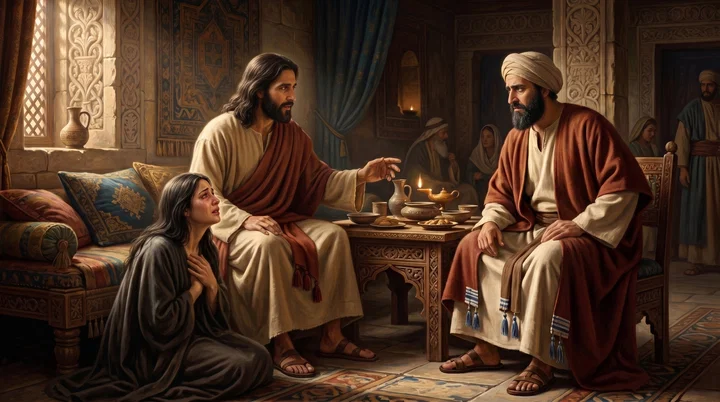
And they that sat at meat with him began to say within themselves, Who is this that forgiveth sins also?
Translations
And they that sat at meat with him began to say within themselves, Who is this that forgives sins also?
King James Version, KJV Cambridge Paragraph Bible
And they that sat at meat with him began to say within themselves, Who is this that forgiveth sins also?
And they that sat at table with him, began to say within themselves, Who is this that forgiveth sins also?
Revised Version, American Standard Version
And they that sat at meat with him began to say within themselves, Who is this that even forgiveth sins?
and those reclining with him (at meat) began to say within themselves, 'Who is this, who also doth forgive sins?'
And they that were with [ them] at table began to say within themselves, Who is this who forgives also sins?
And they who were reclining together, began to be saying within themselves—Who is, this, that, even forgiveth sins?
Berean Standard Bible, Majority Standard Bible
But those at the table began to say to themselves, “ Who is this who even forgives sins?”
Those who sat at the table with him began to say to themselves, “ Who is this who even forgives sins?”
And those who were seated at table with him said to themselves, Who is this who even gives forgiveness of sins?
And they that sate at table with him, began to say within themselues, Who is this that euen forgiueth sinnes?
Douay-Rheims (Challoner revision)
And they that sat at meat with him began to say within themselves: Who is this that forgiveth sins also?
Pictures
Cross-references
- Luke 7:41-43
There was a certain creditor which had two debtors: the one owed five hundred pence, and the other fifty.
Jesus’ parable compares debtors who are forgiven and leads Simon to recognize who loves most.
- Luke 7:39
Now when the Pharisee which had bidden him saw it, he spake within himself, saying, This man, if he were a prophet, would have known who and what manner of woman this is that toucheth him: for she is a sinner.
Simon’s inward doubt about Jesus receiving a sinner prompts the table’s question.
- John 8:11
She said, No man, Lord. And Jesus said unto her, Neither do I condemn thee: go, and sin no more.
Jesus mercifully releases the accused woman and tells her to sin no more.
- Matthew 9:2-6
And, behold, they brought to him a man sick of the palsy, lying on a bed: and Jesus seeing their faith said unto the sick of the palsy; Son, be of good cheer; thy sins be forgiven thee.
Scribes question Jesus’ authority to forgive sins, which he proves by healing the palsied man.
- Luke 7:37-38
And, behold, a woman in the city, which was a sinner, when she knew that Jesus sat at meat in the Pharisee’s house, brought an alabaster box of ointment,
The woman’s tears and precious ointment show her repentant devotion to Jesus.
- Mark 2:7
Why doth this man thus speak blasphemies? who can forgive sins but God only?
Both texts question who can forgive sins, an authority belonging to God.
- Matthew 26:6-13
Now when Jesus was in Bethany, in the house of Simon the leper,
A similar account describes a woman anointing Jesus at a feast in Bethany.
- Mark 14:3
And being in Bethany in the house of Simon the leper, as he sat at meat, there came a woman having an alabaster box of ointment of spikenard very precious; and she brake the box, and poured it on his head.
A woman anoints Jesus at a meal in Bethany.
- Luke 7:44
And he turned to the woman, and said unto Simon, Seest thou this woman? I entered into thine house, thou gavest me no water for my feet: but she hath washed my feet with tears, and wiped them with the hairs of her head.
Jesus contrasts Simon’s lack of water with the woman’s washing of his feet.
- Ephesians 4:32
And be ye kind one to another, tenderhearted, forgiving one another, even as God for Christ’s sake hath forgiven you.
Urges believers to forgive one another.
- Luke 17:3-4
Take heed to yourselves: If thy brother trespass against thee, rebuke him; and if he repent, forgive him.
Calls for repeated forgiveness of a repentant person.
- Matthew 6:12-15
And forgive us our debts, as we forgive our debtors.
Connects receiving forgiveness with forgiving others.
- John 11:2
(It was that Mary which anointed the Lord with ointment, and wiped his feet with her hair, whose brother Lazarus was sick.)
Cited in connection with the woman who anointed Jesus.
Commentary
Each commentary is drawn from primary sources: the writings of Ellen G. White and Adventist pioneers and periodicals. Each commentary is separate. Its own words are not a quotation; follow the references to read the source passages.
Ellen G. White
16 sources
At a meal in the house of Simon the wealthy Pharisee, those reclining with Jesus began to question inwardly when He pardoned the woman, asking among themselves who He is that forgives sins also.DA 557Ms 24, 1891, par. 8817MR 356.2MYP 406.2MH 24.2 Their questioning of His authority showed they did not yet recognize who He is, standing in self-righteous criticism in contrast to His mercy and to the woman's undoubting trust in His divine power.2SP 381.1Ms 24, 1891, par. 8817MR 356.215MR 132.2–3 He has authority to forgive sins, as proved when He pardoned Mary Magdalene.STMs 109, 1901, par. 12ST Aug 20, 1902 He assures all who come to Him confessing their sins that they are forgiven, sending them forth in peace to leave sin behind, and He taught that the one forgiven more will love more.STB 99.119MR 259.1–3Ms 24, 1891, par. 88Ms 109, 1901, par. 12 With pitying kindness rather than open shaming He opened Simon's eyes to his neglect, unbelief, and great debt, convincing his mind and subduing his heart until he became humble and self-sacrificing.2SP 382.34RED 115.1 As the One who forgives sins He stands ready to help all who trust Him, leading the guilty to repentance, forgiveness, and peace.7T 96.1STB 99.1STMs 41, 1902, par. 27–28ST Aug 20, 1902
Question at Simon's Table
The saying belongs to a meal in the house of Simon, a wealthy Pharisee whose invitation was accepted.MYP 406.2MH 24.2 The occasion was used to teach those present, mingling in friendly company and turning the gathering into an opportunity to impart lessons suited to the hearers.MYP 406.2MH 24.2 In this way the meal reached people of wealth and influence, opening spiritual riches to them.MH 24.2
Those dining with him began to speak within themselves, questioning inwardly and privately among themselves who this is that forgives sins also.DA 557Ms 24, 1891, par. 8817MR 356.2 The question was prompted by his forgiving the woman, placing their reaction directly alongside his assurance of forgiveness.DA 55717MR 356.2 Their questioning of his authority to forgive shows they did not yet recognize who he is.DA 557Ms 24, 1891, par. 88
Their reaction sets a critical, self-righteous judgment in contrast with a merciful character.2SP 381.115MR 132.2–3 Mary trusted his divine power without doubt, while Simon doubted because he failed to recognize his own need for forgiveness and mercy.2SP 381.115MR 132.2–3
Forgiveness, Peace, and Help
Jesus has authority to forgive sins, proved when He pardoned Mary Magdalene.STMs 109, 1901, par. 12ST Aug 20, 1902 He assures all who come to Him confessing their sins that they are forgiven.Ms 109, 1901, par. 12 His words to the forgiven bring peace, with the call to go in peace and to turn from sin and sin no more.STB 99.1Ms 109, 1901, par. 12
Through the parable of the debtors He taught with tact the connection between forgiveness and love.19MR 259.1–3 Simon admitted that the one forgiven more would love more, recognizing that Christ must be loved most by the one forgiven most.19MR 259.1–3Ms 24, 1891, par. 88 His patient, kind correction opened Simon's eyes to his own neglect and unbelief and to the magnitude of the debt he owed his Lord.2SP 382.34RED 115.1 Instead of openly rebuking and shaming him before the other guests, He stated his true case to convince his mind and subdue his heart by pitying kindness, since stern denunciation would have closed Simon's heart against repentance.4RED 115.1 That patient admonition convinced him of his error and won his heart, and he became a humble, self-sacrificing man.2SP 382.34RED 115.1
The salvation shown in the verse is to be shown to patients: they are to be led to repent, receive forgiveness, and go in peace, turning away from sin.7T 96.1STB 99.1Ms 41, 1902, par. 27–28 As the One who forgives sins He is a friend ready to help all who trust in Him.ST That pardon makes Him woman's best friend, touched by a mother's woe, sympathizing with every mother in her work, hearing her earnest prayers, and ready to aid her in need if she will trust in Him.STST Aug 20, 1902
Sources
Pioneers and periodicals
51 sources
Those reclining with Him at the meal inwardly questioned His identity and right to forgive as well, after He declared the woman's sins forgiven.ST May 17, 1899ST May 17, 1899ST Jun 9, 1881 The questioning arose at a feast in Simon the Pharisee's house, where a woman notorious in the community as a sinner, known as Mary Magdalene, came from behind weeping, washed His feet with tears, wiped them with her hair, and anointed them with precious ointment.ST Feb 24, 1914ST May 12, 1914ST Oct 11, 1899RH Mar 31, 1903RH Sep 4, 1855 His pardoning word revealed divine authority and manifested God's character in forgiving the penitent.ST Feb 25, 1897ST Sep 2, 1897ST Apr 10, 1907 He sent her away relieved with the assurance that her sins were forgiven and that her faith had saved her to go in peace, which answered those sitting by.ST Dec 19, 1900ST Jun 9, 1881RH Mar 31, 1903 Greater forgiveness awakens greater love, and Simon himself had been cleansed and forgiven as a greater sinner yet exalted himself above her in pride, while she in humble repentance received full and free saving power that cleansed her from sin.ST Oct 9, 1879ST Apr 7, 1898ST Jun 9, 1881ST Dec 10, 1894
Dinner Question and Setting
Those who sat at meat with Jesus began to say within themselves who this is that forgives sins also after He declared the woman's sins forgiven.ST May 17, 1899ST May 17, 1899ST Jun 9, 1881RH Dec 3, 1867ST Apr 9, 1894 Their inward questioning was about who He was, since He claimed authority to forgive sins.ST May 17, 1899ST May 17, 1899ST Jun 9, 1881RH Oct 16, 1913ST Apr 9, 1894 The declaration that her sins were forgiven prompted astonishment and doubt among the guests about His right to forgive.ST Oct 11, 1899RH Dec 3, 1867ST Aug 5, 1886RH Oct 16, 1913
The question arose at a feast in Simon the Pharisee's house, where Jesus reclined at the meal according to custom.ST Oct 11, 1899RH Dec 10, 1901 He accepted the invitation though Simon professed to follow God yet had committed grievous sins, because He came to save sinners.RH Dec 10, 1901 The scene centered on a woman known in the community as a sinner who anointed Jesus, in whom such women were held in contempt, so that His receiving her caused offense and drew the guests' doubt about His authority to forgive.ST Oct 11, 1899RH Dec 10, 1901 She came timidly and unobserved from behind, having hastened because she had heard rumors Jesus might be taken away and feared no other chance to show love and gratitude for the wonderful mercy of forgiveness of her great sins.RH Dec 10, 1901
She broke a very precious alabaster box of ointment upon His feet, while tears of gratitude fell, and wiped them with her long hair and kissed His feet.RH Dec 10, 1901 The anointing of hospitality ordinarily included both feet and head, and she anointed His head and feet.ST Feb 24, 1914ST May 12, 1914 That anointing with precious ointment also signified the preparation of His body for burial, and it urges showing love and offering help while loved ones are still alive rather than waiting until death when they can no longer hear or benefit.ST May 12, 1914RH Jul 3, 1913 The men at meat criticized instead of rejoicing, with Judas saying the ointment should have been sold and given to the poor, and Simon thinking Jesus could not be the Messiah to let such a great sinner touch Him, but Jesus was unmoved and defended her way of showing love with Let her alone.RH Dec 10, 1901
Simon's inward charge was that tolerance of the anointing by the woman who was a sinner proved lack of prophetic insight and nullified high claims, thinking if Jesus knew who and what manner of woman touched Him He would spurn her. Jesus answered by showing that her outward touch weeping at His feet was acceptable to Him, and He rewarded it with His inward touch that binds up the broken heart and anoints with the oil of joy for mourning. The Gospel accounts mention different details of the anointing without contradicting one another.ST Feb 24, 1914 This anointing need not be the same event as that in Matthew 26:6-16, since similar events can be recorded in close connection even when they happened at different times.ST Feb 24, 1914ST Sep 20, 1899
Her washing of His feet was not an ordinary act of hospitality.ST Aug 5, 1886ST Jun 9, 1881 Simon had provided water for Jesus to wash His own feet and failed to show even ordinary hospitality, while the woman washed them with her tears and wiped them with her hair.ST Aug 5, 1886 Her many sins were shown by her loving actions, and those loving acts contrasted with Simon's failure.ST Aug 5, 1886ST Jun 9, 1881
Woman, Host, and Anointing
The woman at the feast was known throughout the community as a sinner, notorious for a sinful past and many sins and burdened by sin and shame.ST Oct 11, 1899RH Mar 31, 1903RH Feb 25, 1875 She is identified as Mary, as Mary Magdalene, and as the Magdalene.ST Sep 9, 1886RH Feb 25, 1875 She was held in contempt as an outcast, regarded as evil and scorned by respectable guests.ST Oct 11, 1899RH Sep 4, 1855RH Aug 17, 1911
She came timidly and unobserved from behind, having heard rumors that Jesus might be taken away and fearing she would have no other chance to show love and gratitude for the wonderful mercy of forgiveness of her great sins.RH Dec 10, 1901 Having strayed into sin, she had heard the good news of the One who brings peace.ST Aug 13, 1902 She came humbly in distress and repentance, seeking pardon.ST Jun 9, 1881ST Aug 13, 1902
Jesus welcomed this guilty, fallen woman instead of repelling her, receiving her gift and drawing her to Himself.ST Oct 9, 1879RH Sep 4, 1855RH Jan 1, 1861 He comforted her in her distress and repentance, showing compassion, sympathy, respect, and pity toward sinners.ST Jun 9, 1881ST Aug 13, 1902RH Sep 4, 1855 He defended her loving act as meaningful and wrought as a good work, refusing to treat it as foolish or useless. That sympathy and respect awakened hope in her that she could be saved from degradation and return to a pure life and peace of mind.ST Jun 9, 1881
Simon and his fellow guests reasoned inwardly that His tolerance of the anointing proved lack of prophetic insight and nullified His high claims. They held that if He were the Christ He would have known what manner of woman touched Him, and would have spurned her and sent her away.ST Oct 9, 1879 They took His receiving her as want of discernment that lowered Him in their estimation, and so questioned His Messiahship and divine character.ST Oct 9, 1879
In truth Simon himself had been a great sinner, a loathsome leper avoided by all, who had piteously implored help and had been cleansed by Jesus from sin and terrible disease and saved from a living death.ST Oct 9, 1879 Christ had forgiven him as well as Mary, though he had been a greater sinner than she.ST Oct 9, 1879 As a proud Pharisee he did not look upon himself as so great a sinner as he really was, but had become self-sufficient and lifted up, exalting himself as far superior to the woman.ST Oct 9, 1879 He thought his entertaining of Jesus was marked respect, and he overlooked the miracle wrought upon him.ST Oct 9, 1879ST Dec 10, 1894 Mary's costly, lavish gift and her manner of bestowing it vexed his proud heart and made him jealous, because the Master's approval of her conduct condemned him.ST Dec 10, 1894
Christ's Authority to Forgive
Those at table inwardly asked who this man could be who also forgave sins, for His pardoning word disclosed divine authority.ST Feb 25, 1897ST Sep 2, 1897ST Apr 10, 1907 Their questioning itself marked the act as extraordinary, something beyond a mere teacher's prerogative.ST Apr 10, 1907 In forgiving the penitent woman He displayed what God is like.ST Feb 25, 1897
He spoke to the woman notorious as a sinner, declaring her sins forgiven, then adding that her faith had saved her and bidding her go in peace.ST Dec 19, 1900ST Jun 9, 1881RH Mar 31, 1903 That second word identified her faith as saving and dismissed her in peace.ST Jun 9, 1881RH Mar 31, 1903 It was the answer to the murmuring of those sitting by.ST Dec 19, 1900
The word rendered saved in that dismissal is the same single Greek word rendered made whole in the word to the woman who had spent all her living upon physicians and could not be healed, to whom He said her faith had made her whole and bade her go in peace.RH Mar 31, 1903 Forgiveness of sins therefore involves healing of the body and is wrought by the same power.RH Mar 31, 1903 Rising and walking becomes visible evidence of forgiven sin, true holiness includes health of body, and wholeness and holiness are identical in His work as Saviour to save His people from their sins.RH Mar 31, 1903
His declaration to the woman that was a sinner in the Pharisee's house was brief, a single sentence uttered in a breath, yet it sent her away penitent and relieved.RH Apr 23, 1867 So small a portion of truth converts the soul when applied from above.RH Apr 23, 1867 In pardoning Mary Magdalene He showed pity toward sinners and power to forgive sins.ST Sep 9, 1886 He declared forgiveness and life to her as one soul, personally offering salvation to the individual, and proved Himself a friend ready to help all who trust in Him.STST Jul 8, 1886RH Jan 1, 1861
Nature of Forgiving Grace
Divine forgiveness is saving power that cleansed the woman from all that dragged her down, saved her from sin and keeps from sin when faith is exercised.ST Dec 19, 1900 It is full and free for everyone who needs to be forgiven, as complete spiritually as the healing of the woman with the issue of blood was complete physically.ST Dec 19, 1900 That same forgiveness washes away reproach in precious blood and makes a pure white soul renewed in the beauty of holiness, humble and teachable as a child looking to its Father for instruction and help in everything, with a glad new spirit rising in rich fragrance to God as Saviour, Restorer and Friend.ST Jul 4, 1900 It has power to forgive even the most despised and utterly lost sinner, saving to the uttermost, and can reach anyone however low fallen, both the destroyed and the destroyer, when sought with a broken and contrite heart like David's for forgiveness and cleansing, with resolve and prayer for a life of purity and holiness.ST Jul 4, 1900ST Jun 2, 1909 This was shown in the lost Magdalene, once beautiful and pure, who fell into vileness and died pale and cold and friendless, while her beautiful sisters and the church in haughty pride scorned her as vile, called themselves pure, and passed coldly by on the other side without pity or tears.ST Jun 2, 1909
The verse belongs to the account of the two debtors in Luke 7:35-50, presented as a lesson about forgiveness and the forgiving spirit to be studied together with the parable in Matthew 18:21-35 about forgiving a brother from the heart.ST Apr 7, 1898 In that episode the declaration of forgiveness led those dining with Him to question who could forgive sins, while the penitent woman's many sins were forgiven, her faith was identified as saving, she was sent away in peace, and her loving acts contrasted with Simon's failure to show even ordinary hospitality.ST Jun 9, 1881 The parable of the two debtors teaches that greater forgiveness gives rise to greater love.ST Jun 9, 1881 Responsive love for Christ and longing to serve Him is a sign of forgiveness, with sorrow for sin and resolve to change mattering insofar as they lead to escape from sin.ST Sep 8, 1898 The story is used to illustrate God's love for sinners and their obligation to love Him in return.ST Jun 1, 1882
The cited account is linked to His judgment that publicans and harlots entered the kingdom before the religious leaders because they believed while the leaders did not.ST Oct 11, 1899 The story of the Magdalene lays the doctrine of repentance open to the multitude more impressively than any system of abstract doctrine and lays faith in Christ open more sweetly than any confession of any church.ST Oct 10, 1878 It pictures the human heart in all its sinfulness and all its divineness and the dark destiny of sin called hell and the bright destiny of virtue called heaven, and shows the Redeemer living and moving and dying and rising again with a charm and power to which learning can add nothing.ST Oct 10, 1878 Guilt before God is measured by the degree of light or knowledge possessed and by the motives prompting the act.RH Jul 28, 1910 The proud, pretentious Pharisee who brought the weeping repentant Mary to Jesus and eagerly accused her had greater light and a proud accusing motive, so he stood under far greater condemnation than Mary and his garments were far more spotted.RH Jul 28, 1910
Christ looked beyond what was bad in her and saw and loved what was good.RH Jun 2, 1904 Her outward touch weeping at His feet was acceptable to Him, and He rewarded it with His inward touch that binds up the broken heart and anoints with the oil of joy for mourning. Her tears are associated with being washed from blame, as she brought her sinful past to Jesus in tearful devotion linked to forgiveness.RH Dec 22, 1904 Coming in contact with Him at any point by faith is coming in touch with eternal life, and His voice and life cleanse sinful souls and heal broken hearts, so His life cleansed away the sins of the poor penitent woman who washed His feet with her tears and wiped them with her hair, and dried her tears.ST Jul 28, 1898
Responses and Christian Living
He entered Simon's house not to partake of a great feast but for the opportunity there presented to teach important lessons, knowing beforehand what would take place.ST Dec 10, 1894 He wanted Simon to see himself in his true light as a pardoned sinner whose gratitude should have called forth generous expressions of praise and admiration for the love that prompted the costly, lavish gift.ST Dec 10, 1894 His patient kindness convinced Simon of his error and won his heart, leading him to recognize his own debt.ST Oct 9, 1879ST Dec 10, 1894
Her sin did not keep her from approaching Him, and abiding with Him drives sin away.ST Apr 9, 1894 He humbly befriends sinners because He is seeking lost souls and wants to save them, visiting all classes rich and great, poor and lowly without favoritism and mingling with every class.ST Dec 10, 1894RH Jan 8, 1914 In receiving both Simon the Pharisee and Mary Magdalene He sought to save both the respected and the degraded, without favoring one over another.ST Dec 10, 1894RH Jan 8, 1914
Condemning a penitent sinner when she kneels in heart gratitude not in service only but in pure worship can mean ruin to that soul today and eternal ruin to the condemner.RH Aug 27, 1914 He knew her act, defended her with Let her alone and She hath wrought a good work, treated her loving act as meaningful though others might call it foolish or useless, and refused to voice the condemnation of those at meat because it would have broken her poor heart.RH Aug 27, 1914 The episode warns against imputing a base motive to her humble act, as evil surmisers would have claimed she had a low design and that He should have forbidden it.RH Sep 22, 1874 It warns against passing judgment with fear or pride and against scornfully treating the outcast as evil.RH Sep 22, 1874RH Aug 17, 1911 It calls every reader to remember how many times He has given another chance and forgiven the same sin over and over, since sins other than adultery can be just as heinous in His sight.RH Aug 27, 1914
The gift is measured by the love that prompts it, be it much or little, for man sees the gift and outward display but Christ sees the heart and will reward accordingly.ST Dec 10, 1894 The same spirit as Simon's appears now when generous gifts to help God's cause are called foolish and givers are told they might better help the starving poor or lay up for a rainy day, for Mary's manner of bestowing vexed his proud heart and he was jealous because the Master's approval condemned him.ST Dec 10, 1894 The anointing with precious ointment urges showing love and offering help while loved ones are still alive rather than waiting until death when they can no longer hear or benefit.RH Jul 3, 1913 The scene of the sinful woman bathing His feet with tears and wiping them with her hair is presented as an image of heaven.RH Mar 9, 1916
That pardon of Mary Magdalene proves Him woman's best friend today, ready to aid her in all the relations of life.ST Apr 4, 1911 He is touched by a mother's woe, sympathizing with every mother in her work, hearing her earnest prayers and ready to aid her in need if she will trust in Him.ST Apr 4, 1911ST Aug 20, 1902
Sources