Luke 7:44
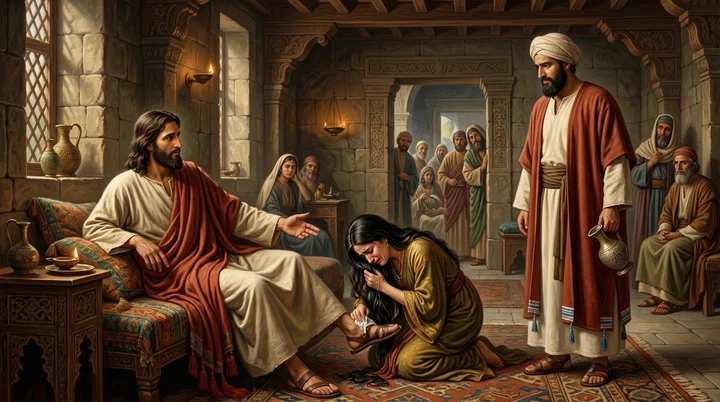
And he turned to the woman, and said unto Simon, Seest thou this woman? I entered into thine house, thou gavest me no water for my feet: but she hath washed my feet with tears, and wiped them with the hairs of her head.
Translations
And he turned to the woman, and said to Simon, See you this woman? I entered into your house, you gave me no water for my feet: but she has washed my feet with tears, and wiped them with the hairs of her head.
King James Version, KJV Cambridge Paragraph Bible
And he turned to the woman, and said unto Simon, Seest thou this woman? I entered into thine house, thou gavest me no water for my feet: but she hath washed my feet with tears, and wiped them with the hairs of her head.
And he turned to the woman, and said to Simon, Seest thou this woman? I entered into thy house, thou gavest me no water for my feet: but she hath washed my feet with tears, and wiped them with the hairs of her head.
And turning to the woman, he said unto Simon, Seest thou this woman? I entered into thine house, thou gavest me no water for my feet: but she hath wetted my feet with her tears, and wiped them with her hair.
And turning to the woman, he said unto Simon, Seest thou this woman? I entered into thy house, thou gavest me no water for my feet: but she hath wetted my feet with her tears, and wiped them with her hair.
And having turned unto the woman, he said to Simon, 'Seest thou this woman? I entered into thy house; water for my feet thou didst not give, but this woman with tears did wet my feet, and with the hairs of her head did wipe;
And turning to the woman he said to Simon, Seest thou this woman? I entered into thy house; thou gavest me not water on my feet, but she has washed my feet with tears, and wiped them with her hair.
And, turning towards the woman, unto Simon, he said—Seest thou this woman? I entered into thy house: water to me, on my feet, thou didst not give,—but, she, with her tears, hath wetted my feet, and, with her hair, wiped off [the tears].
And turning toward the woman, He said to Simon, “ Do you see this woman? When I entered your house, you did not give Me water for My feet, but she wet My feet with her tears and wiped them with her hair.
And turning toward the woman, He said to Simon, “ Do you see this woman? When I entered your house, you did not give Me water for My feet, but she wet My feet with her tears and wiped them with the hair of her head.
Turning to the woman, he said to Simon, “ Do you see this woman? I entered into your house, and you gave me no water for my feet, but she has wet my feet with her tears, and wiped them with the hair of her head.
And turning to the woman he said to Simon, You see this woman? I came into your house; you did not give me water for my feet: but she has been washing my feet with the drops from her eyes, and drying them with her hair.
Then he turned to the woman, and said vnto Simon, Seest thou this woman? I entred into thine house, and thou gauest mee no water to my feete: but she hath washed my feete with teares, and wiped them with the heares of her head.
Douay-Rheims (Challoner revision)
And turning to the woman, he said unto Simon: Dost thou see this woman? I entered into thy house, thou gavest me no water for my feet; but she with tears hath washed my feet, and with her hairs hath wiped them.
Pictures
Cross-references
- John 12:3
Then took Mary a pound of ointment of spikenard, very costly, and anointed the feet of Jesus, and wiped his feet with her hair: and the house was filled with the odour of the ointment.
Mary anoints Jesus’ feet and wipes them with her hair.
- Genesis 18:4
Let a little water, I pray you, be fetched, and wash your feet, and rest yourselves under the tree:
Both texts show the custom of providing guests water to wash their feet.
- Luke 7:38
And stood at his feet behind him weeping, and began to wash his feet with tears, and did wipe them with the hairs of her head, and kissed his feet, and anointed them with the ointment.
She washes Jesus’ feet with tears and wipes them with her hair.
- John 13:14-15
If I then, your Lord and Master, have washed your feet; ye also ought to wash one another’s feet.
Jesus’s foot washing contrasts Simon’s failure of hospitality and gives an example to follow.
- Matthew 26:6-13
Now when Jesus was in Bethany, in the house of Simon the leper,
A woman’s costly devotion to Jesus is criticized, but he defends her act.
- Genesis 24:32
And the man came into the house: and he ungirded his camels, and gave straw and provender for the camels, and water to wash his feet, and the men’s feet that were with him.
Water for washing guests’ feet reflects a custom of hospitality.
- Mark 14:3
And being in Bethany in the house of Simon the leper, as he sat at meat, there came a woman having an alabaster box of ointment of spikenard very precious; and she brake the box, and poured it on his head.
A woman anoints Jesus at a meal in Simon’s house.
- Genesis 19:2
And he said, Behold now, my lords, turn in, I pray you, into your servant’s house, and tarry all night, and wash your feet, and ye shall rise up early, and go on your ways. And they said, Nay; but we will abide in the street all night.
Lot offers guests water to wash their feet, showing a custom of hospitality.
- John 11:2
(It was that Mary which anointed the Lord with ointment, and wiped his feet with her hair, whose brother Lazarus was sick.)
Mary anointed Jesus and wiped his feet with her hair.
- Luke 7:39
Now when the Pharisee which had bidden him saw it, he spake within himself, saying, This man, if he were a prophet, would have known who and what manner of woman this is that toucheth him: for she is a sinner.
Jesus answers Simon’s contempt by pointing to the woman’s loving actions.
- John 13:4-5
He riseth from supper, and laid aside his garments; and took a towel, and girded himself.
Contrasts furnishing water with personally washing feet.
- Genesis 43:24
And the man brought the men into Joseph’s house, and gave them water, and they washed their feet; and he gave their asses provender.
Both describe the custom of providing water for guests to wash their feet.
- Judges 19:21
So he brought him into his house, and gave provender unto the asses: and they washed their feet, and did eat and drink.
Both texts show foot washing as customary hospitality for guests.
- 1 Samuel 25:41
And she arose, and bowed herself on her face to the earth, and said, Behold, let thine handmaid be a servant to wash the feet of the servants of my lord.
Both texts describe washing another’s feet as an act of service.
- Mark 14:6
And Jesus said, Let her alone; why trouble ye her? she hath wrought a good work on me.
Jesus defends a woman’s act and recognizes it as good.
- Mark 14:8
She hath done what she could: she is come aforehand to anoint my body to the burying.
Both describe a woman’s loving tribute to Jesus.
- John 12:7-8
Then said Jesus, Let her alone: against the day of my burying hath she kept this.
Jesus defends Mary’s devotion in response to criticism.
Commentary
Each commentary is drawn from primary sources: the writings of Ellen G. White and Adventist pioneers and periodicals. Each commentary is separate. Its own words are not a quotation; follow the references to read the source passages.
Ellen G. White
16 sources
Jesus pointed to a plain contrast in Simon's house, that the host had omitted the customary washing of a guest's feet while the penitent woman had supplied that lack with her tears and her hair.DA 557.1–2Ms 19, 1897, par. 29 Her humble service expressed repentance, gratitude and love for the forgiveness she had received and prized, while his neglect sprang from self-importance and a small sense of obligation to mercy received.2SP 382.1–24RED 114.1–3DA 567.1–5 The contrast does not mean she owed more because her sins were greater, for both debtors were alike unable to repay their debt of gratitude.2SP 381.1 Jesus reads the motives behind such acts, and He used this truthful yet tactful rebuke to bring Simon to recognize his own debt and the connection between forgiveness and love without humiliating him before his guests.2SP 382.1–2DA 567.1–52SP 382.319MR 259.1–3Ms 24, 1891, par. 88 To withhold such ordinary honor from Him still reveals a failure to give Him the care and devotion of the heart, whether by rejecting His messengers or by neglecting His work.Lt 8, 1898, par. 22–2721MR 297.1–298.3
Customary Welcome and Contrast
In the East washing a traveler's feet upon welcome was the customary hospitality, ordinarily performed by a servant, and to omit it was discourtesy.Ms 19, 1897, par. 29 Simon omitted it when Jesus entered his house, and Jesus named the omission as discourteous neglect.Ms 19, 1897, par. 29 Jesus was speaking in the house of Simon the Pharisee, where He had come by accepted invitation as He attended feasts.MH 24.2 He sought in this way the hearts of the wealthy and cultured, becoming familiar with their lives in order to reveal to them imperishable riches.MH 24.2
He turned to the woman and bade Simon consider her, for Simon had given Him no water for His feet while she had washed His feet with tears and wiped them with the hairs of her head.DA 557.1–2MH 24.2 The woman is Mary Magdalene, whom He had pardoned.ST Her account displays His respect and compassion in His treatment of women.ST
While the Pharisee judged His conduct, He treated people with generous kindness.15MR 132.2–3 His presence and gracious actions gave those who welcomed Him opportunity to know His character.15MR 132.2–3 That openness stood in contrast with self-righteous criticism.15MR 132.2–3
Forgiveness, Gratitude, and Love
The tears with which she washed His feet and the hair with which she wiped them were not mere emotion but repentance and humble service flowing from gratitude and love for pardoning mercy and forgiveness received and prized.2SP 382.1–24RED 114.1–3DA 567.1–52SP 381.1 Her loving attention stood in direct contrast to the failure to offer the customary care due a guest, and it showed that heartfelt courtesy and loving acts are precious in His sight.2SP 382.1–24RED 114.1–3DA 567.1–5 Simon's neglect came from self-importance and self-regard, from counting himself more righteous than she was.2SP 382.1–22SP 381.1RH Sep 25, 1900 That spirit revealed how little he appreciated mercy, and how small his sense of obligation and love toward his Saviour was.4RED 114.1–3DA 567.1–52SP 381.1 His hospitality, though outwardly proper, therefore lacked the deeper appreciation of Christ that her humble love displayed.RH Sep 25, 1900
The contrast does not mean she owed more because her sins were greater, for both debtors were alike unable to repay their debt of gratitude.2SP 381.1 What distinguished them was not the size of the debt but the prizing of mercy, she being filled with gratitude and love while he felt little need.2SP 381.1 Awareness of one's own sinfulness makes Christ's character and deliverance more precious, so her repentant devotion discerned His worth more truly than Simon's entertainment of Him did.RH Sep 25, 1900 Jesus reads the motives behind both actions, seeing through neglect on the one hand and through tears on the other to the heart beneath.2SP 382.1–2DA 567.1–5 Because loving deeds matter to Him, He is grieved when His children fail to express gratitude through words and loving deeds.2SP 382.1–2DA 567.1–5
He set forth this truthful yet compassionate contrast to teach truth tactfully in Simon's own house, exposing ingratitude without humiliating the host before his guests.2SP 382.319MR 259.1–3Ms 24, 1891, par. 88 By placing no water for His feet beside feet washed with tears, He brought Simon to recognize his debt and the meaning of forgiveness and love.2SP 382.319MR 259.1–3Ms 24, 1891, par. 88 The aim was that Simon himself would become humble and self-sacrificing rather than self-satisfied.2SP 382.3 The lesson belongs with the truth that the one forgiven most loves most, with love measured not by self-estimate but by sense of pardon received.19MR 259.1–3
Example and Present Warning
At the Pharisee's feast the occasion was turned into an opportunity for teaching, for words spoken at meals imparted life to those who heard them.MYP 406.2 That example instructs disciples in how to conduct themselves when among people, whether religious or nonreligious.MYP 406.2 Courtesy and sociability at the table thus become a means of reaching hearts with truth.MYP 406.2
To withhold ordinary hospitality, water for the feet and oil for the head, was to fail to honor a guest to whom care and devotion were due.Lt 8, 1898, par. 22–2721MR 297.1–298.3 The lack of water for the feet exposes the same failure in those who reject Christ's messengers and withhold from Him the care and devotion of the heart.Lt 8, 1898, par. 22–27 Their neglected opportunity stands against them in the record of judgment.Lt 8, 1898, par. 22–27 The rebuke to Simon likewise confronts unfaithful stewards who have not given Christ the care and devotion of their hearts, nor honored Him by receiving His messengers or supporting His work.21MR 297.1–298.3
Sources
Pioneers and periodicals
62 sources
At a meal where guests reclined with dust-covered feet, Jesus reproved His Pharisee host for giving Him no water to wash Himself while the penitent woman wet His feet with her tears and wiped them with her hair, continually kissing and anointing them with precious ointment.ST May 17, 1899ST May 17, 1899ST Apr 9, 1894ST May 12, 1914ST Jul 29, 1889 A full welcome customarily included water and towels for the traveler to wash himself, with a kiss and fragrant oil for the head, but no master himself washed his guests' feet, so her act was an extraordinary token of love and not ordinary hospitality.ST May 17, 1899ST May 12, 1914ST Jul 29, 1889ST Aug 5, 1886ST Feb 7, 1884 The woman was Mary Magdalene, a great sinner forgiven much and delivered from evil, while Simon was a Pharisee healed of leprosy who in proud self-regard thought the invitation honor enough, loved little, and inwardly judged both her and Jesus.ST Jul 29, 1889RH Jun 16, 1868ST May 24, 1905RH Oct 16, 1913 The scene belongs to the parable of the two debtors freely forgiven, proving her many sins were forgiven because she loved much, for Christ is precious in proportion as sinfulness and pardon are realized.RH Sep 25, 1900ST Jul 29, 1889ST Apr 7, 1898ST Apr 9, 1894 Forgiveness gives rise to love and love enables forgiveness, so Jesus did not scorn her humble, grateful service but declared her sins forgiven and her faith saving her, honoring one forgiven most who loved most even as the first witness of His resurrection.ST Sep 2, 1897RH May 12, 1903ST Aug 13, 1902ST Jul 4, 1900
Customs and Setting Explained
At Simon's table the guests reclined with feet extended, and road dust made washing the feet a customary welcome.ST May 17, 1899RH Dec 10, 1901ST May 17, 1899 A servant ordinarily brought water to cool and refresh the guest's feet and to remove the dust of travel.ST May 17, 1899ST May 17, 1899ST Jun 9, 1881 Simon gave Jesus no such water when He entered his house.ST May 17, 1899ST May 17, 1899RH Dec 10, 1901ST Jun 9, 1881ST May 17, 1899
The host's custom was to set water and towels before travelers so they could wash their own feet.ST Feb 7, 1884RH Jun 16, 1868ST Mar 29, 1899RH Jan 8, 1867ST Oct 24, 1900 No master of the house himself washed his guests' feet as hospitality.ST Feb 7, 1884RH Jun 16, 1868ST Oct 24, 1900 The words about giving no water therefore mean failure to set water before Him, not failure to wash His feet personally.ST Feb 7, 1884RH Jun 16, 1868 Washing was performed when the guest first entered, with water and utensils supplied by the host while another washed and dried the feet.ST Oct 5, 1882
A full welcome also included a kiss on the cheek with a blessing.ST May 17, 1899ST Jul 29, 1889 It also included fragrant oil for the head and beard, applied by host or servant, the anointing being an especial point of honor.ST May 17, 1899 Anointing the feet was an ordinary expression of honor and hospitality.ST May 12, 1914 The woman both anointed His feet with ointment and continually kissed His feet.ST Jul 29, 1889
One person washing another's feet was not ordinary hospitality.ST Aug 5, 1886ST Mar 29, 1899RH Jan 8, 1867 Her washing His feet with tears and wiping them with her hair was extraordinary.ST May 17, 1899ST May 17, 1899ST Aug 5, 1886 It was a special token of love from a penitent woman, not a customary duty neglected by the host.ST Aug 5, 1886
Neglect Contrasted With Devotion
Jesus turned toward the woman even while speaking to Simon, so that pointing to her would apply the lesson of forgiveness and love, rebuke Simon, expose his true condition, and defend her against criticism.ST May 17, 1899ST Jul 29, 1889ST Jun 9, 1881ST Dec 10, 1894RH Dec 10, 1901 He did not openly rebuke Simon before all the guests or hold him up to scorn, but convinced his mind by a true statement of his case and subdued his heart by pitying kindness, since stern denunciation would have closed his heart against repentance.ST Oct 9, 1879 He had entered Simon's house not to enjoy a feast but for the opportunity to teach, knowing beforehand what would take place.ST Dec 10, 1894
Simon as host gave Jesus no fitting welcome and no customary courtesies, offering no water to wash the dust from His feet when He entered, no kiss on the cheek with a blessing, and no fragrant oil for head and beard by host or servant, the anointing being an especial point of honor.ST May 17, 1899ST Jul 29, 1889ST Jun 9, 1881 The setting was a meal where guests reclined with feet extended, so that omission showed little love and no generous expression of gratitude, praise, and admiration.ST May 17, 1899ST Dec 10, 1894RH Dec 10, 1901 The woman instead wetted His feet with her tears and wiped them with the hair of her head, showing much love, devotion, gratitude, honor, and humble, tender care where Simon showed little.ST May 17, 1899ST May 17, 1899ST Apr 9, 1894ST Feb 24, 1914ST May 12, 1914 Her act expressed the love and gratitude of a penitent sinner forgiven much toward a Saviour whom others treated with haughty neglect.RH Dec 3, 1867ST Jun 9, 1881
She continually kissed His feet and anointed them with very precious ointment from her treasured alabaster box, which she broke so that its perfume filled the room, coming timidly and unobserved behind Him for fear He might soon be taken away.ST Jul 29, 1889RH Dec 10, 1901 She also anointed His head, while anointing the feet was an ordinary expression of honor and hospitality.ST May 12, 1914 Her outward touch at His feet was acceptable to Him, and He rewarded it with His inward touch, binding up her broken heart. He valued her deed of love and tenderly expressed His appreciation by declaring that her many sins were forgiven because she loved much.ST Oct 5, 1904
Her anointing of His head carried the deeper meaning of preparing His body for burial.ST May 12, 1914 This anointing recorded in Luke 7:36-50 is distinct from the later anointing described in Matthew 26:6-16, showing that similar events can be placed together in Scripture even when they occurred at different times, as with Jerusalem's destruction and Christ's second coming in Matthew 24.ST Sep 20, 1899 Jesus graciously accepted Simon's hospitality and humbly dined there to seek and save sinners, using the dinner gathering to present saving truth to those present.RH Oct 16, 1913 Simon had been healed of leprosy, yet gave no water for His feet, in contrast with her humble service of washing His feet with tears and wiping them with her hair, which illustrates the kindness and mercy that can help lead sinners to salvation.RH Oct 16, 1913
Woman and Simon Identified
The woman who washed the feet is Mary, and more particularly Mary Magdalene, the sinful woman who had been forgiven much and set free from Satan's power and from demonic possession, whose sorrow and shame over sin were lifted when Christ came to her.STST Jul 29, 1889ST May 24, 1905ST Jun 2, 1909 She realized how great a sinner she had been and how great the blessing of pardon and freedom was, so her love knew no bounds and poured itself out in devoted service on every occasion.ST Jul 29, 1889ST May 24, 1905 Christ saw and loved what was good in the penitent Magdalene rather than fixing attention on what was bad, and He pardoned her with respect and compassion as one who understands struggles of heart, knows human weakness, pities infirmity, forgives errors, and bestows earnestly desired grace.STRH Jun 2, 1904ST Sep 9, 1886 She is at the same time described as an unnamed woman whom the community and society regarded as a sinner, an outcast and unclean, forsaken with curling lip and scornful eye, yet one of many anonymous women who penitently adored and served the Lord, showing woman's conspicuous place in the primitive church.ST Oct 11, 1899ST Jul 12, 1883ST Jun 2, 1909 She had once been kind and true and pure as the morning dew, but had fallen lost and vile toward ruin, and she was brought by Simon to Jesus.ST Jun 9, 1881RH Jul 28, 1910ST Jun 2, 1909 Having found hope and renewed self-respect in His sympathy and welcome, she was turning from ruin toward a pure life and peace of mind, approaching Him in trust in restoration to honor the one who had helped her.ST Jun 9, 1881ST Jun 2, 1909
Simon was the Pharisee host of the dinner, himself healed of leprosy, who thought that merely inviting Jesus was sufficient honor while neglecting the regard due so exalted and merciful a guest.ST Jul 29, 1889RH Jun 16, 1868RH Oct 16, 1913ST Dec 10, 1894 In proud self-regard and pretension he loved little, because he appreciated his healing only to a limited extent and never realized what forgiveness of sin was worth or his own need.ST Jul 29, 1889RH Jul 28, 1910 He suspected her motive and did not appreciate it, misjudged Jesus, was vexed and jealous at her manner of giving because Jesus approved her instead of condemning her, and reasoned that if Jesus were a prophet or the Messiah He would know what manner of woman touched Him and would spurn so great a sinner.ST Jul 29, 1889ST Dec 10, 1894RH Dec 10, 1901ST Jan 3, 1911 Jesus knew both her unspoken thoughts of repentance and love and Simon's condemning thoughts, and He knew Simon's heart and sins.RH May 12, 1903ST Jan 3, 1911 Yet He did not openly rebuke Simon before all the guests nor exhibit and humiliate him before others, but convinced his mind by a true statement of his case and subdued his heart by pitying kindness and patient admonition.ST Oct 9, 1879ST Jan 3, 1911 Stern denunciation would have closed Simon's heart against repentance, whereas patient dealing opened his eyes, convinced him of error, and won his heart.ST Oct 9, 1879 Touched by that kindness, Simon saw the magnitude of the debt he owed his Lord and became a humble, self-sacrificing man.ST Oct 9, 1879
Forgiveness Produces Loving Repentance
The scene belongs to the parable of the two debtors in Luke 7:35-50, where both debtors were freely forgiven, and it teaches the forgiving spirit set forth also in Matthew 18:21-35 about forgiving a brother from the heart.ST Apr 7, 1898RH May 12, 1903 Turning to the woman while speaking to Simon, Jesus applied the lesson by contrasting Simon's failure to give even the customary courtesy of water for His feet, with no kiss and no oil for the head, against her washing His feet with tears, wiping them with her hair, continually kissing His feet, and anointing them with ointment.ST Oct 9, 1879ST Jul 29, 1889ST Jun 9, 1881ST Apr 9, 1894 That contrast proves her many sins are forgiven because she loved much, while he to whom little is forgiven loves little.ST Oct 9, 1879ST Jul 29, 1889ST Jun 9, 1881ST Apr 9, 1894 She as a penitent woman showed in this the depth of her love and gratitude for the mercy received.ST Oct 9, 1879ST Jun 9, 1881ST Apr 9, 1894
She is Mary, who realized how great a sinner she had been and the blessing of pardon and freedom from the power of Satan, so her love knew no bounds and showed itself on all occasions.ST Jul 29, 1889 Simon loved only to a limited extent because he appreciated healing only in a limited way and never realized what forgiveness of sin was worth or his own need for forgiveness.ST Jul 29, 1889ST Apr 9, 1894 Christ is therefore appreciated in proportion as past sinfulness and pardon are realized, and offerings to His cause manifest that appreciation of Him as a sin-pardoning God.ST Jul 29, 1889 Awareness of one's sinfulness makes Christ's character and deliverance more precious, while lack of love shows failure to recognize need.RH Sep 25, 1900ST Apr 9, 1894
Her tears and the care she gave express penitent shame, deep repentance, humility, gratitude, trust in restoration, and love.RH Dec 22, 1904ST Jun 9, 1881ST Aug 13, 1902ST Aug 13, 1902 Having found hope, renewed self-respect, and sympathy in Jesus, she brought her sinful past and broken pride to Him to honor the one who welcomed her and helped turn her from ruin toward a pure life and peace of mind, and her tears are associated with being cleansed from blame.RH Dec 22, 1904ST Jun 9, 1881 Her outward touch at His feet in weeping and anointing was acceptable to Him, in contrast with austere hypocrisy that would have spurned her as guilty and sorrowful.RH Sep 4, 1855 He rewarded it with His inward touch, binding up her broken heart and anointing her with the oil of joy for mourning, and her washing of His holy feet was the heart of faith touching Him. Her act was not base servility to be suspected or slandered, and Jesus did not scorn her service but affirmed her, declaring her sins forgiven and her faith saving her, sending her away with comfort, pardon, and peace.ST Sep 2, 1897RH May 12, 1903ST Aug 13, 1902
Forgiveness gives rise to love and love enables forgiveness, the two belonging inseparably together, for the one forgiven more loved more though she asked aloud for nothing.RH May 12, 1903 Because Mary Magdalene had been forgiven most she loved most, and because of that love she was honored as the first to see Jesus after His resurrection and the first human messenger of the risen Saviour. His declaring forgiveness and life to one sinful woman shows that one soul is of great value to God.ST Jul 8, 1886 Her reproach washed away in His precious blood, she stands renewed in white holiness as a pure white soul, humble and teachable as a child, her glad new spirit rising in rich fragrance to God as Saviour, Restorer, and Friend, proving no fall is too low for Jesus to reach for the destroyer who seeks Him with a broken and contrite heart like David for forgiveness, cleansing, and a life of purity and holiness through Christ Jesus.ST Jul 4, 1900 Her washing of His feet with tears pictures the doctrine of repentance as the sinful human heart turning toward virtue, and the account illustrates with striking force the lesson of a sinner's love for God in plain terms more powerful than abstract system.ST Oct 10, 1878ST Jun 1, 1882
Footwashing Teaching Clarified
The rebuke over no water for the feet shows a failure of hospitality that called forth instruction, for the charge was that water was not set before the guest so he might wash himself, not that the master of the house failed to wash his guest with his own hands, since no master washed his guests' feet as hospitality but only provided water for them to wash their own.RH Jun 16, 1868 That hospitality setting at meat in the Pharisee's house, where the woman washed the feet with tears and wiped them with her hair, stands apart from the washing of the disciples' feet after the paschal supper, which had no such occasion of neglected welcome and therefore was not meant to teach hospitality.RH Jun 16, 1868 The custom was for the host to furnish water and towels while the guest washed himself, so Simon's fault was giving no water for washing, while the woman herself performed the washing and wiping.ST Oct 24, 1878 Christ's taking basin and towel and Himself washing and wiping the disciples' feet at the Passover supper was therefore a marked departure from that custom, proving He was not merely acting as host to guests but creating a new institution or giving the old rite entirely new meaning.ST Oct 24, 1878
The ordinary hospitality was to supply water and utensils when the guest first entered, and even to give strangers water to wash their own feet, not for the host to wash the feet of guests or servants.ST Mar 29, 1899ST Oct 5, 1882 That entering act, with washing and drying by another from what was supplied, contrasts with Jesus washing the disciples' feet during the meal after they had already bathed.ST Oct 5, 1882 His act was therefore not simply a common custom.ST Mar 29, 1899ST Oct 5, 1882 The Jewish custom when travelers came to a house was for the host to set water before them so they could wash their own feet, and since Jesus received no water in Simon's house yet the woman washed His feet with tears and wiped them with her hair, washing one another's feet is proved not to have been a common Jewish custom but an uncommon act.RH Jan 8, 1867 Christ's washing of His disciples' feet was thus more than keeping custom; it taught humility and gave His followers an example to wash one another's feet.RH Jan 8, 1867
The woman's washing with tears and wiping with hair stands as an instance of her own action, not as evidence that hosts customarily washed guests' feet themselves, since Simon did not even provide water for washing.RH Jul 21, 1868
Scripture Connections and Applications
Love for Christ is proved by what a person gives, and offerings to His cause manifest appreciation of Him as a sin-pardoning God.ST Mar 22, 1883ST Jul 29, 1889 The one forgiven much loves much and gives freely even from deep poverty, while the respectable church member who feels little sense of sin loves little and gives sparingly.ST Mar 22, 1883ST Jul 29, 1889 This is why poor converts from heathen lands contribute largely and sacrificially while American professed Christians contribute less.ST Mar 22, 1883 Simon gave no water for feet, no kiss, and no oil for the head, while she washed feet with tears, wiped them with her hair, continually kissed the feet, and anointed them with ointment.ST Jul 29, 1889 The contrast proves her many sins are forgiven for she loved much, while he to whom little is forgiven loves little.ST Jul 29, 1889 She is Mary, who realized how great a sinner she had been and the blessing of pardon and freedom from the power of Satan, so her love knew no bounds and showed itself on all occasions, whereas Simon loved Christ but only appreciated healing to a limited extent and never realized how much forgiveness of sin was worth, so he suspected Mary, did not appreciate her motive, and loved little.ST Jul 29, 1889 Christ is appreciated in proportion as past sinfulness and pardon are realized.ST Jul 29, 1889 Her costly gift was not misspent, for love moved her to give it, and love — not financial calculation — is the right standard for judging her action.ST Jan 10, 1906
The scene teaches showing love and offering comfort to people while they are still living, rather than saving affection and praise until they can no longer hear or receive them.RH Jul 3, 1913 Her unprompted act of love met His need and reached His heart, and what men might dismiss as foolish or useless He defended and honored. He valued her deed of love and tenderly expressed His appreciation by declaring that her many sins were forgiven because she loved much.ST Oct 5, 1904 His response shows appreciation is a beautiful heavenly virtue and shows His heart hungering for human love and appreciation.ST Oct 5, 1904 She honored Him with humble, tender care in washing His feet with her tears and wiping them with her hair, while Simon had given Him no water for His feet.RH Jul 3, 1913
People should remember how often Jesus has given them another chance and avoid condemning others, since He repeatedly forgives sin.RH Aug 27, 1914 He knew He had lifted her up repeatedly, and He protected her from condemnation because it would have crushed her, for her actions expressed heartfelt gratitude and pure worship.RH Aug 27, 1914 Her example teaches that a sinner should not be driven away from Jesus by shame or by the claim that God's purity makes approach impossible, for abiding with the Lord is the way sin is driven away, and she knew the Lord better than the Pharisee who despised her.ST Apr 9, 1894 Her humble service illustrates the kindness and mercy that can help lead sinners to salvation, set against Simon's failure to provide water for His feet when He humbly dined at Simon's house to seek and save sinners. A person who has done wrong can be welcomed back as a weeping outcast received with love, as an estranged daughter should be welcomed home with forgiveness.RH Jan 1, 1861 Her act exemplifies His gracious attention to people others may despise and His effort to save people of every standing without showing partiality.RH Jan 8, 1914 She is an example of someone cast out as evil whom others should not scorn or pass by.RH Aug 17, 1911
This scene is presented as a picture of heaven: a life of loving, faithful service without the conflict of human sin.RH Mar 9, 1916 Heaven is like that act of a sinful woman from the street bathing His feet with her tears and wiping them with her hair.RH Oct 28, 1915 It is peace, joy, victory, triumph, life, love, and tireless faithful unselfish service going on forever.RH Oct 28, 1915 It is gained by following Christ today, tomorrow, and the day after through prayer and right living.RH Oct 28, 1915
In pardoning Mary Magdalene He treated women with respect and compassion.ST He understands heart struggles, knows the weakness of human nature, pities infirmities, forgives errors, and bestows the graces earnestly desired, and in this He is woman's best friend today, ready to aid her in all the relations of life.ST Apr 4, 1911ST Sep 9, 1886 By allowing a penitent woman to approach and touch Him He revealed His gentleness and tenderness, and in Him God's own character is made visible.ST Feb 25, 1897 His holy mission was to save those who were lost, so He consorted with publicans and sinners and went into the dives to reach them, seeing Mary Magdalene and speaking to her in words of love and hope.ST Oct 2, 1893 An unnamed woman penitently adoring Him in Simon's house stands as one of many anonymous women who served the Lord, showing that woman occupies a conspicuous place in the primitive church.
He saw and loved what was good in the penitent Magdalene rather than fixing attention on what was bad.RH Jun 2, 1904 Degrees of guilt are measured by light and motive, and the weeping, repentant Mary was brought by the proud, pretentious Pharisee Simon to Jesus.RH Jul 28, 1910 Simon stood under far greater condemnation before God than she did, and his garments were far more spotted with the flesh than hers, though he eagerly accused her.RH Jul 28, 1910
Sources