Mark 1:7
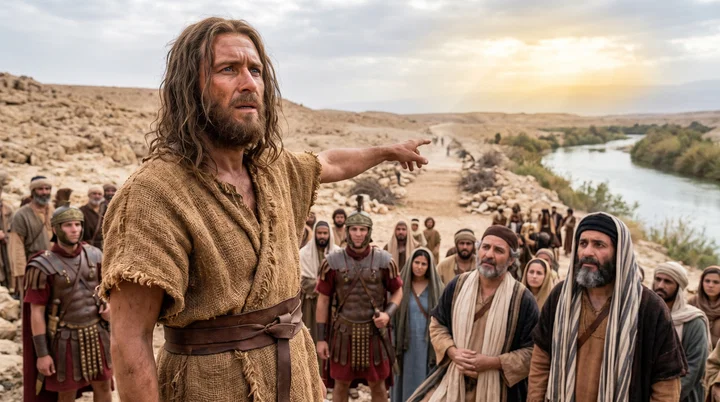
And preached, saying, There cometh one mightier than I after me, the latchet of whose shoes I am not worthy to stoop down and unloose.
Translations
And preached, saying, There comes one mightier than I after me, the lace of whose shoes I am not worthy to stoop down and unloose.
And preached, saying, There cometh one mightier than I after me, the latchet of whose shoes I am not worthy to stoop down and unloose.
and preached, saying, There cometh one mightier than I after me, the latchet of whose shoes I am not worthy to stoop down and unloose.
And preached, saying, There cometh after me one mightier than I, the latchet of whose shoes I am not worthy to stoop down and unloose.
Revised Version, American Standard Version
And he preached, saying, There cometh after me he that is mightier than I, the latchet of whose shoes I am not worthy to stoop down and unloose.
and he proclaimed, saying, 'He doth come — who is mightier than I — after me, of whom I am not worthy — having stooped down — to loose the latchet of his sandals;
And he preached, saying, There comes he that is mightier than I after me, the thong of whose sandals I am not fit to stoop down and unloose.
and he proclaimed, saying—He that is mightier than I cometh after [me], of whom I am not worthy to stoop and unloose the strap of his sandals:
And he began to proclaim: “ After me will come One more powerful than I, the straps of whose sandals I am not worthy to stoop down and untie.
And he proclaimed: “ After me will come One more powerful than I, the straps of whose sandals I am not worthy to stoop down and untie.
He preached, saying, “ After me comes he who is mightier than I, the strap of whose sandals I am not worthy to stoop down and loosen.
And he said to them all, There is one coming after me who is greater than I, whose shoes I am not good enough to undo.
And preached, saying, A stronger then I commeth after me, whose shoes latchet I am not worthy to stoupe downe, and vnloose.
Douay-Rheims (Challoner revision)
And he preached, saying: There cometh after me one mightier than I, the latchet of whose shoes I am not worthy to stoop down and loose.
Pictures
Cross-references
- Luke 3:16
John answered, saying unto them all, I indeed baptize you with water; but one mightier than I cometh, the latchet of whose shoes I am not worthy to unloose: he shall baptize you with the Holy Ghost and with fire:
John announces that one mightier than he is coming.
- Matthew 3:11
I indeed baptize you with water unto repentance: but he that cometh after me is mightier than I, whose shoes I am not worthy to bear: he shall baptize you with the Holy Ghost, and with fire:
John announces the mightier one coming after him and says he is unworthy to carry his shoes.
- John 1:27
He it is, who coming after me is preferred before me, whose shoe’s latchet I am not worthy to unloose.
John says the coming one is greater and he is unworthy to unloose his shoe’s latchet.
- Isaiah 40:3
The voice of him that crieth in the wilderness, Prepare ye the way of the LORD, make straight in the desert a highway for our God.
Predicts the voice preparing the Lord’s way, fulfilled by John.
- Malachi 3:1
Behold, I will send my messenger, and he shall prepare the way before me: and the Lord, whom ye seek, shall suddenly come to his temple, even the messenger of the covenant, whom ye delight in: behold, he shall come, saith the LORD of hosts.
Prophecies of the messenger preparing the way are fulfilled by John.
- John 1:29
The next day John seeth Jesus coming unto him, and saith, Behold the Lamb of God, which taketh away the sin of the world.
John identifies Jesus as the Lamb of God who takes away the world’s sin.
- John 1:35-49
Again the next day after John stood, and two of his disciples;
John’s witness to Christ leads the first disciples to follow him.
- John 1:15
John bare witness of him, and cried, saying, This was he of whom I spake, He that cometh after me is preferred before me: for he was before me.
Both declare Christ’s superiority over the one who came before him.
- John 1:34
And I saw, and bare record that this is the Son of God.
John identifies Jesus as the Son of God.
- Malachi 4:5
Behold, I will send you Elijah the prophet before the coming of the great and dreadful day of the LORD:
Elijah is foretold as the forerunner fulfilled by John.
- John 3:30
He must increase, but I must decrease.
John humbles himself as Christ increases.
- Mark 1:11
And there came a voice from heaven, saying, Thou art my beloved Son, in whom I am well pleased.
The Father’s voice identifies Jesus as his beloved Son and expresses approval.
- Luke 1:57-80
Now Elisabeth’s full time came that she should be delivered; and she brought forth a son.
Part of the cited account of John’s birth and calling.
- Daniel 9:25
Know therefore and understand, that from the going forth of the commandment to restore and to build Jerusalem unto the Messiah the Prince shall be seven weeks, and threescore and two weeks: the street shall be built again, and the wall, even in troublous times.
The passage connects the end of the sixty-nine weeks with the arrival of the Messiah whom John announces.
Commentary
Each commentary is drawn from primary sources: the writings of Ellen G. White and Adventist pioneers and periodicals. Each commentary is separate. Its own words are not a quotation; follow the references to read the source passages.
Ellen G. White
4 sources
The verse stands at the very beginning of the gospel account of Jesus Christ, the Son of God.Lt 66, 1906, par. 1–5 There John is baptizing and preaching in the wilderness to prepare the way of the Lord.Lt 66, 1906, par. 1–5 In that setting John announces that One mightier than himself is coming after him, and that coming One is Christ.Lt 66, 1906, par. 1–5DA 97.1LC1 42.2
John makes the announcement in order to turn the attention of the people away from himself to Christ.LC1 42.2 He does so with deep humility, declaring himself not worthy even to stoop down and untie the latchet of the coming One's shoes.DA 97.1LC1 42.2 The reason for such lowliness is the exaltation of Christ's work and mission, which is so much greater than John's own that even the lowliest service to Him is too high an honor for John.LC1 42.2
By thus pointing beyond his own baptism to the mightier One to come, the verse teaches that having received water baptism is not enough in itself.Ms 189, 1905, par. 1–6 Believers need the Holy Spirit just as much as baptism, and must seek Him rather than resting satisfied upon baptism already received.Ms 189, 1905, par. 1–6
Sources
Pioneers and periodicals
18 sources
John the Baptist announces that One far stronger than himself is coming after him, and confesses himself unworthy even to stoop to loosen His sandal strap.ST Dec 28, 1888RH Oct 30, 1860RH Nov 30, 1916ST Jun 7, 1910 He stands only as the prophet-herald pointing away from himself to Jesus as the expected Redeemer, not as the Messiah himself.ST Jun 26, 1907ST Dec 28, 1888ST Jun 26, 1907ST Jun 14, 1910 That Coming One is the eternal Son by whom the worlds were made, come from glory to reveal the Father, bring forgiveness and hope, and give His life to redeem the world from sin to holiness.RH Oct 30, 1860ST Dec 16, 1897 His coming also brings the promised baptism with the Holy Spirit, poured out in power upon the disciples at Pentecost after Christ was glorified.ST Jan 9, 1912ST May 25, 1904 John's self-effacement remains the pattern for all truly taught by the Spirit, who hide self, glorify Christ as mightier, and point sinners to the Lamb who takes away sin.ST Dec 28, 1888RH Dec 3, 1901RH Feb 8, 1915
John's Witness and Setting
The saying announces that one mightier than John would come after him.ST Dec 28, 1888RH Nov 30, 1916 That mightier one who follows is Jesus.ST Dec 28, 1888RH Nov 30, 1916 John's declaration that he was not worthy even to stoop down and loosen the sandal strap of the coming one shows his humility.ST Dec 28, 1888RH Nov 30, 1916
John stands in the saying as a prophet introducing the Redeemer, not as the Messiah himself.ST Jun 26, 1907ST Jun 26, 1907ST Jun 14, 1910 He points away from himself to Jesus as the expected Messiah.ST Jun 26, 1907ST Jun 26, 1907ST Jun 14, 1910 His word that the Messiah coming after him was far greater than he, and that he was unworthy even to stoop and untie the Messiah's sandal, corrected hopes that he himself might be the promised Shiloh.ST Jun 26, 1907ST Jun 26, 1907ST Jun 14, 1910 The unworthiness to stoop and unfasten the sandals expresses Jesus' greater authority and John's humility before Him, and identifies Jesus as the Messiah whose coming had been announced.ST Jun 26, 1907ST Jun 26, 1907ST Jun 14, 1910
Mark 1:1-8 is a fragmentary Gospel memoir that assumes its readers already know Jesus and John the Baptist.RH Apr 11, 1871 Its abrupt, incomplete form belongs to that memoir character.RH Apr 11, 1871 It reflects the original character of the Gospel materials rather than a later editor's attempt to arrange them into a seamless history.RH Apr 11, 1871
The saying belongs to Mark's account of Jesus and John.ST Dec 16, 1897ST Jan 9, 1896 It belongs to the record of the early ministry in Galilee after the baptism and forty days of temptation in the wilderness.ST May 6, 1880ST Jan 9, 1896 It is to be studied with Isaiah 40:1-5, Matthew 1 and 2, Luke 1-3, and John 1:1-18, and also with Isaiah 61:1-3, Matthew 4, Luke 4, and John 1:35-51 and 2-4.ST Dec 16, 1897ST Jan 9, 1896 That setting includes teaching in Galilee accompanied at first by John, Andrew, Simon, Philip, and Nathanael, including the return through Samaria after the first Passover at Jerusalem.ST Jan 9, 1896 In this chronology Jesus was born in the latter part of the Jewish year B.C. 5, and His baptism by John in the autumn of A.D. 27 began His public preaching that the time was fulfilled.ST Dec 16, 1897ST May 6, 1880
The Mightier Messiah Foretold
The one coming after John is Jesus, mightier than John and far greater in rank and authority.RH Oct 30, 1860ST Jun 7, 1910 The opening portrayal presents him as the glorious King, whose power is joined with humility, love, and benevolence.RH Oct 30, 1860 That surpassing greatness and the great difference in rank is shown by John's confession of unworthiness even to stoop down and loosen the strap of his sandal.ST Jun 7, 1910
He is the Word who became Jesus on earth, the eternal Son of God by whom the worlds were created.ST Dec 16, 1897 He came from his glorious home to reveal the Father in heaven, to express infinite love, to bring messages of forgiveness and hope, to give his life in atonement for sins, and to redeem the world from sin to holiness and heaven.ST Dec 16, 1897 His coming is to be understood with Isaiah 40:1-5, Matthew 1 and 2, Luke 1-3, and John 1:1-18, and he was born in the latter part of the Jewish year B.C. 5.ST Dec 16, 1897
John is the forerunner of the Messiah's first advent, altogether in the spirit of Elijah.RH Nov 18, 1862ST May 25, 1904 He fulfills the prophecy that the forerunner was to be Elijah himself or one in the spirit of Elijah, and he spoke by inspiration of the Holy Spirit to declare his own unworthiness before the mightier Coming One.RH Nov 18, 1862ST May 25, 1904 His announcement of the Coming One came when the Jews were expecting the Messiah.RH Oct 11, 1915 The 69 weeks, or 483 years, in Daniel's prophecy identified the time of Christ's first advent and gave a prophetic basis for the message announcing him.RH Oct 11, 1915
The announcement is a direct prophecy of baptism with the Holy Spirit.ST Jan 9, 1912 It was fulfilled in the shower of courage, fortitude, power, mental and spiritual force and foresight that fell upon the disciples in the upper room in Jerusalem in A.D. 31 at Pentecost.ST Jan 9, 1912 That baptism is the one culminating blessing of Jesus to the world, revealing the exalted character of Christ and the love of God.ST May 25, 1904 It is the sum total of all good gifts heaven bestows on mortals and includes every other gift.ST May 25, 1904 It was not given during the period of Christ's humiliation but after his ascension when he was glorified.ST May 25, 1904
Humility Pattern for Disciples
John humbly points away from himself to the coming Saviour, declaring Him greater than himself and himself unworthy even to serve Him in the lowliest place.ST Dec 28, 1888 Such humility is fitting for Christ's forerunner, for self-exaltation is foreign to the gospel.ST Dec 28, 1888 As Christ humbled Himself, so those who belong to Him must crucify the flesh with its affections and lusts.ST Dec 28, 1888
The same utter unworthiness before Jesus and self-effacement marks everyone truly taught by the Spirit.RH Dec 3, 1901 One so taught does not parade self or gather followers around self, but glorifies Christ and points others to the Lamb who takes away sin.RH Dec 3, 1901 He teaches obedience, humility, and faith in One mighty to save from sin, knows only the crucified Saviour, and offers only a broken and contrite heart trusting in Christ's merits alone.RH Dec 3, 1901 He declares Christ mightier and preferred before himself and himself unworthy to serve Him, that Christ must increase and self must decrease.RH Dec 3, 1901
Stooping to untie Christ's shoes is the sign of that deep humility and devotion.ST Dec 28, 1888RH Dec 3, 1901RH Feb 8, 1915 A believer with a new, warm heart will willingly humble himself for Christ and value Him above every worldly joy.RH Feb 8, 1915 He would even be ready to give up a throne rather than be parted from Him.RH Feb 8, 1915
Sources