Luke 19:45
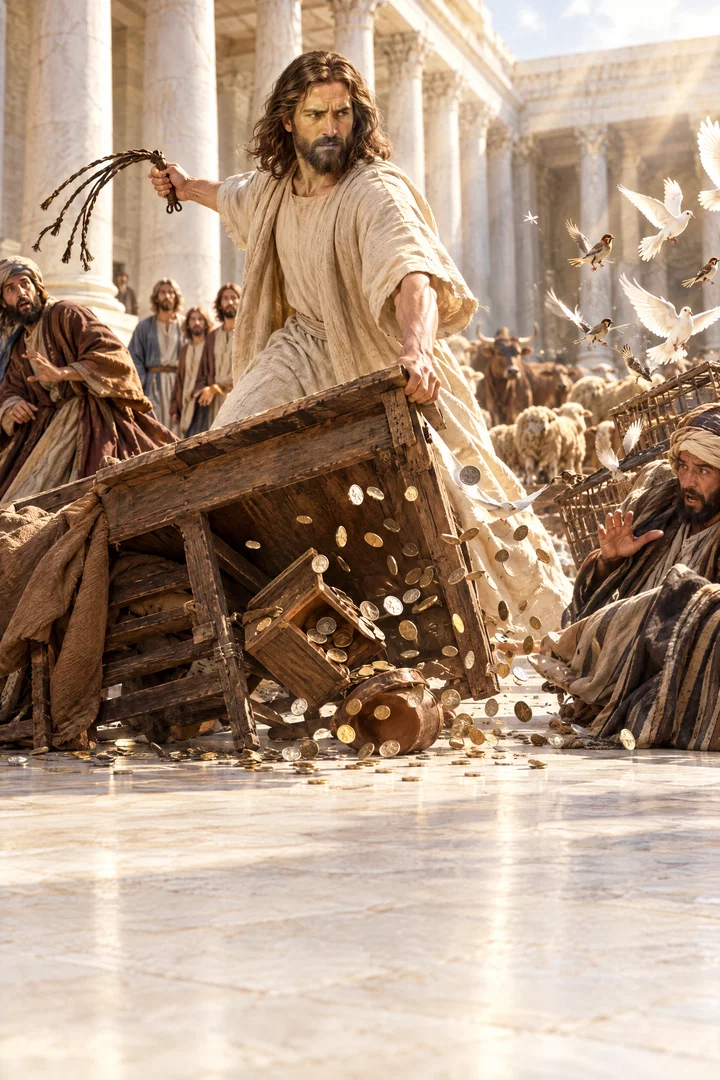
And he went into the temple, and began to cast out them that sold therein, and them that bought;
Translations
American King James Version, King James Version, KJV Cambridge Paragraph Bible
And he went into the temple, and began to cast out them that sold therein, and them that bought;
And he went into the temple, and began to cast out them that sold in it, and them that bought,
Revised Version, American Standard Version
And he entered into the temple, and began to cast out them that sold,
And having entered into the temple, he began to cast forth those selling in it, and those buying,
And entering into the temple, he began to cast out those that sold and bought in it,
And, entering into the temple, he began to be casting out them who were selling;
Then Jesus entered the temple courts and began to drive out those who were selling there.
Then Jesus entered the temple courts and began to drive out those who were selling and buying there.
He entered into the temple and began to drive out those who bought and sold in it,
And he went into the Temple and put out those who were trading there,
He went also into the Temple, and began to cast out them that solde therein, and them that bought,
Douay-Rheims (Challoner revision)
And entering into the temple, he began to cast out them that sold therein, and them that bought.
Pictures
Cross-references
- John 2:14-16
And found in the temple those that sold oxen and sheep and doves, and the changers of money sitting:
Jesus drives merchants from the temple.
- Matthew 21:12
And Jesus went into the temple of God, and cast out all them that sold and bought in the temple, and overthrew the tables of the moneychangers, and the seats of them that sold doves,
Jesus drives buyers and sellers from the temple.
- Mark 11:15-17
And they come to Jerusalem: and Jesus went into the temple, and began to cast out them that sold and bought in the temple, and overthrew the tables of the moneychangers, and the seats of them that sold doves;
Parallel account of Christ cleansing the temple.
- Jeremiah 7:11
Is this house, which is called by my name, become a den of robbers in your eyes? Behold, even I have seen it, saith the LORD.
Condemns making God’s house a den of robbers.
- Isaiah 56:7
Even them will I bring to my holy mountain, and make them joyful in my house of prayer: their burnt offerings and their sacrifices shall be accepted upon mine altar; for mine house shall be called an house of prayer for all people.
Declares God’s house a house of prayer for all people.
- Mark 11:17
And he taught, saying unto them, Is it not written, My house shall be called of all nations the house of prayer? but ye have made it a den of thieves.
Jesus condemns the temple’s misuse and declares its purpose.
- Psalms 69:9
For the zeal of thine house hath eaten me up; and the reproaches of them that reproached thee are fallen upon me.
His zeal for God’s house is shown in the temple cleansing.
- Malachi 3:1
Behold, I will send my messenger, and he shall prepare the way before me: and the Lord, whom ye seek, shall suddenly come to his temple, even the messenger of the covenant, whom ye delight in: behold, he shall come, saith the LORD of hosts.
The Lord comes to his temple, bringing purification.
- 1 Corinthians 3:16-17
Know ye not that ye are the temple of God, and that the Spirit of God dwelleth in you?
Temple cleansing is applied to the heart as God’s dwelling place.
- Luke 19:28-38
And when he had thus spoken, he went before, ascending up to Jerusalem.
triumphal ride from Bethany leads to temple
- John 12
Then Jesus six days before the passover came to Bethany, where Lazarus was which had been dead, whom he raised from the dead.
parallel account of same scene
Commentary
Each commentary is drawn from primary sources: the writings of Ellen G. White and Adventist pioneers and periodicals. Each commentary is separate. Its own words are not a quotation; follow the references to read the source passages.
Ellen G. White
28 sources
He entered the outer court near the close of his mission at Passover time to cleanse it a second time, having also cleansed it when beginning his public ministry about three years earlier.DA 589.1–590.21RED 74.1–2ST Jan 4, 1877 He found it turned into a noisy market like a cattle yard, crowded with animals for sacrifice, money changing, clinking coin, angry bargaining, and clamorous exchange without sacredness.1RED 74.1–2ST Mar 28, 1878ST Jan 4, 1877 Sellers charged exorbitant prices while priests and rulers themselves shared in the buying, selling, and exchange for gain, making sacred worship a source of profit and themselves robbers and thieves in God's sight.Ms 123, 1909, par. 231RED 74.1–2ST Mar 28, 1878 He acted as Israel's king with evident divine authority, showing stern justice as well as love and mercy in a final effort to reform the corrupt priesthood.DA 589.1–590.2STMW7 54.1–2ST Aug 4, 1909 The cleansing announced his mission to cleanse the heart from sin, for the crowded courts represent hearts defiled by selfishness, love of the world, lusts, evil habits, envy, and unholy thoughts that must yield as temples for the divine Spirit.RH Dec 31, 1908ST Jan 10, 1878
Temple Cleansing Described
Luke 19:45 records a second cleansing of the temple near the close of Jesus's mission at Passover time, after He had also cleansed the temple when beginning His public ministry about three years earlier.1RED 74.1–2ST Jan 4, 1877STOM 31.1COS 99.1Lt 1f, 1890, par. 16–17 He entered the outer court to find it turned into a noisy market like a vast cattle yard and common market day without sacredness, crowded with oxen, sheep, and doves, with the lowing, bleating, and cooing of animals mixed with money changing, the sharp clinking of coin, and angry bargaining and altercation between traffickers in clamorous exchange of produce.1RED 74.1–2ST Mar 28, 1878ST Jan 4, 18773SP 20.23MR 61.4 Sellers charged exorbitant prices for sacrificial animals, and priests, temple dignitaries, ministers of sacred rites, and other leaders themselves took part in the buying, selling, and exchange of money, profiting from the trade.1RED 74.1–2ST Mar 28, 1878ST Jan 4, 18773SP 20.2COS 99.1 Greed for gain overcame religious scruples, and their artful and avaricious handling of offerings, extortion, and profit made sacred worship a source of gain and made them no better than robbers and thieves in God's sight.Ms 123, 1909, par. 231RED 74.1–2ST Mar 28, 18783SP 20.2COS 99.1
The noise, bargaining, and altercation disturbed worshippers inside and drowned out prayer, presenting an unsanctified and painful spectacle to conscientious Jews who deplored the desecration of God's holy place but were unable to prevent it because the dignitaries of the temple themselves were engaged in it.ST Jan 4, 18773SP 20.2COS 99.1 The sacrificial service that pointed to Christ's coming sacrifice for the world's sin had its sacred meaning obscured by being turned into a means of gain.DA 589.1–590.2 Jesus acted as Israel's king with evident divine authority and kingly authority, showing He could act with stern justice as well as infinite love and mercy.DA 589.1–590.2ST Aug 4, 1909ST Mar 28, 1878 His cleansing was a warning of His divine mission and a final effort to reform the corrupt priesthood, though He knew that effort would fail.DA 589.1–590.2
His presence and soul-searching look silenced and awed the crowd, and priests, rulers, sellers, and buyers fled in fear as if pursued by armed soldiers, recognizing their hypocrisy and extortion.ST Aug 4, 1909COS 127.2–4EW 139.3ST Mar 28, 1878 The disciples remembered this display of power and later hoped He would similarly disperse the crowd and prove Himself King of Israel at His trial.COS 127.2–4EW 139.3 The flight of the priests and rulers foreshadows the terror of those who reject God's messages when hidden sins are exposed.STMW7 54.1–2 It also symbolized the dispersion of the Jewish nation for wickedness and refusal to repent.ST Aug 4, 1909
Cleansing Applied Today
The driving out of buyers and sellers was an announcement of the mission to cleanse the heart from sin.RH Dec 31, 1908 The temple courts crowded with trade stand for hearts defiled by earthly desires, selfish lusts, evil habits and unholy thoughts.RH Dec 31, 1908 That same desecrated court pictures the human heart which should receive Christ but is defiled by selfishness, love of the world, malice, envy and unholy passion.ST Jan 10, 1878 The temple was meant to witness to the high destiny open to every soul, yet the people did not yield themselves as temples for the divine Spirit.RH Dec 31, 1908 The act warns to heed calls to repentance rather than reject light and warnings received.ST Jan 10, 1878
Applied to the soul temple, the buyers and sellers are worldly merchandise, commercial cares, and the leaven of worldliness mingled with sacred trusts.Lt 102, 1905, par. 8–11 That mixture permeates the mind and destroys spiritual discernment.Lt 102, 1905, par. 8–11 The means and the physical and mental powers entrusted by God are sacred and must be kept unmingled with worldly merchandise and invested only for the Master's service and the increase of His talents.Lt 102, 1905, par. 8–11 Cleansing the soul temple from buyers and sellers frees the mind for single aim to do the Master's bidding, bringing upward growth and the Holy Spirit's transforming work on the heart.Lt 102, 1905, par. 8–11 It brings a generous spirit in kindness and tender regard for others, with self hid with Christ in God.Lt 102, 1905, par. 8–11
The cleansing shows how defiling influences would be removed from schools.CT 25.2FE 174.2 Books that corrupt the minds of the young would be taken away.CT 25.2 Books and teachings that defile the mind, misrepresent God and promote false principles would be removed and replaced with sound knowledge and truths that shape heart and conduct.FE 174.2
Christ claims authority to purge His work of everything that defiles it.6MR 268.1–269.3 When commercial work eclipses the sacred purpose of publishing present truth, that same cleansing would be applied to publishing houses.Lt 140, 1901, par. 1–4 Unjust plans and fraudulent dealings that deprive people of their rights must be cleansed from the publishing house, for such schemes are Satan's way and not Christ's, and those who see wrong must speak against it fearlessly.Lt 76, 1895, par. 9–11 Where justice and integrity and the love of God are not teaching and guiding, but iniquity, unfair schemes and selfish grasping are practiced, the temple courts are defiled.18MR 218.1–3 God bears only for a time with perversity and unsanctified working by leaders who do not work in straightforward righteous lines, His wrath is kindled at unprincipled work, and hearts grow harder and more unimpressible the more iniquity is practiced.18MR 218.1–3 He will soon cleanse His publishing house as He cleansed the temple and rise to punish iniquity, which requires establishing publishing plants in other places rather than remaining dependent on a corrupted center.18MR 218.1–3 The desecration of the temple by commerce is the comparison for the spiritual harm when the publishing office accepts and prints commercial work and material promoting false doctrines.Lt 46, 1903, par. 9–10
The same cleansing would fall on a publishing house that takes in and prints literature that unsettles faith and sows doubt and unbelief.6MR 268.1–269.3 That includes literature questioning the authority and purity of the Old Testament Scriptures, arguing that Christ was only a man, and dishonoring the Redeemer.6MR 268.1–269.3 Such work introduces Satan into the office and sends forth an army of educated infidels.6MR 268.1–269.3 His house shall be called a house of prayer and must not be made a den of thieves, and He commands the removal of what defiles with the words Take these things hence.6MR 268.1–269.3 At Battle Creek likewise the institution must be cleansed of corrupt control, self-serving practices and principles that deprive people of their rights, so that God's temple does not become a place of exploitation but is served by people of piety and holy purpose.Lt 83, 1896, par. 38–40
If Jesus entered churches and saw extravagant fashion on display, He would drive out those who dishonor and desecrate the house of God.4T 642.4–643.1 If He saw feasting and unholy trade encouraged for religious income, He would drive out those who desecrate the church in the name of religion.GC88 474.2 The cleansing near the close of His ministry, as He had also cleansed at the beginning of His public ministry, illustrates the final warning to the world.STOM 31.1Lt 1f, 1890, par. 16–17 That final warning includes the second angel's message and the heavenly call for God's people to come out of Babylon because her sins have reached heaven.STOM 31.1 It is the final call to leave Babylon and reject false worship, including the spurious Sabbath that replaces God's Sabbath.Lt 1f, 1890, par. 16–17
Sources
Pioneers and periodicals
34 sources
Coming into Jerusalem at the close of his ministry after the triumphal ride from Bethany over the Mount of Olives, he went into the temple and with kingly authority cast out both those who sold and those who bought, in the second cleansing of the temple just before his crucifixion, distinct from the first at the beginning of his public ministry.ST Sep 17, 1902ST Aug 20, 1894ST Nov 3, 1898 He found its outer court turned into a noisy cattle yard of animals, money-changing and angry bargaining that drowned out prayer, where worshipers were exploited by exorbitant rates and excessive prices while priests, rulers and leaders approved, shared in and profited from the trade.ST Mar 28, 1878ST Jan 4, 1877ST Oct 7, 1913 Their selfish mercenary commerce defiled the courts dedicated to worship and prayer as the dwelling place of the Most High, corrupted the house of prayer, made them thieves in God's sight and exposed its misuse as a den of thieves.ST Sep 17, 1902STST Oct 7, 1913 He dismissed hundreds by his decisive, quiet command and holy presence, not by angry looks or harshness, silencing the crowd and putting the priests and rulers to flight in recognition of their hypocrisy and extortion.ST Aug 4, 1909ST Sep 17, 1902ST Feb 14, 1878RH Nov 23, 1916 The act condemns turning God's house into a regular market and place of merchandise, so that all artificial means of raising money such as bazaars, fairs, feasts and parties aimed at worldly appetites eat out pure benevolence and cannot please him, since even sellers of sacrificial offerings were rebuked; and the crowded courts picture hearts defiled by selfish lusts, love of the world and unholy passion, announcing his mission to cleanse the heart from sin.RH Dec 31, 1908ST Jan 10, 1878ST Nov 19, 1894ST Jun 10, 1875
Setting in Luke's Narrative
Luke 19:45 belongs to the triumphal entry into Jerusalem in Luke 19:28-48, Luke's fullest account of Christ coming to Jerusalem weeping over the city while the crowd shouts his praise.ST Sep 17, 1894ST The same coming is told also in Matthew 21, Mark 11, and John 12.ST It stands near the close of his ministry, only a few days before his crucifixion, as part of the working out of God's plan for the salvation of the race from his birth onward.ST Sep 17, 1894ST Nov 8, 1883 After this coming the next event of importance is the institution of the Lord's Supper.ST Christ's fulfilled prophecies, miracles, pure life and teaching, and raising of Lazarus had shown that he was the Messiah and king of Israel.ST Nov 8, 1883
The cleansing took place on the Monday before Passover. The buying and selling there showed that it was an ordinary workday, not the Sabbath.
The disciples thought the kingdom of God should immediately appear, so the parable of the nobleman was spoken to correct that impression.ST Sep 16, 1889ST Nov 27, 1879 Yet on entering Jerusalem they still hailed him as king and son of David with palm branches and shouts of triumph.ST Sep 16, 1889ST Nov 27, 1879 They did not realize he was going into the city to suffer and be condemned and crucified as a malefactor.ST Sep 16, 1889ST Nov 27, 1879 Their mistaken expectation cautions against treating their understanding of the timing and order of future events as proof of when those events will occur.ST Sep 16, 1889
The verse closes the triumphal ride from Bethany over the Mount of Olives into Jerusalem.ST Nov 3, 1898 After coming near and weeping over the city, Jesus passed with the enthusiastic throng down through the valley, up the slope to the gate, into the city, and into the temple, where he cast out the traffickers.ST Nov 3, 1898
He entered the temple court up its polished marble steps with the twelve through a pressing throng and took a seat.RH Nov 23, 1916 His holy presence itself began the cleansing by bringing a hush that stopped the money-changers gripping coin and crying, made the sellers dumb, and made the priests slink back abashed and hide.RH Nov 23, 1916 He sat enwrapped in deep silent thought with grief over human guilt and sin and his coming death, awakening pity in beholders.RH Nov 23, 1916 The twelve stood apart dreading to look into his eyes, with John near him and Peter and James by a pillar and Judas by the treasury box coveting the gifts and dreaming of a bargain with the priests to sell the Lord.RH Nov 23, 1916
Nature of Temple Desecration
At Passover he found its outer court turned into a place of buying and selling.ST Mar 28, 1878ST Jan 4, 1877 It had become like a cattle yard filled with animals, money-changing, and angry bargaining.ST Mar 28, 1878ST Jan 4, 1877 The noise and bargaining disturbed worship and drowned out prayer.ST Mar 28, 1878ST Jan 4, 1877
The trade exploited worshipers who needed to exchange money and buy sacrificial animals by charging exorbitant rates and excessive prices.ST Jan 4, 1877ST Oct 7, 1913 The temple's own dignitaries, priests, rulers, and leaders took part in, approved, and profited from the trade and money-changing.ST Mar 28, 1878ST Jan 4, 1877ST Oct 5, 1904 Greed had overcome religious scruples.ST Mar 28, 1878
Their selfish, mercenary commerce defiled and desecrated its courts and corrupted the house of prayer.ST Mar 28, 1878ST Sep 17, 1902ST Sep 22, 1909 That house had been dedicated to worship and prayer as the dwelling place of the Most High meant to show sinners the way of salvation and to witness to the high destiny open to every soul.ST Oct 7, 1913RH Jun 6, 1907 Greed and exploitation made them thieves in God's sight, and exposed its misuse as a den of thieves.ST Mar 28, 1878ST Sep 17, 1902 This filled up the Jewish nation's cup of iniquity as part of finishing transgression.ST
The sellers offered sacrificial offerings, a more legitimate trade than other business, yet their presence still called for rebuke.ST Nov 19, 1894ST Dec 29, 1887 Conducting even otherwise legitimate business there violated the temple's sacred purpose.ST Nov 19, 1894ST Dec 29, 1887
Authority and Manner of Cleansing
He entered the temple after the triumphal ride and with kingly authority began to cast out both those who sold and those who bought, because their commerce had defiled its courts and corrupted the house of prayer.ST Sep 17, 1902ST Feb 14, 1878 He drove out the money-changers and merchants and other tricksters, powerfully dismissing hundreds of people.ST Feb 14, 1878 He did this not with angry looks or harshness or any effort to make people afraid, but through his kingly bearing and decisive, quiet command. His action fulfilled the temple's purpose as a house of prayer for all nations and exposed its misuse as a den of thieves.ST Sep 17, 1902 His power to cleanse the temple is the power needed to save society from political corruption.
He came up its polished marble steps with the twelve through a pressing throng and took a seat, and his holy presence itself began the cleansing.RH Nov 23, 1916 A hush fell that stopped the money-changers gripping their coin and crying, made the sellers dumb, and made the priests slink back abashed and hide.RH Nov 23, 1916 His presence and authority in this way silenced and awed the crowd, showing that he could act with stern justice as well as infinite love and mercy.ST Mar 28, 1878RH Nov 23, 1916 He sat enwrapped in deep silent thought, grieving over human guilt and sin and his coming death on the morrow, awakening pity in those who looked on, while the twelve stood apart dreading to look into his eyes, with John near him and Peter and James by a pillar and Judas by the treasury box coveting the gifts and dreaming of a bargain with the priests to sell the Lord.RH Nov 23, 1916 The priests and rulers fled in fear, recognizing their own hypocrisy and extortion.ST Aug 4, 1909
By clearing the temple of the unholy buying and selling that its leaders had approved and profited from, he displayed his power and his disregard for their prestige.ST Oct 5, 1904 That display intensified their anger and envy against him.ST Oct 5, 1904 Their flight in fear before him symbolized the dispersion of the Jewish nation for wickedness and refusal to repent.ST Aug 4, 1909
The cleansing is similar to that described in John 2:13-16.ST Aug 20, 1894 It was the second cleansing of the temple, done just before the crucifixion at the close of Christ's ministry. It is the same event recorded in Matthew 21:12 and Mark 11:12, 15, and is distinct from the first cleansing at the beginning of his public ministry recorded in John 2:13, 14.
Prophecy History and Parallels
The entry into Jerusalem of which the going into the temple and casting out of sellers and buyers is part took place near the close of the ministry, only a few days before the crucifixion, and fulfills Zechariah 9:9.ST Nov 8, 1883 Fulfilled prophecies, miracles, a pure life and teaching, and the raising of Lazarus had shown that he was the Messiah and King of Israel.ST Nov 8, 1883 The driving of sellers from the temple courts was a faint type of Nehemiah's act of prohibiting commerce on ground consecrated to God.ST Nov 15, 1899
The cleansing near the close of the ministry came after he had cleansed it at the beginning of the public ministry, and this repeated cleansing parallels the final warning to the world.ST Feb 13, 1893 That warning is the second angel's message and heaven's call for God's people to come out of Babylon.ST Feb 13, 1893 The driving of sellers and buyers from the temple also provides the basis for condemning corruptions introduced into the church under the Papacy and for teaching Christians to remove such corruptions as far as they could. In Scotland this application led to the removal of images and objects used to foster idolatry and image-worship.
Call to Church and Heart
The temple was holy to God and not a place for commercial gain, ordinary trade, or even for carrying vessels through it.ST Apr 15, 1880ST Dec 16, 1897 Its sacred purpose is incompatible with using a place of worship to promote commercial or secular amusements, as when churches ally themselves with playhouses and clubrooms as entertainment providers.ST Jun 4, 1885 Money raised through such dealings is unfit for holy service merely because it is called sanctified.ST Apr 15, 1880
The act condemns turning God's house into a regular market and place of merchandise and money-making from sacrifices and oblations.ST Jun 10, 1875ST Dec 30, 1903 Giving for God's cause must be pure benevolence from a sense of duty, from the need of the cause, and from love to God and humanity, not for show, not to get something for self, and not planned so it costs nothing. All artificial means for raising money for benevolent or Christian purposes, such as bazaars, fairs, feasts, parties, and schemes aimed at worldly appetites, have a downward tendency and eat out the spirit of pure benevolence, because in them people hope to give without sacrifice and to be paid back in pleasure for all they give.ST Jun 10, 1875 Such practices cannot please Christ, and since even the sellers of sacrificial offerings — a more legitimate trade than amusements used to raise church funds — were rebuked, religious fundraising never justifies turning worship into a marketplace.ST Nov 19, 1894ST Jun 10, 1875 The church should turn from such practices and plead with God for mercy.ST Dec 30, 1903
That same cleansing is needed when Protestant churches unite to keep and glorify Holy Week as an institution of the Roman Church.RH May 23, 1912 Taking up a Catholic observance defiles the temple, which is the church, and is prima facie evidence that corrupt practices must again be cast out.RH May 23, 1912
The verse shows Christ driving corruption and greed from the church to cleanse it as God's house, and his power to cleanse the temple is the power needed to save society from political corruption.ST Sep 9, 1889 It drives religious leaders away from abandoning worship and teaching for political activity and back to their proper work.ST Mar 23, 1915 It rebukes public servants who corruptly prey on the public and calls for reverence for Christ's teachings in daily life. Rightness is not judged by financial advantage, since moral duty can require action even at material cost and immediate harm to business.ST Sep 22, 1909
The temple courts crowded with buyers and sellers represented hearts defiled by earthly desires, selfish lusts, evil habits, unholy thoughts, selfishness, love of the world, malice, envy, and unholy passion.RH Dec 31, 1908ST Jan 10, 1878 The cleansing announced his mission to cleanse the heart from sin, for the desecrated courts picture the human heart that should receive Christ.RH Dec 31, 1908ST Jan 10, 1878 The temple was meant to witness to the high destiny open to every soul, but the Jews did not yield themselves as temples for the divine Spirit.RH Dec 31, 1908 This warns people to heed his calls to repentance rather than reject the light and warnings they have received.ST Jan 10, 1878
After his triumphant ride he entered the Jerusalem temple and powerfully drove out the money-changers and merchants shortly before his crucifixion.ST Feb 14, 1878 The people of Jerusalem, like people in the present day, were unmindful of their privileges and ignored the warnings of God's Spirit while their time of probation was running out.ST Feb 14, 1878
Sources