John 2:14
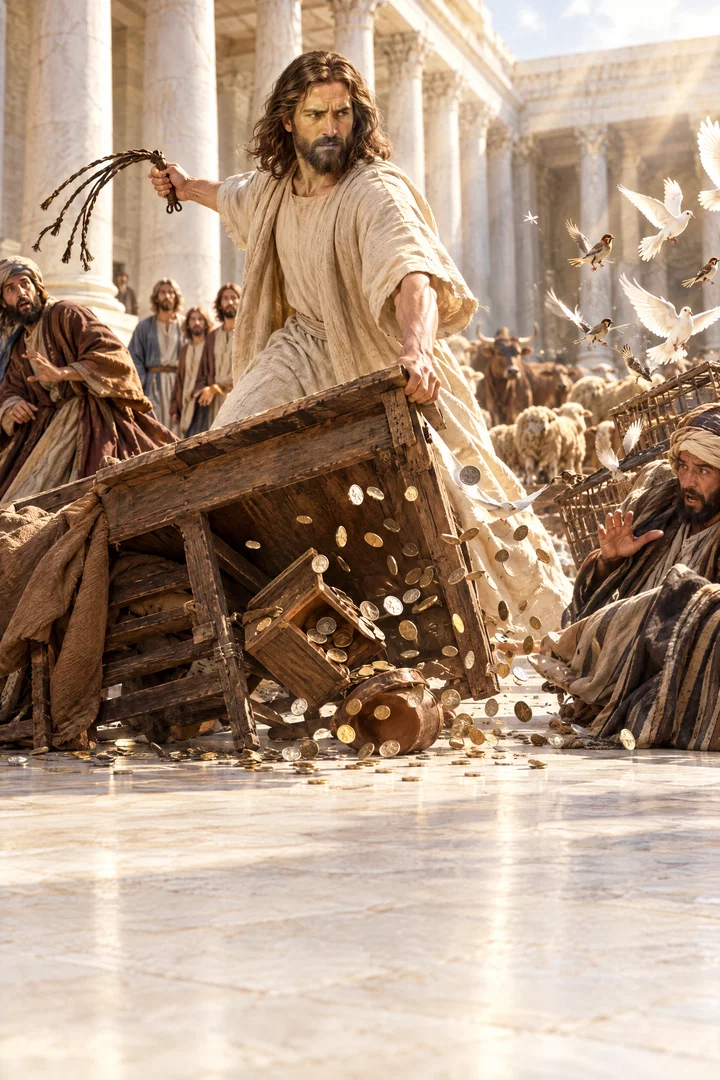
And found in the temple those that sold oxen and sheep and doves, and the changers of money sitting:
Translations
American King James Version, King James Version
And found in the temple those that sold oxen and sheep and doves, and the changers of money sitting:
and found in the temple those that sold oxen and sheep and doves, and the changers of money sitting:
And found in the temple those that sold oxen, and sheep, and doves, and the changers of money, sitting:
Revised Version, American Standard Version
And he found in the temple those that sold oxen and sheep and doves, and the changers of money sitting:
and he found in the temple those selling oxen, and sheep, and doves, and the money-changers sitting,
And he found in the temple the sellers of oxen and sheep and doves, and the money-changers sitting;
And he found, in the temple, them that were selling oxen and sheep and doves, also the money-changers sitting.
Berean Standard Bible, Majority Standard Bible
In the temple courts He found men selling cattle, sheep, and doves, and money changers seated at their tables.
He found in the temple those who sold oxen, sheep, and doves, and the changers of money sitting.
And there in the Temple he saw men trading in oxen and sheep and doves, and he saw the changers of money in their seats:
And he found in the Temple those that sold oxen, and sheepe, and doues, and changers of money, sitting there.
Douay-Rheims (Challoner revision)
And he found in the temple them that sold oxen and sheep and doves, and the changers of money sitting.
Pictures
Cross-references
- Matthew 21:12-13
And Jesus went into the temple of God, and cast out all them that sold and bought in the temple, and overthrew the tables of the moneychangers, and the seats of them that sold doves,
Jesus drives sellers and money changers from the temple and condemns its misuse.
- Mark 11:15-17
And they come to Jerusalem: and Jesus went into the temple, and began to cast out them that sold and bought in the temple, and overthrew the tables of the moneychangers, and the seats of them that sold doves;
Parallel account of Jesus driving out the sellers.
- Luke 19:45-46
And he went into the temple, and began to cast out them that sold therein, and them that bought;
Parallel account of Christ driving traders from the temple.
- Jeremiah 7:11
Is this house, which is called by my name, become a den of robbers in your eyes? Behold, even I have seen it, saith the LORD.
Jesus condemns turning God’s house into a den of thieves.
- Isaiah 56:7
Even them will I bring to my holy mountain, and make them joyful in my house of prayer: their burnt offerings and their sacrifices shall be accepted upon mine altar; for mine house shall be called an house of prayer for all people.
God’s house is meant to be a house of prayer, not defiled by traders.
- 1 Corinthians 3:16-17
Know ye not that ye are the temple of God, and that the Spirit of God dwelleth in you?
The temple’s holiness is applied to believers, with a warning against defiling it.
- Psalms 69:9
For the zeal of thine house hath eaten me up; and the reproaches of them that reproached thee are fallen upon me.
Christ’s zeal for God’s house is shown in driving traders from the temple.
- Exodus 30:13
This they shall give, every one that passeth among them that are numbered, half a shekel after the shekel of the sanctuary: (a shekel is twenty gerahs:) an half shekel shall be the offering of the LORD.
The required half-shekel tribute explains the money exchange at the temple.
- Matthew 21:12
And Jesus went into the temple of God, and cast out all them that sold and bought in the temple, and overthrew the tables of the moneychangers, and the seats of them that sold doves,
Jesus drives sellers and money changers from the temple.
- Jeremiah 7:4
Trust ye not in lying words, saying, The temple of the LORD, The temple of the LORD, The temple of the LORD, are these.
Both rebuke presuming on the temple while disobeying God.
- Malachi 3:1-3
Behold, I will send my messenger, and he shall prepare the way before me: and the Lord, whom ye seek, shall suddenly come to his temple, even the messenger of the covenant, whom ye delight in: behold, he shall come, saith the LORD of hosts.
The coming Lord purifies his people like a refiner.
- Matthew 21:14
And the blind and the lame came to him in the temple; and he healed them.
Healing followed cleansing in the temple.
- Exodus 12:1-14
And the LORD spake unto Moses and Aaron in the land of Egypt, saying,
The temple scene takes place at the Jewish Passover.
- Deuteronomy 16:1-6
Observe the month of Abib, and keep the passover unto the LORD thy God: for in the month of Abib the LORD thy God brought thee forth out of Egypt by night.
The Passover pilgrimage brought worshipers to the temple.
- 1 Corinthians 3:17
If any man defile the temple of God, him shall God destroy; for the temple of God is holy, which temple ye are.
Cleansing the temple foreshadows God’s destruction of temple defilers.
- Deuteronomy 12:5
But unto the place which the LORD your God shall choose out of all your tribes to put his name there, even unto his habitation shall ye seek, and thither thou shalt come:
The temple was the place God chose for his name.
- 2 Corinthians 6:16
And what agreement hath the temple of God with idols? for ye are the temple of the living God; as God hath said, I will dwell in them, and walk in them; and I will be their God, and they shall be my people.
both present God's dwelling in a temple
- Exodus 25:8
And let them make me a sanctuary; that I may dwell among them.
The sanctuary is where God dwells among his people.
- 1 Corinthians 6:19-20
What? know ye not that your body is the temple of the Holy Ghost which is in you, which ye have of God, and ye are not your own?
body as temple Christ claims and cleanses
Commentary
Each commentary is drawn from primary sources: the writings of Ellen G. White and Adventist pioneers and periodicals. Each commentary is separate. Its own words are not a quotation; follow the references to read the source passages.
Ellen G. White
111 sources
Early in His ministry at Passover time Jesus came into the outer court of the temple and found it occupied as a cattle market with sellers of oxen and sheep and doves and money changers seated with their tables.DA 1542SP 118.1–119.1LC1 74.1–2ST Jan 4, 1877 What was meant to accommodate distant worshipers had become noisy traffic and extortion, with priests and rulers sharing the dealers' gain and selling at exorbitant prices while greed displaced prayer and profaned worship.DA 154.1–2ST Sep 16, 1897DA 154.3–155.1LC1 74.1–2ST Jan 4, 1877 The animals sold for offerings were meant to point to the one great Sacrifice, yet Christ the founder of that system stood unrecognized among them and the meaning of blood sacrifice was nearly lost.ST Sep 16, 1897DA 154.3–155.1DA 157.1–2Lt 78, 1903, par. 5–83SP 21.1–2 In zeal for God's house He drove men and beasts beyond the portals with a scourge of cords and overthrew the tables, not by human force but by divine majesty that struck panic and guilt into even the hardened leaders.2SP 118.1–119.11RED 77.1–78.1ST Jan 4, 187718MR 91.1–2Lt 78, 1903, par. 5–8 That cleansing announced His mission to cleanse the human heart and His church from sin and selfish gain, and with His second cleansing at the close of ministry it foreshadows the final warning call and purification before His return.RH Dec 31, 1908STA 39.1STOM 31.1STBk 39.1–40.1
Temple Market at Passover
What Jesus found was inside the temple, in its outer court, where sellers of oxen and sheep and doves and changers of money were seated, so that buying and selling of sacrificial animals and exchanging of money had taken possession of the sacred place.DA 1542SP 118.1–119.1 The commerce itself was unholy and desecrated the courts, turning them into a place of merchandise where greed and avarice flourished.2SP 118.1–119.1
It was early in the morning at Passover at the start of His ministry, when Jerusalem was crowded with people come from a distance and large crowds with His disciples mingled in the throng were already going to the temple.LC1 74.1–2ST Jan 4, 1877 The court had been arranged as a cattle market and place of general traffic, with stalls for beasts and tables set out for business.LC1 74.1–2ST Jan 4, 1877 On any ordinary day it was like a common market, full of noisy clamor and the exchange of produce with buying and selling going on and no sacredness remaining.LC1 74.1–2ST Jan 4, 18773MR 61.4
The money changing exchanged foreign coins and different denominations brought by strangers for temple currency, for the sanctuary shekel and the yearly half-shekel regarded as a ransom for each person and supporting the temple, while other money was brought as freewill offerings.DA 154.1–2DA 154.3–155.1LC1 74.1–2ST Jan 4, 1877 Roman coins were exchanged for money used in the temple, and the priests themselves acted as money-brokers and exchangers at the tables.LC1 74.1–2ST Jan 4, 1877Ms 37, 1894, par. 6 What began as accommodation had grown into a disgraceful traffic and a source of great profit to the priests, becoming a fraudulent trade that brought them revenue.DA 154.1–2LC1 74.1–2ST Jan 4, 1877
Under plea of accommodating visitors who had come too far to bring their sacrificial offerings, cattle, sheep, doves and sparrows were sold in the court.LC1 74.1–2ST Jan 4, 1877 The arrangement served worshipers who could not bring sacrifices from home, since pilgrims brought coins to pay the temple offering and needed animals for sacrifice.LC1 74.1–21RED 74.1–2ST Jul 28, 1909 Because vast numbers of beasts were sacrificed yearly at Passover the sales were immense.LC1 74.1–2ST Jan 4, 18771RED 74.1–2
Sharp bargaining, buying and selling, the lowing of cattle, the bleating of sheep, the cooing of doves, the chinking and clinking of coin, the shouts of drivers and angry disputation made a babel of confusion like a noisy cattle market rather than the sacred temple of God.LC1 74.1–2ST Jan 4, 1877Lt 78, 1903, par. 5–8 The uproar disturbed the worshipers just without the sacred precincts, until words addressed to the Most High were drowned in the confusion invading the temple erected to His glory, and the sight stirred Jesus to indignation.LC1 74.1–2ST Jan 4, 1877
Extortion and Desecration
The traffic in the courts was marked by exorbitant prices, fraud, extortion and false dealing.DA 154.1–2DA 154.3–155.1LC1 74.1–2DA 155.2–33SP 21.1–2 Changing foreign coins and different denominations for temple currency had grown into a disgraceful, fraudulent trade that brought revenue and immense profit to the priests.DA 154.1–2DA 154.3–155.1LC1 74.1–2 Dealers realized large gain that was shared with the avaricious priesthood and men of authority, who under cover of holy profession practiced extortion and made sacred office a source of personal revenue.LC1 74.1–2DA 155.2–33SP 21.1–2 Leaders endeavored to keep the business in their own hands, realizing immense profits while failing to realize the solemn sacred work of their office.3SP 21.1–2
Priests and rulers had bought cattle and other animals at very low cost and were selling them at exorbitant prices to those who had come from a long distance and were compelled to buy animals for sacrifice.Lt 78, 1903, par. 5–8ST Jul 28, 1909 This exploited travelers from afar and people who had been taught they needed to buy offerings to receive God's blessing on their families and lands.ST Sep 16, 1897Lt 78, 1903, par. 5–8ST Jul 28, 1909 The trade in the courts thus dishonored God and oppressed the people, including the poor who struggled to afford offerings for their sins.Ms 37, 1894, par. 1–2ST Sep 16, 1897Ms 27, 1900, par. 5–7 The poor were distressed because they believed there would be no remission of sins without shedding of blood, and the harm reached even those unable to afford a humble offering or food.ST Sep 16, 1897DA 157.1–2Lt 78, 1903, par. 5–8
Greed and concern for money, power and gain had displaced the sacred purpose of the temple service.ST Sep 16, 18972SP 115.1–116.2DA 155.2–3 The temple, meant for worship, prayer and thanksgiving, had become a marketplace and a den of thieves.ST Sep 16, 1897ST Jan 11, 18772SP 129.2–130.2 That trade brought distraction and profanation into the courts, disturbing worship and drowning out prayers.Ms 27, 1900, par. 5–72SP 115.1–116.2DA 155.2–3 The crowd of buyers and sellers there was comparatively innocent, while the great sin of desecration lay upon the chief authorities who had arranged the trade by their own arrangement.LC1 79.2–80.2ST Mar 28, 18781RED 79.2–80.2 The guilt rested on the priests, elders, dignitaries and chief priests who perverted and disgraced their sacred office, themselves taking part in the buying, selling and exchange of money until greed overcame religious scruples and their dealings made them thieves in God's sight.LC1 79.2–80.2ST Mar 28, 18781RED 79.2–80.23SP 20.2
The scene exposed a religion made of forms and ceremonies, with rigorous exactions but no reverence for the true requirements of God, which were daily trampled underfoot.LC1 73.31RED 73.3ST Jan 11, 1877 Those engaged kept only an external appearance of righteousness and holiness while neglecting inward and heart holiness.ST Jan 11, 18772SP 129.2–130.2DA 173.2–174.1 They were sticklers for the letter of the law while grossly transgressing and violating its spirit daily.ST Jan 11, 18772SP 129.2–130.2DA 173.2–174.1 Beneath that outward righteousness lay selfishness and avarice, and not one who fled that day was fitted by the grace of God to be connected with the sacred services of the temple.ST Jan 11, 18772SP 129.2–130.2DA 173.2–174.1
Sacrifices Pointing to Christ
The oxen and sheep and doves offered for sale in the courts were provided as offerings for sacrifice, and those innocent victims were appointed to typify the one great Sacrifice.ST Sep 16, 1897DA 154.3–155.13SP 21.1–2 They were symbols of Christ Himself, standing as signs of His own offering.ST Sep 16, 1897DA 154.3–155.13SP 21.1–2
He was the originator and founder of the whole Jewish economy, and every sacrifice was a type of Himself as the great Offering.DA 157.1–2Lt 78, 1903, par. 5–8 At that Passover season He stood in His own temple among the worshipers unrecognized, while very large sales were driven by the multitude of sacrifices required and the bargaining, lowing of cattle, bleating of sheep, cooing of doves, clinking of coin and angry disputation filled the outer court turned to unholy traffic.DA 157.1–2Lt 78, 1903, par. 5–8
Year by year vast numbers of beasts were brought for Passover and the Feast of Tabernacles, with thousands of cattle slain and their blood caught by priests and poured upon the altar.LC1 74.1–23SP 21.1–2 Those great convocations had thus become scenes of bloodshed and cruelty that in large measure destroyed the solemnity of the institution of sacrifice.3SP 21.1–2 The priests and rulers, grown familiar with blood as a purifier from guilt, had almost lost sight that sin is what made necessary all this shedding of beasts' blood.3SP 21.1–2
By the offering of sacrifices men were to be directed to a crucified Redeemer and to the blood of God's dear Son soon to be shed for the life of the world.DA 157.1–23SP 21.1–2ST Mar 28, 1878 But the Jews had nearly lost that meaning, had misunderstood their offerings, and spiritual worship was disappearing.DA 157.1–23SP 21.1–2ST Mar 28, 1878 They would as little appreciate His blood soon to be shed for the sins of the world as they appreciated the blood of beasts they kept incessantly flowing.3SP 21.1–2
At the close of His ministry the same traffic was found again, three years after it had first been driven out, now spread through the outer court.DA 589.1–590.2COS 99.1 Temple dignitaries themselves took part in buying and selling and exchanging money for greed, turning the sacred place and the sacrificial service into means of gain.DA 589.1–590.2 In this way the sacrifices were obscured in their purpose of pointing people to Christ, the Lamb of God, while extortion and robbery and disturbing noise corrupted the offering of sacrifices for sins.DA 589.1–590.2COS 99.1
Cleansing With Divine Authority
The unholy traffic had desecrated the sacred place, so in lofty zeal and unwonted severity Jesus commanded the bargaining company to leave its sacred limits.2SP 118.1–119.11RED 77.1–78.118MR 91.1–2 With a scourge of small cords gathered on entering the enclosure in His hand, seeming to guilty eyes like a kingly scepter and like gleaming angry swords and terrible as a flaming sword, He drove men and beasts and birds, traders with their sheep and oxen and cattle, beyond the portals.1RED 77.1–78.1Lt 78, 1903, par. 5–8 He overthrew the tables of the money-changers so that coin fell ringing sharply on the marble pavement, yet He struck no man with the whip.1RED 77.1–78.118MR 91.1–2Lt 78, 1903, par. 5–8 Divinity overwhelmed the vast throng with panic and guilt and confusion, so even the hardened obeyed and fled without stopping to gather ill-gotten gain, until the courts were free and deep solemnity settled and His presence made the temple sacred.2SP 118.1–119.11RED 77.1–78.1 The sounds of traffic that had mingled with praise and prayer were cleansed away, and His power in driving out those who profaned it by buying and selling was shown.18MR 91.1–22SP 152.1–153.13RED 15.2–16.1
The purging was not exhibition of human power but working of divine authority and majesty that lifted Him above humanity.LC1 79.2–80.2ST Jan 4, 1877 When He arose in the majesty of His sacred mission they were stricken with sudden fear and condemnation, and felt and realized a power that should have brought them as worshipers at His feet.LC1 79.2–80.2ST Jan 4, 18772SP 120.2–121.1 Even the hardened fled and obeyed His command, showing He could enforce justice in the temple.1RED 77.1–78.1ST Mar 28, 1878 When they slowly drifted back with irresolution and timidity they hesitated and did not dare at once to resume their former occupation and sacrilegious trade.LC1 79.2–80.22SP 120.2–121.1
The youthful Jesus caused officers of the temple, speculating priests, brokers and cattle traders, and dignitaries of the temple to flee precipitously in unquestioning obedience to a single humble man, with the one thought of escaping the condemnation of His presence, none questioning His authority.Lt 78, 1903, par. 5–83SP 23.1–24.1 That flight afterward shamed them, they wondered at their own fears and obedience, and in hardness of heart wondered why they had fled from a single youthful Galilean and questioned His right to interfere.LC1 79.2–80.23SP 23.1–24.1 They felt such surrender could not be repeated and resolved from fear and hatred not to repeat it, looking for a king who would come with great pomp to subdue nations and raise them higher, yet at the second cleansing they fled more terrified and in greater haste.LC1 79.2–80.23SP 23.1–24.1
This was the first driving of unholy traffickers at the commencement of ministry at Passover time, three years before He came again at the close of His earthly mission to find it still desecrated by the same abominable practices and the same defilers.Lt 78, 1903, par. 5–83SP 21.1–23SP 23.1–24.1ST Mar 28, 1878 The defilement then existed in much greater degree, with the same corruption returned, though reforming the corrupt priesthood would be futile.3SP 23.1–24.1ST Mar 28, 1878ST Mar 28, 1878 The act then still gave unbelieving people evidence of His divine mission after the people had proclaimed Him King of Israel in fulfillment of ancient prophecy.ST Mar 28, 1878
After cleansing the courts Jesus spent the entire day in the temple healing the sick and relieving the afflicted with pitying compassion, receiving the poor and oppressed and working with a loving father's demeanor so no suppliant was sent unrelieved.ST Jan 11, 18771RED 78.2–79.1ST Apr 15, 18862SP 125.2 He healed the poor, sick, blind, mute, lame and demon-afflicted and blessed dying infants, turning the cleansed temple into a place of mercy and healing.ST Jan 11, 18771RED 78.2–79.1 All that day He also instructed the restless curious people, reasoning with the scribes and silencing the caviling of haughty rulers by the wisdom of His words.ST Jan 11, 1877ST Apr 15, 1886
The act was a purging that condemned sacrilegious practices and reproved hypocritical lives, exposing misuse, abuse, arrogance, greed and extortion and threatening leaders' control over the people.LC1 73.3ST Jan 4, 1877ST Mar 28, 1878 Their flight exposed their guilt as hypocrites and robbers who had extorted the people and were unfit by grace for sacred service, and showed He rebukes selfish dealings and will remove those who persist in them.ST Aug 4, 1909DA 167.2–168.1Lt 31, 1868, par. 10 It stirred their bitter hatred and scorn instead of repentance.LC1 73.3DA 167.2–168.1
His appearance, the tones of His voice, and the irresistible power He exercised over the multitude led many to believe He was the long-expected Messiah.ST Jan 11, 18774RED 8.1 Many lamented the abuse and hoped His power to drive out the rulers made Him the promised Deliverer who could drive these rulers out.2SP 151.2ST Feb 1, 1877ST Feb 3, 1881 Reports of the act spread and helped prepare the way for His reception in Galilee, strengthening the nobleman's belief that He had power great enough to heal his son.3RED 14.2–15.1ST Feb 1, 1877 Some who witnessed His authority in expelling traders hoped He was the Messiah.ST Mar 28, 1878
The disciples quaked at His terrible majesty so unlike His usual meekness, and later remembered this display of power, hoping He would again disperse His enemies and prove Himself King of Israel.1RED 77.1–78.1EW 139.3 The sudden change He brought to the scene was like the sudden quiet that followed Paul's gesture to the crowd.SLP 218.1–219.2 The cleansing displayed His divinity and proclaimed His Sonship to the Eternal, announcing Him as Messiah and the beginning of His work.ST Jul 28, 1909DA 231.2 That driving out stood together with changing water into wine as an act of miraculous power, showing power great enough to raise a dying child to health even from the brink of the grave.ST Feb 1, 1877
Prophecy of Final Warning
The finding of sellers and money-changers in the temple belongs to the cleansing at the beginning of public ministry, which is the first of two cleansings, the second coming almost as the last act of ministry.STA 39.1STOM 31.1STBk 39.1–40.14MR 242.1Lt 1f, 1890, par. 16–17 Together the two cleansings foreshadow the last work for the warning of the world, in which two distinct calls are made to the churches.STA 39.1STOM 31.1STBk 39.1–40.14MR 242.1Lt 1f, 1890, par. 16–17 The first cleansing corresponds to the second angel's message, and the second cleansing corresponds to the voice from heaven, Come out of her, my people, for her sins have reached unto heaven, and God hath remembered her iniquities, calling God's people out of Babylon.STA 39.1STOM 31.1STBk 39.1–40.1
The trade that turned the sacred Passover service into profit and profaned the temple warns that sacrilegious work will face judgment, for the same kind of profanation is repeated in the last days.STMW7 54.1–2Ms 11, 1903, par. 15–174MR 367.1–368.4 At the first advent commercial work had been brought into the temple and God had been forgotten amid hurry here and there that left no time to think of heaven, and Christ rejected the use of sacred institutions for commercial purposes that displace attention from God.Ms 11, 1903, par. 15–174MR 367.1–368.4 The same work will be done again prior to the second advent, when Christ will cleanse and purify His temple in displeasure.Ms 11, 1903, par. 15–174MR 367.1–368.4 That cleansing presents the principles of God's law and tests obedience by how much of the law has been obeyed, and claiming to be the temple of the Lord gives no authority to do what the Word of God forbids.Ms 11, 1903, par. 15–17
The flight of the temple leaders when ordered out exposed their guilt as hypocrites and robbers who had extorted the people.ST Aug 4, 1909 It also symbolized the dispersion of the Jewish nation because of its wickedness and refusal to repent.ST Aug 4, 1909 Three years after the first cleansing the same corruption had returned in much greater degree, and though reforming the corrupt priesthood would be futile it was cleansed again.ST Mar 28, 1878 This second cleansing took place after the people had proclaimed Him King of Israel, fulfilling ancient prophecy, when He accepted their homage and the offices of king and priest, and the act gave unbelieving people evidence of His divine mission.ST Mar 28, 1878
Temple Heart and Church
The temple was designed as the dwelling place of God's presence and as an object lesson for Israel and the world, and humanity was likewise intended to be a temple for God, but sin defiled the human heart so that it no longer revealed His glory, while through the incarnation God dwells in humanity and by saving grace the heart becomes His temple again.ST Jul 28, 1909 The driving out of the sellers announces the Messiah and the beginning of His work, and at the same time announces His mission to cleanse the human heart, which is meant to be a dwelling place for God, from sin, earthly desires, selfish lusts and evil habits.RH Dec 31, 1908 The corrupt courts crowded with unholy buying and selling represented a heart defiled by sensual passion and unholy thoughts, and His cleansing points to His work of cleansing the soul from sin and making His people a holy temple to the Lord.RH Dec 31, 1908
The act struck directly at a selfish, avaricious spirit that kept only an external appearance of righteousness and an outward holiness while neglecting inward holiness and holiness of heart, keeping the letter of the law while grossly transgressing and violating its spirit daily.ST Jan 11, 18772SP 129.2–130.2DA 173.2–174.1 Those who fled that day were thereby revealed as not fitted by grace for connection with sacred service, and by declaring they had made His Father's house a den of thieves He exposed the people's great necessity.ST Jan 11, 1877DA 173.2–174.1 That necessity is a new moral birth, a removal of the sins that polluted them and cleansing from sin, and a renewal in knowledge and holiness through the transforming work of the Holy Spirit, illustrating the inward work of grace that must be accomplished in everyone who would secure eternal life.ST Jan 11, 18772SP 129.2–130.2DA 173.2–174.1
As the courts were occupied by buyers and sellers and crowded with things that did not belong there so that access was obstructed and Christ had no room, so the heart can become defiled and crowded by continual business, worldly cares, burdens, desires, pride, vanities and worldliness that profane the soul temple where Christ should dwell and leave no room for Jesus or the truth.5T 423.1Ms 2, 1902, par. 12 As the temple courts needed to be cleared, the soul must be freed from these things and worldliness must be removed, keeping God's entrusted goods apart from worldly business, so the truth can renew and transform it.Lt 102, 1905, par. 8–11 Religious profession and sacred responsibilities do not protect a person whose life lacks a living connection with God when the heart is thus crowded.5T 423.1
Worship must not be mingled with worldly business or outward show at the cost of inward purity, for the defilement by commerce and the spirit of gain teaches that believers as God's temple need Jesus to occupy and cleanse the human heart from defilement every day.ST Jan 4, 1877 The soul as God's temple must likewise be cleansed and opened for the indwelling of the Spirit, and this cleansing involves the heart as well as the understanding, since intellectual knowledge of truth alone is not enough.Ms 16, 1890, par. 51–52Lt 94a, 1909, par. 13–14 In this time of test and trial the buyers and sellers must be driven out of heart and mind so the Spirit of God can take possession, revealing the true condition of many, with heart as well as understanding enlarged by heartwork.Lt 94a, 1909, par. 13–14 This is not accomplished by eloquence or ready speech, but the selfish and unbelieving are to look to Jesus in faith and claim Him as Saviour, for every worker needs a personal Saviour and true conversion, since God cannot use the unconverted worker, and character must be formed after the divine pattern by working with Christ into the divine likeness.Lt 94a, 1909, par. 13–14Ms 41a, 1894, par. 4
The purifying of the temple at the beginning of ministry and again at its close illustrates that God purifies His church for its present and eternal good, and the church as God's temple must be cleansed of defilement and its members purified.9T 228.2Ms 2, 1875, par. 39–43Ms 34, 1900, par. 47 Trials that come upon the church are essential to that purification, for God exercises unceasing care for His heritage and allows no affliction except what is essential, and every test and trial He brings purifies from earthliness, deepens piety and gives greater strength to carry forward the triumphs of the cross and to carry the gospel throughout the world.9T 228.2RH Sep 24, 1903RH Aug 8, 1912 The cleansing likewise illustrates the need for the course of clergy and rulers to be regulated, purified and cleansed.Ms 178, 1899, par. 1–5 The same scene provides the pattern for condemning the use of sacred worship for commerce, with tables set beside altars and indulgences sold for money, including to fund the building of St. Peter's church.4SP 101.3
Reform in Institutions Life
God's temple must not be defiled, so the finding of sellers of oxen and sheep and doves and money changers within it calls for living in harmony with the laws of health and practicing true temperance in all things.STBk 126.2 Unless true temperance is practiced there can be no susceptibility to the sanctifying influence of truth, and the duty extends to teaching others the better way by precept and by quiet consistent example.STBk 126.2STA 127.1 Ministers are to give instruction upon health and temperance at large gatherings to arouse intellect and conscience, and to follow up the work with publications and with educate, educate, educate.STA 127.1 The temple setting is thus joined to care for the body and to preserving physical powers for service to God.STA 127.2
As Christ banished defiling things from the temple He would elevate righteousness in schools with instruction after God's order.CT 25.2CE 71.1 Many of the books the youth study would be expelled and their places filled with others that inculcate substantial knowledge and abound in sentiments to be treasured in the heart and in precepts that can safely govern conduct.CT 25.2 The cleansing applies to removing books and teachings that misrepresent God and influence young people toward false principles and defile the minds of the young.CE 71.1FE 174.2
He would likewise drive desecrators from churches where feasting and unholy trade are conducted in the name of religion.GC88 474.24SP 302.2–304.1 Commerce with sellers offering animals for sacrifice and money changers sitting inside the temple represents desecration of a house of worship by buying and selling.Ms 56, 1902, par. 21 The same comparison condemns using churches for fairs, theatrical plays, and merchandise.Ms 56, 1902, par. 21 Turning a sacred place to commerce and gain diverts worshipers from its purpose as a house of prayer and brings sacred things down to the level of common business.1T 471.2–473.1 The same principle applies when ministers or others introduce merchandise into religious meetings, distracting people from the message and weakening its effect, and worship focused on display rather than Christ dishonors a place of worship and invites the same driving out.4T 642.4–643.11T 471.2–473.1
His holy wrath confronted pollution of the temple by dishonest practices, cleansing it and fearlessly exposing the hypocrisy and intrigue of religious leaders.ST Apr 5, 1905 That cleansing illustrates His desire to cleanse hearts of anything resembling fraud.ST Apr 5, 1905 The temple courts occupied by buyers and sellers left Christ no room, and the heart can likewise become defiled and crowded by continual business.5T 423.1 Religious profession and sacred responsibilities do not protect one whose life lacks a living connection with God, and religious status does not excuse unfair dealings, for those who disregard God's commands face the consequences of transgression.5T 423.1Ms 120, 1901, par. 7
The cleansing is the pattern for cleansing publishing houses, the Echo Office, the Review and Herald Office and the Battle Creek office from corrupt practices, control harming God's work, moral pollution, injustice and fraudulent dealings that deprive people of rights and turn them from rights.Lt 83, 1896, par. 38–40Lt 76, 1895, par. 9–11Lt 140, 1901, par. 1–4 The Echo Office should be cleared of publications that dishonor Christ and undermine faith, and the same kind of cleansing would be needed wherever hidden wrongdoing was present, including a publishing office.6MR 268.1–269.3Ms 81, 1901, par. 33 The same need for cleansing that belonged to the temple in Christ's day applies to the office of publication in Battle Creek.Lt 13, 1895, par. 8 God's temple must not become a place ruled by dishonest gain, and His servants must be pious and devoted to holy work, for schemes that deprive people of their rights are contrary to Christ's order.Lt 83, 1896, par. 38–40Lt 76, 1895, par. 9–11
That defilement includes putting commercial work first, some of it of most objectionable character, and printing matter that should never be placed in the hands of workers in God's institution.STGC 21.4 It includes accepting and handling commercial work displeasing to God and bringing in and printing matter containing principles that lead to false doctrine, which shows blindness and lack of spiritual discernment.Lt 46, 1903, par. 9–10 Such defilement of God's publishing house is worse and tenfold more disastrous in result than the defilement of the temple, whose precincts were defiled by selling oxen and sheep and doves and by moneychanging until Christ overturned the tables and drove out sheep and cattle as cleansing judgment because God's house shall be called the house of prayer but had been made a den of thieves.STGC 21.4Lt 46, 1903, par. 9–10
Sacred work corrupted by commercial business, unsanctified judgment in the work received and handled, a low standard of spirituality, and perverted principles rooted in selfishness and covetousness will not be left alone but will be purged by Christ to restore the institution to the results for which it was established.Ms 216, 1902, par. 1–3 Unfair, selfish schemes are defilement that God reproves and will judge, and worldly, money-making practices in the Review and Herald office must give place to self-sacrifice.18MR 218.1–3Ms 12, 1902, par. 32–34 When leading men are not worked upon by the Holy Spirit, do not take time to talk with God, and are not led by justice, integrity, and the love of God but show unsanctified individuality, perversity, and failure to follow a straightforward upright course, the Lord will soon cleanse the publishing house.Ms 12, 1903, par. 1 Delay makes cleansing more necessary because the longer men practice iniquity the harder and more unimpressible their hearts become.Ms 12, 1903, par. 1
The same cleansing will surely fall on His temple today, which is His institutions with representative workers standing in high places manipulating the various lines of work and appropriating to themselves their own estimate of their labor while ministers and missionaries are cut down in wages.Ms 216, 1902, par. 6–7 Grasping for higher wages and greater authority and power to do as they please is a branch of selfishness devised by Satan to ruin souls, and judgment and equity cannot enter such arrangements.Ms 216, 1902, par. 6–7 God will not work with that selfishness; it must be cut off or the whole plant will be uprooted and destroyed, because unequal distribution leaves no means to advance the work where truth has never entered.Ms 216, 1902, par. 6–7
The cleansing of fraud and injustice from the temple is the work needed to remove evils from God's institutions before His favor can be restored.Lt 62, 1900, par. 1–2 The judgments upon the two largest institutions declare that there is to be a reformation among workers in them and in all other institutions, requiring the converting power of God to remove selfishness and sinful influence.Lt 150, 1899, par. 1–2Ms 59, 1903, par. 3 Unless ideas of right and wrong are entirely changed there is cause to tremble for the future.Ms 59, 1903, par. 3 The Lord will remove Board members unfit to serve because dishonest, harsh, unchristian conduct makes their work an offense to God.Lt 57, 1891, par. 7–9
If workers handling sacred truth remain unconsecrated, not under God's control, and without change, Jesus Himself will just as surely cleanse the Review and Herald Office from its defilement as He cleansed the temple when on earth.Ms 240, 1902, par. 2–4 Corrupting a place devoted to God's service is shown as serious, for sellers of animals and money changers conducting business defiled the temple until Christ drove out the animals and overturned the tables.8T 92.3STGC 21.4
Nicodemus witnessed Jesus drive out the traders and saw in the event a manifestation of divine power that stirred the priests' hatred.DA 167.2–168.1 During the entire day after that cleansing He healed the sick and relieved the afflicted, receiving the poor and oppressed with pitying compassion and working with a father's demeanor toward suffering children so no suppliant was sent unrelieved, while instructing the restless curious people, reasoning with scribes and silencing haughty rulers by wisdom.ST Apr 15, 1886 Nicodemus saw this compassion and heard this teaching, and together with searching prophecies pointing to Jesus as the looked-for Messiah it moved him to seek Jesus for conference by night on the Mount of Olives.ST Apr 15, 1886 The act that commenced His work by driving sellers and money changers from courts degraded to traffic and extortion struck directly at the selfish avaricious spirit of those professing to be children of Abraham while keeping only external righteousness, neglecting inward holiness, and keeping the letter while transgressing the spirit daily.ST Jan 11, 1877 Not one who fled that day was fitted by grace to be connected with sacred temple service, and by declaring they had made His Father's house a den of thieves He exposed their great necessity of a new moral birth and removal of polluting sins, illustrating the inward work of grace needed by everyone who would secure eternal life.ST Jan 11, 1877
Sources
Pioneers and periodicals
83 sources
Early in the morning at the Passover he entered the outer court of the temple, including the court of the Gentiles, and found there stalls for oxen and sheep and doves and tables for changers exchanging foreign money for sanctuary coin and selling sacrificial animals to travelers under plea of accommodation.RH Sep 16, 1902ST Feb 22, 1899RH Mar 24, 1910ST Feb 22, 1899 The traffic had made the courts a noisy babel of lowing and haggling that drowned worship, while exorbitant prices, heavy charges and priestly sharing in the gain turned sacred office into extortion and robbery of the poor and of the Gentiles' only place of prayer.ST Sep 16, 1897ST Jan 4, 1877ST Jan 4, 1877ST Feb 22, 1899 With a scourge of small cords and a voice of authority he drove out the traders, overturned the tables and silenced the trade, flashing forth divine majesty through his humanity in righteous wrath as well as love.ST Jan 11, 1877RH Apr 25, 1871ST Aug 20, 1894ST Jul 17, 1884 This was the first cleansing at the beginning of his ministry, evidently in A.D. 28, distinct from the cleansing shortly before the crucifixion, fulfilling Psalm 69:9 in zeal for his Father's house and announcing his mission as Messiah and great High Priest against a perverted priestly system.ST Aug 20, 1894RH Apr 24, 1879RH Sep 9, 1902 The act teaches that what is holy by his presence must not be put to common use, but be kept for reverent worship and inward purity rather than outward show, as an acted parable of the purification of religion.ST Jan 11, 1877ST Jul 28, 1909ST Sep 17, 1894ST Jan 2, 1901RH Jan 17, 1871 It calls for the cleansing of the heart and body as God's dwelling from pride, covetousness, worldly care and every known sin, and warns against turning his house into merchandise by commerce, fairs, entertainments and lotteries for gain.RH Dec 31, 1908RH Oct 17, 1865RH Sep 16, 1902ST Jun 10, 1875RH Feb 19, 1857
Scene in Temple Courts
At Passover in Jerusalem, crowded with people come from a distance, Jesus entered the court of the temple early in the morning with his disciples mingled in the throng.ST Jan 4, 1877ST Aug 20, 1894ST Feb 22, 1899 John 2:14 describes what he found on that visit to Jerusalem for the Passover, sellers of sacrificial animals and changers of money seated in the temple.ST Aug 20, 1894ST Feb 22, 1899RH Apr 3, 1900 This temple cleansing occurred at the beginning of the first full year of his ministry, evidently in A.D. 28.ST Aug 20, 1894
He found there those that sold oxen and sheep and doves, and the changers of money sitting, with stalls for beasts and tables set in the outer court.ST Sep 16, 1897ST Jan 4, 1877RH Sep 16, 1902RH Mar 24, 1910 The sellers and money-changers sat by the side of the main entrance, and the trading had taken over the court of the Gentiles, the only part of the temple where Gentiles could come to learn of the true God and pray.ST Apr 14, 1898ST Aug 20, 1894 The temple, meant for worship, prayer and thanksgiving, had thus become a market where oxen, sheep and doves were sold and money was exchanged for the sacrificial service.ST Sep 16, 1897RH Mar 24, 1910ST Apr 14, 1898 Their din annoyed devout worshipers and marred the beauty of the whole place, turning a place meant for reverent worship into a scene of trade, wrangling and reckless oaths.ST Aug 20, 1894
The trade served travelers who could not bring offerings or local currency from home.ST Jul 28, 1909RH Sep 16, 1902 Worshipers from other countries had to exchange their foreign coins and different denominations for the sanctuary's silver coin for the required half-shekel offering paid upon entering the temple, and animals were sold under plea of accommodating those come from far who could not bring their sacrificial offerings.ST Jan 4, 1877ST Jul 28, 1909ST Feb 22, 1899ST Feb 22, 1899 The arrangement had gradually moved into the temple courts with the priests' approval, so that a useful service became traffic in the house of God carried on under the appearance of religion.RH Sep 16, 1902 The changing to accommodate strangers had grown into a disgraceful traffic and a source of great profit, because great numbers of beasts were sacrificed at the Passover and the sales were immense.ST Jan 4, 1877
This was the first cleansing of the temple at the beginning of his ministry, distinct from the cleansing shortly before the crucifixion and from the events of his final week.ST Aug 20, 1894RH Apr 24, 1879ST Apr 14, 1898 He later cleansed it again at the last Passover he attended, before his public work in the temple court near the end of his ministry.RH Apr 24, 1879ST Feb 22, 1899ST Oct 4, 1899 The same abuse had returned after Jesus cleansed the temple at the beginning of his ministry, so the cleansing was necessary again before he would confirm his Messiahship before the people.ST Oct 4, 1899
Corrupt Trade and Extortion
The courts had become a noisy marketplace and a babel of confusion rather than a house of prayer.ST Jan 4, 1877ST Mar 28, 1878ST Nov 3, 1898 There was the lowing of cattle, the bleating of sheep, the cooing of doves, the clinking of coin, sharp buying and selling, haggling and hard bargaining, angry disputation and wrangling, the shouts of drivers, and even reckless oaths.ST Jan 4, 1877ST Aug 20, 1894ST Aug 20, 1894 The din annoyed devout worshipers and marred the beauty of the place, making it a painful, unsanctified spectacle.ST Mar 28, 1878ST Nov 3, 1898 Words addressed to the Most High were drowned in the uproar that invaded the temple erected to His glory, disturbing those worshiping just without the sacred precincts.ST Jan 4, 1877ST Feb 22, 1899 The changing of foreign coins and different denominations to supply the required sanctuary half-shekel had grown into a disgraceful traffic, with heavy charges adding to the haggling and confusion among the animals' noise.ST Jan 4, 1877ST Feb 22, 1899ST Feb 22, 1899
The selling was done at exorbitant prices, with unfair charges laid on worshipers who came from a distance.ST Sep 16, 1897ST Jan 4, 1877ST Jul 28, 1909 Because great numbers of beasts were sacrificed at Passover the sales were immense, and the dealers made large profit from sharp bargaining.ST Jan 4, 1877ST Jul 28, 1909 Temple dignitaries took part in the traffic, buying the animals cheaply from their owners and then reselling them dearly to worshipers.ST Sep 16, 1897ST Mar 28, 1878RH Mar 26, 1901 This buying and reselling was double robbery, with the large profits shared among those who controlled the trade.ST Jan 4, 1877ST Jul 28, 1909RH Mar 26, 1901
The priests themselves acted as money-brokers and exchangers, with tables set for the work in the outer court.ST Jan 4, 1877ST Jan 4, 1877ST Mar 28, 1878 They shared the gain with avaricious men of authority and rulers among the Jews, whose greed overcame religious scruples.ST Jan 4, 1877ST Mar 28, 1878ST Jan 11, 1877 What was done under cover of holy profession was extortion, making sacred office a source of personal revenue.ST Jan 4, 1877ST Aug 4, 1909 By degrading the courts to a place of traffic and extortion their dealings proved them thieves in God's sight, and their flight when ordered out exposed them as guilty hypocrites and robbers.ST Mar 28, 1878ST Jan 11, 1877ST Aug 4, 1909
The trade exploited worshipers who had been taught they must buy offerings to receive God's blessing on their families and lands.ST Sep 16, 1897ST Jul 28, 1909 It harmed the poor and distressed, including those unable to afford even a humble offering or food.ST Sep 16, 1897 The markets had taken over the court of the Gentiles, the only part of the temple where Gentiles could come to learn of the true God and pray, turning it away from its intended purpose.ST Apr 14, 1898ST Aug 20, 1894ST Aug 20, 1894 The animals and their blood were meant to point to sin and to typify the one great Sacrifice and Christ's blood soon to be shed for the life of the world, but the buying and selling corrupted that sacred purpose until its meaning was nearly lost from sight.ST Sep 16, 1897ST Mar 28, 1878
Cleansing Act and Authority
With a scourge of small cords and a voice of authority He drove the traders out, overturned the money-changers' tables, scattered the seats of those who sold doves, silenced the trading and made the crowd flee before Him.RH Apr 25, 1871ST Aug 20, 1894ST Jan 25, 1899ST Aug 16, 1910 His presence and authority frightened the multitude, exposing the misuse of the courts as a place of commerce rather than worship and striking the corrupt business as a rebuke.ST Aug 20, 1894ST Jan 25, 1899ST Jul 8, 1913 He assumed great authority to condemn the practices of the dignitaries and to cleanse the desecrated courts, and His appearance, the tones of His voice and the irresistible power He exercised over the multitude led many to believe He was the long-expected Messiah.ST Jan 11, 1877ST Mar 28, 1878 The act challenged priests, Pharisees and elders and caused them to consult together about what course to pursue toward Him.ST Jan 11, 1877
The expulsion was a purging of sacrilegious trade and a display of divine majesty and power, not merely human power.ST Jan 4, 1877 He drove out the bartering priests and tradesmen conducting profane commerce at Passover by miraculous power, and the crowd fled and obeyed His command, showing He could enforce justice in the temple.ST Mar 28, 1878ST Jul 8, 1913 His divinity flashed through Him though He passed as an ordinary mortal, both God and man, and some who witnessed it hoped He was the Messiah.ST Mar 28, 1878 That driving out of the desecrators stood together with changing water into wine as an act of miraculous power great enough to raise a dying child to health even from the brink of the grave.ST Feb 1, 1877
After cleansing the courts He spent the entire day there healing the sick and relieving the afflicted with pitying compassion, receiving the poor and the oppressed and working with the demeanor of a loving father toward suffering children to work cures and remove sorrow, so that no suppliant was sent unrelieved from His presence.ST Jan 11, 1877ST Apr 15, 1886 All that day He also instructed the people, instructed the restless and curious, reasoned with the scribes and silenced the rulers and the caviling of the haughty rulers by the wisdom of His words.ST Jan 11, 1877ST Apr 15, 1886 He then compassionately ministered to the sick and sinful, and His cleansing of the desecrated courts became the setting for His later ministry of healing and teaching.ST Nov 15, 1883ST Apr 23, 1896 Nicodemus saw this compassion and heard this teaching, and together with his searching of the prophecies pointing to Jesus as the looked-for Messiah it moved him to seek a conference by night.ST Apr 15, 1886
The episode shows that His spirit includes righteous wrath against sin, not only love and gentleness, for with righteous anger and holy wrath He confronted extortion, dishonest practices and pollution and drove out the unrighteous buyers and sellers as thieves.ST Apr 5, 1905ST Jul 17, 1884ST Apr 12, 1905 He fearlessly exposed the hypocrisy and intrigue of the religious leaders.ST Apr 5, 1905 In the temple the traders fled before Him, displaying vigorous courage and strength and a manliness that was neither weak nor timid.ST Jul 28, 1909 He acted with authority and self-control, and His words and manner were suited to the occasion as an example of faultless government.RH Feb 18, 1902
Prophecy Types and Judgment
Finding sellers of sacrificial animals and money-changers carrying on trade in the temple drew a response of zeal for the Lord's house that fulfills the prophecy in Psalm 69:9.RH Sep 9, 1902ST Feb 22, 1899 This was the first cleansing of the temple early in his ministry, with a second cleansing later at the last Passover he attended.ST Feb 22, 1899 Worshipers from other countries had to exchange foreign coins for the sanctuary's silver half-shekel, and the money-changers charged heavily, producing haggling and confusion amid the noise of animals.ST Feb 22, 1899 The disciples had seen this customary practice before without recognizing its wrong, but his action fulfilled prophecy and strengthened their faith in him.ST Feb 22, 1899
The confrontation with corruption in temple worship was a blow against the existing priestly system, which had been perverted from its original purpose and could no longer foreshadow his glory as the great High Priest. The cleansing announces his mission as Messiah and the beginning of his work.ST Jul 28, 1909 The temple was designed as the dwelling place of God's presence and as an object lesson for Israel and the world, while humanity itself was intended to be a temple for God but sin defiled the human heart so it no longer revealed God's glory, and through the incarnation God dwells in humanity so that by saving grace the human heart becomes his temple again.ST Jul 28, 1909
The cleansing near the end of his ministry parallels the cleansing at the beginning of his public ministry.ST Feb 13, 1893 Together they illustrate the final warning to the world, which includes a call for the churches to leave Babylon.ST Feb 13, 1893 Driving sellers from the temple courts was also a faint type of Nehemiah's prohibition of trading on ground consecrated to God.ST Nov 15, 1899
The flight of the guilty leaders when ordered out exposed their guilt as hypocrites and robbers who had extorted the people, and symbolized the dispersion of the Jewish nation because of its wickedness and refusal to repent.ST Aug 4, 1909 Although driven out, the work of defilement went on as before until its trustees slew him whose dwelling-place it was meant to be, the veil was rent, and final destruction came swift, sudden, and complete.RH Dec 23, 1909 That history is a type of the end of all who continue defiling the temple of the body, and of those who having been cleansed by the power of his Word again embrace ways and deeds that dishonor and defile, upon whom everlasting destruction will be pronounced.RH Dec 23, 1909 The act points ahead to his coming judgment when he will stand in glory as judge, yet he remains the people's advocate and calls the weary to come to him, and it warns that those who do evil under the appearance of religion face a terrible fate when he comes again.ST Sep 15, 1887
His deeds in Jerusalem at the feast were seen by the Galileans and explain why they received him when he came to Galilee.ST Mar 15, 1899 The same abuse of using the court for sale of sacrificial animals and exchange of money had returned after the cleansing at the beginning of his ministry, and the cleansing was necessary before his public work in the temple court near the end of his ministry where he would confirm his Messiahship before the people.ST Oct 4, 1899 His expulsion of traders with such authority that the crowd fled and obeyed showed he could enforce justice in the temple, exposed the abuse and arrogance of the priests, and led people to hope his power could drive out the rulers and that he might be the expected Deliverer.ST Feb 1, 1877ST Feb 3, 1881ST Mar 28, 1878 The report of the act spread to Galilee and strengthened belief that he was the expected Deliverer and King and Priest, including strengthening the nobleman's belief that he could heal his son, and gave evidence of his divine mission.ST Feb 1, 1877ST Feb 3, 1881ST Feb 3, 1881
Holiness and True Worship
The sellers of oxen and sheep and doves and the changers of money sitting in the courts had turned the place set apart for prayer and worship into a noisy mart of business, and the courts made holy by God's presence were thereby profaned.ST Sep 17, 1894ST Jan 2, 1901ST Nov 3, 1898 Holy things must not be treated as common or mixed with the profane, and those who approach God must show reverence, for the cleansing enforces the same lesson given at the burning bush, at Sinai, and in the sanctuary that God is holy and His presence is sacred.ST Sep 17, 1894ST Jan 2, 1901 Care for human traditions had led the Jews to lose sight of what God had made holy, while God's service calls for wholehearted submission to His law and directions.ST Sep 17, 1894
Putting the house where He had chosen to place His name to common and profane use called forth the driving out, which was never without special significance.ST Nov 3, 1898 It was first a rebuke after light-bearers failed to let light into their own souls until sacred things lost their sacredness, directly implying they were not right in the sight of a holy God.ST Nov 3, 1898 It was designed to lead them to consider their spiritual barrenness and need of a Saviour, and with power more convincing than argument it showed that the One able to cleanse a temple of stone is almighty to cleanse the soul temple of its pollutions and defilements and yearns with infinite love to do that work.ST Nov 3, 1898
The act struck at a selfish, avaricious spirit among those who professed to be children of Abraham while keeping only an external appearance of righteousness and neglecting internal holiness, being sticklers for the letter of the law while grossly transgressing its spirit daily.ST Jan 11, 1877 Not one who fled that day was fitted by the grace of God to be connected with the sacred services of the temple, and by declaring they had made His Father's house a den of thieves the cleansing exposed the great necessity of a new moral birth, a removal of the sins that polluted them.ST Jan 11, 1877 Worship must not be mingled with worldly business or outward show at the cost of inward purity, and the lesson illustrates the inward work of grace that must be accomplished in everyone who would secure eternal life, with Jesus occupying and cleansing the human heart from defilement every day.ST Jan 11, 1877ST Jan 4, 1877
The temple was designed as the dwelling place of God's presence and as an object lesson for Israel and the world.ST Jul 28, 1909 The driving of the sellers and their animals from the temple and overturning of the tables was an acted parable picturing the purification of religion and the change that was taking place, not merely an effort to reform temple administration.RH Jan 17, 1871 In this way the cleansing announces His mission as Messiah and the beginning of His work, while humanity likewise intended to be a temple for God had its heart defiled by sin so that it no longer revealed His glory, yet through the incarnation God dwells in humanity and by saving grace the human heart becomes His temple again.ST Jul 28, 1909
This is the only use of force in connection with the services of God's house, cleansing the temple of those defiling it by driving men out of His temple and not into it.RH Dec 31, 1914RH Sep 24, 1914 Those who come must come of their own free will by invitation and not by force, and no one is to be compelled to enter the church under threat.RH Dec 31, 1914RH Sep 24, 1914 Turning the church into a penitentiary as a place of punishment for criminals is wholly contrary to religion, to His purpose in establishing the church, and to the fundamental principle of the gospel.RH Dec 31, 1914
Heart Cleansed as Temple
The driving of buyers and sellers from the courts of stone announced his mission to cleanse the human heart, which is meant to be a dwelling place for God.RH Dec 31, 1908ST Jul 28, 1909ST Nov 3, 1898 The corrupt courts filled with unholy buying and selling represented a heart defiled by sin, earthly desires, selfish lusts, evil habits, sensual passion and unholy thoughts.RH Dec 31, 1908ST Jul 28, 1909 The temple was designed as the dwelling place of God's presence and an object lesson for Israel and the world, and humanity was likewise intended to be a temple for God, but sin defiled the heart so it no longer revealed His glory.ST Jul 28, 1909 Through the incarnation God dwells in humanity, and by saving grace the heart becomes His temple again, cleansed from defilement every day and kept from mingling worship with worldly business and outward show at the cost of inward purity.ST Jul 28, 1909ST Jan 4, 1877 The act was a rebuke for putting the house where He had placed His name to common and profane use after light-bearers failed to let light into their own souls until sacred things lost their sacredness, directly implying they were not right before a holy God and designed to lead them to consider their spiritual barrenness and need of a Saviour.ST Nov 3, 1898 With power more convincing than argument it showed that the One able to cleanse a temple of stone is almighty to cleanse the soul temple of its pollutions and defilements, yearning with infinite love to do that work, and He desires to do thorough work by removing the sin that would drag down and prevent effective service.ST Nov 3, 1898ST Mar 26, 1902 In this He announced Himself as Messiah at the beginning of His work.ST Jul 28, 1909
Pride, covetousness, worldly-mindedness, and every other known sin are the buyers and sellers to be driven out and put away so Jesus can enter and have the whole heart.RH Feb 19, 1857 Hatred, malice, jealousy, envy and uncleanness must likewise be removed so the heart can be pure and fit for God's Spirit.RH Jul 11, 1871 God and mammon cannot both be served.RH Feb 19, 1857
What was sold and exchanged stands for cares found upon the inner shrine of the heart, which is the Lord's abode, where men pay their oblations at the shrine of mammon in a place sanctified by prayer.RH Oct 17, 1865 Worldly cares, burdens, desires, pride and vanities crowd the human heart as buyers, sellers and money-changers crowded the courts, obstructing access to the sacred place and leaving no room for Jesus or the truth. Distracting worldly concerns must be driven from the heart and cleared by the Lord's searching presence and divine aid before prayer meeting, so the mind can turn to God's word and prayer.RH Oct 17, 1865ST May 21, 1885 As the temple courts needed to be cleared, the soul must be freed from these things so the truth can renew and transform it.
The body also is God's temple, perverted from its proper use when made merchandise of, and it must be cleansed and not mistreated because God's presence is meant to dwell in it.ST Feb 7, 1900RH Dec 23, 1909 The driving out of the defilers did not stop the work of defilement, which went on until its trustees slew Him whose dwelling-place it was meant to be, the veil was rent, and final destruction came swift, sudden and complete.RH Dec 23, 1909 That history is a type of the end of all who continue defiling the temple of the body, and of those who having been cleansed by the power of His Word again embrace ways and deeds that dishonor and defile, upon whom God will pronounce destruction and everlasting destruction.ST Feb 7, 1900RH Dec 23, 1909
His holy wrath confronted the pollution by dishonest practices, and His cleansing illustrates His desire to cleanse hearts of anything resembling fraud and to expose hypocrisy and intrigue.ST Apr 5, 1905 In sweeping away the defilers He removes the rubbish of human inventions, where traditions and burdens laid upon plain commands amounted to a man-made way of salvation rather than leading to God through Christ. The purifying of the temple at the beginning of His ministry is the pattern for His purifying of His church.RH Sep 24, 1903RH Aug 8, 1912 Trials that come upon the church are essential to its purification and present and eternal good, and God in unceasing care for His heritage allows no affliction except what is essential, every test purifying from earthliness and giving deeper piety and greater strength to carry forward the work and the triumphs of the cross.RH Sep 24, 1903RH Aug 8, 1912
Warning to Modern Church
John 2:14 shows sellers of sacrificial animals and changers of money doing business inside the temple courts as worshipers gathered, and it stands as a warning to keep commerce and bookkeeping from displacing the gospel mission of the church.RH Sep 16, 1902ST Mar 4, 1903 The sacred place had been turned toward profit from sacrifices and offerings made to God, becoming a market and a house of merchandise.ST Mar 4, 1903 The gospel was meant to be freely available, not joined to the presence of money-changers, and making the Father's house a place of merchandise cannot please him.ST Jun 10, 1875ST Jun 24, 1897
Christ's driving out of that temple commerce means a house of worship is not to be used for money-making schemes, so feasts and entertainments arranged to raise money from worldly motives repeat the misuse.ST Jun 10, 1875ST Dec 30, 1903 Church fairs, festivals, feasts, lotteries and raffling for funds follow the same pattern, and calling the proceeds sacred does not make them fit for holy service.ST Apr 15, 1880ST Dec 30, 1903 Business that could be legitimate elsewhere is wrong in God's house, and gambling, which is wrongful everywhere, is especially unfit there.ST Dec 29, 1887
Selling places in church by pew auction, where the wealthy buy preferred seats while the poor are assigned theirs, repeats the temple's misuse for commerce.ST Jun 4, 1885 Exchanging money for cards at a church gathering recalls the tables of the money-changers and joins worship to commerce in a place set apart.ST Dec 16, 1897 Driving the money-changers out condemns religious greed and the acceptance of money gained through wrongdoing, in contrast to valuing the widow's humble offering above the large gifts of the rich.ST Jul 19, 1905 Worship joined to neglect of poor people in need contradicts what Jesus taught and did.ST Aug 25, 1881
Trade for gain profanes sacred time, and the temple declared holy to God was not to be used for commerce or treated as an ordinary place.ST Mar 13, 1879ST Dec 16, 1897 It was not to be made common by carrying goods through it, and Jesus drove the traders out to stop its desecration.ST Dec 16, 1897
When Christ came to the temple and found it turned into a place of commerce, the desecration revealed the spiritual unpreparedness of his own people in contrast to receiving the Messiah.ST Apr 29, 1913 The courts were defiled by buying and selling, by overturned tables and scattered seats and driven-out sheep and oxen, and he cleansed them with divine authority to reprove corruption.ST Apr 29, 1913ST Oct 4, 1899ST Jun 29, 1904 Many who lamented that misuse and the priests' arrogance hoped he would deliver them from those rulers.ST May 6, 1886 His power to drive out money-changers and tricksters is still needed to overcome corruption and save society when human efforts cannot meet the crisis.
Driving sellers and money-changers from the temple and turning priests from commercial activity back to their proper religious duties models reform that removes corruption and idolatry from churches and monasteries.ST Mar 23, 1915 That cleansing exposes the condition of Protestant churches when they unite to perpetuate and glorify an institution of the Roman Church such as the observance of Holy Week, showing the temple still needs cleansing.RH May 23, 1912
Sources