Mark 11:21
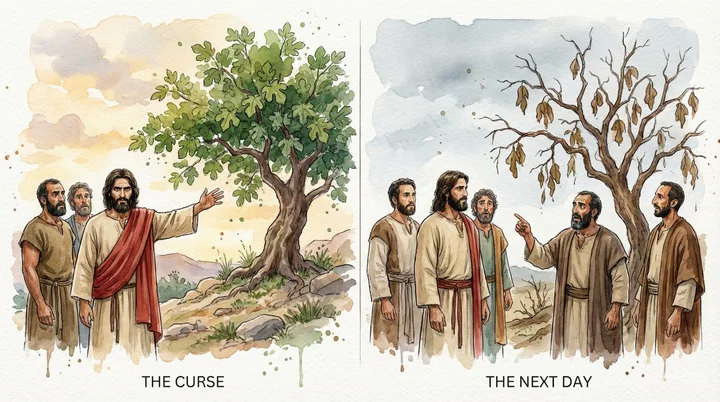
And Peter calling to remembrance saith unto him, Master, behold, the fig tree which thou cursedst is withered away.
Translations
And Peter calling to remembrance says to him, Master, behold, the fig tree which you cursed is withered away.
King James Version, KJV Cambridge Paragraph Bible
And Peter calling to remembrance saith unto him, Master, behold, the fig tree which thou cursedst is withered away.
And Peter calling to remembrance, saith to him, Master, behold, the fig-tree which thou cursedst is withered.
Revised Version, American Standard Version
And Peter calling to remembrance saith unto him, Rabbi, behold, the fig tree which thou cursedst is withered away.
and Peter having remembered saith to him, 'Rabbi, lo, the fig-tree that thou didst curse is dried up.'
And Peter, remembering [ what Jesus had said], says to him, Rabbi, see, the fig-tree which thou cursedst is dried up.
and, put in mind, Peter saith unto him—Rabbi! see! the fig-tree which thou didst curse, is withered.
Berean Standard Bible, Majority Standard Bible
Peter remembered it and said, “ Look, Rabbi! The fig tree You cursed has withered.”
Peter, remembering, said to him, “ Rabbi, look! The fig tree which you cursed has withered away.”
And Peter, having a memory of it, said to him, Master, see, the tree which was cursed by you is dead.
Then Peter remembred, and said vnto him, Master, beholde, the figge tree which thou cursedst, is withered.
Douay-Rheims (Challoner revision)
And Peter remembering, said to him: Rabbi, behold the fig tree, which thou didst curse, is withered away.
Pictures
Cross-references
- Matthew 21:19
And when he saw a fig tree in the way, he came to it, and found nothing thereon, but leaves only, and said unto it, Let no fruit grow on thee henceforward for ever. And presently the fig tree withered away.
Jesus curses the barren fig tree, and it withers.
- Mark 11:12-14
And on the morrow, when they were come from Bethany, he was hungry:
Jesus finds leaves but no fruit on the fig tree and curses it.
- Luke 13:6-9
He spake also this parable; A certain man had a fig tree planted in his vineyard; and he came and sought fruit thereon, and found none.
A fruitless fig tree faces removal as a warning of judgment.
- Mark 11:15-17
And they come to Jerusalem: and Jesus went into the temple, and began to cast out them that sold and bought in the temple, and overthrew the tables of the moneychangers, and the seats of them that sold doves;
The temple cleansing joins the fig tree as a symbolic sign of judgment.
- Mark 11:14
And Jesus answered and said unto it, No man eat fruit of thee hereafter for ever. And his disciples heard it.
Jesus pronounces the curse Peter recalls.
- Luke 17:5-6
And the apostles said unto the Lord, Increase our faith.
cited as the lesson text it illustrates
- Matthew 17:20
And Jesus said unto them, Because of your unbelief: for verily I say unto you, If ye have faith as a grain of mustard seed, ye shall say unto this mountain, Remove hence to yonder place; and it shall remove; and nothing shall be impossible unto you.
listed together as further teaching on faith
- Mark 4:39
And he arose, and rebuked the wind, and said unto the sea, Peace, be still. And the wind ceased, and there was a great calm.
Wind and sea obey Jesus when he speaks.
Commentary
Each commentary is drawn from primary sources: the writings of Ellen G. White and Adventist pioneers and periodicals. Each commentary is separate. Its own words are not a quotation; follow the references to read the source passages.
Ellen G. White
28 sources
The morning after the curse, as Jesus and the disciples passed by toward the city again, Peter remembered and called Him Master and pointed out that the tree was dried to its roots with blasted branches.DA 580DA 580.2–581.2Ms 21, 1902, par. 29–3012MR 406.2–3ST Feb 15, 1899 The disciples were astonished because the act stood alone among His works, for they had known Him only as Restorer and Healer who came to save and not to destroy, and the tree had put forth full leaves unusually early when fruit should have appeared before the leaves, yet bore none.Ms 32, 1898, par. 1–3ST Jul 21, 1909ST Feb 15, 1899STMW7 59.2–3 The leafy but fruitless tree was an acted parable of Israel and Jerusalem, whose showy foliage represented outward religious profession and claims of superior piety without humility, love, good works and the fruits of righteousness.DA 580.2–581.2Ms 32, 1898, par. 1–3Ms 111, 1897, par. 19–21 Its withering from root to branch under the curse revealed the nation's true condition and its certain, sudden ruin when grace was withdrawn, fulfilled in the destruction of Jerusalem and its temple after long abuse of privileges and opportunities to bless the world.DA 580DA 580.2–581.2Ms 32, 1898, par. 1–3Ms 111, 1897, par. 19–2112MR 406.2–3 It stands as a living warning to all churches and Christians to the close of earth's history, for God looks beneath outward appearance for piety, self-sacrifice, compassion and unselfish service, and hollow profession without repentance, faith and ministering to others is hateful to Him and will be brought low.ST Feb 21, 18783SP 19.2Ms 32, 1898, par. 11–12DA 584.1Lt 16, 1888, par. 43
Tree Peter Saw Withered
The morning after the cursing, as Jesus and the disciples passed by on the way to the city again, they found the fig tree dried to its roots.Ms 21, 1902, par. 29–3012MR 406.2–3ST Feb 15, 1899ST Feb 21, 1878 Its blasted branches and drooping leaves drew their attention, showing the tree withered away.Ms 21, 1902, par. 29–30DA 581.3–582.1ST Feb 21, 1878 Its rapid withering by the next morning completed the parable and confirmed the result of the symbolic act.Ms 21, 1902, par. 29–3012MR 406.2–3ST Feb 21, 1878
Peter, calling the curse to remembrance, addressed Jesus as Master and pointed out that the tree He had cursed the day before had withered away.DA 580DA 580.2–581.2Ms 21, 1902, par. 29–30ST Jul 21, 1909ST Feb 15, 1899 His words expressed the astonishment of the disciples, who questioned what the purpose of cursing the tree could be.Ms 32, 1898, par. 1–3ST Jul 21, 1909DA 581.3–582.1 The act seemed unlike Jesus and stood alone among His ways and works.ST Feb 15, 1899DA 581.3–582.1 They had known Him only as Restorer and Healer whose wonderful works restored and never destroyed, for He had come not to condemn the world but that the world through Him might be saved, and not to destroy lives but to save them, to save and restore and not to destroy.ST Jul 21, 1909ST Feb 15, 1899DA 581.3–582.1
The tree had displayed full leaves unusually early, when fruit could be expected because figs appear before leaves, but it bore none.Ms 32, 1898, par. 1–3 The other leafy trees around represented the Gentiles, who made no claim to know God and whose time to bear fruit had not yet come.STMW7 59.2–3
Judgment on Fruitless Israel
The leafy but fruitless tree was an acted parable of Israel and Jerusalem, showing the disciples their true condition and the retribution awaiting the city.DA 580.2–581.2Ms 32, 1898, par. 1–3DA 582.3–583.2 Its showy, pretentious foliage represented outward religious profession and claims of superior piety, with forms of worship but without humility, love, benevolence, piety, good works and the fruits of righteousness.Ms 32, 1898, par. 1–3Ms 111, 1897, par. 19–21DA 582.3–583.2ST Feb 21, 18783SP 18.1–2 The tree stood in full leaf unusually early, when fruit could be expected because figs appear before leaves, yet it bore none, just as the nation made an outward display that concealed corruption and lack of spiritual fruit.Ms 32, 1898, par. 1–3Ms 111, 1897, par. 19–2112MR 406.2–3 Its leaders were corrupting the people with false principles while professing devotion to God.Ms 111, 1897, par. 19–2112MR 406.2–3DA 582.3–583.2
God had granted Israel many privileges, truth, gifts, spiritual advantages and opportunities to bless the world, bringing them from Egypt to become trees of righteousness for His glory.DA 582.3–583.2Ms 21, 1902, par. 31–32ST Jul 21, 1909 What He sought from them was self-sacrifice, compassion, zeal for God, concern for others, love to God and man expressed in unselfish service, and willingness to share His gifts.DA 582.3–583.2ST Jul 21, 1909 Instead in pride and apostasy they separated from God, lost discernment, failed to recognize their Redeemer, withheld blessing from the world, and by refusing to share blessing ceased to receive it.DA 582.3–583.2ST Feb 15, 1899Ms 21, 1902, par. 31–32ST Jul 21, 1909 After more than a thousand years of abusing mercy, inviting judgments and determining their own destruction, punishment must come, in harmony with Christ's lament over Jerusalem missing its day of peace.Ms 21, 1902, par. 31–32
The tree's withering from root to branch under Christ's curse completed the parable and exposed Israel's condition when grace was withdrawn.DA 580DA 580.2–581.2Ms 32, 1898, par. 1–3Ms 21, 1902, par. 29–30ST Jul 21, 1909 Peter's noticing the withered tree is presented as the sign of a doomed people, whose doom would be sudden and certain like the sudden withering that confirmed the curse.DA 580DA 580.2–581.2Ms 111, 1897, par. 19–21DA 580.1 That ruin was the destruction of Jerusalem and its temple.DA 580.2–581.2Ms 32, 1898, par. 1–3 The withered tree served as an object lesson about Israel's rejection of Christ and the judgment that would follow.DA 580.1
The rapid destruction was purposeful, not a usual work of a ministry marked by mercy and restoration, but a display of Christ's disappointment, mournful reluctance, and righteous anger and vengeance against a rejected God.Ms 111, 1897, par. 19–2112MR 406.2–3ST Feb 15, 1899ST Feb 15, 1899Ms 21, 1902, par. 31–32 The barren, leafy tree symbolized Jerusalem as outwardly flourishing but without the spiritual fruit God sought, teaching the disciples of its final doom.ST Feb 15, 1899ST Feb 21, 1878 The nation remained outwardly alive for forty years after the event but was spiritually dead.Lt 35, 1895, par. 8–9 Pretentious hypocrites will be brought low.3SP 18.1–23SP 19.2ST Feb 21, 1878
Warning to Christians Today
The withered tree stands as a living warning for all time to all churches and to all Christians to the close of earth's history, and its lesson repeats in every age because present churches are in the same fruitless condition as the Jews were in Christ's day.ST Feb 21, 18783SP 19.2Ms 32, 1898, par. 11–12DA 584.1 What was judged in Israel is judged again wherever outward religious display conceals lack of good works and genuine devotion, in professed Christians who appear godly yet remain selfish, hypocritical and fruitless.ST Feb 21, 18783SP 19.2 The tree with pretentious branches but no fruit was condemned and destroyed for bearing nothing, and so formal profession without fruit to God's glory falls under the same sentence.3SP 19.2Ms 32, 1898, par. 11–12
God looks beneath outward appearance and distinguishes pretenders from those who bear fruit through good works and unselfish deeds.ST Feb 21, 1878 What He looks for is fruit in piety, self-denial, self-sacrifice, compassion, zeal for God, and a deep yearning to save others from unbelief and ruin, but instead He sees a fruitless fig tree trampling the law of Jehovah.ST Feb 21, 1878Ms 32, 1898, par. 11–12 No one can live the law of God without ministering to others, for those who live for self, planning and acting only to please and gather for themselves, are like the tree, full of pretension but fruitless.DA 584.1 They observe the forms of worship without repentance or faith, profess to honor the law of God while obedience is lacking, and say but do not, and in the withering of the tree is shown how hateful vain pretense is in His eyes.DA 584.1Lt 16, 1888, par. 4321MR 167.3 Outward profession, knowledge and religious form are like foliage without fruit and cannot take the place of repentance and faith, but only conceal inward barrenness.Lt 16, 1888, par. 4321MR 167.3
Formal worship without repentance and faith is hollow pretense, hateful to Christ, and the open sinner is less guilty and in a more favorable condition before God than one who professes to serve God but bears no fruit to His glory.3SP 19.2DA 584.1 The curse therefore has a personal application calling for conversion, lest that judgment fall on the person, since outward religious profession cannot conceal an unholy character or replace the inward putting away of sin.Lt 16, 1888, par. 4321MR 167.321MR 167.4–168.1 Only those cleansed in the blood of the Lamb will endure God's test, so God's people are to apply the lesson to themselves, to reform while there is still time and to walk in the light while they have the light.21MR 167.4–168.1Lt 80, 1901, par. 13 Those who claim great light and godliness but live in sin resemble a tree with leaves and no fruit, and those who do not turn to God face the curse represented by the tree.Lt 16, 1888, par. 4321MR 167.4–168.1
The same fruitlessness appears when men make God's memorial, the sign between Him and His commandment-keeping people, a thing of naught to be despised, while exalting the rival spurious sabbath as the great golden image was exalted in the plains of Dura.Ms 32, 1898, par. 11–12 Claimed Christians call the world to worship the image they have made, which is the mystery of iniquity carried into effect by the man of sin, and all who will not observe the spurious sabbath will be placed under oppressive laws, repeating the ceremony, formalism, vainglory and oppression of Nebuchadnezzar.Ms 32, 1898, par. 11–12 The blighted tree withered to its very roots under the righteous vengeance of a rejected God pictures what becomes of a person purchased at the infinite price of the agony and death of the Son of God who slights proffered mercy, rejects present privileges and the voice of admonition and warning, and continues in unbelief, impenitence and disobedience, with the soul-temple desecrated by sin as the courts of the Jerusalem temple were desecrated.ST Aug 15, 1878 The withered tree also represents those who defraud the Lord, in contrast to the human helpers and resources God from age to age raises up for His people by His appointed means, which will not prove fraudulent if they themselves do not defraud the Lord as those represented by the barren tree did.Ms 65, 1912, par. 11
Sources
Pioneers and periodicals
22 sources
The next morning Peter remembered the sentence spoken the day before and drew attention to the fig tree as dried up and dead to its roots.ST Jul 21, 1909ST Feb 15, 1899ST Oct 4, 1899 The leafy but fruitless tree stood for Jerusalem and the Jewish nation, outwardly flourishing in religious forms yet without genuine devotion and good works and failing to recognize its Redeemer.ST Feb 21, 1878ST Feb 15, 1899RH Jan 17, 1871 Its withering under righteous judgment pictured the city's coming doom and warns professed Christians who appear godly and respectable but remain selfish and fruitless that God looks beneath outward appearance and brings pretension low.ST Feb 21, 1878ST Feb 15, 1899ST Feb 15, 1899RH Jan 17, 1871RH Jan 17, 1871 Pointing to the withered tree led directly to the call to have faith in God, making the episode a lesson on simple trust in His word to accomplish what He has spoken.RH Mar 13, 1900ST Jan 23, 1901ST Mar 3, 1909
Words and Setting
Peter calling to remembrance points out to Jesus that the fig tree he had cursed the day before has withered away, found the next morning withered as the effect of his spoken judgment.ST Jul 21, 1909ST Feb 15, 1899ST Feb 15, 1899ST Oct 4, 1899RH Mar 13, 1900 The disciples find the cursed tree withered the next morning, confirming the result of his symbolic act.ST Jul 21, 1909ST Feb 15, 1899ST Feb 21, 1878ST Oct 4, 1899RH Mar 13, 1900
The withering is seen on the morning journey from Bethany to Jerusalem over the summit foot-path of the Mount of Olives, on the day after the journey from Bethany to Jerusalem when he was met at the descent of the Mount of Olives by the throng with palm branches.ST Nov 17, 1898 The chapter records the triumphal entry amid hallelujah cries and his weeping over Jerusalem, with the fullest account of that same scene in Luke 19.ST The verse belongs to Mark 11:20-24, given as additional reading on the faith asked for in Luke 17:5 and described in Luke 17:6 as able to command a tree to obey.ST Apr 16, 1896 It belongs to Mark 10-11 set to be read with Ecclesiastes 12 within the wider reading of Mark 6-13, to be compared with the parallel stories in the other gospels and taken home to the heart as a lesson of life.ST Jul 29, 1908
Peter's word for cursed means condemned, not that Jesus acted in anger, irritation, or vindictiveness.RH Jan 17, 1871 The tree was out of season for figs, so the withering is not presented as punishment for a moral fault, and the event occurred near the end of Jesus' life.RH Jan 17, 1871 The tree was blighted and withered to its very roots, dried up and dead at once.ST Aug 15, 1878ST Jul 21, 1909ST Aug 23, 1899
The disciples were astonished and surprised at the effect because they knew him as one who came to save and restore, not destroy, whose usual ministry was marked by mercy and restoration.ST Jul 21, 1909ST Feb 15, 1899RH Jan 17, 1871 The tree's rapid destruction showed the act was purposeful, which he intended to make a solemn lesson.ST Feb 15, 1899RH Jan 17, 1871ST May 31, 1910RH Mar 13, 1900
Judgment on Fruitless Profession
The tree had put forth leaves early, at a season when winter figs might still be found, yet it bore nothing but leaves, a pretentious show of foliage without fruit.RH Jan 17, 1871ST May 31, 1910 That barren, leafy tree was Jerusalem and the Jewish nation, Israel itself, outwardly flourishing and displaying the outward forms of religious worship while lacking moral and spiritual fruit, good works, and genuine devotion.ST Feb 21, 1878ST Feb 15, 1899RH Jan 17, 1871 In pride and apostasy it had separated from God, lost the power of discernment, and failed to recognize its Redeemer when He came.ST Feb 15, 1899ST Jul 21, 1909
As an acted parable, its leaves without fruit set forth the priests, scribes, Pharisees, and Sadducees, whose outward forms of religion concealed the want of inward spiritual life.RH Jan 17, 1871 Its withering pictured the consequence of that fruitlessness under God's righteous judgment, anger, and vengeance.ST Feb 15, 1899ST Feb 15, 1899RH Jan 17, 1871 It taught the disciples of Jerusalem's final doom and coming destruction, and like the triumphal entrance and the cleansing of the temple, its blighting marked the city's coming judgment.ST Feb 15, 1899ST Feb 21, 1878ST Aug 15, 1878ST Jan 10, 1878
The withered tree was Israel's ruin after refusing to bear the fruits of righteousness.ST Jul 21, 1909 God had given truth, gifts, and opportunities to bless the world, but Israel withheld those blessings and failed to show love to God and to others through self-sacrificing service.ST Jul 21, 1909 Dried up from the roots when grace was removed, it showed that by refusing to share blessing they would cease to receive it.ST Jul 21, 1909 The same warning reaches professed Christians who appear godly, respectable, and morally upright, yet are selfish, hypocritical, and fruitless.ST Feb 21, 1878RH Jan 17, 1871 God looks beneath outward appearance and distinguishes pretenders from those who bear fruit through good works and unselfish deeds, and pretentious hypocrites will be brought low.ST Feb 21, 1878ST Feb 21, 1878 The distinct fruits required are prayer, love for God, sympathy and kindness toward others, self-denial, patience, gentleness, meekness, and humility, and outward religious life without them is in danger of destruction.RH Jan 17, 1871
The tree blighted and withered to its very roots under the righteous vengeance of a rejected God pictures what becomes of one purchased at the infinite price of the agony and death of the Son of God who slights proffered mercies.ST Aug 15, 1878 Such a one rejects present privileges and the voice of admonition and warning, and continues in unbelief, impenitence, and disobedience to God, with the soul-temple desecrated by sin as the courts of the Jerusalem temple were desecrated.ST Aug 15, 1878 Barrenness in like manner warns that God may discipline and wither those who are self-willed or fruitless.ST May 31, 1910
Faith and Daily Life
Mark 11 makes an emphatic appeal to simple faith in God's Word, and Peter pointing out the withered tree leads directly into Jesus' call to have faith in God, so the whole episode stands as a lesson on faith.ST Jan 23, 1901ST Mar 3, 1909 Peter recalled Jesus' curse on the barren fig tree and pointed out that it had withered, and his words expressed surprise at the effect of words spoken the day before.RH Mar 13, 1900 Because the disciples had heard Jesus pronounce the curse, they should have had the same confidence in His word that He had, for He intended the tree to wither and trusted His word to accomplish it.RH Mar 13, 1900 Faith is the needful response for those seeking rest and peace, and faith can accompany both the desire to receive God's gift and the belief that it has been received, for through God's grace sinful people can be cleansed and renewed.ST Jan 23, 1901
The fig tree withered when God's sustaining power was withdrawn, since it could not continue living by its own strength. Likewise the Christian's life depends moment by moment on divine life and would fail if that life were withdrawn. When Jesus spoke to the fig tree it withered and died at once, for nature obeyed Him literally and immediately, which is evidence that He is God, in contrast with people who refuse to obey and are therefore out of harmony with God.ST Aug 23, 1899 The tree's sudden ruin illustrates the fearful result of being under God's curse, its barrenness of nothing but leaves warning that God may discipline and wither those who are self-willed or fruitless, with encouragement to keep faith in God even under solemn judgment.ST Feb 23, 1915ST May 31, 1910
Like the other miracles recorded, the withering is only a small part of the works wrought by Christ, yet recorded to give comfort to every class of people.ST Jul 29, 1908 It shows Christ just as willing now to forgive the sinful, to heal and restore the sick, and to comfort those in trouble as when people came directly to Him on earth.ST Jul 29, 1908 It shows God is God of all who will seek Him, not of the Hebrew people alone but as truly for all outside the Hebrew tribes.ST Jul 29, 1908
Sources