Mark 11:15
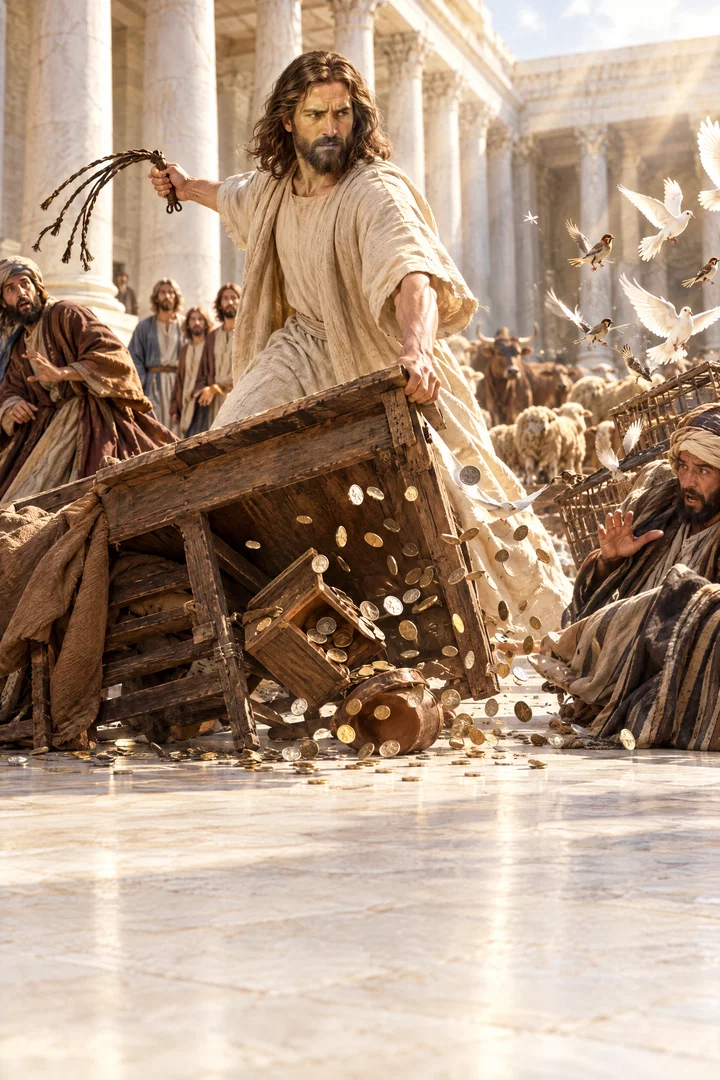
And they come to Jerusalem: and Jesus went into the temple, and began to cast out them that sold and bought in the temple, and overthrew the tables of the moneychangers, and the seats of them that sold doves;
Translations
American King James Version, King James Version
And they come to Jerusalem: and Jesus went into the temple, and began to cast out them that sold and bought in the temple, and overthrew the tables of the moneychangers, and the seats of them that sold doves;
KJV Cambridge Paragraph Bible, Webster Bible
And they come to Jerusalem: and Jesus went into the temple, and began to cast out them that sold and bought in the temple, and overthrew the tables of the money-changers, and the seats of them that sold doves;
Revised Version, American Standard Version
And they come to Jerusalem: and he entered into the temple, and began to cast out them that sold and them that bought in the temple, and overthrew the tables of the money-changers, and the seats of them that sold the doves;
And they come to Jerusalem, and Jesus having gone into the temple, began to cast forth those selling and buying in the temple, and the tables of the money-changers and the seats of those selling the doves, he overthrew,
And they come to Jerusalem, and entering into the temple, he began to cast out those who sold and who bought in the temple, and he overthrew the tables of the moneychangers and the seats of the dove-sellers,
And they come into Jerusalem. And, entering into the temple, he began to be casting out them who were selling and them who were buying in the temple, and, the tables of the money-changers, and the seats of them who were selling doves, he overthrew,—
Berean Standard Bible, Majority Standard Bible
When they arrived in Jerusalem, Jesus entered the temple courts and began to drive out those who were buying and selling there. He overturned the tables of the money changers and the seats of those selling doves.
They came to Jerusalem, and Jesus entered into the temple and began to throw out those who sold and those who bought in the temple, and overthrew the money changers’ tables and the seats of those who sold the doves.
And they came to Jerusalem; and he went into the Temple, and sent out those who were trading there, overturning the tables of the money-changers and the seats of those who were offering doves for money;
And they came to Hierusalem, and Iesus went into the Temple, and began to cast out them that solde and bought in the Temple, and ouerthrewe the tables of the money changers, and the seates of them that solde doues.
Douay-Rheims (Challoner revision)
And they came to Jerusalem. And when he was entered into the temple, he began to cast out them that sold and bought in the temple, and overthrew the tables of the moneychangers, and the chairs of them that sold doves.
Pictures
Cross-references
- John 2:13-17
And the Jews’ passover was at hand, and Jesus went up to Jerusalem,
Records the earlier cleansing of the temple.
- Matthew 21:12-13
And Jesus went into the temple of God, and cast out all them that sold and bought in the temple, and overthrew the tables of the moneychangers, and the seats of them that sold doves,
Parallel account of Jesus driving traders from the temple.
- Isaiah 56:7
Even them will I bring to my holy mountain, and make them joyful in my house of prayer: their burnt offerings and their sacrifices shall be accepted upon mine altar; for mine house shall be called an house of prayer for all people.
Jesus invokes the temple’s purpose as a house of prayer to explain its cleansing.
- Luke 19:45-46
And he went into the temple, and began to cast out them that sold therein, and them that bought;
Parallel account of Jesus expelling those who traded in the temple.
- Jeremiah 7:11
Is this house, which is called by my name, become a den of robbers in your eyes? Behold, even I have seen it, saith the LORD.
Jesus echoes Jeremiah’s rebuke that the temple had become a den of robbers.
- Psalms 69:9
For the zeal of thine house hath eaten me up; and the reproaches of them that reproached thee are fallen upon me.
Jesus’ zealous defense of the temple fulfills the psalm’s prophecy.
- John 12:12
On the next day much people that were come to the feast, when they heard that Jesus was coming to Jerusalem,
Jesus enters Jerusalem the day before cleansing the temple.
- John 2:16
And said unto them that sold doves, Take these things hence; make not my Father’s house an house of merchandise.
same command to remove defilement
- Malachi 3:1-3
Behold, I will send my messenger, and he shall prepare the way before me: and the Lord, whom ye seek, shall suddenly come to his temple, even the messenger of the covenant, whom ye delight in: behold, he shall come, saith the LORD of hosts.
The coming Lord purifies his temple and his people.
- Mark 11:27-33
And they come again to Jerusalem: and as he was walking in the temple, there come to him the chief priests, and the scribes, and the elders,
same temple controversy continued
- Mark 11:11
And Jesus entered into Jerusalem, and into the temple: and when he had looked round about upon all things, and now the eventide was come, he went out unto Bethany with the twelve.
Jesus first entered the temple, looked around, and returned to Bethany.
- Matthew 21:23-46
And when he was come into the temple, the chief priests and the elders of the people came unto him as he was teaching, and said, By what authority doest thou these things? and who gave thee this authority?
same temple controversy continued
- Luke 20:1-19
And it came to pass, that on one of those days, as he taught the people in the temple, and preached the gospel, the chief priests and the scribes came upon him with the elders,
same temple controversy continued
- 1 Corinthians 3:16-17
Know ye not that ye are the temple of God, and that the Spirit of God dwelleth in you?
Both texts portray God’s temple as holy and subject to defilement.
- Isaiah 1:12
When ye come to appear before me, who hath required this at your hand, to tread my courts?
Both condemn profaning God’s courts through corrupt worship.
- Mark 11:20-21
And in the morning, as they passed by, they saw the fig tree dried up from the roots.
Records the fig tree withered after Jesus’ temple cleansing.
- Matthew 23:37
O Jerusalem, Jerusalem, thou that killest the prophets, and stonest them which are sent unto thee, how often would I have gathered thy children together, even as a hen gathereth her chickens under her wings, and ye would not!
Christ laments Jerusalem’s repeated refusal of his care and warnings.
- Mark 12:1-12
And he began to speak unto them by parables. A certain man planted a vineyard, and set an hedge about it, and digged a place for the winefat, and built a tower, and let it out to husbandmen, and went into a far country.
same temple controversy continued
Commentary
Each commentary is drawn from primary sources: the writings of Ellen G. White and Adventist pioneers and periodicals. Each commentary is separate. Its own words are not a quotation; follow the references to read the source passages.
Ellen G. White
34 sources
Mark 11:15 records the second cleansing of the temple near the close of Christ's mission, repeating the cleansing at the beginning of His public ministry.STMW7 54.1–2STOM 31.1Lt 1f, 1890, par. 16–17 At Passover the outer court had been turned into a noisy market of cattle, sheep, doves, money-changers and angry bargaining, whose traffic and extortion drowned prayer and profaned the sacred courts.ST Jan 4, 18771RED 74.1–2 Priests and rulers themselves shared in the buying, selling and exchanging, letting greed turn worship into gain until they stood as thieves and robbers in God's sight.DA 589.1–590.2ST Mar 28, 1878ST Jan 4, 1877 With the majesty of Heaven's King divinity flashed through humanity as He overthrew the tables and seats and commanded the trade removed, so that traffic stopped and the convicted throng fled as from armed men.1MR 207.3–208.1ST Feb 15, 1899ST Aug 4, 1909ST Mar 28, 1878 The act declared the house of prayer made a den of thieves as a final warning and evidence of His divine mission, prefiguring righteous judgment on the fruitless nation as with the blighted fig tree, and enacting the cleansing of the human heart from selfish lust and moral pollution to be a dwelling for God's Spirit.DA 589.1–590.2ST Feb 15, 1899RH Dec 31, 1908STMW7 54.1–2
Temple Desecrated and Cleansed
This was the second cleansing of the temple, near the close of the mission, repeating the cleansing performed at the beginning of the public ministry.STMW7 54.1–2STOM 31.1Lt 1f, 1890, par. 16–17 At Passover the outer court had been turned into a noisy cattle market and place of general trade, crowded with oxen and sheep and doves and birds sold for sacrifice, with money-changers sitting at their tables in busy buying and selling.ST Jan 4, 18771RED 74.1–23SP 20.2 The active exchange of produce went on like an ordinary market day without sacredness, with angry bargaining and disputes filling the sacred space.ST Mar 28, 18783SP 20.23MR 61.4
The noise, traffic, and confusion disturbed worship and drowned out prayer, making the sacred courts profane and resembling a marketplace rather than a holy place.ST Jan 4, 1877COS 99.1 Extortion and robbery were practiced through excessive prices exacted for beasts for sacrifice, especially from worshipers who had come from far away.1MR 207.3–208.1ST Jan 4, 18771RED 74.1–2COS 99.1 Priests, rulers, and temple dignitaries themselves took part in the buying and selling and exchanging of money, sharing the profits with influential men.ST Mar 28, 1878ST Jan 4, 18773SP 20.2 Their greed overcame religious scruples, and their dealings were as corrupt as theft, making them thieves and robbers in God's sight.ST Mar 28, 18783SP 20.2
The sacrifices and worship were meant to point to sin, repentance, and the blood of Christ, but the leaders had turned them into a means of gain and had largely lost sight of the meaning of the symbols.DA 589.1–590.2 As His eye swept the scene divinity flashed through humanity, and with the majesty and authority of Heaven's King He began to cast out sellers and buyers.1MR 207.3–208.1 He overthrew the tables of the money-changers and the seats of dove-sellers and commanded the trade removed, and His command carried divine authority with the solemn force of judgment.ST Feb 15, 1899STMW7 54.1–2 His presence silenced the people and the noise of the animals, the traffic suddenly stopped, and the throng of buyers and sellers fled as though pursued by a company of armed men.ST Mar 28, 1878
With bated breath priests and rulers saw Him clothed with majesty and power, and as if by a flash of light from heaven were convicted as hypocrites and robbers that He was no common man.ST Aug 4, 1909 Fear made those nearby draw back, so that apart from a few disciples He stood alone.ST Mar 28, 1878 The disciples remembered that the sellers had fled before Him as though pursued by armed soldiers, and hoped He would again display such power to scatter His enemies and prove Himself King of Israel.EW 139.3 The soul-searching power of His look confronting buyers and sellers was such that the murderous crowd at His trial would have fled had He looked at them the same way.COS 127.2–4
The act was a rebuke of unholy traffic and of heartless sacrifice displacing obedience and humble repentance, declaring the house of prayer made a den of thieves.1MR 207.3–208.1DA 589.1–590.2 It was a final warning and evidence of His divine mission, given though He knew the corrupt priesthood would not be reformed.DA 589.1–590.2 It warns against turning sacred things and the Passover service into means of worldly gain.STMW7 54.1–2
Judgment on Fruitless Nation
This was the second cleansing of the temple, coming just before and belonging with the lesson of the blighted barren fig tree.ST Feb 15, 1899 Together with the triumphal entrance and the blighting of the barren fig tree, the driving out of buyers and sellers pointed to the doom of Jerusalem.ST Jan 10, 1878
The barren fig tree stood for Jerusalem and the Jewish nation, whose pride and apostasy had left them unable to recognize their Redeemer.ST Feb 15, 1899 Its blighting was God's righteous judgment, the sentence and downfall of the Jewish nation and the final destruction of Jerusalem.ST Feb 21, 1878ST Feb 15, 1899ST Jan 10, 1878 That scattering in dispersion came for wickedness and impenitence.ST Aug 4, 1909
Connected with the blighting of the fig tree, the dispersal of those buying and selling stopped the desecration of the place set apart for holy purpose.12MR 406.2–3 In the same act it symbolized the future punishment of the Jewish nation and prefigured the righteous anger of God.12MR 406.2–3 The priests stood as representative men of the nation, corrupting the people by false principles, and as the fig tree withered so they would wither, with a doom as sudden and certain as that of the tree.12MR 406.2–3
The cleansing laid bare that the people had perverted truth, rejected counsel, and refused repeated entreaties.8T 67.2–3 Its rebuke convinced the priests for a time that He was a prophet, and some believed He was the Messiah, yet they refused to repent.ST Aug 4, 1909 Because of that refusal Christ turned from them.ST Aug 4, 19098T 67.2–3
The judgment on the fruitless tree reaches also to professed Christians who appear devout but bear no fruit.ST Feb 21, 1878 Outward religious form cannot hide selfishness and hypocrisy nor take the place of good works.ST Feb 21, 1878 Genuine Christians bear fruit through good works and unselfish deeds.ST Feb 21, 1878
Cleansing Heart and Institutions
The cleansing of the Jerusalem temple is a sign of the mission to cleanse the human heart from sin, for the courts defiled by unholy trade represent hearts defiled by earthly desires, selfish lusts, evil habits and moral pollution.RH Dec 31, 1908ST Aug 15, 1878Lt 76, 1895, par. 9–11 The heart becomes a den of thieves when it rejects Christ's mercy and disobeys God.ST Aug 15, 1878 The temple was meant to witness to the high destiny open to every soul of becoming a dwelling for God's Spirit, and its cleansing enacted the purification in Malachi in which the Lord comes to His temple as a refiner to purify His people.RH Dec 31, 1908
Christ searches the temple of the heart, and those who practice truth in unselfish love have no buyers and sellers for Him to condemn, because truth occupies the citadel of the soul and God is enthroned in the heart.1MR 206.1–207.2 The soul-temple must be kept free from worldly merchandise mingled with God's sacred entrusted goods of means and physical and mental powers given for wise investment in the Master's service.Lt 102, 1905, par. 8–11 Commercial matters and the leaven of worldliness that permeate the mind and destroy spiritual discernment must be cast out, so that doing the Master's bidding and promoting His work becomes the one aim and purpose of life.Lt 102, 1905, par. 8–11
The same cleansing applies to schools, for if Christ entered them He would drive out defiling influences and remove what defiles them.CT 25.2FE 174.2 This includes many books studied by youth and teachings that defile young minds, to be replaced with substantial knowledge, heart-treasured sentiments, and precepts and sound principles that safely guide conduct and shape character.CT 25.2FE 174.2 Religious activity does not excuse unholy commerce, so churches that raise money by feasting or appeals to appetite, gain, or pleasure would face Christ's rebuke as did the money-changers.GC88 474.2 Churches where extravagant dress and attention to fashion turn worship into display that distracts from Christ dishonor God's house and desecrate the Father's house, and those who so desecrate it would be driven out.4T 642.4–643.1
The rebuke and its words apply to practicing physicians called Christians who charge exorbitant prices, just as exorbitant prices were exacted for beasts for sacrifice.1MR 207.3–208.1 The medical profession is no less under the Lord's jurisdiction and under the rule of the standard of righteousness than the farmer, the merchant, or the minister of the gospel.1MR 207.3–208.1 Institutions must be purged of commercial corruption, unjust control, injustice, fraudulent dealings, moral pollution, and practices turning people from their rights, to be free from thieves and money-changers and devoted to holy service.Lt 83, 1896, par. 38–40Lt 76, 1895, par. 9–11 Publishing houses established for present truth are defiled when devoted principally to commercial work, entering contracts for questionable matter merely for gain and taking a mass of outside work requiring increased facilities and workers, thereby losing the sense of sacred purpose, cheapening their work, and needing Christ to cleanse them as He cleansed the temple.Lt 140, 1901, par. 1–4
Printing and handling infidel, degrading, doubt-sowing literature and matter containing principles leading to false doctrines defiles the office just as buying and selling defiled the temple.6MR 268.1–269.3Lt 46, 1903, par. 9–10 Such work introduces Satan, dishonors the Redeemer, shows blindness and lack of spiritual discernment, poisons workers' minds, and leads to discontent over wages.6MR 268.1–269.3Lt 46, 1903, par. 9–10 It demands new presses and facilities that demand still more commercial work, showing the need for the reformation the Lord calls for.Lt 46, 1903, par. 9–10 If Christ were on earth He would cleanse the office of all such defiling matter as He cleansed the temple, commanding it to be taken away, because His house must be a house of prayer and not a den of thieves.6MR 268.1–269.3 The Lord's coming judgment on dishonest and selfish practices in the publishing house is compared to that cleansing.18MR 218.1–3
The repeated cleansing near the end of ministry, repeating the cleansing performed at the beginning of public ministry, is linked to the final warning to the world.STOM 31.1Lt 1f, 1890, par. 16–17 That warning includes the second angel's message and God's call for His people to leave Babylon so they will not share her sins or worship the beast and its image.STOM 31.1Lt 1f, 1890, par. 16–17 The temple cleansing thus stands alongside the call to leave religious corruption and false worship.Lt 1f, 1890, par. 16–17
Sources
Pioneers and periodicals
38 sources
Jesus came to Jerusalem to the outer court of the Gentiles on Monday, three days before the Passover, to cleanse the temple a second and final time, distinct from His earlier cleansing at the opening of His ministry.ST Oct 5, 1882ST Oct 4, 1899ST Nov 19, 1894 The sacred courts had been turned into a noisy cattle market of buying and selling, exchanging money and offering sacrificial animals at extortionate prices, a desecration sanctioned and shared in by the priests and rulers themselves for gain.ST Mar 28, 1878ST Jan 4, 1877ST Dec 16, 1886ST Oct 7, 1913 With divinity flashing through humanity He overthrew the tables of the money-changers and the seats of those who sold doves, stopped the traffic through the temple, and drove the traders out by His own divine authority and zeal for His Father's house.ST Dec 16, 1886ST Oct 7, 1913RH Nov 23, 1916 Set beside the cursing of the barren fig tree, the act was judgment upon Jerusalem and Israel for outward religion without spiritual fruit, pointing to the downfall of the nation for pride, apostasy and rejection of their Redeemer.ST Feb 21, 1878ST Feb 15, 1899ST Aug 4, 1909RH Jan 17, 1871 It is the sign of His mission to cleanse the human heart defiled by selfish lusts and to cleanse His church, condemning the turning of God's house into a house of merchandise by church fairs, bazaars, festivals and other worldly schemes for raising money.RH Dec 31, 1908ST Aug 15, 1878ST Dec 29, 1887ST Apr 15, 1880ST Nov 19, 1894
Time and Setting
Mark 11:15 describes the second and final cleansing of the temple shortly before the crucifixion, distinct from the earlier cleansing at the beginning of the ministry recorded by John.ST Oct 4, 1899ST Feb 13, 1893 The same cleansing had been performed three years earlier at the beginning of the public ministry, but the abuse had returned because the first cleansing had not been heeded, making the second cleansing necessary.ST Oct 4, 1899 The sellers were driven out twice even though they were offering animals for sacrifices.ST Nov 19, 1894 The final cleansing applies to the last warning work for the world, in that the second angel's message and heaven's call to come out of Babylon are distinct calls that cleanse the churches from their sins.ST Feb 13, 1893
It took place on Monday, the third day before the Passover, the day after the entry into Jerusalem amid hallelujah cries.ST Jesus had returned to Bethany, then came back to the city, cursing the barren fig tree on the way, cleansed the temple, then taught until evening and left the city.ST Oct 5, 1882 After driving out buyers and sellers He taught and healed the sick. The buying and selling show it was a common workday, not the Sabbath. Luke 19 gives the fullest account of the entry scene.ST
Jesus came to Jerusalem and entered the temple, which stood on Mount Moriah where He walked and taught, and cleansed its outer court, the court of the Gentiles.RH Nov 10, 1863ST Nov 19, 1894ST Sep 22, 1909 The court had been profaned by the sale of sacrificial animals and the money-changers, and by selfish, mercenary trade.RH Nov 10, 1863ST Sep 22, 1909 He drove out those who bought and sold, overthrew the money-changers' tables and the seats of the dove sellers, stopped people from carrying vessels through the temple, and taught that God's house was meant to be a house of prayer for all nations but had been made a den of thieves and must not be used for profane business.RH Nov 10, 1863ST Dec 16, 1886ST Sep 22, 1909 This cleansing precedes the priests' question about His authority.ST Oct 11, 1899 It was necessary before His public work in the temple court confirming His Messiahship before the people, since the temple could not serve that purpose while desecrated.ST Oct 4, 1899ST Oct 4, 1899
His act was a faint type of Nehemiah's prohibition against selling on ground consecrated to God.ST Nov 15, 1899 The sellers were barred from the sacred place, not forbidden to sell elsewhere.ST Nov 15, 1899
Trade Defiling the Temple
The sacred courts had been turned into a marketplace and cattle market, filled with those selling oxen and sheep and doves, those buying, and changers of money sitting at their tables.ST Mar 28, 1878ST Jan 4, 1877 Busy traffic and angry bargaining filled the holy precincts, with animals, money changing, and general trade crowding the space meant for worship.ST Mar 28, 1878ST Jan 4, 1877 People were even carrying vessels through the temple, adding to the press of common work in the sacred place.ST Dec 16, 1886
The temple dignitaries, priests and rulers themselves took part in the buying and selling rather than merely permitting it.ST Mar 28, 1878ST Jan 4, 1877 They sanctioned the unholy traffic and were especially involved in it, exchanging money and selling sacrificial animals.ST Jan 4, 1877ST Oct 5, 1904 The profits were shared with influential men, so greed overcame religious scruple.ST Mar 28, 1878ST Jan 4, 1877
Worshipers who came from distant places needed to exchange money and buy sacrificial animals, which gave occasion for the trade.ST Oct 7, 1913 That need was exploited by dishonest dealing, greed and avarice, excessive prices for animals and exorbitant rates of exchange.ST Feb 15, 1899ST Jan 4, 1877ST Oct 7, 1913 Such conduct made the leaders thieves in God's sight and profaned the holy precincts.ST Mar 28, 1878 The traffic was a counterfeit and adulteration of the sacred service appointed to show sinners the way of salvation.ST Oct 7, 1913RH Jun 6, 1907 Therefore it drew the declaration that God's house, meant to be called the house of prayer, had been made a den of thieves.RH Jun 6, 1907
The commerce profaned the court of the Gentiles, which had been dedicated to God as a house of prayer for all nations and for worship.RH Nov 10, 1863ST Dec 16, 1886ST Oct 7, 1913 Its noise and bargaining disturbed worship, drowning out prayer and making the temple resemble a marketplace rather than a sacred place.ST Jan 4, 1877 Its holiness meant it was not a place for business and not to be desecrated by trading or turned to commercial use.RH Nov 10, 1863ST Dec 16, 1897ST Dec 16, 1897
Christ's Authority Displayed
Jesus began to cast out those who sold and bought in the temple, overthrew the tables of the money-changers and the seats of those who sold doves, stopped people from carrying vessels through the temple, and drove the greedy traders and tricksters out by His own power.ST Dec 16, 1886RH Jun 6, 1907ST Dec 29, 1887 The traffic suddenly stopped and the throng of buyers and sellers fled.ST Dec 16, 1886 His action exposed the commerce as a counterfeit and adulteration of the sacred service.RH Jun 6, 1907
As His eye swept the scene divinity flashed through His humanity, and clothed with majesty and power as Heaven's King He stood apart with only a few disciples.ST Mar 28, 1878 His presence silenced the people and the noise of the animals, and fear made those nearby draw back and flee as though pursued by armed men.ST Mar 28, 1878 The cries stopped and the priests withdrew in embarrassment, while priests and rulers with bated breath felt the conviction forced upon their beclouded minds as by a flash of light from heaven that He was no common man.RH Nov 23, 1916
His command carried divine authority over the temple, displaying His power with disregard for the prestige of the rulers who had sanctioned the unholy buying and selling and were especially involved in it.ST Feb 15, 1899ST Feb 14, 1878ST Oct 5, 1904 His decisive discipline shows His authority came from influence, not from official position, and that firm discipline need not depend on anger, threats, or making people afraid. His forceful rebuke revealed divine zeal for the sacredness of His Father's house and for its appointed service showing sinners the way of salvation, giving a vivid miniature picture of judgment.ST Oct 7, 1913 It was an acted parable picturing the purification of religion and the change taking place, rather than merely reforming temple administration.RH Jan 17, 1871
With an authority that revealed the priests' true position as hypocrites and robbers, His rebuke convinced them for a time that He was a prophet, and some believed He was the Messiah, but they refused to repent.ST Aug 4, 1909
Judgment on Fruitless Israel
The cleansing took place amid the signs of Jewish worship in Jerusalem's sacred precinct, where outwardly impressive religion was challenged for lacking spiritual fruit.RH Jan 17, 1871 That temple setting frames the lesson of the barren fig tree, that religious appearance alone is not genuine spiritual life.RH Jan 17, 1871 The barren fig tree whose judgment the cleansing precedes symbolizes Jerusalem and the Jewish nation in pride and apostasy, unable to recognize their Redeemer.ST Feb 15, 1899 Its blight represents God's righteous judgment, the sentence and downfall of the nation, its dispersion for wickedness and impenitence, and Jerusalem's final destruction.ST Feb 21, 1878ST Feb 15, 1899ST Aug 4, 1909 The triumphal entrance, the temple cleansing, and the blighting of the tree together pointed to Jerusalem's doom.ST Jan 10, 1878
The scene warns that those who disregard privileges and the Spirit's warnings may let their time of probation run out.ST Feb 14, 1878 It teaches God's people to trust His faithfulness even when He disciplines or tests them, with faith resting on His word and promises rather than human strength.ST May 31, 1910 The lesson also applies to professed Christians who appear devout but bear no fruit.ST Feb 21, 1878 Outward religious form cannot hide selfishness, hypocrisy, or lack of good works, while genuine Christians bear fruit through good works and unselfish deeds.ST Feb 21, 1878
Cleansing Hearts and Churches
The cleansing of the Jerusalem temple is a sign of the mission to cleanse the human heart from sin.RH Dec 31, 1908 The courts defiled by unholy trade, traffic and confusion represent hearts defiled by earthly desires, selfish lusts and evil habits.RH Dec 31, 1908ST Aug 15, 1878 The temple was meant to witness to the high destiny open to every soul of becoming a dwelling for God's Spirit.RH Dec 31, 1908 The cleansing enacts the purification in Malachi in which the Lord comes to His temple as a refiner to purify His people.RH Dec 31, 1908 When the heart rejects Christ's mercy and disobeys God, it becomes a den of thieves.ST Aug 15, 1878
The final cleansing belongs near the end of the ministry, after an earlier cleansing at its beginning, and is applied to the last warning work for the world.ST Feb 13, 1893 The second angel's message and heaven's call for God's people to come out of Babylon are distinct calls that cleanse the churches from their sins.ST Feb 13, 1893 It is an image of the need to reform churches that unite to uphold a Roman Catholic institution.RH May 23, 1912 It exposes the enormous corruptions introduced into the church under the Papacy and lays on Christians the duty to remove such corruptions as far as in their power. That duty includes stripping churches of images and pictures, pulling down monasteries, overthrowing the houses of monks, and destroying all instruments employed to foster idolatry and image-worship, because it is largely by magnificence of temples and splendid apparatus of worship that the senses and imaginations of the people are fascinated and held.
Even legitimate business becomes wrong when conducted in God's house.ST Dec 29, 1887 The verse condemns turning it into a house of merchandise and a place of money-making, including modern bazaars, fairs and other makeshift ways of raising money in churches.ST Jun 10, 1875 The money-changers' tables in the Lord's house are church fairs, festivals, sanctified lotteries, feasts, parties, bazaars and other schemes that use religious gatherings to raise money for sacred uses by appealing to worldly pleasure.ST Apr 15, 1880ST Jun 10, 1875 Though the sellers were offering animals for sacrifices, a more legitimate trade than selling amusements for church revenue, Jesus drove them out twice.ST Nov 19, 1894 He acted despite the disturbance, and raffling in church fairs stands condemned as gambling and thieving wherever it occurs.ST Dec 29, 1887
Proceeds from such fairs, festivals, sanctified lotteries and feasts are unclean and unfit for holy service, like money that has not been honestly made, and must be refused and sent back to the hands they came from rather than taken for God.ST Apr 15, 1880 All such artificial means for benevolent or Christian purposes have a downward tendency and eat out the spirit of pure benevolence. They do so by letting people hope to give without sacrifice and to be compensated in pleasure for all they give. True giving gives from a sense of duty and the need of the cause, and from love of God and humanity, not for show, not to get something out of it, and not planned so it will cost nothing. The church is urged to humble itself before God and seek mercy as it returns to faithful worship and rejects worldly ways of raising money.ST Dec 30, 1903
The act proves He sees wrong done in His house and stops it, and that He cares for His own and would not leave them to perish uncared for.ST Aug 25, 1881 The verse is applied to the need for Christ to cleanse the church when money rules its offices, overrides discipline, and protects wrongdoing, for God's house must be a house of prayer, not a place where wealth shields those who corrupt it.ST Sep 9, 1889 It pictures the temple invaded by predatory profiteers and greedy wrongdoers who corrupt sacred life and should be driven out. It confronts religious leaders who had turned the temple into a place of buying and selling, driving them from the trade and back to their religious duties.ST Mar 23, 1915 A church where the rich come in fine clothes to pray while His poor brothers and sisters starve outside cannot have Him listening there, because the Jesus who cleansed the temple would not stay silent over that greater neglect.ST Aug 25, 1881
Widespread rottenness that no human power can successfully grapple with can only be met by that same power that drove the money-changers and other tricksters from the temple of old by His own power. Nothing short of the power of Christ can save the political corruption of today.
Sources