Mark 11:14
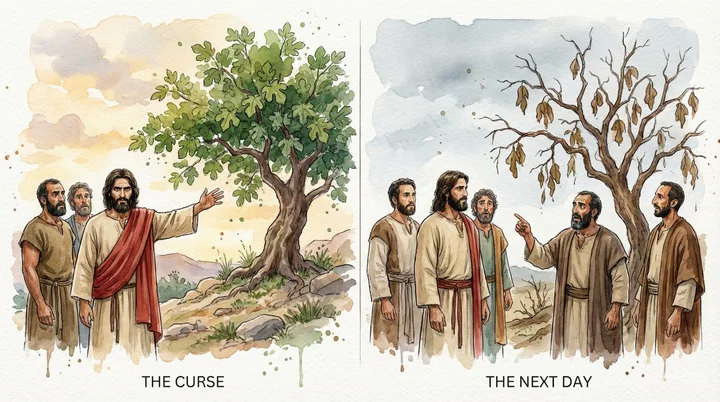
And Jesus answered and said unto it, No man eat fruit of thee hereafter for ever. And his disciples heard it.
Translations
And Jesus answered and said to it, No man eat fruit of you hereafter for ever. And his disciples heard it.
King James Version, KJV Cambridge Paragraph Bible
And Jesus answered and said unto it, No man eat fruit of thee hereafter for ever. And his disciples heard it.
And Jesus answered and said to it, Let no man eat fruit of thee hereafter for ever. And his disciples heard it.
Revised Version, American Standard Version
And he answered and said unto it, No man eat fruit from thee henceforward for ever. And his disciples heard it.
and Jesus answering said to it, 'No more from thee — to the age — may any eat fruit;' and his disciples were hearing.
And answering he said to it, Let no one eat fruit of thee any more for ever. And his disciples heard [ it].
And, answering, he said unto it—No more, unto times age-abiding, let anyone of thee, eat fruit. And his disciples were listening.
Then He said to the tree, “ May no one ever eat of your fruit again.” And His disciples heard this statement.
Then Jesus said to the tree, “ May no one ever eat of your fruit again.” And His disciples heard this statement.
Jesus told it, “ May no one ever eat fruit from you again!” and his disciples heard it.
And he said to it, Let no man take fruit from you for ever. And his disciples took note of his words.
Then Iesus answered, and sayd to it, Neuer man eate fruite of thee hereafter while the world standeth: and his disciples heard it.
Douay-Rheims (Challoner revision)
And answering he said to it: May no man hereafter eat fruit of thee any more for ever. And his disciples heard it.
Pictures
Cross-references
- Matthew 21:18-19
Now in the morning as he returned into the city, he hungered.
Parallel account of Jesus’ curse on the fig tree.
- Mark 11:20-21
And in the morning, as they passed by, they saw the fig tree dried up from the roots.
The disciples see the cursed fig tree withered from its roots.
- Luke 13:6-9
He spake also this parable; A certain man had a fig tree planted in his vineyard; and he came and sought fruit thereon, and found none.
The barren fig tree’s threatened judgment is displayed by the cursed fig tree.
- Mark 11:21
And Peter calling to remembrance saith unto him, Master, behold, the fig tree which thou cursedst is withered away.
Peter points out that the tree cursed by Christ has withered.
- Matthew 21:20-22
And when the disciples saw it, they marvelled, saying, How soon is the fig tree withered away!
The withered fig tree leads into Jesus’ teaching about faith and prayer.
- Matthew 7:19
Every tree that bringeth not forth good fruit is hewn down, and cast into the fire.
Fruitless lives face condemnation.
- Matthew 3:10
And now also the axe is laid unto the root of the trees: therefore every tree which bringeth not forth good fruit is hewn down, and cast into the fire.
The barren tree is cut down and burned as a warning of judgment.
Commentary
Each commentary is drawn from primary sources: the writings of Ellen G. White and Adventist pioneers and periodicals. Each commentary is separate. Its own words are not a quotation; follow the references to read the source passages.
Ellen G. White
46 sources
On a hungry morning Jesus came to a single fig tree already full of leaves, which promised well-developed fruit because fruit normally appears before the leaves, and finding nothing but pretentious foliage He doomed it to lasting barrenness so that no one would ever eat from it again, and by next morning it was dried up from the roots.3SP 17.2–3DA 580Ms 21, 1902, par. 29–30DA 581.3–582.1Ms 109, 1909, par. 55 The sentence was an acted parable upon Israel, the leafy but barren tree picturing the Jewish nation in its outward flourishing of piety, ceremonies and temple worship while lacking righteousness, love and Christlike character.3SP 17.2–3DA 580.2–581.2DA 580DA 582.3–583.2Ms 21, 1902, par. 31–32 What He hungers for and searches for is not inviting leaves but fruit, namely love for God and others shown in piety, self-denial, compassion and merciful unselfish service to save others.Ms 109, 1909, par. 55Ms 32, 1898, par. 11–12Ms 65, 1912, par. 12DA 584.1Lt 190, 1903, par. 3 The withering reveals the certainty of retribution in loss of place, privileges and ruin for those entrusted with truth who abuse mercy and withhold light, and it stands as a living warning to every Christian church and professor to the close of history whose formal, selfish profession blesses no one.DA 580DA 582.3–583.2ST Feb 21, 18784T 614.1ST Feb 15, 1899 Outward profession, knowledge and religious form are therefore worthless without inward grace, repentance and victory over sin, and all must be converted and reform while there is still time or the same curse will rest on them at the final accounting.Ms 32, 1898, par. 11–12Lt 80, 1901, par. 1321MR 167.3Lt 16, 1888, par. 435T 146.1
Words and Setting
It was morning and He was hungry after a night in prayer, going between Bethany and Jerusalem toward the temple past a fig orchard with His disciples present.Ms 21, 1902, par. 29–30DA 581.3–582.1 He saw a single tree afar off in advance of the others and already covered with leaves, came to it hoping to find fruit, and searched it thoroughly from the topmost twig to the lowest bough.Ms 21, 1902, par. 29–30DA 581.3–582.1Ms 109, 1909, par. 55Ms 67, 1903, par. 25–26 Though it was not the season for ripe figs on the highlands about Jerusalem, in the fig tree the growing fruit normally appears before the leaves open.ST Feb 21, 1878DA 581.3–582.1ST Feb 15, 1899 A tree already full of leaves therefore gave promise of well-developed fruit and raised a reasonable expectation of finding some.ST Feb 21, 1878DA 581.3–582.1Ms 58, 1895, par. 7–11ST Feb 15, 189918MR 199.4–200.2
He found nothing but leaves, a mass of pretentious, flourishing foliage and deceptive appearance that concealed barrenness.Ms 21, 1902, par. 29–30ST Feb 21, 1878DA 581.3–582.1 It flaunted its flourishing branches in the very face of justice.Ms 109, 1909, par. 55Ms 67, 1903, par. 25–26 He answered the tree by dooming it to lasting barrenness, that no one would ever eat fruit from it again hereafter forever.3SP 17.2–3DA 580Ms 21, 1902, par. 29–30DA 581.3–582.1Ms 32, 1898 His disciples heard the words.3SP 17.2–3DA 580Ms 21, 1902, par. 29–30Ms 32, 1898
The next morning as they passed by, the tree was dried up from the roots, with blasted branches and drooping leaves.Ms 21, 1902, par. 29–30ST Jul 21, 1909DA 581.3–582.1 Peter pointed it out to Him.Ms 21, 1902, par. 29–30DA 581.3–582.1 The destructive act stood alone and astonished the disciples and raised questioning.ST Jul 21, 1909DA 581.3–582.1ST Feb 15, 1899Ms 32, 1898 They had known Him only as Restorer and Healer whose works restored rather than destroyed, who came not to condemn the world or destroy lives but to save.ST Jul 21, 1909DA 581.3–582.1 They asked its meaning as a parable.ST Feb 15, 1899
Judgment on Israel
The sentence upon the tree was an acted parable and a miracle, a significant object lesson revealing Israel's true condition.DA 580.2–581.2DA 582.3–583.2Ms 21, 1902, par. 31–32 By making a dumb, unconscious tree a responsible agent, the lesson was fixed so the disciples would ever remember the terrible result of fruitlessness.Ms 21, 1902, par. 31–32 Its curse testifies to disappointment that the Jewish nation bore no fruit and to the punishment that must come to them.Ms 21, 1902, par. 31–32
The barren, leafy tree represents the Jewish nation in its outward flourishing, displaying religion and exceptional piety and knowledge of God.3SP 17.2–3ST Feb 21, 18783SP 18.1–2 It displayed sacred privileges and abundant ceremonies, traditions, temple worship, and priestly service.3SP 17.2–3DA 582.3–583.2Ms 65, 1912, par. 31–32 Yet it lacked good fruit such as righteousness, humility, love, devotion, goodness, truth, service, and Christlike character.3SP 17.2–3DA 582.3–583.2ST Feb 21, 18783SP 18.1–2Ms 58, 1895, par. 7–11 Its leaves gave reason to expect fruit and therefore represented false profession, a beautiful, flourishing appearance concealing barrenness.3SP 17.2–3ST Feb 21, 1878Ms 58, 1895, par. 7–11
Those leaves without fruit picture empty profession concealing pride, worldliness, greed, oppression, hypocrisy, cruelty, and disobedience.ST Feb 21, 18783SP 18.1–25T 146.1 They concealed also vanity, selfishness, apostasy and separation from God.ST Feb 15, 1899Ms 65, 1912, par. 31–325T 146.1 Through pride and apostasy the nation lost power of discernment and failed to recognize its Redeemer.ST Feb 15, 1899 The people were corrupted by the false principles of their religious leaders, ignorant of God's requirements, and the tree's fate represented the punishment of those leaders.ST Feb 21, 187812MR 406.2–3
Though entrusted with truth and greatly blessed, the people were brought by the mighty working of God's power from Egypt into a land where they were to become trees of righteousness, the planting of the Lord, that He might be glorified.Ms 21, 1902, par. 31–32 For more than a thousand years they did not profit by their blessings but abused mercy and invited judgments.Ms 21, 1902, par. 31–32DA 584.2 In pride and self-sufficiency they withheld light from the world, refused to share blessings and serve others, and sought no response of love and service matching the grace and advantages received.DA 582.3–583.2Ms 58, 1895, par. 7–11ST Jul 21, 1909 Thus they determined their own destruction, in perfect harmony with the lament that Jerusalem did not know in its day the things belonging to its peace, now hidden from its eyes.Ms 21, 1902, par. 31–32
The curse and withering show the certainty of retribution: loss of place as God's chosen people and removal of grace and privileges.DA 580DA 582.3–583.2ST Jul 21, 1909 Its withering portrayed the ruin that followed and represented God's righteous anger in Jerusalem's temporal ruin and destruction, beheld with tears showing rejected compassion and pleadings.DA 580.1DA 582.3–583.2ST Feb 15, 1899 The judgment fell especially on the generation that rejected Jesus, which remained outwardly alive for forty years afterward as a living, thinking people but was spiritually dead.Lt 35, 1895, par. 8–9STMW7 59.2–3 By refusing to pass on blessing they would lose it and bring ruin on themselves.ST Jul 21, 1909 The bare trees by contrast represented the Gentiles, who made no claim to know God or to religious piety and were awaiting light, whose time to bear fruit had not yet come.Ms 58, 1895, par. 7–11Lt 35, 1895, par. 8–9STMW7 59.2–3
The event belongs to the time of the triumphal ride into Jerusalem, which was the dim foreshadowing of coming in the clouds of heaven with power and glory amid the triumph of angels and the rejoicing of the saints.DA 580.1 Then the words that they would not see Him till they welcomed Him coming in the name of the Lord will be fulfilled.DA 580.1 Then Zechariah's prophetic vision of that day of final triumph and of those who pierced Him mourning as for an only son and as for a firstborn will be fulfilled.DA 580.1 This scene was foreseen when beholding the city and weeping over it, seeing in the temporal ruin of Jerusalem the final destruction of that people guilty of the blood of the Son of God.DA 580.1
Fruit God Requires
What Christ hungers for and must have is fruit, not leaves alone however inviting.Ms 109, 1909, par. 55Lt 190, 1903, par. 3Ms 67, 1903, par. 25–26 His hunger represents the people's unsatisfied need for spiritual fruit, which He had pledged His own life to supply through His grace and righteousness.Ms 65, 1912, par. 12 His divine soul finds no satisfaction in show alone.Lt 190, 1903, par. 3 The genuine fruit He hungers for from His people is lacking when ministers and church members may pray and teach Bible truth yet do not bear the fruits of righteousness that make service acceptable to God.18MR 199.4–200.2 That wanted fruit is borne when men and women as well as youth are trained to work in the Master's vineyard, with all possible work done by native help and hopeful evangelistic work carried on, as in the Southern field, so that much of the vineyard is worked.Lt 190, 1903, par. 3
God looks for fruit and searches critically for what is genuine, for outward appearance and profession alone have no value when they mask barrenness.Ms 32, 1898, par. 11–12Lt 45, 1891, par. 9–11 The fruit He requires is love for Him and for others, shown in piety, self-denial, self-sacrifice, compassion, zeal for God, and a deep yearning of soul to save fellow men from unbelief and ruin.Ms 32, 1898, par. 11–12ST Jul 21, 1909ST Feb 15, 1899 It is a life of merciful, unselfish service to others and work for their salvation.DA 584.1ST Jul 21, 1909
Warning to Churches
The doom spoken to the fruitless tree stands as a living warning to every Christian church in every age to the close of earth's history.4T 614.1Ms 32, 1898, par. 11–12 It reaches both individuals and churches that profess the truth yet bear no spiritual fruit, whose religion is only formal, selfish, boastful, hypocritical and worldly.ST Feb 21, 18783SP 19.2FE 50.1 Such profession blesses no one by good works and harms those around it, unless a thorough work is done within.ST Feb 21, 18784T 614.1FE 50.1 The leaves promised devotion but concealed barrenness, and the test exposes the difference between pretended devotion and genuine faith, for true use of God-given opportunity and privilege is to imitate Christ in unselfish deeds and good works.ST Feb 21, 1878FE 50.1
The fruitlessness condemned is worship without repentance, faith, obedience, and glory to God.3SP 19.2DA 584.1ST Jul 21, 1909 Vain pretense of this kind is hateful in His eyes.3SP 19.2ST Jul 21, 1909 A fruitless professor is in a worse condition before God and less excusable than an open sinner, and this empty profession is more blameworthy than open sin.3SP 19.2DA 584.1ST Jul 21, 1909
As in Christ's day, churches that bear no such fruit trample God's law and bring destruction upon themselves.Ms 32, 1898, par. 11–12ST Feb 15, 1899 They make God's memorial, the sign between Him and His commandment-keeping people, a despised thing of naught, while a rival spurious sabbath is exalted as the great golden image on the plain of Dura was exalted.Ms 32, 1898, par. 11–12 Men claiming to be Christians call the world to worship the image they have made, which is the mystery of iniquity devised by satanic agencies and carried into effect by the man of sin, and all who will not observe the spurious sabbath are placed under oppressive laws, repeating the ceremony and formalism, vainglory and oppression of Nebuchadnezzar.Ms 32, 1898, par. 11–12
The warning presses especially where great light, privileges and institutions have been given, as at Battle Creek, where leaders yield to worldly influence instead of following the Spirit of God and lives contradict claims of loyalty.TBC1882 70.3–71.1 It exposes institutions whose workers lack the virtues that win souls, and false shepherds and churches displaying outward prosperity, beautiful music and splendid decorations while fast becoming converted to the world, not feeding the flock.Lt 45, 1891, par. 9–11Lt 120, 1907, par. 1–2 Cherished impurity and disobedience make such flourishing appearance empty, picturing spiritual blindness, hardness of heart, and leaving first love.5T 146.118MR 199.4–200.2 As Jesus unmasked the tree, He will unmask these pretentious hypocrites, yet with mournful reluctance He pronounces the doom under which they wither, a lesson to be applied by reforming while there is still time and walking in the light while it is had.Lt 80, 1901, par. 13Lt 45, 1891, par. 9–11
Personal Call to Fruitfulness
Outward profession, knowledge, and religious form cannot take the place of God's inward work, and like leaves concealing a barren tree they are worthless without repentance, faith, and corresponding fruit.21MR 167.3Lt 16, 1888, par. 4321MR 167.4–168.1 The leaves are appearances that conceal spiritual barrenness, while the fruit is a life matching profession and bringing glory to God, with inward victory over sin and Christlike character in place of cherished impurity and disobedience.Lt 16, 1888, par. 435T 146.121MR 167.4–168.1 Ministers and church members may pray and teach Bible truth yet lack the fruits of righteousness that make service acceptable, showing spiritual blindness, hardness of heart, and leaving of first love.18MR 199.4–200.2 Those who claim great spiritual light and profess godliness but whose daily lives and unholy characters contradict that profession show only a flourishing appearance without love, devotion, goodness, righteousness, and Christlike character, and such outward religion without fruit is unacceptable and cannot endure God's proving.5T 146.121MR 167.4–168.1Ms 58, 1895, par. 12
Christ's daily invitations come through His agencies and must be heeded with conversion, for otherwise the tree's curse will rest on the person at the final accounting when the life is reviewed.21MR 167.3Lt 16, 1888, par. 43Lt 35, 1888, par. 2 With mournful reluctance doom was pronounced on the pretentious, fruitless tree and under the curse of an offended God it withered and died, a lesson to be applied by reforming while there is still time and walking in the light while possessing the light.Lt 80, 1901, par. 13 A people given great light and abundant opportunity to bear fruit face judgment if selfishness replaces love and godliness, so repentance is needed while there is still time. Habits and character formed in youth shape whether the life that follows bears fruit to God's glory or is worthless bearing only leaves.Lt 35, 1888, par. 2
Those who walk in the way of God's commandments will be like a flourishing fig tree full of fruit, revealing to the world that they are under the rule of God and dependent upon Him for temporal and spiritual victories.Ms 65, 1912, par. 2–3 They are safe with His presence and favor although they may suffer persecution for truth's sake, with His goodness and the riches of His grace as their protection and salvation.Ms 65, 1912, par. 2–3 The barren tree with only pretentious leaves and no fruit stands as a parable everyone should heed for all times and for all nations, kindreds, tongues, and peoples.Ms 65, 1912, par. 2–3
The tree pictures families that spend much of their time in dressing for display, full of outward show with no fruit, flaunting flourishing branches in the very face of justice while Christ comes hungering and searching from the topmost twig to the lowest boughs and finds nothing but leaves.Ms 109, 1909, par. 55Ms 67, 1903, par. 25–26 What Christ hungers for and must have is fruit, not leaves alone however inviting.Ms 109, 1909, par. 55Ms 67, 1903, par. 25–26 The barren tree also represents some who defraud the Lord, whereas from age to age God raises up human helpers and resources for His people from His inexhaustible fountain of wisdom and strength, and these God-given agencies will not prove fraudulent if they themselves do not defraud the Lord as those represented by the barren tree did.Ms 65, 1912, par. 11
Sources
Pioneers and periodicals
47 sources
Hungry on the morning road from Bethany to Jerusalem, Jesus found a fig tree in full leaf but with no fruit though the season for figs had not yet come, and declared that no one would ever eat fruit from it again, which the disciples heard and saw fulfilled when it was withered from the roots by the next morning.ST Oct 4, 1899ST Oct 5, 1882RH Jan 17, 1871 The leaves gave reason to expect fruit, since fig fruit normally appears before the leaves, so its flourishing show without fruit was a deceptive profession of bearing while concealing barrenness.ST Feb 21, 1878ST May 22, 1907ST Feb 22, 1877RH Jan 17, 1871ST Oct 4, 1899 The sentence was not passion nor treating a tree as moral, but a deliberate acted parable whose lasting barrenness foretold the irreversible judgment and downfall of the Jewish church, nation and Jerusalem after long patience was exhausted.ST Jul 21, 1909ST Oct 4, 1899ST Feb 22, 1877RH Apr 2, 1908RH Jan 17, 1871 The same tree stands for professed Christians and churches who claim great light and make an outward show of godliness while bearing no fruit, and whose fruitlessness, if continued, brings the same destructive rebuke.ST Feb 21, 1878RH May 22, 1913ST Oct 4, 1899ST Oct 4, 1899RH Jul 25, 1871 The fruit required is love to God and to others shown in righteousness, self-denial, compassion, obedience and zeal to save others, and mere profession with leaves only cannot satisfy Christ and ends in ruin.ST Feb 15, 1899ST Feb 24, 1881ST Jul 21, 1909ST Feb 15, 1899RH Jun 21, 1870
Setting, Timing and Wording
The wording renders the Greek aion as "for ever," showing that the term can be expressed with language about duration and does not in itself always specify an endless period.RH Mar 6, 1855 The pronouncement that no one would eat fruit from the tree thereafter was spoken as Jesus traveled with His disciples from Bethany toward Jerusalem on Monday of Passion Week.RH Jan 29, 1914 That Monday is counted as the fourth day before the Passover.RH Jan 29, 1914 Those who reckon it as the third day before the Passover place on that same Monday both the cursing of the fig tree on the return from Bethany to Jerusalem and the cleansing of the temple.RH Jan 29, 1914
Because buying and selling went on in the temple, the day is identified as a common workday. The tree cursed that morning was found dried up from the roots the next morning, Tuesday.RH Jan 29, 1914 The road was the foot-path from Bethany to Jerusalem over the summit of the Mount of Olives.ST Nov 17, 1898 It was traveled on the morning after He had been met at the descent of the mount by the throng with palm branches, which was the day after the feast at the house of Simon the leper following the resurrection of Lazarus.ST Nov 17, 1898
In Mark 11 this stands amid the hallelujah cries, weeping over the city, triumphant entrance and visit to the temple shortly before the crucifixion.STST Feb 14, 1878 The same scene is told in Matthew 21 and John 12 and most fully in Luke 19.ST The curse came on the morning after Jesus rode into Jerusalem, entered the temple and looked around, and returned to Bethany for the night.ST Oct 5, 1882 It came on the same day He entered Jerusalem again, cleansed the temple, taught until evening and left the city again, and its effect in the withered tree was pointed out by the disciples the next morning when He returned once more.ST Oct 5, 1882
This belongs in the count of three full days after the Bethany feast where Mary anointed Jesus six days before the Passover.ST Oct 5, 1882 Jesus, hungry on the way from Bethany to Jerusalem, found only leaves on the tree, though it was not yet the season for figs.ST Oct 4, 1899RH Jan 17, 1871 He declared that no one would ever eat fruit from it again, and the disciples heard Him.ST Oct 4, 1899RH Jan 17, 1871 The tree withered, and the next morning it was seen dried up from the roots.ST Oct 4, 1899RH Jan 17, 1871
The destructive sentence astonished the disciples because they knew Jesus as one who restored and healed.ST Jul 21, 1909ST Feb 15, 1899 They remembered His stated purpose to save rather than condemn or destroy.ST Jul 21, 1909 They questioned why He had acted this way and asked for its meaning as a parable.ST Jul 21, 1909ST Feb 15, 1899
Why the Tree Was Cursed
Fig fruit normally comes before the leaves, so a tree already in full leaf gave reasonable ground to expect fruit even though it was not yet the usual season for ripe figs.ST Feb 21, 1878ST Feb 15, 1899ST May 22, 1907ST Feb 22, 1877RH Jan 17, 1871 Its early foliage raised the expectation that fruit was developing before the leaves opened, including winter figs ripe in early spring.ST Feb 21, 1878ST Feb 15, 1899ST May 22, 1907ST Feb 22, 1877RH Jan 17, 1871 Coming to such a tree and finding leaves but nothing to eat, Jesus declared that no one would ever eat fruit from it again.ST Feb 21, 1878ST Feb 15, 1899RH Jan 17, 1871
Its leaves signaled that it should have fruit and advertised a superiority it did not possess.ST May 22, 1907ST Oct 4, 1899ST Nov 17, 1898 Its beautiful, flourishing appearance with nothing but leaves, neither blossoms nor fruit, made a deceptive show of bearing while concealing barrenness.ST Feb 21, 1878ST Sep 4, 1879ST May 22, 1907ST Oct 4, 1899ST Nov 17, 1898 It was condemned for bearing no fruit, not for bearing bitter fruit.RH Mar 13, 1856 Plant life is meant to work and produce, and seen even in the middle of summer without fruit it was failing the purpose to bear.ST Jun 3, 1908
By failing its God-given, designed purpose while making that deceptive show, it forfeited its place in creation, and the word that had produced it pronounced its removal.ST Oct 4, 1899 Its destruction was not an act of passion or inconsistency.ST Feb 22, 1877 Nor was the pronouncement a judicial sentence treating the tree as a moral being, but a fitting lesson and dramatic acted parable meant to convey moral truth and produce a lasting effect.ST Feb 22, 1877RH Jan 17, 1871
Whom the Tree Represented
The leafy but fruitless tree was a type and acted parable of the Jewish church, nation and Jerusalem, which had sacred privileges and an outward show of religion with exceptional claims to piety and knowledge of God.ST Feb 21, 1878ST Feb 21, 1878ST Feb 15, 1899ST May 22, 1907RH Feb 16, 1905 Its beautiful, flourishing, pretentious foliage without fruit symbolized a nation separated from God through pride and apostasy, that had lost discernment and failed to recognize its Redeemer.ST Feb 21, 1878ST Feb 15, 1899RH Feb 16, 1905 In particular it pictured Israel and its leaders and worship around Jerusalem as outwardly pretentious and impressive in forms of religion yet bearing no moral and spiritual fruit to God.ST Feb 21, 1878RH May 22, 1913RH Jan 17, 1871 It pictured the priests, scribes, Pharisees and Sadducees, who displayed the outward forms of religion but lacked its spiritual reality, corrupted by worldliness and greed, hypocritical and cruel, and ignorant of God's requirements.ST Feb 21, 1878RH Jan 17, 1871RH Jan 17, 1871
The leafless trees represented the Gentiles, who were also ungodly but had not professed to serve God and whose time of fruit had not yet come.RH Feb 16, 1905 Israel's greater blessings and privileges made the nation more accountable, and boasting in those privileges increased its guilt.RH Feb 16, 1905 The same tree also represents professed Christians and Christian churches who claim greater light and truth than others but do not fulfill the purpose for which they were made.ST Feb 21, 1878ST Oct 4, 1899ST Oct 4, 1899 It represents those who appear godly yet are formal, selfish, boastful or hypocritical and bless no one through good works, who profess to be guided by the word of God and are familiar with the evidences of faith yet have no fruit.ST Feb 21, 1878ST Feb 24, 1881ST Mar 8, 1899
Like the Jewish nation in Christ's day, churches that bear no piety, self-denial, self-sacrifice, compassion and zeal to save others from unbelief and ruin, and that trample on God's law, bring destruction upon themselves.ST Feb 15, 1899 Such profession of Christianity has outward appearance but no fruit in a renewed life, failing to provide light and help to seekers and even driving them to despair, whereas genuine experience is rooted in God's Word.ST Mar 8, 1899 Its outward leaves represent deceptive appearance and pretentious display, and the test reveals the difference between pretended devotion and genuine faith.ST Feb 21, 1878ST Aug 6, 1896 As Adam and Eve's fig-leaf covering could not hide their nakedness, pretentious Christian leaves cannot hide barrenness from God's searching judgment, for outward religious show without the fruit of a faithful life will not protect, and the leafy tree that bears no fruit is a symbol of the hypocrite who makes large pretensions but bears no fruit.ST Feb 22, 1877ST Aug 6, 1896
Judgment on Israel Foretold
The sentence that no one would ever eat fruit from the leaf-covered tree again was a sentence of lasting barrenness and judgment, heard by the disciples and afterward found fulfilled when the tree was withered from its roots.ST Jul 21, 1909ST Oct 4, 1899 It astonished them because they knew Him as one who restored and healed and whose stated purpose was to save rather than condemn or destroy, so that they questioned why He had acted in this way.ST Jul 21, 1909 Its instant withering confirmed the sentence and showed it to be irreversible.ST Jul 21, 1909ST Oct 4, 1899RH Apr 2, 1908
That withering was the judgment and downfall and doom of the Jewish nation, which had sacred privileges and an outward show of religion but rejected Christ and bore no good fruit.ST Feb 21, 1878ST Feb 15, 1899 The pretentious foliage without fruit pictured Jerusalem and a nation separated from God through pride and apostasy, with lost power of discernment and failure to recognize its Redeemer.ST Feb 15, 1899 Its withering represented God's righteous anger in the destruction of Jerusalem, coming upon Israel for failing to bear righteousness despite gifts and opportunities, with the withered tree representing the people after God's grace was removed.ST Feb 15, 1899ST Jul 21, 1909 The blighting stood as a sign pointing to Jerusalem's doom, while His tears as He looked over the city showed His compassion and pleadings being rejected.ST Jan 10, 1878
The fruit sought was love for God and for others, shown in righteousness, self-sacrifice, compassion, zeal for God and work for the salvation of others.ST Jul 21, 1909 Israel's pride and self-sufficiency led it to withhold truth from the world and refuse to serve, and by refusing to pass on blessing it lost blessing and brought ruin on itself.ST Feb 15, 1899ST Jul 21, 1909 Though displaying leaves before other trees, the tree bore no fruit and failed its God-given purpose, and its removal marks the time when God's patience with such fruitlessness has reached its limit.ST Oct 4, 1899ST Oct 4, 1899
As in the parable of the barren fig tree, God's long patience gives way to judgment when the time comes, and the curse was a symbolic declaration that the year of respite for God's people was over and their doom was fixed.ST Oct 4, 1899ST Oct 4, 1899RH Apr 2, 1908 The same judgment awaits all who fail to meet the purpose for which they were made.ST Oct 4, 1899 Amid the triumphant entrance into Jerusalem and the visit to the temple shortly before the crucifixion, the lesson is that people may be unmindful of their privileges and ignore the warnings of the Spirit of God while their time of probation is rapidly ending.ST Feb 14, 1878
Fruit Required of Christians
Profession without performance finds no favor with Christ, for leaves that promised fruit but bore none made the tree a picture of empty profession under judgment.RH May 22, 1913RH Jul 25, 1871 Outward show cannot satisfy the Master, who searches foliage for useful fruit and, finding none, leaves it condemned, with continued fruitlessness exposed to a final, destructive rebuke.ST Feb 24, 1881RH Jul 25, 1871 Those full of leaves yet destitute of fruit are such as profess to be guided by God's word and are familiar with the evidences of faith yet have nothing to show, in contrast to fruitful Christians who are connected with heaven, meditate on the truth and love of God, feast on the words of life, and burn within when the word is preached.ST Feb 24, 1881 The declaration heard by the disciples that it would never bear fruit again stands as a warning against coming to meet the Master with no fruit from a life of service.RH Dec 24, 1872
The fruit God accepts and looks for is piety, self-denial, self-sacrifice, compassion, and zeal to save others from unbelief and ruin, and churches that bear no such fruit while trampling on His law bring destruction upon themselves.ST Feb 15, 1899 That acceptable fruit is not showy action but deeds without self-seeking, including patient submission, self-denial, secret kindness to others, and obedience in public duties.RH Jun 21, 1870 Vain religious pretense is hateful in His eyes, for leafy appearance without fruit is worship and claims of obedience lacking repentance, faith, and actual obedience, living for self and failing to serve others.ST Jul 21, 1909 One who openly sins is less guilty than one who professes to serve God but bears no fruit for His glory, and by refusing to pass on blessing such professors lose it and bring ruin on themselves, as Israel by pride and self-sufficiency withheld truth, refused to serve, and was left withered after grace was removed.ST Jul 21, 1909ST Jul 21, 1909
The same curse falls on those who have embraced the truth and had years of experience yet have no strength to stand alone in the truth with God's promised help and are incapable of helping others to the light, being like the flourishing tree with nothing but leaves, neither blossoms nor fruit.ST Sep 4, 1879 A life spent only for one's own good comes to the harvest with nothing but leaves, and present life already shows whether fruit will appear in the Judgment, where a life without good fruit, or bearing evil fruit, faces condemnation and a useless life ends in final ruin.RH Jun 21, 1870 The tree's fate illustrates the fearful consequence of withholding what belongs to God, specifically the curse for failing to return His tithe, withering from the roots by the next morning after the word that it would never bear fruit again.ST Feb 23, 1915 The contrast between a fruit-laden tree and withered, dry branches teaches children the lesson and calls them to become better workers for Jesus.RH Nov 12, 1914
A people given great light and abundant opportunity face judgment if selfishness replaces love and godliness, and need repentance while there is still time before the pretentious, fruitless tree withers under the curse. A life of leaves without fruit means not one good deed done, a wasted life that should bring grief over self, trust only in Christ's blood for acceptance, striving harder than ever to overcome every sin and be perfect before seeing the Saviour.RH Nov 1, 1870 Such striving works out salvation with fear and trembling for eternal life and a home with Jesus, to see Him when He comes and be like Him, pressing toward a crown of immortality.RH Nov 1, 1870 Genuine Christian experience must have the power of a renewed life rooted in God's Word, for mere outward profession gives no light and help to seekers of hope and may drive them to despair.ST Mar 8, 1899 One plea asks patience that a flourishing but useless life be given more time to produce fruit before judgment falls for having only outward signs and no fruit thereafter.RH Feb 16, 1911
The tree depended on God's sustaining power, and when that power was withdrawn it withered and ceased to be a tree, so a person's Christian life cannot stand for an instant by acquired strength if divine life is interrupted. Jesus spoke with complete confidence that His word would bring about the withering, and the disciples who heard Him should have trusted His word as fully as He did, knowing it would accomplish its purpose.RH Mar 13, 1900 Its withering is a solemn example of God judging fruitlessness and an encouragement to hold to His faithfulness and trust Him even when He disciplines or judges.ST May 31, 1910 The tree obeyed Christ's divine authority literally and at once, withering and dying, proving He is God, since all nature except man's heart obeys God, as waters brought forth at creation, the sea recognized His voice, devils fled at His word, and the grave gave back its dead.ST Feb 25, 1897 Man's refusal to obey when Christ speaks puts him out of harmony with God, restored only by learning to obey, since eternal salvation is eternal safety given only to those who obey Him and not to those who merely feel, talk, or say Lord, Lord, and a tree and a person with nothing but leaves and no good fruit is under judgment and will never bear fruit again.ST Apr 13, 1904ST Apr 8, 1903ST Feb 25, 1897
Sources