Mark 14:56
For many bare false witness against him, but their witness agreed not together.
Translations
For many bore false witness against him, but their witness agreed not together.
King James Version, KJV Cambridge Paragraph Bible
For many bare false witness against him, but their witness agreed not together.
For many bore false testimony against him, but their testimony agreed not together.
Revised Version, American Standard Version
For many bare false witness against him, and their witness agreed not together.
for many were bearing false testimony against him, and their testimonies were not alike.
For many bore false witness against him, and their testimony did not agree.
for, many, were bearing false-witness against him, and the testimonies were not, agreed.
Berean Standard Bible, Majority Standard Bible
For many bore false witness against Jesus, but their testimony was inconsistent.
For many gave false testimony against him, and their testimony didn’ t agree with each other.
For a number gave false witness against him and their witness was not in agreement.
For many bare false witnesse against him, but their witnesse agreed not together.
Douay-Rheims (Challoner revision)
For many bore false witness against him, and their evidences were not agreeing.
Pictures
Cross-references
- Matthew 26:59-60
Now the chief priests, and elders, and all the council, sought false witness against Jesus, to put him to death;
False witnesses testify against Jesus, but their accounts do not agree.
- Deuteronomy 19:15
One witness shall not rise up against a man for any iniquity, or for any sin, in any sin that he sinneth: at the mouth of two witnesses, or at the mouth of three witnesses, shall the matter be established.
Requires two or three witnesses to establish a charge.
- Deuteronomy 17:6
At the mouth of two witnesses, or three witnesses, shall he that is worthy of death be put to death; but at the mouth of one witness he shall not be put to death.
Requires two or three witnesses for a death sentence.
- Deuteronomy 19:16-18
If a false witness rise up against any man to testify against him that which is wrong;
Both describe false witnesses giving testimony against another.
- John 18:13-27
And led him away to Annas first; for he was father in law to Caiaphas, which was the high priest that same year.
parallel account of same hearing
- Luke 22:54-71
Then took they him, and led him, and brought him into the high priest’s house. And Peter followed afar off.
parallel account of same hearing
- 2 Corinthians 13:1
This is the third time I am coming to you. In the mouth of two or three witnesses shall every word be established.
Both invoke the standard of witnesses, though Mark describes testimony that failed to agree.
- John 8:17-18
It is also written in your law, that the testimony of two men is true.
Jesus contrasts his and the Father’s testimony with false witnesses.
- Matthew 27:1
When the morning was come, all the chief priests and elders of the people took counsel against Jesus to put him to death:
parallel account of same hearing
- Matthew 18:16
But if he will not hear thee, then take with thee one or two more, that in the mouth of two or three witnesses every word may be established.
Both concern the requirement for witnesses to agree in establishing a matter.
Commentary
Each commentary is drawn from primary sources: the writings of Ellen G. White and Adventist pioneers and periodicals. Each commentary is separate. Its own words are not a quotation; follow the references to read the source passages.
Ellen G. White
8 sources
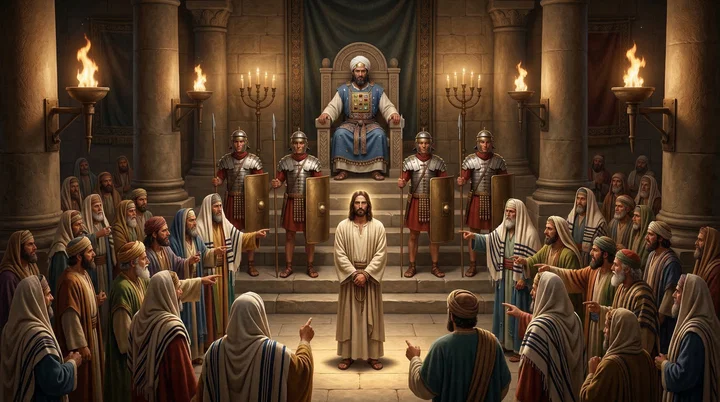
Mark 14:56 belongs to what took place before Annas and the court of Caiaphas the high priest.DA 6985RED 35.3–36.23SP 115.3–116.2 It was in the judgment hall where Caiaphas presided over the council, with Jesus standing as a captive before him under the eyes of the multitude amid wild excitement.DA 6985RED 35.3–36.23SP 115.3–116.2 While His life was at stake, Jesus stood calmly before that judgment hall.5RED 35.3–36.23SP 115.3–116.2
He stood calm, serene, dignified and majestic, with a God-like presence from which a holy influence emanated.5RED 35.3–36.23SP 115.3–116.2 This was in contrast to the excited and malignant bearing of His judges, Annas and Caiaphas, and raised the question whether such a one should be sentenced as a common criminal.3SP 115.3–116.2 Though tried for His life at the foot of an earthly throne in coarse, homely garb, He is One who has reigned in the courts of heaven, crowned and in garments of brightness attended by holy angels.3SP 115.3–116.2
Caiaphas was struck with admiration for Jesus and convicted that He was akin to God, then banished the thought.3SP 115.3–116.2 In sneering, haughty tones he demanded a mighty miracle, which Jesus ignored as though He heard not.3SP 115.3–116.2 Perceiving the influence turning in Jesus' favor, Caiaphas hastened the trial.3SP 115.3–116.2 He took his seat on the throne of judgment in gorgeous robe with glittering tiara and costly breastplate, with Jesus at its foot, judges and interested parties on either side and Roman soldiers ranged on the platform below the throne.3SP 115.3–116.2
Many bore false witness against Jesus, but their accounts did not agree together.Ms 102, 1897, par. 1–3DA 698.1–700.5SPBC 139.3–4Lt 38, 1896, par. 23–26ST Sep 16, 1913 Their conflicting testimony failed to establish a consistent charge and provided no sound basis for condemning Him.Ms 102, 1897, par. 1–3DA 698.1–700.5ST Sep 16, 1913 In this their disagreement exposed the injustice of the trial.DA 698.1–700.5 The charge that He had broken the Sabbath by rubbing grain in His hands and eating was unfounded, for His actions were in harmony with the Sabbath commandment.ST Sep 16, 1913 If His accusers could have proved that charge, they would not have needed to procure false testimony against Him.ST Sep 16, 1913
The verse shows that self-seeking religious opposition produces contradictory false charges against Christ and His truth.SPBC 139.3–4Lt 38, 1896, par. 23–26 It stands as an example that in most religious controversies self is striving for supremacy over matters that are not vital at all but are treated as vital only because men have given importance to them.SPBC 139.3–4Lt 38, 1896, par. 23–26 Even Seventh-day Adventists are in danger of closing their eyes to truth as it is in Jesus when it contradicts what they have taken for granted as truth.Lt 38, 1896, par. 23–26
Sources
Pioneers and periodicals
27 sources
At his trial before Caiaphas many false witnesses were brought against him, their testimony deliberately sought out to mislead the court and secure his condemnation and death though no fault could be found in him.ST Jan 19, 1882ST Jan 19, 1882ST Dec 1, 1898 Their accounts were vague and contradictory, each undermining the other and even falsifying themselves under questioning until the accusation collapsed.ST May 27, 1889ST Jan 19, 1882 Such disagreement and self-contradiction is positive proof of falsehood that cannot establish a valid charge, for the law required two witnesses to agree together in a capital case.ST May 27, 1889ST Jan 19, 1882ST Jul 12, 1899 Because the witnesses had refuted themselves he did not need to answer, and his dignified silence amid their accusations stood in his favor.ST Jan 19, 1882ST Oct 26, 1882 The same failure to agree exposes later false opposition, where conflicting arguments against the seventh-day Sabbath and differing reasons for keeping Sunday contradict one another yet unite only in condemning God's holy day.RH Jan 7, 1873ST Apr 3, 1893ST Oct 4, 1905ST May 28, 1885
False Witnesses Against Jesus
At his trial before Caiaphas the high priest many false witnesses were brought against Jesus.ST Nov 19, 1912ST Jan 19, 1882ST Jan 19, 1882ST Dec 1, 1898 Their testimony was deliberately sought to support the accusation and to mislead the court and the crowd in order to secure his condemnation and death.ST Jan 19, 1882ST Jan 19, 1882 This was done although the authorities had already decided on his death and although no fault could be found in him.ST Nov 19, 1912ST Dec 1, 1898
Their accounts were vague and contradictory, contradicting one another and failing to provide valid evidence.ST May 27, 1889ST Jan 19, 1882ST Jan 19, 1882 Each witness undermined the previous one, until the accusation collapsed.ST Jan 19, 1882 When questioned they even falsified their own statements.ST May 27, 1889
Such disagreement between witnesses and self-contradiction by a witness, direct or indirect, is positive proof of falsehood.ST Jul 12, 1899 It cannot establish truth or a valid charge.ST May 27, 1889ST Jan 19, 1882ST Dec 1, 1898ST Sep 23, 1889 The law required two witnesses to concur in a capital case, which is why the leaders relied on false witnesses in their attempt to condemn him, yet failed.ST May 25, 1904ST Dec 1, 1898
Because the witnesses had refuted themselves, Jesus did not need to answer.ST Jan 19, 1882 Their testimony did not require an answer.ST Oct 26, 1882 His dignified silence amid their accusations may have influenced many in his favor.ST Oct 26, 1882
The contradictions exposed the weakness of the charges and failed to agree on essential points.RH Jun 23, 1868 They did not convince Pilate of guilt.RH Jun 23, 1868 They instead left him able to recognize Jesus' innocence and the justice of his claim to be the Messiah.RH Jun 23, 1868
The charge that he broke the Sabbath by rubbing grain in his hands and eating was unfounded, for his actions were in harmony with the Sabbath commandment.ST Sep 16, 1913 If his accusers could have proved that charge, they would not have needed to procure false testimony against him.ST Sep 16, 1913
The witnesses disagreed in details and gave conflicting testimony that clashed and did not agree together.RH Jan 7, 1873RH Mar 14, 1865RH Jan 7, 1873 Yet they were united in the vital point and final issue and decisive aim of condemning him as guilty of death and not fit to live so that his blood would be shed and his death brought about.RH Jan 7, 1873RH Mar 14, 1865RH Jan 7, 1873 Their agreement on that conclusion did not make their conflicting testimony reliable.RH Mar 14, 1865
The verse belongs to the account of Christ's rejection and mistreatment, showing how hollow homage can quickly give way to open outrage.RH Dec 29, 1863 The discordant testimony of the false witnesses, which failed to provide reliable evidence against him, contrasts with the consistent witness God gives to Christ's divine mission.ST Sep 23, 1889
Disagreement Exposes False Opposition
Like the false witnesses whose testimony could not be made to agree, the conflicting arguments made against the seventh-day Sabbath and against keeping God's Sabbath contradict one another and cannot stand together.ST Apr 3, 1893ST Oct 4, 1905ST May 27, 1908RH Apr 6, 1911 Their discordant explanations and defenses disagree with one another, so their conflicting claims are unreliable after the pattern of accusations whose accounts did not agree.ST Apr 3, 1893ST Oct 4, 1905ST May 27, 1908RH Apr 6, 1911 Disagreement in testimony can coexist with unity in purpose, for while the accounts clashed they were united in the vital point and final issue of condemning the Lord as not fit to live so that His blood would be shed, and in the same way contradictory defenses of Sunday observance still unite in the same conclusion to trample God's holy sanctified day and condemn it.RH Jan 7, 1873 The conflicting arguments offered in support of Sunday observance do not agree and cannot stand together, and the differing reasons people give for keeping Sunday repeat the witnesses' failure to agree.ST May 28, 1885ST Aug 22, 1916
The failure to agree is repeated by theologians who agree that the Jews did not have the Lord's Sabbath but contradict one another about when and how it was changed.ST Jul 24, 1879 Testimony fails when the witnesses do not agree, and conflicting claims that divine authority changed the Sabbath from the seventh day to the first cannot convince thoughtful people, so their failure gives support to keeping the Sabbath.ST Aug 10, 1882 The same conflicting testimony illustrates how criticism directed against the Bible produces conflicting claims, as when critics of the Bible make claims about geology that contradict each other.ST Jan 19, 1882RH Oct 7, 1915 Because false witnesses contradicted one another their testimony undermined itself, and so claims against the Bible do not agree and their conflicting accounts weaken the case against it, while reasoning about life shaped by Christ supports the Bible.ST Jan 19, 1882
That same disagreement exposes the contradiction of saying at once that one public action is an alarming assault upon the foundations of holy religion and that it is not a religious question at all. People who profess to uphold God's Word but contradict it by their lives bear false witness against Christ after the pattern of witnesses whose false testimony did not agree.ST Nov 4, 1897
Sources