Matthew 27:1
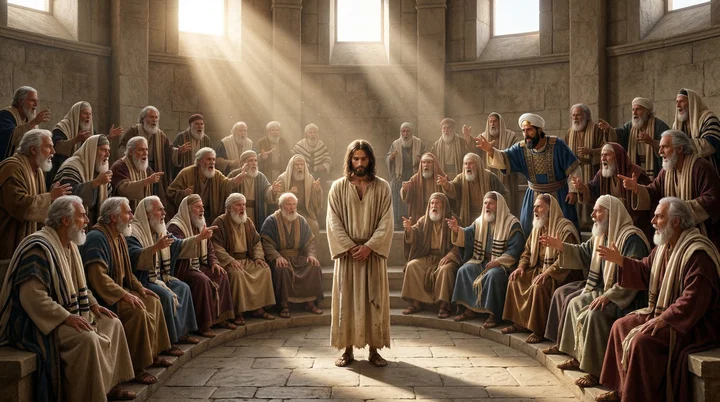
When the morning was come, all the chief priests and elders of the people took counsel against Jesus to put him to death:
Translations
American King James Version, King James Version, KJV Cambridge Paragraph Bible
When the morning was come, all the chief priests and elders of the people took counsel against Jesus to put him to death:
When the morning was come, all the chief priests and elders of the people took counsel against Jesus to put him to death.
Revised Version, American Standard Version
Now when morning was come, all the chief priests and the elders of the people took counsel against Jesus to put him to death:
And morning having come, all the chief priests and the elders of the people took counsel against Jesus, so as to put him to death;
And when it was morning all the chief priests and the elders of the people took counsel against Jesus so that they might put him to death.
Now, when morning came, all the High-priests and Elders of the people took, counsel, against Jesus, so as to put him to death:
Berean Standard Bible, Majority Standard Bible
When morning came, all the chief priests and elders of the people conspired against Jesus to put Him to death.
Now when morning had come, all the chief priests and the elders of the people took counsel against Jesus to put him to death.
Now when it was morning, all the chief priests and those in authority took thought together with the purpose of putting Jesus to death.
When the morning was come, all the chiefe Priests, and the elders of the people tooke counsell against Iesus, to put him to death,
Douay-Rheims (Challoner revision)
And when morning was come, all the chief priests and ancients of the people took counsel against Jesus, that they might put him to death.
Pictures
Cross-references 20 of 25
- Matthew 26:57-66
And they that had laid hold on Jesus led him away to Caiaphas the high priest, where the scribes and the elders were assembled.
Jesus is examined by the authorities and condemned before the morning council plans his death.
- Mark 15:1
And straightway in the morning the chief priests held a consultation with the elders and scribes and the whole council, and bound Jesus, and carried him away, and delivered him to Pilate.
The leaders meet in the morning and hand Jesus over to Pilate.
- Luke 22:66
And as soon as it was day, the elders of the people and the chief priests and the scribes came together, and led him into their council, saying,
The elders gather in the morning to bring Jesus before the council.
- John 18:28-38
Then led they Jesus from Caiaphas unto the hall of judgment: and it was early; and they themselves went not into the judgment hall, lest they should be defiled; but that they might eat the passover.
The leaders bring Jesus to Pilate, who examines him and finds no fault.
- John 18:13-27
And led him away to Annas first; for he was father in law to Caiaphas, which was the high priest that same year.
Jesus faces questioning while Peter denies knowing him.
- Matthew 26:47
And while he yet spake, lo, Judas, one of the twelve, came, and with him a great multitude with swords and staves, from the chief priests and elders of the people.
Judas arrives with a crowd sent by the leaders to arrest Jesus.
- Mark 14:53-64
And they led Jesus away to the high priest: and with him were assembled all the chief priests and the elders and the scribes.
Records Jesus’ examination and the council’s decision to condemn him to death.
- Luke 23:1-5
And the whole multitude of them arose, and led him unto Pilate.
Jesus is accused before Pilate after the chief priests and elders conspire against him.
- Matthew 26:3-5
Then assembled together the chief priests, and the scribes, and the elders of the people, unto the palace of the high priest, who was called Caiaphas,
The leaders gather and secretly plot to kill Jesus.
- Matthew 27:20
But the chief priests and elders persuaded the multitude that they should ask Barabbas, and destroy Jesus.
The leaders persuade the crowd to choose Barabbas and destroy Jesus.
- Matthew 27:26
Then released he Barabbas unto them: and when he had scourged Jesus, he delivered him to be crucified.
Pilate delivered Jesus to be crucified.
- Matthew 26:66
What think ye? They answered and said, He is guilty of death.
The judges declare Jesus guilty and deserving of death.
- Isaiah 53:8-9
He was taken from prison and from judgment: and who shall declare his generation? for he was cut off out of the land of the living: for the transgression of my people was he stricken.
Describes the Messiah condemned and put to death.
- John 18:31
Then said Pilate unto them, Take ye him, and judge him according to your law. The Jews therefore said unto him, It is not lawful for us to put any man to death:
The leaders say they lack authority to execute Jesus.
- Matthew 27:12
And when he was accused of the chief priests and elders, he answered nothing.
The chief priests and elders accuse Jesus before Pilate.
- Matthew 26:51-56
And, behold, one of them which were with Jesus stretched out his hand, and drew his sword, and struck a servant of the high priest’s, and smote off his ear.
Jesus’ arrest leads into the morning counsel against him.
- Matthew 26:5
But they said, Not on the feast day, lest there be an uproar among the people.
The leaders delayed arresting Jesus to avoid a disturbance during the feast.
- Isaiah 53:7
He was oppressed, and he was afflicted, yet he opened not his mouth: he is brought as a lamb to the slaughter, and as a sheep before her shearers is dumb, so he openeth not his mouth.
Jesus is compared to a sheep led to slaughter.
- Matthew 27:22
Pilate saith unto them, What shall I do then with Jesus which is called Christ? They all say unto him, Let him be crucified.
The crowd demands Jesus’ crucifixion after the leaders plot his death.
- Matthew 27:62-66
Now the next day, that followed the day of the preparation, the chief priests and Pharisees came together unto Pilate,
sealing done in closing part of Sabbath
Commentary
Each commentary is drawn from primary sources: the writings of Ellen G. White and Adventist pioneers and periodicals. Each commentary is separate. Its own words are not a quotation; follow the references to read the source passages.
Ellen G. White
7 sources
When morning came, at daybreak, all the chief priests and elders of the people joined together in counsel against Jesus with the purpose and resolve to put Him to death.Ms 51, 1897, par. 25Ms 29, 1909, par. 12–17Ms 40, 1897, par. 11–15Ms 150, 1906, par. 1–3DA 698.1–700.5 His condemnation had already been decided, but Jewish law required a formal trial by day, so after being mocked and abused in the guard room He was brought before the judges at daybreak where they pronounced the final sentence of condemnation.COS 130.3–131.1 Their plan required a formal trial with charges that would condemn Him in both Jewish and Roman eyes — blasphemy to the Jews and sedition to the Romans — and they pursued it through secret, unlawful proceedings seeking to complete it without delay.DA 698.1–700.5
This counsel began the trial and humiliation that led to His crucifixion, carried out by binding Him and leading and delivering Him to Pilate the governor like a sentenced criminal and a sheep led to slaughter, exposed as a spectacle to the world, to angels, and to men.Ms 51, 1897, par. 25Ms 29, 1909, par. 12–17Ms 40, 1897, par. 11–15 Once condemned, He was reviled by the crowd that had hailed Him as king, and the crowd and the elders demanded His crucifixion, showing their resolve to carry out the plan.Ms 29, 1909, par. 12–17DA 394.2–3 After Jesus was condemned, Judas recognized the condemnation, confessed that he had betrayed innocent blood, returned the thirty pieces of silver, and then hanged himself after the leaders refused responsibility.Ms 40, 1897, par. 11–15 The chief priests and elders were professedly pious people, showing that religious profession does not excuse conduct contrary to God's law.Ms 150, 1906, par. 1–3 Jesus knew this ordeal of betrayal, condemnation, and death was coming, and He allowed an earlier crisis of faith to occur while He was still with His true followers so He could strengthen them, exposing selfish motives and helping prepare the disciples for that trial.DA 394.2–3
Sources
Pioneers and periodicals
15 sources
At daybreak after his nighttime arrest and condemnation, the chief priests and elders of the people, elders meaning presbuteros, met together in council against him to have him put to death and had him taken to Pilate to secure execution, though Pilate alone could pass the death sentence and declared he found no crime in him.ST Oct 26, 1882RH Feb 5, 1914RH Mar 20, 1879RH Jan 9, 1855ST Dec 24, 1912 Their morning action kept the appearance of the rule that judicial proceedings be held by day, yet because the trial had begun late the evening before, trial, sentence and execution fell on the same day by Jewish reckoning in violation of the law forbidding sentence in a capital case on the day of trial.ST Oct 26, 1882 That plot carried forward the foretold rejection and condemnation of the Messiah, leading to his crucifixion on Friday the fifteenth of Abib as the great sacrifice for human sin in the middle of the seventieth week, bringing the sacrificial offerings to an end and purifying the people.RH Nov 18, 1862RH Feb 5, 1914ST Jun 12, 1901 Because he would not submit to their traditions made into civil law, the religious leaders joined with the state and appealed to Pilate for his death, condemning even the Son of God through the demands of religion carried out by the civil government, which warns against the state enforcing religious beliefs or practices.ST Feb 1, 1883RH Jun 25, 1908 In so doing they rejected light at his trial and misled the people against him, a crime repeated when churches oppose God's law and the testimony of fulfilled prophecy and warn against those spreading the grand truths for the last perilous days, yet such opposition, like that of Judas and Pilate, cannot overthrow the word of God.RH Jun 13, 1865ST Jul 15, 1908
Morning Council and Setting
The elders of the people were part of the group that took counsel against Jesus to put him to death, and elders renders the Greek word presbuteros.RH Jan 9, 1855 When morning came at daylight, all the chief priests and elders took counsel against him, though they had already condemned him in the night before.ST Oct 26, 1882RH Feb 5, 1914RH Mar 20, 1879ST Dec 24, 1912 That night work had been his arrest and trial and condemnation by Annas and Caiaphas, and the morning council stood immediately after Peter's denial and the crowing of the rooster.ST Oct 26, 1882RH Feb 5, 1914RH Mar 20, 1879ST Dec 24, 1912
Jewish law required judicial proceedings to be conducted and concluded by day, so acting again in the morning gave the appearance of observing that rule.ST Oct 26, 1882 Another law forbade pronouncing sentence in a capital case on the day of the trial, yet because the trial began late the previous evening, Jewish reckoning placed the trial, the sentence, and the execution on the same day in violation of that law.ST Oct 26, 1882 In this way the leaders secured his condemnation before the people knew what had happened.RH Feb 5, 1914
Having condemned him, the council sent him to Pilate to secure his execution.RH Jul 16, 1861 Pilate sent him to Herod because he was a Galilean, Herod returned him to Pilate, and the hostility of the religious leaders with the crowd's demand for crucifixion drove the proceedings forward.RH Jul 16, 1861 Caiaphas had condemned Jesus for blasphemy but lacked authority to enforce a death sentence, so the case was brought to Pilate, who alone passed the death sentence despite declaring that he found no crime in Jesus.ST Dec 24, 1912
The verse belongs to the events of the day of Christ's crucifixion recorded in Matthew 27:1-66, including his trial before the chief priests and elders and his condemnation.RH Feb 13, 1872RH Feb 5, 1914 Matthew 27 belongs directly with Matthew 28, for in the original there is no division between chapters and verses, and in the most ancient copies there is no division even between words.ST Jul 16, 1912 The going of the Jews to Pilate on the Sabbath to have the sepulcher made sure, with the sealing of the stone and the setting of a watch, happened in the end of the Sabbath in its very closing part, immediately before Mary Magdalene and the other Mary came as it began to dawn toward the first day of the week.ST Jul 16, 1912
Prophecy and Sacrificial Death
When morning came the chief priests and elders met to plot Jesus' death, carrying forward the rejection and condemnation foretold of the Messiah.RH Nov 18, 1862 That morning counsel came after his nighttime arrest and trial, when the leaders secured his condemnation before the people knew what had happened, and it belongs to the events leading to his crucifixion on Friday, the fifteenth day of Abib.RH Feb 5, 1914 His death by crucifixion was his role as the great sacrifice for human sin, occurring in the middle of the seventieth week and bringing the sacrificial offerings to an end.
He was chosen to die for the nation and was then led to the cross, where his suffering served the purification of the people.ST Jun 12, 1901 The day of his crucifixion, including his trial before the chief priests and elders and his condemnation, witnessed events more memorable than any other in his history because he gave his life for sinful humanity.RH Feb 13, 1872 It was the day on which he showed his love for humanity above all other days and was made a curse for us, yet the day itself was not set apart as sacred or given the title Lord's day.RH Feb 13, 1872
Religious Liberty and Warning
When the morning was come, all the chief priests and elders of the people joined together in a plot to have Jesus put to death because He would not submit to their traditions, which they had made civil law. By joining with the state, the religious leaders turned its power against Him and used it to condemn even the Son of God. Their seeking of His death and their appeal to Pilate for a mandate is the pattern of religious leaders employing civil power against truth and reform.ST Feb 1, 1883 He was condemned to die through the demands of the religious leaders and by the act of the civil government carrying out those demands, which stands as a warning against the state enforcing religious beliefs or practices.RH Jun 25, 1908
In taking counsel to put Him to death the chief priests and elders rejected light at His trial and misled the people against Him.RH Jun 13, 1865 The same crime is committed by the Protestant churches in 1865 when they oppose God's holy law and the testimony of the Old and New Testaments concerning the fulfillment of prophecy.RH Jun 13, 1865 They ignore the grand truths applicable to the last perilous days, cover those truths with error and confusion, and warn all to avoid those who spread them as heresy and fanaticism, while the light now rejected is even greater than the light then rejected.RH Jun 13, 1865 The chapter's account of His sufferings serves to subdue pride and remove discontent.ST Apr 17, 1879 Matthew 27:1-26 belongs among the examples of those who set themselves against the truth, with Judas Iscariot and Pilate remembered among its opponents, yet their opposition did not overthrow the word of God.ST Jul 15, 1908
Sources