Translations
And there arose certain, and bore false witness against him, saying,
King James Version, KJV Cambridge Paragraph Bible
And there arose certain, and bare false witness against him, saying,
And there arose certain, and bore false testimony against him, saying,
Revised Version, American Standard Version
And there stood up certain, and bare false witness against him, saying,
And certain having risen up, were bearing false testimony against him, saying —
And certain persons rose up and bore false witness against him, saying,
And some, standing up, were bearing false-witness against him, saying—
Berean Standard Bible, Majority Standard Bible
Then some men stood up and testified falsely against Him:
Some stood up and gave false testimony against him, saying,
Then some got up and gave false witness against him, saying,
Then there arose certaine, and bare false witnesse against him, saying,
Douay-Rheims (Challoner revision)
And some rising up, bore false witness against him, saying:
Pictures
Cross-references
- Matthew 26:59-60
Now the chief priests, and elders, and all the council, sought false witness against Jesus, to put him to death;
The council seeks false testimony against Jesus at his trial.
- Luke 22:63-65
And the men that held Jesus mocked him, and smote him.
Jesus is mocked and mistreated during the events surrounding his arrest.
- John 18:19-23
The high priest then asked Jesus of his disciples, and of his doctrine.
Jesus is questioned before the Jewish authorities and challenged to answer accusations.
- Isaiah 53:7
He was oppressed, and he was afflicted, yet he opened not his mouth: he is brought as a lamb to the slaughter, and as a sheep before her shearers is dumb, so he openeth not his mouth.
The suffering servant remains silent before his accusers.
- Deuteronomy 19:15
One witness shall not rise up against a man for any iniquity, or for any sin, in any sin that he sinneth: at the mouth of two witnesses, or at the mouth of three witnesses, shall the matter be established.
Sets the rule that a matter is established by two or three witnesses.
- Matthew 27:12
And when he was accused of the chief priests and elders, he answered nothing.
Jesus made no reply to the accusations.
- Deuteronomy 17:6
At the mouth of two witnesses, or three witnesses, shall he that is worthy of death be put to death; but at the mouth of one witness he shall not be put to death.
Requires two witnesses for a death sentence.
- Mark 15:1
And straightway in the morning the chief priests held a consultation with the elders and scribes and the whole council, and bound Jesus, and carried him away, and delivered him to Pilate.
parallel account of same hearing
- Matthew 27:1
When the morning was come, all the chief priests and elders of the people took counsel against Jesus to put him to death:
parallel account of same hearing
- John 15:25
But this cometh to pass, that the word might be fulfilled that is written in their law, They hated me without a cause.
Jesus is hated without cause.
Commentary
Each commentary is drawn from primary sources: the writings of Ellen G. White and Adventist pioneers and periodicals. Each commentary is separate. Its own words are not a quotation; follow the references to read the source passages.
Ellen G. White
5 sources
The rising of certain ones to bear false witness belongs to the hearing before Annas and the court of Caiaphas, where Jesus stood before the high priest in the judgment hall with Caiaphas presiding.DA 6985RED 35.3–36.23SP 115.3–116.2
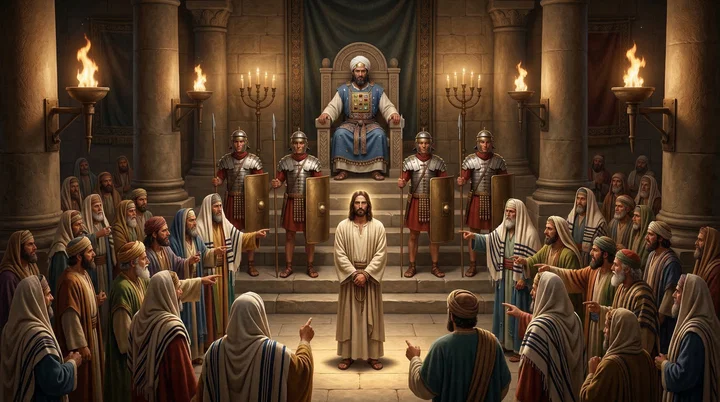
Caiaphas sat on the throne of judgment with Jesus at its foot to be tried for His life, with judges and those interested in the trial on either side, Roman soldiers ranged on the platform below the throne, and a multitude watching amid wild excitement.3SP 115.3–116.2
Amid the surrounding excitement and hostility Jesus remained calm and serene, dignified and majestic, with a holy influence emanating from Him, in strong contrast to the excited and malignant deportment of Annas and Caiaphas, so that even the hardened multitude questioned whether a man of God-like presence should be sentenced as a common criminal.5RED 35.3–36.23SP 115.3–116.2
Caiaphas himself was struck with admiration for Jesus' bearing and convicted that He was akin to God, but he banished the thought and in sneering, haughty tones demanded that Jesus work one of His famous miracles before him, which Jesus passed by as though He heard it not.3SP 115.3–116.2
Perceiving Jesus' influence over the crowd, Caiaphas hastened the trial.3SP 115.3–116.2
He was arrayed in gorgeous robe with glittering tiara and costly breastplate on which the light of God's glory had formerly flashed, while Jesus stood in coarse, homely garments, though He had reigned in the courts of heaven crowned and in garments of brightness attended by holy angels.3SP 115.3–116.2
Certain witnesses were sought out and arose to falsely accuse Jesus during His trial in order to secure His condemnation, since the rulers could establish no valid charge against Him by fair means.Ms 102, 1897, par. 1–3DA 698.1–700.5
They claimed He had said He would destroy the temple made by human hands and build another in three days, but their testimony did not agree, exposing the accusation as unreliable.Ms 102, 1897, par. 1–3
When questioned about this testimony, Jesus remained silent.Ms 102, 1897, par. 1–3
Sources
Pioneers and periodicals
14 sources
Mark 14:57 belongs to Jesus' hurried, unjust appearance before the Sanhedrin in the judgment hall at night, when he stood alone after his disciples fled while the leaders sought to unite against him under a pretense of legal form.ST May 27, 1889ST Mar 14, 1906ST May 25, 1904RH Dec 29, 1863 No genuine fault could be found in him, so false witnesses were brought to secure his condemnation for blasphemy, a capital charge under Jewish law requiring two agreeing witnesses, though his death had already been decided.ST Nov 19, 1912ST May 25, 1904ST Dec 1, 1898 Certain men rose up agreeing in their accusation against him but disagreeing in the proof they offered, and this lack of agreement made them false witnesses, so that he did not need to answer but kept a dignified silence that won influence in his favor.ST Oct 26, 1882ST Nov 4, 1897 Their testimony perverted his true prophecy that rejection of his counsel would bring national ruin upon Jerusalem and leave the temple without one stone upon another into the false claim that he himself would destroy the temple, a charge of high treason that like every other charge against him was false.RH Nov 20, 1900 The disagreement of the witnesses shows that those who defend error invent different and discordant reasons while truth is consistent, as seen in the conflicting arguments advanced against the Sabbath and for a counterfeit day in contrast to the single biblical reason for keeping the Lord's Sabbath.ST Apr 3, 1893ST May 4, 1876ST May 27, 1908
Unjust Trial Before Council
Mark 14:57 belongs to Jesus' hurried appearance before the Sanhedrin in the judgment hall, an informal and unjust trial held hastily at night despite a pretense of following legal forms.ST May 27, 1889ST May 25, 1904 Capital cases were not lawfully tried between sunset and sunrise, yet his was pressed forward in the night hours.ST May 25, 1904 The surrounding events place him alone among his enemies after the disciples fled, as the leaders sought to unite against him.ST Mar 14, 1906 It stands in the account of his rejection and mistreatment, where hollow homage gives way to mockery and open outrage.RH Dec 29, 1863
The charge pursued against him was blasphemy, a capital offense under Jewish law that required two witnesses to agree, and the council accepted the testimony of two false witnesses to condemn him.ST May 25, 1904 False witnesses were brought before the high priest because no genuine fault could be found in him, and their lies were needed to secure his condemnation and death.ST Nov 19, 1912 They tried to find evidence from his past that could condemn him, though his condemnation had already been decided.ST Dec 1, 1898
The false testimony perverted his true prophecy about the temple into the claim that he had said he would destroy the temple, brought as a charge of high treason.RH Nov 20, 1900 He had in fact warned that rejection of his counsel could only end in national ruin, pronouncing woes against Capernaum, Chorazin, and Bethsaida that would reduce them to ruin and bring them down to hell.RH Nov 20, 1900 He had declared that Jerusalem would be compassed with armies and laid low even in the dust with her children within her, and that the temple which was their pride and trust would be so ruined that not one stone would be left upon another.RH Nov 20, 1900 The charge of high treason and every other charge against him was false, and though made by the chief religionists it was in reality made only by the chief politicians, which is to say their religion was only politics.RH Nov 20, 1900
Certain men rose up to give false testimony, agreeing in their accusation against him but not agreeing on the proof they offered or their reasons for rejecting him.ST Jul 24, 1879 Their testimony contradicted one another and did not agree, and this lack of agreement made them false witnesses.ST Oct 26, 1882ST Nov 4, 1897 Because of that disagreement he did not need to answer their accusations.ST Oct 26, 1882 His dignified silence during the trial, even after his death had been decided, influenced people in his favor and sowed seeds that would later bear fruit.ST Oct 26, 1882
Lessons From Conflicting Testimony
The disagreement of the false witnesses who testified against Jesus shows that those who defend error can invent different reasons for their position, while truth remains consistent.ST May 4, 1876 Their testimony did not agree with one another, and that lack of agreement itself marks the character of falsehood in contrast to the unity of truth.ST May 4, 1876 The contrast is applied to the many different reasons offered for keeping Sunday as opposed to the single reason for keeping the Lord's Sabbath.ST May 4, 1876
In the same way, the conflicting claims brought against Jesus illustrate how opponents of the Sabbath advance discordant arguments against it and in favor of a counterfeit day.ST Apr 3, 1893ST May 4, 1876ST May 27, 1908 Their testimonies do not agree, and that disagreement exposes their lack of consistent biblical proof.ST May 4, 1876ST May 27, 1908 The many reasons given for Sunday observance stand against the one reason for keeping the Lord's Sabbath, revealing the difference between invented error and consistent truth.ST May 4, 1876
Because the verse places Jesus in the judgment hall facing false witnesses in his suffering, his followers are urged to remain close to him there.ST Mar 14, 1906 They are to stay near him in that place of rejection and accusation just as they would in more triumphant moments.ST Mar 14, 1906
Sources