Mark 14:55
And the chief priests and all the council sought for witness against Jesus to put him to death; and found none.
Translations
American King James Version, King James Version, KJV Cambridge Paragraph Bible
And the chief priests and all the council sought for witness against Jesus to put him to death; and found none.
And the chief priests, and all the council sought for testimony against Jesus to put him to death; and found none.
Revised Version, American Standard Version
Now the chief priests and the whole council sought witness against Jesus to put him to death; and found it not.
And the chief priests and all the sanhedrim were seeking against Jesus testimony — to put him to death, and they were not finding,
And the chief priests and the whole sanhedrim sought testimony against Jesus to cause him to be put to death, and did not find [ any].
Now, the High-priest, and all the High-council, were seeking, against Jesus, testimony, with the intent to put him to death,—and were not finding any;
Berean Standard Bible, Majority Standard Bible
Now the chief priests and the whole Sanhedrin were seeking testimony against Jesus to put Him to death, but they did not find any.
Now the chief priests and the whole council sought witnesses against Jesus to put him to death, and found none.
Now the chief priests and all the Sanhedrin were looking for witness against Jesus so that they might put him to death; and they were unable to get any.
And the hie Priests, and all the Councill sought for witnesse against Iesus, to put him to death, but found none.
Douay-Rheims (Challoner revision)
And the chief priests and all the council sought for evidence against Jesus, that they might put him to death, and found none.
Pictures
Cross-references
- Matthew 26:59-60
Now the chief priests, and elders, and all the council, sought false witness against Jesus, to put him to death;
The council seeks false testimony against Jesus but finds none.
- John 18:19-21
The high priest then asked Jesus of his disciples, and of his doctrine.
Annas questions Jesus about his disciples and teaching during his examination.
- Luke 22:54-71
Then took they him, and led him, and brought him into the high priest’s house. And Peter followed afar off.
Parallel account of Jesus’ hearing and trial.
- Matthew 27:1
When the morning was come, all the chief priests and elders of the people took counsel against Jesus to put him to death:
parallel account of same hearing
- Deuteronomy 17:6
At the mouth of two witnesses, or three witnesses, shall he that is worthy of death be put to death; but at the mouth of one witness he shall not be put to death.
Jewish law required two witnesses for a death sentence.
- Deuteronomy 19:15
One witness shall not rise up against a man for any iniquity, or for any sin, in any sin that he sinneth: at the mouth of two witnesses, or at the mouth of three witnesses, shall the matter be established.
Requires multiple witnesses to establish a matter.
- Mark 15:1
And straightway in the morning the chief priests held a consultation with the elders and scribes and the whole council, and bound Jesus, and carried him away, and delivered him to Pilate.
continuation of same hearing
- Isaiah 53:7
He was oppressed, and he was afflicted, yet he opened not his mouth: he is brought as a lamb to the slaughter, and as a sheep before her shearers is dumb, so he openeth not his mouth.
Jesus remains silent under accusation as the suffering servant.
- Matthew 26:63-64
But Jesus held his peace. And the high priest answered and said unto him, I adjure thee by the living God, that thou tell us whether thou be the Christ, the Son of God.
Records the high priest’s question and Jesus’ answer at the trial.
- John 11:47-53
Then gathered the chief priests and the Pharisees a council, and said, What do we? for this man doeth many miracles.
The leaders decide beforehand that Jesus must die.
- Hebrews 10:28
He that despised Moses’ law died without mercy under two or three witnesses:
Both describe testimony by multiple witnesses in a legal proceeding.
- 2 Corinthians 13:1
This is the third time I am coming to you. In the mouth of two or three witnesses shall every word be established.
Both invoke testimony established by two or three witnesses.
- Exodus 20:16
Thou shalt not bear false witness against thy neighbour.
The council sought false testimony against Jesus, violating the command against false witness.
- John 7:51
Doth our law judge any man, before it hear him, and know what he doeth?
The law requires hearing a person before judgment, challenging the council’s plan.
- Matthew 18:16
But if he will not hear thee, then take with thee one or two more, that in the mouth of two or three witnesses every word may be established.
Jesus continued the requirement for two or three witnesses.
- Acts 6:13
And set up false witnesses, which said, This man ceaseth not to speak blasphemous words against this holy place, and the law:
False witnesses were also brought against Stephen.
Commentary
Each commentary is drawn from primary sources: the writings of Ellen G. White and Adventist pioneers and periodicals. Each commentary is separate. Its own words are not a quotation; follow the references to read the source passages.
Ellen G. White
6 sources
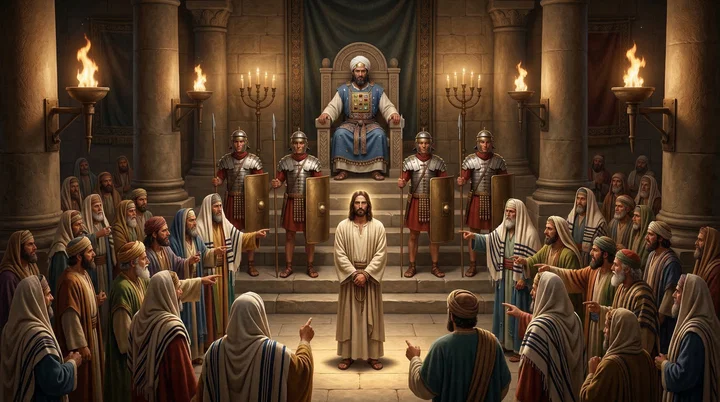
Mark 14:55 belongs to the account of Jesus brought before Annas for a preliminary examination and then before the court of Caiaphas for the formal trial before the Sanhedrin.DA 698DA 698.1–700.5 The whole council was assembled in the judgment hall with Caiaphas as presiding officer.3SP 115.3–116.2 Jesus stood at the foot of the throne of judgment while Caiaphas sat upon it, with judges and others interested in the trial on either side, and Roman soldiers ranged on the platform below.3SP 115.3–116.2
Those judging Him were moved by rivalry and bitter jealousy because crowds were drawn to Jesus and His wise teaching.3SP 115.3–116.2 The chief priests and all the council were judging Him for His life and sought testimony against Him to justify putting Him to death.Ms 102, 1897, par. 1–3DA 698.1–700.55RED 35.3–36.2 They found none because He had said nothing that gave them advantage, and the witnesses who came forward gave false and conflicting accounts that left no consistent evidence against Him.Ms 102, 1897, par. 1–3DA 698.1–700.5
Under Roman rule the Sanhedrin could examine and pass judgment but could not execute a death sentence without Roman ratification.DA 698.1–700.5 An accusation still had to be found that would condemn Him as a blasphemer in the eyes of the Jews and as guilty of sedition as a disturber of the peace and creator of insurrection in the eyes of the Romans.DA 698.1–700.5 Annas tried the Roman charge first by questioning Jesus about His disciples and doctrines to prove a secret society plotting a new kingdom, but Jesus denied any secret bond and pointed to His open teaching in synagogue and temple.DA 698.1–700.5 The midnight seizure, mockery, and abuse before any accusation or condemnation violated the law and their own rule that every man be treated as innocent until proved guilty.DA 698.1–700.5
While the trial proceeded Jesus remained calm, dignified, serene, majestic and God-like in bearing, with a holy influence pervading the air around Him.5RED 35.3–36.23SP 115.3–116.2 This stood in contrast to the excited and malignant deportment of Annas and Caiaphas, so that even the hardened multitude questioned sentencing a man of such presence as a common criminal.3SP 115.3–116.2 Caiaphas was at first struck with admiration and conviction that Jesus was akin to God, but he banished the thought and hastened the trial.3SP 115.3–116.2 Demanding in sneering, haughty tones that Jesus work a mighty miracle before him, he was ignored as though He heard it not.3SP 115.3–116.2
The contrast extended to dress, with the high priest in gorgeous robe, glittering tiara and costly breastplate once lit by divine glory, while Jesus wore coarse, homely garments, though He had reigned in the courts of Heaven crowned and clothed in brightness and attended by holy angels.3SP 115.3–116.2 The failure to find witness proves Jesus guiltless of violating the Sabbath, for His actions in satisfying hunger with His disciples were in harmony with the Sabbath commandment.ST Sep 16, 1913 If His conduct had truly broken the commandment they would not have needed false witnesses at His trial.ST Sep 16, 1913
Sources
Pioneers and periodicals
12 sources
The chief priests and all the council held a hurried, informal and unjust trial of Jesus before Caiaphas with only a pretense of legal forms, having already determined to put Him to death and seeking evidence to justify the sentence.ST May 27, 1889ST Dec 1, 1898 It was rushed because a capital case was not lawful between sunset and sunrise and they wanted Him in Roman hands before His friends could rally, with blasphemy as the capital charge requiring two agreeing witnesses.ST May 25, 1904 It was driven by malice, hatred, envy and rivalry over His teaching, crowds and pure life that threatened their influence, and because no true charge from His past conduct could be found they relied on false and hired witnesses whose testimony contradicted and failed to agree.ST May 27, 1889RH Jun 23, 1868ST Dec 11, 1893ST Jan 29, 1902 No truthful charge that would justify death could be found because the claim that He broke the Sabbath could not be sustained, so that if He had truly violated the commandment they would not have needed false witnesses.ST Nov 19, 1912ST Sep 16, 1913 The discordant and disagreeing witnesses illustrate the conflicting arguments made against the Sabbath and the seventh-day Sabbath, which will fare no better.ST Apr 3, 1893
The Unjust Trial
The verse describes Jesus hurried before the Sanhedrin for an informal and unjust trial, with only a pretense of following legal forms, presided over by Caiaphas.ST May 27, 1889 The trial was rushed because a capital case was not lawful between sunset and sunrise, and the leaders wanted to hand Jesus over to the Roman authorities before His friends could rally to defend Him.ST May 25, 1904 The accusation was blasphemy, a capital offense under Jewish law requiring two witnesses to agree.ST May 25, 1904 The chief priests and all the council had already determined to put Jesus to death and sought evidence to justify the sentence rather than conducting an impartial inquiry, and because spies had failed to find grounds against Him no charge could be established from His past conduct.ST Dec 1, 1898
Caiaphas regarded Jesus as a rival, and jealousy over the crowds drawn to Jesus and His teaching had stirred hostility.ST May 27, 1889 The prosecution was gotten up and carried on by malice, hatred and envy to criminalize and destroy Him.RH Jun 23, 1868 His pure life and truthful words exposed the false-hearted teachers, while His growing support among the people threatened their influence and position.ST Jan 29, 1902 Because they could find no true charge that would serve their purpose, they had to rely on false and hired witnesses.ST May 25, 1904ST Dec 1, 1898 Those witnesses brought against Him could not agree in their testimony and the proof they offered, but gave conflicting testimony that was contradictory and lacked agreement on essential points.RH Jun 23, 1868ST Dec 11, 1893ST Dec 1, 1898ST Jul 24, 1879 Many false witnesses testified against Him, but their reasons for rejecting Him did not agree, so even the plainest charges failed.RH Jun 23, 1868
The proceeding is also described as a trial before Pontius Pilate, instigated by Satan.RH Jun 23, 1868 The contradictory mass of testimony failed to convince even the time-serving Pilate, who greatly desired to please the accusers.RH Jun 23, 1868 He hesitated to pronounce sentence and tried to throw the responsibility on them.RH Jun 23, 1868 From that testimony he drew truth enough to establish in his own mind both the innocence of Jesus and the justice of His claim to the Messiahship, writing on the cross that He is Jesus the King of the Jews.RH Jun 23, 1868
Sabbath Proof and Application
The council could find no truthful charge against Jesus that would justify putting Him to death, because the charge that He broke the Sabbath could not be sustained, so they resorted to false witnesses.ST Nov 19, 1912 No accusation that He violated the Sabbath could be substantiated, for if His conduct had truly broken the commandment they would not have needed false witnesses at His trial.ST Sep 16, 1913 His actions in satisfying hunger with His disciples were in harmony with the Sabbath commandment, leaving Him guiltless of the charge.ST Sep 16, 1913
The chief priests and all the council sought testimony against Him in order to put Him to death, but found none, and the conflicting arguments made against the Sabbath are like those witnesses against Jesus in being discordant and destined to fare no better.ST Apr 3, 1893 When He was on trial many false witnesses testified against Him, but their reasons for rejecting Him did not agree, which illustrates the lack of agreement among arguments that oppose the seventh-day Sabbath.ST Apr 3, 1893
The trial belongs to the account of Christ's rejection, in which outward professions of homage can be hollow and mocking and the step from such profession to open rejection and abuse can be swift.RH Dec 29, 1863 It is part of the setting in which Peter followed Jesus at a distance, while the chief priests and the whole council sought testimony against Jesus in order to put Him to death but could find none.ST Mar 14, 1906 That setting calls for remaining close to Jesus even in the judgment hall and on the way to Calvary.ST Mar 14, 1906
Sources