Translations
American King James Version, King James Version, KJV Cambridge Paragraph Bible
But neither so did their witness agree together.
But neither so did their testimony agree together.
Revised Version, American Standard Version
And not even so did their witness agree together.
and neither so was their testimony alike.
And neither thus did their testimony agree.
And, not even so, was the testimony, agreed.
Berean Standard Bible, Majority Standard Bible
But even their testimony was inconsistent.
Even so, their testimony didn’ t agree.
And even so their witness was not in agreement.
But their witnesse yet agreed not together.
Douay-Rheims (Challoner revision)
And their witness did not agree.
Pictures
Cross-references
- Matthew 26:59-60
Now the chief priests, and elders, and all the council, sought false witness against Jesus, to put him to death;
False witnesses give conflicting testimony against Jesus.
- Deuteronomy 19:15
One witness shall not rise up against a man for any iniquity, or for any sin, in any sin that he sinneth: at the mouth of two witnesses, or at the mouth of three witnesses, shall the matter be established.
Requires two or three witnesses to establish a charge.
- John 18:19-24
The high priest then asked Jesus of his disciples, and of his doctrine.
Jesus is questioned before the high priest and calls for witnesses to testify about his teaching.
- Matthew 26:63-64
But Jesus held his peace. And the high priest answered and said unto him, I adjure thee by the living God, that thou tell us whether thou be the Christ, the Son of God.
The failed testimony is followed by the high priest’s question and Jesus’ answer.
- Luke 22:66-71
And as soon as it was day, the elders of the people and the chief priests and the scribes came together, and led him into their council, saying,
Another account of Jesus’ hearing before the council.
- John 2:19-21
Jesus answered and said unto them, Destroy this temple, and in three days I will raise it up.
Jesus’ temple saying referred to his death and resurrection.
- Deuteronomy 17:6
At the mouth of two witnesses, or three witnesses, shall he that is worthy of death be put to death; but at the mouth of one witness he shall not be put to death.
Requires two witnesses to impose the death penalty.
Commentary
Each commentary is drawn from primary sources: the writings of Ellen G. White and Adventist pioneers and periodicals. Each commentary is separate. Its own words are not a quotation; follow the references to read the source passages.
Ellen G. White
4 sources
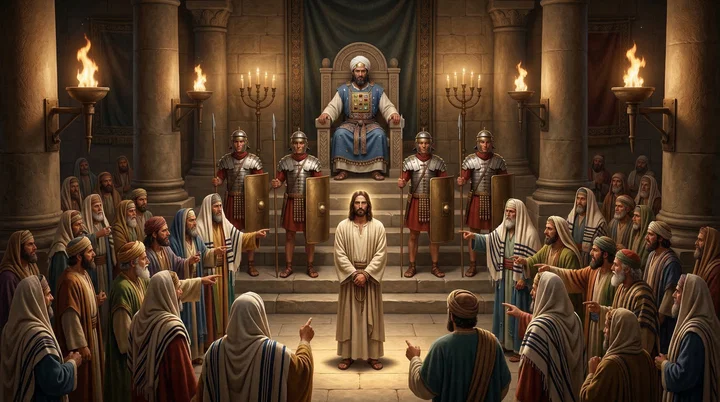
The setting was the judgment hall during the trial before Caiaphas as presiding officer, with Jesus standing at the foot of the throne of judgment while the judges and those interested in the trial stood on either side and Roman soldiers were ranged on the platform below the throne.3SP 115.3–116.2 In that setting Caiaphas presided in gorgeous robe with glittering tiara and costly breastplate while Jesus stood in coarse clothing.3SP 115.3–116.2 Jesus stood calm and serene and majestic under the gaze of the multitude amid wild excitement, with a holy influence emanating from Him that led even hardened onlookers to question whether a man of such God-like presence should be sentenced as a common criminal.3SP 115.3–116.2
Behind this lay months of hunting Jesus to entrap Him and bring Him before a secret tribunal, seeking to obtain by perjury what was impossible to gain by fair means.DA 698.1–700.5 The midnight seizure by a mob with mockery and abuse, before He was condemned or even accused, violated the law and the rulers' own rule that every man should be treated as innocent until proved guilty.DA 698.1–700.5 The preliminary examination before Annas concerning His disciples and His doctrines was meant to draw out material to prove He sought to establish a secret society for a new kingdom, so as to convict Him of sedition before the Romans and of blasphemy before the Jews.DA 698.1–700.5 Christ answered that He spoke openly in synagogue and temple with nothing said in secret, and that questioning was without success.DA 698.1–700.5 The renewed questioning by Annas and Caiaphas while the Sanhedrim assembled was again without success, leaving them with no accusation and forcing them to hasten the form of a legal trial to unite the Sanhedrim against Him.DA 698.1–700.5
The witnesses accusing Jesus gave contradictory testimony that did not agree together, so the priests gained nothing against Him, their evidence was worthless, and their statements could not establish a consistent charge or maintain the accusations.Ms 102, 1897, par. 1–3DA 698.1–700.55RED 35.3–36.2
Sources
Pioneers and periodicals
18 sources
The verse belongs to Jesus' hurried and unjust appearance before the Sanhedrin, amid His rejection and mockery.ST May 27, 1889RH Dec 29, 1863 The witnesses brought against Him contradicted one another so that each undermined the other, and their testimony was manufactured by a court that had already decided to condemn Him rather than honestly gathered from those who knew Him.ST Mar 6, 1901ST Jan 19, 1882ST Jan 19, 1882ST Dec 1, 1898ST Mar 6, 1901 The law required two or three agreeing witnesses before a person could be put to death, so their disagreement meant the charge could not be sustained and no fault could be found in Him.ST Nov 19, 1912ST May 25, 1904ST Mar 6, 1901 Because their testimony did not agree no answer was required from Him, and His dignified silence won many in His favor.ST Oct 26, 1882 That disagreement shows that testimony against the Lord is self-contradictory and thereby proves itself untrue, for those who oppose Him share the same aim yet give conflicting reasons, as when opponents of the seventh-day Sabbath advance conflicting arguments against it and in favor of Sunday.ST Apr 3, 1893ST Jul 12, 1899ST May 4, 1876ST Nov 4, 1897
Trial Setting and Meaning
Mark 14:59 belongs to Jesus' hurried appearance before the Sanhedrin, where the proceeding kept a pretense of legal form while remaining informal and unjust.ST May 27, 1889 It stands in the account of Christ's rejection and mockery, as the scene passes from hollow homage to open outrage when He is smitten and buffeted.RH Dec 29, 1863 The witnesses brought against Him before Caiaphas could not make their testimony agree but contradicted one another, so that each undermined the one before it.ST Mar 6, 1901ST Jan 19, 1882ST Dec 1, 1898 Their malicious and conflicting accusations thus canceled themselves and failed to establish any consistent charge from His past by which He could justly be condemned.ST Mar 6, 1901ST Jan 19, 1882ST Dec 1, 1898
Their testimony was manufactured rather than honestly gathered, for it was sought and produced by men pursuing a particular charge instead of by examining those who knew what Jesus had done, showing that manufactured testimony fails to establish the truth.ST Jan 19, 1882 The Sanhedrin was seeking to condemn Jesus rather than to judge Him fairly, having already decided to put Him to death.ST Dec 1, 1898ST Mar 6, 1901 The charge of blasphemy required two witnesses whose accounts concurred, and Scripture required two or three agreeing witnesses before a person could be put to death, so the disagreement meant the charge could not be sustained.ST Nov 19, 1912ST May 25, 1904ST Mar 6, 1901 Because no fault could be found in Him, His accusers relied on false testimony to secure His condemnation and death.ST Nov 19, 1912ST May 25, 1904
Because the accusing witnesses contradicted one another and their testimony did not agree, no answer from Jesus was required.ST Oct 26, 1882 His dignified silence during the trial influenced many in His favor.ST Oct 26, 1882
False Testimony Exposes Error
The failure of the accusers to agree shows that testimony raised against the Lord and His work may contradict itself, and such self-contradiction is proof that it is untrue.ST Jul 12, 1899ST May 4, 1876 Those who invent arguments for error offer conflicting reasons, while those who receive the truth speak in harmony.ST May 4, 1876 Conflicting testimony of this kind makes those who give it false witnesses.ST Nov 4, 1897
Although all the witnesses were brought forward to oppose Jesus and to deny that He was the true Christ, they did not agree in the reasons they gave and the proof they presented.ST Jul 24, 1879 Their common purpose did not produce a common story, for each line of evidence differed from the others.ST Jul 24, 1879
As those witnesses failed, so those who oppose the seventh-day Sabbath bring forward conflicting arguments against it and in favor of Sunday and take conflicting positions among themselves.ST Apr 3, 1893ST May 27, 1908 Their efforts against the Lord's Sabbath follow the same pattern of disagreement and are to have no greater success.ST Apr 3, 1893ST Jul 12, 1899 The mere presenting of two witnesses does not settle a question when their evidence does not establish what is claimed, as is seen in the two witnesses put forward to prove that Sunday is the seventh day.ST Jun 19, 1879
The same lack of agreement marks the claims of geologists who argue against the Bible, whose facts and theories contradict one another.ST Jan 19, 1882 The disagreement also warns against claiming to uphold the Word of Christ while living a life that contradicts it.ST Nov 4, 1897
Sources