John 18:19
The high priest then asked Jesus of his disciples, and of his doctrine.
Translations
American King James Version, King James Version, KJV Cambridge Paragraph Bible
The high priest then asked Jesus of his disciples, and of his doctrine.
The high priest then asked Jesus concerning his disciples, and concerning his doctrine.
Revised Version, American Standard Version
The high priest therefore asked Jesus of his disciples, and of his teaching.
The chief priests, therefore, questioned Jesus concerning his disciples, and concerning his teaching;
The high priest therefore demanded of Jesus concerning his disciples and concerning his doctrine.
The High-priest, therefore, questioned Jesus concerning his disciples, and concerning his teaching.
Berean Standard Bible, Majority Standard Bible
Meanwhile, the high priest questioned Jesus about His disciples and His teaching.
The high priest therefore asked Jesus about his disciples and about his teaching.
Then the high priest put questions to Jesus about his disciples and his teaching.
(The hie Priest then asked Iesus of his disciples, and of his doctrine.
Douay-Rheims (Challoner revision)
The high priest therefore asked Jesus of his disciples, and of his doctrine.
Pictures
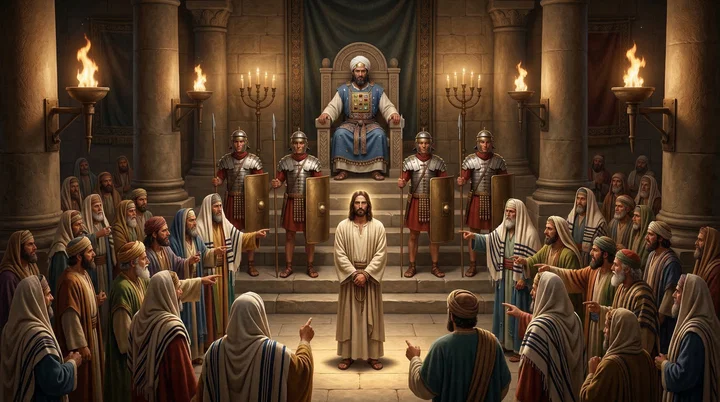
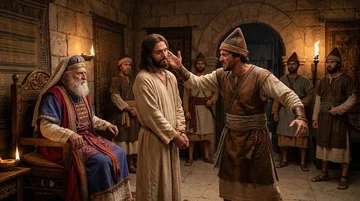
Cross-references
- Matthew 26:57-68
And they that had laid hold on Jesus led him away to Caiaphas the high priest, where the scribes and the elders were assembled.
Jesus is brought before Caiaphas, questioned, and condemned for blasphemy.
- Mark 14:60-62
And the high priest stood up in the midst, and asked Jesus, saying, Answerest thou nothing? what is it which these witness against thee?
Jesus is questioned by the high priest and answers during his hearing.
- Luke 22:54-71
Then took they him, and led him, and brought him into the high priest’s house. And Peter followed afar off.
A parallel account of Jesus’ arrest, examination, and Peter’s denial.
- John 18:13-14
And led him away to Annas first; for he was father in law to Caiaphas, which was the high priest that same year.
Jesus is taken first to Annas, then Caiaphas, before the questioning.
- John 18:23
Jesus answered him, If I have spoken evil, bear witness of the evil: but if well, why smitest thou me?
Jesus mildly answers the blow during his trial.
- John 11:49-50
And one of them, named Caiaphas, being the high priest that same year, said unto them, Ye know nothing at all,
Caiaphas argues that Jesus should die for the nation.
- John 18:24
Now Annas had sent him bound unto Caiaphas the high priest.
Annas sends Jesus bound to Caiaphas.
- Matthew 26:62-64
And the high priest arose, and said unto him, Answerest thou nothing? what is it which these witness against thee?
questioning and answer to remember
- Luke 22:66-71
And as soon as it was day, the elders of the people and the chief priests and the scribes came together, and led him into their council, saying,
Jesus is questioned before the council.
- John 18:25-27
And Simon Peter stood and warmed himself. They said therefore unto him, Art not thou also one of his disciples? He denied it, and said, I am not.
Peter denies being Jesus’ disciple while the questioning proceeds.
- Isaiah 53:7
He was oppressed, and he was afflicted, yet he opened not his mouth: he is brought as a lamb to the slaughter, and as a sheep before her shearers is dumb, so he openeth not his mouth.
prophecy of silence before accusers
- Matthew 26:59-60
Now the chief priests, and elders, and all the council, sought false witness against Jesus, to put him to death;
The council sought testimony to condemn Jesus.
- Matthew 27:11-31
And Jesus stood before the governor: and the governor asked him, saying, Art thou the King of the Jews? And Jesus said unto him, Thou sayest.
Listed as a parallel account of Jesus’ trial.
Commentary
Each commentary is drawn from primary sources: the writings of Ellen G. White and Adventist pioneers and periodicals. Each commentary is separate. Its own words are not a quotation; follow the references to read the source passages.
Ellen G. White
15 sources
Annas the high priest questions Jesus about His followers who believed in Him and about His teaching and doctrine.Ms 104, 1897, par. 1–2Ms 91, 1909, par. 11–15DA 698.1–700.5 The questioning takes place early in the morning while still dark in the high priest's judgment hall as the Sanhedrin is assembled, in the course of a night of insults, mockery and scourging as He is passed from ruler to ruler.3SP 107.13SP 113.2Ms 95, 1897, par. 10–12 It is not a fair inquiry after truth but a secret, mock trial kept from the people, designed as a trap to provoke some statement that would condemn Him as secretly organizing a movement and plotting insurrection to alarm Rome, or as a blasphemer under Jewish law.DA 698.1–700.5ST Jun 13, 18785RED 33.3–34.13SP 113.3–114.13SP 113.2 In answer He declares that He taught openly to the world in synagogue and temple with nothing in secret and no hidden purpose, and bids them ask those who heard Him, thereby rebuking their unjust methods when they already know His words through spies who long hunted Him to entrap Him.Ms 104, 1897, par. 1–2Ms 91, 1909, par. 11–15DA 698.1–700.5ST Jun 13, 18785RED 33.3–34.1
Setting and Purpose of Questioning
The questioner is Annas the high priest, and his inquiry concerns both Jesus' disciples, the followers who believed in Him, and His teaching or doctrine.Ms 104, 1897, par. 1–2Ms 91, 1909, par. 11–15DA 698.1–700.5ST Jun 13, 18783SP 113.3–114.1 The questioning takes place in the high priest's judgment hall early in the morning while it is still dark and while the Sanhedrin is being assembled.3SP 107.13SP 113.2 It comes in the course of a night of repeated insults, mockery, and scourging as Jesus is passed from one ruler to another, where He is coarsely accused, sneeringly questioned, and reviled by the assembly.3SP 107.1Ms 95, 1897, par. 10–12
It is not a fair inquiry after truth but a secret, mock trial held where the people have no voice.ST Jun 13, 18785RED 33.3–34.13SP 113.3–114.15RED 33.1 The secrecy is deliberate, so the people cannot bring testimony about His mighty works that would expose the council and lead to His release, and so that by perjury before a secret tribunal may be obtained what cannot be gained by fair means.ST Jun 13, 18785RED 33.1 The questions are a trap to provoke a statement usable to condemn Him.DA 698.1–700.5ST Jun 13, 18785RED 33.3–34.1 They hope to find evidence that He was secretly organizing a movement, forming a secret society, and plotting insurrection to set up a new kingdom, and so to alarm the Roman authorities.DA 698.1–700.5ST Jun 13, 1878
Annas and Caiaphas want material to condemn Him on either ground: as a disturber of the peace and leader of rebellion punishable by Rome, or as a blasphemer condemnable under Jewish law.3SP 113.25RED 33.1 During this humiliation Peter denies knowing Jesus, even with cursing and swearing.Lt 54, 1874, par. 15–163SP 107.1 That denial by a beloved disciple pierces Jesus more deeply than the coarse accusations, sneering questions, and reviling of the assembly.3SP 107.1
At the same time John stays as near to Jesus as possible in a retired corner out of the mob's observation to hear and see all that transpires at the trial.5RED 32.1 He does not conceal that he is a follower of Jesus and does not mingle with the rough company that insults and mocks his Master.5RED 32.1 Because he assumes no false character he therefore lays himself under no suspicion and is not questioned.5RED 32.1
Open Teaching and Faithful Witness
When asked about His followers and His teaching, Jesus answered that He had taught openly to the world, always in the synagogue and in the temple where the Jews gather, and had said nothing in secret.Ms 104, 1897, par. 1–2Ms 91, 1909, par. 11–15DA 698.1–700.5ST Jun 13, 18783SP 113.3–114.1 There were no secret doctrines, no hidden purpose, and no concealment about His purpose, and He therefore directed the high priest to question those who had heard Him.Ms 91, 1909, par. 11–15DA 698.1–700.5ST Jun 13, 18785RED 33.3–34.13SP 113.3–114.1 His counter-question, why ask Him, was a pointed rebuke that exposed their unjust, secretive methods in contrast with His public ministry.DA 698.1–700.5ST Jun 13, 18785RED 33.3–34.13SP 113.3–114.1 The priests and rulers already knew what He had said, for they had set spies to watch His movements, attend every gathering of the people, and report His words and deeds, after hunting Him for months to entrap Him.ST Jun 13, 1878 They had brought Him before a secret tribunal where the people had no voice in order to obtain by perjury what could not be gained by fair means.ST Jun 13, 18785RED 33.3–34.13SP 113.3–114.1
In these proceedings He bore witness to the truth despite being treated as unjust when no sin was proven against Him.Lt 100, 1910, par. 12–15 He was coarsely accused, sneeringly questioned, and reviled by the assembly in the judgment hall.3SP 107.1 Through a night of repeated insults, mockery, and scourging as He was passed from one ruler to another, He maintained His dignity and spoke only what was essential, saying nothing that failed to honor God.Ms 95, 1897, par. 10–12
He had prepared His disciples while still with them for this ordeal of betrayal and condemnation in the judgment hall.4RED 102.2–103.1 His condemnation and the crowd's rejection of Him were a great trial for His followers.4RED 102.2–103.1 During His humiliation Peter denied knowing Him, and that denial led to deep remorse and repentance, after which, restored and humbled, he could better sympathize with the weak and erring and strengthen others.Lt 54, 1874, par. 15–16
His mistreatment in this trial stands as an example of the abuse and hostile treatment His followers must be prepared to endure for His name's sake.19MR 162.1
Sources
Pioneers and periodicals
19 sources
After His arrest Jesus was taken first to Annas, the former high priest and father-in-law of Caiaphas, out of respect for his former office amid the leaders' effort to unite against Him.ST Mar 14, 1906ST Dec 24, 1912 The questioning sought grounds to condemn Him as a threat to public order, as a trap to draw out a claim that He was forming a secret society to set up a new kingdom to alarm the Romans.ST Jan 17, 1900ST Jun 13, 1878 He left the question about His disciples unanswered and answered about His teaching that He had taught openly in synagogues and the temple where the Jews gather and said nothing in secret, thereby denying any hidden designs and exposing the unfairness of asking a prisoner to supply evidence for his own indictment.ST Jan 17, 1900ST Jun 13, 1878ST Jun 14, 1899 Before that hostile and unjust proceeding He remained calm, dignified and unresentful, and when struck He did not answer violence with violence but asked for evidence if He had done wrong.ST Apr 15, 1897ST Oct 27, 1898ST Mar 14, 1906 His trial about His disciples and doctrine still goes on before the world where His life, character and doctrine are attacked, and to be silent then is to deny Him as spoken words can deny Him, so love for Him requires cheerful, bold testimony at sacrifice to self.ST Mar 6, 1901ST Oct 24, 1911
Trial Setting and Meaning
After arrest Jesus was taken first to Annas, the former high priest and father-in-law of Caiaphas, who then held the office, out of respect for his former office, amid the leaders' effort to unite opposition against Him.ST Mar 14, 1906ST Dec 24, 1912 Annas condemned Jesus though he had no authority to judge Him, and the nighttime condemnation was contrary to Jewish law.ST Dec 24, 1912
The questioning about His disciples and His doctrine sought grounds to condemn Him as a threat to public order.ST Jan 17, 1900ST Jun 13, 1878 It was a trap to provoke a statement that could alarm the Roman authorities that He was forming a secret society to set up a new kingdom.ST Jun 13, 1878 The priests and rulers already knew what He had said through spies set to watch His movements, attend gatherings, and report His words and deeds.ST Jun 13, 1878 Annas had hunted Him for months to bring Him before a secret tribunal where the people had no voice in order to obtain by perjury what could not be gained by fair means.ST Jun 13, 1878
Jesus left the question about His disciples unanswered and answered about His teaching that He had taught openly in synagogues and the temple where the Jews gather and said nothing in secret.ST Jan 17, 1900ST Jun 13, 1878ST Jun 14, 1899 He told Annas to question those who had heard Him.ST Jan 17, 1900ST Jun 13, 1878 Thereby He denied any secret organization or hidden designs, silenced Annas, and exposed the unfairness of asking a prisoner to supply evidence for his own indictment when accusers should name a crime or release Him.ST Jan 17, 1900ST Jun 13, 1878ST Jun 14, 1899
His teaching was given openly to the world, not kept as secret doctrine for an inner circle.ST Apr 15, 1897ST Jun 14, 1899 Even words shared privately with loving hearers were meant to be proclaimed publicly, for His message was for all people.ST Jun 14, 1899 The religious leaders there officially rejected Him though He was the one foreshadowed by their offerings, because they replaced God's Word with human traditions.ST Jun 7, 1899 His Passover sacrifice took place on the fourteenth day of the first month, in fulfillment of the Passover type at its appointed time.RH Oct 30, 1855
The account is to be read together with Matthew 26:57-75, Mark 14:53-72, and Luke 22:54-62, covering Jesus led to the house of the high priest and questioned there while Peter followed afar off.ST Mar 6, 1901 Matthew 26:62-64, Isaiah 53:7, Revelation 1:7, and Romans 14:11 are to be remembered with it, and Matthew 16:16 as its truth that He is the Christ, the Son of the living God.ST Mar 6, 1901 The account of His trial belongs to a detailed and historically consistent narrative of His trial and execution.RH Feb 11, 1862
Example and Application
Before hostile and unjust proceedings he remained calm, dignified, unresentful, and true to himself in public and private and before his judges.ST Oct 27, 1898ST Mar 14, 1906RH Dec 3, 1861 When struck by an officer he did not answer violence with violence but asked for evidence if he had done wrong.ST Apr 15, 1897ST Mar 14, 1906 His suffering under accusation in the judgment hall, and under judgment and cruelty in the final scenes before crucifixion, was part of the steps of his sacrifice for fallen humanity in giving his life for the lost.RH Mar 26, 1861RH Jun 10, 1862 It is an example of bearing suffering, shame, and loss without turning away.RH Mar 26, 1861
His dignified conduct before his accusers and before Pilate, who found no evidence of crime, testified to a power and innocence beyond what Pilate knew and urged him to do right.ST Oct 27, 1898 His trial before rulers thus also brought the gospel to them as a witness and opportunity to accept it.ST Oct 27, 1898 The setting involving Caiaphas, a time-serving high priest, shows how religious leaders can use political power and sacrifice an individual in the name of protecting the nation.ST Oct 14, 1889 His example shows that the church is to proclaim God's Word and live Christ's life, not use political power or force to defeat its opponents.ST Apr 15, 1897
The questioning took place while Peter followed at a distance and watched from the courtyard.ST Mar 6, 1901ST Mar 14, 1906 The episode shows how fear can lead a disciple to deny the Lord by silence or speech.ST Oct 24, 1911 Cowardly distance and silence can make others think Jesus is not worth standing by.ST Jan 31, 1911 Circumstances there brought Peter's prior choice to avoid identification with Jesus to light.RH Jul 13, 1911 His trial before the high priest about his disciples and doctrine still goes on before the world, where his holy life, hallowed name, exalted character, and doctrine are still attacked and derided. To be silent then is to deny him just as spoken words can deny him, so love for Christ requires cheerful, bold, fervent testimony and defense at sacrifice to self, in social meetings and in company with the ungodly, so that he will confess his friends before his Father and the holy angels.
Sources