Mark 14:58
We heard him say, I will destroy this temple that is made with hands, and within three days I will build another made without hands.
Translations
American King James Version, King James Version, KJV Cambridge Paragraph Bible, Webster Bible
We heard him say, I will destroy this temple that is made with hands, and within three days I will build another made without hands.
Revised Version, American Standard Version
We heard him say, I will destroy this temple that is made with hands, and in three days I will build another made without hands.
'We heard him saying — I will throw down this sanctuary made with hands, and by three days, another made without hands I will build;'
We heard him saying, I will destroy this temple which is made with hands, and in the course of three days I will build another not made with hands.
We, heard him saying, I, will pull down this shrine, the one made by hand, and, in three days, another, not made by hand, will I raise.
Berean Standard Bible, Majority Standard Bible
“ We heard Him say, ‘ I will destroy this man-made temple, and in three days I will build another that is made without hands.’”
“ We heard him say, ‘ I will destroy this temple that is made with hands, and in three days I will build another made without hands.’”
He said in our hearing, I will put an end to this Temple which is made with hands, and in three days I will make another without hands.
We hearde him say, I will destroy this Temple made with hands, and within three daies I will builde another, made without hands.
Douay-Rheims (Challoner revision)
We heard him say, I will destroy this temple made with hands, and within three days I will build another not made with hands.
Pictures
Cross-references
- Matthew 26:61
And said, This fellow said, I am able to destroy the temple of God, and to build it in three days.
Records the parallel false testimony about destroying and rebuilding the temple.
- John 2:19-21
Jesus answered and said unto them, Destroy this temple, and in three days I will raise it up.
Jesus’ temple saying refers to his body and foretells his resurrection.
- Matthew 24:2
And Jesus said unto them, See ye not all these things? verily I say unto you, There shall not be left here one stone upon another, that shall not be thrown down.
Both foretell the temple being thrown down; the true prophecy was twisted.
- Matthew 27:40
And saying, Thou that destroyest the temple, and buildest it in three days, save thyself. If thou be the Son of God, come down from the cross.
Uses the same word in a taunt about destroying the temple.
- Mark 15:29
And they that passed by railed on him, wagging their heads, and saying, Ah, thou that destroyest the temple, and buildest it in three days,
Uses the same word in a taunt about destroying the temple.
- Acts 6:14
For we have heard him say, that this Jesus of Nazareth shall destroy this place, and shall change the customs which Moses delivered us.
Uses the word in an accusation that Jesus would destroy the temple.
- Mark 13:2
And Jesus answering said unto him, Seest thou these great buildings? there shall not be left one stone upon another, that shall not be thrown down.
Uses the same word for the temple being thrown down.
- 2 Corinthians 5:1
For we know that if our earthly house of this tabernacle were dissolved, we have a building of God, an house not made with hands, eternal in the heavens.
Uses the word for an earthly dwelling being dissolved.
- John 18:13-27
And led him away to Annas first; for he was father in law to Caiaphas, which was the high priest that same year.
parallel account of same hearing
- Mark 15:1
And straightway in the morning the chief priests held a consultation with the elders and scribes and the whole council, and bound Jesus, and carried him away, and delivered him to Pilate.
parallel account of same hearing
- Luke 22:54-71
Then took they him, and led him, and brought him into the high priest’s house. And Peter followed afar off.
parallel account of same hearing
Commentary
Each commentary is drawn from primary sources: the writings of Ellen G. White and Adventist pioneers and periodicals. Each commentary is separate. Its own words are not a quotation; follow the references to read the source passages.
Ellen G. White
8 sources
This saying belongs to the midnight effort to condemn Jesus after He was hurried bound over the brook Kedron to the palace of Annas, the ex-high priest recognized as head of the priestly family, for a preliminary examination before the formal trial before the Sanhedrin in the court of Caiaphas in the judgment hall before the high priest.DA 698.1–700.5DA 6985RED 35.3–36.2 Under Roman rule the Sanhedrin could not execute a death sentence and had to find charges that were criminal to the Romans and condemning to the Jews, so the priests sought to prove blasphemy against the Jews and sedition against the Romans.DA 698.1–700.5 Annas first questioned Jesus about His disciples and doctrines to make Him appear the leader of a secret society setting up a new kingdom, but Jesus denied any secret bond or hidden teaching because He had spoken openly in synagogue and temple.DA 698.1–700.5 The midnight seizure, mockery, and abuse before accusation or condemnation violated the rule that every man be treated as innocent until proved guilty.DA 698.1–700.5
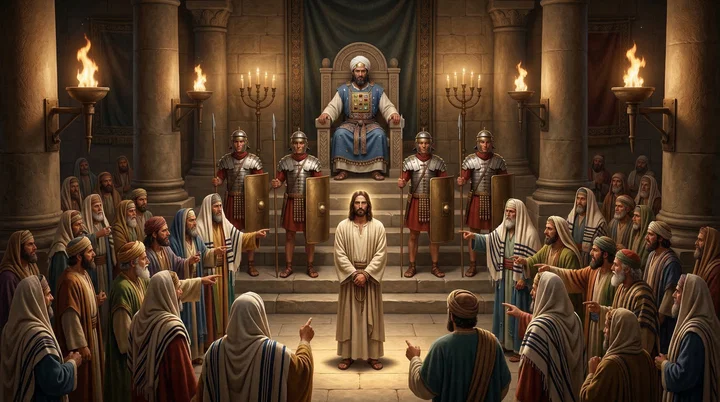
It takes place with Jesus standing at the foot of the throne of judgment while Caiaphas as presiding officer sits upon it, with judges and those specially interested on either side, Roman soldiers ranged on the platform below the throne, and the eyes of the multitude upon Him amid wild excitement.3SP 115.3–116.2 While the high priest and the crowd react with hostility, excitement, and malignant deportment, Jesus stands calm, serene, dignified, majestic and akin to God, with a holy influence emanating from Him and pervading the atmosphere.5RED 35.3–36.23SP 115.3–116.2 Even the hardened multitude compare His bearing with theirs and question whether a man of God-like presence should be sentenced as a common criminal.3SP 115.3–116.2 Caiaphas presides in gorgeous robe with glittering tiara and costly breastplate once associated with the flashing light of God's glory, in strong contrast to the coarse, homely garments of Jesus, though Jesus had reigned crowned in the courts of heaven in garments of brightness attended by holy angels.3SP 115.3–116.2
The verse records bought, false and malicious testimony from two witnesses, including a corrupt man who had sold his honor for money and spoke of Christ as on his own low level, whose evidence was less contradictory than the vague and worthless testimony before it.Ms 102, 1897, par. 1–33SP 118.1–2 Their testimony did not agree, so the charge was not established.Ms 102, 1897, par. 1–3 In figurative prophetic language concerning the temple of His body, Jesus foretold His own death and His conflict and victory in raising it again and rising after three days.5RED 36.3–38.23SP 118.1–23SP 116.3–117.2 He said He could destroy it and raise it again in three days.3SP 116.3–117.2
His hearers mistook the saying for a claim about the Jewish temple, and His enemies twisted and distorted it to make it sound offensive and able to build the Jewish temple in three days if destroyed.5RED 36.3–38.23SP 118.1–23SP 116.3–117.2 The words as Jesus spoke them were truth and verity and had nothing offensive in them, and accurately reported they did not support a charge of blasphemy.5RED 36.3–38.23SP 118.1–2 Even on the enemies' assumption that He was a mere man, the claim would only show an unreasonable, boastful spirit and could not be construed into blasphemy.3SP 118.1–2
This was the one saying of Jesus the priests could use to condemn Him, and alone could unite Romans and Jews, Pharisees and Sadducees, because all held the temple in great veneration.3SP 116.3–117.2 Other charges would fail because denouncing priests and scribes would weigh nothing with Romans or Sadducees, disregarding traditions would weigh nothing with Romans or Sadducees, and accusing Sabbath-breaking would expose His healing miracles.3SP 116.3–117.2 The Romans had rebuilt and embellished the temple and took great pride in it as a work of science and art, so they would be indignant that a humble man declared Himself able to build it in three days if destroyed.3SP 116.3–117.2
Sources
Pioneers and periodicals
16 sources
The charge twisted his saying about the temple of his body that he would raise after his death, for the witnesses who brought it were false and malicious and their accounts contradicted one another and did not agree.ST May 27, 1889ST Mar 6, 1901ST Apr 3, 1893 His words were figurative prophecy of his own death and resurrection, his conflict, and his victory, and reported exactly they contained nothing offensive and could not have been construed as blasphemy.ST May 27, 1889ST May 27, 1889 The saying belongs to his hurried trial before the Jewish council on a capital offense between sunset and sunrise, where two witnesses whose testimony agreed were required yet false testimony was accepted to condemn him, and because the contradictory accusations required no answer he remained silent before them.ST May 25, 1904ST Oct 26, 1882 The charge perverted his true warning that the temple which was their pride and trust would be ruined so that not one stone would be left on another, twisting his saying that it should be ruined into the claim that he himself would destroy it.RH Nov 20, 1900 The temple not made with hands is Christ, Jehovah our Righteousness, the effective Sin-bearer and eternal Priest who can save completely, and like the conflicting testimony against him the arguments opposing the seventh-day Sabbath and defending a counterfeit day contradict one another and disagree.ST Apr 3, 1893STST May 27, 1908ST Aug 22, 1916
Words and Trial Setting
The saying uses the Greek word kataluo for throwing down or destroying a building, here applied to the temple.RH Jul 16, 1857 The days spoken of for rebuilding within three days are full twenty-four-hour periods including night and daylight, not daylight hours only.RH Dec 12, 1871 The same saying is paralleled by the accusation in Matthew 26:61, where witnesses claim Jesus said he was able to destroy the temple and rebuild it in three days.ST Mar 6, 1901
It belongs to Jesus' hurried trial before the Jewish council, held despite the rule against trying a capital offense between sunset and sunrise, where two witnesses whose testimony agreed were required and false testimony was accepted in order to condemn him.ST May 25, 1904 The witnesses bringing this charge were false and malicious, and their accounts contradicted one another and did not agree.ST May 27, 1889ST Mar 6, 1901ST Apr 3, 1893ST Oct 26, 1882 Framed as his ability to rebuild Jerusalem's temple in three days if it were pulled down, the conflicting claim did not provide enough evidence to condemn him.ST Dec 1, 1898 It could establish no fault in him, so false witnesses were used and he was condemned through false witness.ST Nov 19, 1912ST Nov 4, 1897 Because the contradictory accusations required no answer, Jesus remained silent before them.ST Oct 26, 1882
True Meaning and Prophecy
The accusation twisted what had actually been said about the temple of the body, which would be raised again after death.ST May 27, 1889 The original saying was figurative prophecy of death and resurrection, of conflict and of victory.ST May 27, 1889 Stated exactly, it contained nothing offensive, and even on the supposition of mere humanity it would have amounted only to unreasonable boasting and could not have been construed as blasphemy.ST May 27, 1889
The perversion concealed a true warning of national ruin.RH Nov 20, 1900 Having lived among his own people to bring them to God and having been rejected, ruin was declared to follow, with woes bringing Capernaum, Chorazin, and Bethsaida down to ruin and hell, with Jerusalem to be compassed with armies and laid low in the dust with her children within her, and with the temple that was their pride and trust to be ruined so that not one stone would be left upon another.RH Nov 20, 1900 The saying that the temple should be ruined was produced in proceedings for high treason and twisted into the claim that he himself would destroy it.RH Nov 20, 1900 That charge of treason was false like every other charge, and though brought by the chief religionists it was in reality brought by chief politicians whose religion was only politics.RH Nov 20, 1900
The temple not made with hands is the greater reality foreshadowed by the sanctuary and its priesthood.ST It is Christ, Jehovah our Righteousness, the effective Sin-bearer and eternal Priest who is able to save completely.ST
Doctrinal Use and Application
The conflicting accounts given by the witnesses who testified against Jesus did not agree with one another.ST Apr 3, 1893ST May 27, 1908ST Aug 22, 1916 In the same way the arguments brought against the seventh-day Sabbath and in defense of a counterfeit day contradict one another and are inconsistent.ST Apr 3, 1893ST May 27, 1908 This disagreement illustrates how humanly devised reasons offered without clear scriptural support fail to agree.ST Aug 22, 1916 When Jesus, the Lord of the Sabbath, was on trial, the reasons given for rejecting Him likewise did not agree, and such inconsistent opposition is unlikely to succeed.ST Apr 3, 1893
The charge that He would destroy the temple could establish no fault in Him, so false witnesses were required to secure His condemnation.ST Nov 19, 1912 That trial shows the accusation of Sabbath-breaking against Him was also false, for He honored the Sabbath and taught that works of mercy and necessity were lawful on it.ST Nov 19, 1912 The saying belongs to the account of His rejection and mockery, which warns that hollow homage to Christ can give way quickly to open outrage.RH Dec 29, 1863
Sources