Mark 4:17
And have no root in themselves, and so endure but for a time: afterward, when affliction or persecution ariseth for the word’s sake, immediately they are offended.
Translations
And have no root in themselves, and so endure but for a time: afterward, when affliction or persecution rises for the word’s sake, immediately they are offended.
And have no root in themselves, and so endure but for a time: afterward, when affliction or persecution ariseth for the word’s sake, immediately they are offended.
and have no root in themselves, and so endure but for a time; afterward, when affliction or persecution ariseth for the word’s sake, immediately they are offended.
And have no root in themselves, and so endure but for a time: afterward, when affliction or persecution ariseth for the word's sake, immediately they relapse.
Revised Version, American Standard Version
and they have no root in themselves, but endure for a while; then, when tribulation or persecution ariseth because of the word, straightway they stumble.
and have not root in themselves, but are temporary; afterward tribulation or persecution having come because of the word, immediately they are stumbled.
and they have no root in themselves, but are for a time: then, tribulation arising, or persecution on account of the word, immediately they are offended.
and have no root in themselves, but, only for a season are,—afterwards, when there ariseth tribulation or persecution by reason of the word, straightway, they find cause of stumbling;
Berean Standard Bible, Majority Standard Bible
But they themselves have no root, and they remain for only a season. When trouble or persecution comes because of the word, they quickly fall away.
They have no root in themselves, but are short-lived. When oppression or persecution arises because of the word, immediately they stumble.
And they have no root in themselves, but go on for a time; then, when trouble comes or pain, because of the word, they quickly become full of doubts.
Yet haue they no roote in themselues, and endure but a time: for when trouble and persecution ariseth for the worde, immediatly they be offended.
Douay-Rheims (Challoner revision)
And they have no root in themselves, but are only for a time: and then when tribulation and persecution ariseth for the word they are presently scandalized.
Pictures

Cross-references
- Matthew 13:20-21
But he that received the seed into stony places, the same is he that heareth the word, and anon with joy receiveth it;
The stony-ground hearers receive the word joyfully but fall away under persecution.
- Luke 8:13
They on the rock are they, which, when they hear, receive the word with joy; and these have no root, which for a while believe, and in time of temptation fall away.
Rocky hearers believe for a time but fall away when tested.
- Matthew 13:5-6
Some fell upon stony places, where they had not much earth: and forthwith they sprung up, because they had no deepness of earth:
Rocky-ground seed springs up briefly, then withers for lack of root.
- John 6:66
From that time many of his disciples went back, and walked no more with him.
Some disciples turn back and stop following Jesus when his teaching is hard to accept.
- Mark 4:3-9
Hearken; Behold, there went out a sower to sow:
The parable shows how the word is received and why some hearers fall away.
- Luke 8:11
Now the parable is this: The seed is the word of God.
Identifies the seed in the parable as the word of God.
- Mark 4:5-6
And some fell on stony ground, where it had not much earth; and immediately it sprang up, because it had no depth of earth:
The stony ground depicts hearts that receive the word briefly but lack root.
- Luke 8:6
And some fell upon a rock; and as soon as it was sprung up, it withered away, because it lacked moisture.
Seed on rock springs up but withers for lack of moisture.
- Colossians 2:7
Rooted and built up in him, and stablished in the faith, as ye have been taught, abounding there in with thanksgiving.
It urges believers to be rooted and established in faith.
- John 15:4-5
Abide in me, and I in you. As the branch cannot bear fruit of itself, except it abide in the vine; no more can ye, except ye abide in me.
Rootless hearers lack the life that comes from abiding in Christ.
- John 16:1
These things have I spoken unto you, that ye should not be offended.
Christ’s words are intended to keep his followers from being offended.
- Matthew 11:6
And blessed is he, who soever shall not be offended in me.
Blesses those who are not offended in Christ.
- 1 John 2:19
They went out from us, but they were not of us; for if they had been of us, they would no doubt have continued with us: but they went out, that they might be made manifest that they were not all of us.
Those who leave are shown not to have truly belonged.
Commentary
Each commentary is drawn from primary sources: the writings of Ellen G. White and Adventist pioneers and periodicals. Each commentary is separate. Its own words are not a quotation; follow the references to read the source passages.
Ellen G. White
48 sources
The verse describes the stony-ground hearers whose seed springs up at once with no depth of earth but withers when the sun scorches it because it has no root.ST Jun 30, 18812SP 238.3–239.2COL 33.1COL 56.1–2 They receive the word eagerly with joy and great zeal yet are controlled by feeling without stability of character, exalting truth in word without being doers of it and without the heart renewed by God's Spirit.ST Jun 30, 18813T 111.2–112.1TCBMP 140.1–142.1Ms 74, 1897, par. 33–35 To have no root is to have only superficial knowledge while pride, self-importance and love of supremacy remain in the heart, and to be disconnected from Christ instead of nourished by unseen union with Him through faith.COL 47.1Ms 151, 1902, par. 24–25Ms 4a, 1885, par. 3–6 When affliction, persecution, reproach or plain pointed truth calls for self-denial, sacrifice and taking up the cross, they are immediately offended and fall away because they did not count the cost and yield the life fully to its control.ST Jun 30, 18814RED 84.1–33T 111.2–112.1ST May 3, 1877ST Jan 26, 1915 Hearers need not remain shallow, but gain deep enduring root by repentance that uproots evil, by studying Scripture and seeking God for wisdom, and by living Christ's life in denying self, bearing burdens and working for others.COL 56.1–2COL 57.1–2ED 111.1–2Ms 11, 1893, par. 721MR 284.2
Parable Setting and Symbols
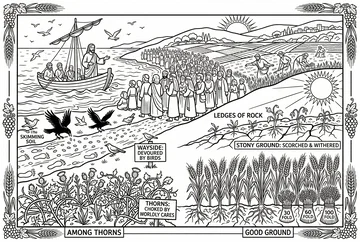
The parable to which this verse belongs was taught in the early morning on the Sea of Galilee after a night spent in prayer, spoken to the multitude crowding the water's edge from a fisherman's boat pulled out a little from shore.ST Jun 30, 1881 The lesson was drawn from the scenery at hand — sowers casting seed beside reapers harvesting early grain, fruitful valleys and hillsides, barren rocks upon the beach, and birds and sea-fowls — so that those everyday objects would daily remind the hearers of the truth.ST Jun 30, 1881
The parable sets forth the different tendencies and classes of the human heart as Christ met them.2SP 241.1–2ST May 3, 18774RED 86.2–3 It helps explain why His ministry produced only limited immediate results, for people were not forced to believe or obey but had to choose whether to receive Christ.2SP 241.1–2ST May 3, 18774RED 86.2–3 That choice requires joining human effort with His divine power to overcome besetting sin and develop Christian character.2SP 241.1–2ST May 3, 1877
The seed in the parable is the word of God as explained by Jesus and sown by preachers, which must be received by hearers whose hearts God prepares.COL 30.1STMW7 45.19MR 33.2 Its effect may not be seen at once, yet attentive hearers can retain and repeat His words so that they bear fruit and save souls in later generations.ST May 2, 1878 The verse describes the stony-ground hearers, whose seed sprang up immediately because it had no depth of earth, but when the sun was up it was scorched and withered away because it had no root.ST Jun 30, 1881
Eager Yet Shallow Reception
These hearers receive the truth eagerly with joy and great zeal, amazed that all cannot see what is so plain to them, urging the doctrine upon others and talking earnestly with ardor about faith and hope.ST Jun 30, 18813T 111.2–112.1 They readily receive anything new and exciting, and hastily condemn those who carefully weigh the evidence or those of long experience as cold and unbelieving and lacking enthusiasm.ST Jun 30, 18813T 111.2–112.1 They are controlled by feeling, without depth and stability of character, for principle does not reach deep enough to underlie action.3T 111.2–112.1TCBMP 140.1–142.1 They exalt truth in word but are not doers of it, because the heart has not been renewed by the transforming influence of God's Spirit.3T 111.2–112.1TCBMP 140.1–142.1 Their Christianity has not transformed character or produced a better daily life, but believes only for a time until tribulation comes.TCBMP 140.1–142.1Ms 74, 1897, par. 33–35
Having no root means having only a superficial knowledge of the truth and breaking off some evil practices while the heart remains filled with pride and impurities, unholy ambition and self-importance, and love for supremacy.Ms 4a, 1885, par. 3–6 The spirit and principles that characterized the life of Christ have not been planted in the heart to control the life.Ms 4a, 1885, par. 3–6 Very many professed Christians are therefore Christians only in name, holding the truth in unrighteousness as a mere theory they can prove scriptural and sound while their course of action denies their faith.Ms 4a, 1885, par. 3–6 Their hearts are unsanctified through the truth, without its spirit and power, unholy in heart and unchristlike in deportment, content with a half-Christian life and doing as others do.Ms 4a, 1885, par. 3–6
Some welcome the teaching with enthusiasm, but when they return to worldly surroundings, cares, and temptations their impressions fade, they take up sins again and relapse into indifference, while others carry its principles into daily life and retain the lesson.2SP 234.1–2 In the same way, those with no root may follow something new for a time, as with those drawn merely by the impression that someone has advanced new light rather than being firmly grounded in the truth already given.Lt 58, 1890, par. 3–4 Faith without firm root can also be overcome when words of doubt take root and bear fruit, as when a weak brother trusted the doubts and unbelief voiced by brethren, said he no longer believed the Bible, and became drawn to spiritualism.Lt 11, 1862, par. 14–16
Trial Exposes Lack of Root
Those described have no deep, lasting root in themselves and endure only briefly or for a time, and afterward, when affliction or persecution arises for the word's sake, immediately they are offended and quickly fall away.2SP 238.3–239.2COL 33.1COL 56.1–2COL 57.1–2HSFM 232.1 Those who firmly take their stand on truth will face such trials, which test whether they are rooted in it and willing to obey God, and believers need to be rooted in themselves, living the truth and setting a godly example.HSFM 232.121MR 284.2
The testing comes as affliction, persecution, reproach, temptation, tribulation, hardship, the heat of trial, and reproof.4RED 84.1–33T 111.2–112.1ST May 3, 1877ST Jan 26, 1915Ms 74, 1897, par. 33–35 It comes when the word exposes cherished sin and calls for self-denial or sacrifice, when plain, pointed, close truth is brought to bear on the heart to reveal deformity of character, and when the pruning-knife is applied that they may bring forth fruit unto perfection.4RED 84.1–33T 111.2–112.1ST Jan 26, 1915 Their faith endures only while life is easy, and the seed withers because it lacks roots able to sustain it through trial.4RED 84.1–3ST May 3, 1877Ms 74, 1897, par. 33–35 Their Christianity has not transformed character or produced a better daily life.Ms 74, 1897, par. 33–35
They falter and fail because they did not accept the cross as part of religious life and avoid it, and when ardor cools they turn from it and refuse to take it up.ST Jun 30, 18812SP 238.3–239.24RED 84.1–3ST May 3, 1877 Trying to serve both self and Christ makes a person half-hearted, weak in purpose, and changeable in desire, so that person will not stand firm when difficulty comes.COL 49.3–50.1 They could cultivate and enrich the heart so truth would take deeper hold, but that calls for patience and self-denial and radical change of life that costs too much effort.ST Jun 30, 18812SP 238.3–239.24RED 84.1–3ST May 3, 1877 Taking up the cross and patiently making the self-denying changes truth requires would let faith take deeper hold able to sustain through trial, but those who refuse that effort abandon it under pressure.4RED 84.1–3
They are easily offended by reproof, like the disciples who left Jesus because his saying was hard to hear.ST Jun 30, 1881 Though conscience tells them the close words spoken are truth, many will not bear the test or listen but close their eyes to imperfections, give up truth rather than submit to be sanctified through it, and flatter themselves they may get to heaven an easier way.3T 111.2–112.1 The problem is not immediate joy in receiving the word but failure to count its cost and yield life fully to its control, and they may mistake the gospel for escape from suffering rather than deliverance from sin.ST Jan 26, 1915
The seed's taking root is revealed by the life that follows: the heart may receive the word but thorns may overcome it, and actions will show whether the word has taken root and borne fruit, while those who reject the light of truth are overcome by temptation and lose self-control.ST May 10, 1877 Affliction does not always cause offense, for the seed of truth can also remain dormant for a time before God's grace awakens it to life and it bears fruit.TBC1872 111.1 Seed of truth planted by personal effort in the wise distribution of papers and tracts reaches people who will not listen to a living preacher, making impressions on minds that cannot readily be forgotten, and that seed may lie buried for years beneath the rubbish of the world and pleasing fables or remain dormant before it is awakened.GW92 409.1 When earthly sorrow or affliction comes it softens the heart rather than causing offense, so the buried seed springs up and bears fruit to the glory of God.GW92 409.1
Growing Deep Enduring Roots
To have no root is to be disconnected from Christ, for spiritual life is nourished by the unseen union of the soul with Christ through faith, just as a plant is nourished by roots hidden in the soil, while stony-ground hearers instead rely on themselves, their good works, good impulses, and their own righteousness and are not strong in the Lord.COL 47.1 Faith without inward root is shallow and valueless because so much of self is cherished that the life of Christ in the soul is quenched, and doubt and unbelief, refusal to cast self out of the heart, and want of love and unity keep the seed of the eternal Word from taking root.Ms 151, 1902, par. 24–25 Hearers need not remain shallow, for by resisting God's Spirit they become inattentive to the word, while repentance and earnest effort in Christ's strength can prepare the heart for the word to take root.COL 56.1–2 The heart must be cultivated by repentance and by uprooting evil tendencies so the good seed can grow.COL 56.1–2ED 111.1–2
The test of God's Word exposes supposed conversions that have not brought truth into the heart and conscience, leaving unsanctified self alive and producing weakness instead of a deep, enduring spiritual life.Ms 130, 1897, par. 26 There must therefore be deeper ploughing in the heart, purification of the vessels, and breaking of the heart before God in longing for true holiness, with practical knowledge of genuine faith, love and trust developing gentleness, so that the seed may take root and spring up to bear fruit of a different quality to the glory of God instead of evil thinking and evil speaking as the fruit of an evil tree.Ms 151, 1902, par. 24–25 A person gains that root by studying Scripture and seeking God for wisdom to understand its truths.Ms 11, 1893, par. 7 This grounding is needed because everything that can be shaken will be shaken, and Satan works to undermine the Bible and those working for Christ, spreading unbelief and misleading minds.Ms 11, 1893, par. 7
Believers are to be taught from the beginning to live by Christ's life and character, bear burdens, deny natural desires, work for Christ, and endure hardship, for trusting Christ's love and serving the lost help keep worldly attractions and troubles from choking the word.COL 57.1–2 Believers need to be rooted in themselves, live the truth, and set a godly example that recommends the truth to others, and decided effort to become firmly rooted is needed to keep from following those who abandon it.21MR 284.2Lt 52, 1897, par. 1 Having no root means having only a superficial knowledge of the truth and breaking off some evil practices while the heart remains filled with pride, impurities, unholy ambition, self-importance, and love for supremacy, without the spirit and principles that characterized the life of Christ planted in the heart to control the life.Ms 4a, 1885, par. 3–6 Having root means letting pure and holy principles take root downward so that fruit appears, especially in institutions for health.Ms 4a, 1885, par. 3–6 Unless the soul temple is cleansed of defilement with purity of thought, intensity of desire, and earnest daily effort to meet the standard in God's Word and correct the evil of the heart and deformity of character, even one cherished darling sin defiling the whole soul will cause entire failure to become elevated, subdued, and purified, to wear the white linen which is the righteousness of the saints, and to be fitted for companionship with the pure and holy.Ms 4a, 1885, par. 3–6
Having root means burning and shining amid moral darkness, standing firm in the truth received through great light and many opportunities, and enduring so as to be relied upon in gospel labor.8MR 95.2–3 Those with root hold up the hands of workers sent to the regions beyond to those who sit in darkness and have no light, send earnest prayers as sharp sickles into the harvest field, take upon themselves responsibility and accountability for the saving of souls who have never heard the truth, exercise faith in Christ as their personal Saviour, accept the burden of responsibility, and serve as witnesses for God.8MR 95.2–3 Believers need to be educated so the truth is firmly rooted in them, shaping lives that faithfully uphold and recommend it to others.Ms 6, 1894, par. 208MR 95.2–3 The word may take hold for a time, but presenting truth without Christ and his redeeming love can leave hearers unbalanced in their commitment, while presenting Christ as Saviour alongside the truth may help the seed bear lasting fruit.4T 393.3
Warnings for Church Life
The heart is soil that must be prepared for the Sower to scatter good seed so that the word takes root and endures, and parents prepare this soil by keeping young children under their own teaching till eight or ten years of age and not trusting the moulding of the infant mind to other hands too early.CTBH 67.3 Their schoolroom is to be the open air amid the flowers and birds and their textbook the treasures of nature, with parents opening before them God's great book of nature as fast as their minds can comprehend it, so that lessons given amid such surroundings will not soon be forgotten, and this calls for time and labor devoted to cultivation of children's minds and formation of correct habits instead of time worse than wasted in following the fashions of the world.CTBH 67.3 In early life, when the mind is especially impressible, good seed is to be sown in good soil so it can bear fruit unto eternal life, and clear, skillful teaching plants truth through children's education and church schools, whose good will be fully revealed at the day of God.4T 499.26T 205.1 Books of skeptical science and philosophy, vague fanciful stories, and Scripture writings mixed with fanciful human interpretation planted in young minds as seed in soil grow and produce a plentiful harvest of infidelity, seen in the depravity of the human family.CT 186.3–187.2
Churches raised up by ministers who are not converted likewise lack an inward foundation and cannot stand on their own when trouble comes.4T 315.2–316.1 Church members who know the truth are to have deep roots in themselves, use their spiritual strength, care intensely for people who have not yet heard it, and accept responsibility for helping carry the truth to them, for those who receive the truth without being rooted in it endure only briefly and fall away when trouble or persecution comes because of the word.Lt 18, 1898, par. 1Lt 47, 1894, par. 36–37 Entering schools without a settled connection with God risks being led astray instead of correcting error and sharing light, since hearers without deep roots in the truth can be led away from it.Ms 22c, 1895 [Copy 3], par. 21–24
Even a heart as hard as a beaten path can be softened so the seed can take root through Christ's love shown in personal ministry, for the word of truth must take root in a person's heart.GW 185.1 The seed of truth sown by preaching can take root in a hearer's heart and later bear fruit even when the person hears only one discourse, and continued meetings allow more people to hear and give the seed opportunity to grow and lead to conversion.Lt 202, 1897, par. 6
Sources
Pioneers and periodicals
61 sources
The verse describes hearers who receive the word at once with joy and zeal yet have no root in themselves and so last only for a time.ST Jan 28, 1889RH Oct 30, 1860ST Jan 28, 1889ST Nov 29, 1899 Having no root means the truth has not taken firm hold in the heart as its ruling principle, while having root means believing and practicing the truth until its sanctifying power shapes life and character.ST Oct 10, 1911RH Aug 6, 1861 Their faith holds only while life is easy, because they want salvation without enduring the trials required for the crown, and have not accepted the cross, self-denial, and full surrender as part of religious life.ST Jan 28, 1889ST May 3, 1877ST Jan 26, 1915ST Nov 26, 1894 When affliction, trouble, temptation, reproach or persecution arises for the word's sake, they are immediately offended, stumble, wither and fall away.ST Jun 16, 1887ST Nov 12, 1885RH Jul 30, 1861 Whether the seed has taken root is revealed by the life that follows, for shallow reception fails to ripen while faith joined with action takes root and ripens to fruit.ST May 10, 1877ST Feb 11, 1875RH Dec 10, 1867
Parable Setting and Purpose
Mark 4:17 belongs to the parable of the sower taught in the early morning on the Sea of Galilee after a night spent in prayer, spoken from a fisherman's boat pulled out a little from shore to the multitude crowding the water's edge.ST Jun 30, 1881 The lesson was drawn from the scenery about him, with sowers casting seed beside reapers harvesting early grain, fruitful valleys and hillsides, barren rocks upon the beach, and birds and sea-fowls, so that those daily objects would remind the hearers of the truth.ST Jun 30, 1881 In that setting the verse describes the stony-ground hearers, whose seed sprang up immediately because it had no depth of earth, but when the sun was up it was scorched and withered away because it had no root.ST Jun 30, 1881
The parable is given in Mark 4:1-41 as parallel to Luke 8, showing how different human hearts receive Christ's teaching.ST May 3, 1877ST Feb 6, 1896 It helps explain why his ministry did not produce greater immediate results, and it is set forth to encourage faith by the possibilities attending the seed that fell on good ground.ST May 3, 1877ST Feb 6, 1896 Receiving and following him is a choice, for belief is not forced, and people must unite their own efforts with divine power to overcome the sins that beset them and develop Christian character.ST May 3, 1877
The parable teaches spiritual truth through a familiar illustration that instructs honest-hearted lovers of truth who are ready to receive it while concealing its meaning from others.ST Jan 28, 1889 Teaching needs receptive soil, for good seed can be smothered by the way it is planted, and truth should not be buried under excessive explanation, since the seed itself is essential.ST Oct 19, 1882 In the parable the seed is the word of God and present truth, and sowing the seed means preaching the word.RH Dec 21, 1905RH Nov 11, 1909 That sowing is done quietly by isolated Sabbath-keepers through personal testimony and daily lives, preparing the way for definite efforts by ministers, and more broadly by preaching the truth and spreading publications as opportunity offers.RH Nov 11, 1909ST Aug 12, 1880 The seed of truth can revive people, with the fruit sought being that they obey the truth, and growing and producing an abundant harvest means people receiving the truth.RH Dec 21, 1905ST Aug 12, 1880 The word should fall on well-prepared soil so it can take root and bear fruit, which illustrates the need to prepare the heart to receive the gospel.RH May 11, 1869 Life is the time for sowing, in which people's choices prepare the good or bad harvest they will later receive, and the work requires persevering in sowing with prayer and hope for God's blessing.ST Aug 12, 1880RH Sep 17, 1857
Root Soil Seed Imagery
To have no root in themselves is for the truth not to have taken firm hold in the heart as its ruling principle, while to have root is to believe and practice the truth so that its sanctifying power shapes life and character.ST Oct 10, 1911RH Aug 6, 1861 Outward enthusiasm or belief alone is not enough, for shallow or divided commitment receives for a time but falls away when affliction or persecution comes because of the word.ST Oct 10, 1911RH Aug 6, 1861 Worldly cares, desires and rival priorities can choke out the truth, while a heart that gives it no sustaining place lets it wither under pressure.RH Aug 6, 1861 The stony ground is an unprepared heart with too little earth for lasting growth, whose spiritual footing is as untenable for harvest as seed sown on rock.RH May 11, 1869ST Aug 5, 1913 Life must therefore be kept soft and receptive to divine influences, lest those influences be scattered in vain, yet human lives as soil, even when what is offered seems small, can become fruitful when yielded.RH Oct 22, 1914ST Aug 5, 1913
The heart as soil is ground where every ill weed will naturally take root and spread, including thorns of worldly care, thistles of worldly vanity, and roots of bitterness that get possession if left alone.RH Jul 10, 1856 As the husbandman watches his land, so the heart must be searched and examined to cast out all unprofitable weeds and roots of bitterness.RH Jul 10, 1856 When that clearing work is rightly done the soil is ready for the good seed of the word, which springs up and prospers under divine grace as corn grows by the blessing of rain and sunshine from heaven.RH Jul 10, 1856 If the word fails to bear fruit the fault is not in the seed but in the conditions receiving it, for the word received without faith has no root and lasts only for a time until hardship comes.ST Apr 11, 1900 The hoped-for opposite is fertile soil and deep root in the heart, in which the word takes hold and grows instead of falling away.ST Apr 11, 1900ST Jun 27, 1911
Whether the seed has taken root is revealed by the life that follows, for actions show whether the word has taken root and borne fruit or has been overcome.ST May 10, 1877 Shallow reception fails to take root deeply and fails to ripen, lasting only briefly until hardship or persecution comes.ST Feb 11, 1875RH Dec 10, 1867 When faith is joined with action the seed can take root and ripen to fruit, and seeing faith expressed in loving action helps it grow in others.ST Feb 11, 1875RH Dec 10, 1867 Those who reject the light of truth are instead overcome by temptation and lose self-control.ST May 10, 1877
Temporary Joyful Reception
The verse describes hearers who receive the word but have no root in themselves and so endure only for a time.RH Oct 30, 1860ST Jan 28, 1889ST Oct 4, 1910RH Jul 7, 1874ST Sep 13, 1910 They receive it with joy yet without inward root, so their commitment lasts only temporarily and briefly.ST Nov 29, 1899RH Jul 7, 1874ST Sep 13, 1910 When affliction, trouble, hardship, or persecution arises because of the word they immediately stumble, are quickly offended, and fall away.RH Oct 30, 1860ST Jan 28, 1889ST Nov 29, 1899ST Oct 4, 1910RH Jul 7, 1874 That reception is at once, with joy and zeal and amazement that all cannot see what is plain to them.ST Jan 28, 1889ST Jun 30, 1881 In that first ardor they urge the doctrine upon others and hastily condemn those who carefully weigh the evidence as cold and unbelieving.ST Jan 28, 1889ST Jun 30, 1881
Their faith lasts only while life is easy because they have not allowed the truth to bring patient, thorough change.ST Jan 28, 1889 They want salvation but are unwilling to endure the trials required to gain the crown.ST Nov 26, 1894 The fault is not immediate joy in receiving the word but failure to count its cost and yield life fully to its control.ST Jan 26, 1915 They mistake the gospel for escape from suffering rather than deliverance from sin, and when it exposes cherished sin and calls for self-denial or sacrifice they are offended and fall away.ST Jan 26, 1915 When temptation, reproach, affliction, or persecution comes for the truth's sake they falter and turn away.ST Jan 28, 1889
They have not accepted the cross as part of religious life.ST Jan 28, 1889ST Jun 30, 1881ST May 3, 1877 They could cultivate and enrich the heart so truth would take deeper hold, but that calls for patience and self-denial and radical change of life that costs too much effort, so they avoid it.ST Jun 30, 1881ST May 3, 1877 When ardor cools they turn from the cross and refuse to take it up.ST Jun 30, 1881 They are easily offended by reproof, like the disciples who left Jesus because His saying was hard to hear.ST Jun 30, 1881 The stony soil is the heart unprepared through patience and self-denial, unable to withstand trials for the truth.ST May 3, 1877
Such profession of religion without deep root lasts only while conditions are calm, and when tribulation or persecution comes because of the word such people turn back and shrink from duty.RH Jul 1, 1858 They may appear zealous for a time but fall away when suffering comes, for trials expose lack of inward steadfastness and reveal hypocrisy and false profession.RH Jul 1, 1858ST Jun 5, 1879 Prosperity may multiply such shallow professions, while adversity removes them.ST Jun 5, 1879 Profession of faith is therefore not enough, and continual self-testing is needed to expose whether faith is genuine and truly rooted.ST Jan 22, 1902 Affliction or persecution for the word's sake reveals the one who has no root and quickly falls, and Christians must prove themselves lest they fail when Christ examines them.ST Jan 22, 1902
Trial Offense and Falling
Afterward, when affliction, trouble, temptation, reproach or persecution arises for the word's sake, those described endure only briefly because they have no deep inward root in themselves, and they are immediately offended, stumble, wither and fall away.ST Jun 16, 1887RH Jul 6, 1869ST Nov 12, 1885RH Jun 6, 1871RH Jul 30, 1861 The word must take effect in the conscience and bear fruit, otherwise the enemy may take it away, and preaching should make the guilty person recognize his particular sin so the word can awaken him.ST Jun 16, 1887 Some who initially rejoice in the truth turn away when opposition comes.RH Jul 30, 1861
In the present this is seen when the claims of the seventh-day Sabbath, the unconscious state of the dead, and Christ's coming are presented.ST Jul 16, 1894 Some turn away from hearing or examining the evidence, and those who resist the prospect of Christ's return reject the call for change.ST Jul 16, 1894 Falling away includes a preacher who left because the truth was too strict and the way too narrow, tent-meeting stony-ground hearers who gave up, and those who decide to obey and keep all the commandments but do not continue.ST May 6, 1880RH Oct 20, 1874ST Oct 6, 1887
The good seed before it takes root can be carried away by faultfinding.ST Dec 2, 1897 Criticism at the Sabbath dinner table threatens the sermon sown in a boy, whose delight in the message is marred by fear of his family's faultfinding, and their opinions quench his spiritual interest.ST Dec 2, 1897 Those without firm root are liable to confusion from false and contradictory teachings, while becoming thoroughly grounded in the truth helps withstand pressure.RH Dec 6, 1906 Physical and spiritual fitness through health reform fits people to stand in the coming trial of faith when trouble and persecution arise.RH Jun 6, 1871 The separation of those who wither can be necessary for the spiritual health of those who remain faithful.RH Jul 6, 1869
A time of peril and testing reveals who has real personal Christian experience and who depends on someone else's.RH Jul 8, 1902 Each person must know God and stand with him and his truth personally, for another cannot believe or live the Christian life on his behalf.RH Jul 8, 1902 Some are already falling away and others show weakness.RH Jul 8, 1902 The image of having no root in oneself is also applied to a sect portrayed as unable to live independently and as relying on others for support.ST Mar 12, 1885
Lasting Root and Fruit
In contrast to brief response, lasting reception keeps truth sown in the heart for eleven years until clearer light comes and leads a man and his wife to take their stand for it.ST May 5, 1881 The seed of the Reformation in Holland took deep root, so that Luther's doctrines spread rapidly and produced a rich harvest. After hearing the Bible explained, Procopio Diaz received the word so that it took root in him, and he became the first gospel preacher in Acapulco and Guerrero.
The parable is verified in experience, where some grow weary in well-doing and are overcome by the cares and pleasures of life while others bring forth fruit.RH Jul 10, 1860 Soil receptive to the word as good seed receives the truth and brings forth lasting believers and churches that form the backbone strength of the work in a district.ST Where seed is sown slowly in a difficult field, as in Java in the Dutch East Indies, the temporary response of those without deep root who quickly fall away under affliction or persecution for the word's sake stands in contrast to some fruit eventually appearing as lasting fruit.RH Dec 26, 1912
Hearing does not always lead to lasting faith, for people who hear the truths and the plan of salvation and at once give themselves to Christ may endure only for a time and fall out by the way even though the gospel seed has been sown in their hearts.RH Jan 9, 1913RH Dec 24, 1908 Without root within, endurance is only temporary and gives way when trouble or persecution comes because of the word.RH Dec 24, 1908 Yet the sown word can be received and understood, bear fruit, and lead to salvation through the Saviour's merits by understanding the plan of salvation.RH Dec 24, 1908
Song has part in sowing, for it can soften hearts described as stony ground and help the good seed sown by the preacher spring up to everlasting life.RH Oct 23, 1913 Even those who listen only briefly for a few minutes can receive the seed, which germinates and leads them to further investigation.ST Truth sown in sanitarium patients who are helped physically but do not become believers before leaving may later take root and grow. The effect of the seed of truth may not be seen at once, but attentive hearers can retain and repeat the words heard so that they bear fruit and save souls in later generations.ST May 2, 1878
Teaching children is sowing with hope that the seed will fall on good ground and produce lasting fruit.RH Oct 7, 1915 The good influences of the Bible lesson need to become rooted in their hearts, but distractions can divert them before they settle and take hold.ST Jun 18, 1885 The gospel sown in a young mind can take root and produce an abundant harvest, with good impressions contributing to salvation.ST Mar 18, 1889 Seeds sown in true hearts, such as memories, a friend's words, and thoughts from above, can take root and bring forth love as their fruit.ST Dec 25, 1893
Sources