Translations
And when even was now come, his disciples went down to the sea,
King James Version, KJV Cambridge Paragraph Bible
And when even was now come, his disciples went down unto the sea,
And when evening had now come, his disciples went down to the sea,
Revised Version, American Standard Version
And when evening came, his disciples went down unto the sea;
And when evening came, his disciples went down to the sea,
But when evening was come, his disciples went down to the sea,
But, when evening came, his disciples went down unto the sea;
Berean Standard Bible, Majority Standard Bible
When evening came, His disciples went down to the sea,
When evening came, his disciples went down to the sea.
When evening came the disciples went down to the sea;
When euen was nowe come, his disciples went downe vnto the sea,
Douay-Rheims (Challoner revision)
And when evening was come, his disciples went down to the sea.
Pictures
Cross-references
- Mark 6:45-51
And straightway he constrained his disciples to get into the ship, and to go to the other side before unto Bethsaida, while he sent away the people.
Jesus sends the disciples across; amid the storm, he comes to them on the water and reassures them.
- Matthew 14:22-33
And straightway Jesus constrained his disciples to get into a ship, and to go before him unto the other side, while he sent the multitudes away.
Jesus sends the disciples by boat, comes to them on the stormy sea, and rescues Peter.
- Matthew 14:13-21
When Jesus heard of it, he departed thence by ship into a desert place apart: and when the people had heard thereof, they followed him on foot out of the cities.
A parallel account of Jesus feeding the multitude.
- Matthew 8:23-27
And when he was entered into a ship, his disciples followed him.
Jesus stills the storm on the sea.
- Mark 6:47-51
And when even was come, the ship was in the midst of the sea, and he alone on the land.
The disciples struggle at sea, and Jesus comes to them walking on the water.
- Mark 4:35-41
And the same day, when the even was come, he saith unto them, Let us pass over unto the other side.
Both describe the disciples crossing the sea during a storm.
- Matthew 14:22
And straightway Jesus constrained his disciples to get into a ship, and to go before him unto the other side, while he sent the multitudes away.
Jesus sends his disciples ahead by boat.
- John 6:20-21
But he saith unto them, It is I; be not afraid.
Jesus came to the disciples on the water, calmed their fear, and reassured them of His identity.
- Matthew 14:28-29
And Peter answered him and said, Lord, if it be thou, bid me come unto thee on the water.
Peter walking on water that same night
- Mark 6:49-50
But when they saw him walking upon the sea, they supposed it had been a spirit, and cried out:
The disciples fear they see a spirit, and Jesus reassures them.
- Matthew 14:23
And when he had sent the multitudes away, he went up into a mountain apart to pray: and when the evening was come, he was there alone.
Jesus praying in mountain while disciples crossed
- Luke 8:22-25
Now it came to pass on a certain day, that he went into a ship with his disciples: and he said unto them, Let us go over unto the other side of the lake. And they launched forth.
Both describe the disciples’ boat journey and their fear during a storm.
- Mark 6:35-44
And when the day was now far spent, his disciples came unto him, and said, This is a desert place, and now the time is far passed:
The passage points to Mark’s account of Jesus feeding the crowd.
- John 6:25
And when they had found him on the other side of the sea, they said unto him, Rabbi, when camest thou hither?
crowd asks how Jesus crossed
- Mark 6:52
For they considered not the miracle of the loaves: for their heart was hardened.
The disciples’ failure to understand the loaves miracle shaped their response during the sea crossing.
- Matthew 14:33
Then they that were in the ship came and worshipped him, saying, Of a truth thou art the Son of God.
same confession after walking on water
Commentary
Each commentary is drawn from primary sources: the writings of Ellen G. White and Adventist pioneers and periodicals. Each commentary is separate. Its own words are not a quotation; follow the references to read the source passages.
Ellen G. White
33 sources
When evening came after the multitude had eaten on the grassy plain, the disciples went down to the sea to cross toward Capernaum without Jesus while He remained behind to dismiss the people.Ms 78, 1902, par. 5–7Ms 106, 1905, par. 4–8Lt 93, 1901, par. 11DA 377.1DA 377.3–378.1 He sent them away alone to separate them from the rising movement to seize Him by force and make Him an earthly king, an honor that would have brought violence and hindered His spiritual work of mercy and instruction.Ms 106, 1905, par. 4–8DA 377.2DA 377.3–378.1DA 378.2 They obeyed reluctantly and entered the gathering darkness with murmuring, disappointed hearts, regretting that they had not stayed to proclaim Him King of Israel.3RED 60.1–62.12SP 267.12SP 264.1–265.13RED 57.1DA 378.3 On the lake they labored at the oars all night against a furious storm that drove them from their course, yet He watched them from shore with piercing care, came to them walking calmly upon the waves, turned their terror into faith by His voice, and with Peter's venture and the sudden stilling brought the boat safely to land.3RED 60.1–62.1DA 381.12SP 274.22SP 267.12SP 267.2–268.1 With His presence fear of death was gone, showing His power over sea and storm and teaching dependence on Him rather than on men, while the whole sequence leads to receiving Him by faith as the living Bread from heaven, greater by far than perishable food.Lt 9, 1902, par. 1–7Ms 78, 1902, par. 5–721MR 44.1–24T 288.1–2ST Jul 18, 1878
Evening Departure Setting
And when even was now come marks the evening hour when the disciples went down to the sea, after the multitude had eaten the food provided on the grassy plain at twilight, before the storm and the events of the night in which Jesus came walking on the water.Ms 78, 1902, par. 5–7Lt 93, 1901, par. 11DA 377.19MR 31.1–2
The verse belongs to the account of Jesus walking on the sea after feeding the multitude, and to the chapter that teaches dependence on Christ rather than on human beings and receiving Him and the truth in Him into daily life by faith.Ms 78, 1902, par. 5–7Lt 93, 1901, par. 119MR 31.1–2
The departure followed the rising hope of the people that He would deliver Israel from Roman rule and establish earthly dominion, with determination to take Him by force and proclaim Him King of Israel.DA 377.22SP 264.1–265.1
That exaltation as an earthly king would have brought violence and insurrection and defeated His work of instruction and mercy, for He did not come to set up a temporal kingdom but a spiritual kingdom.Ms 106, 1905, par. 4–82SP 264.1–265.1
To change the current of feeling among the people, He sent the disciples away to separate them from the attempted movement to crown Him.DA 377.3–378.12SP 264.1–265.1
In the evening, after sending the disciples away and withdrawing alone to the mountain, they went down to the sea and entered a boat to cross toward Capernaum and the other side while He was not with them.Ms 106, 1905, par. 4–8DA 378.2
He stayed behind alone to dismiss the multitude, stopping the effort to make Him king, and had firmly commanded them to go and directed them to return while He remained.DA 378.23RED 58.23RED 57.1
He promised to meet them that night or the following morning at the port and the place appointed, yet they faced a dangerous storm remembering His former rescue.2SP 264.1–265.12SP 307.1–308.1
They were unwilling to go and found it hard to leave Him alone on the desolate shore surrounded by high barren mountains, and were reluctant to leave Him and the crowd.2SP 264.1–265.13RED 57.1
They wanted Him to receive His true honor and be lifted above the priests and rulers who sought His life, seeing the crowds gathering from all quarters for the Passover at Jerusalem as the golden opportunity to establish Him on David's throne.2SP 264.1–265.1
They protested and hoped the people's enthusiasm would lead to His being made king, but He was firm and commanded them with an authority He had never before used toward them, and they turned toward the sea and obeyed in silence when they recognized His authority.2SP 264.1–265.1DA 378.3
They left in the gathering darkness after waiting for Him to join them, with dissatisfied and impatient hearts, murmuring among themselves because their wish to exalt Him as King of Israel had not been gratified.2SP 267.1DA 380.1–22SP 267.2–268.1
They blamed themselves for turning so easily from their purpose and yielding so readily to His command, reasoning that if they had remained and persisted they might have gained their point.2SP 267.12SP 267.2–268.1
They regretted that they had obeyed His command instead of persisting in their plan to proclaim Him king, and their regret over leaving Him deepened when the storm arose and thwarted their efforts to reach the place where He had promised to meet them.DA 380.1–2ST Dec 29, 1887
Their desire for honor and disappointment were leading them into unbelief, and their dissatisfied departure put them in trouble and led them humbly to seek help when their ambition was subdued.3RED 60.1–62.1DA 380.1–2ST Dec 29, 1887
Storm Watch and Rescue
After going down to the sea in the evening without Jesus, the disciples spent the night on the lake in a violent storm that lashed the water into fury.2SP 274.22SP 267.12SP 267.2–268.1 Hour after hour all night they labored at the oars in their frail bark, which was driven hither and thither and tossed upon the raging billows.2SP 274.22SP 267.12SP 267.2–268.1 They made no progress but were carried farther and farther from the port they sought and from the place where He had promised to meet them, liable at any moment to be engulfed.2SP 274.22SP 267.12SP 267.2–268.1 The futile toil was a severe trial of faith that filled even strong men accustomed to the water with terror.2SP 267.2–268.1DA 383.2–384.1
Jesus did not forget them but watched them from the distant shore with deep, mother-like care and compassion.DA 381.12SP 267.2–268.1ST Dec 29, 1887 His eye pierced the darkness to see their danger and to read their thoughts, and He would not suffer one of them to perish.2SP 267.2–268.1ST Dec 29, 1887 Their danger tested their faith and subdued them, quelling their unholy ambition.3RED 60.1–62.1DA 381.12SP 267.2–268.1ST Dec 29, 1887 Regretting that they had left Jesus and longing for His calm commanding presence for security, they humbled themselves and prayed for help, and then help was given.3RED 60.1–62.1DA 381.12SP 267.2–268.1ST Dec 29, 1887
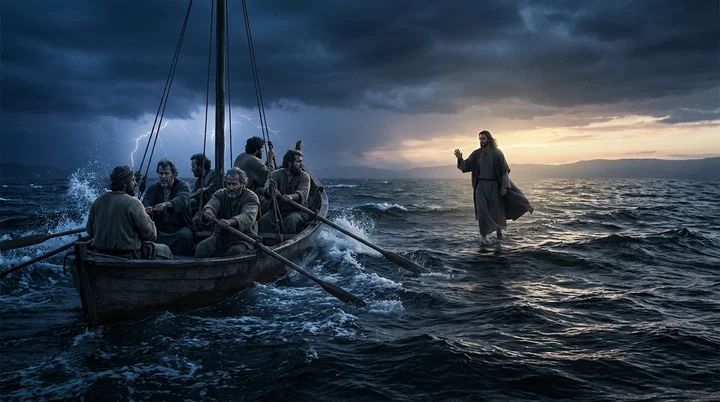
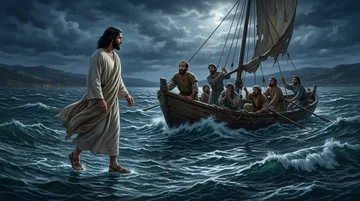
Though He had no boat by which to cross, Jesus came to them walking firmly and calmly upon the white-capped billows.3RED 60.1–62.12SP 274.24T 288.1–2ST Jul 18, 18782SP 267.2–268.1 At the very moment they believed themselves lost, a flash of lightning revealed a man walking toward them upon the waves, first mistaken for a spirit foreboding immediate destruction.ST Jul 18, 18782SP 267.2–268.1 Seized with unspeakable terror they cried out, then recognized His advancing form as though He would pass them and supplicated His help.DA 3763RED 60.1–62.12SP 267.2–268.1 He turned, and His well-known voice saying that it was He and they should not be afraid stilled their fear, changed their despair into faith and hope, and left them speechless with joy as their apprehensions went and the storm was forgotten while they hailed Him as their Deliverer.DA 3762SP 274.24T 288.1–2ST Jul 18, 18782SP 267.2–268.1
Peter ventured out on the water toward Him, the tempest was suddenly stilled, and the boat immediately reached land.2SP 274.24RED 87.27MR 280.4–281.2DA 383.2–384.1 When those who knew He had no boat by which He could pass found Him and the disciples already on the other side, they were surprised and astonished and inquired how and when He had crossed.2SP 274.2 The disciples recounted to the wondering crowd the rowing against adverse winds, the walking on the water, the fear, the reassuring words, Peter's adventure, the stilling of the tempest, and the landing.2SP 274.24RED 87.2 With Christ present they no longer feared death, showing that He brings life rather than death and that His power rules even sea and waves.4T 288.1–2ST Jul 18, 1878 The account teaches trust and obedience to Christ and dependence on Him rather than on human beings for strength, wisdom, and guidance, for they had crossed at His command and remembered that He had before walked on the water to rescue them.Ms 78, 1902, par. 5–74T 288.1–2ST Jul 18, 18782SP 307.1–308.1
Living Bread Meaning
John 6:16 belongs to the record of compassionate ministry in which hunger of the multitude was met with provided food, while the lesson pressed was that the spiritual food and living bread given is of greater consequence than perishable food.Lt 9, 1902, par. 1–7 The chapter teaches receiving Christ and the truth in Him into daily life by faith, with eating His flesh and drinking His blood representing that inward reception.Lt 93, 1901, par. 11 The Word of God is living bread from heaven and living oracles, to be received and lived by, and His words concerning His flesh and blood are His flesh and blood in a spiritual sense even before His crucifixion.21MR 44.1–2Lt 93, 1901, par. 11Lt 40, 1899, par. 17–18
That language about His flesh and blood points to His life-giving work as the substitute for sin, which was ancient Israel's only hope.21MR 44.1–2Lt 40, 1899, par. 17–18 The New Testament adds light that reflects back upon the Old Testament and gives significance to the Jewish economy without replacing it.21MR 44.1–2Lt 40, 1899, par. 17–18 The Old Testament directions remain spiritually nourishing and call for practical holiness and obedience.21MR 44.1–2Lt 40, 1899, par. 17–18
The verse begins the connected sequence of the loaves and fishes, Christ walking on the water, His declaration that He is the Bread of life, and the turning away of some of His disciples from Him.14MR 335.1–39MR 242.1Lt 13, 1876, par. 1–39MR 32.3–5 That group of subjects is of intense interest and highest value.9MR 242.1
Sources
Pioneers and periodicals
25 sources
When evening came after Jesus had fed the five thousand with five barley loaves and two fishes on the plain near Bethsaida, his disciples went down to the Sea of Galilee.ST Jul 7, 1898 The people were about to take him by force to make him an earthly king, so he dismissed the crowd, sent the disciples away by boat to prevent violence and insurrection, and withdrew alone into the mountain to pray.ST Aug 25, 1881ST May 20, 1886ST Sep 17, 1896 In the dark they went down in silence without him and entered the boat for the farther shore toward Capernaum, disappointed and reluctant because he had refused the crown they had hoped for at the Passover season.ST May 20, 1886ST Sep 1, 1881ST Sep 17, 1896ST Oct 28, 1897ST Oct 12, 1904 Their crossing grew perilous through the night, for a contrary wind raised furious waves against which they rowed for hours with little progress and were tossed in danger until near dawn.ST Sep 17, 1896ST Sep 17, 1896 That lonely voyage pictures believers and the church sailing life's stormy sea in darkness while Jesus prays for them and watches from shore, and his coming to them walking on the waves to still the tempest and bring them safely to land shows that effort without him is fruitless but with him received there is no need to fear.ST Jul 18, 1878ST Sep 17, 1896ST Oct 12, 1904ST May 12, 1909
Evening Departure Across Sea
Even was come after Jesus had taught the people, healed their sick, and fed the multitude, the disciples having been concerned about providing food for the crowd. The feeding of the five thousand with five barley loaves and two small fishes took place on a hill, on the plain near Bethsaida Julia just across the Jordan about two miles east of Capernaum at the head of the Sea of Galilee.ST Jul 7, 1898 This was when the Jews had assembled to celebrate the Passover, in which eating the flesh of the lamb and having its blood upon the doorposts represented Christ as the Lamb of God, his protection, and his blood shed for the sins of the world.ST Sep 1, 1881
After the feeding the people were about to come and take Jesus by force to make him an earthly and temporal king, expecting him to overthrow Roman rule and establish Israel's worldly dominance.ST Sep 17, 1896ST Mar 5, 1896 Jesus refused, dismissed the crowd, and sent the disciples away by boat to stop a movement that could lead to violence and insurrection and hinder his kingdom.ST Aug 25, 1881ST Sep 17, 1896ST Dec 22, 1887 He withdrew alone into the mountain to pray to his Father's throne.ST May 20, 1886ST Sep 17, 1896ST Mar 5, 1896ST Oct 12, 1904
In the evening when it was dark, the disciples went down in silence to the sea, the Sea of Galilee, leaving Jesus alone on the desolate shore surrounded by high, barren mountains while he remained behind.ST May 20, 1886ST Sep 17, 1896ST Dec 22, 1887 In obedience to his command they entered a boat and set out toward the other, farther side, toward Capernaum and Bethsaida and the west side of the lake.ST May 20, 1886ST Oct 28, 1897ST Mar 4, 1913ST Oct 12, 1904 They went without him because he had not yet come to them, though he promised to meet them that night or the next morning.ST Sep 17, 1896ST Dec 22, 1887
They left disappointed, dissatisfied, discouraged and reluctant, regretting leaving him, because Jesus had not allowed them and the crowd to make him king.ST Oct 28, 1897ST Oct 12, 1904ST Oct 28, 1897ST Dec 22, 1887 They had hoped the people gathering for Passover would make him king and raise him above the persecution of the priests and rulers.ST Dec 22, 1887ST Dec 22, 1887 They were weary and tired yet true and tried fishermen with pure hearts, rude fare and coarse garments and no hope of worldly ease or pride, who with calloused hands loosed the cable.
Their crossing became perilous in darkness from a great, contrary wind that raised the sea into fiercely dashing, furious waves.ST Sep 17, 1896ST Oct 12, 1904ST Oct 28, 1897 They rowed strenuously for hours through the night against the storm with little progress, still only halfway across by the fourth watch before dawn, driven off course, tossed and unable to reach shore.ST Sep 17, 1896 They were distressed, afraid, and in danger, beginning the storm and the events of the night that set the scene for Jesus' later stilling of the sea.ST Sep 17, 1896ST Oct 12, 1904
Rescue and Spiritual Meaning
The voyage was undertaken in obedience, yet it left the disciples helpless and expecting to perish until Christ, who watched over them from shore and saw their sad plight, came to them walking calmly on the rolling waves as though on rock.ST Jul 18, 1878ST Aug 25, 1881ST Dec 29, 1887ST Oct 12, 1904 It was the deepest darkness of night just before the breaking of day, when overwrought nerves and past superstitions magnified every incident portending evil.ST Oct 12, 1904 They mistook Him for a storm-wraith foretokening destruction, so that though strong men they cried out in terror, and His appearance first increased their fear.ST Jul 18, 1878ST Oct 12, 1904 Their trouble and danger tested their faith, and when ambition was subdued they humbly sought help.ST Aug 25, 1881ST Dec 29, 1887
He came not to terrorize but to save, coming in a way to inspire utmost confidence.ST Oct 12, 1904 However the sea might roar and be troubled and lash its proud waves, He revealed Himself as its Master able to save to the uttermost.ST Oct 12, 1904 His voice saying that it was He and that they should not be afraid changed despair to faith and hope, so that with Christ present they no longer feared death.ST Jul 18, 1878ST Oct 12, 1904 When with open, broken hearts they received Him into the boat the tempest ceased and they immediately reached the desired haven and were brought safely to land, confessing that He is indeed the Son of God.ST Aug 25, 1881ST Sep 17, 1896ST Oct 12, 1904 On that same crossing Peter also walked on the water, and after strenuous rowing against the wind with little progress their receiving Jesus brought immediate arrival at their destination.ST Sep 17, 1896ST Jul 7, 1898
The experience shows the fruitlessness of trying to go forward without Him and the change that comes when He is received.ST Sep 17, 1896 It shows that He knew their need and had not abandoned them, though they were tired, distressed, afraid, and unable to reach shore in darkness on a stormy sea.ST Mar 4, 1913RH Jul 28, 1903 He is near and ready to help His troubled followers, to bring them peace and safety.RH Jul 28, 1903 He remains their unfailing source of safety, comfort, and joy, upon whom those who know Him can rely in danger.RH Sep 10, 1901
The lonely night voyage, tossed on the wave until fearless hearts grew less brave and sore dismayed, pictures believers sailing over life's stormy sea through dark gales and roaring waves toward the by-and-by, when Jesus draws nigh in glorious light, hears their cry, and stills fear with His voice. It portrays the church struggling through the dark and stormy world while Jesus, though ascended, prays for her and will come to her rescue, bring peace, and guide her safely to the other shore.ST May 12, 1909 The beginning of that night of darkness, surrounded by fiercely dashing waves threatening to devour, pictures life's days of darkness when thick storm-clouds lower.RH Jan 28, 1873 In that darkness Jesus is forever nigh, walking the waves beside His followers where no storm can drive Him away, speaking above the tempest that it is He and bidding fearful ones be not afraid.RH Jan 28, 1873
He bids the waters bear the believer, His arm is defense, His face shines on the billows to illumine the way, and He beckons the fearful to follow without faltering and let all terror fly.RH Jan 28, 1873 He draws nigh in glorious light to hear their cry and still fear with His voice. The storm-at-sea scene thus applies to life's troubles, teaching that Jesus alone can save and that people should trust His power in every circumstance, day or night, calm or conflict, and rely on Him in danger.ST Mar 4, 1913RH Sep 10, 1901
Sources