Matthew 14:31
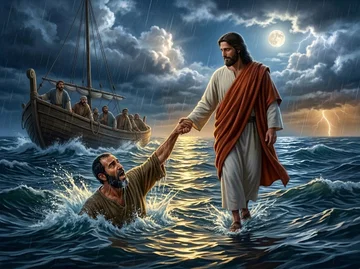
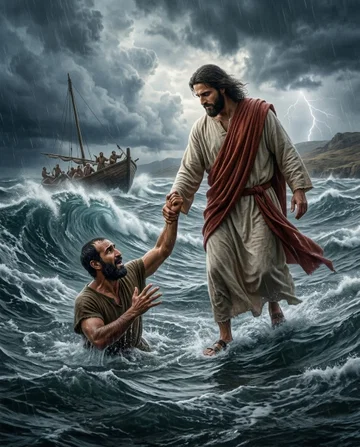
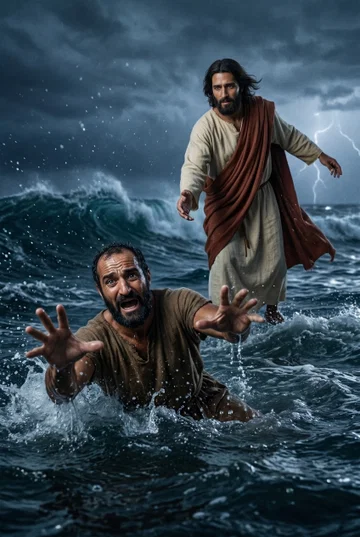
And immediately Jesus stretched forth his hand, and caught him, and said unto him, O thou of little faith, wherefore didst thou doubt?
Translations
And immediately Jesus stretched forth his hand, and caught him, and said to him, O you of little faith, why did you doubt?
King James Version, KJV Cambridge Paragraph Bible
And immediately Jesus stretched forth his hand, and caught him, and said unto him, O thou of little faith, wherefore didst thou doubt?
And immediately Jesus stretched forth his hand, and caught him, and said to him, O thou of little faith, Why didst thou doubt?
Revised Version, American Standard Version
And immediately Jesus stretched forth his hand, and took hold of him, and saith unto him, O thou of little faith, wherefore didst thou doubt?
And immediately Jesus, having stretched forth the hand, laid hold of him, and saith to him, 'Little faith! for what didst thou waver?'
And immediately Jesus stretched out his hand and caught hold of him, and says to him, O thou of little faith, why didst thou doubt?
And, straightway, Jesus, stretching forth his hand, laid hold upon him and saith unto him—O little-of-faith! why didst thou doubt?
Berean Standard Bible, Majority Standard Bible
Immediately Jesus reached out His hand and took hold of Peter. “ You of little faith,” He said, “ why did you doubt?”
Immediately Jesus stretched out his hand, took hold of him, and said to him, “ You of little faith, why did you doubt?”
And straight away Jesus put out his hand and took a grip of him, and said to him, O man of little faith, why were you in doubt?
So immediatly Iesus stretched foorth his hande, and caught him, and saide to him, O thou of litle faith, wherefore diddest thou doubt?
Douay-Rheims (Challoner revision)
And immediately Jesus stretching forth his hand took hold of him, and said to him: O thou of little faith, why didst thou doubt?
Pictures
Cross-references
- Mark 6:48-52
And he saw them toiling in rowing; for the wind was contrary unto them: and about the fourth watch of the night he cometh unto them, walking upon the sea, and would have passed by them.
Jesus walks to the storm-tossed disciples, and the parallel account highlights their little faith.
- John 6:19-21
So when they had rowed about five and twenty or thirty furlongs, they see Jesus walking on the sea, and drawing nigh unto the ship: and they were afraid.
Jesus approaches the disciples across the stormy sea and joins them in the boat.
- Matthew 14:27
But straightway Jesus spake unto them, saying, Be of good cheer; it is I; be not afraid.
Jesus reassures the disciples amid the storm, answering their fear with words of assurance.
- Hebrews 12:2
Looking unto Jesus the author and finisher of our faith; who for the joy that was set before him endured the cross, despising the shame, and is set down at the right hand of the throne of God.
Looking to Jesus sustains faith and keeps Peter from sinking in doubt.
- Matthew 8:26
And he saith unto them, Why are ye fearful, O ye of little faith? Then he arose, and rebuked the winds and the sea; and there was a great calm.
Jesus rebukes the disciples’ little faith amid a storm.
- 2 Corinthians 5:7
( For we walk by faith, not by sight:)
Peter walks on the billows by faith while looking to Jesus.
- Mark 4:39-40
And he arose, and rebuked the wind, and said unto the sea, Peace, be still. And the wind ceased, and there was a great calm.
Jesus stills the storm and questions the disciples’ fear and lack of faith.
- Matthew 17:19-20
Then came the disciples to Jesus apart, and said, Why could not we cast him out?
Jesus connects the disciples’ failure with their lack of faith.
- Hebrews 11:6
But without faith it is impossible to please him: for he that cometh to God must believe that he is, and that he is a rewarder of them that diligently seek him.
Both teach that faith is necessary to please God.
- 1 John 5:4
For whatsoever is born of God overcometh the world: and this is the victory that overcometh the world, even our faith.
Faith in God overcomes the world.
- Matthew 14:25
And in the fourth watch of the night Jesus went unto them, walking on the sea.
Jesus walking on the sea is invoked in the poem.
- Matthew 26:69-75
Now Peter sat without in the palace: and a damsel came unto him, saying, Thou also wast with Jesus of Galilee.
Peter’s failing faith is shown in his denial of Jesus.
- Mark 4:38
And he was in the hinder part of the ship, asleep on a pillow: and they awake him, and say unto him, Master, carest thou not that we perish?
The disciples’ cry in the storm parallels Peter’s appeal to Jesus amid danger.
- Luke 8:23-25
But as they sailed he fell asleep: and there came down a storm of wind on the lake; and they were filled with water, and were in jeopardy.
Jesus rescues his disciples during a storm and questions their faith.
- Romans 14:23
And he that doubteth is damned if he eat, because he eateth not of faith: for whatsoever is not of faith is sin.
Both connect doubt with acting apart from faith.
- Hebrews 11:1
Now faith is the substance of things hoped for, the evidence of things not seen.
Faith grasps what is hoped for and unseen.
- Luke 12:29
And seek not ye what ye shall eat, or what ye shall drink, neither be ye of doubtful mind.
Both warn against doubt and a wavering mind.
Commentary
Each commentary is drawn from primary sources: the writings of Ellen G. White and Adventist pioneers and periodicals. Each commentary is separate. Its own words are not a quotation; follow the references to read the source passages.
Ellen G. White
74 sources
As Peter began to sink beneath the waves he cried out for help, and at once Jesus stretched out His hand and caught him while gently asking why one of little faith doubted.Ms 33, 1892, par. 35Lt 26, 1885, par. 1–3Lt 31, 1893, par. 11–14Ms 18, 1895, par. 11–13COS 86.1 While Peter kept his eyes fixed on Jesus he walked safely on the water, but when he turned them to the wind and high waves fear took hold and his faith gave way so that he began to sink.Ms 33, 1892, par. 35Lt 31, 1893, par. 11–14Ms 19, 1892, par. 47–49 The rescue shows Christ as the all-powerful, compassionate helper who watches His people in peril, does not leave a sinking doubting soul to perish, and answers even weak and feeble faith at once.ST Dec 12, 1906Lt 26, 1885, par. 1–3ST Jul 23, 1896Lt 38, 1885, par. 2–7 His question rebukes short-sighted unbelief that dishonors God by fixing the eyes on self, danger and appearances after He has already proved Himself an ever-present Saviour.Lt 11, 1864, par. 5–9ST Dec 12, 1906Lt 24b, 1896, par. 31–34Lt 100, 1895, par. 15–17Lt 26, 1895, par. 5–7 Safety is found only by looking continually and confidingly to Jesus rather than trusting self, refusing to indulge doubt and fear, and placing the hand in His hand in loving trust.Lt 11, 1864, par. 5–9Lt 100, 1895, par. 15–17Lt 26, 1895, par. 5–7Lt 38, 1885, par. 2–7Lt 92, 1896, par. 10
Setting on Stormy Sea
The night crossing belongs after the feeding of the multitude seated on the grassy plain in the twilight of a spring evening, when the people ate the food Christ provided and said He is the prophet that should come into the world.DA 377.1 That crowning miracle strengthened conviction that Jesus is the long-looked-for Deliverer.DA 377.2 It raised hope that He would make Judea an earthly paradise, a land flowing with milk and honey and satisfying every desire, by breaking the power of Rome, delivering Judah and Jerusalem, healing soldiers wounded in battle, supplying whole armies with food, conquering the nations, and giving Israel long-sought dominion.DA 377.2
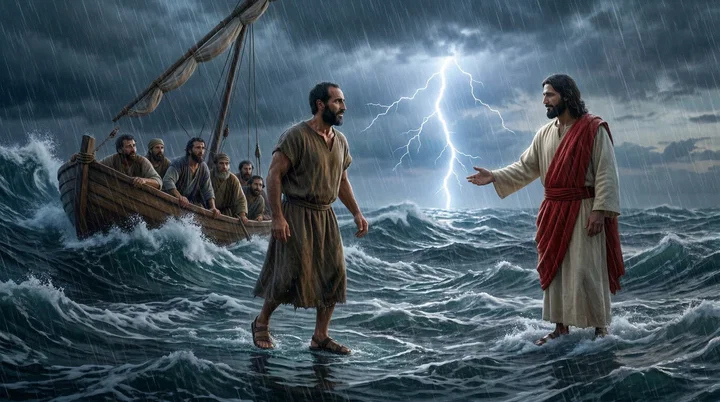
In obedience to His command the disciples crossed the sea through a long tedious night of rowing against contrary winds and a furious tempest.ST Jul 18, 1878Lt 5, 1876, par. 9–15LSEGW 229.3–230.1 Their vessels became unmanageable, their strength was exhausted, and they laid down their oars in despair expecting to perish.ST Jul 18, 1878Lt 5, 1876, par. 9–15 The storm, the disciples' fear, and Jesus' reassuring words belong together with Peter's attempt to walk on the water ending in danger and Jesus rescuing him.ST Mar 15, 1877 On that stormy night Jesus came to the small pitching boat walking calmly upon the white-capped, boisterous waves in the fourth watch.DA 376ST Jul 18, 1878Lt 5, 1876, par. 9–157MR 280.4–281.2 The terrified disciples huddled in astonishment with all eyes riveted on Him, mistaking Him for a sure precursor of death.DA 376ST Jul 18, 1878
Instead of heralding death He came as the messenger of life.ST Jul 18, 1878 His voice was heard above the roar of the elements reassuring the frightened men not to be afraid.DA 376ST Jul 18, 1878Lt 5, 1876, par. 9–15 His presence and outstretched hand turned terror and despair into faith, hope, and joy, so they no longer feared because He was with them.4T 288.1–2ST Jul 18, 1878Lt 5, 1876, par. 9–15 The verse shows Jesus responding to a disciple's fear with help and a gentle rebuke for doubting.3RED 60.1–62.1
The episode shows Jesus seeing their danger, watching over them with compassionate care when human effort proved useless, exercising power over the elements and the waters, and giving help when their hearts were humbled and they prayed for it.2SP 267.2–268.1ST Dec 29, 1887DA 381.1GW92 31.1–22SP 307.1–308.1 He reassured the disciples, suddenly stilled the tempest, and landed the boat.2SP 274.2 The disciples afterward faithfully recounted all of this, including Peter's adventure and its outcome, to the wondering crowd gathered in the synagogue where Jesus was teaching.
Why Peter Began Sinking
So long as Peter kept looking to Christ he walked safely on the waves, but when he turned his eyes from Jesus to the angry waters, the boisterous wind, and the high waves coming between him and the Master, fear followed and he began to sink.Ms 33, 1892, par. 35Lt 31, 1893, par. 11–14Ms 19, 1892, par. 47–49ST Dec 29, 1887 The waves and Jesus had not changed; his faith had given way.ST Dec 29, 1887 His doubt followed when he looked away from the Saviour to the threatening billows, and his wavering trust gave way to fear while rescue was near at hand.Lt 31, 1893, par. 11–14COS 86.1ST Dec 29, 1887
Doubt comes when the eyes are withdrawn from Jesus and fixed on self and on danger like troubled, tumultuous waves.Lt 11, 1864, par. 5–9Lt 26, 1895, par. 5–7Lt 3b, 1881, par. 3–5 Fixing attention on appearances, on turmoil and confusion and perplexity, and on unworthiness brings despondency and weakness and causes sinking.Lt 11, 1864, par. 5–9Lt 3b, 1881, par. 3–52T 273.1–3 Letting appearances weaken trust threatens moral corruption and shipwreck of faith, just as Peter's faith failed when he looked at the troubled waves instead of keeping his eyes on Jesus.Lt 26, 1895, par. 5–72T 273.1–3
His sinking also involved self-trust, self-satisfaction, and pride.Lt 26, 1895, par. 5–72SP 269.1–23RED 62.2–63.1DA 381.4–6 He trusted his own human efforts and looked no higher than his own strength, and in self-exaltation he looked back at his companions in concern for their admiration.Lt 26, 1895, par. 5–72SP 269.1–23RED 62.2–63.1DA 381.4–6ST Dec 29, 1887 In that moment he lost sight of Christ and lost his footing, and his unbelief and self-exaltation very nearly cost him his life.2SP 269.1–2DA 381.4–62SP 270.1
The experience revealed his weakness and taught that safety depends on continual reliance on divine power.DA 382.2ED 88.5ST Nov 23, 1915 He was weakest where he thought himself strong, self-trust leads to defeat and brings close to ruin, and recognizing his need of Christ would have prepared him to endure a later great test.DA 382.2ED 88.5ST Nov 23, 1915 He could walk on the water only while keeping his eyes fixed steadily on Jesus, which illustrates that faith in Christ rather than reliance on human help is essential.SPBC 151.4–152.1Lt 57, 1895, par. 45–4614MR 130.1 So the sinner can no more be saved without making it his life business to behold the uplifted Saviour and by faith accept the merits it is his privilege to claim.Lt 57, 1895, par. 45–4614MR 130.1
Immediate Rescue by Christ
As soon as Peter began to sink beneath the white-capped waters and recognized his danger, he lifted his hand and cried in terror, Lord save me, and Jesus was there to support him.Ms 18, 1895, par. 11–1321MR 116.5–117.1Lt 38, 1885, par. 2–7ST May 12, 1898 When he looked away to the waves instead of Christ he sank into peril, but that lifting of his hand to Christ in appeal brought immediate rescue.21MR 116.5–117.1Lt 38, 1885, par. 2–7ST May 12, 1898 He could have sought Christ's help in the same way when warned that he would deny Him, even when he could not see or understand his own danger, and Christ would have helped him overcome his own weakness and remain faithful.ST May 12, 1898
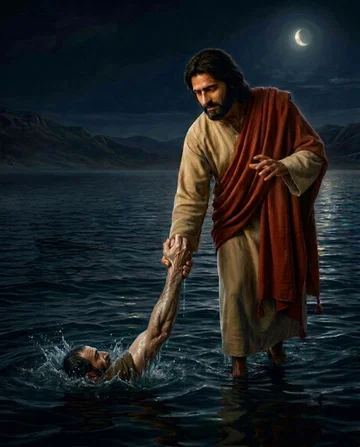
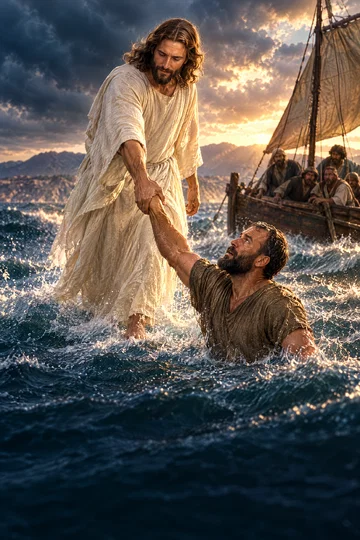
Jesus immediately stretched forth His hand and caught him, grasped his outstretched hands and lifted him from the waves.Ms 33, 1892, par. 35Ms 19, 1892, par. 47–49COS 86.1Lt 225, 1904, par. 1–2 He does not leave a sinking doubting person to perish but saves fully when appealed to with the prayer, save, Lord, or I perish.Lt 26, 1885, par. 1–3Lt 31, 1893, par. 11–14 Peter began to sink when he looked at the waves after turning his eyes from Christ, but when he cried to Jesus for help Christ immediately reached out and saved him as the one who rescues the helpless and helps in every time of need.Ms 33, 1892, par. 35Lt 31, 1893, par. 11–14Ms 19, 1892, par. 47–49 His cry was answered by an ever-ready hand, and a person sinking in danger should keep hold of faith in Christ and call on Him for deliverance, walking with humble steps and eyes fixed on Jesus while Christ strengthens the believer to walk beside Him.Ms 19, 1892, par. 47–49Lt 225, 1904, par. 1–2
Jesus then held Peter's hand and they walked side by side into the boat together, leaving Peter subdued and silent with no reason to boast over others.DA 381.4–6 That rescue is never in vain, for Jesus responds at once to faith even when weak and doubting and feeble.Lt 26, 1885, par. 1–3Lt 38, 1885, par. 2–7 Even when faith feels feeble and the hold on Him feels weak, He has a firm hold of the soul He died to save and keeps it by divine power, supplying by mercy and merits what repentant, humble, feeble ones lack and never leaving nor forsaking one penitent soul that looks to Him.Lt 26, 1885, par. 1–3Lt 38, 1885, par. 2–7 Placing the hand in the hand of Christ and confiding all to Him gives refuge while the tempest rolls, pardon through His blood, and help for the helpless.Lt 38, 1885, par. 2–7
That same outstretched arm is still stretched out to hold up all who are depressed and sinking and is laid hold of by prayer in loving trust toward Jesus.Lt 92, 1896, par. 10 Taking hold of that arm in weakness gives courage, vital energy, and pure wisdom, because strength comes from God and not from human supports.Lt 92, 1896, par. 10 Those who lay hold of infinite strength stand on the solid rock of God's promises, become strong in Jesus, and are able to take responsibilities and give others courage instead of hesitance and weakness.Lt 92, 1896, par. 10 The sinking disciple on the stormy sea reaching up his hand to grasp the hand of Christ pictures refusing to cherish doubts and fears, which grow by looking upon them and talking them, and instead reaching to Christ for safety.Lt 7, 1877, par. 2–3
Rebuke of Little Faith
Jesus met sinking Peter with rescue and reproof together, stretching out His arm to save him while gently and mildly asking why one of little faith had doubted, correcting wavering trust weakened by fear.Lt 11, 1864, par. 5–9Ms 18, 1895, par. 11–133RED 60.1–62.12SP 269.1–2RH Feb 6, 1913 The hand was ready to save the moment Peter turned his eyes back from the angry waters to Jesus and cried for help, grasping his outstretched hands and lifting him from the white-capped waves.Ms 18, 1895, par. 11–13COS 86.12SP 269.1–2RH Feb 6, 1913DA 381.4–6 Peter had trusted enough to step onto the water, but his faith was mixed with unbelief, for when he looked away from the Saviour toward the threatening wind, high waves, and even his companions' admiration, he forgot his Lord's power, became afraid, and began to sink.COS 86.12SP 269.1–2RH Feb 6, 1913DA 381.4–6DA 382.2 Doubt comes when eyes are withdrawn from Jesus and fixed on self and on danger like troubled tumultuous waves, and faith grows strong only by being exercised in conflict with doubt in seasons of discouragement and distress instead of letting hands slip off God's promises, settling under the cloud, and talking failure and discouragement which strengthens unbelief every moment.Lt 11, 1864, par. 5–9Ms 18, 1895, par. 11–132SP 269.1–2
The question exposes short-sighted, faithless unbelief that dishonors God, lets difficulties foster distrust, and breaks into murmuring and complaining in strait circumstances after Christ has already proved Himself an ever-present Saviour who knows all about trials.ST Dec 12, 1906Lt 24b, 1896, par. 31–34Lt 100, 1895, par. 15–17Lt 26, 1895, par. 5–7Lt 24, 1896, par. 20–22 Trials expose inherited and cultivated tendencies to wrong, and the same unbelief often seen in tempted believers must be met by standing fast and unmovable, taking eyes off self, and trusting not in self but in Christ within the veil.Lt 100, 1895, par. 15–17Lt 26, 1895, par. 5–7Lt 24, 1896, par. 20–22ST Sep 17, 1896 Instead of doubt, those rebuked are to pray in the hour of need for the Holy Spirit to bring to mind His many past manifestations of power, to believe He is as willing to help now as on former occasions, and to let remembrance of His past dealings strengthen and uphold trusting faith.Lt 24b, 1896, par. 31–34Lt 24, 1896, par. 20–22ST Sep 17, 1896 When He leads into hard places as at Rephidim it is for good and for His name's glory, and looked to in trusting faith He will in His own time turn the bitterness of Marah into sweetness and open the flinty rock to bring forth cooling streams, so His people should praise Him for past mercies and go forward with full assurance that He will be with them always even to the end of the world.Lt 24b, 1896, par. 31–34Lt 24, 1896, par. 20–22 No tribulation can separate from Christ, and the mightiest power is given to enable believers to stand, so that looking unto Jesus as Author and Finisher of faith and anchored in Christ amid raging temptation they are like a tempest-tossed yet immovable ship, not driven upon rocks or drawn into the whirlpool, with life bound up with the life of Christ.Lt 24b, 1896, par. 31–34Lt 100, 1895, par. 15–17Lt 26, 1895, par. 5–7
The rebuke also laid bare unbelief and self-exaltation that very nearly cost Peter his life when in self-satisfaction he lost sight of Christ, lost his footing, and had no reason left to boast over others as Jesus held his hand and they walked side by side into the boat together, leaving him subdued and silent.DA 381.4–6DA 382.2 The experience revealed his weakness and taught that safety depends on continual reliance on divine power by distrusting his own strength and relying on Christ, for he was weakest where he thought himself strong and recognizing that need would have prepared him to endure a later great test.Lt 26, 1895, par. 5–7DA 381.4–6DA 382.2 Hearing Christ's words without trusting them leaves a person vulnerable to doubt, so believers must believe the Scriptures for themselves, heed the Word, and rely on the Holy Spirit in order to guide others.Lt 104, 1898, par. 5–6 The same words about little faith apply to particular failures: to a wife who feared the consequences of her husband losing his job for keeping the Sabbath until the Lord opened a better way and she recognized her fear had shown too little trust, and to brethren who lost time by failing to move forward with sanitarium work, marking their delay as failure of faith.Lt 33, 1898, par. 4–8STB 103.5–104.3 The rebuke therefore calls doubters to trust Him rather than doubt, to come to the Lord just as they are without delay believing He wants to work for them, with the Holy Spirit working in their hearts.ST Dec 12, 1906Lt 24b, 1896, par. 31–34Lt 12, 1900, par. 3
What Rescue Reveals About Christ
Christ in this verse is an all-powerful helper who knows the trials of His people and is willing to help them in their hour of need, confronting doubt with both help and correction and rebuking the short-sighted unbelief that lets difficulties foster distrust.ST Dec 12, 1906RH Apr 7, 190310MR 117.2–3 He does not leave a sinking, doubting person to perish, but immediately stretches out His hand and saves fully when appealed to with the prayer for rescue from perishing, responding at once even to weak, doubting and feeble faith.Lt 26, 1885, par. 1–3ST Jul 23, 1896 He is willing to save to the uttermost the poor, trembling, imperiled soul whose cry of distress reaches Him in His infinite compassion, and He will save all who ask Him in faith, supplying by mercy and merits what repentant, humble, feeble ones lack and never leaving nor forsaking one penitent soul that looks to Him.Lt 26, 1885, par. 1–3ST Jul 23, 1896 His past help gives reason to trust Him through present difficulties, which cannot separate believers from Him, and remembrance of His past acts of power with prayer for the Holy Spirit to bring them to mind strengthens faith and keeps doubt from prevailing.ST Dec 12, 1906RH Apr 7, 190310MR 117.2–3
He watches over His people in danger and gives help when they humbly seek it in prayer, seeing their danger when their hearts are humbled.2SP 267.2–268.1ST Dec 29, 1887DA 381.1 His watchful eye of tender sympathy and pitying love rests upon them all through the fearful storm with compassion as tender as a mother watching a suffering child, and that love is infinite.Lt 5, 1876, par. 9–15 In the greatest peril and need He is close by and has not forgotten them, present to strengthen and support by His all-powerful arm, touched with the feeling of infirmities and loving and pitying beyond human pity.Lt 10, 1865, par. 5–8Lt 5, 1876, par. 9–1510MR 28.1–2 He still saves His laboring servant who has spent strength for His cause, bringing out from affliction to health and triumph and turning sorrow into joy, so the sufferer should be of good courage, wait patiently in firm faith without doubting, and expect to see all come out right in happy rejoicing in God the Deliverer.Lt 10, 1865, par. 5–8Lt 5, 1876, par. 9–15
He holds the winds in His hands and controls the waters, walking upon the waves and stilling the angry waters, which proves His power over the elements amid the disciples' peril in the storm-tossed boat.Lt 5, 1876, par. 9–157MR 280.4–281.2Ms 138, 1897, par. 1–4 He is thereby shown to be a powerful, gracious, compassionate Redeemer able to calm all tempests and revive all hearts, who can be trusted in the storm as well as the sunshine.Lt 5, 1876, par. 9–15 He will not tear Himself away from one who grasps His promises by living faith, but will hold and protect and keep from falling everyone who takes Him at His word and believes He will do exactly as promised.Lt 26, 1885, par. 1–3Ms 18, 1895, par. 11–13 Faith itself cannot be originated by man, for it is the gift of God, the living fire of His own kindling, and He responds to every soul that has true faith to use in prayer.Ms 18, 1895, par. 11–13
His rescue, together with healing the sick, feeding thousands, and walking the stormy sea to reach the disciples, and with all events from the manger to the cross, forces the conviction that Jesus in human flesh is the only-begotten Son of the Father, the same rock smitten in the desert that gave forth pure water.ST Jul 23, 1896 That same reaching out to save Peter when the waves threatened to overwhelm him also pictures His love reaching him when sin and its consequences and trial threatened to overwhelm his soul, for self-trust brought him close to ruin but Christ did not abandon him.ED 88.5ST Nov 23, 1915 Yet He cannot prevent the consequences of evil that a person has not forsaken, and Peter's experience teaches that self-trust leads to defeat.ED 88.5 When He leads into hard places as at Rephidim it is for good and for His name's glory, and looked to in trusting faith He will in His own time turn the bitterness of Marah into sweetness and open the flinty rock to bring forth cooling streams.Lt 24b, 1896, par. 31–34Lt 24, 1896, par. 20–22 Therefore remembrance of His many past manifestations of power should strengthen and uphold trusting faith that He is as willing to help now as on former occasions, an ever-present Saviour and ever-present help in trouble who knows all about trials, so that no tribulation can separate from Him and His people should praise Him for past mercies, pray for the Holy Spirit to recall His dealings, go forward with full assurance, and be with them always even to the end of the world.Lt 24b, 1896, par. 31–34Lt 24, 1896, par. 20–22ST Sep 17, 1896RH Apr 7, 190310MR 117.2–3
When human effort proves useless, His followers can cease relying on their own strength and trust Him to do what they cannot, for He compassionately helps those who turn to Him in faith.GW92 31.1–2 In trouble they must keep their eyes on Him and rely on His power rather than their own, for He does not call them to follow Him only to forsake them.GW92 31.1–2DA 382.1
Living by Faith Not Doubt
Looking to Jesus in confiding trust keeps a person as safe walking on the waves as on solid land, for anchored in Christ amid raging temptation the soul is like a tempest-tossed yet immovable ship that is not driven upon the rocks or drawn into the whirlpool, with life bound up with the life of Christ so as not to be moved.Lt 11, 1864, par. 5–9Lt 100, 1895, par. 15–17Lt 26, 1895, par. 5–7 Faith grows strong only by being exercised in conflict with doubt in seasons of discouragement and distress, rather than letting the hands slip off God's promises, settling down under the cloud, and talking failure and discouragement, which strengthens unbelief every moment.Lt 11, 1864, par. 5–9 Doubts and fears grow when they are indulged by looking upon them and talking them, so the tempted soul is to stand fast and unmovable, take the eyes off self, trust not in self but in Christ within the veil, and refuse doubt while encouraging hope and confidence in Christ who is the Author and Finisher of faith.Lt 100, 1895, par. 15–17Lt 26, 1895, par. 5–74T 557.4–558.1Lt 7, 1877, par. 2–3
Keeping the eye of faith fixed steadily on Jesus gives strength and hope and keeps from sinking, by meditating on His mercy, goodness, and excellency of character as Surety and Substitute and spotless Lamb of God, hanging the helpless care-troubled soul upon Him as the helpful Burden-bearer, crying to Him for help and trusting in Him fully and entirely.Lt 3b, 1881, par. 3–5 Faith cannot be originated by man, for faith is the gift of God, the living fire of God's own kindling, and the Lord responds to every soul that has true faith to use in prayer and that takes Him at His word believing He will do exactly as promised.Ms 18, 1895, par. 11–13 The sinner can no more be saved without making it his life business to behold the uplifted Saviour and by faith accept the merits it is his privilege to claim, for Peter could walk upon the water only while he kept his eyes fixed steadily upon Jesus.Lt 57, 1895, par. 45–4614MR 130.1
Placing the hand in Christ's hand and confiding all to Him gives refuge while the tempest rolls, pardon through His blood, and help for the helpless, for even when faith feels feeble and the hold feels weak He keeps by divine power the soul He died to save.Lt 38, 1885, par. 2–7 Those who thus lay hold of infinite strength by prayer in loving trust stand on the solid rock of God's promises, receive courage, vital energy, and pure wisdom, become strong in Jesus, and give others courage in the Lord instead of hesitance and weakness.Lt 38, 1885, par. 2–7Lt 92, 1896, par. 10 One sinking in danger should keep hold of faith, call on Him for deliverance, and with humble steps and eyes fixed on Jesus walk beside Him, looking to Jesus rather than fixing attention on life's tumultuous troubles and trusting that God loves and sustains.Lt 225, 1904, par. 1–2Lt 41, 1874, par. 10–11Lt 51, 1874, par. 20–2819MR 368.2Lt 35, 1874, par. 15
As He still saves His laboring, afflicted servant by His all-powerful arm, with compassionate eye, strengthening presence, and sympathy touched with the feeling of infirmities, the sufferer should be of good courage, wait patiently a little longer in firm faith without doubting, call to mind God's lovingkindness, and believe He will reach down His strong arm to lift the head above the cloud, bring out to health, and make all come out right in happy rejoicing in God the Deliverer.Lt 10, 1865, par. 5–810MR 28.1–2Lt 31, 1859, par. 4 Peter could have sought Christ's help in the same way when warned that he would deny Him, even when he could not see or understand his own danger, and Christ would have helped him overcome his own weakness and remain faithful.ST May 12, 1898
Pattern for Helping Others
Jesus as Elder Brother holding out His helping hand to sinking Peter when he had to swim against the stream with all the force of the current and the weight of waves driving him back is the pattern for helping tempted ones who must swim against the current, hedged up by Satan and the world.COL 387.2Lt 50a, 1897, par. 44–46Lt 50, 1897, par. 43–44 Those who err and feel their shame and folly and look upon their mistakes until they are driven almost to desperation are not to be neglected, and those struggling against mistakes and shame or nearly overwhelmed by them are not to be left to perish.ST Jul 6, 1915COL 387.2Ms 126, 1907, par. 28–3121MR 179.5 Such a person needs a helping hand held out in the same way and hopeful words spoken that establish confidence, restore confidence, and awaken love.ST Jul 6, 1915COL 387.2Ms 126, 1907, par. 28–31 His hand represents saving help and tender care, with a hand ready to hold up the weak and a heart responding with pity, as a model of compassionate, personal help that lifts and saves rather than weakens or destroys.Ms 126, 1907, par. 28–31RH Jan 19, 191121MR 179.5
Believers are to hold out a hand to them in the same way, give hopeful advice that establishes confidence and awakens love, and give no occasion for discouragement to one supposed to have moved wrongly.COL 387.2Lt 50a, 1897, par. 44–46Lt 50, 1897, par. 43–44 They are to let him feel the strong clasp of a sympathizing hand and pray with him, calling to pray together, offering support that understands weakness rather than mere belief in law or force.Lt 50a, 1897, par. 44–46Lt 50, 1897, par. 43–44Ms 126, 1907, par. 28–31 Such prayer unites hearts with one another and with God and brings Jesus to the side.Lt 50a, 1897, par. 44–46Lt 50, 1897, par. 43–44 Such help keeps the discouraged from sinking and from becoming discouraged, and gives new strength and fresh grace to the fainting, perplexed soul to overcome the world, the flesh, and the devil and to turn aside the attacks of Satan.Lt 50a, 1897, par. 44–46Lt 50, 1897, par. 43–44 The Holy Spirit gives a rich experience to both helper and helped, and such helping work is registered in the heavenly books.Lt 50a, 1897, par. 44–46Lt 50, 1897, par. 43–44
Sources
Pioneers and periodicals
119 sources
Peter began to sink in the stormy sea and cried for help, and Jesus at once stretched out his hand, caught hold of him, lifted him up and brought him safely back while gently reproving his little faith and asking why he doubted.ST Dec 29, 1887ST Dec 29, 1887ST Feb 17, 1888 While he kept his attention fixed on Jesus he walked safely on the water, but when he turned to look at the wind and waves instead of Christ he became afraid, his trust gave way to doubt, and he began to go down.ST Jun 14, 1899ST Apr 14, 1914ST Jun 23, 1898RH Dec 2, 1858 Little faith is faith weakened by fear, and doubt stands opposed to simple faith that takes God at his word and expects him to do as he has said.RH Apr 7, 1903RH Jul 30, 1861ST May 17, 1910RH Mar 14, 1871RH Jul 25, 1871 Safety comes from keeping the eyes fixed constantly on Jesus in faith, for looking to him enables passing through adversity while turning to trouble or to self-trust brings sinking.ST Jun 20, 1900RH Jul 28, 1903RH Jul 28, 1903RH Nov 30, 1916ST Jan 16, 1912 In every time of trouble he is near and ready to rescue as soon as the troubled soul calls, giving help and strength, calming the waters and restoring peace.ST Dec 12, 1906RH Jul 28, 1903ST Jul 8, 1930
Stormy Sea Setting
The night of this rescue was the night after the feeding of the multitude, when the disciples were crossing the sea and afterward landed where people gathered to Jesus, leading to the teaching about the bread of life.ST Jul 26, 1905ST Jun 14, 1899 Jesus reaching out and catching Peter when he began to sink belongs to that sequence after Jesus overtook the disciples on the sea by walking to them, coming after their troubled experience in the night and before Christ and the disciples landed and the people gathered to Him.ST Jun 14, 1899
After many hours of fruitless rowing against a furious storm and adverse winds, their vessels became unmanageable and they laid down their oars in despair and expected to perish.ST Jul 18, 1878ST May 20, 1886 While tempest and billows talked with death, Jesus whom they had left behind appeared walking calmly upon the boisterous white-capped waves.ST Jul 18, 1878 Bewildered by useless effort and hopelessness, they mistook Him for a sure precursor of immediate death and cried out in great fear.ST Mar 15, 1877ST Jul 18, 1878 Instead of heralding death He came as the messenger of life, His voice heard above the roar of the elements, and the scene quickly changed from horror of despair to joy of faith and hope in the presence of the beloved Master, with no more anxiety nor dread of death because He was with them.ST Jul 18, 1878 Peter had asked to be bidden to come to Jesus on the water, was told Come, went down from the boat and walked toward Jesus, then saw the wind, became afraid and began to sink, and cried Lord, save me.ST May 20, 1886 Jesus immediately stretched forth His hand and took hold of Peter as he was beginning to sink, rescuing him and reproving his little faith and doubt.ST Oct 12, 1904ST Jul 7, 1898ST May 20, 1886 After they went up into the boat the wind ceased, the disciples were greatly amazed because they understood not concerning the loaves and their heart was hardened, they willingly received Jesus and worshiped Him saying of a truth He is the Son of God, and the boat was straightway at the land where they were going.ST Oct 12, 1904ST May 20, 1886 The event was afterward recounted with the storm, the disciples’ fear, and Jesus’ reassuring words to the wondering crowd in the synagogue.ST Mar 15, 1877
The episode shows Jesus seeing His disciples’ danger and struggling, knowing the needs of people in distress, watching over them and giving help when their hearts are humbled and they pray for it.ST Dec 29, 1887ST Oct 28, 1897RH Oct 7, 1909 He had not forgotten them and was near even when they thought they were lost and forsaken, and the storm taught them their helplessness.ST Oct 28, 1897RH Oct 7, 1909 He came to save the disciples and bring relief, not to frighten them, as master of the sea and able to save them through every storm.ST Oct 28, 1897ST Oct 12, 1904ST May 30, 1878 His presence brought reassurance amid fear and danger, and His presence and command calmed the angry roar and stilled the tempest, as the life-giving Word.ST Sep 21, 1904ST Jul 7, 1898ST May 30, 1878 When they received Him aboard they reached the haven and confessed that He was the Son of God, for life’s passage beset by contrary winds and opposition is piloted quickly to the other shore when the Lord comes aboard.ST Oct 12, 1904ST Jul 14, 1898
The warnings in this chapter are given not to condemn people but to lead them to seek God’s kingdom and righteousness.ST Feb 10, 1898 The disciples’ experience on the sea was a test of faith, a lesson they did not fully learn until they received the Holy Spirit.ST Feb 1, 1899
Why Peter Sank
As long as Peter kept his attention fixed on Jesus he walked safely on the water, but when he turned to look at the wind and the storm-driven waves instead of Christ he became afraid and began to sink.ST Jun 14, 1899ST Apr 14, 1914ST Jun 20, 1900ST Aug 2, 1905 His fear arose when he took his eyes from Jesus and focused on the surging waves and the danger around him, and seeing the wind made him slow to trust the Lord who was near.ST Aug 25, 1881ST Jun 14, 1899ST Apr 14, 1914 His cry, Lord, save me, was immediately answered by the outstretched hand taking hold of him, with the rebuke identifying his lack as little faith and asking why he doubted.ST Aug 25, 1881ST Jun 20, 1900ST Aug 2, 1905 Faith had enabled him to walk while his attention stayed on Jesus and on his word, and that word with the outstretched hand was sufficient to save him when he sank.ST Apr 14, 1914ST Aug 2, 1905
His failure came when fear displaced trust in Jesus' word, so that the sustaining word faded from his mind and faith mixed with unbelief gave way.RH Apr 7, 1903ST Jun 23, 1898RH Jul 1, 1862RH Jul 23, 1901 Reason turned his attention from the promise, he doubted his ability to reach Jesus, and he forgot his Lord's power, though the waves and Jesus had not changed.RH Apr 7, 1903RH Dec 2, 1858RH Jul 1, 1862 Faith weakened by fear gives way to doubt when circumstances look threatening, with trembling and uncertainty taking hold amid tossing waves.RH Apr 7, 1903RH Dec 2, 1858RH Feb 26, 1861 The lesson is not to imitate the outward act of walking on water but to believe and act on the Lord's word, holding to God's promises and pressing forward rather than yielding to fearful guesses or turning back from the way of life.ST Jun 23, 1898RH Dec 2, 1858RH Feb 26, 1861
Looking away came from pride in an achievement that depended on Christ, from thinking of self and trusting his own ability instead of forgetting self in trust toward Jesus.ST Jun 20, 1900RH Nov 30, 1916ST Jun 20, 1900ST Jan 16, 1912 He took his eyes from Jesus to seek the admiration of others, and fear with loss of guidance followed when he stopped looking to the Lord.ST Aug 25, 1881ST Dec 29, 1887RH Nov 30, 1916 Safety is to keep the eyes fixed constantly on Jesus rather than to be overcome by surrounding dangers or by confidence in self, and faith must continue to look to the divine power that enabled the walk on the water.ST Dec 29, 1887ST Jun 20, 1900RH Nov 30, 1916ST Jun 20, 1900 Trial exposed the defeat of such self-trust, when sin and self-confidence brought his soul to the brink of ruin.ST Aug 25, 1881RH Nov 30, 1916ST Jan 16, 1912
What Little Faith Means
Doubt springs from little faith and stands opposed to faith, while simple faith takes God at his word, expects him to do as he has said, and credits him with sincerity and truthfulness, so that the simple believer is not troubled with doubts and fears.RH Jul 30, 1861ST May 17, 1910 The question is addressed to the sinner who doubts the Saviour's power and willingness to save, though he has saved millions of as great sinners and never refused anyone who came to him.RH Jul 30, 1861 It is addressed also to the Christian who doubts the Saviour's care and kindness, though there is never any justifiable cause, because he cares for the believer as the object of his eternal love, the purchase of his precious blood, the gift of his Father, and a member of his body, guarding him more carefully than a monarch guards the jewels of his crown or a husband guards his beloved bride, with a kindness steeped in love.RH Jul 30, 1861 Since the Saviour never gave any reason or occasion for doubt and is faithful who promised, the answer is to trust him, confide in him, look to him, always expect from him, commit all to him, leave all with him, honor him by confidence, and trust at all times without fear.RH Jul 30, 1861 Doubt is therefore not to be made the starting point for religious inquiry.ST May 17, 1910
The words of little faith describe faith weakened by fear, and little faith gives way to doubt when fear and uncertainty take hold amid threatening circumstances.RH Apr 7, 1903RH Mar 14, 1871RH Jul 25, 1871RH Feb 26, 1861 Peter beginning to tremble amid the tossing waves illustrates how fear and uncertainty weaken faith when circumstances look threatening, and Christians anxious about present troubles and the signs of the times are to hold to God's promises and press forward rather than yield to fearful guesses.RH Feb 26, 1861 Unbelief in this way weakens trust in God and brings distress, while the Lord can help and raise up those who call on him, so the lesson is to believe God's promises with strong, unwavering faith.RH Mar 18, 1858 The rebuke is thus a call to recognize spiritual weakness and seek God's help, and Christ as an all-powerful helper knows his children's trials and is willing to help them in their hour of need, with his past help giving reason to trust him through present difficulties which cannot separate believers from him.RH Apr 7, 1903RH Mar 14, 1871
Spiritual weakness comes from little faith and little prayer and from taking only a little of the grace and spiritual provision available, not from any lack in God.RH Jul 25, 1871ST Aug 22, 1878 Weak and unhealthy spiritual life takes only drops from the unsealed fountain, only crumbs from the bread before it, and only pennies from the open treasury, instead of using its privileges, so that spiritual hunger, thirst and poverty have no excuse while the throne of grace stands open.ST Aug 22, 1878 The true cause is pride that will not come as a poor sinner, sloth that will not labor for more, and unbelief that ties and paralyzes the tongue, for the lack is not in God but in man.ST Aug 22, 1878 The cure is to awake, cast off pride, indolence and unbelief, and come boldly, sinful as one is, in the name of the great High Priest, to receive abundant help and blessings available through him.RH Jul 25, 1871ST Aug 22, 1878
Presumption is not faith, and Peter's failure on the water shows an ambition to display supernatural power that is not honored as faith.ST Oct 1, 1896 Doubting comes from losing confidence in Christ when trust stops and attention turns to wind and waves, and the doubter in that state is a spiritual coward who fails.ST Jun 12, 1901 Doubt can also appear as hesitation even in a sincere seeker after truth, who may be convinced of vital Christian truths yet become uncertain and slow to decide when shaken by skeptical arguments.RH May 30, 1871 Trials can expose unbelief and lead to murmuring, but remembering Christ's past acts of power should strengthen faith that he is present and willing to help in present trouble.ST Sep 17, 1896 Believers should therefore pray for the Holy Spirit to bring those past acts to mind and trust Christ rather than doubt, looking when faith weakens and sinking begins to the evidence of God's power and to his promises to use that power on their behalf, which are given to strengthen faith in his ability to fulfill them.ST Sep 17, 1896ST Apr 10, 1893
Jesus Immediately Rescued Him
When he began to sink and cried out for rescue, Jesus immediately stretched forth his hand and caught him, grasped his hands and lifted him up, took hold of him and kept him from going under, and guided him safely back to the boat.ST Feb 17, 1888ST Aug 2, 1905ST Aug 30, 1883 The word of Jesus was sufficient to sustain him, but it had to be exercised by faith, and the swiftness shows that Christ answers the prayer of faith without delay while calling for faith that remains full and steady.ST Feb 17, 1888ST Aug 2, 1905 His help stays near even when faith falters, and his invitation to come brings protection, guidance and safety, so that a struggling soul who cries to him for help can trust his saving power.ST Aug 2, 1905ST Aug 30, 1883 Those who lose courage and feel weak can call on him in the same way.ST Aug 30, 1883
The rescue came with a loving, mild and gentle rebuke that identified his fear and sinking as little faith and asked why he doubted while the Saviour was near.ST Dec 29, 1887ST Dec 29, 1887RH Apr 10, 1913ST May 24, 1905ST Jan 5, 1882 His doubt followed when he took his eyes from Jesus to look at the threatening waves and to seek others' admiration, and fear and loss of guidance followed.ST Dec 29, 1887ST Dec 29, 1887 Keeping the eyes fixed on the Saviour enables facing the storms of life, and his saving hand remains a source of rescue and comfort when fear overwhelms faith.ST Dec 29, 1887RH Oct 4, 1906 His care for his children sinking amid life's troubles comes with that gentle word against fear.RH Apr 10, 1913
That personal bodily touch was a privilege and a joy, for he laid his holy hand on sinking Peter to hold him.RH Oct 2, 1900RH Apr 16, 1867 That small touch of the hand saved as truly as if he had clasped him in his arms.ST Feb 20, 1893ST Jun 12, 1907 Even a small part of his truth, received and followed rather than detached from him, leads to him and brings salvation.ST Feb 20, 1893ST Jun 12, 1907 The same hands that rescued Peter were later lifted in blessing at the ascension.RH Oct 2, 1900
The swiftness proves he speeds toward his people in danger rather than away, running to rescue like one swift to help, opposite in direction to one that flees. He caught him the moment the water-pavement broke beneath him, giving pardon to the sinner and help to the baffled soul at the exact moment they must have it or perish, because grace that comes too late is no grace at all. What is needed is a God now, whose wings are swifter than any bird's wing and who is always in quick pursuit of his children. When faith is like a palsied arm yet longs to stretch out, he strengthens its spiritual nerve, bids it reach out its hand, and immediately stretches out his own hand to catch it.RH Sep 2, 1873 Though unseen, he does this everywhere today, beside every person, so that no one who would reach him by faith is beyond his help.RH Sep 2, 1873
He does not turn away from those who reach out to him for mercy, but with infinite compassion catches the poor, trembling, imperiled soul, willing to save to the uttermost.ST Aug 25, 1881ST Jul 23, 1896 He is ready to help even childlike and faltering faith and to lift the one who calls above trials, as he lifted Peter above the waves.RH Mar 23, 1869 His helping hand remains able to save those who seek his aid in their time of need, and trust in him rather than pride or attention to admiration keeps a person steady amid danger.ST Aug 25, 1881ST Jul 22, 1913 His rescue belongs with healing the sick, feeding thousands, and walking the stormy sea to reach the disciples, and with all the events from the manger to the cross it forces the conviction that Jesus in human flesh is the only-begotten Son of the Father, the same rock smitten in the desert that gave forth pure water.ST Jul 23, 1896
The account was later misused to claim that Peter's successors had authority to rule the nations, because the sea symbolized nations and Peter had been given power to walk on it.RH Nov 28, 1907 Being caught or covered by the waves when Peter walked on the sea was not baptism in the religious sense, which requires obedience to the discipline of religion.ST Jan 13, 1881 At the crucifixion the rescue was thrown back as mockery, calling the walking a conjurer's trick and jeering that he who saved others on the sea cannot save himself from the cross.ST Jan 24, 1911
Look to Jesus Continually
Safety comes from keeping the eyes fixed constantly on Jesus, and looking to Christ in faith enables people to pass safely through adversity, while turning attention to trouble brings them down.ST Jun 20, 1900RH Jul 28, 1903RH Jul 28, 1903ST Mar 15, 1905ST Oct 18, 1905 When fear made him look away from Jesus toward the storm-driven waves instead of keeping his attention on Christ, he began to sink, though keeping his eyes on Jesus had given him divine power to walk on the sea.ST Jun 20, 1900RH Jul 28, 1903RH Jul 28, 1903ST Mar 15, 1905 Pride in an achievement that depended on Christ had led him to look away, and losing sight of Jesus and focusing on surrounding trouble leads to fear and sinking.ST Jun 20, 1900RH Jul 28, 1903 Jesus remains near and ready to rescue as soon as the sinking one calls, to give help and strength, restore peace, and enable those who keep attention on him to help and encourage others who are sinking.RH Jul 28, 1903RH Jul 28, 1903RH May 16, 1912 Keeping close to Christ and looking to him brings safety through life's storms and strength to bear everyday sorrow, and as the Rock of Salvation he keeps believers through hours of trial and temptation, making faith stronger and pointing always to the Lamb who takes away sin, so that the believer fixed upon him does not see the turbulent waters round about.RH May 16, 1912ST Oct 18, 1905
He was safe while he trusted Christ and forgot himself, but began to sink when he stopped looking to Jesus and trusted his own ability amid the storm.RH Nov 30, 1916ST Jan 16, 1912 Faith must therefore continue to look to the Lord rather than be overcome by surrounding dangers or by confidence in self, for turning from him leads to failure because faith depends on Christ.RH Nov 30, 1916ST Jan 16, 1912 The only way to walk in a life pleasing to God is to keep looking to Jesus rather than trusting in personal attainments, religious standing, or achievements, and faith must endure rather than rely on sight, with obedience growing from living faith.RH Oct 21, 1858RH Nov 30, 1916
Faith stays steady by looking up in perfect confidence and never looking down at the turbid, roaring water beneath, so that great danger and small danger are the same.RH Oct 9, 1866 One look down at the torrent plunges into instant destruction, and succeeding in life requires that same fixed upward look.RH Oct 9, 1866 The Christian when tempted and dismayed is like an inexperienced swimmer in danger, where discouragement increases peril and dropping the head brings strangling, but courageously looking upward to Jesus enables him to mount the waves with buoyancy and delight. The lesson is not to imitate the act of walking on water but to believe and act on the Lord's word, since fear displaced trust in Jesus' word, and the question why he doubted challenges people today to trust Jesus and his enduring word.ST Jun 23, 1898 Leaving the sinking boat means clinging to no frail floating supports, though tossed in peril at night in a frail, trembling boat with Jesus drawing near on the wave and bidding him come. It means standing upright on the slippery, treacherous wave strong in Christ's strength and brave in his courage and not by one's own exalted power, without thinking on how high the angry waters rise or on wondering onlookers, but by fixing the eyes on his divine face, taking the kind hand he stretches out, and letting clear faith not waver nor grow dim, and so walking on the waters to him.
Christ's Power to Save
Peter did walk on the water when he was told to come, doing what no human ability can do because divine power upheld him, and the story is not only failure since the call itself assured that support.ST Jan 2, 1893 His eye fixed on Christ held him up at first in daring trust even over what looked like an abyss, and he did not sink when he stepped out toward Jesus.ST Jan 2, 1893 Christ's word was sufficient and sustained him as long as he did not doubt, for God's power enables what His command requires while attention stays on its source.ST Aug 2, 1905ST Jun 23, 1898ST Jun 23, 1898ST Jan 23, 1893 When fear distracted him and his eyes turned from Jesus to the wind and storm, the sustaining word faded from his mind and he began to sink, yet Jesus immediately rescued him and exposed the doubt that had overcome his faith.ST Aug 2, 1905ST Jun 23, 1898ST Jun 23, 1898 Obeying the Lord's commands brings a reward that meets the demand of the hour, implicit obedience is the first step into the Lord's confidence and toward final reward as the law of friendship with Christ, and His command comes with divine power to uphold those who obey. The lesson is to keep the eye of faith on Christ rather than on threatening circumstances, to trust His word and act on it, and to meditate on, believe, and live by the promises of Scripture rather than treat them as mere familiar words, with assurance that He remains with followers to the end.ST Jun 23, 1898
Walking on water is impossible for man, yet Peter did it by faith in Jesus.RH May 7, 1914 This proves that lost people who cannot help themselves must still avail themselves of salvation by doing what only God's power working through them can do, doing better than they can do, since all power in heaven and earth is in Christ's hands and is at human disposal through Christ dwelling in the heart by faith, leaving no room for finding fault with God for requiring the impossible.RH May 7, 1914 Sinners can be saved only by continually beholding Jesus and accepting by faith the merits of His righteousness rather than looking to or trusting in human help, and a child of God enjoys what faith lays hold of.RH Nov 24, 1904RH Apr 11, 1871 Peter's failure came from little faith, and while he kept his eyes fixed steadily on Jesus he could walk, but when he failed to do so Jesus caught him.RH Nov 24, 1904RH Apr 11, 1871 He was just as dependent on Jesus for support while walking on land as on the water, though he was conscious of that dependence on the water, and God's people can stand amid disaster by relying on God's word, which cannot be moved.RH Jul 25, 1907ST Aug 26, 1897
Rescue requires letting go of every other hold and trusting Jesus alone.ST Jul 17, 1879 Asking for His help while still clinging to one's own weak support refuses the help and makes saving impossible, but when the sinner releases his own hold in full trust and prayer Jesus receives him, which means implicit trust, taking Jesus at His word and yielding fully to Him instead of trying to do God's will in one's own way.ST Jul 17, 1879 A person is lost only by letting go of Christ's sustaining hand, for Christ reaches out to support those who call on Him, and one who turns attention from Christ to dangers sinks but is rescued on crying to Him.ST Nov 12, 1912 The only way to resist Satan is by faith in Christ rather than by watching Satan as a physical foe.ST Sep 11, 1893 Fixing the eyes on the enemy causes falling and making believers look at him is Satan's greatest object, while looking unto Jesus is the only safety because faith puts Christ before the believer so the believer does not meet the enemy himself but Christ meets him, with accusations falling against Christ's righteousness, craft against His wisdom, and power against His mighty power, making believers more than conquerors by faith.ST Sep 11, 1893
Faith is the key to receiving heaven's power, without which the disciples were unable to do the works He did, and even His own perfect obedience depended on faith.ST The reproof of little faith shows that lack of faith leaves His followers unable to do what He did.ST The rescue belongs with healing the sick, feeding thousands, and walking the stormy sea to reach the disciples, and with all events from the manger to the cross in forcing the conviction that Jesus in human flesh is the only-begotten Son of the Father, the same rock smitten in the desert that gave forth pure water.ST Jul 23, 1896 His cry of distress reached Jesus who is infinite in compassion and willing to save to the uttermost, who immediately stretched forth His hand and caught the poor trembling imperiled soul when Peter looked away to the waves and began to sink.ST Jul 23, 1896
Present Help for Believers
In trouble Jesus is near, all-powerful to help, knowing the trials of his people and willing to meet them in the hour of need.ST Dec 12, 1906RH Jul 28, 1903ST Jul 8, 1930RH Jun 23, 1903ST Feb 17, 1909 When the sinking one cries out he hears at once and comes to aid, rescuing from danger to those who trust him and turn to him instead of being overwhelmed.RH Jul 28, 1903ST Jul 8, 1930RH Jun 23, 1903ST Feb 17, 1909ST Feb 11, 1886 Losing sight of him to fix attention on surrounding trouble brings fear and sinking, while looking to him brings strength to endure trials and overcome difficulties, restores peace, calms rough waters to rest, and meets need.ST Dec 12, 1906RH Jul 28, 1903RH Jun 23, 1903ST Feb 11, 1886 Those who keep attention on him in this way are also enabled to help and encourage others who are sinking.RH Jul 28, 1903 His past deliverance and present power give reason not to fear or doubt even amid hardship and uncertainty, for he guides his own and will bring what is best, though why present troubles are permitted may become clear only later.ST Dec 12, 1906RH Jun 23, 1903
His outstretched arm is sustaining mercy that keeps from sinking into the mire and keeps the waters of strife and sorrow from overwhelming those who hold fast to him.ST Oct 18, 1905RH Sep 25, 1860 Keeping the eyes fixed constantly upon him keeps the believer from seeing the turbulent waters round about, and his strength enables walking where personal strength would fail.ST Oct 18, 1905RH Sep 25, 1860 As the Rock of Salvation he keeps believers through hours of trial and temptation, making faith stronger and pointing always to the Lamb of God who takes away sin.ST Oct 18, 1905 He is forever near in dark days when storm clouds lower and fierce waves threaten to devour, speaking above the tempest to take away fear, walking the waves beside the believer where no storm can drive him away, bidding the waters bear him up, defending with his arm, shining his face on the billows to drive away terror, and lighting the way forward as he beckons without faltering.RH Jan 28, 1873
The sinking of Peter when fear and doubt overcame trust on the waves, followed by the grasp that caught him and the rebuke of little faith, calls followers who fear to trust God when obedience brings sacrifice to keep eyes fixed on Christ and act on his word without doubt.ST Jun 27, 1900 The same applies to Christians anxious about present troubles and uncertain about the signs of the times, whose fear and uncertainty weaken faith when circumstances look threatening: faith holds to God's promises and presses forward rather than yielding to fearful guesses.ST Jun 27, 1900RH Feb 26, 1861 The words about little faith rebuke doubting that God can save an unbelieving contentious husband and the whole household, calling for faith that salvation can reach the entire family, since expecting failure leaves failure and loss.RH Feb 20, 1900 The rebuke also meets discouragement when efforts or giving bring no quick visible results, for moral courage depends on faith in God and fails when faith gives way to doubt.ST Oct 11, 1877RH May 3, 1860
Peter's venture out of the boat at the bidding of Jesus to walk to him on the waves was commendable, giving him an experience those who stayed in the boat did not have.RH Jun 25, 1901RH Mar 2, 1852RH May 16, 1907 Though he began to sink he also began to pray, proving that sinking times are praying times that teach where to reinforce human weakness by laying hold on infinite strength.RH Jun 25, 1901 Stepping out by faith and making an effort brings the Lord's help and blessing and holds the believer securely beside the Master, while abandoning obedience to escape danger would bring greater peril and calls for speedy repentance.RH Jun 25, 1901RH Mar 2, 1852RH May 16, 1907 The rescue belongs to the warfare for eternal life against the world, the flesh, and the enemy, where high billows seem ready to sweep over the head and sinking begins when hope and courage fail and the mind is caught away from Christ who rules the storm to look with fear at wind and peril.RH Nov 25, 1873 No victory is won without hope, courage, and perseverance, yet frail man is not left alone to guide his fragile bark over the stormy sea of time, for his Captain is a conqueror never overcome who pleads for followers with the same compassion, bidding good cheer.RH Nov 25, 1873
Believers on the voyage to the bright land of rest free from sin, temptation, and strife become faithless like Peter when dangers tower to the skies, and must fly to the Saviour crying to be saved lest they perish.RH Jul 16, 1861RH Oct 20, 1863ST Sep 21, 1904 He as pilot delivers those whose boat is broken, having seen tears and heard groans, and those who embrace promise by faith and heed his voice find rejoicing.RH Jul 16, 1861 When storm clouds gather and winds and waves run high he does not forsake for an hour but stays ever near, immediately stretching forth his hand amid fears, calming rough waters to rest, guiding by the hand safe to heaven and to eternal rest.RH Jul 16, 1861RH Oct 20, 1863ST Sep 21, 1904 He has marked the way because he passed over before them, teaches to shun rocks and shoals and all dangers, and in his strength those who have begun the course will not fall, welcoming all who entrust themselves to him through danger and fear toward eternal rest.RH Jul 16, 1861ST Sep 21, 1904
His praying on the mountain pictures his praying on high for the church after ascension, when she seems forsaken and alone through dark watches on the dark waters of this world.ST May 12, 1909 The buffeting by the storm pictures the bruising of the church by storms of satanic wrath before sharing victory in the world to come.ST May 12, 1909 His coming in the night storm, walking the sea, catching the sinking, speaking peace to storm-tossed children, and piloting quickly to the other shore pictures his soon coming to rescue the struggling church when the world goes to wreck amid crashing elements.ST May 12, 1909 Those who lose courage and feel weak can call on him for help, and those sinking under temptation will find his arm able to save.ST Aug 30, 1883RH Oct 21, 1858 Those who fare well in prosperity may falter when trouble or sorrow comes, and tired believers after long hard struggle with darkness may feel almost forsaken and sinking beneath waves of adversity, yet he sees trouble, gives help that defeats the enemy, lifts clouds, and fills souls with comfort only he can give, coming with cheering comfort and smiles against little faith and doubting.ST Aug 30, 1883RH Aug 19, 1873RH Apr 30, 1872
He is an unfailing source of joy, comfort, and safety, the same at all times as on Galilee, and knowing him now brings peace and prepares for knowing him at his coming and having peace in the day of judgment.RH Apr 10, 1913RH Sep 10, 1901 His care for his children sinking amid life's troubles comes with a gentle word against fear as he reaches to save.RH Apr 10, 1913RH Sep 10, 1901 A plea born of felt need is heard and answered, for he answers the prayer of faith without delay while calling for faith full and steady.ST Feb 17, 1888RH Oct 10, 1907 The needy soul may reach tremblingly for his hand and be rescued by his touch without eloquent words, and urgent need warrants praying without waiting for an authorized form, since stopping to recite a lengthy creed in the moment of sinking would leave one to drown.ST Feb 17, 1888RH Sep 30, 1915RH Oct 10, 1907RH Sep 23, 1858ST Apr 10, 1893
Over boisterous billows one may tread as long as faith looks overhead to Jesus, who walked the wave, controls the winds, and as Maker of heaven, earth, and sea has a strong arm to save and succor those who trust him.ST Mar 13, 1893 He calls the child of dust to draw near, place hand in his hand, give fear to the winds, and walk by divine faith.ST Mar 13, 1893 Fleshly fear obstructs the road to full obedience, holiness, and God, but faith casts fear away so love fills the heart and fulfills the law.ST Mar 13, 1893 Peter could have sought help in the same way when warned he would deny his Lord, and Christ would have helped him overcome weakness and remain faithful, showing help may be asked even when danger is not seen or understood.ST May 12, 1898 Nor was failure to follow faithfully final, for he could return to loving loyal service.ST May 12, 1898RH Mar 18, 1915
The helping hand is an example for offering hopeful words and personal compassionate help to one struggling against mistakes and shame, restoring confidence and awakening love.ST Jul 6, 1915RH Jan 19, 1911 His hand is ready to hold up the weak and his heart responds with pity, and strength in God enables a worker to reach out to those wrestling with trouble in a troubled sea.RH Jan 19, 1911ST Oct 7, 1886RH Mar 18, 1902ST Apr 17, 1893 The bold and impetuous Peter stepped out because he loved Jesus and most desired his company, and while angry billows threatened he cried to be saved with earnestness and confidence.RH Nov 25, 1873 His unbelief and doubt brought peril when he saw the wind boisterous and his mind was caught away from his Lord, yet immediate rescue calls to trust rather than doubt, and his character and outcome teach a useful lesson.RH Nov 25, 1873RH Jul 23, 1901 Scripture's promises must therefore not be treated as mere familiar words but meditated on, believed, and lived by, trusting Christ's word and acting on it with assurance that he remains with followers to the end, looking to evidence of God's power and his promises to use it on behalf of his people to strengthen faith in his ability to fulfill them.ST Jun 23, 1898ST Apr 10, 1893
Sources