Matthew 20:7
They say unto him, Because no man hath hired us. He saith unto them, Go ye also into the vineyard; and whatsoever is right, that shall ye receive.
Translations
They say to him, Because no man has hired us. He says to them, Go you also into the vineyard; and whatever is right, that shall you receive.
King James Version, KJV Cambridge Paragraph Bible
They say unto him, Because no man hath hired us. He saith unto them, Go ye also into the vineyard; and whatsoever is right, that shall ye receive.
They say to him, Because no man hath hired us. He saith to them, Go ye also into the vineyard; and whatever is right, that shall ye receive.
Revised Version, American Standard Version
They say unto him, Because no man hath hired us. He saith unto them, Go ye also into the vineyard.
they say to him, Because no one did hire us; he saith to them, Go ye — ye also — to the vineyard, and whatever may be righteous ye shall receive.
They say to him, Because no man has hired us. He says to them, Go also ye into the vineyard [ and whatsoever may be just ye shall receive].
They say unto him—Because, no one, hath hired, us. He saith unto them—Ye also, go your way into the vineyard.
‘ Because no one has hired us,’ they answered.So he told them, ‘ You also go into my vineyard.’
‘ Because no one has hired us,’ they answered. So he told them, ‘ You also go into my vineyard, and you will receive whatever is right.’
“ They said to him, ‘ Because no one has hired us.’“ He said to them, ‘ You also go into the vineyard, and you will receive whatever is right.’
They say to him, Because no man has given us work. He says to them, Go in with the rest, into the vine-garden.
They sayd vnto him, Because no man hath hired vs. He sayd to them, Goe ye also into my vineyard, and whatsoeuer is right, that shall ye receiue.
Douay-Rheims (Challoner revision)
They say to him: Because no man hath hired us. He saith to them: Go you also into my vineyard.
Pictures

Cross-references
- Matthew 9:37-38
Then saith he unto his disciples, The harvest truly is plenteous, but the labourers are few;
Both portray the Lord’s work as a harvest requiring laborers.
- Matthew 21:28
But what think ye? A certain man had two sons; and he came to the first, and said, Son, go work to day in my vineyard.
Both texts call people to work in the vineyard.
- Matthew 20:16
So the last shall be first, and the first last: for many be called, but few chosen.
The vineyard parable concludes by reversing the order of the first and last.
- Matthew 19:27-30
Then answered Peter and said unto him, Behold, we have forsaken all, and followed thee; what shall we have therefore?
Jesus answers Peter’s question about reward, concluding that the last shall be first.
- Matthew 20:12
Saying, These last have wrought but one hour, and thou hast made them equal unto us, which have borne the burden and heat of the day.
The first workers complain that latecomers receive equal pay.
- 1 Corinthians 3:8-9
Now he that planteth and he that watereth are one: and every man shall receive his own reward according to his own labour.
God’s workers labor together and receive their reward.
- Revelation 22:12
And, behold, I come quickly; and my reward is with me, to give every man according as his work shall be.
Christ gives each person a reward according to their work.
- Matthew 16:27
For the Son of man shall come in the glory of his Father with his angels; and then he shall reward every man according to his works.
Both promise reward according to works.
- Matthew 20:2
And when he had agreed with the labourers for a penny a day, he sent them into his vineyard.
Agreed wages contrast with payment received in trust.
- John 4:35-36
Say not ye, There are yet four months, and then cometh harvest? behold, I say unto you, Lift up your eyes, and look on the fields; for they are white already to harvest.
The vineyard call pictures gathering a ripe harvest.
- Colossians 3:23-24
And what soever ye do, do it heartily, as to the Lord, and not unto men;
Both urge service with the Lord as master and look to him for reward.
- Matthew 22:9-10
Go ye therefore into the highways, and as many as ye shall find, bid to the marriage.
The parable shows the invitation extended to those found after the first invitees refuse.
- John 15:5
I am the vine, ye are the branches: He that abideth in me, and I in him, the same bringeth forth much fruit: for without me ye can do nothing.
Effective labor in God’s vineyard depends on Christ’s power.
- Mark 10:29-30
And Jesus answered and said, Verily I say unto you, There is no man that hath left house, or brethren, or sisters, or father, or mother, or wife, or children, or lands, for my sake, and the gospel’s,
Jesus promises reward to those who give up possessions and relationships for his sake.
Commentary part 1 of 2
Each commentary is drawn from primary sources: the writings of Ellen G. White and Adventist pioneers and periodicals. Each commentary is separate. Its own words are not a quotation; follow the references to read the source passages.
Ellen G. White
172 sources
The men waited in the marketplace hoping to be hired, and they stood idle all day because no one had hired them, not because they refused to work, until at the eleventh hour the householder called even the still-unhired into His vineyard with the promise to give them whatsoever is right.9T 73.3–74.1Ms 23, 1908, par. 33–36Ms 19, 1897, par. 38–41Ms 87, 1899, par. 1–3ST Aug 9, 1899 The parable teaches God's free grace, correcting the idea that favor must be earned, for first and last share the same great eternal reward given not as debt but from the generosity of the Master's purpose, exceeding what was earned.9T 73.3–74.1COL 390.1ST Aug 9, 1899ST Jul 13, 1915RH Jul 24, 1900 The worth of service is measured by the spirit of faith and love in which it is given rather than by length of labor or visible results, so those who trust without bargaining receive His right dealing while those who bargain for a fixed sum reveal the hireling spirit that breeds envy and self-righteousness.9T 73.3–74.1Ms 87, 1899, par. 13–14Ms 29, 1911, par. 67ST Jul 13, 1915RH Aug 13, 1908 Their late hiring does not vindicate those who hear the truth and deliberately refuse the first call of mercy to keep their own time and way, yet even when life's sands are nearly run the hardened sinner on the borders of eternity can still be saved by coming at once broken and crying for mercy.Ms 87, 1899, par. 25RH Jul 31, 1900COL 399.1Lt 1e, 1890, par. 4Lt 1d, 1890, par. 17 The voice of Jesus sounds to the present commanding all who name Him to go work while it is day, for the vineyard is God's work in the world field to present truth to those in darkness, probation is limited, and night comes when no one can work.Ms 15, 1910, par. 13Ms 153, 1897, par. 5ST Apr 21, 18813T 202.13T 121.1–2
Story and Parable Setting
The men found standing idle at the eleventh hour had stood idle all day because no one had hired them, not because they refused work or chose idleness for themselves.9T 73.3–74.1Ms 23, 1908, par. 33–36Ms 87, 1899, par. 1–3RH Jul 24, 1900ST Aug 9, 1899 They had remained waiting to be hired, and when found they were still waiting because no earlier call had taken them into service.9T 73.3–74.1Ms 23, 1908, par. 33–36Ms 87, 1899, par. 1–3RH Jul 24, 1900RH Jul 31, 1900 Their idleness was therefore the idleness of the unhired, not of those who heard the truth and deliberately refused to obey it in order to keep their own time and way.RH Jul 24, 1900ST Aug 9, 1899RH Jul 31, 1900
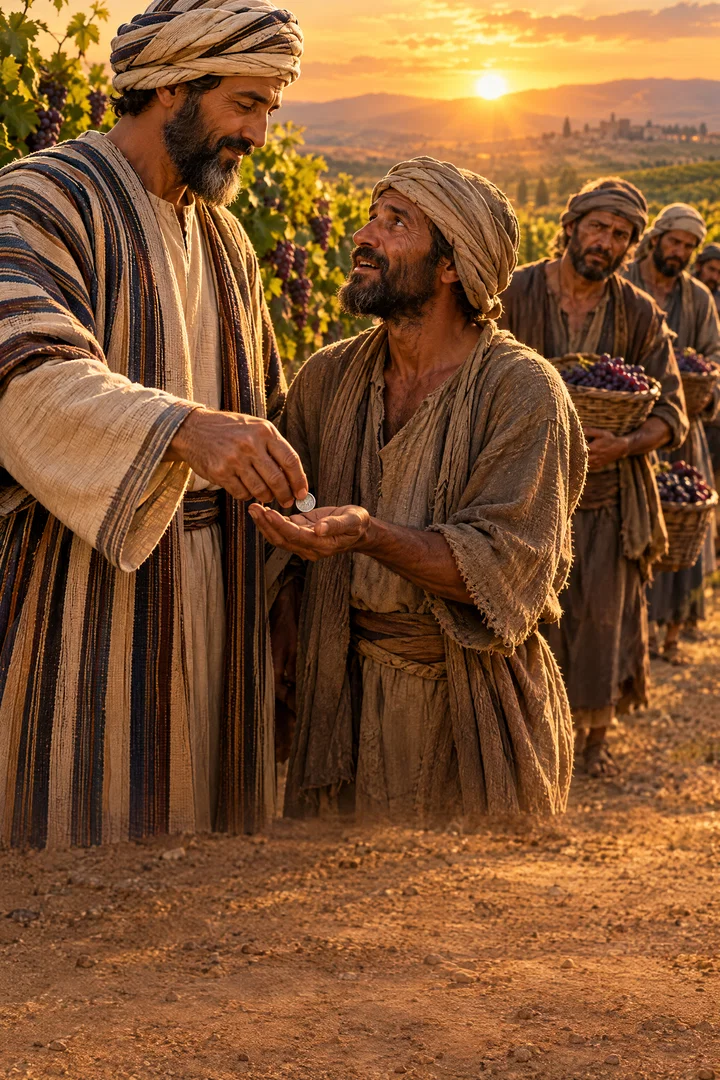
Even at the eleventh hour the householder calls those still unhired into his vineyard, sending them to work with the promise to give them whatsoever is right.9T 73.3–74.1Ms 23, 1908, par. 33–36Ms 19, 1897, par. 38–41Ms 87, 1899, par. 1–3COL 390.1 The unemployed explain that no one has hired them, and the landowner answers by inviting them to labor with assurance that they will receive what is right.9T 73.3–74.1Ms 23, 1908, par. 33–36Ms 19, 1897, par. 38–41COL 390.17MR 186.1 Their late start does not exclude them from the work or from its reward.9T 73.3–74.17MR 186.1
That late call shows the Master adding workers to His service through the ages, including some who begin only shortly before the workday ends.Ms 19, 1897, par. 38–4115MR 81.110MR 170.2–3Ms 43, 1912, par. 10 The call remains urgent near the close of earth's history, and even when the work has grown harder and people more resistant, faithful workers who enter late still receive their appointed reward.Ms 19, 1897, par. 38–4115MR 81.110MR 170.2–3Ms 43, 1912, par. 10 Faithful self-sacrificing workers thus take places left vacant, with young and old given power from above for mind, hands, feet, and tongue until the work is complete.15MR 81.110MR 170.2–3Ms 43, 1912, par. 10
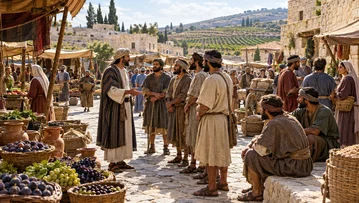
The scene pictures a familiar hiring custom in which men wanting work wait in the marketplace hoping to be employed and men needing workmen come there to find them, a custom still remaining in Europe.ST Aug 9, 1899 The parable of the kingdom of heaven follows that custom through the day's hirings until the eleventh-hour finding of others standing idle in the marketplace.ST Aug 9, 1899 It was spoken because the disciples disputed over who should be greatest, and it continues Christ's answer to Peter's question about what those who have forsaken all and followed Him shall receive.ST Aug 9, 1899
Grace and Generous Reward
The parable corrects the idea that divine favor and reward must be earned by works, teaching instead God's free grace.COL 390.1COL 401.2–402.1ST Jul 13, 1915 The hiring and payment expose motives, for the first hired picture envy and self-righteousness, taking credit for advancement and expecting preference and compensation, while the Lord judges motives rather than appearances and rewards humble, self-sacrificing love.ST Aug 9, 1899ST Jul 13, 1915 First and last are to share the same great eternal reward, given by grace and not as debt, so no one can claim it as a right or resent another's share.ST Jul 13, 1915COL 401.2–402.1 Those invited late in the day with the promise of what is right receive the same wage as those hired earlier, illustrating the householder's generosity and the equal reward he chooses to give.RH Jul 24, 1900Ms 17, 1901, par. 21 Even those who enter Christ's work at the eleventh hour after having had no opportunity earlier, including those who accept truth and become workers during the final crisis and earnest men and women brought in amid last-day perils whose minds are enlarged to bless whole communities, receive equal wages with earlier workers.Ms 18, 1888, par. 30Ms 17, 1901, par. 21 Those who serve must therefore trust the householder's goodness rather than complain or claim a larger reward for longer service, for eternal life is God's gift and not to be treated selfishly.RH Jul 31, 1900
The later-hired trusted the promise to give what is right and asked no questions about wages, and their reward rested not on the amount of work done but on the generosity of the master's purpose.Ms 29, 1911, par. 67COL 396.3–397.1COL 396.1–2 The payment they receive exceeds what they earned, showing the gracious reward given to those who serve with thankful, loving hearts like the poor sinner who comes late, expects little, and is grateful simply to be accepted into service.RH Jul 24, 1900 Their trust without bargaining illustrates confidence in God, and the master's liberality toward them reveals a generosity that selfish hearts fail to recognize.COL 396.3–397.1Ms 29, 1911, par. 66 The vineyard master's treatment represents God's dealings, which are governed by the principles of His kingdom rather than human standards of earned compensation.ST Jul 13, 1915COL 396.1–2
The value of service is measured by the spirit of faith and love in which it is given, not by how long one has labored.9T 73.3–74.1RH Aug 13, 19089T 74.2 It is not length of time labored but willingness and fidelity that makes work acceptable, and God regards love and faithfulness more than amount done, looking to see how much of the Spirit of Christ is cherished and how much of Christ's likeness the work reveals.ST Jul 13, 1915ST Jul 13, 1915 He does not reward according to amount of labor or visible results but according to the spirit brought into the work, and the gospel of the kingdom is not confined by precise regulations but deals with people to develop moral and spiritual capabilities.RH Jul 24, 1900Ms 87, 1899, par. 8–9 The smallest duty done in sincerity and self-forgetfulness is more pleasing than the greatest work marred by self-seeking, and without love to brethren and humility before God even long service and abundant labors are nothing.ST Jul 13, 1915 The eleventh-hour workers were thankful for opportunity, surprised at full-day pay knowing they had not earned it, filled with joy at the employer's kindness and never forgetting his goodness; so the sinner who knows his unworthiness and enters late feels his service short and himself undeserving yet rejoices to be accepted and works with humble trust as a coworker with Christ, a spirit God delights to honor.ST Jul 13, 1915 God's dealing with the human family follows the higher law of His kingdom, higher than human thoughts and ways and not bound by human standards, opinions, or worldly rules, working according to laws not of this world to cultivate moral and spiritual capabilities, so what observers call unfair is right.RH Jul 24, 1900Ms 87, 1899, par. 8–9
Service does not earn salvation and gives no grounds to claim a greater reward for having worked longer or endured more, for payment is not measured by years of service.Ms 87, 1899, par. 16 The reward is not for workers to measure against one another but is determined by the spirit and principles governing the work, so purity of motive and earnest desire to glorify God bring the faithful worker the same reward as one who accomplishes more.Ms 72, 1902, par. 34 Christ's followers are workers purchased by His blood and suffering, so time and possessions belong to Him as stewards entrusted with His gifts, each to work faithfully with given abilities and opportunities, with even the humblest service or smallest gift accepted when offered willingly.Lt 1, 1883, par. 60–63 The reward is left to what is right and just, and those who stipulate no terms but trust without a bargain receive His right and just dealing, while those hired first for a fixed sum receive only the amount for which they agreed.RH Jul 24, 1900Ms 87, 1899, par. 8–9MYP 206.2–207.1
Trust Versus Hireling Spirit
The last-hired trusted the householder's promise to give whatever was right, asking no questions about wages instead of bargaining for a fixed sum, and that faith in his word shaped their work and put them first, for what is valued is the spirit in which service is done.Ms 87, 1899, par. 13–14Ms 29, 1911, par. 67RH Jul 24, 1900COL 396.3–397.1ST Jul 13, 1915 Their reward rested not on the amount of work done but on the generosity of the master's purpose, whose dealings are governed by the principles of His kingdom rather than human standards of earned compensation.Ms 29, 1911, par. 67COL 396.3–397.1ST Jul 13, 1915 This trust and willingness to work without demanding a reward pictures the poor sinner who comes late, expects little, and is grateful simply to be accepted into service.RH Jul 24, 1900Ms 87, 1899, par. 11–12COL 397.2–398.1 Such workers were thankful for the opportunity, with hearts full of gratitude to the one who accepted them, and when paid for a full day they were greatly surprised because they knew they had not earned such wages.RH Jul 24, 1900ST Jul 13, 1915 The kindness in the employer's countenance filled them with joy, they never forgot his goodness and generous compensation, and the payment exceeding what was earned shows the gracious reward given to those who serve with thankful, loving hearts.RH Jul 24, 1900ST Jul 13, 1915Ms 87, 1899, par. 11–12
This trust stands against the hireling spirit that bargains with God for a stated reward and regards its own service as more valuable than that of others.RH Jul 24, 1900Ms 87, 1899, par. 10 Service in God's vineyard is not meant to be governed by insisting on a fixed wage as though He will not deal fairly, and grumbling over His dealings calls for a change of heart rather than complaint.Ms 87, 1899, par. 10Ms 29, 1911, par. 65Ms 87, 1899, par. 15 Those who turn His generosity into a cause for complaint are warned not to bargain for a fixed reward but to trust that the Master will deal fairly.Ms 29, 1911, par. 65Ms 87, 1899, par. 15 By contrast the first hired represent people who are envious and self-righteous, take credit for their own advancement, and expect preference and compensation for their work.ST Aug 9, 1899COL 399.5–401.1 They are those who think hardship and long service entitle them to greater honor, who will not work without the wages they themselves stipulate, and who resent others receiving equal privileges through the Lord's goodness, finding themselves last at the close of the day.COL 399.5–401.1Lt 93, 1899, par. 14Ms 142, 1903, par. 90
The parable therefore rebukes all jealousy and suspicion, warning laborers, however long their service or abundant their labors, that without love to brethren and without humility before God they are nothing.ST Aug 9, 1899ST Jul 13, 1915 The Lord judges motives rather than appearances and rewards humble, self-sacrificing love, with love rejoicing in the truth and making no envious comparisons but comparing only the loveliness of Christ with one's own imperfect character.ST Aug 9, 1899ST Jul 13, 1915 Workers must not exalt themselves or belittle others, but serve with love and dependence on God rather than giving way to worry and anxiety.ST Jul 13, 1915Ms 87, 1899, par. 26–27 Their service is not to be driven by wages, praise, or self-exaltation, nor ranked by human standards, but borne as the householder's message in many kinds of work in cooperation with God.Ms 29, 1911, par. 65Ms 87, 1899, par. 15RH Jul 31, 1900
God delights to honor the humble, trusting spirit that knows its unworthiness, feels its time of service is short and itself undeserving, yet is filled with joy that God has accepted him at all and works thankful for the privilege of being a coworker with Christ.ST Jul 13, 1915COL 397.2–398.1 The sinner entering at the eleventh hour with this grateful, humble, trusting spirit is pleasing to God and satisfied if Christ will receive him, and even brief service or humble work done in simple faith and love receives heaven's reward by grace rather than by greatness, wisdom, status, or amount of work.Ms 87, 1899, par. 11–12COL 397.2–398.1ST Jul 13, 1915
Warning Against Refusing Mercy
The men found standing idle at the eleventh hour had not turned down work earlier but were still waiting because no one had hired them, and when asked they explained that lack of hiring as the reason for their idleness.Ms 87, 1899, par. 25RH Jul 31, 1900COL 399.1ST Jul 13, 1915 Their being taken on late therefore gives no support to those who hear the truth and deliberately refuse to obey it in order to keep their own time and way.Ms 87, 1899, par. 25RH Jul 31, 1900COL 399.1ST Jul 13, 1915 Those who reject the first call to labor and neglect it have no excuse, and it is unsafe to trifle with the first invitation of mercy.Ms 87, 1899, par. 25RH Jul 31, 1900COL 399.1ST Jul 13, 1915
Those who have refused and afterward repent do well to repent, for repentance remains open to them.Ms 87, 1899, par. 25RH Jul 31, 1900COL 399.1 Even near the end of life a person can still hear His call, turn to Him in repentance and faith, and receive Him into the heart.Ms 87, 1899, par. 25RH Jul 31, 1900Lt 4, 1885, par. 5–6 Even when life's sands are nearly run out, pardon is still possible for one who comes to God just as he is with no plea except that Christ died to save the chief of sinners.Lt 1e, 1890, par. 4Lt 1d, 1890, par. 17
The eleventh hour is before it is utterly too late, even on the very borders of the eternal world, so that a conscience hardened in sin and transgression and unbelief, without hope and without God, can still be saved.Lt 1e, 1890, par. 4Lt 1d, 1890, par. 17 He must come at once without waiting for anything and without stopping to reason, fall on Christ Jesus the Rock and be broken, and throw himself at the feet of Jesus with a broken repentant heart crying for mercy as did blind Bartimaeus, and then God will not leave him to perish.Lt 1e, 1890, par. 4Lt 1d, 1890, par. 17 Pardon requires cooperation with God, for Christ did not die to cover transgression that is unrepented of and unconfessed.Lt 1e, 1890, par. 4Lt 1d, 1890, par. 17 Confession is required, with some sins to be confessed alone to God and to the parties injured, while not all sins are to be confessed publicly, and God Himself will touch the heart with new tenderness and lead to a sense of long-perverted obligations to Him.Lt 1e, 1890, par. 4Lt 1d, 1890, par. 17
Idleness in the marketplace stands for spiritual unfaithfulness, and slothfulness carries its penalty.Ms 132, 1901, par. 174T 537.2Ms 9, 1898, par. 13 Even actions worthy in themselves receive no credit when a person's work bears the mark of unfaithfulness.Ms 9, 1898, par. 13 Idleness in the Lord's vineyard gives up any claim to the reward of the righteous, while what is right is promised to those invited to work and to those who work faithfully.Ms 132, 1901, par. 174T 537.2 Receiving God's grace does not remove the need to do our part faithfully, and the fruit of the work reveals its character.Ms 132, 1901, par. 174T 537.2
Late Workers in Prophecy
The eleventh-hour workers are those who come in to fill the places left vacant by those who have departed from the faith through apostasy and death.7MR 186.1Ms 43, 1912, par. 10Lt 98a, 1897, par. 45–47 Faithful, self-sacrificing workers, both younger and older, are given power from above, with mind, hands, feet and tongue equipped for service, and they carry the work steadily forward until it is complete.Ms 43, 1912, par. 10 Though they have had few opportunities, they consecrate their abilities and means to advance the work and faithfully declare the whole counsel of God.Ms 183, 1897, par. 3–6Lt 123, 1897, par. 24–28Lt 98a, 1897, par. 45–47 Their reward rests on faithfulness and loyalty to principle, and even young and new workers can serve faithfully as the work grows harder.Lt 123, 1897, par. 24–28Lt 98a, 1897, par. 45–47
They are those who receive light and enter the work after others with greater light, privilege and opportunity have turned away from Christ, rejected duty and fallen away.Ms 183, 1897, par. 3–6RCOC 123.3Lt 123, 1897, par. 24–28 They devote their abilities and resources to the work, remain true to principle, and do not shrink from declaring God's whole counsel.Ms 183, 1897, par. 3–6Lt 123, 1897, par. 24–28 People from other churches who have not resisted heaven's light may accept and obey the truth late, for having had less light does not prevent response.RCOC 123.3Lt 36a, 1890, par. 7 Those with greater light who fail to live by it lose it, their light fades and their lamps go out for lack of the oil of grace.RCOC 123.3Lt 36a, 1890, par. 7
They include those who hear the truth for the first time in the last days, having had no opportunity to be hired earlier, whom the Lord mercifully admits into His fold and gathers as a company from the world to serve Him, including a converted ministry.Ms 18, 1888, par. 30Lt 103, 1903, par. 12Ms 64, 1898, par. 26–2720MR 320.1–2 Even while God's judgments are falling and the door is closed to those who refused to enter, many of these new hearers are accepted and become Christ's workers during the final crisis.Ms 18, 1888, par. 30Lt 103, 1903, par. 12 Those who thus enter at the eleventh hour receive the same reward and equal wages with those who have worked throughout the day.Ms 18, 1888, par. 30Ms 17, 1901, par. 21
In the closing work the eleventh-hour call goes forth for the last time, when an accumulation of divine agencies combines with human effort and the work is most assuredly cut short in a most unexpected manner.Lt 43a, 1890, par. 17 Thousands will then see and acknowledge the truth and the movements of the Spirit in a day, in conversions so rapid and surprising that the church is surprised and God alone is glorified.12MR 155.21MR 179.1Lt 43a, 1890, par. 17Lt 43, 1890, par. 8 The Spirit moves like the wind where He wills, so no one can say when His movings will be realized or in what direction or through whom He will manifest Himself.Lt 43a, 1890, par. 17 He passes by those who have had their day of testing and opportunity but have not distinguished the voice of God, recognized His voice, or valued and appreciated the movings of His Spirit.12MR 155.21MR 179.1Lt 43a, 1890, par. 17
These late laborers come out of the ranks of the world and out of the churches, even the Catholic church, when crisis and the season of calamity come.16MR 238.2Ms 30, 1889, par. 73–79 Their zeal will far exceed that of those who have stood in rank and file to proclaim the truth heretofore, including Sabbathkeeping Adventists who do not walk in the light.16MR 238.2Ms 30, 1889, par. 73–79 Seeing the battle coming they give the trumpet a certain sound, come to the front, gird themselves with the whole armor of God, exalt His law, adhere to the faith of Jesus, and maintain the cause of religious liberty in the conflict.16MR 238.2Ms 30, 1889, par. 73–79 Those without the burden of the message must stand out of the way and prepare the way for them and not interpose themselves between God and His work.Ms 30, 1889, par. 73–79
Amid the perils of the last day men and women are still brought into the fold at the eleventh hour, and if they are in earnest the Lord accepts them and works through them.Ms 17, 1901, par. 21Lt 317a, 1904, par. 11–13 As they put on Christ their minds are enlarged and they give the treasures of heavenly truth to others to be given to still others, so the good work is extended and whole communities are blessed.Ms 17, 1901, par. 21 The invitation offers saving grace, calling them to live by doing good and practicing godliness, and in the parable they are represented as being paid as much as those who first entered the field.Ms 17, 1901, par. 21Lt 317a, 1904, par. 11–13 Those thus called at the eleventh hour may, through Christ's grace and faithful presentation of truth, be accounted first.Lt 36, 1895, par. 30–32
The first-called laborers are those who will not work without the wages they themselves stipulate, fixing their own destiny while there is a world to be warned, and at the close of the day they find themselves last.Lt 93, 1899, par. 14Ms 142, 1903, par. 90 True self-sacrificing faithful workers go forth with God's angels sent with them, deny self, take up the cross daily and follow Christ, and by obeying enter into the design of the divine Planner where they are instructed and guided.Lt 93, 1899, par. 14 The thief on the cross exemplifies this late faith, for he acknowledged Jesus as Lord and was saved at the eleventh hour near the end of his life.Ms 52, 1897, par. 26–27DA 750.3 Entrusting his helpless, dying life to Christ in earnestness, repentance and dependence on mercy, he represents those who come to faith late in life and receive the same reward as those who have served longer.Ms 52, 1897, par. 26–27DA 750.3
Vineyard Means God's Work
The vineyard is the Lord's work in the world field, the work of presenting truth to those in darkness and laboring for the salvation of fellow men.3T 202.13T 121.1–2GW92 47.34T 454.1TCBMP 201.1 All who are Christians in every sense of the word are called to be workers in it, each with a task or portion, giving self unreservedly in devoted self-sacrifice rather than sleeping at opportunity's opening.3T 202.1GW92 47.34T 454.1TCBMP 201.1 That call requires staying wide awake, pressing in the truth at every opening, and working in unison with God and angels who are moving upon hearts and consciences even in other nations.3T 202.1TCBMP 201.1 It is to be done in imitation of the Saviour's life of self-denial, sacrifice, and faithful earnest labor, with persevering daily effort increasing ability to labor effectively and bear fruit to God's glory.3T 202.14T 454.1TCBMP 201.1 Means entrusted to men as stewards are to be advanced for this same work.3T 121.1–2
Vineyard work is earnest, persevering labor for souls that opens new fields and warns the world.RH Apr 7, 19107T 255.2–3ST Oct 31, 1911 In the last days it prepares people for Christ's coming by bringing souls out of darkness and error and establishing them in truth, through willing, devoted, unselfish labor that leaves none to remain idle.7T 255.2–3SBAWP 10.3–11.1 The summons applies with special force to entering the cities and working with heart, soul, and voice to win souls, responding with courage, zeal, and sustained effort to make up for lost time.RH Apr 7, 1910ST Oct 31, 1911Ms 49, 1910, par. 4 For young men this means consecrating themselves unreservedly to become earnest, persevering, successful laborers by studying the Scriptures, becoming intelligent in spiritual knowledge and the things of the kingdom, warning sinners, turning them to Christ, and pointing the unbelieving and desponding heavenward.3T 159.2 It requires turning powers of mind once used for self and property-getting into God's service, turning the mind into a heavenly divine channel, walking in the light, and going from one degree of light and strength to another until the warfare ended brings welcome into the joy of the Lord.3T 159.2
God's vineyard is the whole world field with many different places needing work, many unworked places, foreign lands, and destitute regions left without culture, facilities, or cultivation.YGBCOEP 39.3–40.2CE 46.1Lt 180, 1901, par. 5–6Lt 43, 1900, par. 6 The Lord sees where memorials for truth should stand and where fields lack workers and means, and His command to go into the vineyard means workers and means must go to many cities and not be absorbed in one place.YGBCOEP 39.3–40.211MR 45.3–46.1Lt 180, 1901, par. 5–6 Equity and just judgment are required of all who serve Him, so that every building is erected with reference to other places needing similar buildings and every part of the vineyard is given a chance to have facilities.YGBCOEP 39.3–40.2Lt 43, 1900, par. 6 The Southern field left with nothing or next to nothing is one such portion, and placing the work on a proper basis everywhere from the Lord's treasury forbids putting overabundance into expensive buildings in one place while others lie uncultivated.YGBCOEP 39.3–40.2Lt 43, 1900, par. 6 While working in one portion, sharp keen men must use sanctified ability to plan a more proportionate work for all portions, for unfaithful stewardship in this distribution will stand before the universe of heaven.Lt 43, 1900, par. 6 Institutions such as sanitariums are not to be bound to one great center like Battle Creek by human contracts and plans, but each worker high and lowly has his own part to act in perfect harmony under God as confidence, power, ruler, counselor, and guardian, so burdens are distributed and light reaches farther.Lt 180, 1901, par. 5–68T 138.2–3
The vineyard includes the home, where older family members are to cultivate their part by patiently teaching and helping younger children and sharing the knowledge God has given them.RH Jun 2, 1910Lt 25a, 1890, par. 13 Parents who profess present truth yet neglect home training of children and fail to cooperate with school workers in the education dearest to the Saviour's heart lay off their own responsibility and are little better than idlers in the vineyard.Lt 25a, 1890, par. 13 Their duty is to take up responsibility for training and make the most of facilities God has placed within reach so schools established after the Lord's plans may succeed.Lt 25a, 1890, par. 13 A mother's work in her own home belongs to this same call, as when amid poverty, wounds and bruises of soul, and an unbelieving husband's profanity, abuse, disregard of her authority, and opposition to prayer and the Bible, she remains and counteracts a godless father's Satan-controlled influence rather than leaving her children to it.Lt 28, 1890, par. 23–24
The vineyard figure also calls for study, for Christ uses a vineyard to represent the world and His parables using it are to be studied.FE 512.4Ms 99, 1907, par. 3 Going into the vineyard means entering God's work in the ministry, for which God accepts those with good abilities as talents entrusted by the Creator to whom all is owed.3T 160.2 Those talents must be cultivated and improved by education that disciplines the mind, develops its powers, and directs them to advance God's glory, including at least the common branches, the truths of God's word for this time, and lectures upon the prophecies, so that even a few months of such schooling greatly benefits those called to labor.3T 160.2Ms 19, 1908, par. 3–5 Those going to mission fields must be trained in cultivation of the soil and various lines of manual labor to take hold of any line of work where called, for no work is more effectual than that of those educated in practical life who go forth prepared to instruct as they have been instructed.Ms 99, 1907, par. 3 Faithful cultivation of school land and disinterested care of school buildings by students belongs to this training and replaces the love of sports and amusements that perplexes school work.FE 512.4Ms 99, 1907, par. 3
Vineyard service bears the householder's message, serves Christ in many kinds of work, and is accomplished through human cooperation with God.RH Jul 31, 1900TCBMP 201.1Ms 51, 1900, par. 11 True workers show faith, prayer, and self-denial in life, depend on God rather than wages, praise, or self-exaltation, and their labor bears fruit.RH Jul 31, 1900GW 80.2 They do not rank their own work or others' by human standards.RH Jul 31, 1900 The church is Christ's vineyard, one great field with God's servants working in different parts of the cause without selfish or sectional aims to warn the careless and save the lost.4T 454.15T 417.2Ms 76, 1894, par. 25–26 Its members must not remain idle but each serve God, share responsibility, and work as co-laborer with Christ in the Lord's large field to be cultivated in many places by many laborers spread throughout it.11MR 45.3–46.15T 417.2Ms 76, 1894, par. 25–26 The vineyard is large, and the Master knows and watches over His workers wherever they labor.RH Jun 2, 1903
Those truly called to teach the truth feel its burden and labor to raise up Sabbathkeepers in new fields, while some may assist without being called to devote themselves wholly to preaching or travel extensively.Ms 1a, 1859, par. 7–8
Urgent Call to Serve
The voice of Jesus in the call to the idle reaches through time to the present, commanding professed Christians standing idle in the marketplace to leave idleness and enter the vineyard and work while it is day.Ms 15, 1910, par. 13Ms 153, 1897, par. 5RH Nov 17, 1910 The call is urgent because the day for work is limited and a night is coming when no one can work, and the signs of the end show that day is nearing its close.Ms 15, 1910, par. 13Ms 153, 1897, par. 5RH Nov 17, 1910 Even those called late in the day are still to go at once and trust to receive what is right, for no service for the Lord is wasted, yet prompt action is required before life's evening comes.ST Apr 21, 18812MR 329.2–330.1 The urgency is now because probation is fast closing and the opportunity to give the last message of mercy to the lost will soon be forever past, so the help of everyone who loves Jesus is needed with no idlers allowed to remain.2MR 329.2–330.1
Everyone who names Christ is called to serve at once in some capacity and place, and every moment of life carries a duty to God or to other people.5T 203.34T 518.1–2CH 583.2 The invitation to those not yet hired comes with assurance of receiving what is right, yet it has been repeatedly given and largely disregarded.5T 203.34T 518.1–2 There is work for everyone and none should remain idle, for the vineyard work in these last days includes preparing people for Christ's coming by bringing souls out of darkness and error and establishing them in truth.5T 386.1SBAWP 10.3–11.13T 64.1–2 That work is open to all and can be tested by practical effort, it can be found by every accountable person including in helping suffering people, and it requires willing, devoted, unselfish labor to the utmost of ability wherever needed.CH 583.25T 386.1SBAWP 10.3–11.13T 64.1–2
The call is not excused by not preaching from a pulpit, for consecrated lay members have work outside it and believers not called to preach or ordained are still called to useful service for souls.AA 110.3–111.1RH Mar 24, 1910Ms 42, 1890, par. 31–32 Every church member shares responsibility for communicating heaven's light to the world, and each person has a part in that work.AA 110.3–111.1Ms 42, 1890, par. 31–32 The Lord calls idle women to holy work for spreading truth and saving souls, which is not beneath dignity, and diligence, patience and perseverance therein show devotion expressed in deeds rather than words.ST Jan 9, 1879RH Dec 10, 1914 Women who humbly distribute literature, write to others, and do what they can are workers being trained as acceptable workers, and church members are to labor in the spiritual vineyard for youth and children.HCSSP 18.1RH Dec 10, 1914 The call likewise reaches youth and children, foreigners in their own languages, and ordinary workers with little education who keep learning and growing in ability.HCSSP 18.1CH 26.1GW 36.2–3
Believers should begin serving where they are rather than waiting for a regular process or assigned line, including in homes and among neighbors and friends, in cities and towns, and in neglected parts of the field.RCOC 114.5Lt 76, 1899, par. 11Ms 42, 1894, par. 4–5Ms 10a, 1895, par. 101–102 Service is not limited to preaching from a desk, and the Lord's vineyard is everywhere.Lt 109, 1901, par. 12Ms 42, 1894, par. 4–5 Work in so-called irregular lines outside the regular lines is included, and if one hundred laborers would step out in self-sacrificing work souls would be won, with workers learning by experience what it means to labor together with God.Lt 109, 1901, par. 12Lt 76, 1899, par. 11 Those not yet given work should be set to work where they are rather than held back in one place, and all are to cultivate neglected fields and help share the message of life with no idlers.Lt 76, 1899, par. 11Ms 10a, 1895, par. 101–102
Ministers and experienced workers are to give the unhired a share in God's work, correct their mistakes, and set them to work again, for people learn to use abilities by putting them to work.SPBC 220.3–221.1OEWP 36.1–37.1Ms 10a, 1895, par. 99–100Lt 47, 1895, par. 87–88 Practical work should not be needlessly delayed for further education, and students should be prepared promptly and sent to labor because time is short and warning the world is urgent.OEWP 36.1–37.1FE 353.1–354.1 Youth are to be trained promptly for the same reason, with ability learned by use rather than by years of unnecessary study.SPBC 220.3–221.1FE 353.1–354.1 Christ welcomes those given no place to work, sees qualifications in those who may discourage others, and as they keep learning fits them by providence for work within their abilities and gives power through the Holy Spirit.CH 26.17T 271.1GW 36.2–3
Service requires giving self unreservedly with devoted self-sacrifice, being wide awake and not asleep, availing every opening to press in truth, and working in unison with God and angels moving on hearts and consciences.3T 202.14T 75.4 The example is the Saviour's life of self-denial, sacrifice, and faithful earnest labor to save people, which leaves no room to excuse oneself from laboring for souls.3T 202.14T 75.4 Labor is to be whole-hearted to the utmost of ability, without setting the highest estimate on one's own services, swelling with pride and self-importance, measuring every hour with exactness, studying how little may be done to reach the lowest standard, or seeking the position bringing most enjoyment or gain.5T 386.1ACSMHFP 12.2SSP 13.1–2 Standing idle is not neutral, for an idle person hinders those working and leaves room for service to Satan, while the wholly consecrated, whether farmers, mechanics, teachers or pastors, grow in grace to full stature and become efficient agents by making the most of every opportunity and ability.ACSMHFP 12.25T 393.3
New converts, especially those with promise and ability, must be taught to work earnestly and unselfishly for others' salvation, and church members are to be educated for service.AA 186.2–320MR 123.2Ms 6, 1902, par. 2 Ministers are to proclaim to those who have not heard, constantly enlarge the circle of effort to encircle the world, and not spend time only on those already accepting truth but go forth with burning love to win sinners.Lt 233, 1905, par. 40–42RH Aug 19, 1902Ms 6, 1902, par. 2 They are to sow beside all waters, visit place after place, raise up church after church, proclaim truth in regions beyond, and as soon as a church is organized set members to work, devoting more time to educating than to preaching and training worthy young men as co-laborers so companies come under gospel power and new converts at once carry the message onward.RH Aug 19, 1902 Medical missionaries answer the call by serving neglected fields rather than seeking advantage in places already served, and canvassing that brings truth to families is ministry that must not be refused for selfish gain.Lt 233, 1905, par. 40–42Ms 122, 1899, par. 80–83
The vineyard is God's work to be advanced with means entrusted to stewards, and abilities used in His service do good while turned to selfish gain they do great harm.3T 121.1–2TCBMP 156.13T 126.2–127.2TCBMP 164.2–165.2 Service is a calling carrying duty to use abilities faithfully and well, to give self fully, trust God, and go forward with His sustainment, wisdom and strength.RH Apr 13, 1905Lt 29, 1877, par. 11 Powers are to be used wisely without destroying health, and laborers are to receive fair wages and support.RH Apr 13, 1905Lt 29, 1877, par. 11 Gifts and freewill offerings offered to Christ can support workers going out to bring to God those for whom Jesus died, and experienced trainers of youth in God's appointed work are entitled to accept them without being bound by manmade rules leaving them on constant strain.21MR 223.3–6Lt 168, 1907, par. 5–6
Knowing the truth obligates labor where need is great in unity with God's working people, joining Christ rather than waiting for others to help, refusing to waste God-given time, bury talents, or leave burdens to others.GW92 326.2ST May 24, 18832T 114.2–4Ms 151, 1897, par. 28–29 Those thinking they have no useful place should take up work rather than remain idle, and slothful members are to unearth talents bound in a napkin to enlighten others and make Christ known, for this belongs not to ministers alone but to all professing truth since God has given every man his work.ST May 24, 18832T 114.2–4Ms 151, 1897, par. 28–29 Refusing to labor is refusal to use abilities in His service, nor does the call justify abandoning personal and family responsibilities to be eased from work.MC 40.3–4Lt 21, 1859, par. 3 Self-pleasing ease and pursuits leave no time for, for God-given abilities are to be developed and used for others' benefit while opportunity lasts.2MR 329.2–330.1GW92 326.2
Christ sees promise in the discouraging, welcomes those idle in the marketplace who feel they do not know how to serve, and calls them to work rather than remain idle.CH 26.17T 271.1Lt 80, 1894, par. 30–33 Through continued learning, providence, and the Holy Spirit He fits them for work suited to abilities, and beginners entering neglected fields humbly and wholeheartedly can prove the right workers for that time and place.CH 26.1FE 45.1–2GW 36.2–3 Those with usable abilities can be helped by instruction to serve effectively, and laborers are to take up the sacred work of seeking souls with unselfish purpose, devotion and faith.FE 45.1–2TBC1872 20.2 The worn are preserved and reassigned for continued valuable service within their strength.CH 26.1GW 36.2–3
God's servants must plan proportionate work for all portions of the field, for the vineyard includes the most destitute regions left without culture, facilities, and means, such as the Southern field.Ms 46, 1903, par. 27Lt 43, 1900, par. 6 Means from the Lord's treasury are to place work on a proper basis everywhere, not put over-abundance into expensive buildings in one place while others lie uncultivated, and sharp, keen men while working one portion must plan with sanctified ability for all, since unfaithful stewardship in distribution stands before heaven.Lt 43, 1900, par. 6Ms 173, 1898, par. 12–13 The church and institutions are to send workers, support them with sympathy and opportunities to grow, and sustain producers who bear fruit.21MR 223.3–6Ms 46, 1903, par. 27 Workers entering needy new fields are to come prepared for self-denial, determined not to fail nor be discouraged, willing to labor without paid passage, large wages, or being carried financially or spiritually, with cooperation given while they cooperate with God, and no narrow rule may dictate which kind of work must precede service, for each is to seek God's direction and labor according to ability.Ms 173, 1898, par. 12–132MR 62.2 Even when leaders neglect, the faithful are to persist and prepare their own way to help destitute fields.Lt 43, 1900, par. 6Ms 173, 1898, par. 12–13
True workers show faith, prayer and self-denial, and their labor bears fruit.GW 80.23T 191.2 They send earnest prayers in faith for those not fully in truth, feel the worth of every soul for whom Christ died, handle sacred things with sacredness and not trifling frivolity as common labor, and grieve not angels by careless fruitlessness.3T 191.2Lt 31, 1879, par. 4 Those entering late can still labor earnestly, value God's Word, and bring its truths into daily life, with even the humblest servant taking part and doing what is right itself a reward.Lt 56, 1902, par. 11RH Jun 17, 1902Lt 31, 1879, par. 4 Consecration brings closer union with Christ and growth in spiritual strength and knowledge of His work and sacrifice, with purity of motive, godliness in daily life, and consistent living of faith rather than mere argument or public speaking.SBAWP 13.2GW 80.2Lt 31, 1879, par. 4 In the closing third angel's message long-indifferent people will heed the call and labor for the Master.RH Mar 24, 1910 The call comes through full consecration, trusting God for wisdom and strength, as shepherd and flock labor together, with consecrated youth becoming earnest persevering workers who when finished share the Lord's joy.SBAWP 13.2STSE 27.1–28.1Lt 29, 1877, par. 11
Sources